Flashcards · Biology
Evidence for Evolution and Classification
-
What is a fossil?
The remains of an organism from millions of years ago, found in rocks.
-
Name the three ways in which fossils form.
Parts not decayed, parts replaced by minerals, and preserved traces.
-
Why might an organism not decay?
One or more of the conditions needed for decay is absent.
-
Give an example of a place where decay is prevented.
Amber, ice or a peat bog.
-
What replaces the parts of an organism in some fossils?
Minerals.
-
Give three examples of trace fossils.
Footprints, burrows and rootlet traces.
-
Why have early soft-bodied organisms left few fossils?
They have no hard parts, so they decayed without leaving traces.
-
What destroyed many early fossils?
Geological activity.
-
Why can scientists not be sure how life began?
The traces of the earliest soft-bodied organisms were mostly destroyed.
-
What can fossils show about how organisms have changed?
How much or how little they have changed.
-
In undisturbed rock layers, which fossils are older?
Those in the deeper layers.
-
What kind of fossil is Archaeopteryx?
A fossil with features of both birds and reptiles.
-
Is the fossil record complete?
No. Most organisms never form fossils.
-
What type of rock usually contains fossils?
Sedimentary rock.
-
What other evidence supports Darwin's theory, besides fossils?
Genes passing on characteristics, and antibiotic resistance in bacteria.
-
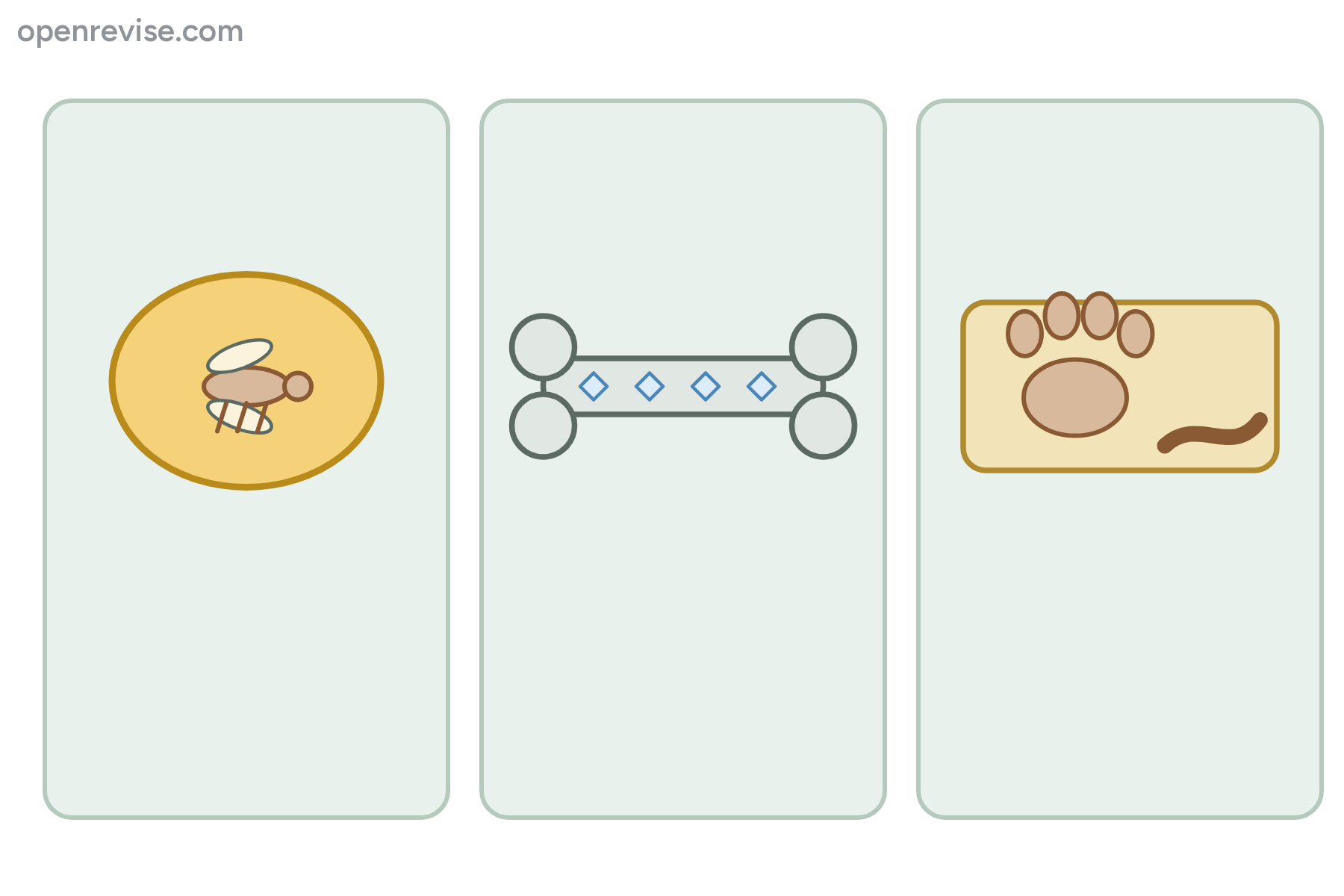 Name the three ways in which fossils form and give an example of each. (Look at the blank diagram.)
 1 Parts that have not decayed, such as an insect in amber. 2 Parts replaced by minerals, such as a bone. 3 Preserved traces, such as footprints and burrows.
-
When does a species become extinct?
When there are no remaining individuals of the species still alive.
-
Name three factors that may contribute to extinction.
New predators, new diseases and new competitors.
-
How can environmental change cause extinction?
The species cannot adapt, move or evolve fast enough.
-
Give two catastrophic events that can cause extinction.
A massive volcanic eruption and an asteroid collision.
-
When did the dinosaurs go extinct?
About 66 million years ago.
-
What happened to the climate after the asteroid impact?
It became colder as dust blocked the sunlight.
-
Name an animal that humans hunted to extinction.
The dodo.
-
How does habitat destruction cause extinction?
The species loses the place and the resources it needs.
-
Why are small populations at greater risk?
One event could kill all the individuals, and there is little variation.
-
Why does low variation increase the risk?
No individual may have the allele that helps it survive a change.
-
What is a mass extinction?
An event in which a large proportion of species die out together.
-
Why are island species often at risk?
They have not evolved defences against newly arrived predators.
-
How do fossils show that extinction has happened?
Fossils of species that no longer exist are found in rocks.
-
Name one human activity that causes global warming.
Burning fossil fuels.
-
Is extinction always caused by humans?
No. It has happened naturally throughout the history of life.
-
Why can bacteria evolve rapidly?
They reproduce at a fast rate.
-
What produces new strains of bacteria?
Mutations.
-
What does antibiotic resistance mean?
The bacteria are not killed by the antibiotic.
-
What happens to non-resistant bacteria when an antibiotic is used?
They are killed.
-
What happens to resistant bacteria when an antibiotic is used?
They survive and reproduce.
-
Why does the population of the resistant strain rise?
The survivors reproduce and there is no competition from the killed bacteria.
-
Why does a resistant strain spread?
People are not immune to it and there is no effective treatment.
-
What does MRSA stand for?
Methicillin-resistant Staphylococcus aureus.
-
Do antibiotics work against viruses?
No.
-
Why should patients finish a course of antibiotics?
So all the bacteria are killed and none survive to form resistant strains.
-
Why should farm use of antibiotics be restricted?
It gives bacteria more chances to evolve resistance.
-
Why is developing new antibiotics difficult?
It is costly and slow.
-
Is antibiotic resistance evidence for evolution?
Yes. It shows natural selection happening in bacteria.
-
Can a single bacterium change to become resistant because it was exposed to an antibiotic?
No. Resistance comes from random mutations, and the antibiotic selects the resistant ones.
-
Why is a hospital a risky place for resistant bacteria to spread?
Patients are ill, have wounds, and antibiotics are used a lot.
-
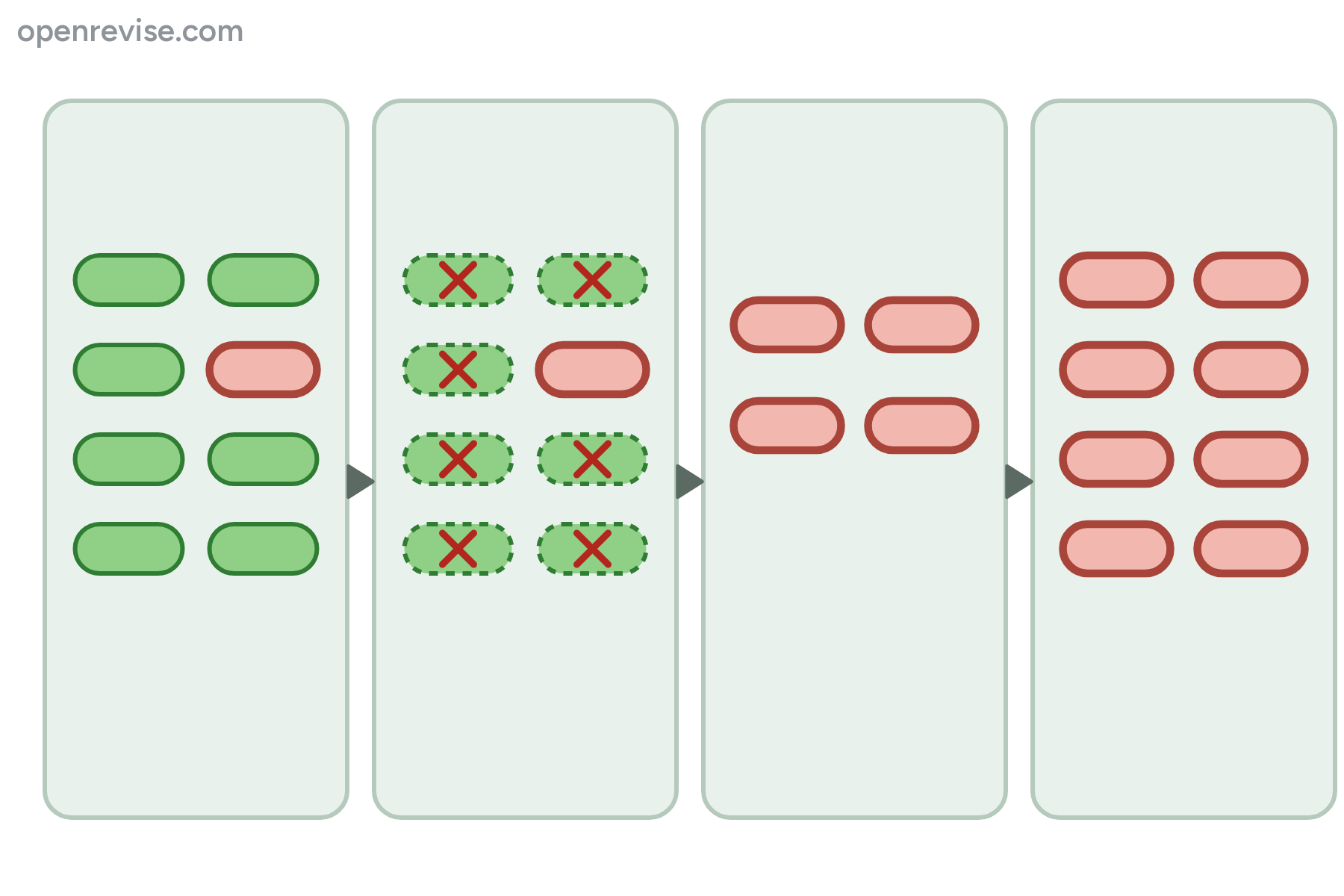 Describe what is happening in each panel to explain how the population becomes resistant. (Bacteria and an antibiotic.)
 1 A mutation makes one bacterium resistant. 2 The antibiotic kills the bacteria that are not resistant. 3 The resistant bacterium survives and reproduces. 4 The population is now resistant and the strain can spread.
-
Who developed the traditional system of classification?
Carl Linnaeus.
-
What is classification based on in the Linnaean system?
The structure and characteristics of organisms.
-
Name the seven ranks in order, from largest to smallest.
Kingdom, phylum, class, order, family, genus and species.
-
Which is the biggest group, kingdom or species?
Kingdom.
-
What is the smallest group in the Linnaean system?
Species.
-
What is the binomial system?
Naming an organism using its genus and species.
-
What does binomial mean?
Two names.
-
How is a binomial name written?
Genus with a capital letter, then species with a lower case letter, in italics or underlined.
-
What is the scientific name of humans?
Homo sapiens.
-
What is the genus of the lion and the tiger?
Panthera.
-
Why do scientists use scientific names instead of common names?
They are the same in every country and name only one species.
-
If two organisms are in the same genus, how closely related are they?
Very closely related.
-
What do organisms in the same family have in common?
More characteristics than organisms in the same order.
-
Which rank comes after class?
Order.
-
Give a memory aid for the ranks.
King Philip Came Over For Good Soup.
-
What new techniques led to new models of classification?
Better microscopes and chemical analysis, and a better understanding of biochemical processes.
-
Who developed the three-domain system?
Carl Woese.
-
What kind of evidence led to the three-domain system?
Evidence from chemical analysis.
-
Name the three domains.
Archaea, Bacteria and Eukaryota.
-
What are Archaea?
Primitive bacteria usually living in extreme environments.
-
What are Bacteria in the three-domain system?
The true bacteria.
-
Which organisms are in the domain Eukaryota?
Protists, fungi, plants and animals.
-
What do all eukaryotic cells have?
A nucleus.
-
What is an evolutionary tree?
A diagram showing how scientists believe organisms are related.
-
What data do scientists use to draw evolutionary trees?
Classification data for living organisms and fossil data for extinct organisms.
-
What does a branch point show on an evolutionary tree?
A common ancestor from which two groups separated.
-
On a tree, how can you tell which two organisms are most closely related?
Their branches meet at the most recent branch point.
-
Is classification a fixed fact?
No. It is a model that changes with new evidence.
-
Why were archaea given their own domain?
Their chemistry is very different from that of true bacteria.
-
Does the order of the tips on a tree show closeness?
No. Only the branch points do.
-
Who proposed the theory of evolution by natural selection?
Charles Darwin.
-
What was the name of Darwin's ship?
HMS Beagle.
-
Which years did Darwin's voyage take place?
1831 to 1836.
-
When did Darwin publish On the Origin of Species?
1859.
-
What are the three ideas of natural selection?
Variation, survival of the best suited, and passing on the characteristics.
-
Why did Darwin delay publishing?
He spent years gathering evidence, until Wallace's letter prompted him.
-
Give one reason why the theory was only gradually accepted.
It challenged the idea that God made all the animals and plants.
-
Give another reason why it was only gradually accepted.
There was insufficient evidence at the time.
-
What was not known until 50 years after publication?
The mechanism of inheritance and variation.
-
What did Lamarck suggest?
Changes that occur in an organism during its lifetime can be inherited.
-
Is Lamarck's idea correct?
In the vast majority of cases, this type of inheritance cannot occur.
-
How would Lamarck explain the long neck of a giraffe?
The giraffe stretched its neck and passed on the longer neck.
-
How would Darwin explain the giraffe's neck?
Variation: those with longer necks survived and passed on their alleles.
-
What did Darwin see on the Galapagos Islands?
Finches with beaks of different shapes suited to their food.
-
Was Darwin's theory developed by one person only?
No. It developed from information gathered by many scientists.