Exam questions · Biology
Evidence for Evolution and Classification
- 42 exam questions
- 133 marks
- 48 quick checks
Fossils and the Fossil Record
Just this lesson-
1 State [1 mark]
What is a fossil?
Show answerHide answer
Model answer
The remains of an organism from millions of years ago, found in rock.
Mark scheme
- Remains of an organism from millions of years ago, found in rocks — 1 mark
-
2 Name [3 marks]
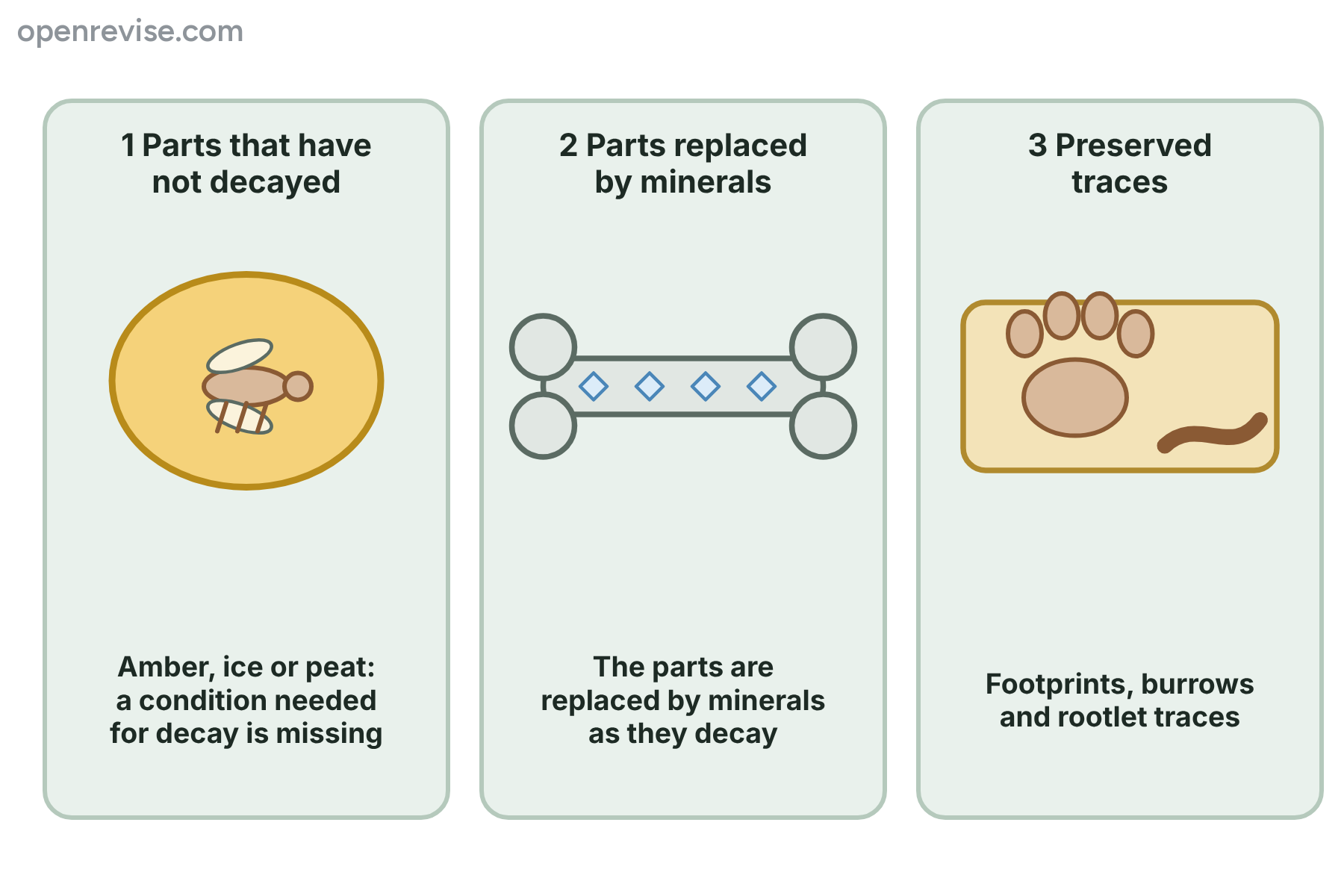
The diagram shows three ways in which fossils form. Describe what is happening in each of the three ways.
Show answerHide answer
Model answer
In 1 the parts of the organism have not decayed because a condition needed for decay, such as oxygen or warmth, is missing. In 2 the parts of the organism have been replaced by minerals as they decayed. In 3 only a trace of the organism, such as a footprint, burrow or rootlet, has been preserved.
Mark scheme
- Parts not decayed because a condition for decay is absent — 1 mark
- Parts replaced by minerals as they decay — 1 mark
- Preserved traces such as footprints or burrows — 1 mark
-
3 Give [2 marks]
Give two conditions that are needed for decay and say how the absence of one of them could preserve an organism as a fossil.
Show answerHide answer
Model answer
Any two of: warmth, moisture, oxygen. If one is missing, for example if there is no oxygen in a peat bog or the temperature is too low in ice, decay microorganisms cannot work, so the parts of the organism are preserved.
Mark scheme
- Two correct conditions for decay — 1 mark
- The absence of one prevents decay so the organism is preserved — 1 mark
-
4 Explain [4 marks]
Explain why the fossil record is incomplete.
Show answerHide answer
Model answer
Many early forms of life were soft-bodied, so they left few traces. The traces that were left have mainly been destroyed by geological activity, such as the folding and erosion of rocks. Fossils form only in particular conditions, so most organisms decay without leaving a fossil. Many fossils have also not been found.
Mark scheme
- Soft-bodied organisms left few traces — 1 mark
- Traces destroyed by geological activity — 1 mark
- Fossils form only in particular conditions — 1 mark
- Many fossils are not yet found — 1 mark
-
5 Calculate [3 marks]
A scientist finds fossils of 12 species in an older rock layer and 21 species in a younger layer. Calculate the percentage increase in the number of species.
Show answerHide answer
Model answer
75%. The increase is \(21 - 12 = 9\), and \(\frac{9}{12} \times 100 = 75\%\).
Mark scheme
- \(21 - 12 = 9\) — 1 mark
- \(\frac{9}{12} \times 100\) — 1 mark
- 75% — 1 mark
-
6 Explain [3 marks]
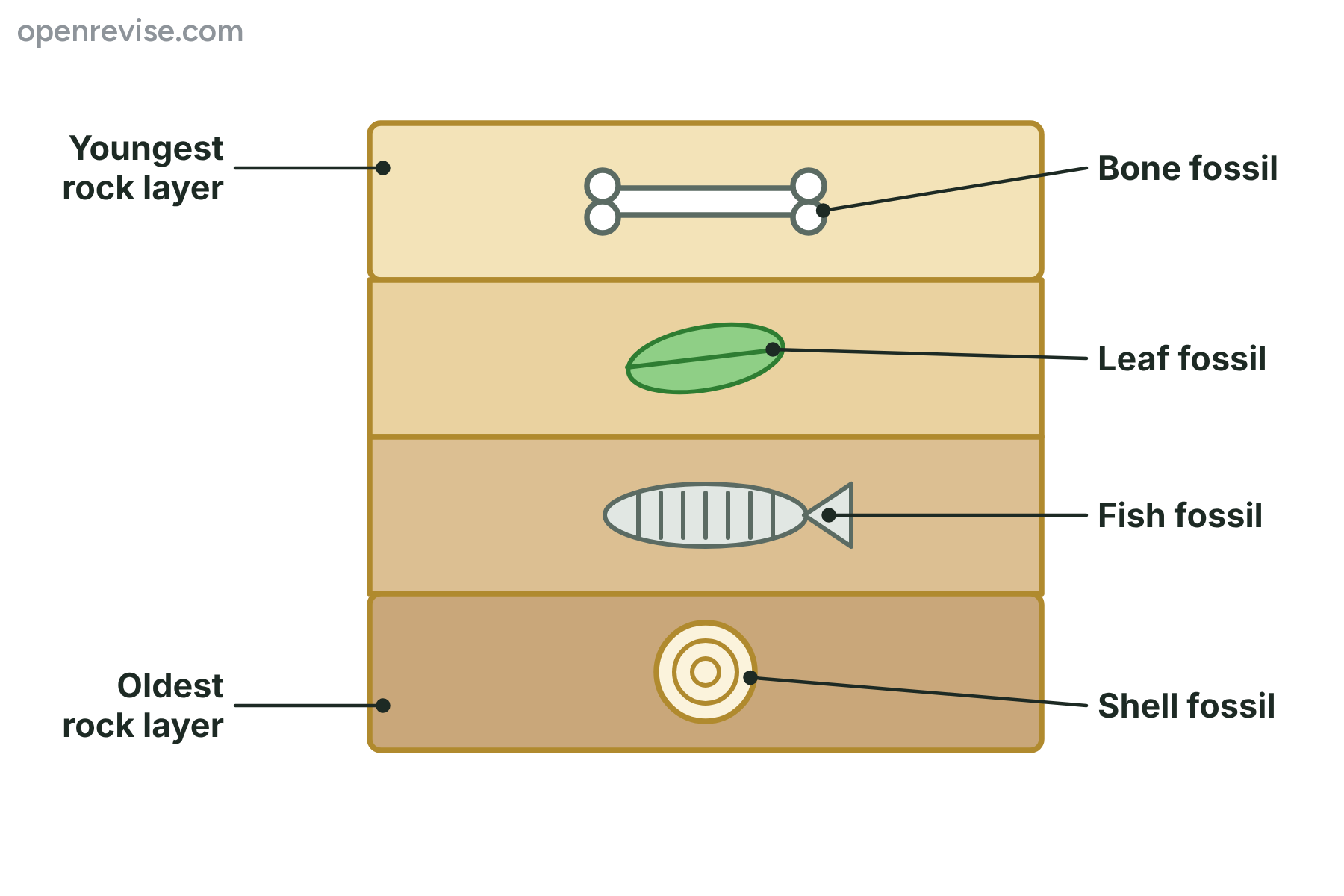
The diagram shows fossils in four layers of undisturbed rock. Explain which fossil is likely to be of the oldest organism, and how scientists use fossils like these to learn about evolution.
Show answerHide answer
Model answer
The shell fossil is likely to be the oldest, because it is in the bottom layer, and in undisturbed rock the deepest layers are the oldest. By comparing fossils from layers of different ages, scientists can see how much or how little organisms have changed over time.
Mark scheme
- Shell, because it is in the oldest (bottom) layer — 1 mark
- Deeper layers are older — 1 mark
- Compare fossils of different ages to see how organisms have changed — 1 mark
-
7 Evaluate [4 marks]
Archaeopteryx had feathers and wings like a bird but also teeth and a long bony tail like a reptile. Evaluate how far this fossil is evidence for evolution.
Show answerHide answer
Model answer
The fossil has features of two groups, which suggests that birds evolved from reptile-like ancestors, so it supports the theory that species change over time. However, it is only one fossil, and the fossil record is incomplete, because few organisms form fossils, so scientists cannot be certain of the whole sequence. Other evidence, such as antibiotic resistance in bacteria, is needed alongside it.
Mark scheme
- Features of both birds and reptiles suggest a link between groups — 1 mark
- Supports the idea that species change over time — 1 mark
- One fossil only and the record is incomplete — 1 mark
- Other evidence needed to be certain — 1 mark
Quick check
-
1
What is a fossil?
Show answerHide answer
B: The remains of an organism from millions of years ago
Fossils are the remains of organisms from millions of years ago, found in rocks.
-
2
Which of these is NOT a way in which fossils form?
Show answerHide answer
D: Living cells grown in a laboratory
Fossils form by the absence of decay, by replacement by minerals and as preserved traces, but not from living organisms that have been kept in a laboratory.
-
3
Which of these is a trace fossil?
Show answerHide answer
A: A footprint
Footprints, burrows and rootlet traces are trace fossils.
-
4
Why have few fossils of early soft-bodied organisms been found?
Show answerHide answer
C: They left few traces that survived
Soft-bodied organisms left few traces, and geological activity destroyed most of them.
-
5
In undisturbed layers of rock, where are the oldest fossils?
Show answerHide answer
D: At the bottom
The deeper layers of rock were laid down first, so they are the oldest.
-
6
What does a fossil of Archaeopteryx show?
Show answerHide answer
B: A group of animals with features of both birds and reptiles
It had features of both reptiles and birds, so it is evidence that one group may have evolved from the other.
-
7
Why can scientists not be certain about how life began on Earth?
Show answerHide answer
A: The traces of early life were mostly destroyed
Early life was soft-bodied and the few traces that formed were mainly destroyed by geological activity.
-
8
Which condition could prevent decay and so help a fossil form?
Show answerHide answer
C: No oxygen
With no oxygen, as in a peat bog, decay microorganisms cannot work.
Extinction
Just this lesson-
1 State [1 mark]
What is meant by extinction?
Show answerHide answer
Model answer
There are no remaining individuals of a species still alive.
Mark scheme
- No individuals of a species remain alive — 1 mark
-
2 Give [3 marks]
Give three factors which may contribute to the extinction of a species.
Show answerHide answer
Model answer
Any three of: a new predator, a new disease, a new competitor, a change to the environment, a catastrophic event such as a volcanic eruption or asteroid collision, human activity such as hunting or habitat destruction.
Mark scheme
- First factor — 1 mark
- Second factor — 1 mark
- Third factor — 1 mark
-
3 Explain [3 marks]
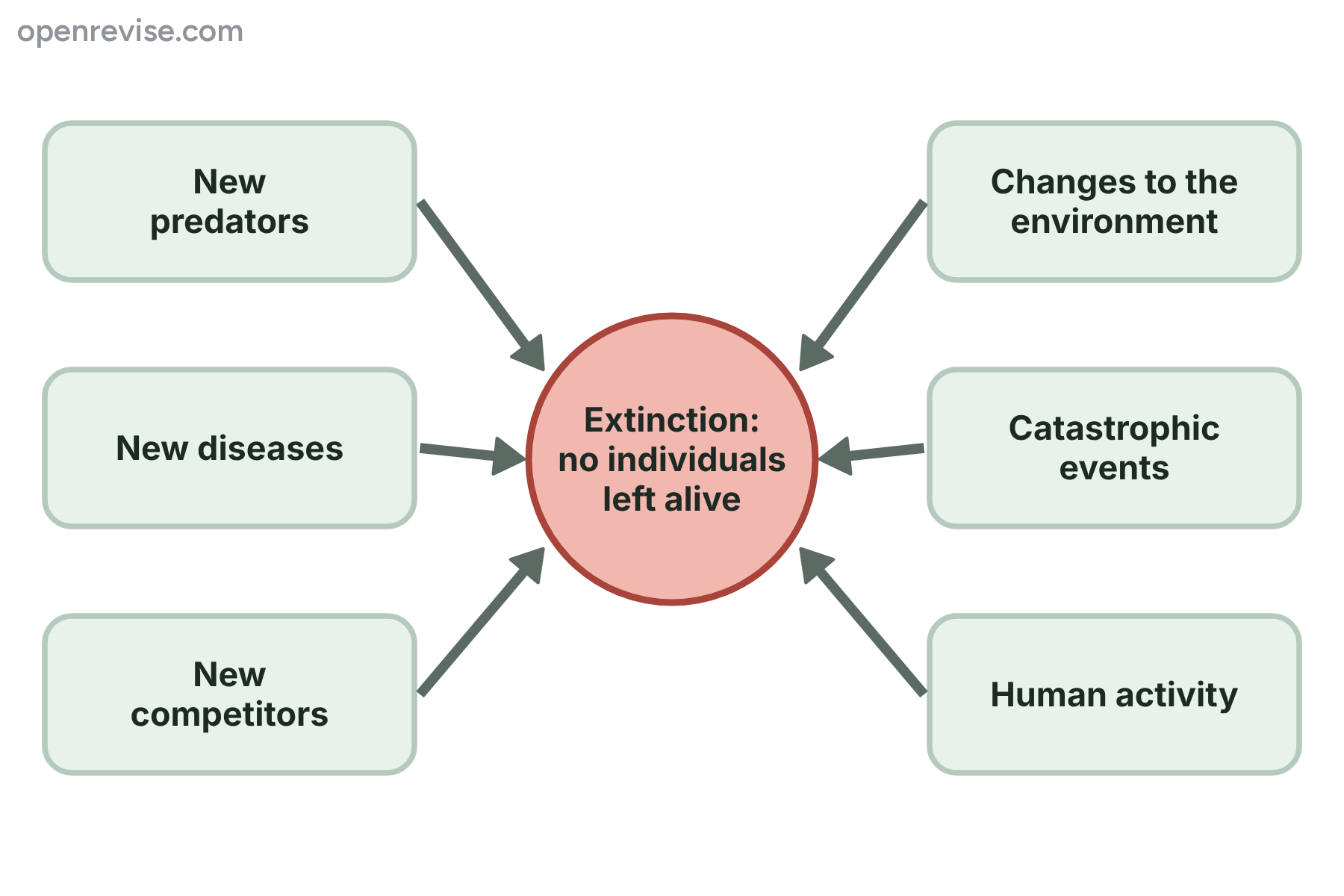
A new species of rat arrives on an island and eats the eggs of a species of ground-nesting bird. Use the diagram to explain how this could lead to the extinction of the bird.
Show answerHide answer
Model answer
The rat is a new predator, so it eats the eggs, so fewer chicks hatch. The birds have not evolved a defence against the rat, so numbers of the birds fall. If every egg is eaten, no new birds are produced, and when the last adult dies the species is extinct.
Mark scheme
- The rat is a new predator (or competitor) — 1 mark
- Eggs eaten, so fewer chicks — 1 mark
- Numbers fall until no individuals remain, so extinct — 1 mark
-
4 Calculate [3 marks]
The population of a rare plant in a nature reserve was 1 800 in 2010 and 450 in 2020. Calculate the percentage decrease in the population.
Show answerHide answer
Model answer
75%. The decrease is \(1800 - 450 = 1350\), and \(\frac{1350}{1800} \times 100 = 75\%\).
Mark scheme
- \(1800 - 450 = 1350\) — 1 mark
- \(\frac{1350}{1800} \times 100\) — 1 mark
- 75% — 1 mark
-
5 Explain [4 marks]
Explain how a catastrophic event such as an asteroid collision could cause the extinction of large numbers of species.
Show answerHide answer
Model answer
The impact throws dust and gas into the atmosphere, which blocks out sunlight and makes the climate colder. Plants cannot photosynthesise, so producers die, and the animals that eat them, and the predators that eat those, have no food. Species that cannot adapt to the new environment die out.
Mark scheme
- Dust and gas block the sunlight, changing the climate — 1 mark
- Plants cannot photosynthesise — 1 mark
- Food chains collapse, so consumers have no food — 1 mark
- Species that cannot adapt go extinct — 1 mark
-
6 Explain [3 marks]
Explain why a species with very little genetic variation is more likely to become extinct when a new disease appears.
Show answerHide answer
Model answer
With little variation, all the individuals are likely to have the same alleles. If none of them has an allele that gives resistance to the disease, they will all be affected in the same way. So the disease could kill them all and the species goes extinct.
Mark scheme
- Little variation means individuals have similar alleles — 1 mark
- None may have a resistant allele — 1 mark
- So all could be killed by the disease — 1 mark
-
7 Evaluate [6 marks]
Some people say that the extinction of species is natural and so nothing should be done to prevent it. Evaluate this view.
Show answerHide answer
Model answer
Extinction has happened naturally throughout the history of life, for example when the dinosaurs died out after an asteroid collision, so it is part of evolution. New species have evolved to take the place of those lost. However, many extinctions today are caused by human activity, such as hunting, habitat destruction and global warming, and they are happening much faster than natural extinctions. Losing species reduces biodiversity, which can make ecosystems less stable, and it removes organisms that may be useful to humans. Many people also believe that humans have a duty to prevent extinctions they have caused. Overall, the view is not convincing for extinctions caused by people, even if extinction is a natural process.
Mark scheme
- Extinction is natural and has always happened — 1 mark
- An example such as the dinosaurs — 1 mark
- Many current extinctions are caused by human activity — 1 mark
- Faster than natural extinctions — 1 mark
- Loss of biodiversity or useful species — 1 mark
- A reasoned conclusion — 1 mark
Quick check
-
1
What is extinction?
Show answerHide answer
C: When no individuals of a species remain
Extinction occurs when there are no remaining individuals of a species still alive.
-
2
Which of these may contribute to the extinction of a species?
Show answerHide answer
A: A new disease
A new disease can spread through a population with no immunity and kill most of the individuals.
-
3
Which event is thought to have caused the extinction of the dinosaurs?
Show answerHide answer
D: An asteroid collision
An asteroid collision about 66 million years ago changed the climate.
-
4
How did humans cause the extinction of the dodo?
Show answerHide answer
B: Through hunting and introduced animals
Sailors hunted them, and the animals they brought ate the eggs, so the dodo was extinct within about a century.
-
5
Why is a species with a small population more at risk of extinction?
Show answerHide answer
C: One event could kill all the individuals
One event could kill all the individuals, and there is little genetic variation.
-
6
Which of these is a human cause of extinction?
Show answerHide answer
A: Habitat destruction
Destroying habitats by building or farming removes the places species live.
-
7
What does a mass extinction mean?
Show answerHide answer
D: Many species die out at about the same time
It is an event in which a large proportion of all species die out together.
-
8
A species depends on one type of plant for food. Why is it at greater risk?
Show answerHide answer
B: The species has no alternative food if the plant is lost
If the plant is lost, the species has no other food and may go extinct.
Antibiotic-resistant Bacteria
Just this lesson-
1 State [1 mark]
Why can bacteria evolve rapidly?
Show answerHide answer
Model answer
They reproduce at a fast rate.
Mark scheme
- They reproduce at a fast rate — 1 mark
-
2 Explain [5 marks]
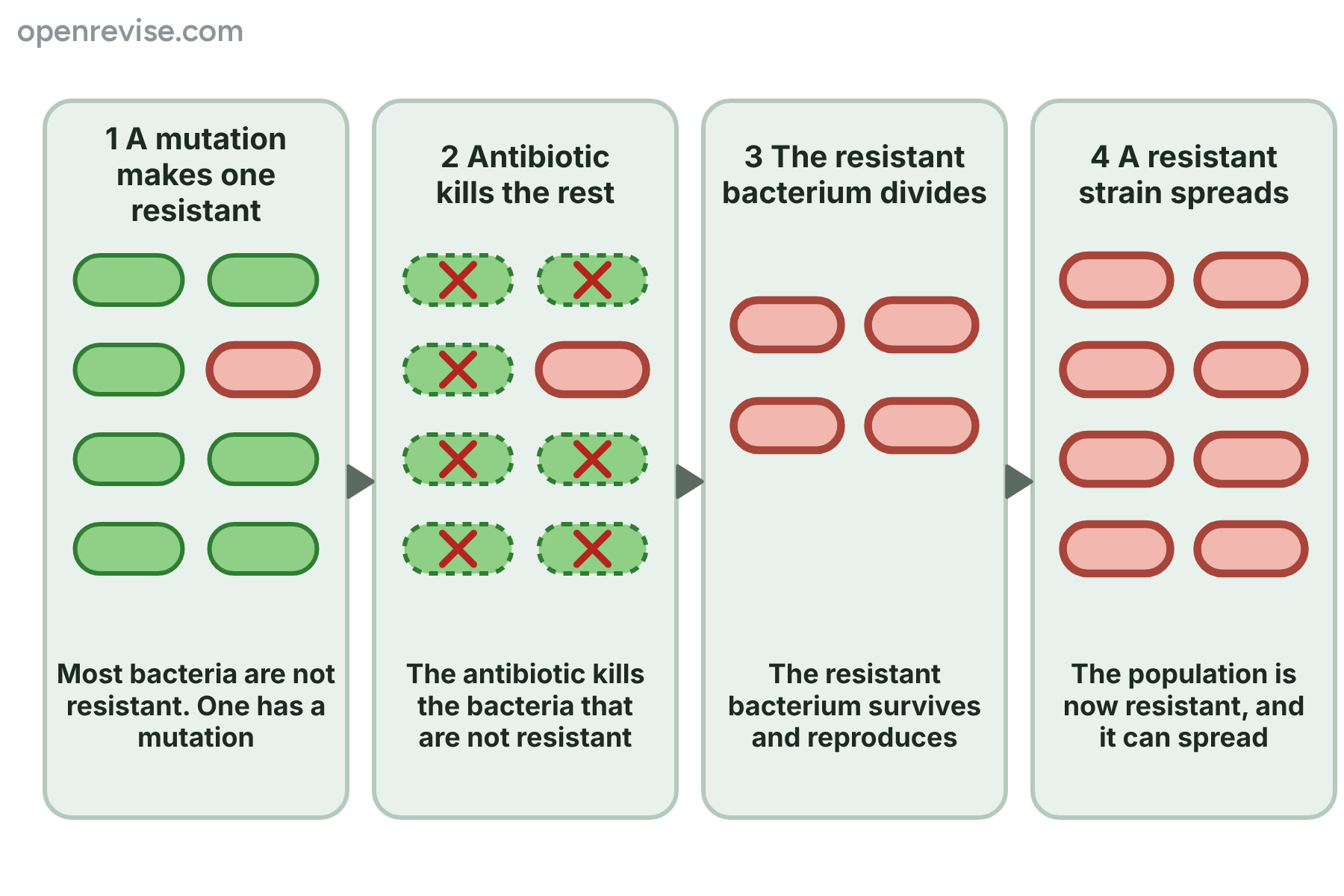
The diagram shows a population of bacteria exposed to an antibiotic. Explain how the diagram shows evolution by natural selection.
Show answerHide answer
Model answer
There is variation, as a mutation has made one bacterium resistant. The antibiotic acts as a selection pressure and kills the non-resistant bacteria. The resistant bacterium survives and reproduces, passing on the resistance allele. So the resistant strain becomes the whole population.
Mark scheme
- A mutation gives variation — 1 mark
- The antibiotic kills the non-resistant bacteria — 1 mark
- The resistant bacterium survives — 1 mark
- It reproduces and passes on the allele — 1 mark
- The resistant strain becomes more common — 1 mark
-
3 Calculate [3 marks]
A resistant bacterium divides once every 20 minutes. Calculate how many resistant bacteria there will be after 3 hours.
Show answerHide answer
Model answer
512 bacteria. 3 hours is 180 minutes, so there are \(180 \div 20 = 9\) divisions, and \(2^9 = 512\).
Mark scheme
- \(180 \div 20 = 9\) divisions — 1 mark
- \(2^9\) — 1 mark
- 512 — 1 mark
-
4 Explain [3 marks]
A patient with a bacterial infection stops taking antibiotics after three days, when they begin to feel better. Explain why this could lead to a resistant strain.
Show answerHide answer
Model answer
After three days not all the bacteria have been killed. The surviving bacteria are the ones that are most able to survive the antibiotic, and they may mutate. They reproduce, so the strain with resistance could become common and spread to other people.
Mark scheme
- Some bacteria are still alive — 1 mark
- Survivors are best able to withstand the antibiotic, and may mutate — 1 mark
- They reproduce and may form a resistant strain — 1 mark
-
5 Explain [3 marks]
A patient has a cold, which is caused by a virus, and asks the doctor for antibiotics. Explain why the doctor should not prescribe them.
Show answerHide answer
Model answer
Antibiotics do not kill viruses, so they will not cure the cold. Taking them would only expose the patient's own bacteria to the antibiotic, which selects any that are resistant. This helps to increase the number of resistant strains.
Mark scheme
- Antibiotics do not kill viruses — 1 mark
- They would expose bacteria to the antibiotic, selecting resistant ones — 1 mark
- This increases the development of resistant strains — 1 mark
-
6 Explain [3 marks]
Explain why the development of new antibiotics is unlikely to solve the problem of antibiotic resistance.
Show answerHide answer
Model answer
The development of new antibiotics is costly and slow. Bacteria reproduce at a fast rate, so resistant strains to the new antibiotics can appear quickly. New antibiotics are therefore unlikely to keep up with new resistant strains.
Mark scheme
- Development is costly and slow — 1 mark
- Bacteria reproduce quickly so resistance appears again — 1 mark
- New drugs unlikely to keep up with resistant strains — 1 mark
-
7 Evaluate [6 marks]
A government is deciding whether to ban the use of antibiotics on healthy farm animals. Evaluate the proposal.
Show answerHide answer
Model answer
Banning the use of antibiotics on healthy farm animals would reduce the chance that bacteria are exposed to antibiotics, so there would be less selection for resistant strains. Resistant strains from animals can spread to people in food or by contact, so the ban could reduce the spread. However, farmers use antibiotics to stop diseases spreading in crowded conditions, so without them more animals might become ill, and animal welfare and food production could suffer, and food costs might increase. Overall, since resistance is a serious threat to human health, the ban is likely to be justified, as long as farmers have other ways, such as better hygiene, to keep animals healthy.
Mark scheme
- Less exposure, so less selection for resistance — 1 mark
- Resistant strains can spread from animals to people — 1 mark
- Antibiotics prevent disease in crowded farms — 1 mark
- Animal welfare or food production could suffer — 1 mark
- Higher food costs or alternatives such as better hygiene — 1 mark
- A reasoned conclusion — 1 mark
Quick check
-
1
Why can bacteria evolve quickly?
Show answerHide answer
A: They reproduce at a fast rate
They reproduce at a fast rate, so there are many generations in a short time.
-
2
How do resistant strains of bacteria first arise?
Show answerHide answer
C: Mutations in the bacteria
Mutations produce new strains, some of which may be resistant.
-
3
What happens to resistant bacteria when an antibiotic is used?
Show answerHide answer
B: They survive and reproduce
They are not killed, so they survive and reproduce.
-
4
Which of these is resistant to antibiotics?
Show answerHide answer
D: MRSA
MRSA is resistant to antibiotics.
-
5
Why should patients complete their course of antibiotics?
Show answerHide answer
A: So that all bacteria are killed
So that all the bacteria are killed and none survive to mutate and form resistant strains.
-
6
Why are antibiotics not given for viral infections?
Show answerHide answer
C: They do not kill viruses
Antibiotics do not kill viruses, and using them would help to select resistant bacteria.
-
7
Why might the agricultural use of antibiotics be restricted?
Show answerHide answer
D: It increases the chance of resistant strains
It gives bacteria more opportunities to evolve resistance, which can spread to people.
-
8
Why are new antibiotics unlikely to solve resistance?
Show answerHide answer
B: They are slow to develop and resistance appears again
They are costly and slow to develop, and resistant strains can appear again quickly.
Classification and the Linnaean System
Just this lesson-
1 Name [2 marks]
Name the smallest and the largest groups in the Linnaean system of classification.
Show answerHide answer
Model answer
The smallest group is the species. The largest group is the kingdom.
Mark scheme
- Species is the smallest — 1 mark
- Kingdom is the largest — 1 mark
-
2 Give [3 marks]
Write the seven ranks of the Linnaean system in order, starting with the largest group.
Show answerHide answer
Model answer
Kingdom, phylum, class, order, family, genus, species.
Mark scheme
- Kingdom, phylum, class in order — 1 mark
- Order and family in order — 1 mark
- Genus and species in the right order — 1 mark
-
3 Explain [3 marks]
The diagram shows the classification of humans. Explain how the binomial name for humans is made up, and why the bars get narrower.
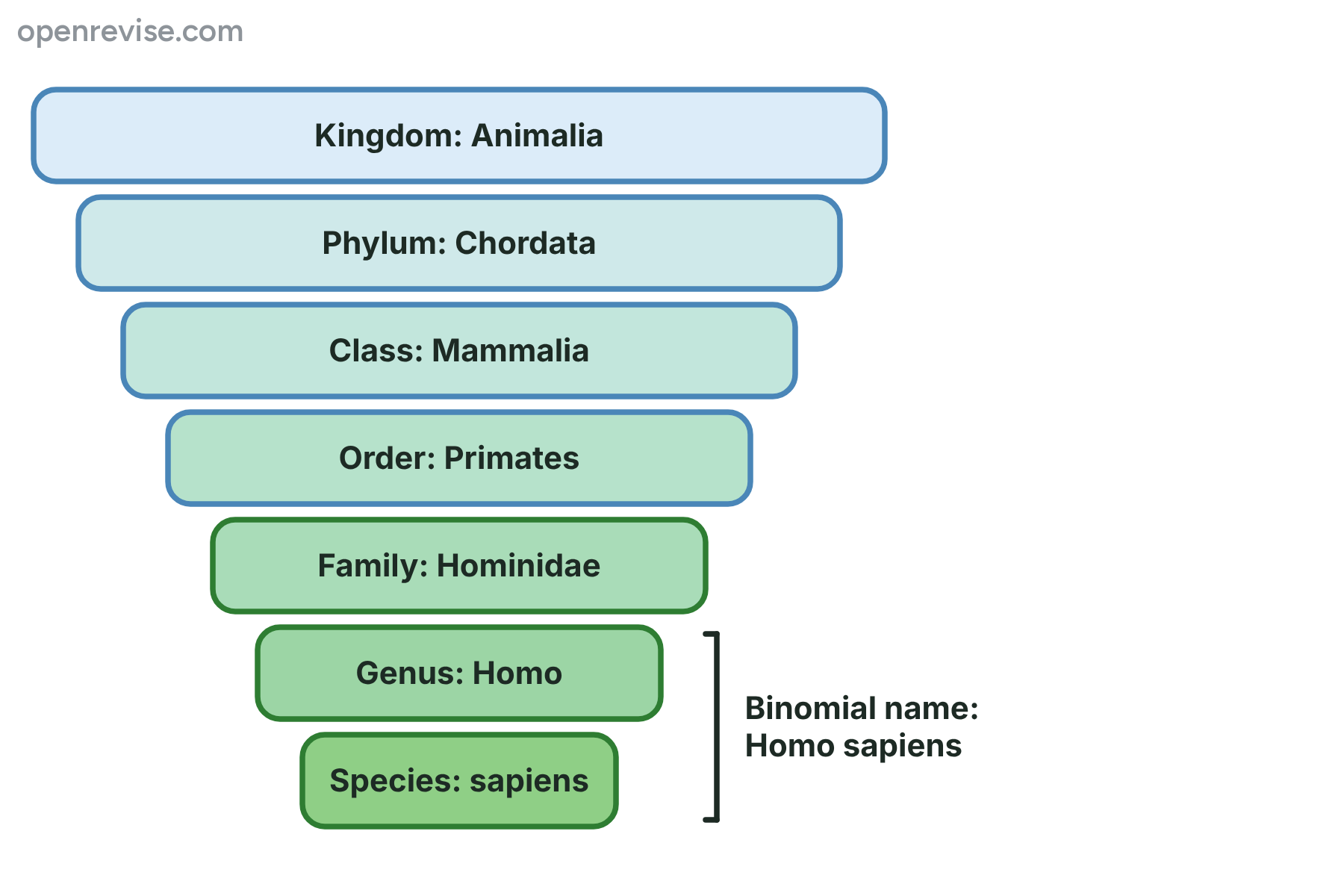
Show answerHide answer
Model answer
The binomial name has two parts, the genus followed by the species, so it is Homo sapiens. The bars get narrower because each group is divided into smaller groups, so there are fewer organisms in each rank down, and they have more characteristics in common.
Mark scheme
- Genus followed by species — 1 mark
- Homo sapiens — 1 mark
- Each rank has fewer organisms, which are more alike — 1 mark
-
4 Explain [3 marks]
The classification of four mammals is shown. Mammal W: Panthera leo. Mammal X: Panthera tigris. Mammal Y: Felis catus. Mammal Z: Canis lupus. Which two mammals are most closely related? Explain your answer.
Show answerHide answer
Model answer
Mammals W and X are most closely related. They are in the same genus, Panthera, which means that they share more ranks than any other pair. Y is in a different genus of the same family, and Z is in a different family.
Mark scheme
- W and X — 1 mark
- Same genus (Panthera) — 1 mark
- They share more groups than other pairs — 1 mark
-
5 Describe [3 marks]
Describe how organisms are named using the binomial system.
Show answerHide answer
Model answer
Each organism has a name of two parts. The first part is the genus, written with a capital letter, and the second part is the species, written with a lower case letter. The name is written in italics, or underlined if handwritten.
Mark scheme
- Two names — 1 mark
- Genus then species — 1 mark
- Capital letter for the genus and lower case for the species — 1 mark
-
6 Explain [3 marks]
Explain why scientists use scientific names for organisms rather than common names.
Show answerHide answer
Model answer
Common names are different in different countries and languages. The same common name may be used for more than one species. A scientific name is the same everywhere and identifies only one species.
Mark scheme
- Common names vary between countries — 1 mark
- A common name may refer to more than one species — 1 mark
- A scientific name is the same everywhere — 1 mark
-
7 Evaluate [4 marks]
Evaluate the Linnaean system of classification as a way of showing how closely organisms are related.
Show answerHide answer
Model answer
The system is useful because organisms in the same group share structures and characteristics, and the lower the rank they share, the more closely they are related. It is standard and used worldwide. However, it is based on structure, so organisms that look similar may be grouped together even if they are not closely related, and it cannot show how recently species diverged. New evidence has led to changes.
Mark scheme
- Groups organisms by shared characteristics — 1 mark
- Standard and used worldwide — 1 mark
- Based on structure, so may not show true ancestry — 1 mark
- Has been changed by new evidence — 1 mark
Quick check
-
1
Who developed the system of classification into kingdom, phylum, class, order, family, genus and species?
Show answerHide answer
C: Carl Linnaeus
Carl Linnaeus developed the system.
-
2
Which is the smallest group in the Linnaean system?
Show answerHide answer
B: Species
The species is the smallest group.
-
3
Which is the correct order of ranks from largest to smallest?
Show answerHide answer
D: Kingdom, phylum, class, order, family, genus, species
Kingdom, phylum, class, order, family, genus, species.
-
4
What does the binomial system use to name an organism?
Show answerHide answer
A: Its genus and species
Binomial means two names: the genus and the species.
-
5
Which is the correct way to write the scientific name of humans?
Show answerHide answer
C: Homo sapiens
The genus has a capital letter and the species has a lower case letter: Homo sapiens.
-
6
Two organisms are in the same genus. What does this show?
Show answerHide answer
B: They are very closely related
Organisms in the same genus are very closely related.
-
7
What is the Linnaean system mainly based on?
Show answerHide answer
D: Their structure and characteristics
Traditionally organisms were grouped by their structure and characteristics.
-
8
Why is a scientific name better than a common name?
Show answerHide answer
A: It is the same everywhere and names one species
It is the same all over the world and refers to one species.
The Three-domain System and Evolutionary Trees
Just this lesson-
1 Name [3 marks]
Name the three domains in the three-domain system of classification.
Show answerHide answer
Model answer
Archaea, Bacteria and Eukaryota.
Mark scheme
- Archaea — 1 mark
- Bacteria — 1 mark
- Eukaryota — 1 mark
-
2 Explain [3 marks]
Explain why new models of classification were proposed after the Linnaean system.
Show answerHide answer
Model answer
Microscopes improved, so scientists could see the internal structures of cells. Scientists also understood biochemical processes better and could use chemical analysis to compare organisms. This new evidence did not always fit the old groups, so new models were needed.
Mark scheme
- Improved microscopes showed internal structures — 1 mark
- Better understanding of biochemistry and chemical analysis — 1 mark
- New evidence did not fit old groups, so new models were proposed — 1 mark
-
3 Describe [2 marks]
Describe two differences between the Linnaean system and the three-domain system of classification.
Show answerHide answer
Model answer
The Linnaean system was developed by Linnaeus and is based on the structure and characteristics of organisms. The three-domain system was developed by Woese, and is based on evidence from chemical analysis.
Mark scheme
- Linnaeus and structure and characteristics — 1 mark
- Woese and chemical analysis — 1 mark
-
4 Name [3 marks]
The diagram shows an evolutionary tree. Which two organisms, marked A to E, are the most closely related, and which of A to C is the most closely related to them? Explain your answer.
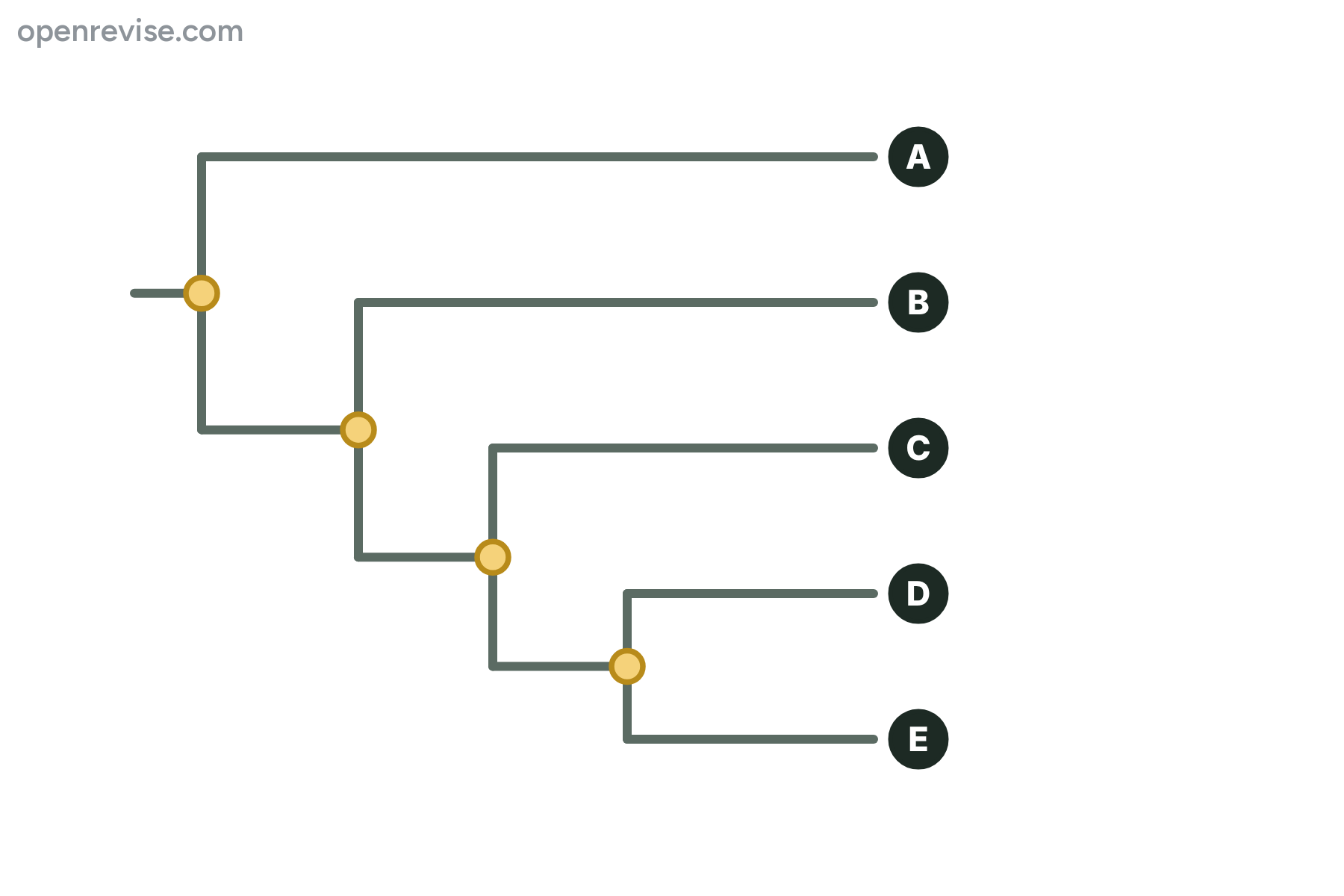
Show answerHide answer
Model answer
D and E are the most closely related, because their branches join at the most recent branch point, so they share the most recent common ancestor. C is the closest relative of D and E, because its branch joins theirs at the next branch point back.
Mark scheme
- D and E — 1 mark
- Their branches meet at the most recent branch point (common ancestor) — 1 mark
- C is next closest — 1 mark
-
5 Explain [3 marks]
Scientists use both classification data and fossil data to produce evolutionary trees. Explain why both are needed.
Show answerHide answer
Model answer
Classification data from living organisms, such as DNA and structure, allows scientists to work out the relationships of the organisms alive today. Extinct organisms cannot be studied directly, so fossil data are needed to place them on the tree. Together they give a fuller picture.
Mark scheme
- Classification data for living organisms — 1 mark
- Fossil data are needed for extinct organisms — 1 mark
- Together they give a fuller picture of relationships — 1 mark
-
6 Describe [3 marks]
Describe the three domains of the Woese system, giving one example of an organism in each.
Show answerHide answer
Model answer
Archaea are primitive bacteria, usually living in extreme environments, for example in hot springs. Bacteria are the true bacteria, for example the bacteria that cause disease. Eukaryota include protists, fungi, plants and animals, for example humans.
Mark scheme
- Archaea, with extreme environments or an example — 1 mark
- Bacteria, true bacteria with an example — 1 mark
- Eukaryota with protists, fungi, plants and animals — 1 mark
-
7 Evaluate [4 marks]
A student says, "Classification systems are facts, so they never change." Evaluate this statement.
Show answerHide answer
Model answer
The statement is not correct. Classification systems are models, which scientists change as new evidence becomes available. For example, better microscopes and chemical analysis led to the three-domain system, which replaced earlier models. New fossils and DNA evidence may lead to further changes. This is how scientific methods and theories develop over time.
Mark scheme
- Classification is a model, not a fact — 1 mark
- Changes when new evidence is found — 1 mark
- An example such as the three-domain system — 1 mark
- Further changes are possible, as theories develop over time — 1 mark
Quick check
-
1
Who developed the three-domain system?
Show answerHide answer
D: Carl Woese
Carl Woese developed the three-domain system.
-
2
Which is one of the three domains?
Show answerHide answer
B: Archaea
The domains are Archaea, Bacteria and Eukaryota.
-
3
Which organisms are in the domain Eukaryota?
Show answerHide answer
A: Protists, fungi, plants and animals
Protists, fungi, plants and animals are all eukaryotes.
-
4
What are Archaea?
Show answerHide answer
C: Primitive bacteria in extreme environments
Archaea are primitive bacteria usually living in extreme environments.
-
5
What evidence led to the three-domain system?
Show answerHide answer
B: Chemical analysis
Evidence from chemical analysis, such as comparing DNA and RNA sequences.
-
6
What does an evolutionary tree show?
Show answerHide answer
D: How organisms are thought to be related
It shows how scientists believe organisms are related.
-
7
On an evolutionary tree, which pair of organisms is most closely related?
Show answerHide answer
A: The pair whose branches meet at the most recent branch point
The pair whose branches meet at the most recent common ancestor.
-
8
What data are used to make evolutionary trees?
Show answerHide answer
C: Classification data and fossil data
Current classification data for living organisms and fossil data for extinct organisms.
Darwin, Lamarck and the Theory of Evolution
Just this lesson-
1 State [2 marks]
State two things that Darwin did that helped him to develop the theory of evolution by natural selection.
Show answerHide answer
Model answer
Any two of: he made observations on a round-the-world expedition, he carried out years of experimentation and discussion, he linked his ideas to developing knowledge of geology and fossils.
Mark scheme
- First correct thing — 1 mark
- Second correct thing — 1 mark
-
2 Describe [3 marks]
Describe the theory of evolution by natural selection.
Show answerHide answer
Model answer
There is a wide range of variation for a characteristic between individuals in a species. Individuals with the characteristics most suited to the environment are more likely to survive to breed successfully. The characteristics that enabled these individuals to survive are passed on to the next generation.
Mark scheme
- Variation between individuals — 1 mark
- Best-suited individuals survive and breed — 1 mark
- Characteristics passed on to the next generation — 1 mark
-
3 Explain [3 marks]
Explain why the theory of evolution by natural selection was only gradually accepted.
Show answerHide answer
Model answer
The theory challenged the idea that God made all the animals and plants on Earth, which many people believed. There was not enough evidence at the time it was published to convince many scientists. The mechanism of inheritance and variation was not known until 50 years later.
Mark scheme
- Challenged the belief that God made all organisms — 1 mark
- Insufficient evidence at the time — 1 mark
- Mechanism of inheritance not known for 50 years — 1 mark
-
4 Describe [3 marks]
Use the timeline to describe how the theory of evolution developed over time.
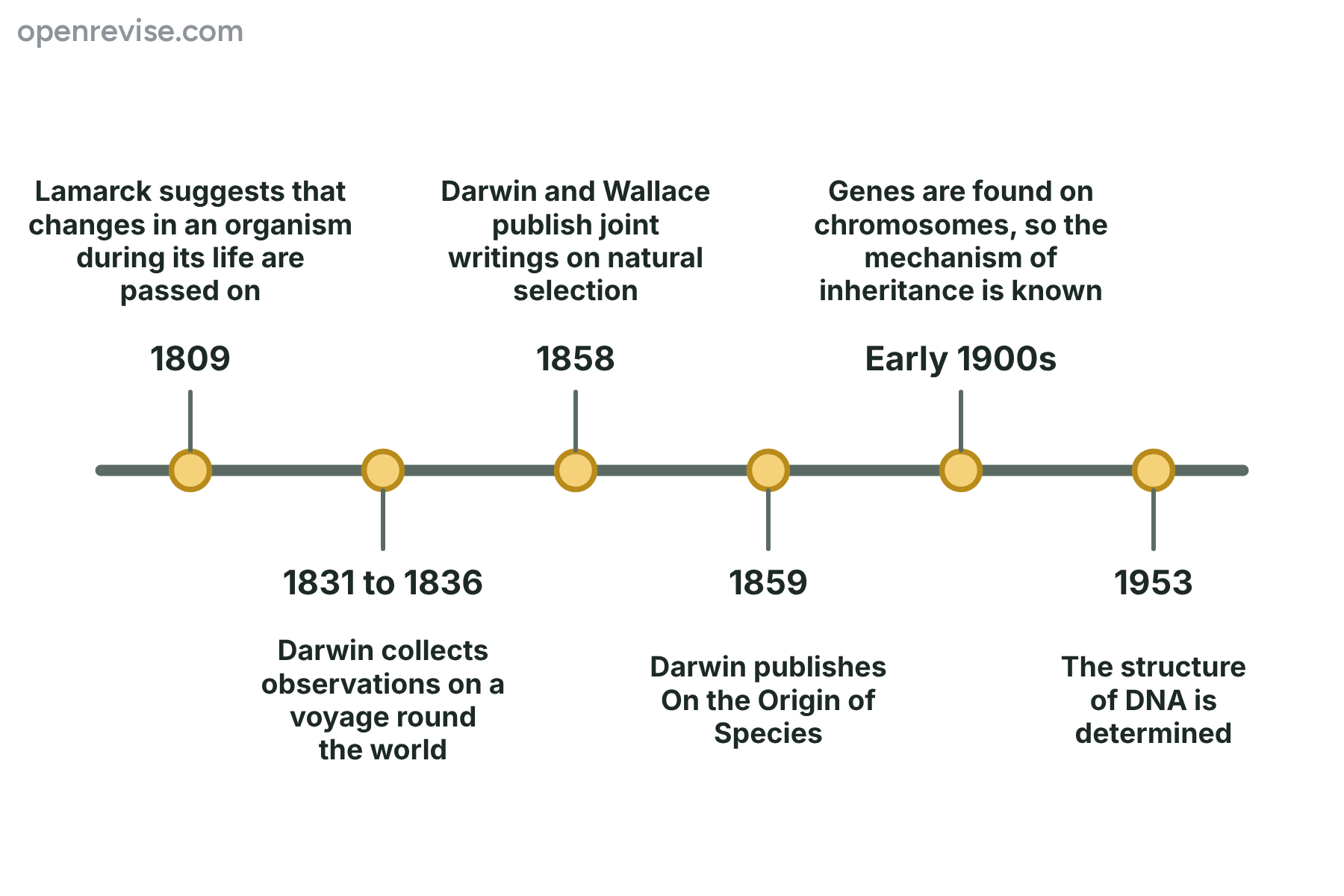
Show answerHide answer
Model answer
Lamarck proposed an earlier idea in 1809. Darwin collected observations on his voyage between 1831 and 1836, and he and Wallace published their joint writings in 1858, followed by Darwin's book in 1859. About fifty years later, in the early 1900s, genes were found on chromosomes, which explained inheritance, and in 1953 the structure of DNA was found. The theory developed over time using work by many scientists.
Mark scheme
- Earlier idea by Lamarck — 1 mark
- Darwin and Wallace 1858 and 1859 publication — 1 mark
- Later discoveries about genes and DNA support the theory — 1 mark
-
5 Compare [4 marks]
Compare Lamarck's explanation of how a giraffe came to have a long neck with Darwin's explanation.
Show answerHide answer
Model answer
Lamarck thought that giraffes stretched their necks to reach leaves, so their necks became longer during their lives and this change was inherited by their young. Darwin's explanation is that there was variation in neck length. Giraffes with longer necks could reach more food, so they survived and bred, and passed on the alleles for long necks, so over many generations the population had longer necks.
Mark scheme
- Lamarck: neck stretched during life — 1 mark
- Lamarck: the change was inherited — 1 mark
- Darwin: variation in neck length — 1 mark
- Darwin: longer-necked giraffes survived and bred, passing on alleles — 1 mark
-
6 Explain [3 marks]
Explain why Lamarck's idea that a blacksmith's children would inherit his large muscles is not correct.
Show answerHide answer
Model answer
Large muscles are developed during the blacksmith's life by exercise, so they are an acquired characteristic. They are not caused by a change to the genes in his gametes, so they are not passed on. In the vast majority of cases this type of inheritance cannot occur.
Mark scheme
- Muscles developed through exercise during life — 1 mark
- Genes in the gametes are not changed — 1 mark
- So the characteristic is not inherited — 1 mark
-
7 Evaluate [6 marks]
Evaluate the importance of the work of many scientists, and not just Darwin, in the development of the theory of evolution by natural selection.
Show answerHide answer
Model answer
Darwin made observations on his voyage and linked them to geology and fossils, and spent years gathering evidence. Wallace independently proposed the same idea, which prompted Darwin to publish, so the theory was not the work of one person. Later scientists provided evidence that Darwin lacked. Mendel's work and the discovery of genes on chromosomes explained how characteristics are inherited, and the structure of DNA explained the nature of variation, while fossils and antibiotic resistance gave more evidence. So the theory developed over time with information from many scientists, and it was strengthened as new evidence became available. Although Darwin's insight was central, the theory could not have been accepted without the work of the others.
Mark scheme
- Darwin's observations and evidence — 1 mark
- Wallace independently proposed the theory — 1 mark
- Genes and inheritance explained how characteristics are passed on — 1 mark
- Fossils or bacteria provide further evidence — 1 mark
- The theory developed over time using work by many scientists — 1 mark
- A reasoned conclusion — 1 mark
Quick check
-
1
Who proposed the theory of evolution by natural selection?
Show answerHide answer
A: Charles Darwin
Charles Darwin proposed the theory, which was also proposed independently by Alfred Russel Wallace.
-
2
In which year did Darwin publish On the Origin of Species?
Show answerHide answer
C: 1859
It was published in 1859.
-
3
Which statement is part of the theory of natural selection?
Show answerHide answer
B: Individuals best suited to the environment are more likely to survive and breed
Individuals with the characteristics most suited to the environment are more likely to survive to breed.
-
4
Which of these was a reason why the theory was only gradually accepted?
Show answerHide answer
D: The mechanism of inheritance was not known
The mechanism of inheritance and variation was not known until 50 years after the theory was published.
-
5
What did Lamarck suggest?
Show answerHide answer
A: Changes during life are inherited
Lamarck suggested that changes that occur in an organism during its lifetime can be inherited.
-
6
Which is evidence against Lamarck's idea?
Show answerHide answer
C: A blacksmith's children do not inherit his muscles
In the vast majority of cases, characteristics that change during life cannot be inherited.
-
7
Why did Darwin visit the Galapagos Islands?
Show answerHide answer
B: As part of a voyage round the world
He was a naturalist on HMS Beagle, a voyage round the world on which he made observations.
-
8
Which was an important result of the 1858 joint writings?
Show answerHide answer
D: Darwin published his book the next year
Wallace and Darwin published joint writings, which prompted Darwin to publish On the Origin of Species the following year.