Flashcards · Biology
Genetic Inheritance
-
What is an allele?
A different form of the same gene.
-
Where are the two alleles of a gene found?
On the two chromosomes of a pair, at the same position.
-
How many alleles of a gene does a gamete carry?
One.
-
What is a dominant allele?
One that is always expressed, even if only one copy is present.
-
When is a recessive allele expressed?
Only when two copies are present, so there is no dominant allele.
-
How are dominant and recessive alleles written?
A capital letter for dominant and the lower case of the same letter for recessive.
-
What does homozygous mean?
Both alleles of the gene are the same.
-
What does heterozygous mean?
The two alleles of the gene are different.
-
What is a genotype?
The alleles an organism has, such as Bb.
-
What is a phenotype?
The characteristic that shows, such as brown fur.
-
Which genotype gives a recessive phenotype?
Only the homozygous recessive genotype, such as bb.
-
Do BB and Bb have the same phenotype?
Yes, if B is dominant, but they are different genotypes.
-
Give two examples of single gene characteristics.
Fur colour in mice and red-green colour blindness in humans.
-
Are most characteristics controlled by one gene?
No. Most are controlled by many genes interacting.
-
What is a common mistake about dominant alleles?
Thinking they are stronger or more common. They are only expressed when present.
-
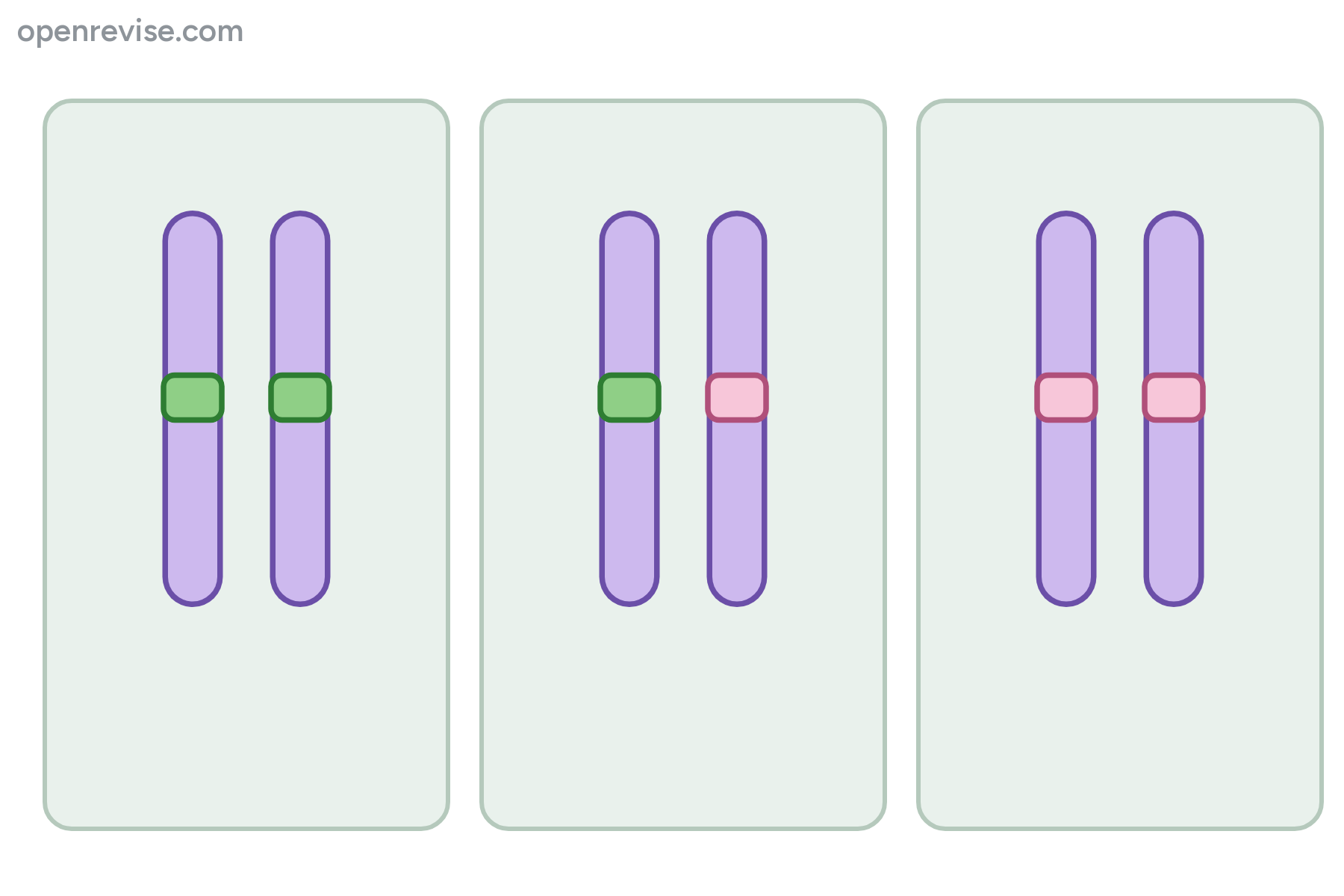 Describe the three pairs of chromosomes, using the words homozygous, heterozygous, dominant and recessive.
 Panel 1 is homozygous dominant (BB), panel 2 is heterozygous (Bb) and panel 3 is homozygous recessive (bb). Panels 1 and 2 show the dominant phenotype. Only panel 3 shows the recessive phenotype.
-
How many alleles does each gamete carry?
One allele of each gene.
-
What is a Punnett square?
A diagram showing all the possible combinations of gametes in a cross.
-
What gametes does a parent with the genotype Bb make?
B and b.
-
What gametes does a parent with the genotype bb make?
Only b.
-
What are the offspring genotypes in Bb x Bb?
1 BB : 2 Bb : 1 bb.
-
What is the phenotype ratio in Bb x Bb?
3 dominant to 1 recessive.
-
What is the phenotype ratio in Bb x bb?
1 dominant to 1 recessive.
-
What is the chance of a recessive offspring from Bb x Bb?
1 in 4, or 25%.
-
What is the chance of a recessive offspring from Bb x bb?
1 in 2, or 50%.
-
Which allele do you write first in a heterozygous genotype?
The dominant allele, so Bb.
-
Does a 3 : 1 ratio mean that exactly 3 in every 4 offspring show the dominant phenotype?
No. It is the expected ratio over many offspring and each fertilisation is a chance event.
-
A couple have a child with a recessive disorder. What is the chance that the next child has it too?
The same as before. Each fertilisation is independent.
-
If two black mice have a brown offspring, what are the parents' genotypes? (Higher tier)
Both are Bb.
-
How do you find the probability of two independent events both happening? (Higher tier)
Multiply their probabilities.
-
What is the chance that two offspring from Bb x Bb are both brown? (Higher tier)
\(\frac{1}{4} \times \frac{1}{4} = \frac{1}{16}\)
-
Complete the Punnett square for two heterozygous black mice (Bb x Bb) and give the genotype and phenotype ratios.
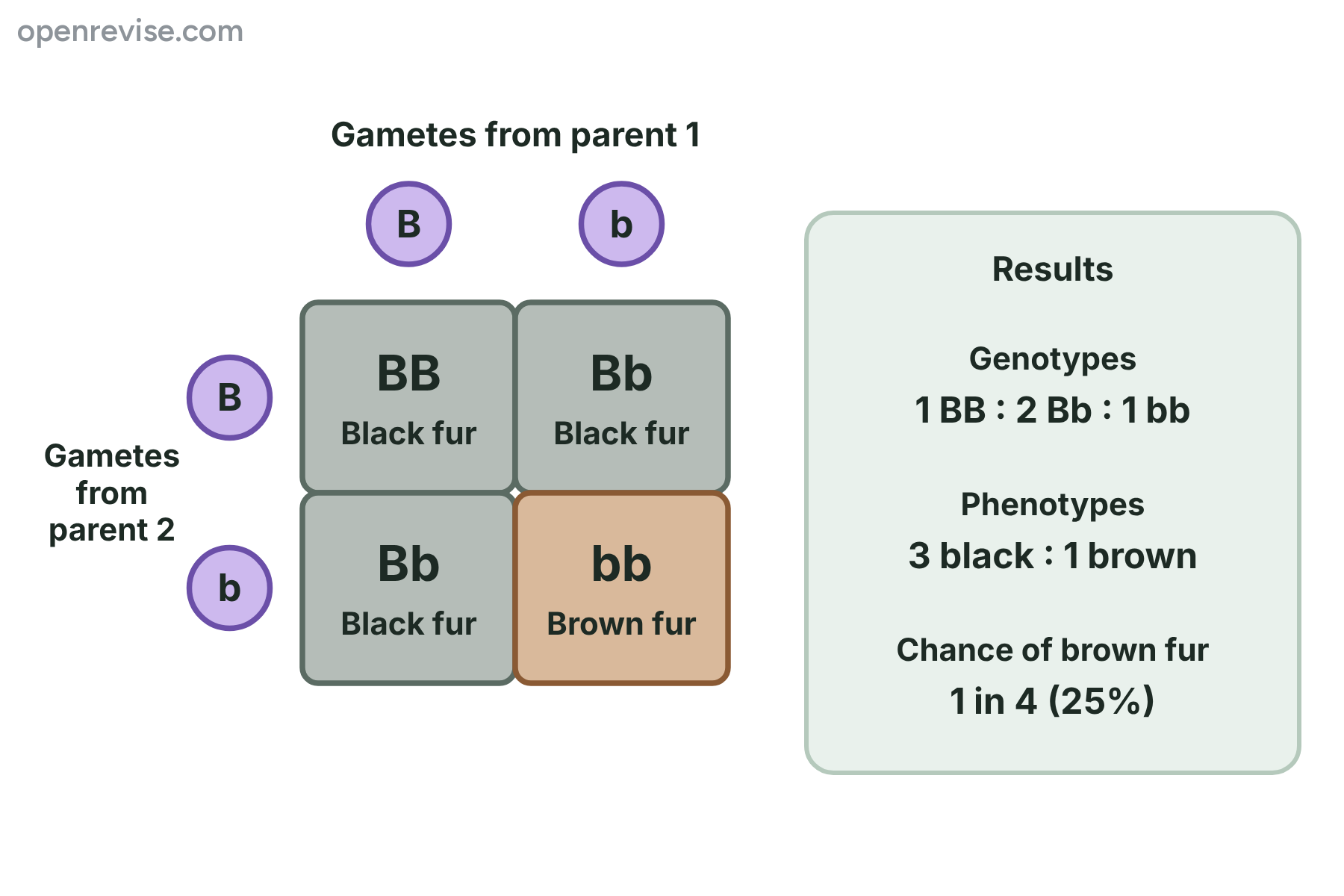
The squares are BB, Bb, Bb and bb. The genotype ratio is 1 BB : 2 Bb : 1 bb. The phenotype ratio is 3 black to 1 brown, so a 25% chance of brown fur.
-
What causes an inherited disorder?
The inheritance of certain alleles from the parents.
-
What is polydactyly?
Having extra fingers or toes, caused by a dominant allele.
-
What is cystic fibrosis?
A disorder of cell membranes caused by a recessive allele.
-
How many copies of the cystic fibrosis allele are needed to have the disorder?
Two.
-
What is a carrier?
A person with one recessive allele who does not have the disorder.
-
Can two parents without cystic fibrosis have a child with it?
Yes, if they are both carriers.
-
What is the chance that two carrier parents have a child with the disorder?
1 in 4, or 25%.
-
What is the chance that two carrier parents have a child who is a carrier?
1 in 2, or 50%.
-
How can you tell from a family tree that a disorder is recessive?
Two unaffected parents have an affected child.
-
What does a shaded symbol on a family tree show?
A person who has the disorder.
-
What do squares and circles mean in a family tree?
Squares are males and circles are females.
-
What is embryo screening?
Testing an embryo for a faulty allele, so only healthy embryos are put in the womb.
-
Name one ethical objection to embryo screening.
Embryos with the faulty allele are destroyed.
-
What is gene therapy?
Modifying the genes in a person's cells to overcome an inherited disorder.
-
Is a dominant disorder always common?
No. A dominant allele can be rare.
-
A family tree shows two unaffected parents with an affected child. Is the allele dominant or recessive, and what are the parents' genotypes?
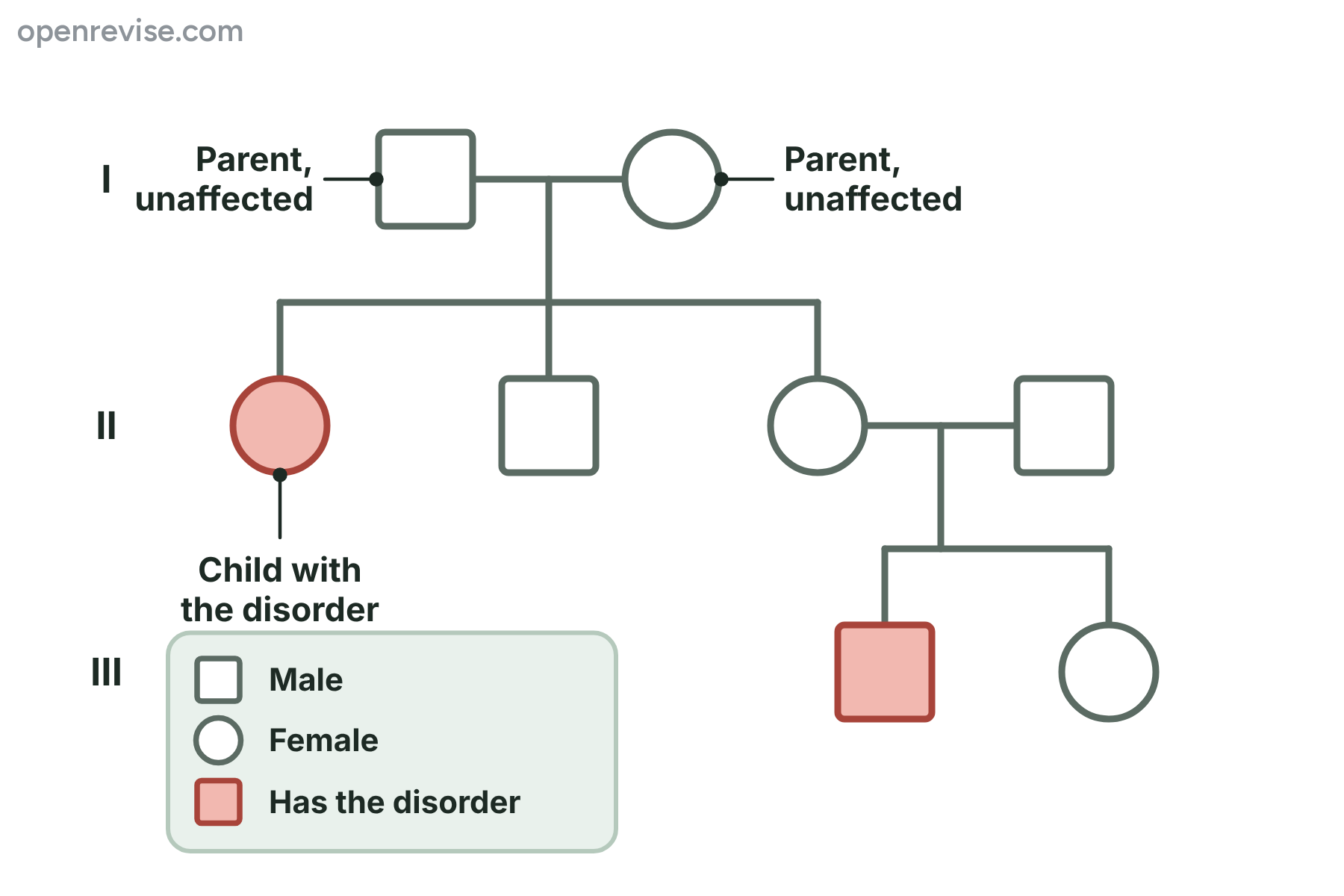
The allele is recessive. Both parents are carriers, so they are both Nn, and the affected child is nn.
-
How many pairs of chromosomes are in a human body cell?
23.
-
How many pairs control characteristics only?
22.
-
What does the 23rd pair carry?
The genes that determine sex.
-
What are the sex chromosomes of a female?
XX.
-
What are the sex chromosomes of a male?
XY.
-
Which chromosome is shorter, X or Y?
Y.
-
Which sex chromosomes do eggs carry?
Every egg carries an X.
-
Which sex chromosomes do sperm carry?
Half carry X and half carry Y.
-
What is the sex of a baby if a Y sperm fertilises the egg?
A boy (XY).
-
What is the sex of a baby if an X sperm fertilises the egg?
A girl (XX).
-
What is the ratio of girls to boys from a genetic cross?
1 : 1.
-
What is the chance that a baby is a girl?
50%, or 1 in 2.
-
A couple have four girls. What is the chance that the next baby is a boy?
50%, because each birth is independent.
-
Who decides the sex of the baby, the mother or the father?
The father, because his sperm carries either X or Y.
-
Why is the 1 : 1 ratio only seen in large populations?
Each fertilisation is a chance event, so small families vary.
-
Draw and complete a Punnett square to show sex inheritance in humans and give the ratio.
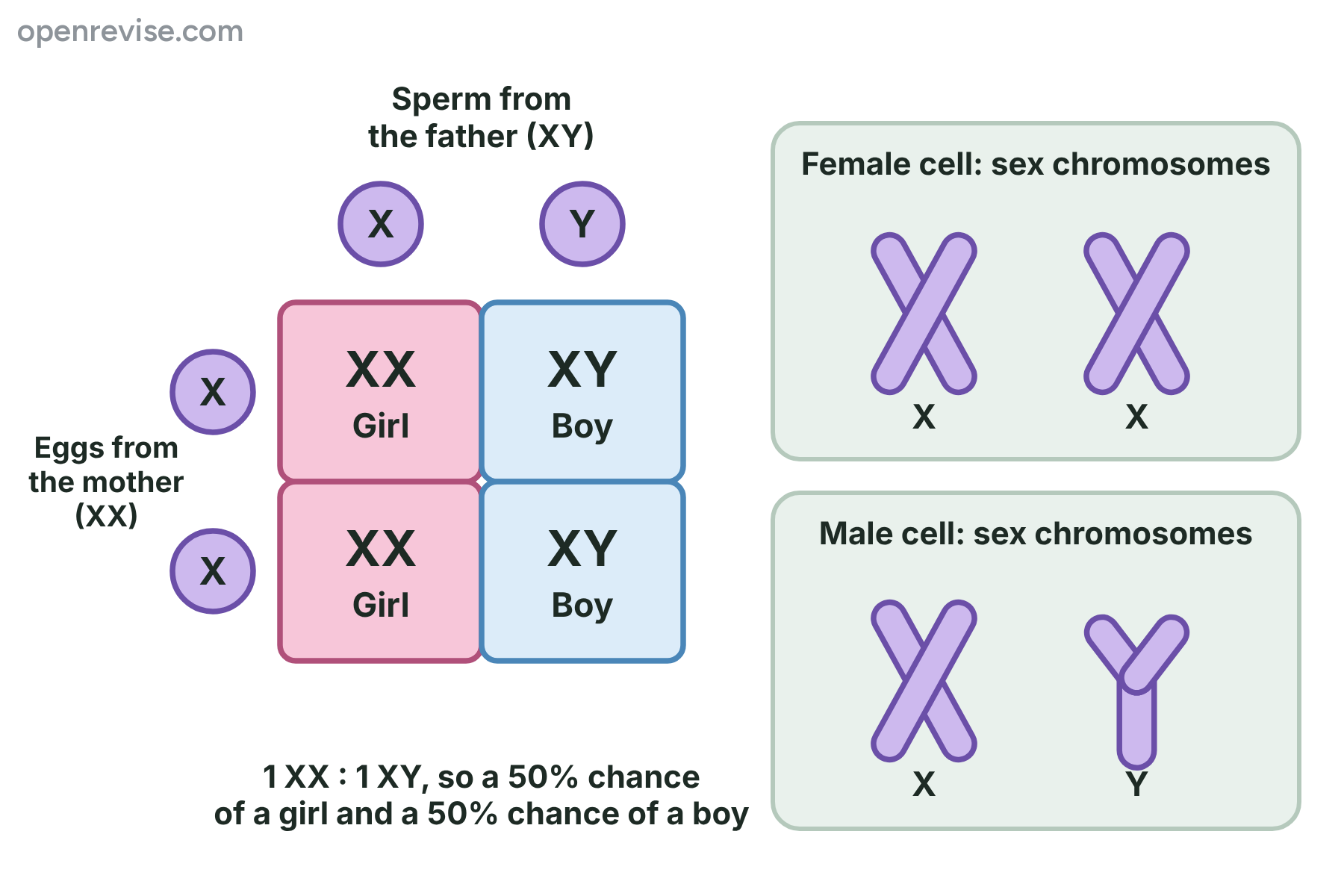
The mother is XX and makes X eggs. The father is XY and makes X and Y sperm. The squares are XX, XY, XX and XY, so the ratio of girls to boys is 1 : 1.