Exam questions · Biology
Genetic Inheritance
- 32 exam questions
- 100 marks
- 32 quick checks
Genes, Alleles and Genetic Terms
Just this lesson-
1 State [2 marks]
State what is meant by the terms allele and genotype.
Show answerHide answer
Model answer
An allele is a different form of the same gene. The genotype is the combination of alleles that an organism has.
Mark scheme
- Allele: a different form of a gene — 1 mark
- Genotype: the alleles present — 1 mark
-
2 Describe [2 marks]
Describe the difference between a dominant allele and a recessive allele.
Show answerHide answer
Model answer
A dominant allele is always expressed, even if only one copy is present. A recessive allele is only expressed if two copies are present.
Mark scheme
- Dominant is expressed with one copy — 1 mark
- Recessive needs two copies — 1 mark
-
3 Give [3 marks]
In sweet peas, the allele for purple flowers (P) is dominant to the allele for white flowers (p). Give the phenotype of a plant with each of the genotypes PP, Pp and pp.
Show answerHide answer
Model answer
PP is purple. Pp is purple. pp is white.
Mark scheme
- PP: purple — 1 mark
- Pp: purple — 1 mark
- pp: white — 1 mark
-
4 Explain [3 marks]
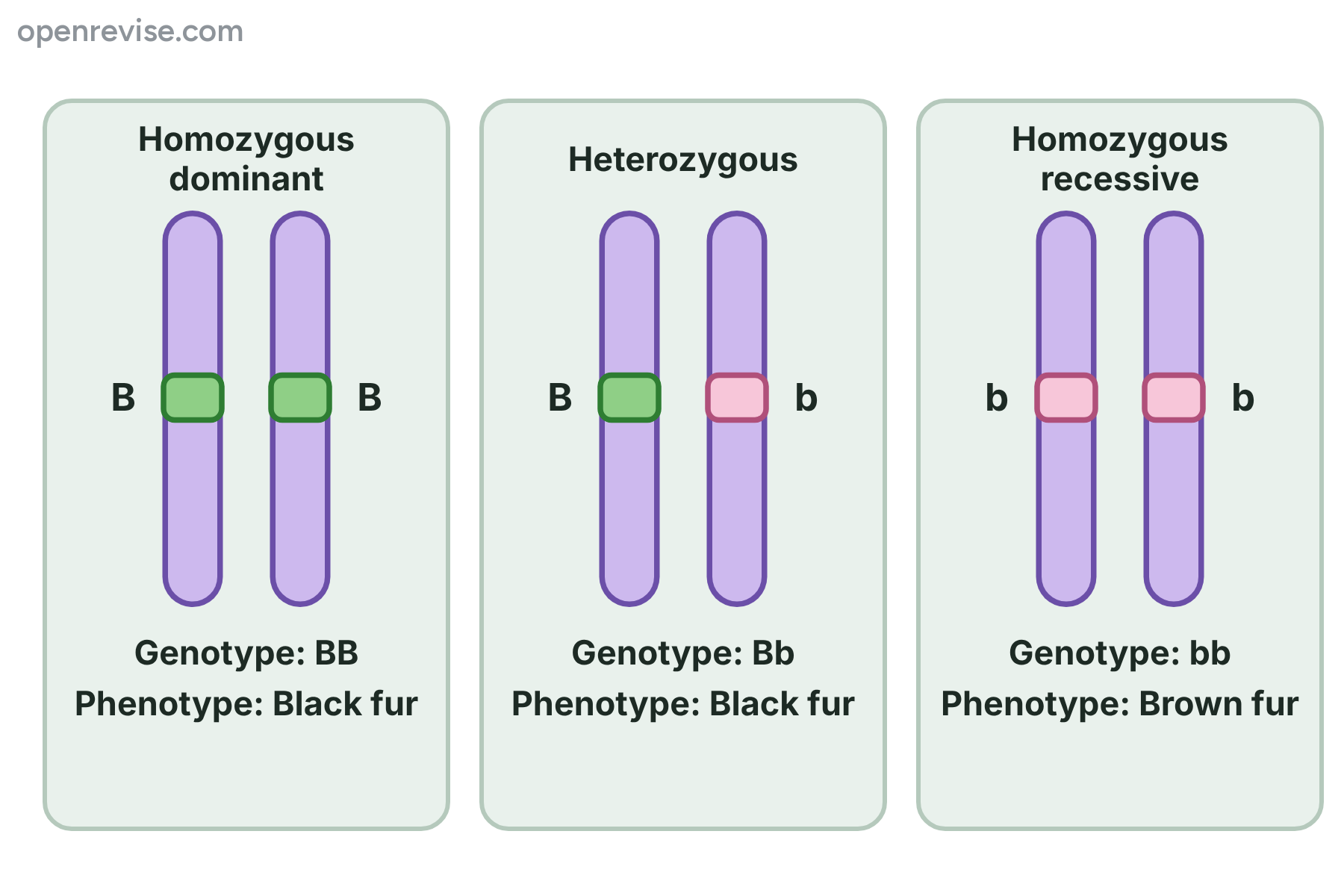
The diagram shows the alleles for fur colour in mice. Explain why the mouse with the genotype Bb has black fur, but the mouse with the genotype bb has brown fur.
Show answerHide answer
Model answer
The allele for black fur (B) is dominant, so it is expressed even when only one copy is present. In Bb there is one B, so the fur is black. The allele for brown fur (b) is recessive, so it is only expressed when two copies are present, as in bb.
Mark scheme
- B is dominant and expressed with one copy — 1 mark
- Bb has one B allele, so black fur — 1 mark
- b is recessive, so only expressed when two copies are present (bb) — 1 mark
-
5 Explain [2 marks]
A student says that a dominant allele is always the most common allele in a population. Explain why the student is wrong.
Show answerHide answer
Model answer
Dominant only means that the allele is expressed when only one copy is present. It says nothing about how common the allele is. A dominant allele can be rare, and a recessive allele can be very common.
Mark scheme
- Dominant refers to expression, not how common — 1 mark
- A dominant allele can be rare (or recessive common) — 1 mark
-
6 Explain [3 marks]
Most human characteristics, such as height, are not controlled by a single gene. Explain why a cross cannot predict a person's height as simply as it can predict fur colour in mice.
Show answerHide answer
Model answer
Height is controlled by many genes interacting, not by one gene with two alleles. The environment, such as diet, also affects height. So the offspring do not fall into simple ratios such as three to one.
Mark scheme
- Height is controlled by many genes — 1 mark
- The environment also affects it — 1 mark
- So no simple ratio can be predicted — 1 mark
-
7 Explain [4 marks]
Two black mice are both heterozygous for fur colour. Explain how they can have a brown offspring. Use the letters B and b in your answer.
Show answerHide answer
Model answer
Each parent has the genotype Bb. Each parent can make gametes carrying B or b. If an egg with b is fertilised by a sperm with b, the offspring has the genotype bb. With no dominant allele present, the recessive allele is expressed, so the offspring has brown fur.
Mark scheme
- Both parents are Bb — 1 mark
- Gametes carry B or b — 1 mark
- A b gamete from each parent gives bb — 1 mark
- No dominant allele, so brown fur is expressed — 1 mark
Quick check
-
1
What is an allele?
Show answerHide answer
C: A different form of a gene
Alleles are the different forms of the same gene.
-
2
Which genotype is homozygous recessive?
Show answerHide answer
D: tt
Homozygous recessive means two copies of the recessive allele, written as two lower case letters.
-
3
A plant has the genotype Gg. Which word describes it?
Show answerHide answer
B: Heterozygous
The two alleles are different, so it is heterozygous.
-
4
When is a recessive allele expressed?
Show answerHide answer
A: When two copies are present
A recessive allele is only expressed when two copies are present, so no dominant allele is there to mask it.
-
5
In mice B is dominant to b. Which genotype gives brown fur?
Show answerHide answer
C: bb
Brown fur is the recessive phenotype, so it needs the genotype bb.
-
6
What does phenotype mean?
Show answerHide answer
D: The characteristic that is expressed
The phenotype is the characteristic that is expressed, such as the colour of fur.
-
7
Which of these is controlled by a single gene?
Show answerHide answer
B: Red-green colour blindness
Red-green colour blindness is an example of a single gene characteristic, whereas height and skin colour involve many genes.
-
8
How many alleles of one gene are in each gamete?
Show answerHide answer
A: One
Gametes have one copy of each chromosome, so one allele of each gene.
Single Gene Crosses and Punnett Squares
Just this lesson-
1 State [2 marks]
State the gametes that can be made by a parent with the genotype Tt, where T is the allele for tall stems and t is the allele for short stems.
Show answerHide answer
Model answer
T and t. Each gamete carries one allele.
Mark scheme
- T — 1 mark
- t — 1 mark
-
2 Complete [4 marks]
In guinea pigs, the allele for rough coat (R) is dominant to the allele for smooth coat (r). Two guinea pigs with the genotype Rr are crossed. Complete a Punnett square and state the genotypes of the offspring.
Show answerHide answer
Model answer
The gametes from each parent are R and r. The squares are RR, Rr, Rr and rr.
Mark scheme
- Gametes R and r from each parent — 1 mark
- RR in one square — 1 mark
- Rr in two squares — 1 mark
- rr in one square — 1 mark
-
3 Give [3 marks]
Two guinea pigs with the genotype Rr are crossed. Give the ratio of rough-coated to smooth-coated offspring, and the percentage chance of an offspring having a smooth coat.
Show answerHide answer
Model answer
The ratio is 3 : 1 (rough to smooth). The chance of a smooth coat is 25%, because only the genotype rr, one square in four, gives a smooth coat.
Mark scheme
- Rough : smooth is 3 : 1 — 1 mark
- Smooth coat needs rr, one square in four — 1 mark
- 25% — 1 mark
-
4 Calculate [3 marks]
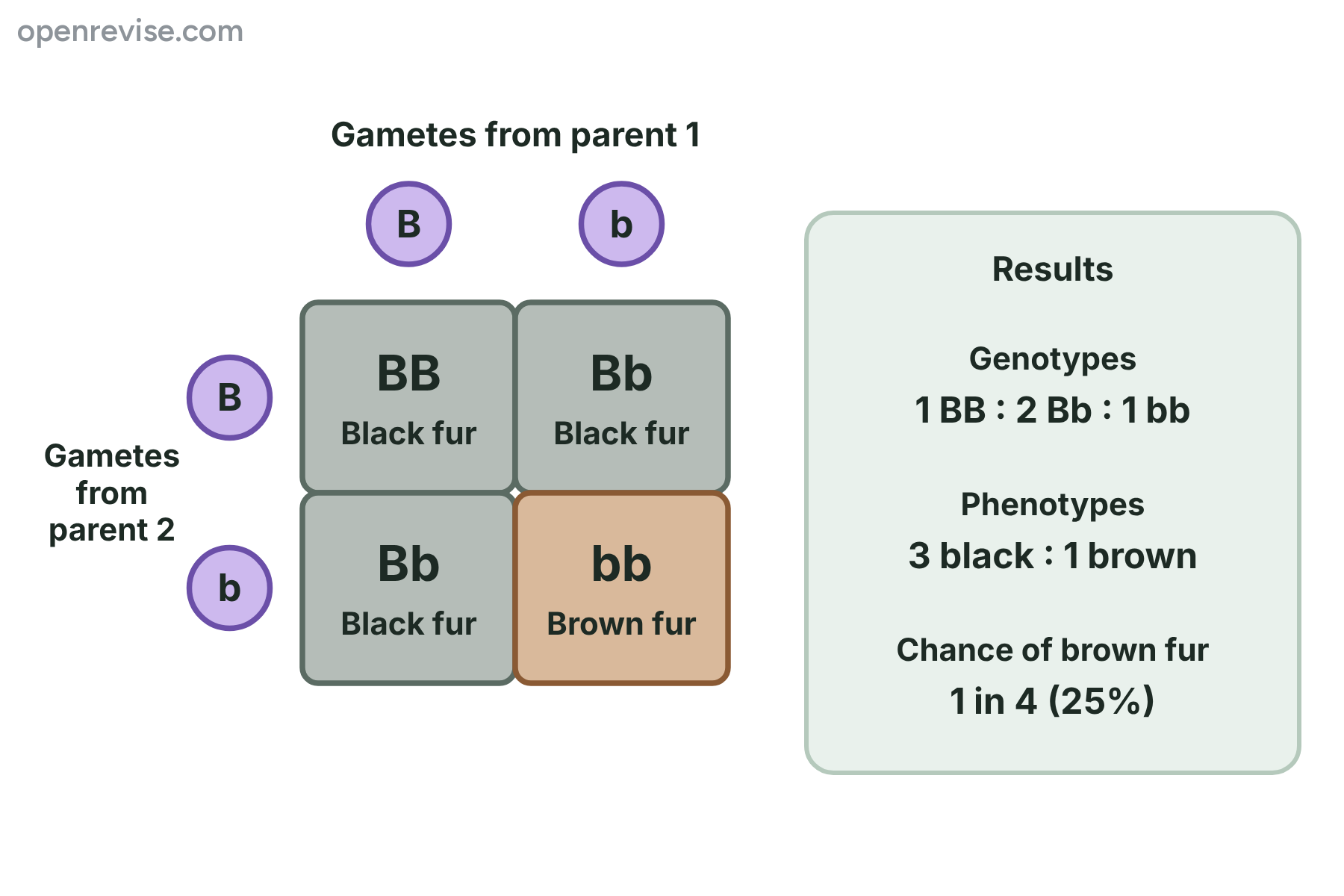
The diagram shows a cross between two black mice. The mice produced 24 offspring. Use the diagram to calculate how many of the 24 offspring you would expect to have brown fur.
Show answerHide answer
Model answer
6 offspring. One in four offspring is expected to be brown (bb), and \(\frac{1}{4} \times 24 = 6\).
Mark scheme
- Chance of brown is \(\frac{1}{4}\) — 1 mark
- \(\frac{1}{4} \times 24\) — 1 mark
- 6 — 1 mark
-
5 Explain [3 marks]
A farmer crossed two Bb black mice and got a litter of four, in which two were brown. A student says that the Punnett square must be wrong because it predicts a 3 : 1 ratio. Explain why the student is wrong.
Show answerHide answer
Model answer
A Punnett square only predicts probabilities. Each fertilisation is a separate chance event, so with only four offspring the result can easily differ from the expected ratio. The 3 : 1 ratio would only be seen on average over a large number of offspring.
Mark scheme
- It only predicts probabilities — 1 mark
- Each fertilisation is a chance event — 1 mark
- A small number of offspring need not match the ratio — 1 mark
-
6 Explain [4 marks]
A black mouse is crossed with a brown mouse. Brown fur (b) is recessive to black fur (B). All of the offspring are black. Use a Punnett square to explain what the genotype of the black parent is.
Show answerHide answer
Model answer
The brown parent is bb, so every gamete it makes carries b. If the black parent was Bb, about half of the offspring would be bb and brown, which did not happen. All of the offspring are black, so the black parent only makes B gametes and is homozygous dominant, BB. Every offspring is then Bb.
Mark scheme
- The brown parent is bb and only makes b gametes — 1 mark
- A Bb parent would give about half brown offspring — 1 mark
- All offspring are black, so the black parent only makes B gametes — 1 mark
- The black parent is BB and all offspring are Bb — 1 mark
-
7 Calculate [4 marks]
Two black mice, both with the genotype Bb, have two offspring. Calculate the probability that both of the offspring have brown fur. Show your working.
Show answerHide answer
Model answer
The chance that one offspring has brown fur (bb) is \(\frac{1}{4}\). Each fertilisation is independent, so the probability that both are brown is \(\frac{1}{4} \times \frac{1}{4} = \frac{1}{16}\), which is 0.0625 or 6.25%.
Mark scheme
- Chance of one brown offspring is \(\frac{1}{4}\) — 1 mark
- Events are independent so multiply — 1 mark
- \(\frac{1}{4} \times \frac{1}{4} = \frac{1}{16}\) — 1 mark
- 0.0625 or 6.25% (any equivalent form) — 1 mark
-
8 Explain [5 marks]
A breeder has a black mouse and does not know whether its genotype is BB or Bb. The breeder crosses it with a brown mouse and gets eight offspring, four black and four brown. Draw a Punnett square for the cross and explain what the result shows about the genotype of the black mouse.
Show answerHide answer
Model answer
The brown mouse is bb and only makes b gametes. If the black mouse was BB, every offspring would be Bb and black. Four brown offspring (bb) means that the black mouse must have passed on a b allele, so it is Bb. A Bb x bb cross gives Bb, Bb, bb and bb, which is a 1 : 1 ratio and matches four black and four brown.
Mark scheme
- Brown parent is bb and makes only b gametes — 1 mark
- Correct Punnett square for Bb x bb — 1 mark
- BB would give all black offspring — 1 mark
- Brown offspring (bb) means the black parent has a b allele — 1 mark
- So the black mouse is Bb, giving a 1 : 1 ratio — 1 mark
Quick check
-
1
What gametes does a parent with the genotype Aa make?
Show answerHide answer
B: A and a
The two alleles separate, so half of the gametes carry A and half carry a.
-
2
In a cross between two Bb parents, what proportion of the offspring are expected to be bb?
Show answerHide answer
C: One quarter
One of the four squares in the Punnett square is bb, so one quarter.
-
3
Two heterozygous parents are crossed. What is the expected ratio of the dominant to the recessive phenotype?
Show answerHide answer
D: 3 : 1
The squares are BB, Bb, Bb and bb, so three show the dominant phenotype for every one that shows the recessive phenotype.
-
4
A cross between Bb and bb is carried out. What percentage of the offspring are expected to be bb?
Show answerHide answer
A: 50%
Two of the four squares are bb, so 50%.
-
5
A couple have three children with a recessive disorder. What is the chance that their fourth child will have it?
Show answerHide answer
B: The same as for each earlier child
Each fertilisation is independent, so the chance is the same as for any other child, such as 1 in 4 if both parents are carriers.
-
6
Which statement about a Punnett square is correct?
Show answerHide answer
C: It shows the probability of each outcome
A Punnett square gives the probability of each outcome, not what will definitely happen.
-
7
Two black mice have a brown offspring. What are the genotypes of the parents?
Show answerHide answer
D: Bb and Bb
The brown offspring is bb, so each parent passed on a b, and as both parents are black they must each be Bb.
-
8
Two independent events each have a probability of one quarter. What is the probability that both happen?
Show answerHide answer
A: One sixteenth
The probabilities are multiplied: one quarter times one quarter is one sixteenth.
Inherited Disorders and Family Trees
Just this lesson-
1 Name [2 marks]
Name one inherited disorder caused by a dominant allele and one inherited disorder caused by a recessive allele.
Show answerHide answer
Model answer
Polydactyly is caused by a dominant allele. Cystic fibrosis is caused by a recessive allele.
Mark scheme
- Polydactyly (dominant) — 1 mark
- Cystic fibrosis (recessive) — 1 mark
-
2 Explain [3 marks]
Two parents do not have cystic fibrosis, but they have a child who does. Explain how this is possible.
Show answerHide answer
Model answer
Cystic fibrosis is caused by a recessive allele. Both parents have one copy of the recessive allele, so they are carriers and do not have the disorder. Each parent passed on the recessive allele to the child, who has two copies.
Mark scheme
- The allele is recessive — 1 mark
- Both parents are carriers, with one recessive allele each — 1 mark
- The child inherited a recessive allele from each parent — 1 mark
-
3 Calculate [3 marks]
Both parents are carriers of the cystic fibrosis allele. Draw a Punnett square for the cross and give the probability that their child will have cystic fibrosis. Use C for the normal allele and c for the cystic fibrosis allele.
Show answerHide answer
Model answer
The gametes are C and c from each parent. The squares are CC, Cc, Cc and cc. Only cc has cystic fibrosis, so the probability is 1 in 4 (0.25 or 25%).
Mark scheme
- Gametes C and c from each parent — 1 mark
- Squares CC, Cc, Cc, cc — 1 mark
- Probability 1 in 4 — 1 mark
-
4 Explain [3 marks]
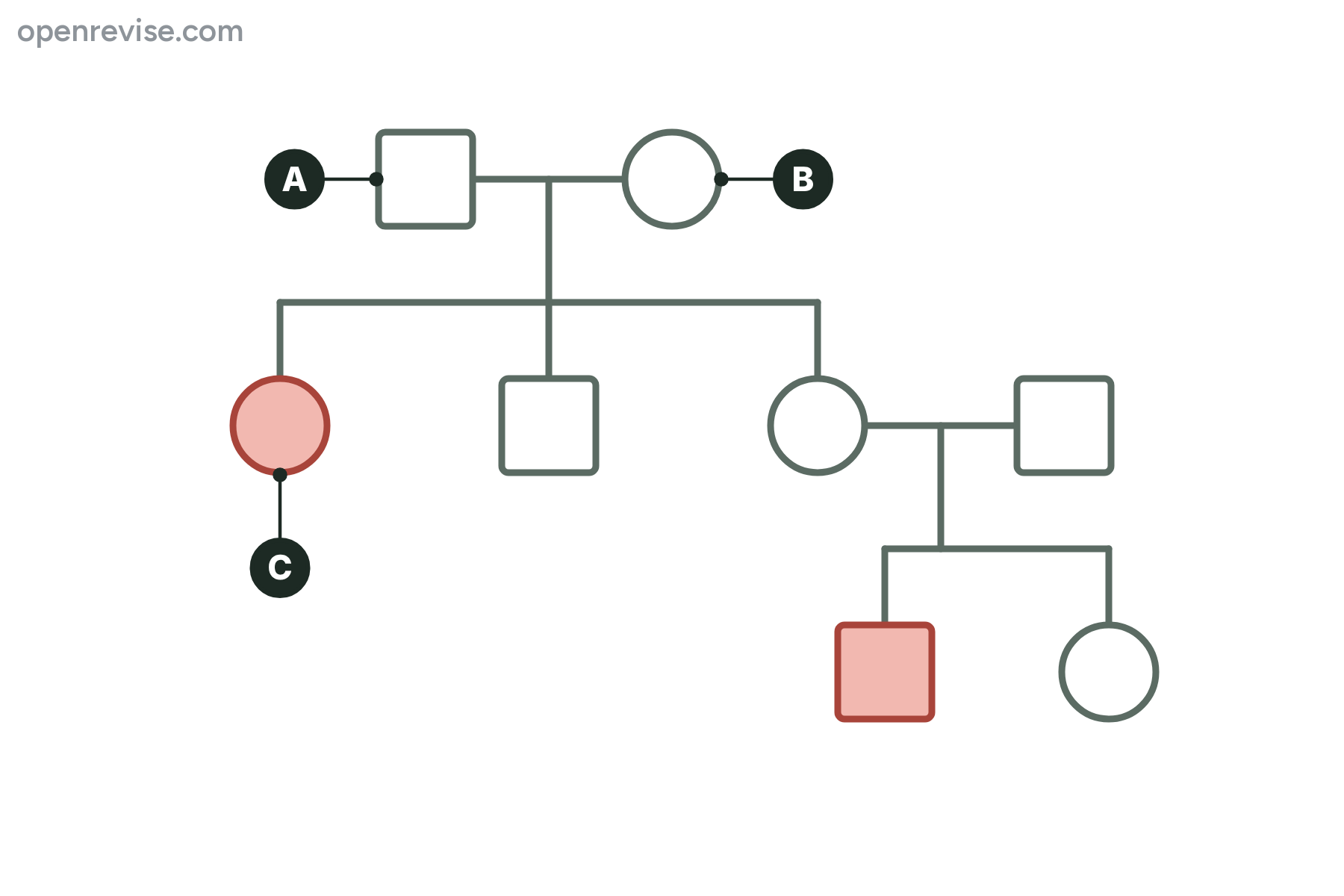
The family tree shows a disorder. A and B do not have the disorder, but their daughter C does. Explain what this shows about the allele that causes the disorder.
Show answerHide answer
Model answer
The allele is recessive. If it was dominant, C would have had to inherit it from A or B, and that parent would have the disorder. A and B are both carriers, and C inherited a recessive allele from each of them.
Mark scheme
- The allele is recessive — 1 mark
- Parents are unaffected, so a dominant allele could not have been passed on — 1 mark
- A and B are carriers and each passed on a recessive allele to C — 1 mark
-
5 Calculate [3 marks]
A woman with polydactyly has the genotype Dd. Her partner does not have polydactyly. The allele for polydactyly (D) is dominant to the normal allele (d). Calculate the percentage chance that their first child has polydactyly.
Show answerHide answer
Model answer
50%. The partner is dd, so the squares are Dd, Dd, dd and dd, and two out of four give the dominant phenotype.
Mark scheme
- The partner is dd — 1 mark
- Two squares in four have a D allele — 1 mark
- 50% — 1 mark
-
6 Describe [3 marks]
Describe how embryo screening can be used to avoid the birth of a baby with a serious inherited disorder.
Show answerHide answer
Model answer
Eggs are fertilised by IVF and the embryos are allowed to grow to a small ball of cells. One cell is taken from each embryo and tested for the faulty allele. Only embryos that do not have the allele are put into the mother's womb.
Mark scheme
- Embryos made by IVF — 1 mark
- A cell is removed and tested for the allele — 1 mark
- Only embryos without the faulty allele are implanted — 1 mark
-
7 Evaluate [6 marks]
Evaluate the use of embryo screening for couples who are both carriers of the cystic fibrosis allele. Use the economic, social and ethical issues in your answer.
Show answerHide answer
Model answer
Embryo screening allows a couple to have a baby who does not have cystic fibrosis, which avoids the suffering of the child and of the family, and the cost of lifelong treatment (an economic and social benefit). It avoids the need to terminate an affected pregnancy. However, embryos with the allele are destroyed, which some people believe is wrong because an embryo is a potential human life (an ethical issue). IVF is expensive, is not always successful and can be stressful. There is also concern that screening could be extended to choose other features. Overall, the benefit of preventing a serious disorder can outweigh these objections for many couples, but the final decision depends on the beliefs of the people involved.
Mark scheme
- A benefit such as a healthy child and less suffering — 1 mark
- Economic point such as the cost of lifelong treatment or the cost of IVF — 1 mark
- Social point such as the effect on the family — 1 mark
- Ethical objection such as destruction of embryos — 1 mark
- A further objection or limitation such as designer babies or IVF failing — 1 mark
- A reasoned conclusion that weighs both sides — 1 mark
-
8 Explain [4 marks]
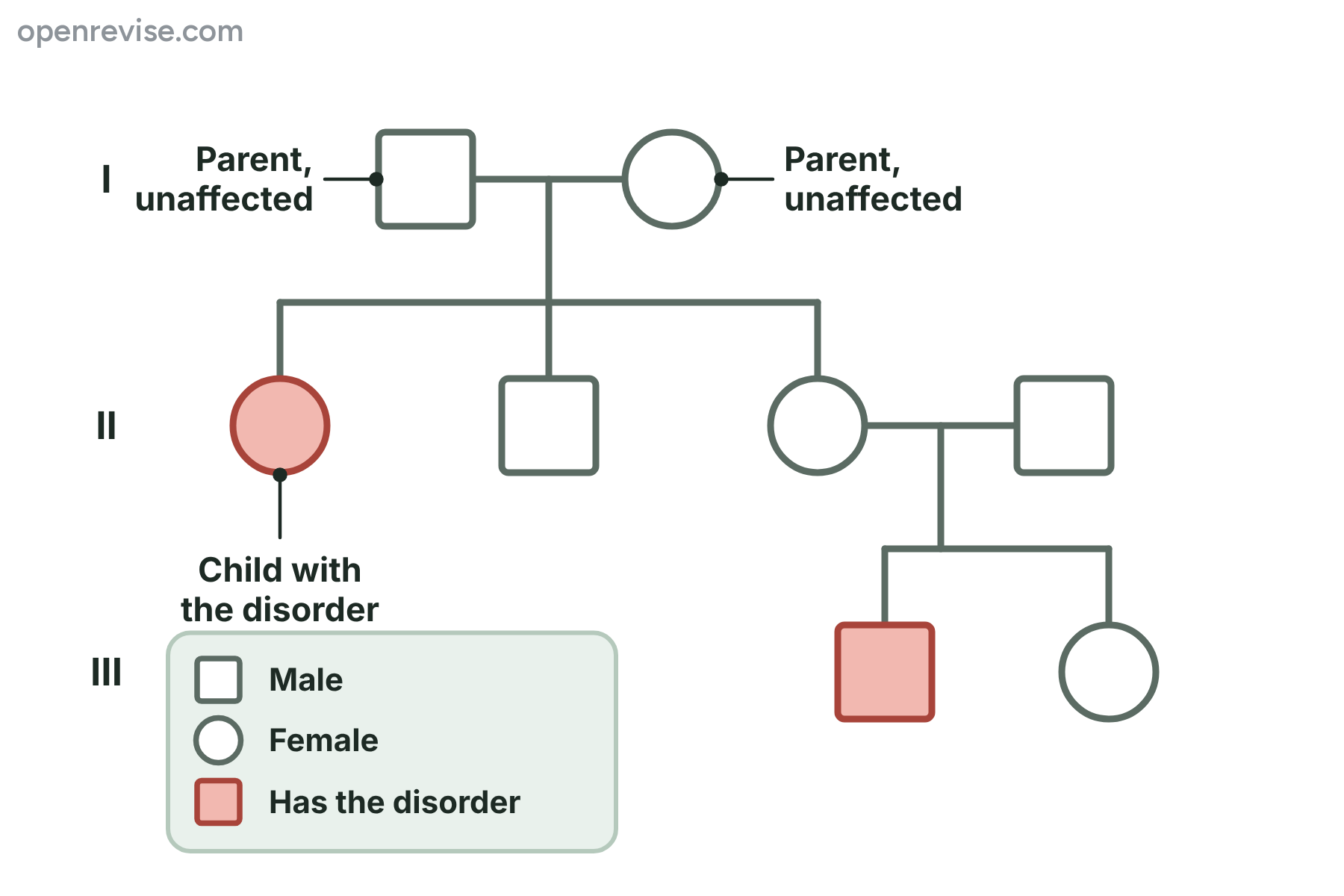
The family tree shows the inheritance of a recessive disorder. Let N be the normal allele and n be the allele for the disorder. Give the genotypes of the two parents in generation I and of their daughter with the disorder, and explain your answers.
Show answerHide answer
Model answer
The daughter has the disorder, which is recessive, so she is nn. She got one n from each parent. The parents do not have the disorder, so each also has a normal allele, so both parents are Nn.
Mark scheme
- Daughter is nn — 1 mark
- She inherited one n from each parent — 1 mark
- Parents do not have the disorder so each has an N allele — 1 mark
- Both parents are Nn — 1 mark
-
9 Calculate [4 marks]
The woman in generation II who is joined to the unaffected man has a shaded son. The disorder is recessive. Explain why both she and her partner must be carriers, then calculate the probability that their next child will have the disorder.
Show answerHide answer
Model answer
Their son has the disorder, so he is nn and inherited an n allele from each parent. As neither parent has the disorder, each must also have an N allele, so both are Nn. A cross of Nn with Nn gives NN, Nn, Nn and nn, so the probability that the next child has the disorder is 1 in 4, or 25%.
Mark scheme
- Son is nn, so each parent passed on n — 1 mark
- Parents do not have the disorder so both are Nn — 1 mark
- Correct cross Nn x Nn — 1 mark
- Probability 1 in 4 (25%) — 1 mark
Quick check
-
1
Which inherited disorder is caused by a dominant allele?
Show answerHide answer
C: Polydactyly
Polydactyly is caused by a dominant allele, whereas cystic fibrosis is caused by a recessive allele.
-
2
What does cystic fibrosis affect?
Show answerHide answer
B: Cell membranes
Cystic fibrosis is a disorder of cell membranes, producing thick sticky mucus.
-
3
What is a carrier of a recessive disorder?
Show answerHide answer
D: Someone with one recessive allele who does not have the disorder
A carrier has one recessive allele and one dominant allele, so does not have the disorder but can pass the allele on.
-
4
Two carriers of cystic fibrosis have a child. What is the probability that the child has the disorder?
Show answerHide answer
A: 1 in 4
The cross Cc x Cc gives CC, Cc, Cc and cc, so one in four have cc.
-
5
In a family tree, two unaffected parents have an affected child. What does this show?
Show answerHide answer
B: The allele is recessive
The disorder must be recessive, and both parents must be carriers.
-
6
What does a circle on a family tree represent?
Show answerHide answer
C: A female
Circles are females and squares are males.
-
7
Which statement about embryo screening is correct?
Show answerHide answer
D: It tests embryos made by IVF for a faulty allele
In embryo screening, cells are tested for a faulty allele and only embryos without it are implanted.
-
8
A man with polydactyly (Dd) and a woman without it (dd) have a child. What is the chance that the child has polydactyly?
Show answerHide answer
A: 50%
The cross Dd x dd gives two Dd and two dd, so 50% have polydactyly.
Sex Determination
Just this lesson-
1 State [2 marks]
State the sex chromosomes found in an ordinary human body cell from a female and from a male.
Show answerHide answer
Model answer
A female has two X chromosomes (XX). A male has one X and one Y chromosome (XY).
Mark scheme
- Female: XX — 1 mark
- Male: XY — 1 mark
-
2 Describe [2 marks]
Ordinary human body cells contain 23 pairs of chromosomes. Describe the job of the 23 pairs of chromosomes.
Show answerHide answer
Model answer
22 pairs control characteristics only. One pair carries the genes that determine sex.
Mark scheme
- 22 pairs control characteristics only — 1 mark
- One pair determines sex — 1 mark
-
3 Name [2 marks]
The diagram shows how the sex of a baby is inherited. State the sex chromosomes carried by every egg, and by the sperm.
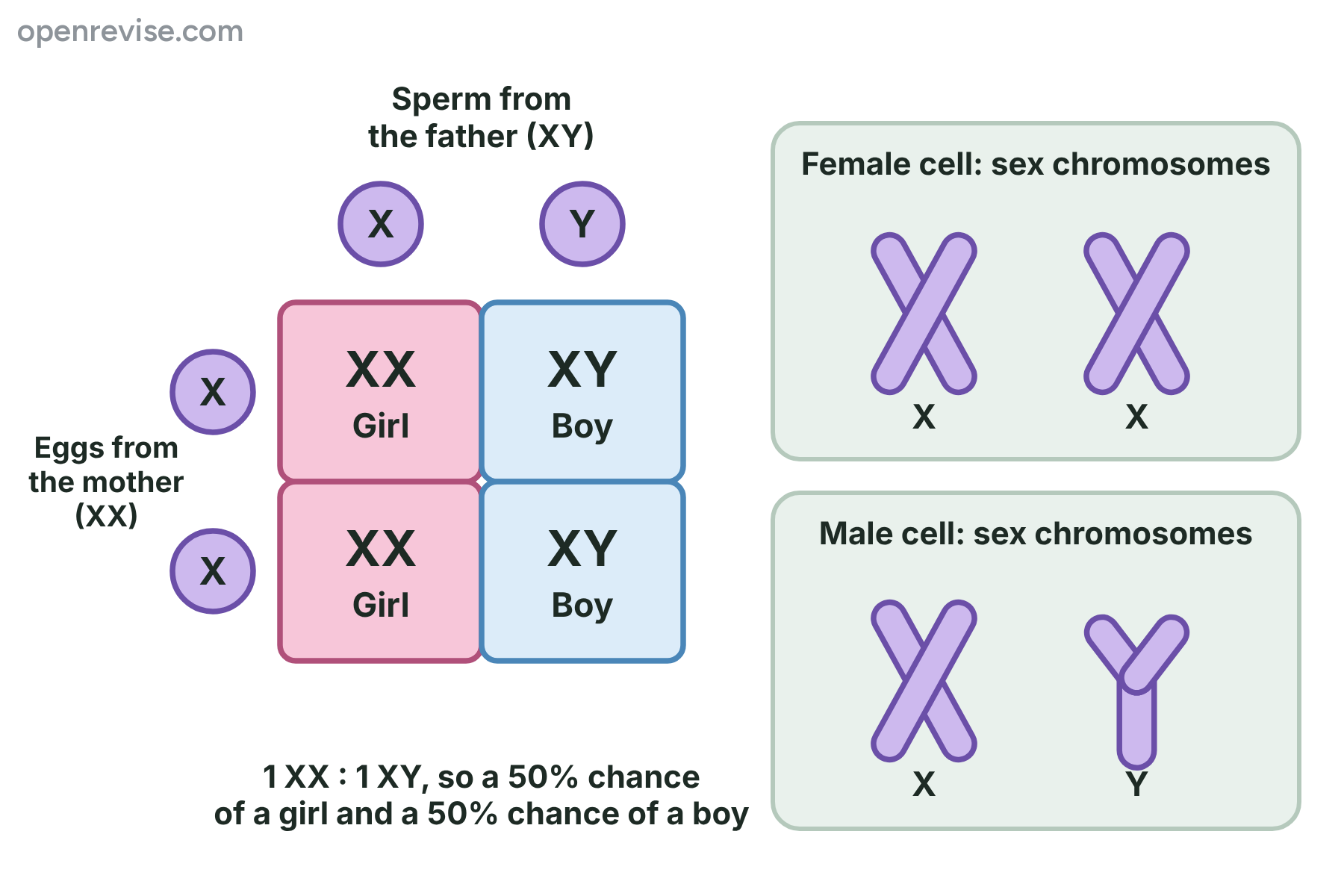
Show answerHide answer
Model answer
Every egg carries an X chromosome. Half of the sperm carry an X chromosome and half carry a Y chromosome.
Mark scheme
- Every egg carries X — 1 mark
- Sperm carry X or Y — 1 mark
-
4 Explain [3 marks]
Explain why the father, and not the mother, determines the sex of a baby.
Show answerHide answer
Model answer
The mother is XX, so every egg she makes carries an X chromosome. The father is XY, so half of his sperm carry an X and half carry a Y. The sperm that fertilises the egg decides whether the baby is XX (a girl) or XY (a boy).
Mark scheme
- Mother's eggs all carry X — 1 mark
- Sperm carry X or Y — 1 mark
- The sperm that fertilises the egg decides the sex — 1 mark
-
5 Calculate [2 marks]
In one year 2 400 babies were born in a town. Use the sex ratio from a genetic cross to estimate how many of the babies were boys.
Show answerHide answer
Model answer
1 200 boys. The ratio of girls to boys is 1 : 1, so half of the babies are boys, and \(\frac{1}{2} \times 2400 = 1200\).
Mark scheme
- Ratio 1 : 1, so half are boys — 1 mark
- 1 200 — 1 mark
-
6 Explain [3 marks]
A couple have five daughters and are expecting a sixth child. The father says, "It must be a boy this time." Explain why he is wrong.
Show answerHide answer
Model answer
Each baby is the result of a separate fertilisation. The chance that the sperm which fertilises the egg carries a Y chromosome is the same every time, 50%. So the sixth child still has a 50% chance of being a girl.
Mark scheme
- Each fertilisation is a separate event — 1 mark
- The chance is 50% every time — 1 mark
- Earlier children do not change the chance — 1 mark
-
7 Describe [4 marks]
Use a genetic cross to show how sex is inherited in humans.
Show answerHide answer
Model answer
The mother is XX, so she makes only X eggs. The father is XY, so he makes X sperm and Y sperm. The Punnett square gives XX, XY, XX and XY. XX is female and XY is male, so the ratio of girls to boys is 1 : 1, or a 50% chance of each.
Mark scheme
- Mother XX and father XY — 1 mark
- Gametes X, X and X, Y — 1 mark
- Offspring XX, XY, XX, XY — 1 mark
- Ratio 1 : 1 (50% girls and 50% boys) — 1 mark
-
8 Explain [4 marks]
In a family with four children, the ratio of girls to boys was 3 : 1. In a country with 20 million births, the ratio was almost exactly 1 : 1. Explain these results.
Show answerHide answer
Model answer
The ratio from a genetic cross is 1 : 1, but each fertilisation is a separate chance event with a 50% chance of a girl. In a family with only four children, chance variation can easily give a different ratio such as 3 : 1. In a population of 20 million births the chance variation is much smaller relative to the total, so the ratio is very close to the expected 1 : 1.
Mark scheme
- Expected ratio is 1 : 1 — 1 mark
- Each fertilisation is a chance event — 1 mark
- With small numbers, chance can give a different ratio — 1 mark
- With very large numbers the ratio is close to the expected one — 1 mark
Quick check
-
1
How many pairs of chromosomes in a human body cell carry the genes that determine sex?
Show answerHide answer
A: One
One of the 23 pairs carries the genes that determine sex. The other 22 pairs control characteristics only.
-
2
Which pair of sex chromosomes does a human male have?
Show answerHide answer
C: XY
Males have one X and one Y chromosome.
-
3
Which sex chromosome is carried by every egg cell?
Show answerHide answer
B: X
The mother is XX, so every egg carries an X chromosome.
-
4
A sperm cell carrying a Y chromosome fertilises an egg. What is the sex of the baby?
Show answerHide answer
D: A boy
The baby is XY, so a boy.
-
5
What is the expected ratio of girls to boys from a genetic cross?
Show answerHide answer
A: 1 : 1
The Punnett square gives two XX to two XY, which simplifies to 1 : 1.
-
6
A couple have had three sons. What is the chance that their next child is a daughter?
Show answerHide answer
C: 50%
Each fertilisation is independent, so the chance is 50% every time.
-
7
Why can a very large population have almost equal numbers of males and females even though a single family may not?
Show answerHide answer
B: Because chance variation averages out in large numbers
Each birth is a chance event with a 50% probability, and the effect of chance averages out over large numbers.
-
8
Which statement about human chromosomes is correct?
Show answerHide answer
D: 22 pairs control characteristics only
22 of the 23 pairs control characteristics only, and the last pair determines sex.