Flashcards · Biology
Homeostasis and the Nervous System
-
What is homeostasis?
The regulation of the internal conditions of a cell or organism to maintain optimum conditions for function.
-
Name three conditions that the body controls.
Body temperature, blood glucose concentration and water content.
-
At what temperature is the human body kept?
About 37 °C.
-
Why must body temperature stay constant?
Enzymes work best at an optimum temperature.
-
What happens to enzymes if the body gets too hot?
They denature and stop working.
-
What does a receptor do?
Detects a change in a condition.
-
What does a coordination centre do?
Receives the information and decides on the response.
-
What does an effector do?
Carries out the response.
-
Give two examples of coordination centres.
The brain and the pancreas.
-
What is negative feedback? (Higher tier)
A response that reverses a change and brings the condition back to normal.
-
What happens if the condition is too high in negative feedback? (Higher tier)
The response makes it fall.
-
What happens if the condition is too low in negative feedback? (Higher tier)
The response makes it rise.
-
Why is the water content of the blood controlled?
Osmosis would make cells gain or lose water.
-
Why is blood glucose controlled?
Cells need a supply of glucose for respiration.
-
Is homeostasis automatic?
Yes, you do not have to think about it.
-
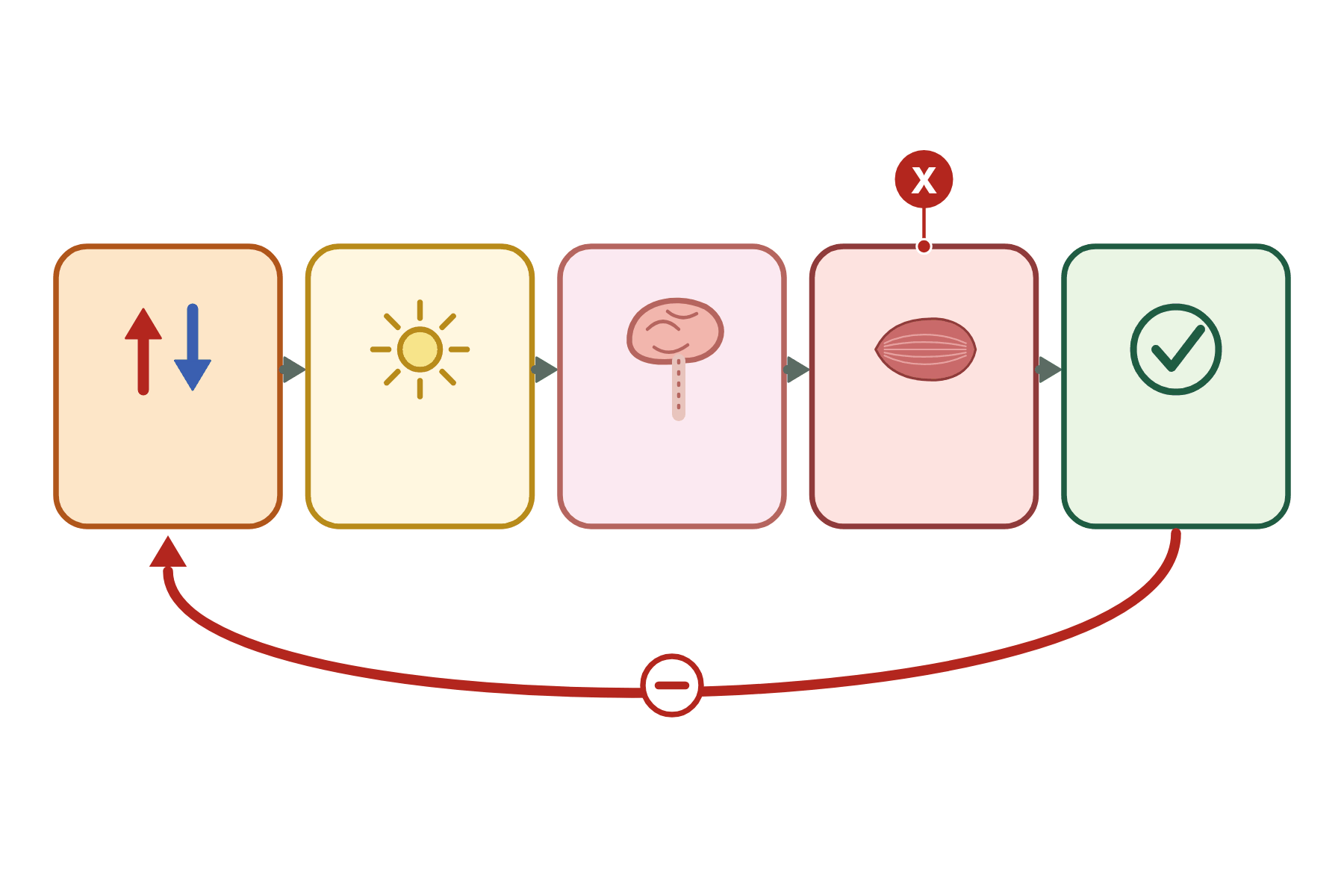 Name the part of the control system marked X.
 The effector. It carries out the response, such as a muscle contracting or a gland releasing a chemical.
-
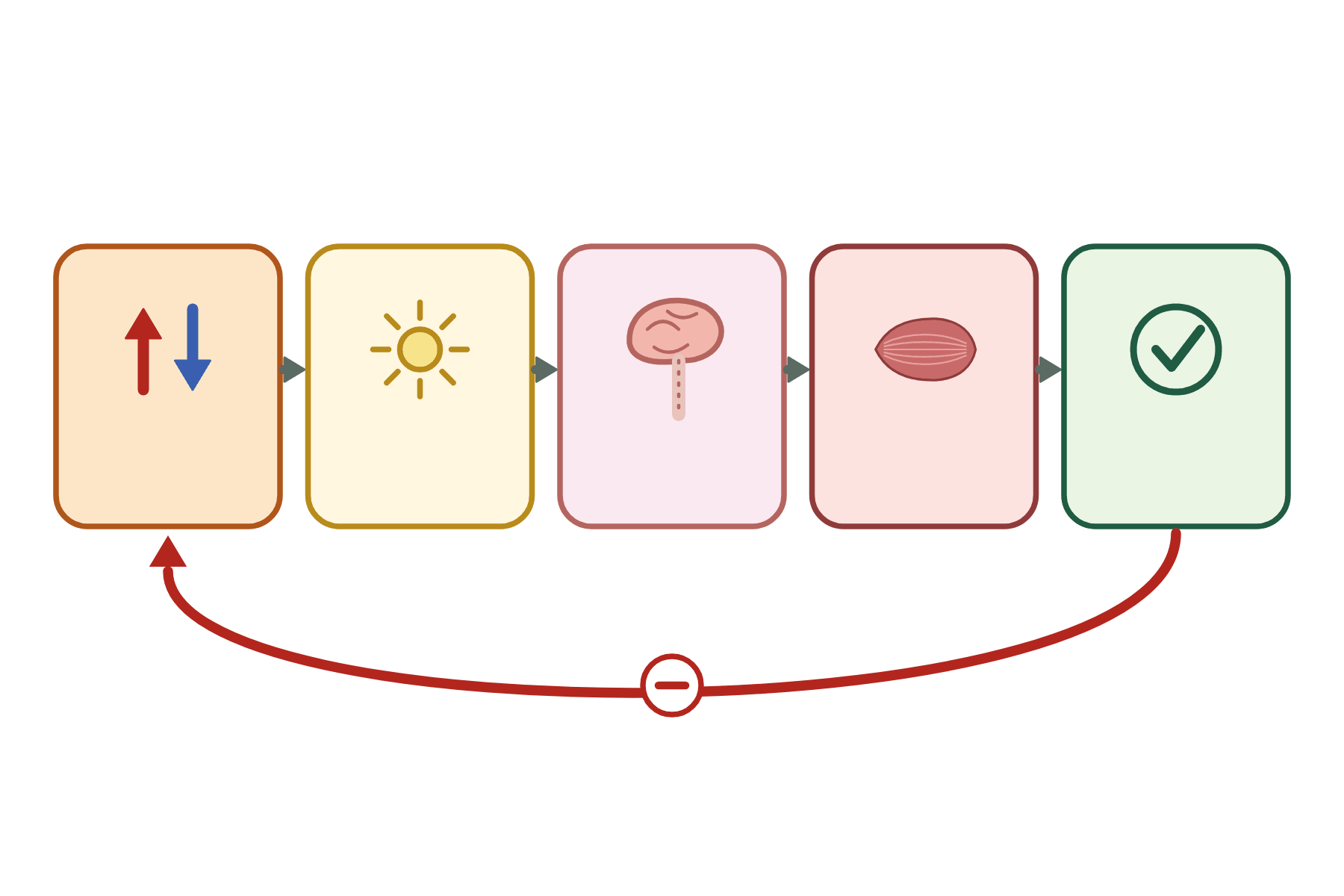 Name each stage of a negative feedback loop.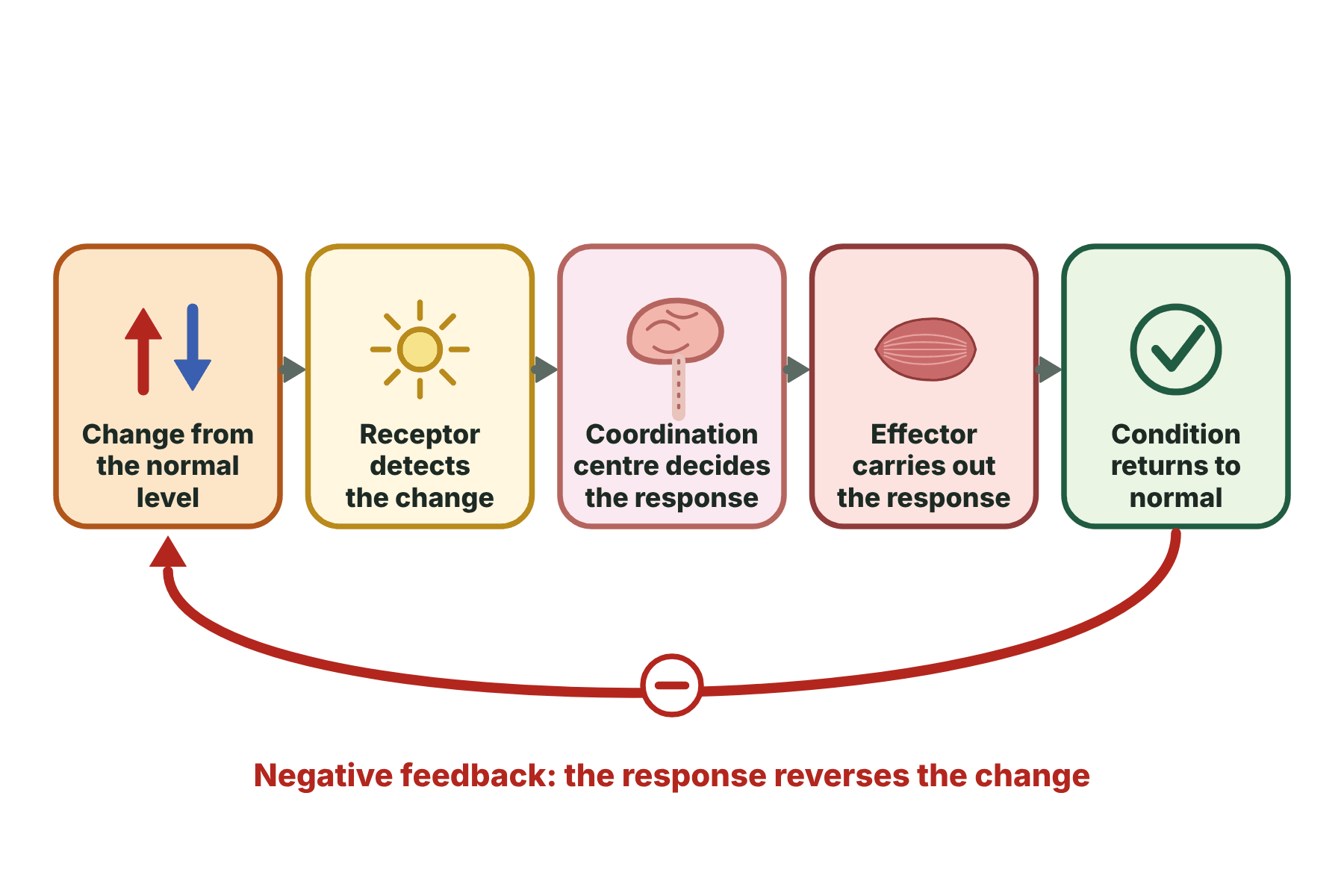
Change from normal, receptor, coordination centre, effector, return to normal. The response reverses the change, which is negative feedback.
-
What is a stimulus?
A change in the surroundings that can be detected.
-
What does a receptor do?
It detects a stimulus and changes it into an electrical impulse.
-
What is an effector?
A muscle or a gland that carries out a response.
-
What is the central nervous system?
The brain and the spinal cord.
-
What does a sensory neurone do?
Carries impulses from a receptor to the central nervous system.
-
What does a relay neurone do?
Carries impulses inside the central nervous system.
-
What does a motor neurone do?
Carries impulses from the central nervous system to an effector.
-
What is the axon?
The long fibre that carries the impulse away from the cell body.
-
What does the myelin sheath do?
Insulates the axon and makes the impulse travel faster.
-
What are dendrites?
Short branches that receive impulses.
-
What is a synapse?
A small gap between two neurones.
-
How does the signal cross a synapse?
Neurotransmitters diffuse across the gap and start a new impulse.
-
Why can impulses only pass one way across a synapse?
The neurotransmitter is released from one side only.
-
Name the two types of effector.
Muscles and glands.
-
Why is the response of the nervous system coordinated?
Nerves reach every part of the body, with many links and many types of receptor.
-
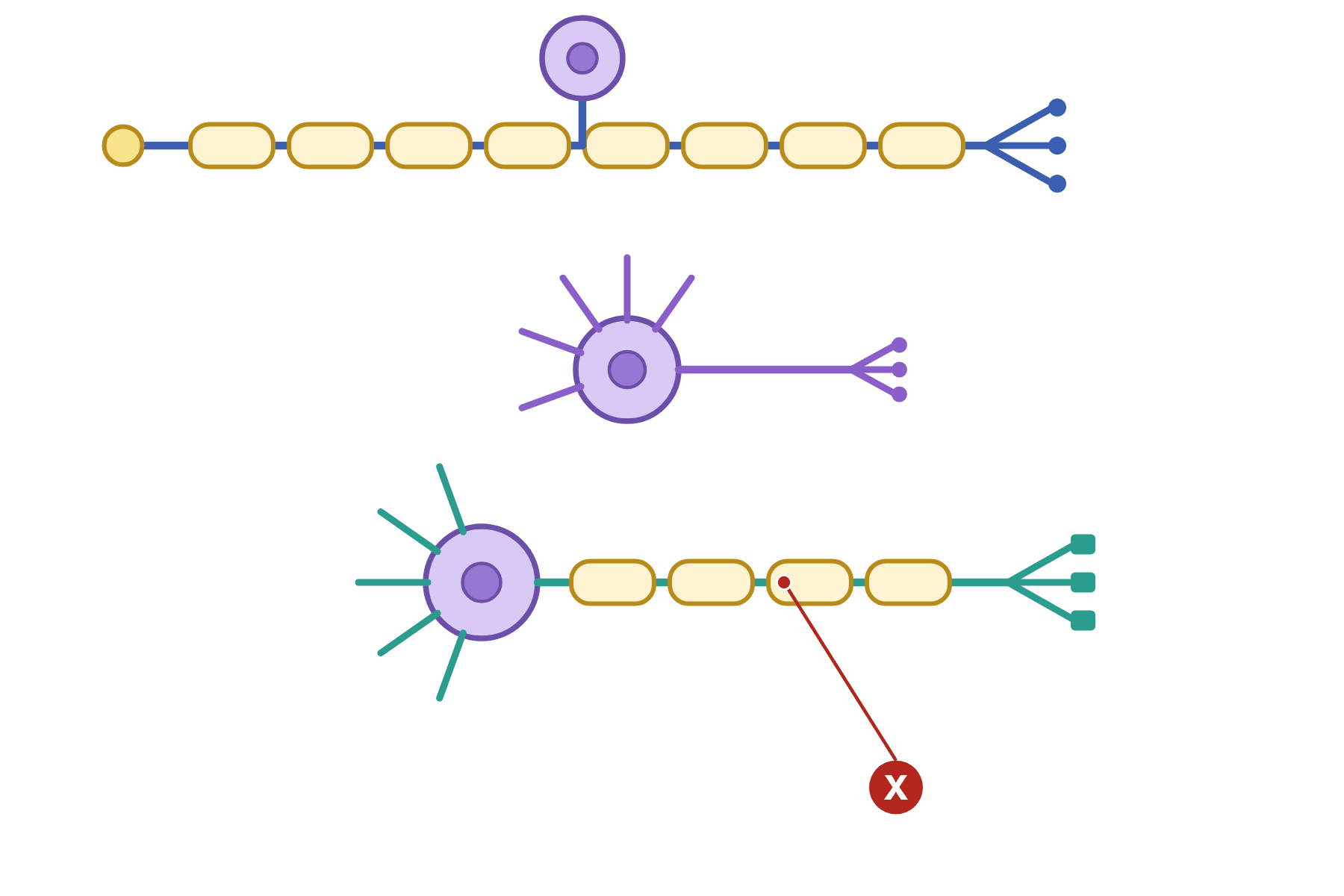 Name the part of the neurone marked X.
 The myelin sheath. It insulates the axon and speeds up the impulse.
-
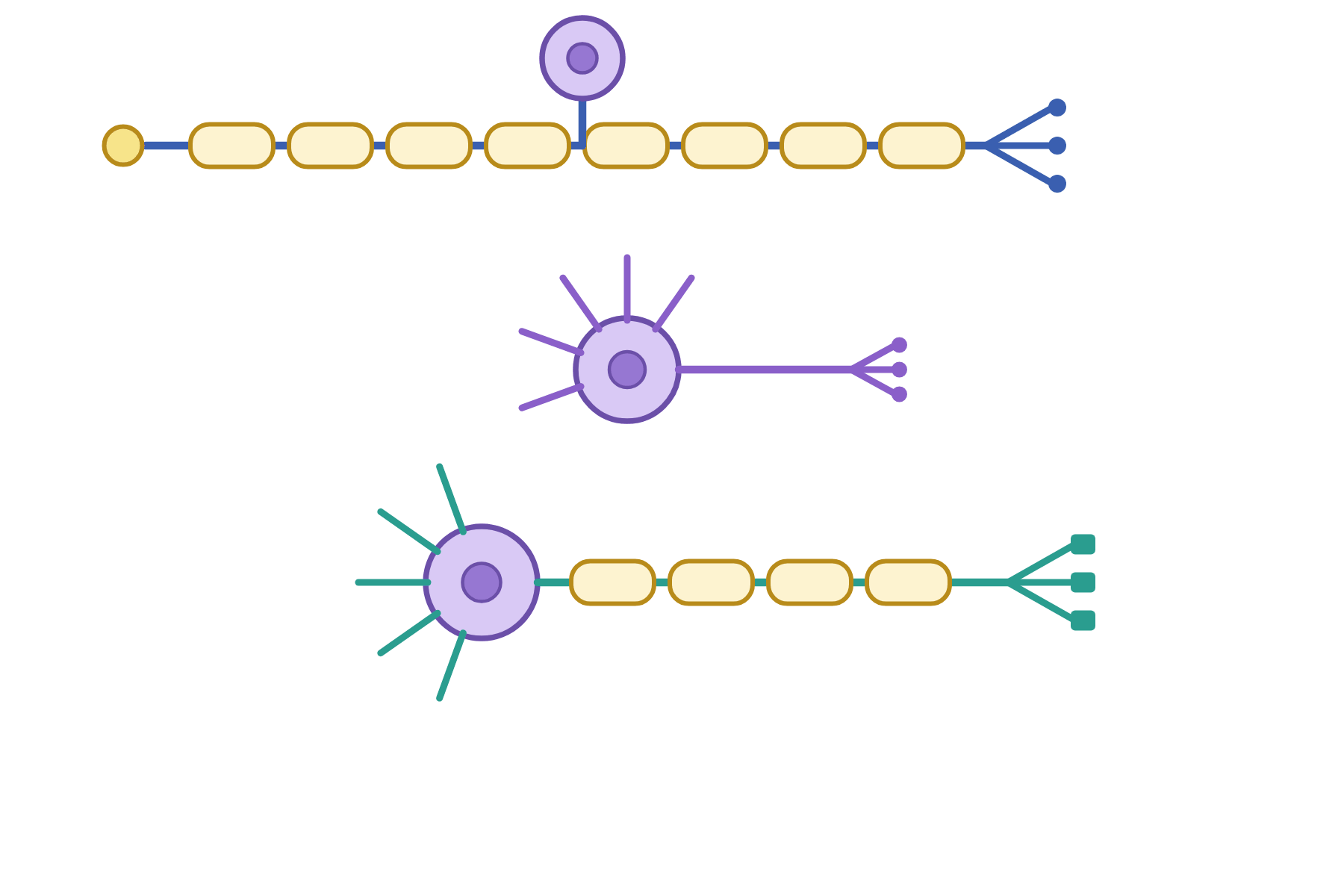 Name the three types of neurone and label the parts of one.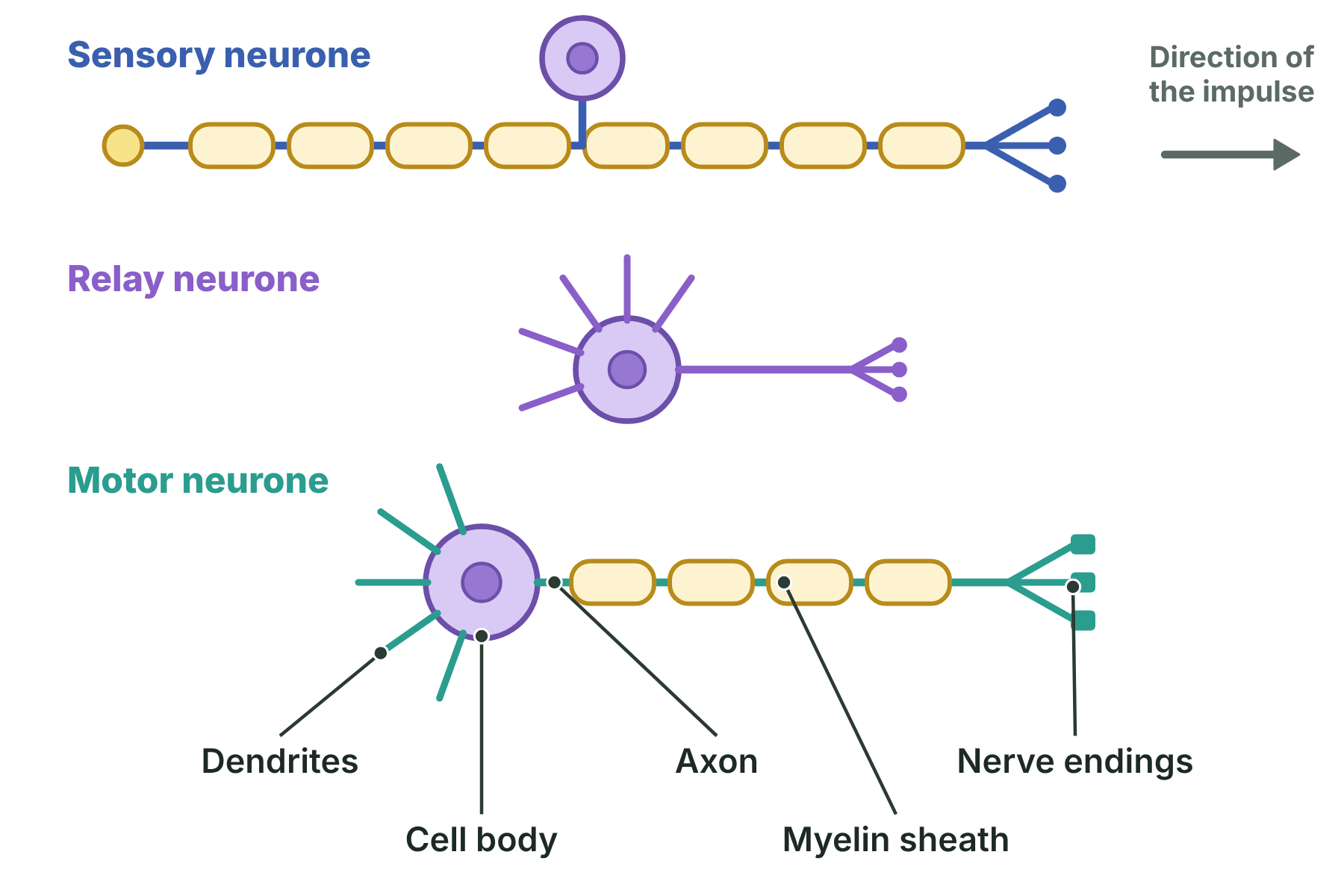
Sensory, relay and motor neurones. The parts are the cell body, dendrites, axon, myelin sheath and nerve endings.
-
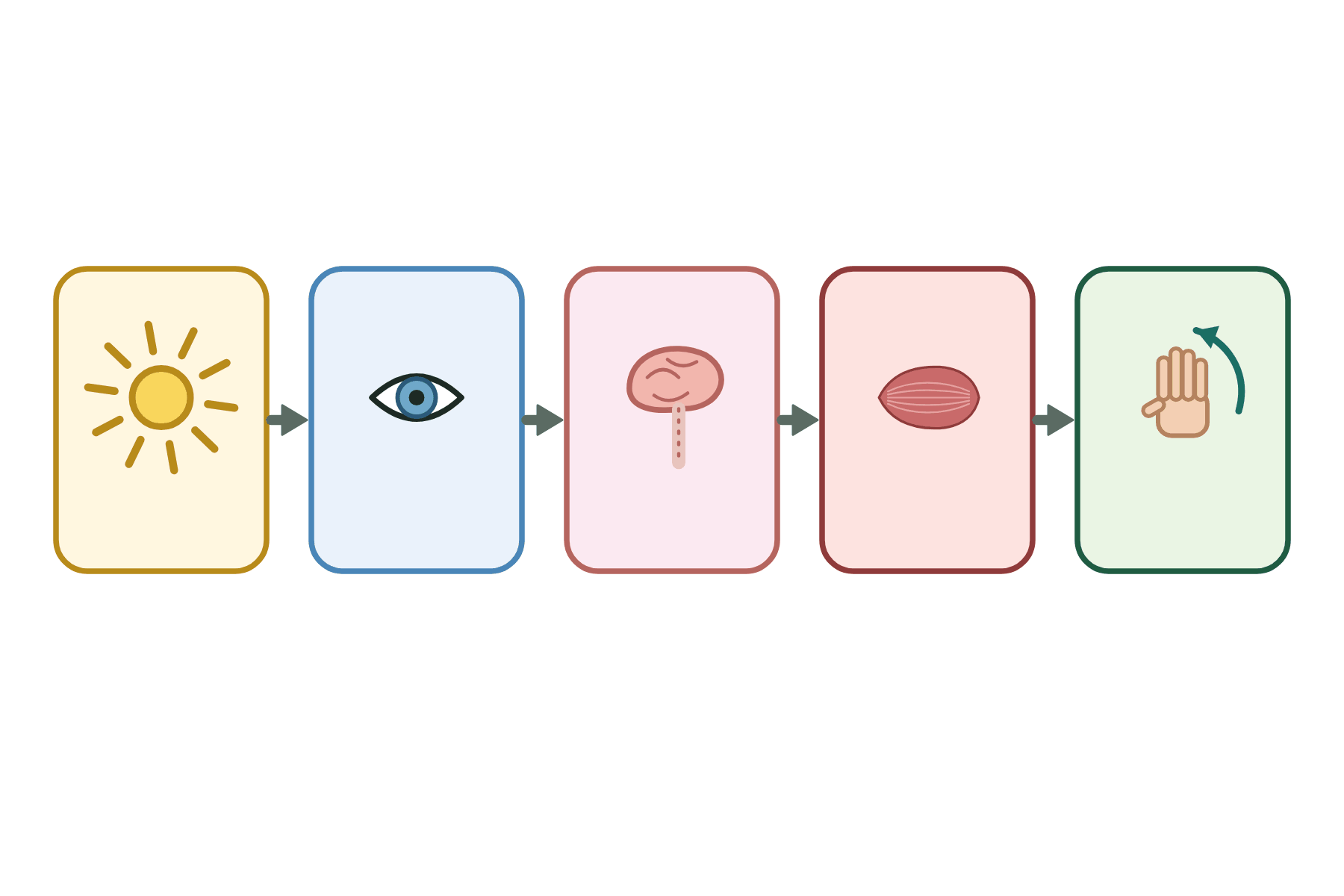 Name each stage from stimulus to response.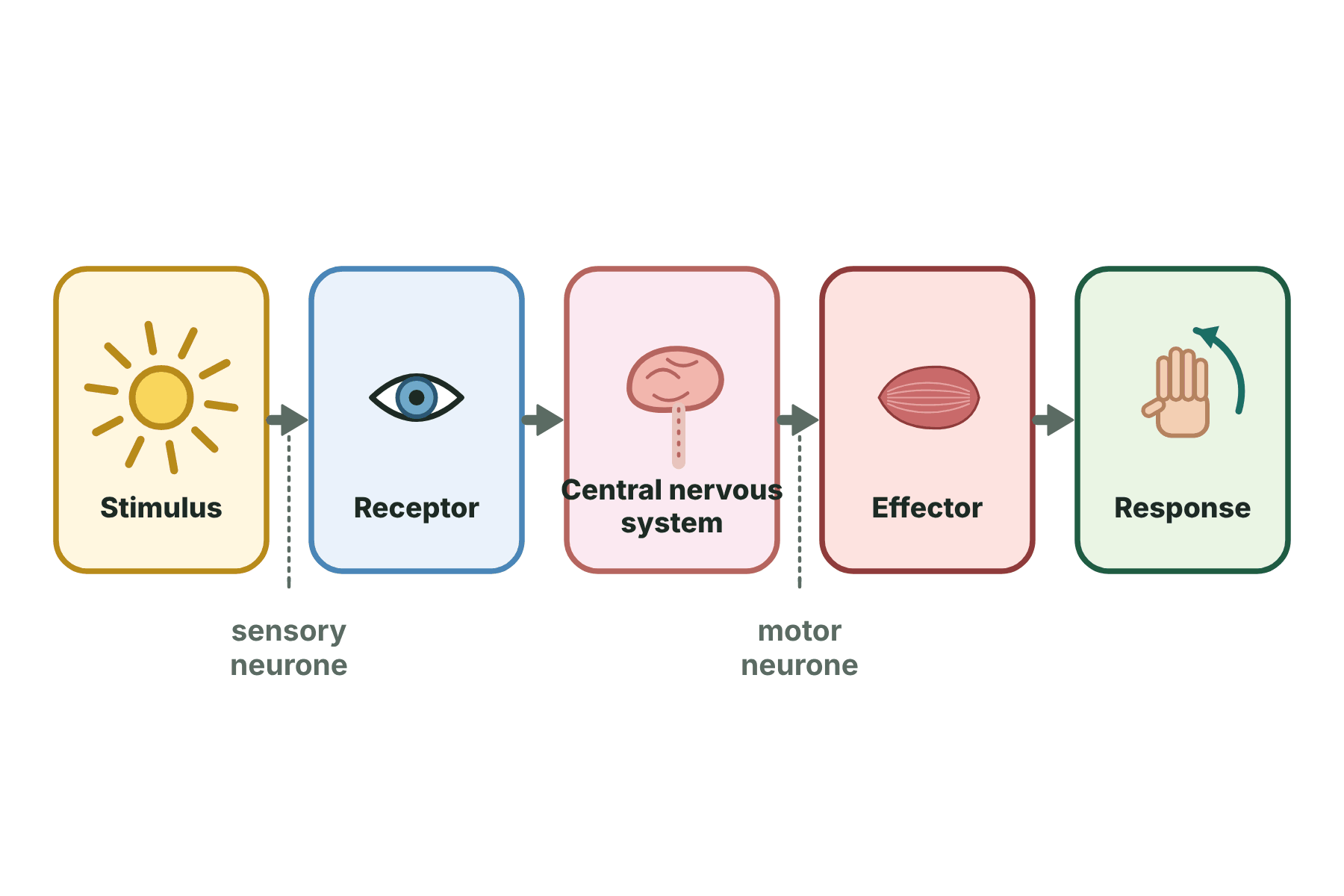
Stimulus, receptor, central nervous system, effector, response. A sensory neurone joins the receptor to the central nervous system, and a motor neurone joins it to the effector.
-
What is a reflex action?
A rapid, automatic response that protects the body.
-
Why is a reflex fast?
The pathway is short, with few neurones and synapses.
-
Why is a reflex automatic?
It does not need conscious thought.
-
Name the parts of a reflex arc in order.
Receptor, sensory neurone, relay neurone, motor neurone, effector.
-
Where is the relay neurone in a reflex arc?
In the spinal cord.
-
What does the motor neurone do in a reflex arc?
It carries the impulse from the spinal cord to the effector.
-
What is the effector in a reflex such as pulling away a hand?
A muscle.
-
How does an impulse cross a synapse?
Neurotransmitter diffuses across the gap and binds to receptors.
-
Why do impulses only pass one way across a synapse?
The neurotransmitter is released from one side only.
-
How is a reflex action different from a voluntary action?
A reflex is faster and automatic; a voluntary action is chosen and involves the brain.
-
Give an example of a reflex.
Pulling a hand away from a hot object, or blinking.
-
How can reaction time be measured?
By a ruler drop test.
-
In the reaction time practical, what is the dependent variable?
The reaction time, measured as the distance that the ruler falls.
-
Give two control variables for the reaction time practical.
Any two of: the same person, the same hand, the same ruler, the same starting position.
-
In the ruler drop test what does a shorter distance mean?
A faster reaction time.
-
Why should the test be repeated?
To calculate a mean and reduce the effect of anomalies.
-
What does the myelin sheath do?
It speeds up the impulse.
-
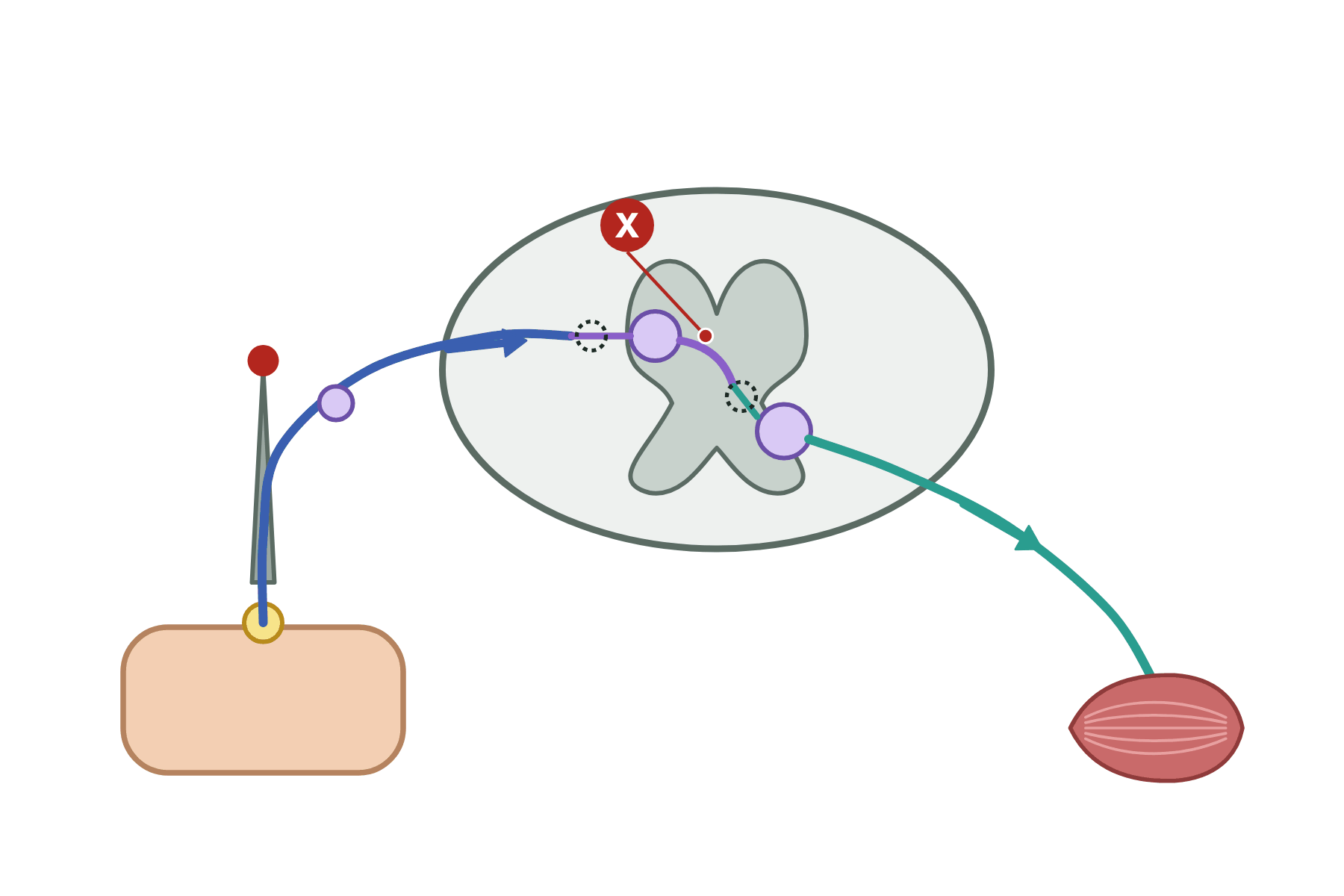 Name the neurone marked X and say what it does.
 The relay neurone. It links the sensory neurone to the motor neurone inside the spinal cord.
-
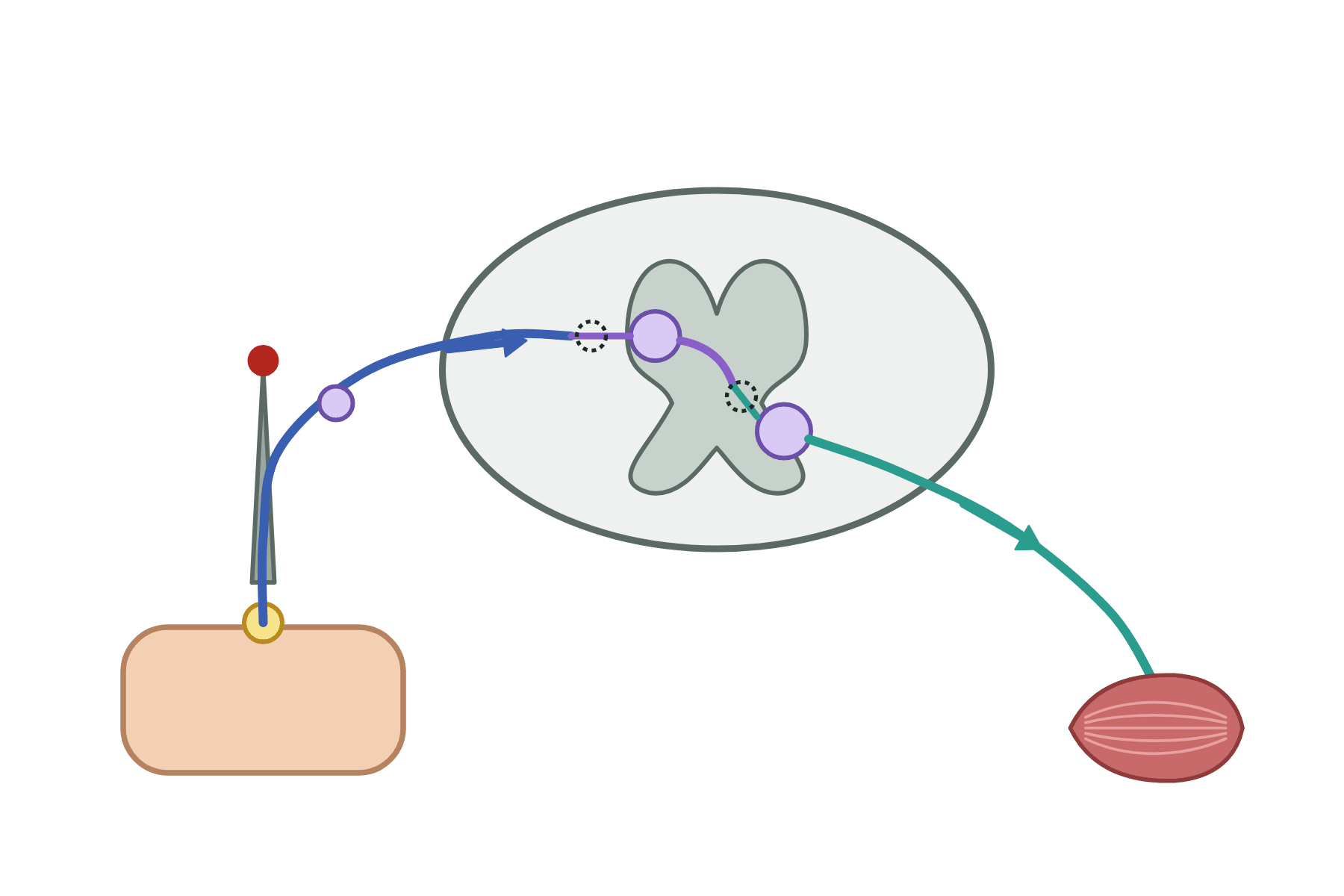 Label the parts of this reflex arc.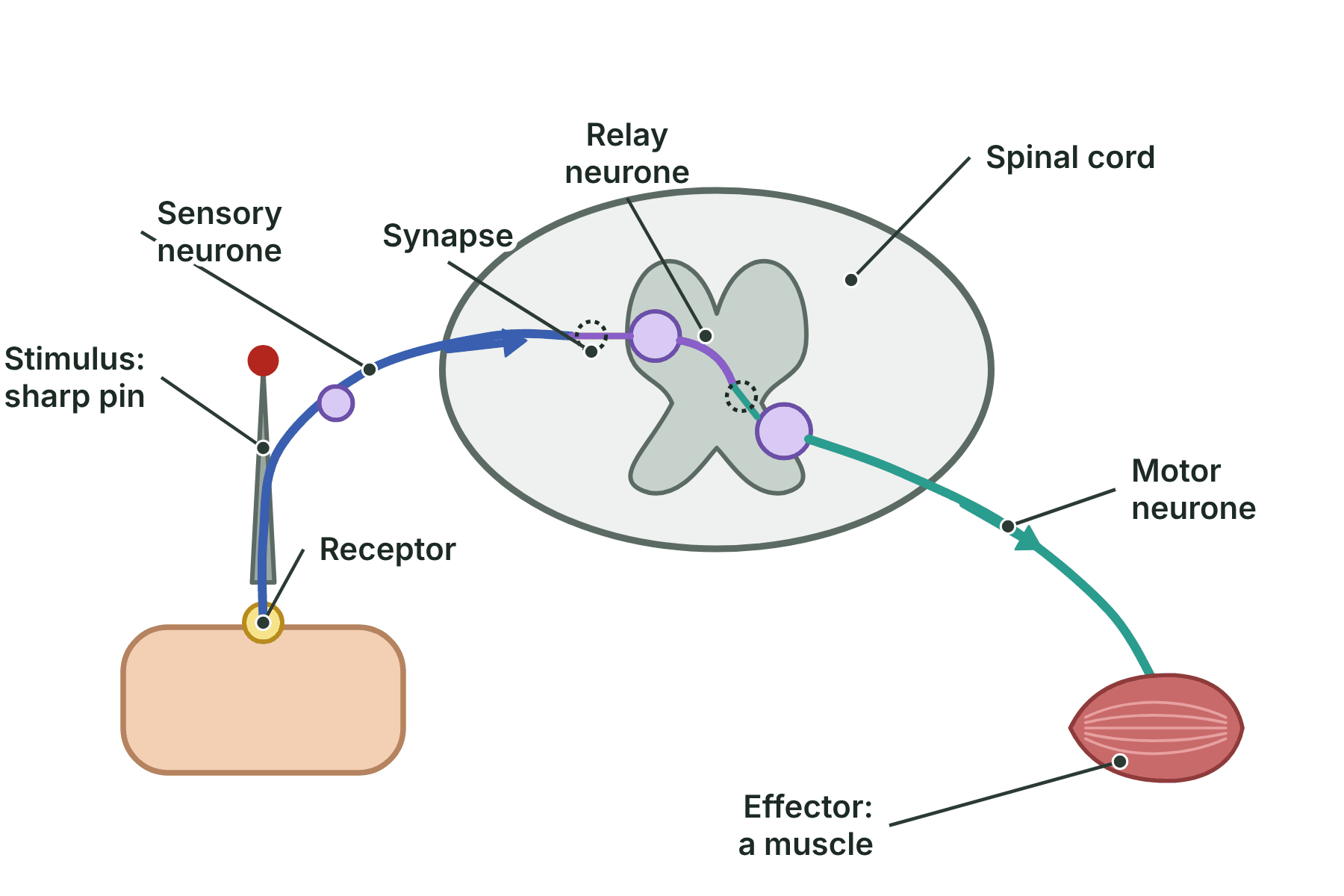
Stimulus, receptor, sensory neurone, relay neurone, motor neurone and effector. The relay neurone is in the spinal cord, and synapses join the neurones.
-
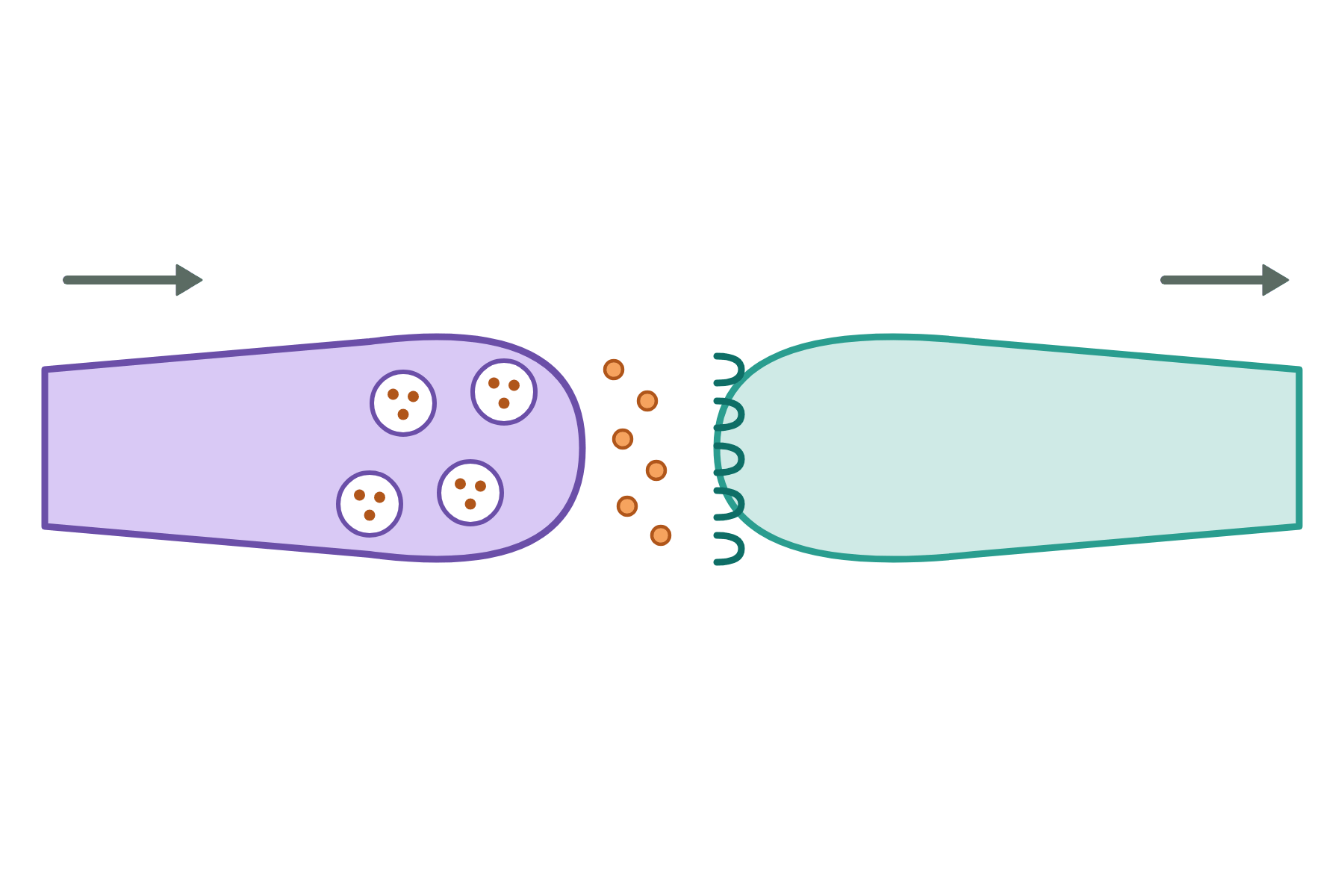 Describe what happens at the gap between the neurones.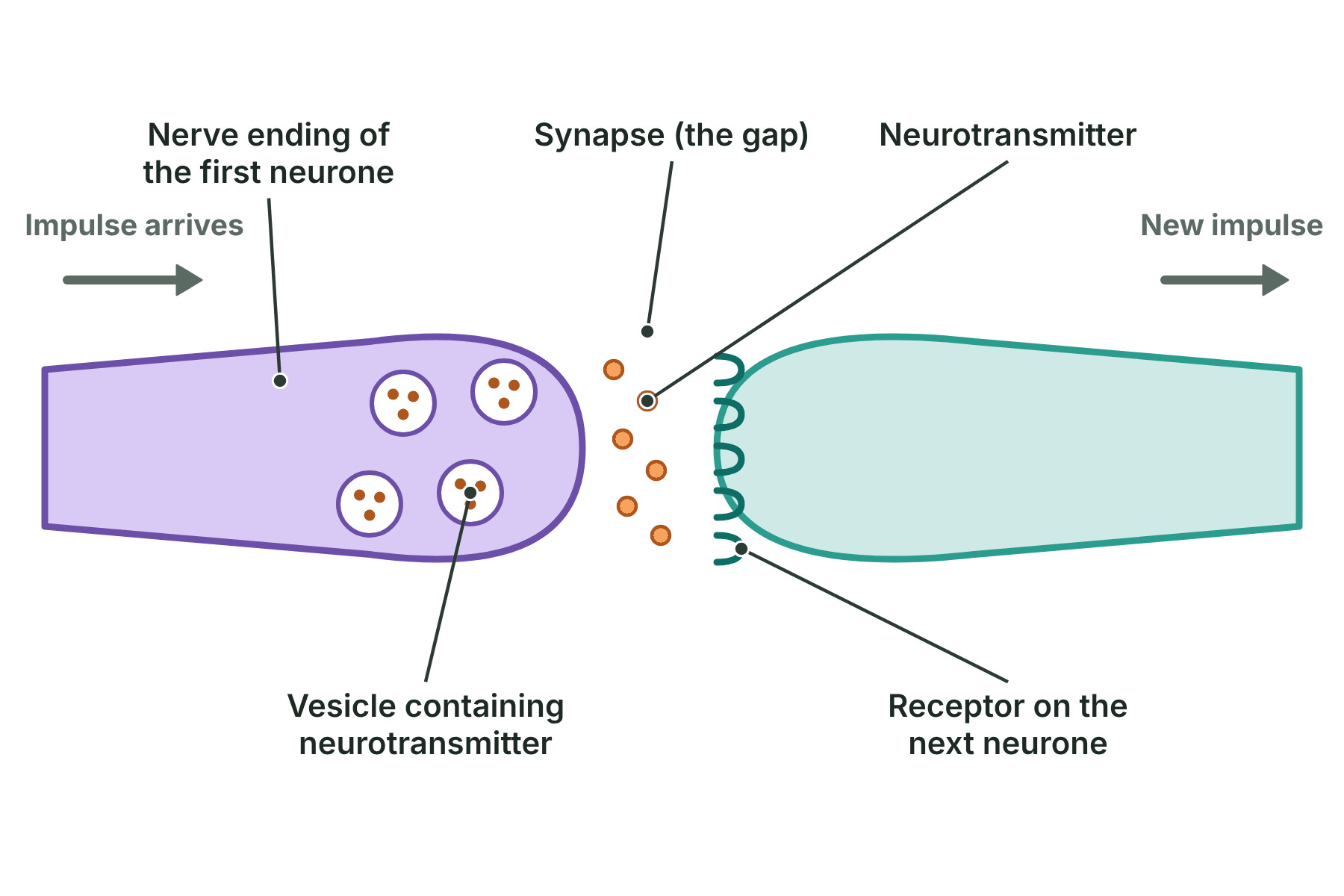
The impulse makes the nerve ending release neurotransmitter. It diffuses across the gap and binds to receptors on the next neurone, starting a new impulse.
-
What does the cerebral cortex control?
Conscious thought, memory, language and voluntary movement.
-
What does the cerebellum control?
Coordination of movement and balance.
-
What does the medulla control?
Automatic actions such as heart rate and breathing.
-
Which part of the brain is joined to the spinal cord?
The medulla.
-
Which part of the brain is at the back below the cerebral cortex?
The cerebellum.
-
Name one way of investigating the brain. (Higher tier)
A case study, a scan or electrical stimulation.
-
Give a difficulty of investigating the brain. (Higher tier)
It is complex and hard to reach, and there are ethical issues.
-
Why are case studies of brain damage limited? (Higher tier)
Each injury is different, and it is hard to be sure which region is responsible.
-
Why is brain damage hard to treat? (Higher tier)
Neurones repair poorly and the damage is often irreversible.
-
Why is operating on the brain risky? (Higher tier)
Parts are hard to reach and surrounding tissue can be damaged.
-
What can happen if the spinal cord is cut? (Higher tier)
Impulses cannot cross, so movement and feeling are lost below the injury.
-
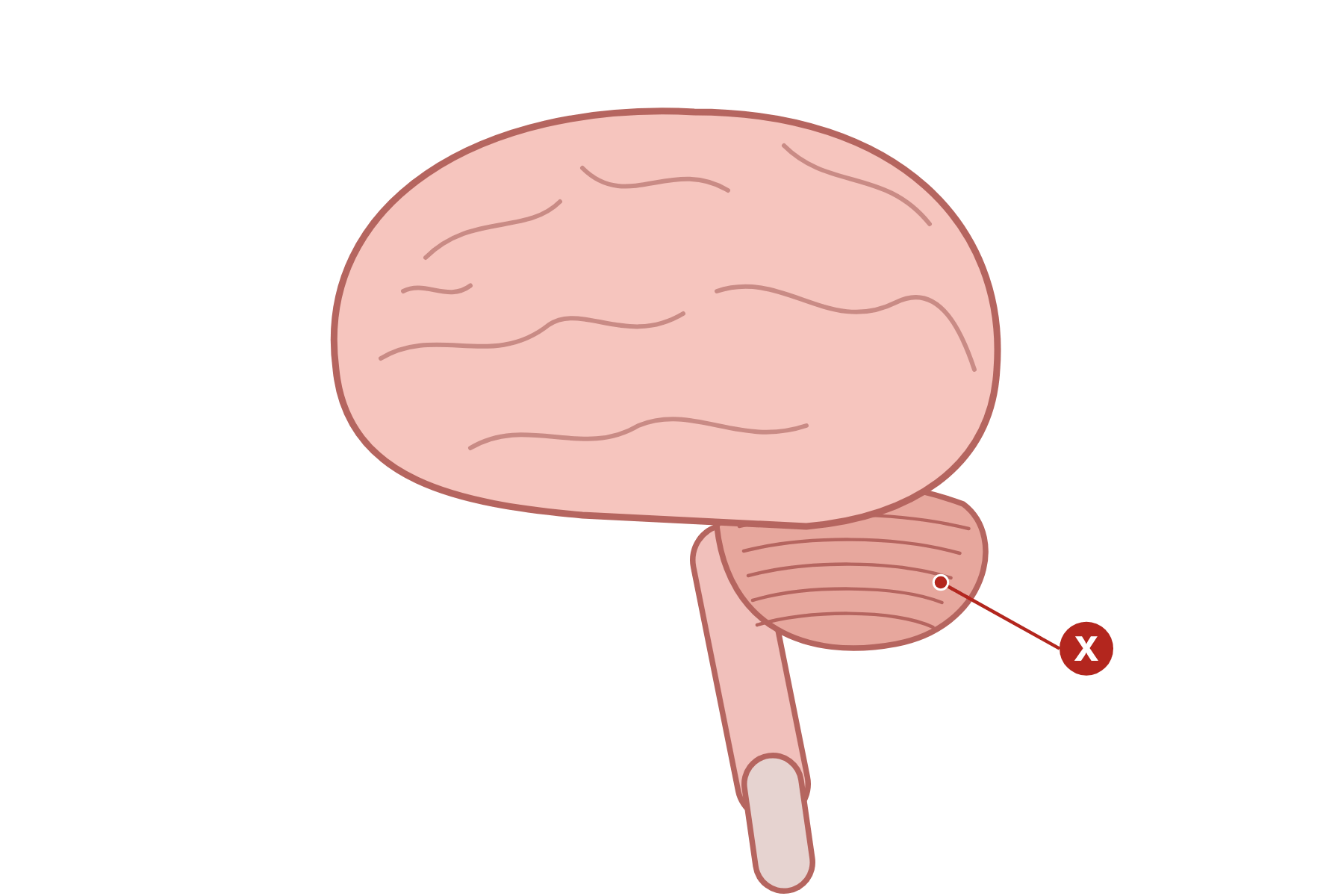 Name the part of the brain marked X and say what it controls.
 The cerebellum. It coordinates movement and keeps balance.
-
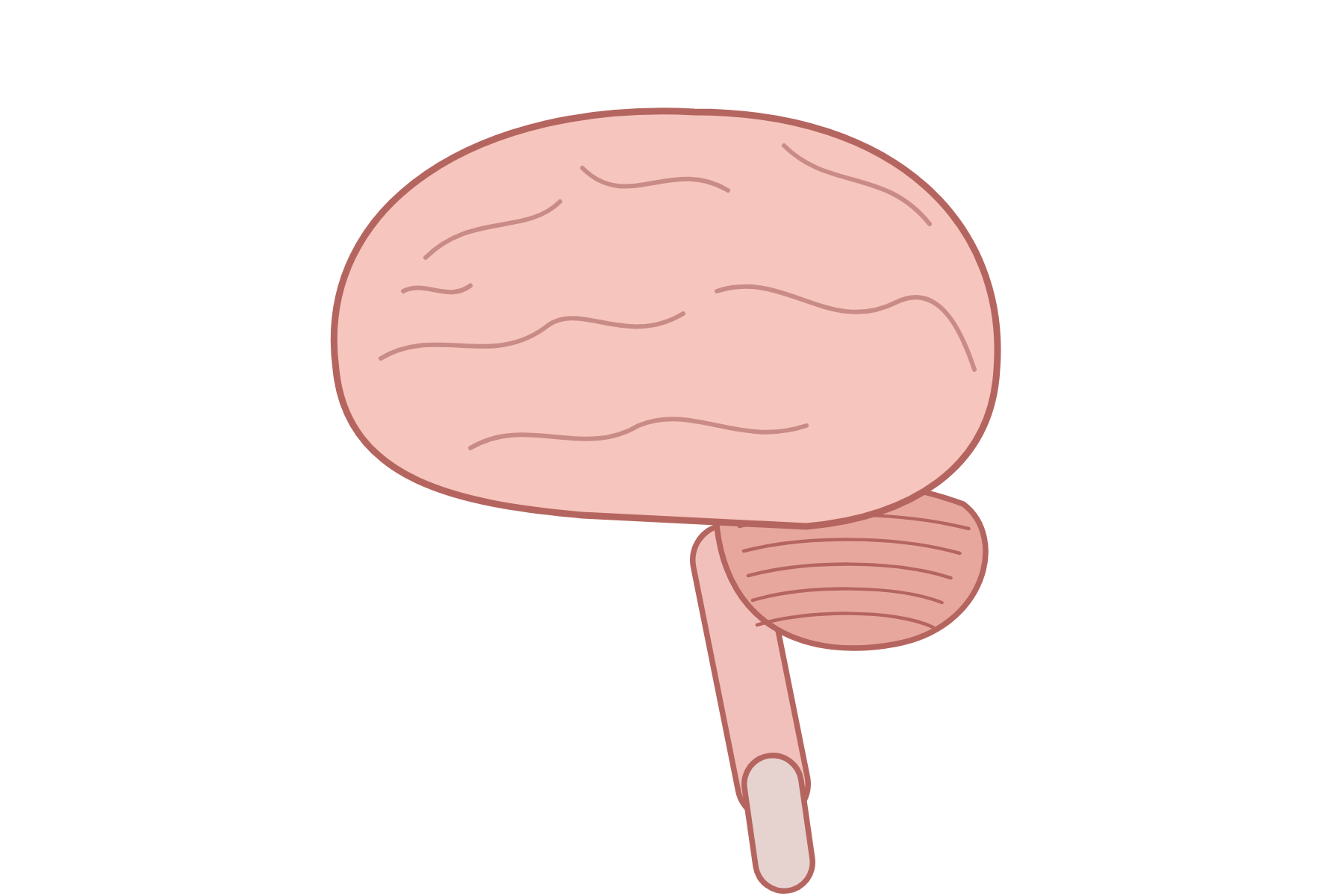 Name each part of the brain and what it controls.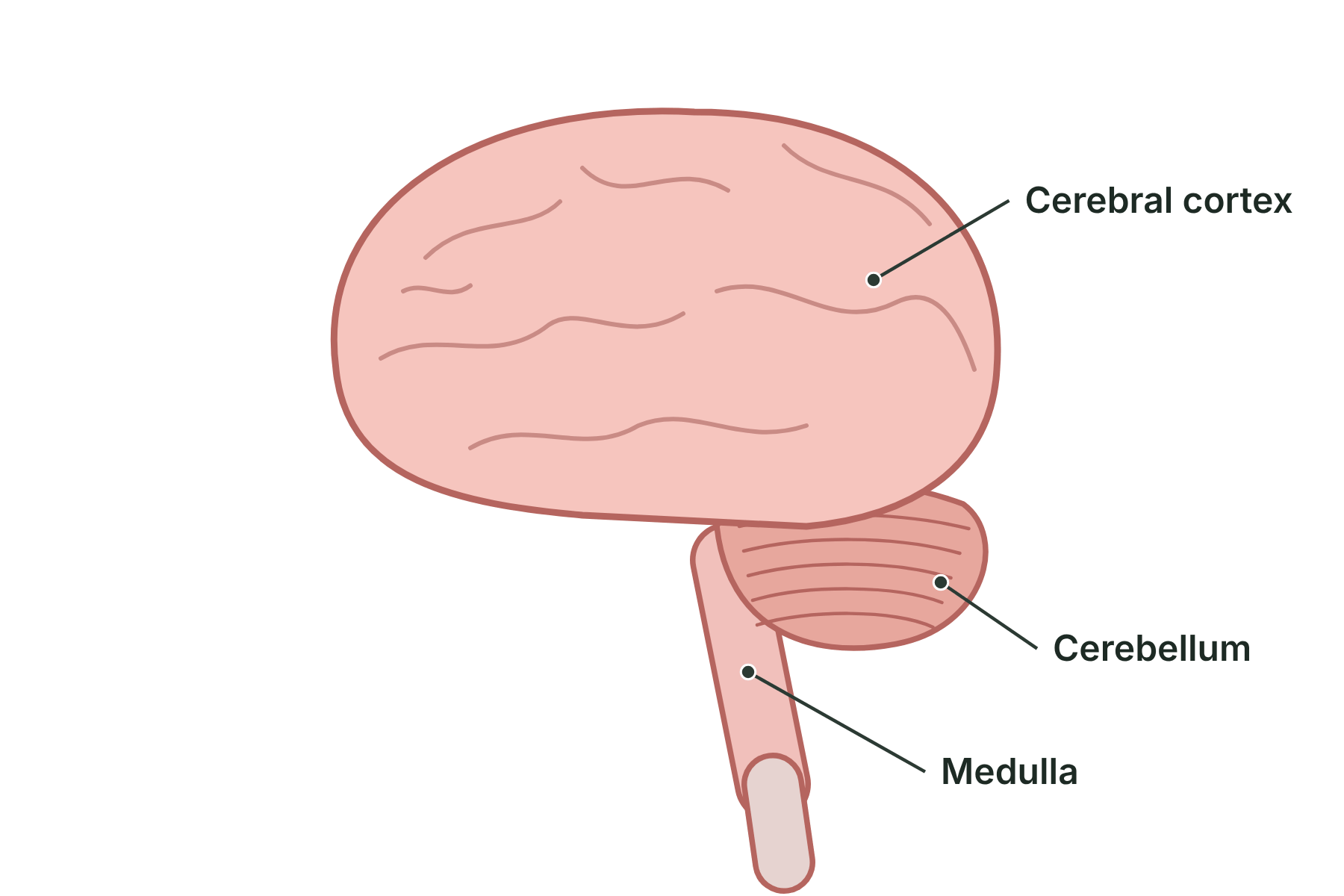
Cerebral cortex: consciousness, intelligence, memory, language and voluntary movement. Cerebellum: coordination and balance. Medulla: heart rate and breathing.
-
What does the cornea do?
It refracts light and does most of the focusing.
-
What does the iris do?
It controls the amount of light entering the eye.
-
What is the sclera?
The tough, white outer layer of the eye that protects it.
-
How does the eye adapt to dim light?
The pupil gets larger so more light enters, and the rod cells become more sensitive.
-
What is the pupil?
The hole in the iris that lets light in.
-
What does the lens do?
It changes shape to focus light on the retina.
-
What does the retina contain?
Light receptor cells, rods and cones.
-
What does the optic nerve do?
It carries impulses from the retina to the brain.
-
What do the suspensory ligaments do?
They connect the lens to the ciliary muscles and hold it in place.
-
What happens to the pupil in bright light?
It becomes smaller.
-
What happens to the pupil in dim light?
It becomes larger.
-
How does the lens change to see a near object?
The ciliary muscles contract, the ligaments slacken and the lens becomes thicker.
-
How does the lens change to see a distant object?
The ciliary muscles relax, the ligaments are pulled tight and the lens becomes thinner.
-
What causes myopia (short sight)?
The lens is too strong or the eyeball too long, so light focuses in front of the retina.
-
How is myopia (short sight) corrected?
With a concave lens.
-
How is hyperopia (long sight) corrected?
With a convex lens.
-
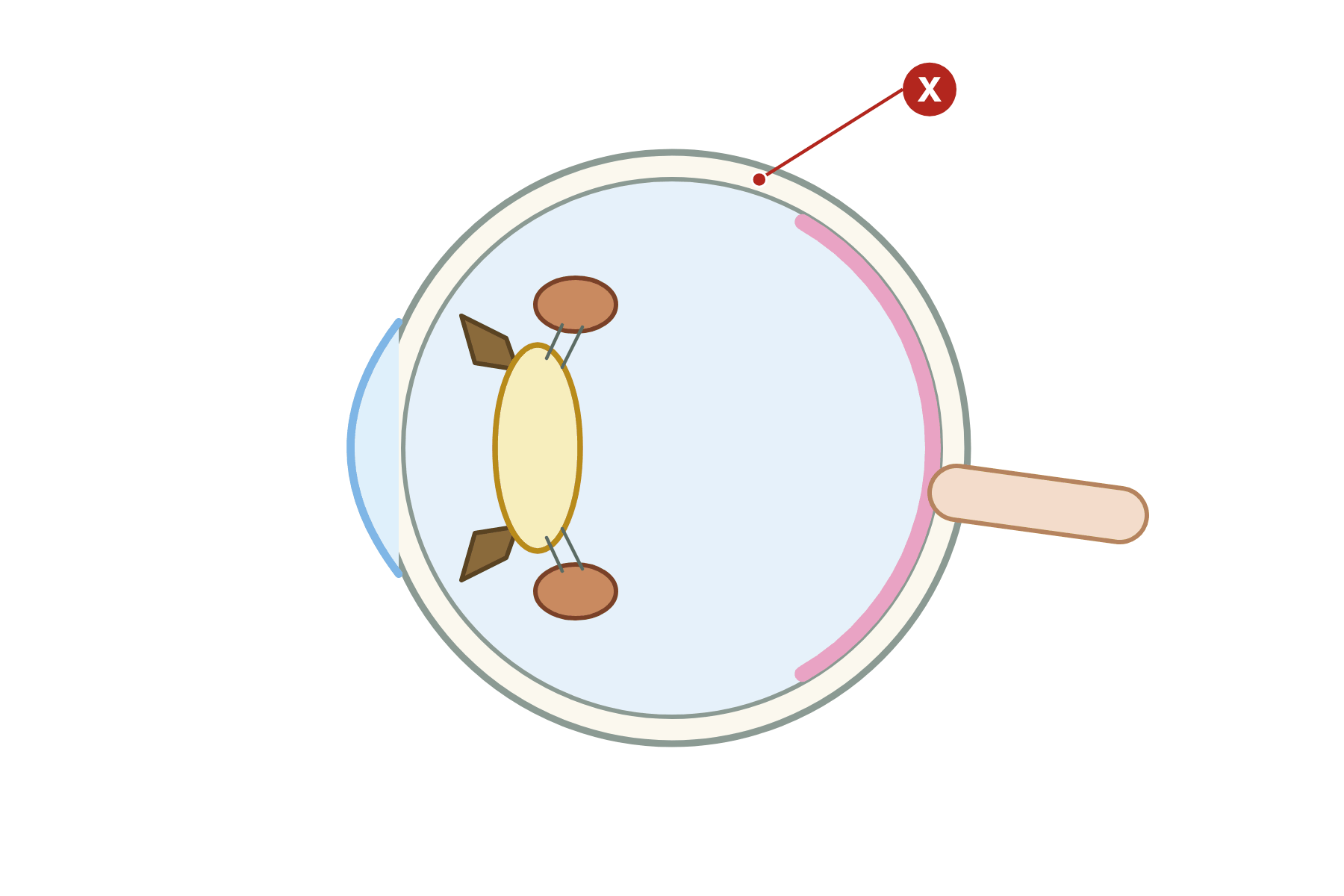 Name the part of the eye marked X and say what it does.
 The sclera. It is the tough, white outer layer that protects the eye and gives it its shape.
-
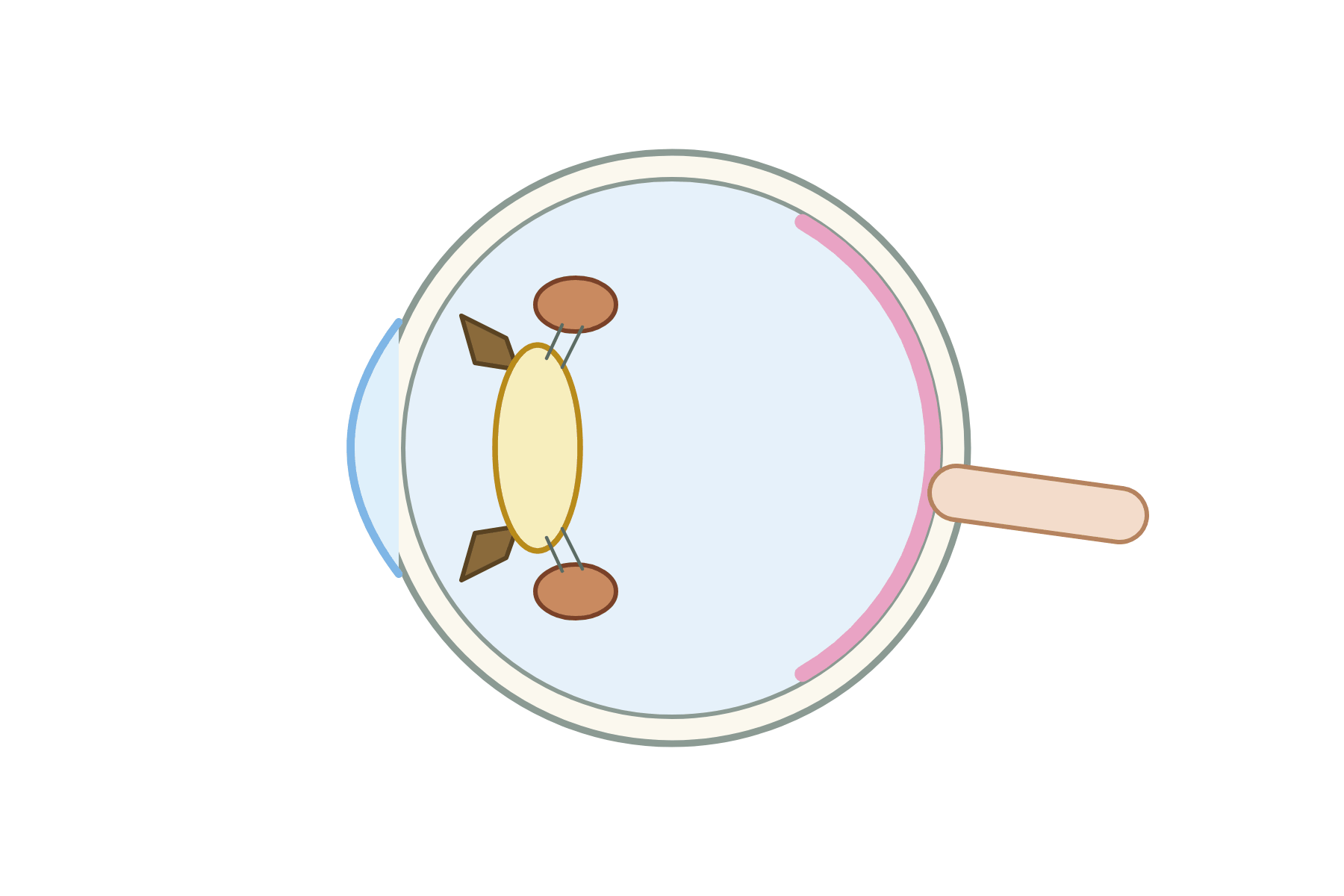 Label the eye.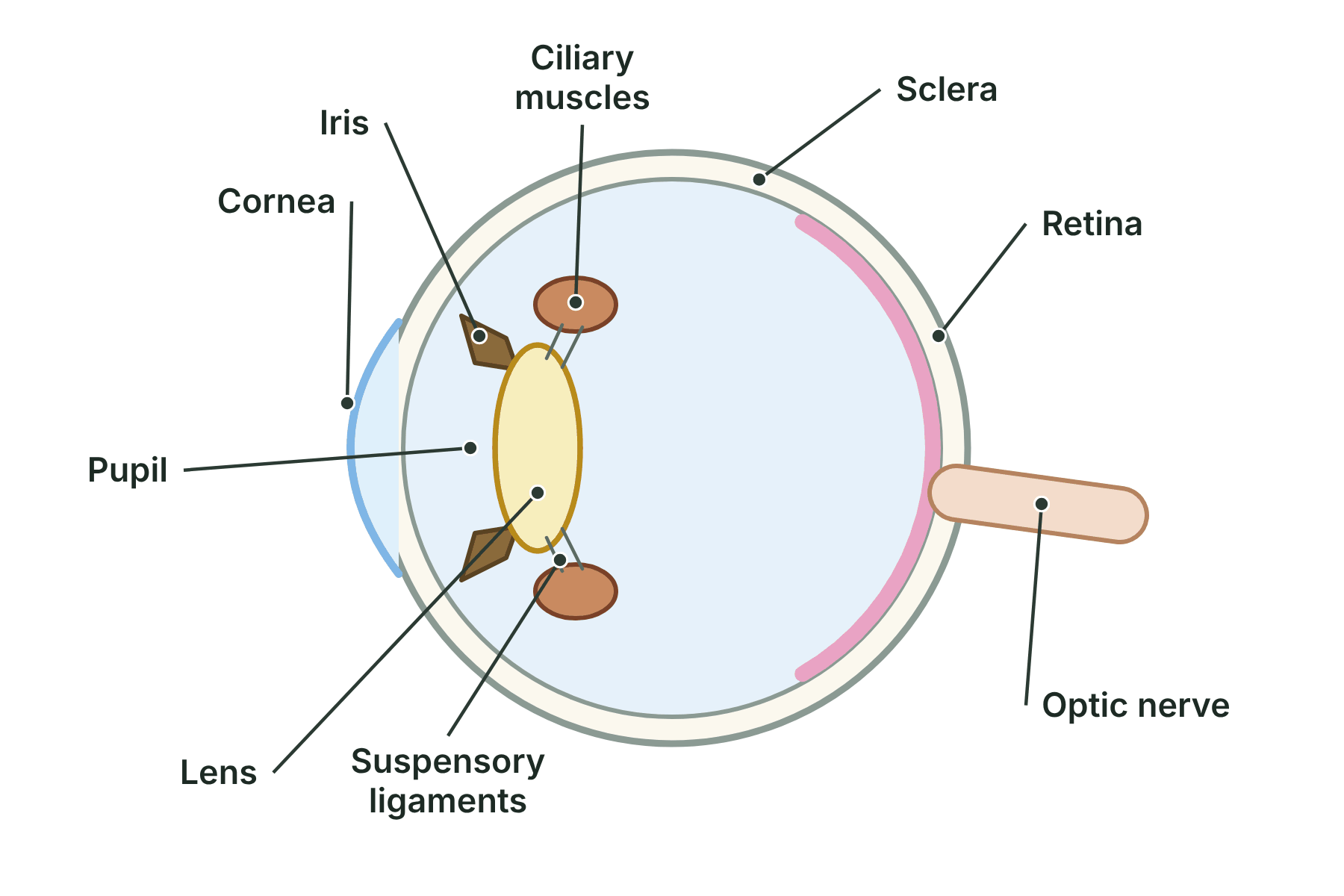
Cornea, sclera, iris, pupil, lens, ciliary muscles, suspensory ligaments, retina and optic nerve.
-
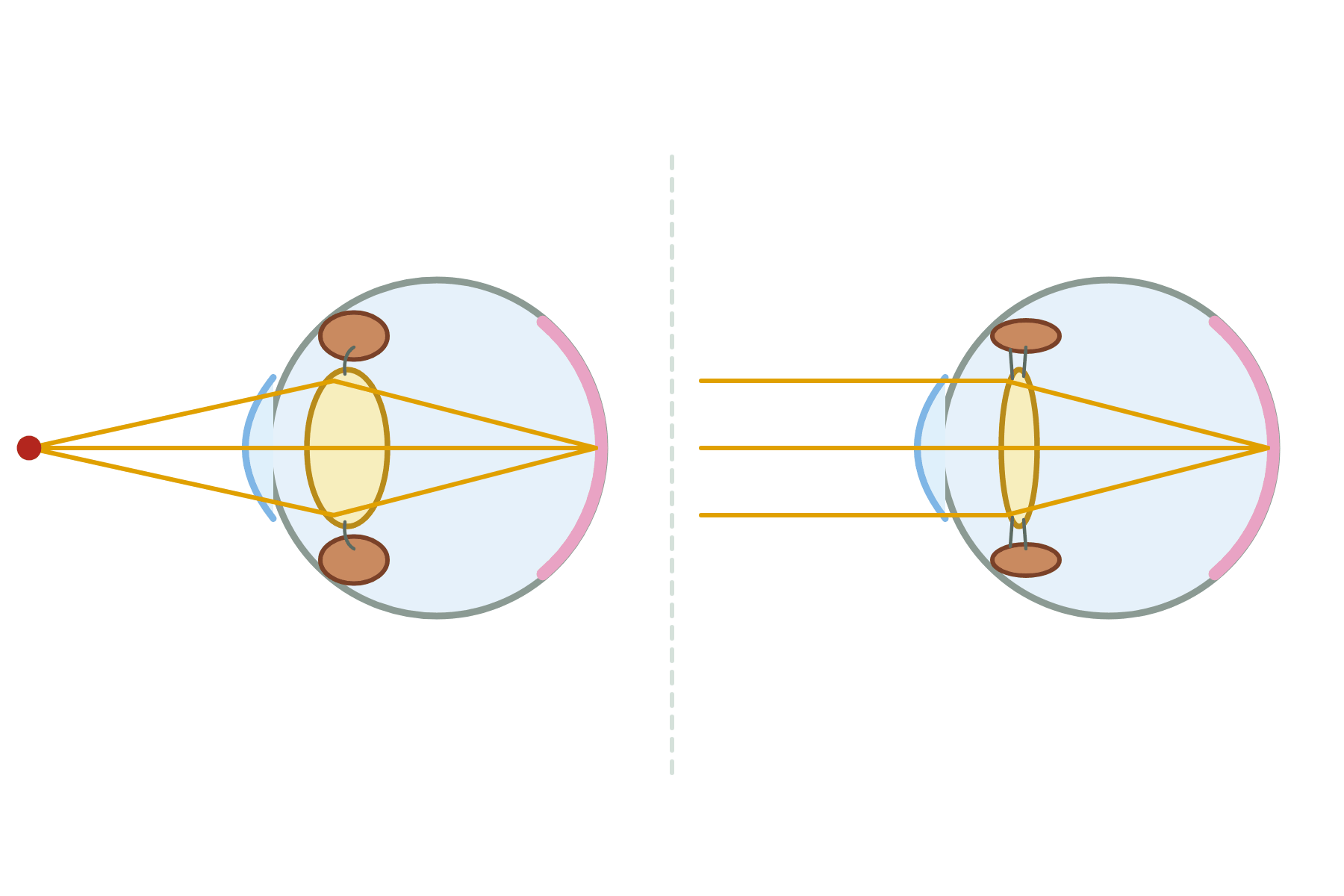 Describe what happens to the lens in each eye.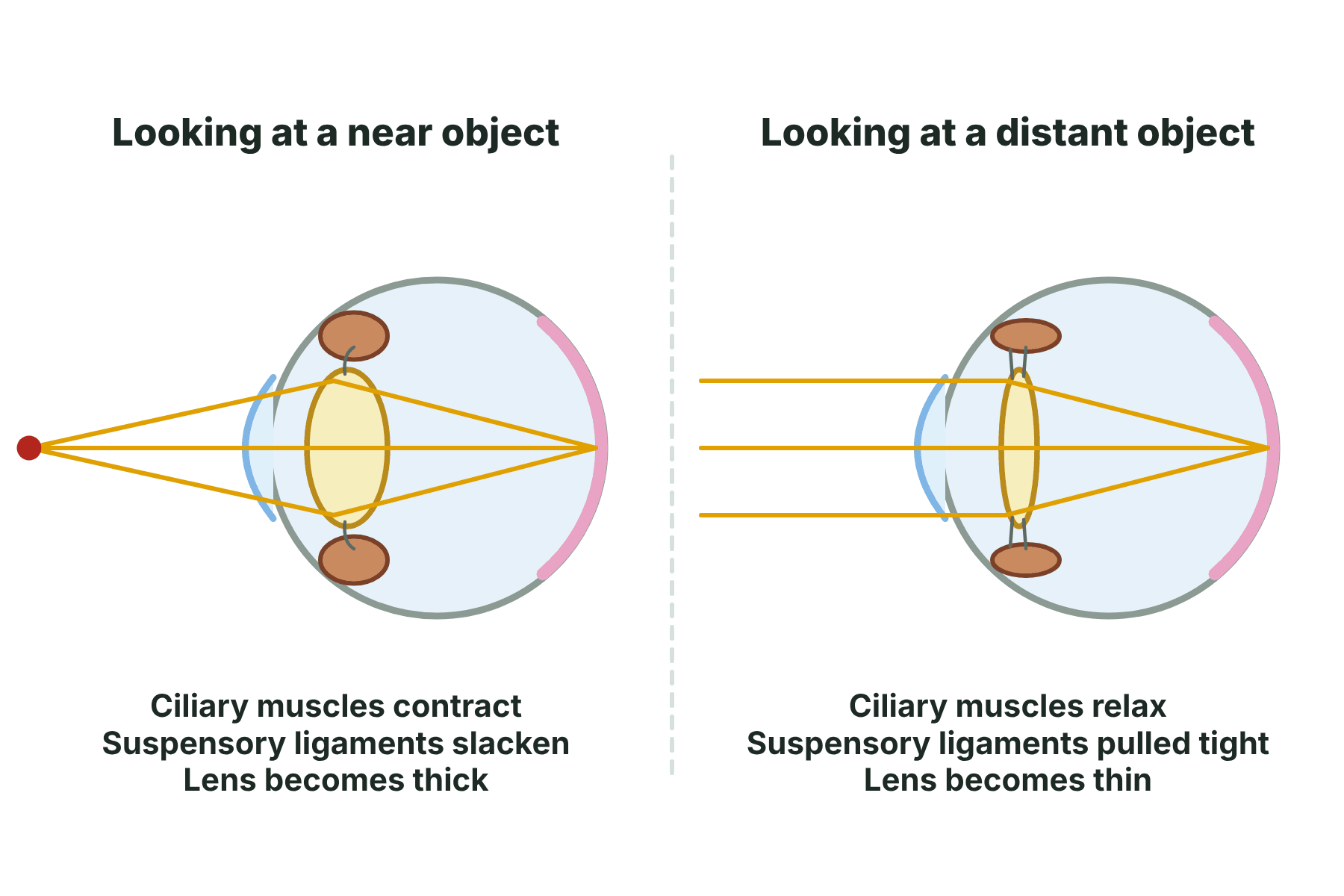
Near object: the ciliary muscles contract, the ligaments slacken and the lens is thick. Distant object: the ciliary muscles relax, the ligaments are taut and the lens is thin.
-
At what temperature is the body kept?
About 37 °C.
-
What monitors and controls body temperature?
The thermoregulatory centre in the brain.
-
What does the thermoregulatory centre contain?
Receptors that are sensitive to the temperature of the blood.
-
What do the temperature receptors in the skin do?
They send nervous impulses to the thermoregulatory centre.
-
Name the effectors for temperature control.
The sweat glands, the blood vessels in the skin and the skeletal muscles.
-
What happens to the blood vessels in the skin when the body is too hot?
They dilate (vasodilation).
-
What happens to the blood vessels in the skin when the body is too cold?
They constrict (vasoconstriction).
-
What happens to sweating when the body is too hot?
Sweat is produced.
-
What happens to sweating when the body is too cold?
It stops.
-
How does sweating cool the body?
The sweat evaporates and takes energy from the skin.
-
What happens to the skeletal muscles when the body is too cold?
They contract and relax rapidly (shiver).
-
How does shivering warm the body?
Respiration in the muscles releases energy.
-
Why does the skin look red when it is hot?
More blood flows close to the surface because the vessels dilate.
-
Why does the skin look pale when it is cold?
Less blood flows close to the surface because the vessels constrict.
-
Do blood vessels move closer to the skin when it is hot? (Higher tier)
No. They only get wider.
-
 Describe the body's responses to being too hot and too cold.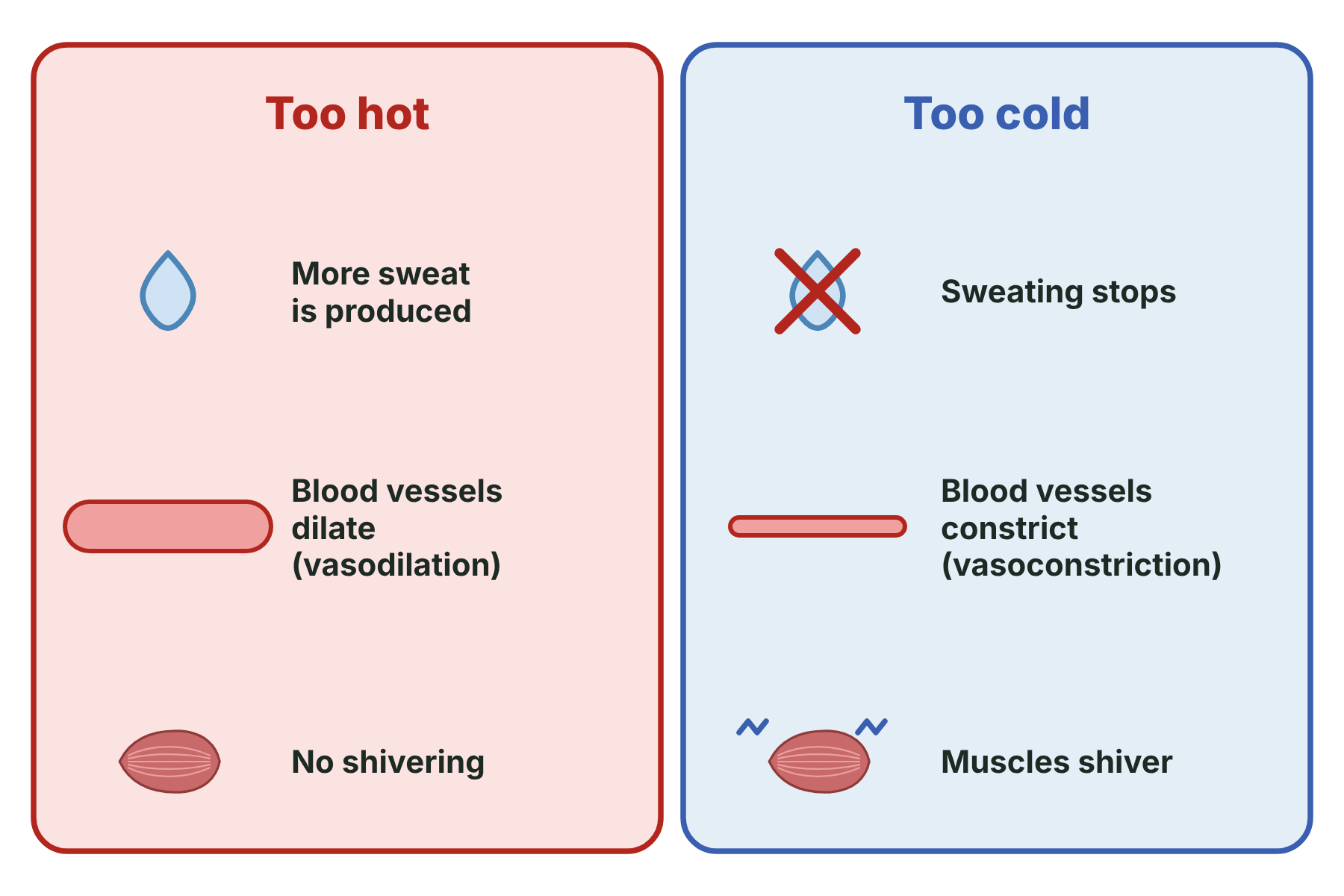
Too hot: sweat is produced, the blood vessels dilate and there is no shivering. Too cold: sweating stops, the blood vessels constrict and the muscles shiver.
-
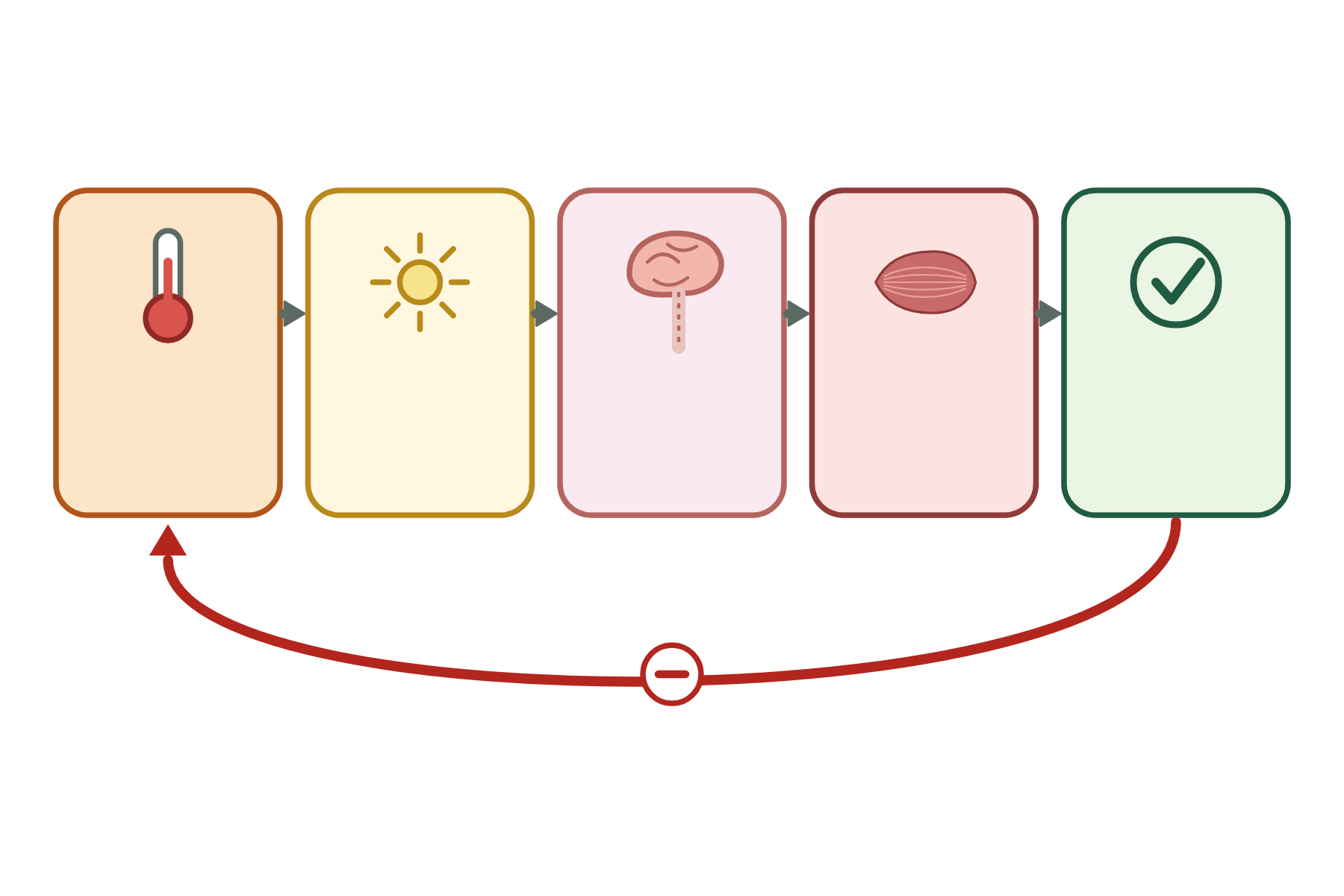 Name each stage in the control of body temperature.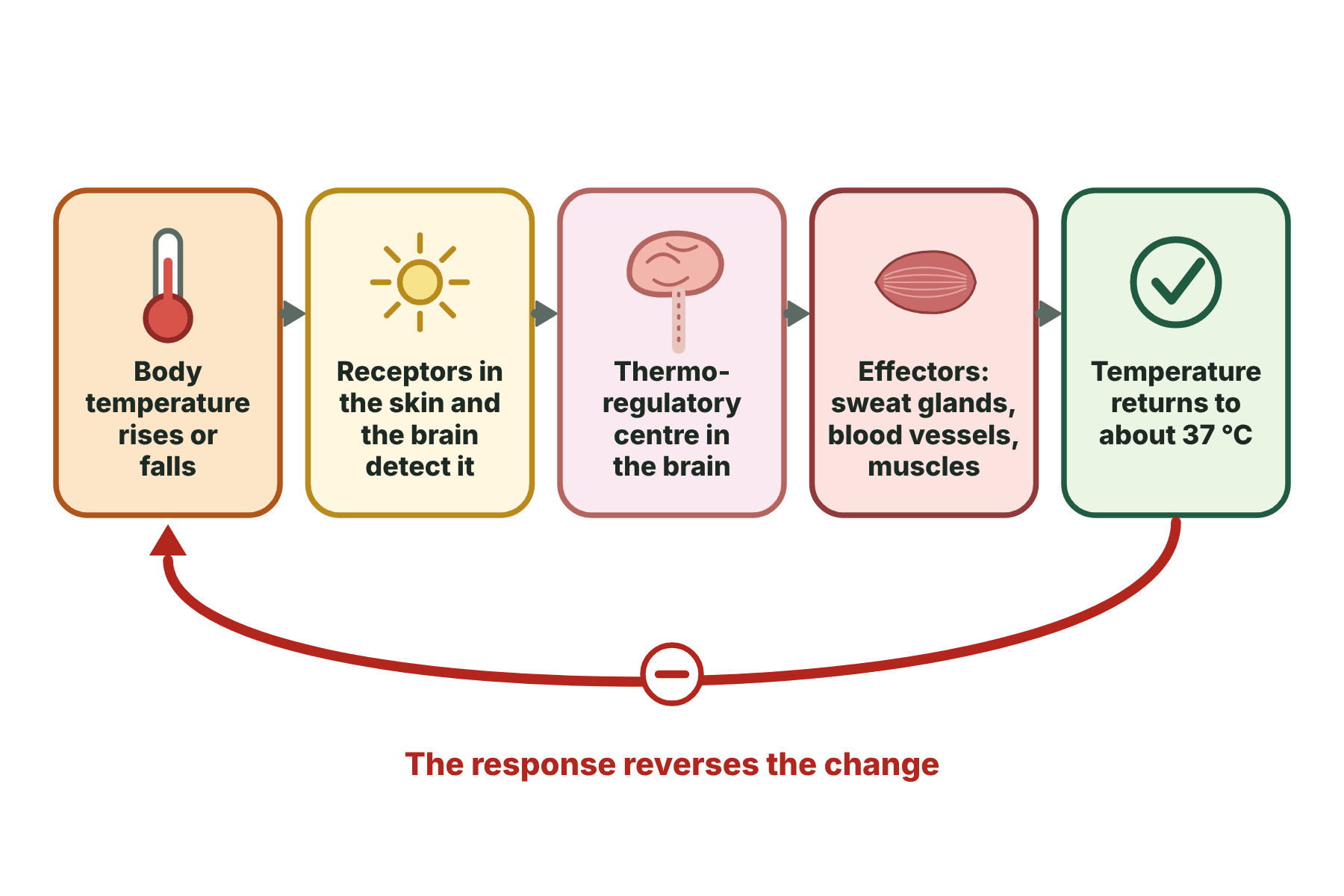
Change in temperature, receptors in the skin and brain, thermoregulatory centre, effectors (sweat glands, blood vessels, muscles), temperature returns to about 37 °C.