Flashcards · Biology
Variation and Evolution
-
What is variation?
Differences in the characteristics of individuals in a population.
-
Name three possible causes of variation.
Genes, the environment, or a combination of both.
-
Give an example of a characteristic caused only by genes.
Eye colour or blood group.
-
Give an example of a characteristic caused by the environment.
Scars, or the language you speak.
-
Give an example of a characteristic caused by genes and the environment.
Height or body mass.
-
Where do all genetic variants come from?
Mutations.
-
How often do mutations occur?
Continuously.
-
What do most mutations do to the phenotype?
Nothing.
-
What do a very few mutations do to the phenotype?
Determine it.
-
What can happen if a rare mutation gives a phenotype suited to a changed environment?
A relatively rapid change in the species.
-
Why is variation important for a species?
It means some individuals may survive if the environment changes.
-
What is the modal class on a frequency chart?
The tallest bar, the group with the most individuals.
-
Do identical twins have exactly the same phenotype?
No. The environment gives small differences.
-
Is there usually a lot or a little genetic variation in a population?
Extensive variation.
-
What shape is a frequency chart for height?
Bell-shaped.
-
Sort these into genetic, environmental or both: eye colour, scars, height, language spoken.
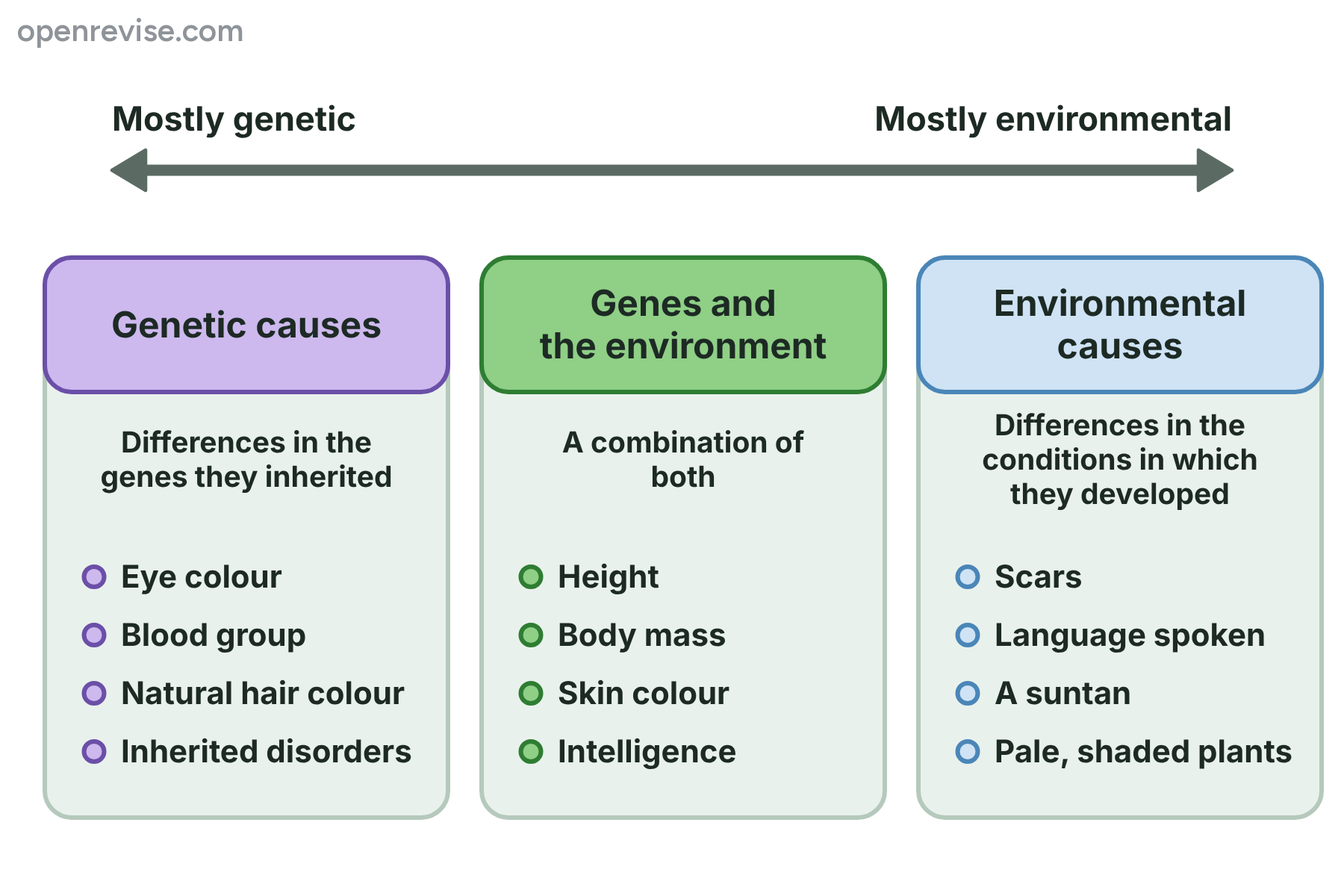
Eye colour is genetic. Scars and language spoken are environmental. Height is both.
-
What is evolution?
A change in the inherited characteristics of a population over time, through natural selection.
-
How long ago did the first simple life forms develop?
More than three billion years ago.
-
What does natural selection act on?
The variants in a population that give phenotypes best suited to the environment.
-
What happens to the best-suited individuals?
They are more likely to survive and breed successfully.
-
What is passed on to the next generation in natural selection?
The alleles that gave the advantage.
-
What is the source of new alleles?
Mutations.
-
Does natural selection happen to one individual in its lifetime?
No. It changes a population over many generations.
-
What is a selection pressure?
A factor, such as a predator, that affects survival.
-
When have two populations formed two new species?
When they can no longer interbreed to produce fertile offspring.
-
How can isolation lead to a new species?
Different environments select different phenotypes, so the populations grow apart.
-
Why did dark peppered moths become common in industrial areas?
The trees were blackened by soot, so dark moths were better camouflaged and survived to breed.
-
Why did pale peppered moths become common again?
The air was cleaned, the trees became lighter, and pale moths were better camouflaged.
-
Why is saying "the moth changed colour to hide" wrong?
Individuals do not change. Mutations are random and the environment selects.
-
Name two selection pressures.
Predation and disease (or competition for food).
-
What must an individual do for its alleles to be passed on?
Survive and breed.
-
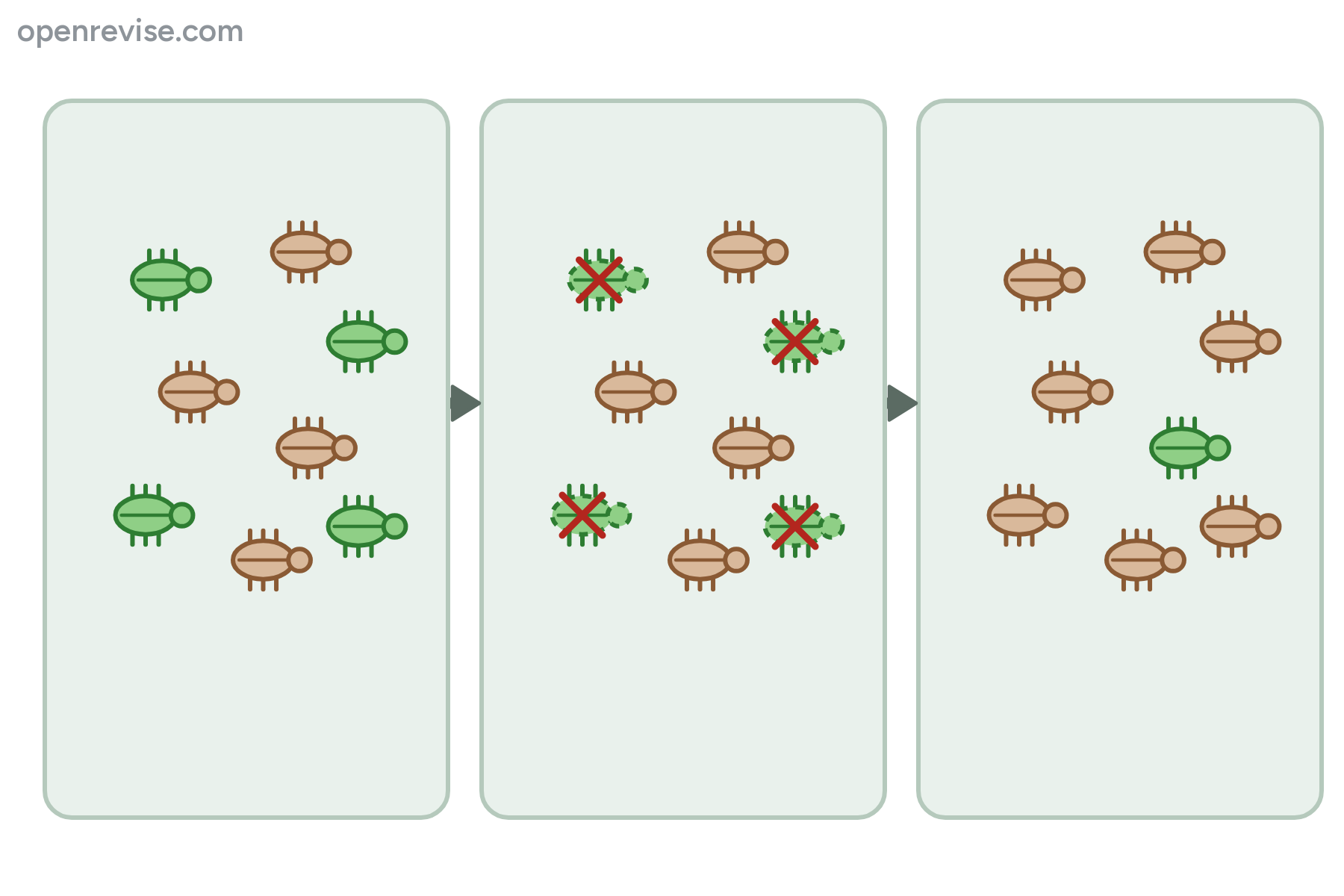 Describe what is happening in each panel, using the words variation, survive, breed and allele. (Beetles on soil, eaten by birds.)
 Panel 1: there is variation in colour. Panel 2: the green beetles are easier to see, so more are eaten and fewer survive. Panel 3: the brown beetles survive and breed and pass on their alleles, so most of the next generation is brown.
-
What is selective breeding?
The process by which humans breed plants and animals for particular genetic characteristics.
-
Another name for selective breeding?
Artificial selection.
-
How long have humans been doing selective breeding?
For thousands of years.
-
What is the first step in selective breeding?
Choose parents with the desired characteristic.
-
How many generations does selective breeding take?
Many, until all the offspring show the desired characteristic.
-
Give an example of selective breeding in food plants.
Disease resistance in crops, or large fruit.
-
Give an example of selective breeding in animals.
More meat or milk, or a gentle nature in dogs.
-
Why are large or unusual flowers selected?
Gardeners find them attractive, so they sell better.
-
What is inbreeding?
Breeding closely related individuals again and again.
-
What problem does inbreeding cause?
Some breeds are prone to disease or inherited defects.
-
Why is a lack of variation a risk?
A new disease or environmental change could affect all individuals.
-
How is selective breeding different from natural selection?
Humans choose the parents, not the environment.
-
Name a vegetable group from one wild species.
Cabbage, broccoli, cauliflower and kale all come from wild cabbage.
-
Give one welfare concern about selective breeding.
Some breeds have health problems, such as breathing difficulties.
-
Why can selective breeding take a long time?
It has to be repeated for many generations.
-
Describe the stages of selective breeding for the cow with the highest milk yield.
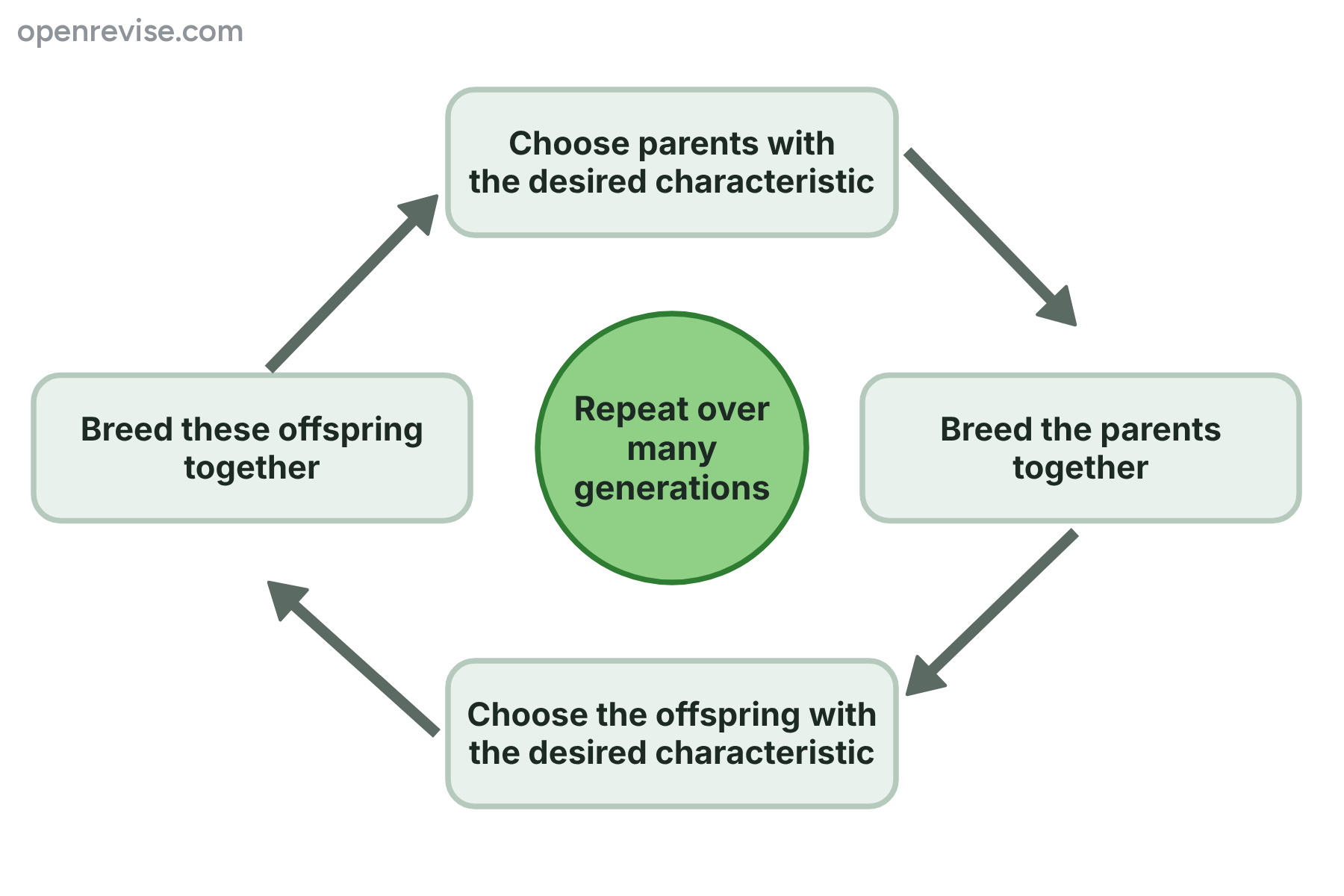
Choose the cows that give the most milk and breed them. Choose the offspring that give the most milk and breed them together. Repeat for many generations until the herd gives high yields.
-
What is genetic engineering?
Modifying the genome of an organism by introducing a gene from another organism to give a desired characteristic.
-
What are GM crops?
Crops that have had their genes modified.
-
Name two characteristics given to GM crops.
Resistance to insect attack and resistance to herbicides.
-
What effect do GM crops generally have on yield?
They generally show increased yields.
-
Which useful substance do genetically engineered bacteria make?
Human insulin.
-
Why is human insulin made by bacteria useful?
It treats people with diabetes.
-
Give one concern about GM crops and wildlife.
They could affect the populations of wild flowers and insects.
-
Give one concern about GM crops and health.
The effects of eating them on human health have not been fully explored.
-
Name one area of medical research using genetic modification.
Overcoming some inherited disorders.
-
Why do some people object to genetic engineering?
They believe it is wrong to change the genes of living organisms.
-
How is genetic engineering different from selective breeding?
It can use genes from a different species, and works in a single generation.
-
What are enzymes used for in genetic engineering? (Higher tier)
To isolate the required gene.
-
What is a vector? (Higher tier)
A carrier, usually a bacterial plasmid or a virus, that inserts the gene into the cells.
-
When are genes transferred to animals and plants? (Higher tier)
At an early stage of development, so they develop with the desired characteristics.
-
What is a plasmid? (Higher tier)
A small ring of DNA in a bacterial cell, used as a vector.
-
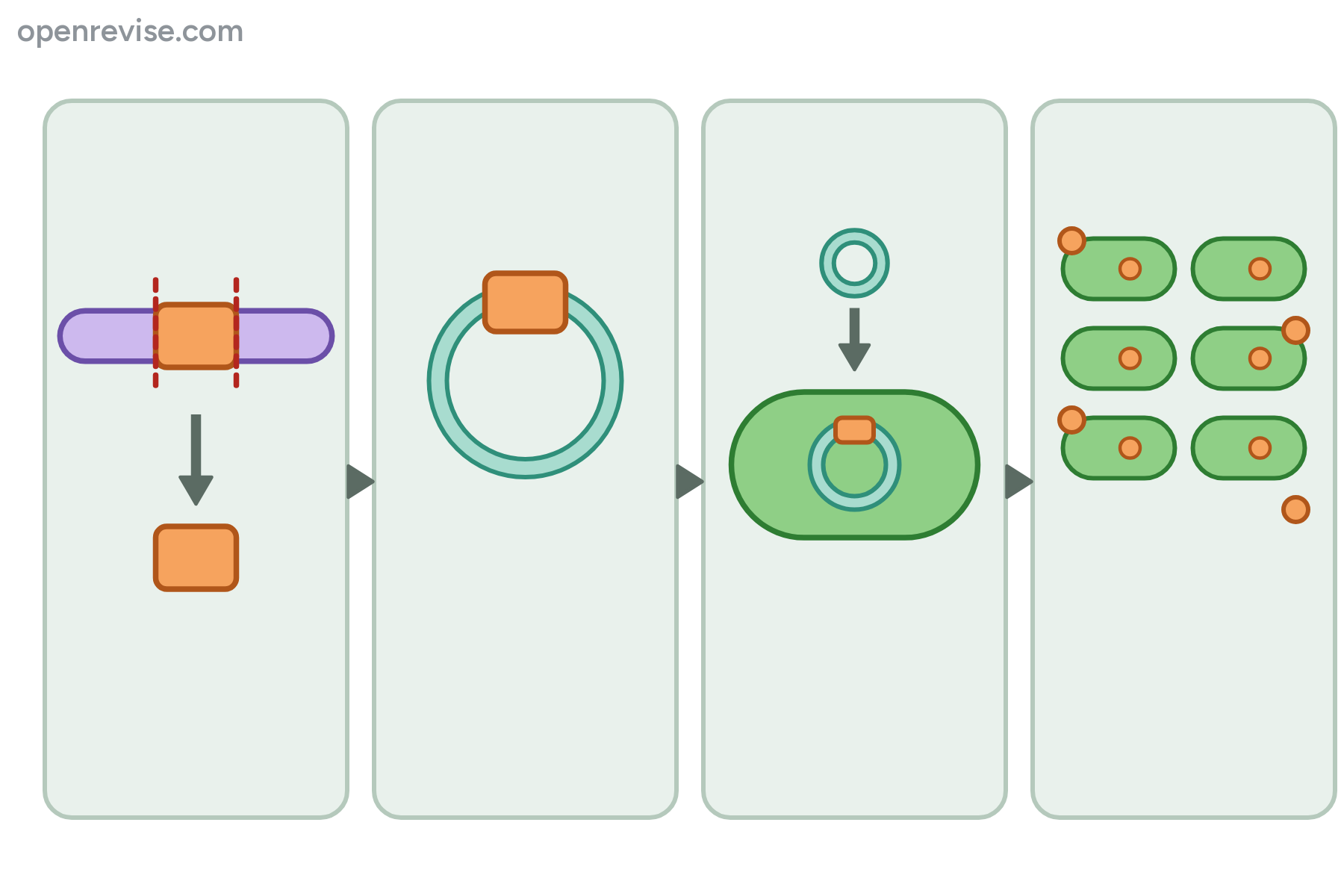 Describe what is happening at each of the four stages. (Higher tier)
 1 Enzymes cut the human insulin gene from the DNA. 2 The gene is inserted into a plasmid, the vector. 3 The vector carries the gene into a bacterium. 4 The bacteria divide and make human insulin.
-
What is cloning?
Producing genetically identical copies of an organism.
-
Why are cloned plants genetically identical?
They are made by mitosis, with no fusion of gametes.
-
What is tissue culture?
Using small groups of cells from part of a plant to grow identical new plants.
-
Where are the cells for tissue culture taken from?
The tip of a plant.
-
What do the cells grow on in tissue culture?
Sterile agar jelly containing nutrients and hormones.
-
Why must conditions be sterile in tissue culture?
To stop microorganisms growing on the agar and killing the cells.
-
What are cuttings?
Pieces of stem used by gardeners to grow many identical new plants.
-
Why is rooting powder used on cuttings?
It contains hormones that help roots to grow.
-
Why is tissue culture important for rare plants?
It preserves species by growing many plants from a tiny piece of tissue.
-
Why do nurseries use tissue culture?
To produce thousands of identical plants commercially.
-
Give one advantage of cloning in agriculture.
The plants have the same desirable characteristics.
-
Give one risk of cloning in agriculture.
No variation, so a disease could affect all the plants.
-
Which is cheaper, cuttings or tissue culture?
Cuttings.
-
Do clones have genetic variation?
No. They have the same genes.
-
Can seeds be used to produce clones?
No, because seeds come from sexual reproduction, so they vary.
-
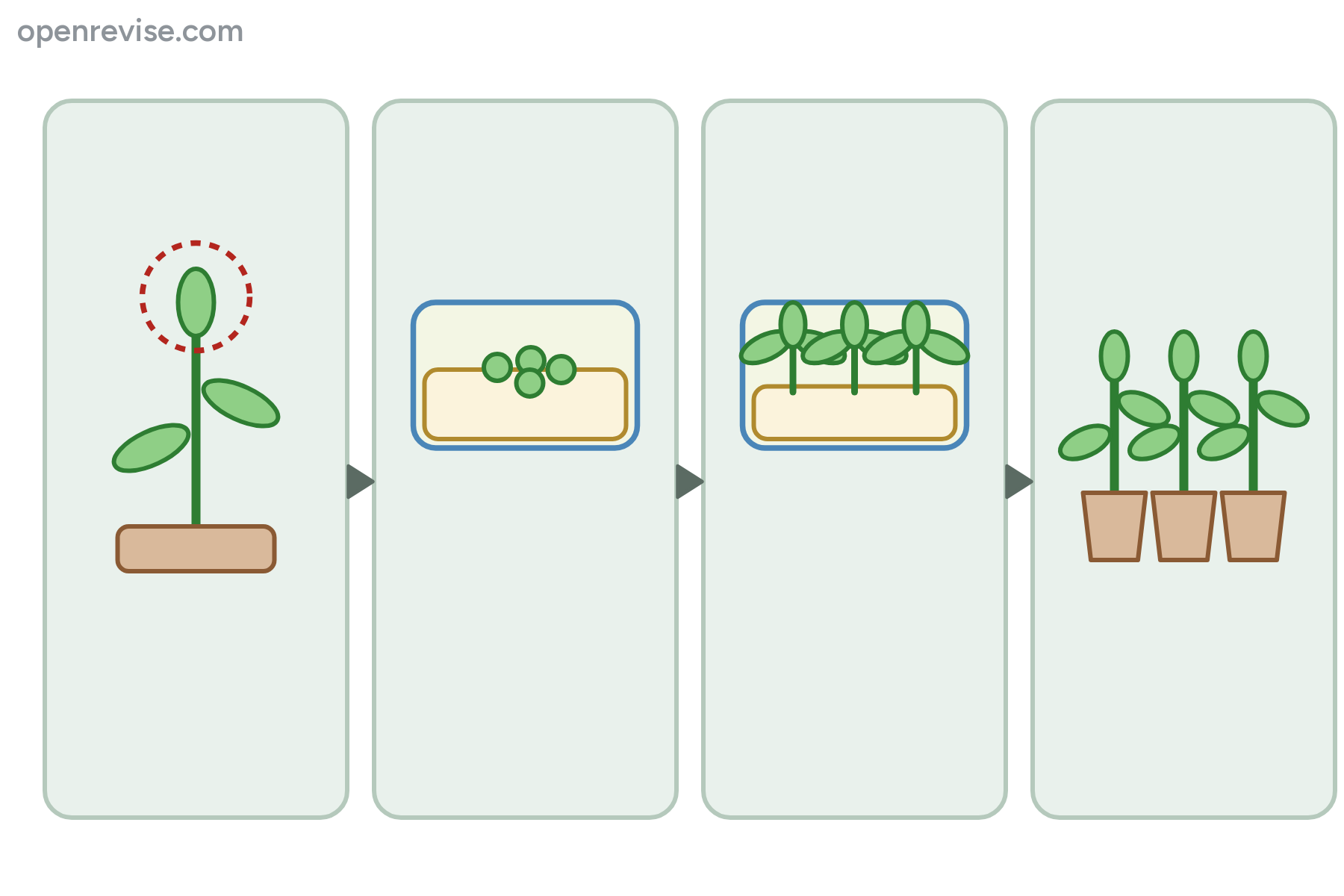 Describe how tissue culture can be used to produce hundreds of identical plants from one parent. (Biology only)
 Take small groups of cells from the plant tip. Put them on sterile agar jelly with nutrients and hormones. The cells divide into plantlets, which are then planted out and grown. All the plants are genetically identical to the parent.
-
What is an embryo transplant?
Splitting cells apart from an early embryo and putting the identical embryos into host mothers.
-
When are the cells of an embryo split apart in embryo transplants?
Before they become specialised.
-
Are animals from an embryo transplant clones of their parents?
No. They are identical to each other, but made by sexual reproduction.
-
What is removed from the egg cell in adult cell cloning?
The nucleus.
-
Where does the new nucleus come from in adult cell cloning?
An adult body cell, such as a skin cell.
-
What starts the egg cell dividing in adult cell cloning?
An electric shock.
-
What happens to the embryo in adult cell cloning?
It is put into the womb of an adult female.
-
How does the clone compare with the adult donor?
It has the same genetic information.
-
Which animal was the first mammal cloned from an adult cell?
Dolly the sheep.
-
Why was Dolly a clone of the Finn Dorset ewe?
Her nucleus came from that ewe's cell.
-
Give one benefit of cloning animals.
Large numbers of animals with high yield or disease resistance.
-
Give one risk of cloning animals.
Low success rate and possible health problems.
-
Give one ethical objection to cloning animals.
Some people believe it is wrong or causes suffering, or fear it could lead to human cloning.
-
Why do clones have no variation?
They have the same alleles.
-
Why use an unfertilised egg?
It can be given a new nucleus and start to divide.
-
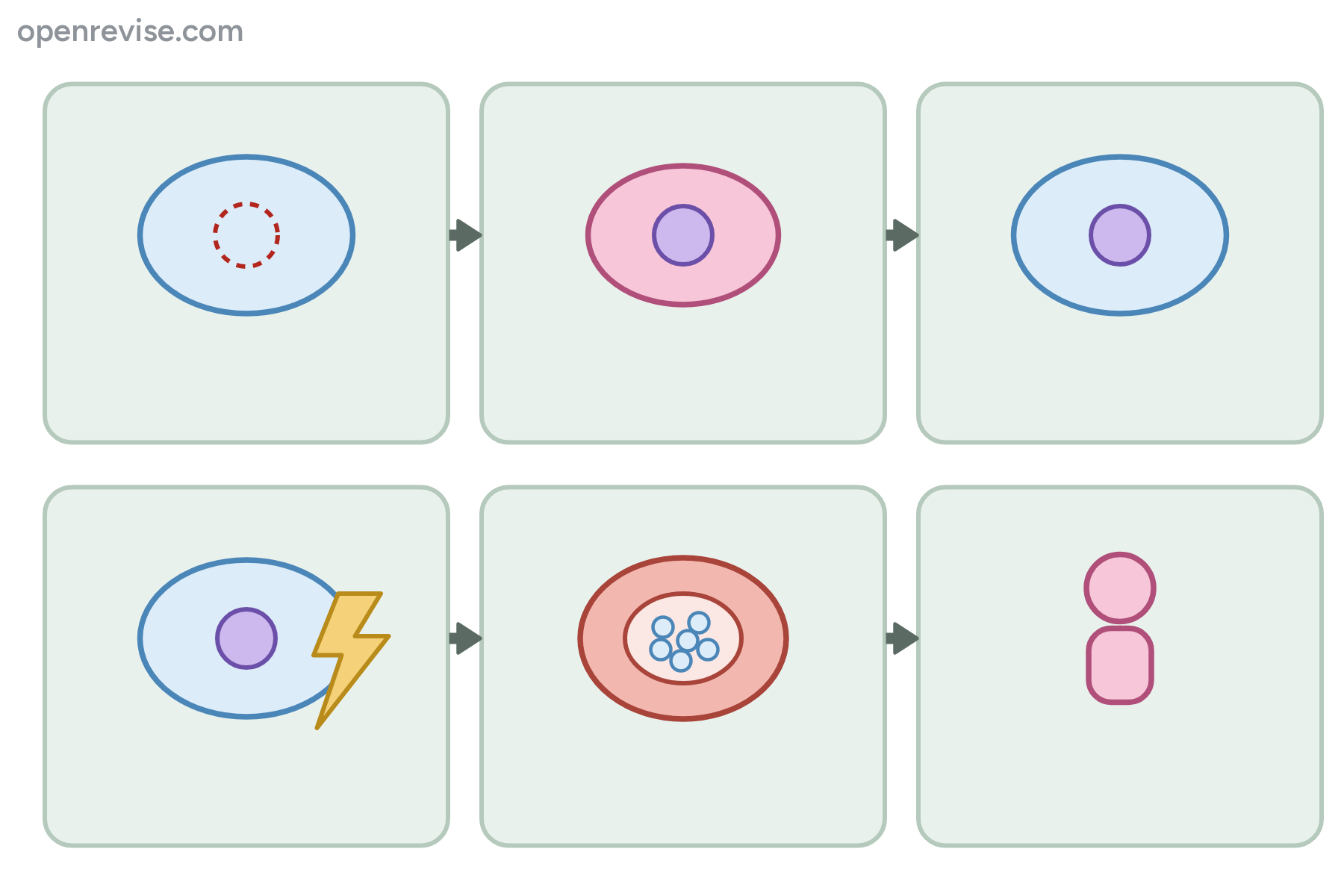 Put the stages of adult cell cloning in order, from the egg cell to the birth of the clone. (Biology only)
 1 The nucleus is removed from an unfertilised egg. 2 A nucleus is taken from an adult body cell. 3 It is inserted into the egg. 4 An electric shock makes the egg divide. 5 The embryo is put in the womb of an adult female. 6 A clone of the adult donor is born.