Exam questions · Biology
Variation and Evolution
- 42 exam questions
- 136 marks
- 48 quick checks
Variation
Just this lesson-
1 Give [3 marks]
Give three possible causes of the differences between individuals of the same species.
Show answerHide answer
Model answer
Differences in the genes they inherited. Differences in the environment in which they developed. A combination of genes and the environment. (Mutations also produce new variants.)
Mark scheme
- Genetic causes — 1 mark
- Environmental causes — 1 mark
- A combination of both — 1 mark
-
2 State [2 marks]
Name one characteristic that is controlled only by genes in humans and one that is controlled mainly by the environment.
Show answerHide answer
Model answer
Genes only: eye colour (or blood group). Environment: a scar (or the language a person speaks).
Mark scheme
- A characteristic controlled by genes, such as eye colour — 1 mark
- A characteristic caused by the environment, such as a scar — 1 mark
-
3 Explain [3 marks]
Two plants have identical genes and are grown from cuttings. One is grown in the light and one in the dark. The plant in the dark is pale and weak. Explain this difference.
Show answerHide answer
Model answer
The plants have the same genes, so the difference cannot be genetic. The environment is different, because one plant had no light. Without light the plant cannot make chlorophyll or photosynthesise properly, so it is pale and weak.
Mark scheme
- Same genes, so the difference is not genetic — 1 mark
- The environment (light) is different — 1 mark
- No light, so little chlorophyll or photosynthesis — 1 mark
-
4 Calculate [3 marks]
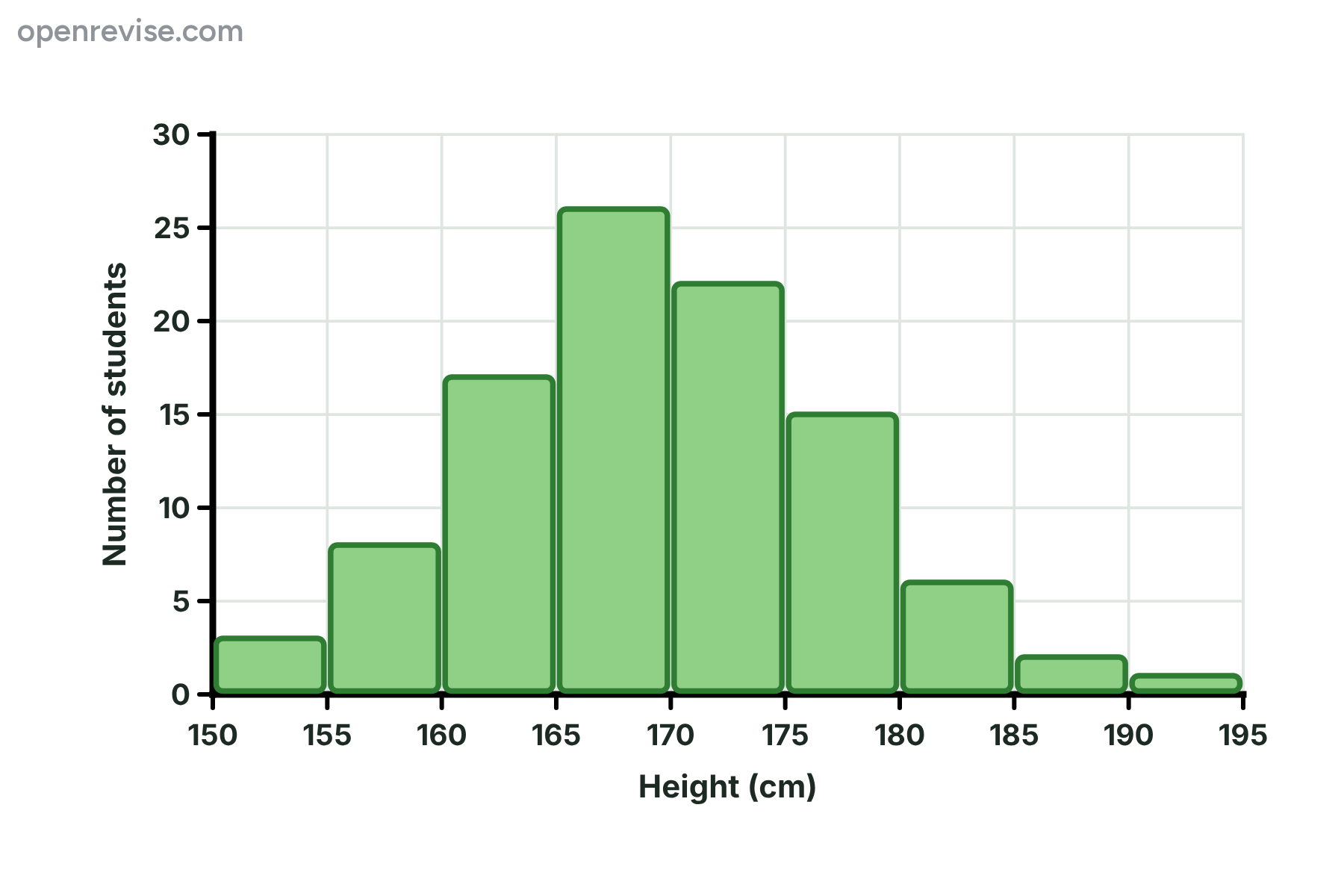
Use the chart to calculate the percentage of the students who are shorter than 160 cm.
Show answerHide answer
Model answer
11%. The students shorter than 160 cm are in the first two bars, 3 + 8 = 11, and \(\frac{11}{100} \times 100 = 11\%\).
Mark scheme
- \(3 + 8 = 11\) — 1 mark
- \(\frac{11}{100} \times 100\) — 1 mark
- 11% — 1 mark
-
5 Describe [3 marks]
Describe the pattern shown by the chart, and state the modal class.
Show answerHide answer
Model answer
Most students have a height near the middle of the range, and fewer students are very short or very tall, so the chart is bell-shaped. The modal class is 165 to 170 cm.
Mark scheme
- Most near the middle, fewer at the extremes — 1 mark
- Bell-shaped (or symmetrical) — 1 mark
- Modal class 165 to 170 cm — 1 mark
-
6 Explain [3 marks]
Mutations occur continuously, but most have no effect on the phenotype. Explain why a very small number of mutations can matter to a species.
Show answerHide answer
Model answer
A mutation can produce a new allele and so a new phenotype. If the new phenotype is suited to a change in the environment, the individuals with it are more likely to survive and breed. The allele can then become common and bring about a relatively rapid change in the species.
Mark scheme
- A mutation may give a new phenotype — 1 mark
- It may be suited to a changed environment, so those individuals survive and breed — 1 mark
- This can lead to a relatively rapid change in the species — 1 mark
-
7 Explain [4 marks]
Explain why most of the differences between people in height cannot be put down to genes alone.
Show answerHide answer
Model answer
Height is controlled by many genes, not a single gene. The conditions in which a person develops also matter, such as diet and health. A person can inherit the genes for being tall but not reach their full height if they are not well fed. So height depends on a combination of genes and the environment.
Mark scheme
- Height is controlled by many genes — 1 mark
- The environment affects it, such as diet — 1 mark
- Example of a person with tall genes who does not reach full height — 1 mark
- A combination of genes and environment — 1 mark
Quick check
-
1
What is variation?
Show answerHide answer
B: Differences between individuals in a population
Variation is the differences in the characteristics of individuals in a population.
-
2
Which characteristic is controlled only by genes?
Show answerHide answer
D: Eye colour
Eye colour is genetic, but a scar, a suntan and the ability to speak French are caused by the environment.
-
3
Which characteristic is caused by a combination of genes and the environment?
Show answerHide answer
A: Height
Height depends on the genes inherited and on conditions such as diet.
-
4
Where do all genetic variants originally come from?
Show answerHide answer
C: Mutations
All variants arise from mutations.
-
5
What effect do most mutations have on the phenotype?
Show answerHide answer
B: They have no effect
Most mutations have no effect on the phenotype.
-
6
How often do mutations occur?
Show answerHide answer
D: Continuously
Mutations occur continuously, by chance.
-
7
Two identical twins have different body masses. What is the most likely cause?
Show answerHide answer
A: Differences in diet and exercise
Identical twins have the same genes, so differences are caused by the environment, such as diet and exercise.
-
8
On a frequency chart, what does the tallest bar show?
Show answerHide answer
C: The modal class
The tallest bar is the group with the most individuals, the modal class.
Evolution and Natural Selection
Just this lesson-
1 State [1 mark]
What is meant by evolution?
Show answerHide answer
Model answer
A change in the inherited characteristics of a population over time, through natural selection.
Mark scheme
- A change in the inherited characteristics of a population over time — 1 mark
-
2 Explain [2 marks]
Explain why mutations are important in evolution.
Show answerHide answer
Model answer
Mutations produce new alleles, which give variation in the population. Natural selection can then act on this variation, so beneficial alleles may become more common.
Mark scheme
- Mutations produce new alleles (variation) — 1 mark
- Selection acts on the variation — 1 mark
-
3 Explain [4 marks]
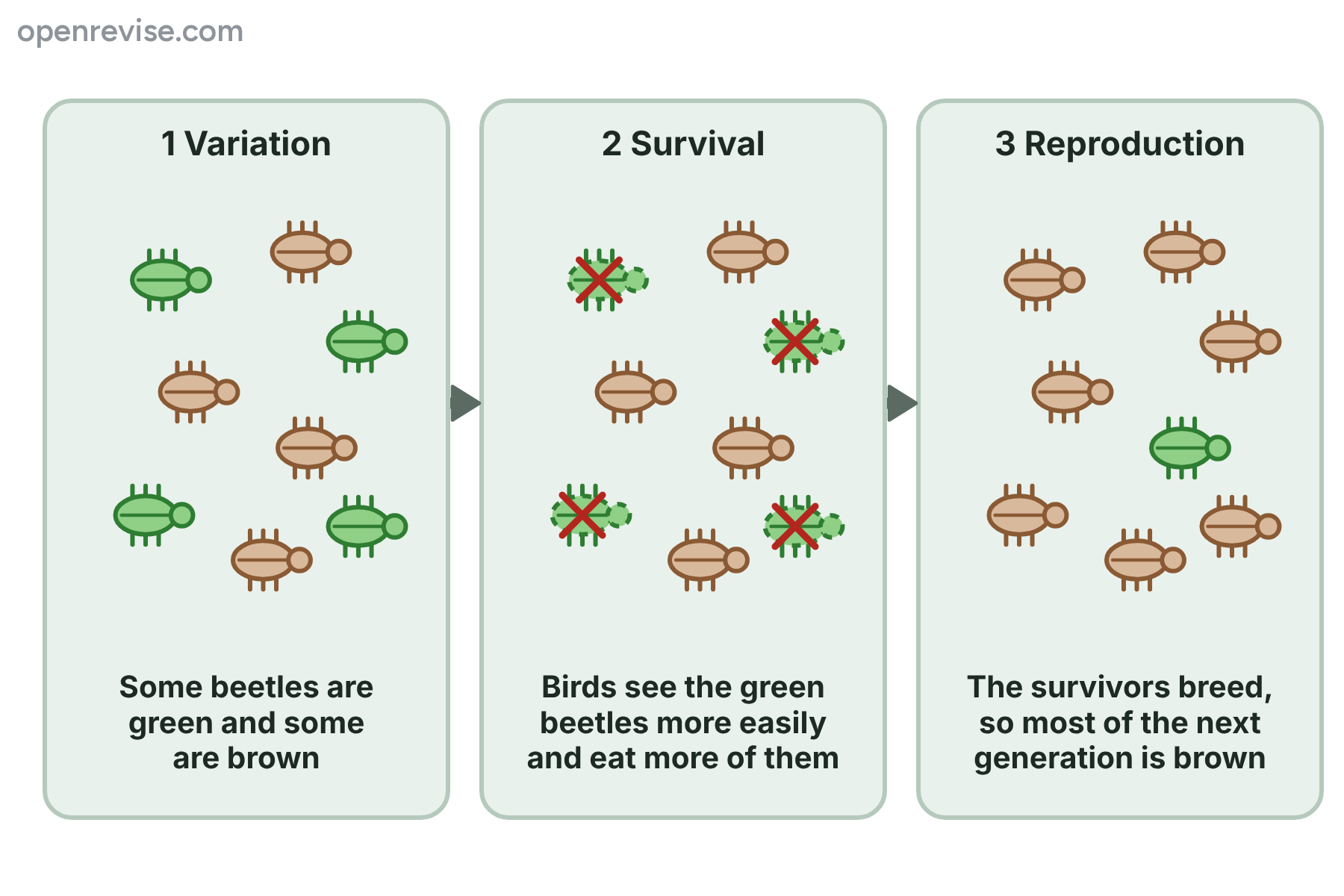
The diagram shows how the colour of a population of beetles changed. Use the theory of natural selection to explain the change.
Show answerHide answer
Model answer
There is variation in the colour of the beetles. The green beetles are easier for birds to see, so more of them are eaten and fewer survive to breed. The brown beetles are more likely to survive and breed, so they pass on the allele for brown to the next generation. Over time the allele for brown becomes more common.
Mark scheme
- There is variation in colour — 1 mark
- Green beetles are more likely to be eaten (predation) — 1 mark
- Brown beetles survive and breed — 1 mark
- The allele for brown is passed on, so it becomes more common — 1 mark
-
4 Calculate [3 marks]
A population of 600 beetles includes 240 green beetles. After many generations the population is the same size but only 12% of the beetles are green. Calculate the change in the number of green beetles.
Show answerHide answer
Model answer
At the end there are \(\frac{12}{100} \times 600 = 72\) green beetles. The change is \(240 - 72 = 168\), a fall of 168 green beetles.
Mark scheme
- \(\frac{12}{100} \times 600\) — 1 mark
- 72 green beetles — 1 mark
- A decrease of 168 — 1 mark
-
5 Explain [3 marks]
A student writes, "The peppered moths became dark because they needed to be camouflaged on the dark trees." Explain why this is not a correct use of the theory of natural selection.
Show answerHide answer
Model answer
Moths did not change colour because they needed to. Mutations produced dark moths by chance, so there was variation. When the trees became dark, dark moths were better camouflaged, so more survived and bred and passed on the allele for dark colour.
Mark scheme
- Mutations are random, so the moths did not change because they needed to — 1 mark
- Dark moths were already present, as variation — 1 mark
- Dark moths survived and bred, passing on their alleles — 1 mark
-
6 Explain [4 marks]
Explain how a new species of finch could form on an island that is separated from the mainland where the original species lives.
Show answerHide answer
Model answer
The island population is isolated from the mainland population, so the two do not interbreed. The island has a different environment, so different phenotypes are selected for. Over many generations mutations and natural selection make the two populations more and more different. If they become so different that they cannot interbreed to produce fertile offspring, they are two new species.
Mark scheme
- The two populations are separated and do not interbreed — 1 mark
- Different environments select different phenotypes — 1 mark
- The populations become more different over many generations — 1 mark
- They can no longer interbreed to produce fertile offspring — 1 mark
-
7 Explain [5 marks]
Rabbits in a snowy region show variation in fur colour. Explain, using the theory of evolution by natural selection, why after many generations most of the rabbits have white fur.
Show answerHide answer
Model answer
There is variation in the fur colour of the rabbits, due to different alleles that arose from mutations. White rabbits are better camouflaged on the snow, so predators find them less easily. White rabbits are more likely to survive and breed. They pass on the allele for white fur to their offspring. Over many generations the allele for white fur becomes more common.
Mark scheme
- Variation in fur colour, caused by mutations — 1 mark
- White rabbits are better camouflaged — 1 mark
- White rabbits are more likely to survive and breed — 1 mark
- They pass on the allele for white fur — 1 mark
- The allele becomes more common over many generations — 1 mark
Quick check
-
1
What is evolution?
Show answerHide answer
C: A change in the inherited characteristics of a population over time
Evolution is a change in the inherited characteristics of a population over time, through natural selection.
-
2
Which individuals are most likely to pass on their alleles?
Show answerHide answer
B: Those best suited to the environment
Individuals best suited to the environment are more likely to survive and breed successfully.
-
3
What is the original source of new alleles?
Show answerHide answer
D: Mutation
All new alleles arise from mutations.
-
4
What does a selection pressure do?
Show answerHide answer
A: It affects which individuals survive and breed
A selection pressure, such as a predator or disease, affects which individuals survive and breed.
-
5
Two populations of one species form two new species when they...
Show answerHide answer
C: Can no longer interbreed to produce fertile offspring
Two species cannot interbreed to produce fertile offspring.
-
6
Why did dark peppered moths become common in industrial cities?
Show answerHide answer
B: Dark moths were better camouflaged on dark trees, so survived and bred
Soot darkened the trees, so dark moths were better camouflaged, survived and bred more, and passed on the allele for dark colour.
-
7
Which statement is correct?
Show answerHide answer
D: Populations evolve over many generations
Natural selection acts on populations over many generations, and the individuals do not change.
-
8
How long ago did the first simple life forms develop, according to the theory of evolution?
Show answerHide answer
A: More than three billion years ago
All species have evolved from simple life forms that developed more than three billion years ago.
Selective Breeding
Just this lesson-
1 State [1 mark]
What is meant by selective breeding?
Show answerHide answer
Model answer
The process by which humans breed plants and animals for particular genetic characteristics.
Mark scheme
- Humans breed plants or animals for particular genetic characteristics — 1 mark
-
2 Give [2 marks]
Give two characteristics that farmers might select in domesticated animals or food plants.
Show answerHide answer
Model answer
Any two of: disease resistance in food crops, more meat or milk from animals, larger fruit, a gentle nature in dogs, large or unusual flowers.
Mark scheme
- First suitable characteristic — 1 mark
- Second suitable characteristic — 1 mark
-
3 Describe [4 marks]
Describe how a farmer could use selective breeding to produce a herd of cattle that gives more milk.
Show answerHide answer
Model answer
The farmer chooses the cows that give the most milk and the bulls from mothers that gave a lot of milk, and breeds them together. From the offspring the farmer selects the ones that give the most milk, and breeds these together. This is repeated for many generations until the herd gives high yields.
Mark scheme
- Choose parents with high milk yield — 1 mark
- Breed them together — 1 mark
- Select offspring with the highest yield and breed them — 1 mark
- Repeat over many generations — 1 mark
-
4 Calculate [3 marks]
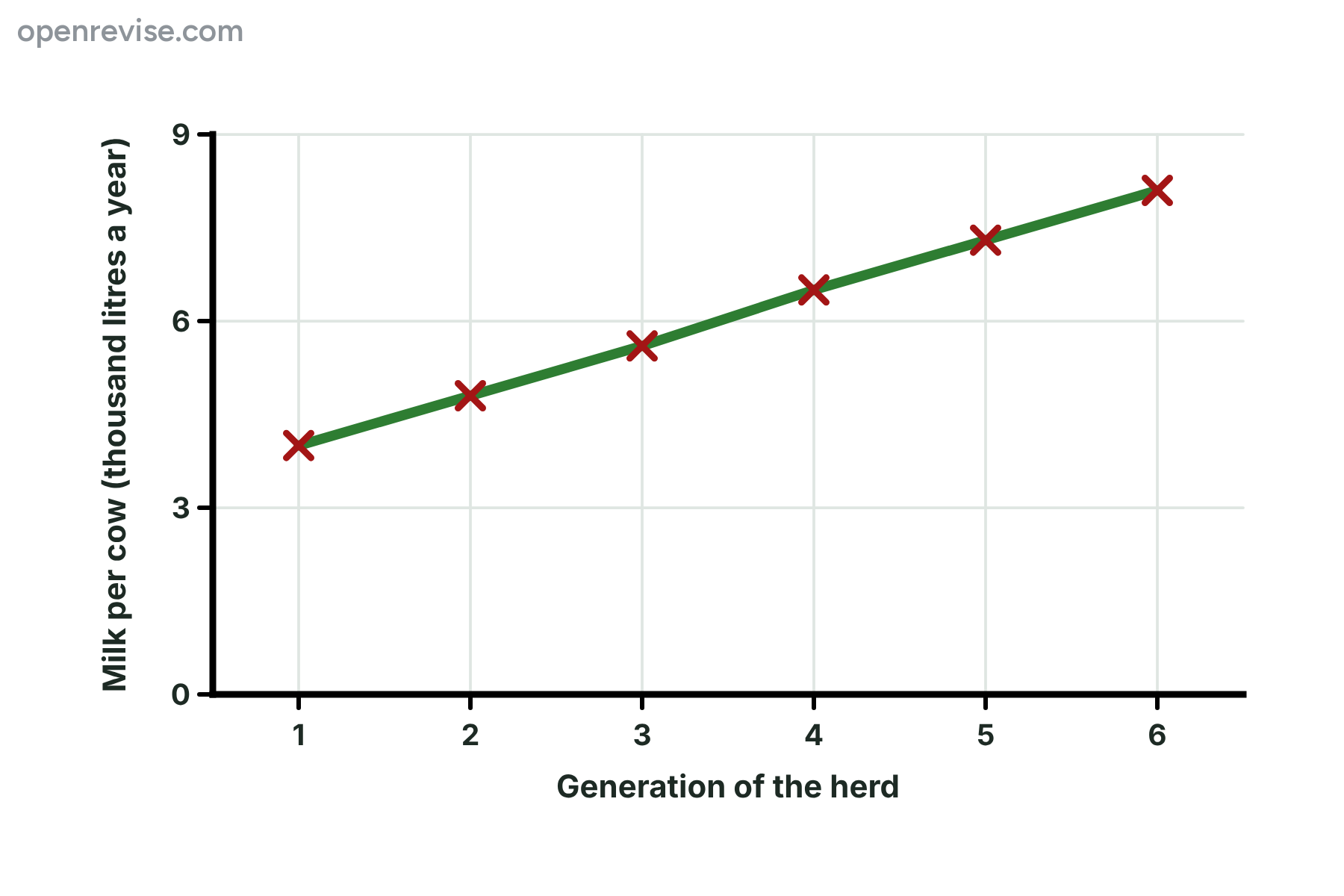
The graph shows the average milk yield over six generations of selective breeding. Calculate the mean increase in yield per generation between generation 1 and generation 6, in thousand litres per cow per year.
Show answerHide answer
Model answer
0.82 thousand litres per generation. The total increase is \(8.1 - 4.0 = 4.1\), over 5 generations, so \(4.1 \div 5 = 0.82\).
Mark scheme
- \(8.1 - 4.0 = 4.1\) — 1 mark
- Divided by 5 generations (not 6) — 1 mark
- 0.82 — 1 mark
-
5 Explain [3 marks]
Explain why selective breeding can lead to inbreeding.
Show answerHide answer
Model answer
Breeding only from the few individuals with the desired characteristic means that the parents are often closely related. After many generations all the animals are closely related. This is inbreeding.
Mark scheme
- Only a few individuals with the desired characteristic are bred — 1 mark
- They are often closely related — 1 mark
- Over many generations all the individuals are closely related, giving inbreeding — 1 mark
-
6 Explain [3 marks]
Some breeds of dog are particularly prone to disease and inherited defects. Explain why.
Show answerHide answer
Model answer
These breeds have been selectively bred from a small number of closely related dogs, which is inbreeding. Inbreeding reduces the variety of alleles, so harmful recessive alleles are more likely to be inherited from both parents. This causes inherited defects and disease.
Mark scheme
- Small number of related parents (inbreeding) — 1 mark
- Less variety of alleles — 1 mark
- Harmful alleles more likely to be inherited, so more defects or disease — 1 mark
-
7 Evaluate [6 marks]
A farmer is deciding whether to grow a variety of wheat that has been selectively bred for high yield and disease resistance. Evaluate the benefits and risks of using selectively bred crops.
Show answerHide answer
Model answer
The wheat gives a higher yield, so the farmer produces more food and income from the same land. Disease resistance means that less of the crop is lost and the farmer may spend less on pesticides. However, if all the plants in the crop are closely related they have very little variation. A new disease or a change in the climate could damage the whole crop, because no plants have the suited allele. The seed may be costly. Overall, the benefits of higher yield and resistance are likely to outweigh the risks, as long as the farmer keeps some variety and watches for new diseases.
Mark scheme
- Higher yield means more food or income — 1 mark
- Disease resistance means less crop loss or fewer pesticides — 1 mark
- A further benefit such as consistent quality — 1 mark
- Crops closely related so little variation — 1 mark
- A new disease or environmental change could affect all plants — 1 mark
- A reasoned conclusion that weighs benefits and risks — 1 mark
Quick check
-
1
Selective breeding is also called...
Show answerHide answer
B: Artificial selection
Artificial selection, because humans choose which individuals breed.
-
2
Which of these is the first step in selective breeding?
Show answerHide answer
A: Choose parents with the desired characteristic
The breeder starts by choosing parents with the desired characteristic.
-
3
How many generations does selective breeding usually take?
Show answerHide answer
D: Many
The process continues over many generations until all offspring show the characteristic.
-
4
Which characteristic might be selected in a food crop?
Show answerHide answer
C: Disease resistance
Disease resistance is a useful characteristic in food crops.
-
5
What is inbreeding?
Show answerHide answer
B: Breeding closely related individuals
Inbreeding is breeding closely related individuals, which reduces genetic variation.
-
6
Why are some dog breeds prone to inherited defects?
Show answerHide answer
D: They have been inbred
Inbreeding reduces variation, so harmful alleles are more likely to be inherited from both parents.
-
7
How is selective breeding different from natural selection?
Show answerHide answer
A: Humans choose which individuals breed
In selective breeding humans choose the individuals which breed, whereas in natural selection the environment selects.
-
8
Why is low variation in a crop a risk?
Show answerHide answer
C: A new disease could affect the whole crop
If the plants are very similar, a new disease or change in the environment could affect all of them.
Genetic Engineering
Just this lesson-
1 State [1 mark]
What is meant by genetic engineering?
Show answerHide answer
Model answer
Modifying the genome of an organism by introducing a gene from another organism to give a desired characteristic.
Mark scheme
- Introducing a gene from one organism into another to give a desired characteristic — 1 mark
-
2 Give [2 marks]
Give two ways in which crop plants have been genetically engineered.
Show answerHide answer
Model answer
Any two of: to be resistant to diseases, to be resistant to insect attack, to be resistant to herbicides, to produce bigger or better fruits.
Mark scheme
- First correct way — 1 mark
- Second correct way — 1 mark
-
3 Describe [2 marks]
Describe how genetic engineering is used in the treatment of diabetes.
Show answerHide answer
Model answer
Bacterial cells are genetically engineered with the human insulin gene, so they make human insulin. The insulin is harvested and used to treat people with diabetes.
Mark scheme
- Bacteria are genetically engineered to make human insulin — 1 mark
- The insulin is used to treat diabetes — 1 mark
-
4 Explain [4 marks]
Some people are in favour of growing GM crops and some are against. Explain one reason in favour and one reason against.
Show answerHide answer
Model answer
In favour: GM crops generally show increased yields, which means more food can be produced from the same land, so more people can be fed. Against: there are concerns about the effects on populations of wild flowers and insects, and some people feel that the effects of eating GM crops on human health have not been fully explored.
Mark scheme
- In favour: increased yield or insect/herbicide resistance — 1 mark
- Developed: more food or lower costs — 1 mark
- Against: effect on wild flowers and insects or on health — 1 mark
- Developed: for example populations may decline, or long-term effects are uncertain — 1 mark
-
5 Describe [4 marks]
Describe the main steps in the process of genetic engineering of a bacterium to make human insulin.
Show answerHide answer
Model answer
Enzymes are used to isolate the human insulin gene from the DNA. The gene is inserted into a vector, which is usually a bacterial plasmid. The vector is used to insert the gene into the bacterial cells. The bacteria then divide and make human insulin.
Mark scheme
- Enzymes isolate the required gene — 1 mark
- The gene is inserted into a vector such as a plasmid — 1 mark
- The vector inserts the gene into the bacterial cells — 1 mark
- The bacteria make the human insulin — 1 mark
-
6 Name [3 marks]
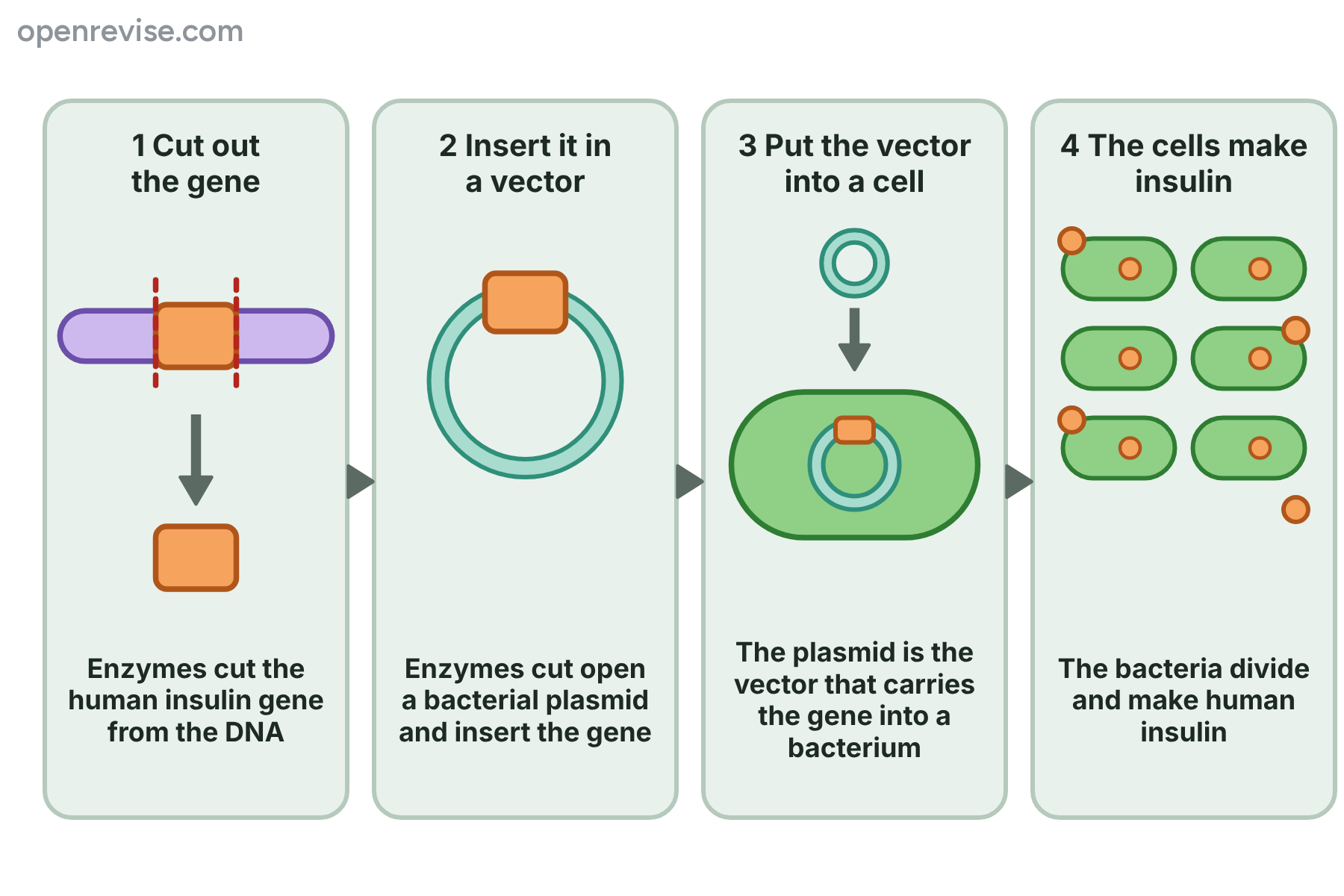
The diagram shows the genetic engineering of bacteria. Name the substances that cut the gene out of the DNA, name the vector, and state what the bacteria make.
Show answerHide answer
Model answer
Enzymes cut the gene out. The vector is the plasmid. The bacteria make human insulin.
Mark scheme
- Enzymes — 1 mark
- Plasmid — 1 mark
- Human insulin — 1 mark
-
7 Explain [3 marks]
Explain why genes are transferred to animals and plants at an early stage of their development when they are genetically engineered.
Show answerHide answer
Model answer
At an early stage the organism is only a few cells. If the gene is transferred then, every cell that develops from it will contain the gene. So the organism develops with the desired characteristic.
Mark scheme
- Early stage means few cells — 1 mark
- All the cells that develop contain the gene — 1 mark
- So the organism develops with the desired characteristic — 1 mark
-
8 Evaluate [6 marks]
A company wants to grow a genetically modified crop that is resistant to insect attack. Evaluate the benefits and risks of growing the crop.
Show answerHide answer
Model answer
The crop is resistant to insects, so less is lost to pests and yields are higher. The farmer may need to use fewer insecticides, which saves money and may reduce pollution. However, there are concerns about the effects on populations of wild flowers and insects, because insects are part of food chains and pollinate flowers. Some people feel that the effects on human health of eating the crop have not been fully explored. Some people object to genetic engineering for ethical reasons. Overall, the benefits of food production may outweigh the risks if the crop is tested carefully, but some people will still object.
Mark scheme
- Higher yields because less is lost to insects — 1 mark
- Fewer insecticides, so lower cost or less pollution — 1 mark
- Effects on wild flowers and insects — 1 mark
- Effects on human health not fully explored — 1 mark
- Some people object on ethical grounds — 1 mark
- A reasoned conclusion that weighs both sides — 1 mark
Quick check
-
1
What does genetic engineering involve?
Show answerHide answer
C: Moving a gene from one organism to another
A gene is introduced from one organism into another to give a desired characteristic.
-
2
Which substance is made by genetically engineered bacteria to treat diabetes?
Show answerHide answer
A: Human insulin
Bacteria with the human insulin gene make human insulin.
-
3
What are crops with modified genes called?
Show answerHide answer
D: GM crops
They are genetically modified (GM) crops.
-
4
Which is a characteristic that GM crops may be given?
Show answerHide answer
B: Resistance to insect attack
Resistance to insect attack or herbicides is a common modification.
-
5
Which is a concern about GM crops?
Show answerHide answer
A: Effects on wild flowers and insects
There are concerns about effects on populations of wild flowers and insects.
-
6
What are enzymes used for in genetic engineering?
Show answerHide answer
C: To isolate the required gene
Enzymes are used to isolate the required gene.
-
7
Which of these is usually used as a vector?
Show answerHide answer
D: A bacterial plasmid
Vectors are usually bacterial plasmids or viruses.
-
8
Why are genes transferred at an early stage of development?
Show answerHide answer
B: All the cells that develop will contain the gene
Then all the cells that develop contain the gene, so the organism develops with the desired characteristic.
Cloning Plants
Just this lesson-
1 State [1 mark]
What is a clone?
Show answerHide answer
Model answer
An organism that is genetically identical to its parent.
Mark scheme
- Genetically identical organism — 1 mark
-
2 Describe [3 marks]
Describe how a gardener could use cuttings to produce new plants identical to a parent plant.
Show answerHide answer
Model answer
The gardener cuts a piece of stem from the parent plant and removes the lower leaves. The cutting is dipped in rooting powder and planted in compost. It grows roots and develops into a new plant that is identical to the parent.
Mark scheme
- Cut a piece of stem from the parent — 1 mark
- Plant it (in compost), perhaps after dipping in rooting powder — 1 mark
- It grows into a new identical plant — 1 mark
-
3 Describe [4 marks]
The diagram shows tissue culture. Describe the steps that are used to produce new plants.
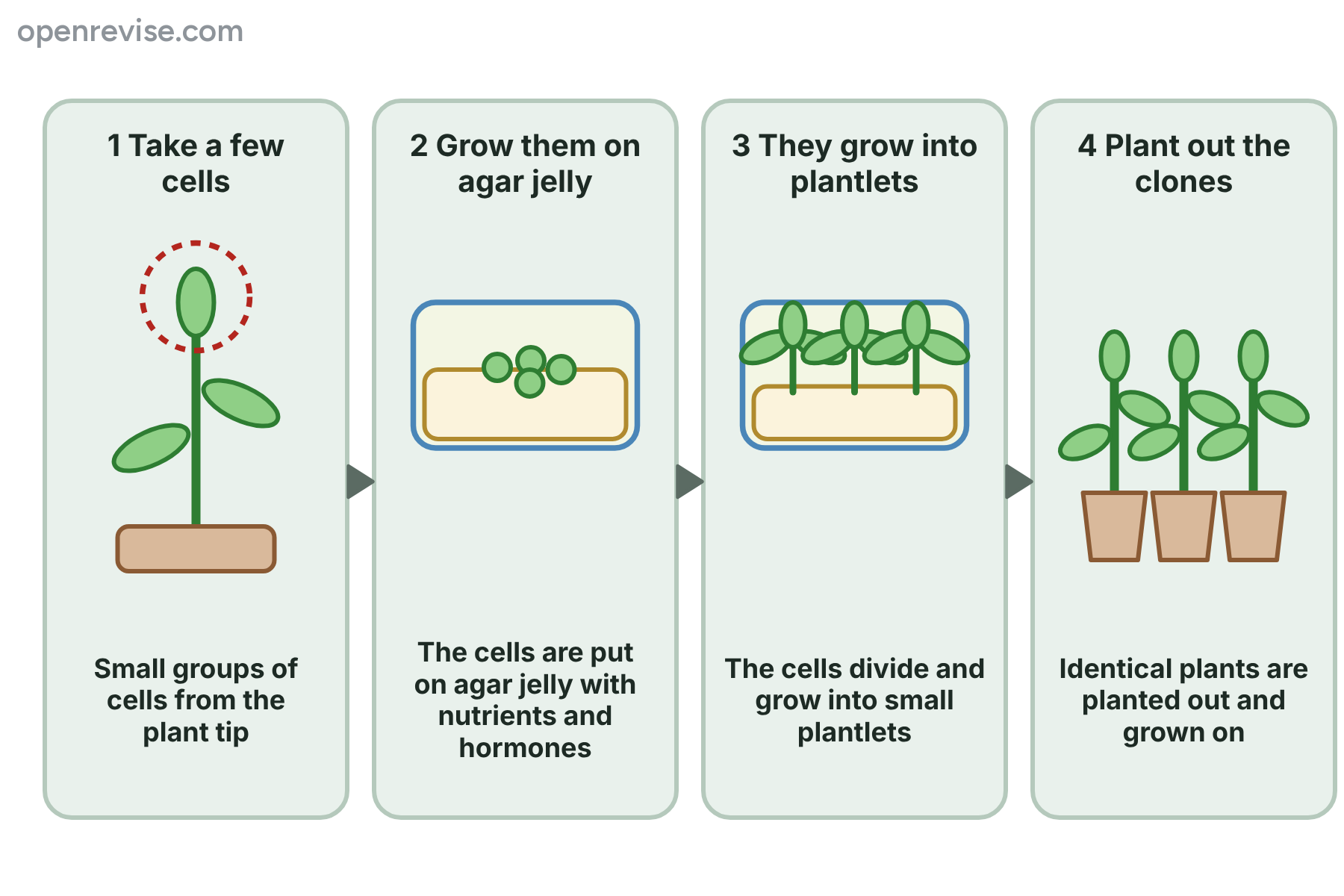
Show answerHide answer
Model answer
Small groups of cells are taken from the tip of the plant. They are put on agar jelly which contains nutrients and hormones. The cells divide and grow into small plantlets. The plantlets are planted out and grown on into identical plants.
Mark scheme
- Small groups of cells taken from the plant — 1 mark
- Placed on agar jelly with nutrients and hormones — 1 mark
- They grow into small plantlets — 1 mark
- Planted out to grow into identical plants — 1 mark
-
4 Explain [3 marks]
Explain why tissue culture is useful for preserving a rare species of plant.
Show answerHide answer
Model answer
Many new plants can be grown from a tiny piece of tissue, so very few plants need to be taken from the wild. This does not damage the wild population. The new plants can be grown on and replanted to increase the numbers.
Mark scheme
- Many plants from a tiny piece of tissue — 1 mark
- Wild population is not damaged — 1 mark
- Numbers can be increased by planting out — 1 mark
-
5 Calculate [3 marks]
A nursery produces 600 plantlets by tissue culture. 8% of them die before being planted out. Calculate the number of plants that are planted out.
Show answerHide answer
Model answer
552 plants. \(\frac{8}{100} \times 600 = 48\) die, and \(600 - 48 = 552\).
Mark scheme
- \(\frac{8}{100} \times 600\) — 1 mark
- 48 die — 1 mark
- 552 — 1 mark
-
6 Explain [3 marks]
A grower uses cuttings from one tomato plant to produce a whole crop. Explain the risk of growing a crop in which all of the plants are clones.
Show answerHide answer
Model answer
The plants are genetically identical, so they have no variation. If a new disease arrives, or the climate changes, all the plants may be affected in the same way because none have a different allele that helps them survive. The whole crop could be lost.
Mark scheme
- Clones are genetically identical (no variation) — 1 mark
- A disease or change in conditions could affect them all — 1 mark
- The whole crop could be lost — 1 mark
-
7 Evaluate [6 marks]
A nursery wants to produce 10 000 identical plants of a variety that has large red flowers. Evaluate the use of tissue culture rather than cuttings.
Show answerHide answer
Model answer
Tissue culture can produce thousands of plants from a small amount of tissue, and so a nursery can make 10 000 identical plants quickly, in a small space and at any time of year. Cuttings give far fewer plants from each parent, so many parent plants would be needed. Tissue culture needs a laboratory, sterile conditions and trained staff, so it costs more. The plants from both methods are clones, so they will all have large red flowers, but the lack of variation means a disease could affect all of them. Overall, tissue culture is the better choice for such a large number of plants.
Mark scheme
- Many plants from a small piece of tissue — 1 mark
- Quick, small space, all year round — 1 mark
- Cuttings give fewer plants, so more parent plants are needed — 1 mark
- Tissue culture is more costly or needs a sterile laboratory — 1 mark
- Both methods give clones, so no variation and risk from disease — 1 mark
- A reasoned conclusion — 1 mark
Quick check
-
1
How are plants produced in tissue culture genetically?
Show answerHide answer
D: Identical to the parent
They are produced by mitosis from the parent's cells, so they are genetically identical clones.
-
2
What do the cells grow on in tissue culture?
Show answerHide answer
B: Agar jelly with nutrients
The cells grow on sterile agar jelly containing nutrients and hormones.
-
3
Why is tissue culture important for rare plants?
Show answerHide answer
A: Many plants can be grown without damaging the wild population
It allows many plants to be grown from a small piece of tissue, without damaging the wild population.
-
4
What is a cutting?
Show answerHide answer
C: A piece of a plant that grows into a new plant
A cutting is a piece cut from a plant that grows into a new plant identical to the parent.
-
5
Which statement about cloned plants is correct?
Show answerHide answer
B: They have no genetic variation
Cloned plants have the same genes, so there is no genetic variation between them.
-
6
Why is tissue culture done in sterile conditions?
Show answerHide answer
D: To stop microorganisms damaging the cells
To stop microorganisms growing on the jelly and killing the plant cells.
-
7
What is a risk of growing a crop of clones?
Show answerHide answer
C: One disease could affect all the plants
With no variation, a new disease could affect all of the plants.
-
8
Which method needs more equipment and sterile conditions?
Show answerHide answer
A: Tissue culture
Tissue culture needs a laboratory, whereas cuttings can be done by gardeners at home.
Cloning Animals
Just this lesson-
1 Describe [2 marks]
Describe how an embryo transplant can be used to produce several identical animals.
Show answerHide answer
Model answer
Cells are split apart from a developing animal embryo before they become specialised. The identical embryos are then transplanted into host mothers.
Mark scheme
- Cells of an early embryo are split apart — 1 mark
- Identical embryos transplanted into host mothers — 1 mark
-
2 Describe [5 marks]
The diagram shows adult cell cloning. Describe the process.
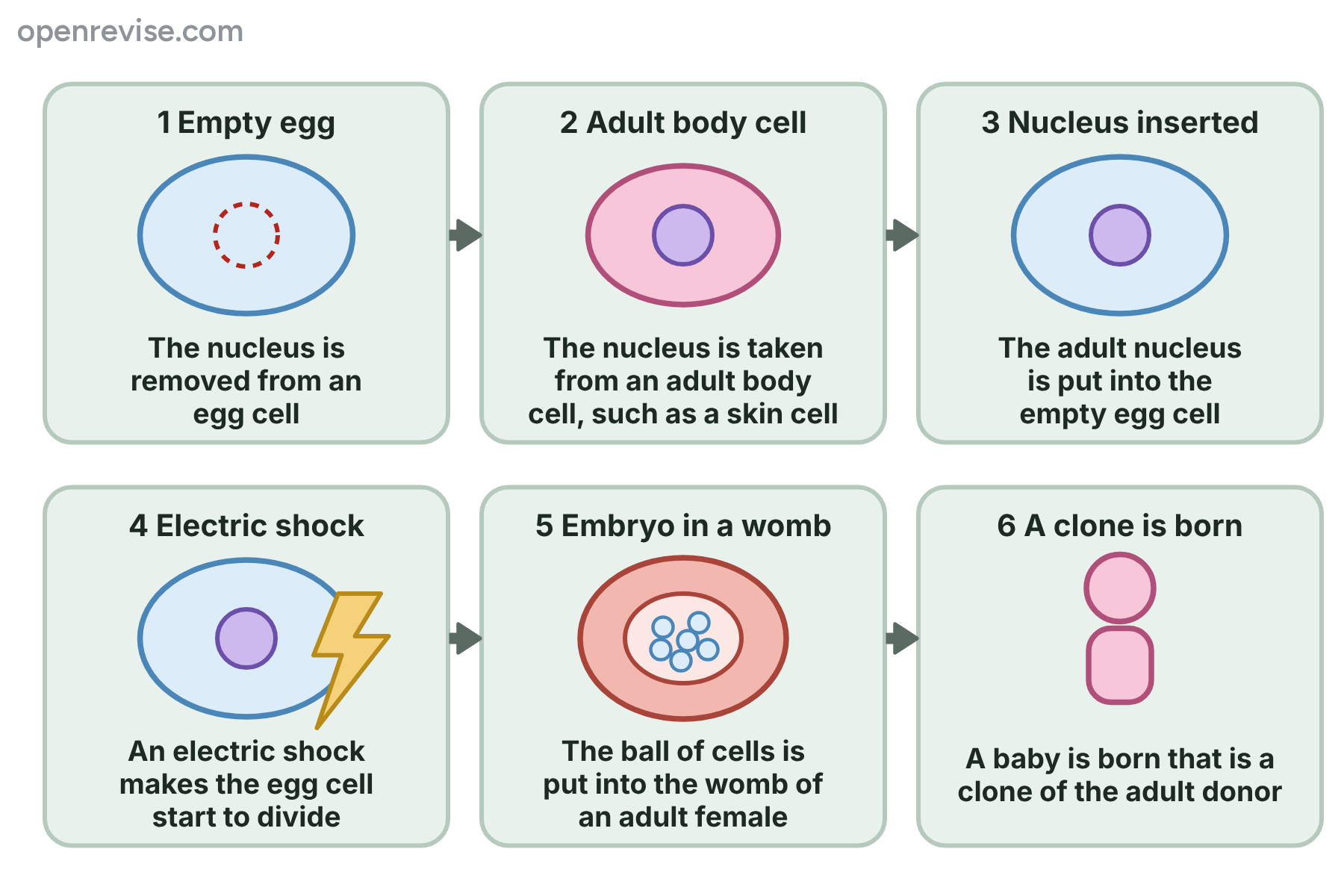
Show answerHide answer
Model answer
The nucleus is removed from an unfertilised egg cell. The nucleus from an adult body cell, such as a skin cell, is inserted into the egg cell. An electric shock stimulates the egg cell to divide to form an embryo. When the embryo is a ball of cells, it is inserted into the womb of an adult female. The embryo develops into an animal that has the same genetic information as the adult donor.
Mark scheme
- Nucleus removed from an unfertilised egg — 1 mark
- Nucleus from adult body cell inserted — 1 mark
- Electric shock stimulates division — 1 mark
- Embryo inserted into the womb of an adult female — 1 mark
- Offspring has the same genetic information as the donor — 1 mark
-
3 Explain [3 marks]
Explain why Dolly the sheep looked like the Finn Dorset ewe that gave the nucleus, and not like the Scottish Blackface ewe that gave the egg cell.
Show answerHide answer
Model answer
The nucleus contains the genetic information, which was taken from the Finn Dorset ewe. The nucleus was removed from the Blackface egg cell, so it did not contribute any genes. Dolly's characteristics were controlled by the genes from the Finn Dorset nucleus.
Mark scheme
- The nucleus contains the genetic information — 1 mark
- The nucleus of the Blackface egg was removed — 1 mark
- Dolly's genes came from the Finn Dorset nucleus — 1 mark
-
4 Explain [4 marks]
Explain why the cells of an embryo have to be split apart before they have become specialised in an embryo transplant.
Show answerHide answer
Model answer
Before they are specialised, the cells are all alike and any one can develop into a complete animal. If they are left until after they have become specialised, they can only develop into particular types of cell and cannot form a whole animal. So the cells must be separated early to give several identical embryos.
Mark scheme
- Early cells are not specialised — 1 mark
- Any one can develop into a whole animal — 1 mark
- Specialised cells can only form certain cell types — 1 mark
- So it has to be early to give several identical embryos — 1 mark
-
5 Explain [3 marks]
A farmer clones the cow with the highest milk yield. Explain one benefit and one risk.
Show answerHide answer
Model answer
Benefit: the clones are genetically identical to the high-yielding cow, so they should all give a high milk yield. Risk: the clones have no genetic variation, so a new disease could affect the whole herd.
Mark scheme
- Benefit: all clones should have a high yield — 1 mark
- Risk: no genetic variation — 1 mark
- Developed: a disease could affect them all — 1 mark
-
6 Evaluate [6 marks]
Some scientists want to use adult cell cloning to produce large numbers of cattle that all give a very high milk yield. Evaluate this proposal.
Show answerHide answer
Model answer
Adult cell cloning produces cattle that are genetically identical to the best cow, so the herd would all give high milk yields, and the farmer would earn more. However, the success rate is low, many attempts fail, and so it is expensive. The cloned animals can have health problems, which raises welfare issues. Because the clones have no genetic variation, a single new disease could affect the whole herd. Some people also object to cloning animals on ethical grounds. Overall, the risks and cost may outweigh the benefit, unless the success rate improves and the health of the animals can be guaranteed.
Mark scheme
- Clones would all give a high yield — 1 mark
- Low success rate and expensive — 1 mark
- Health or welfare problems — 1 mark
- No genetic variation so one disease affects the whole herd — 1 mark
- Ethical objections — 1 mark
- A reasoned conclusion — 1 mark
Quick check
-
1
What is removed from the egg cell in adult cell cloning?
Show answerHide answer
A: The nucleus
The nucleus is removed so the egg has no genetic material of its own.
-
2
Which cell supplies the nucleus in adult cell cloning?
Show answerHide answer
C: An adult body cell
The nucleus comes from an adult body cell, such as a skin cell.
-
3
What makes the egg cell start to divide?
Show answerHide answer
B: An electric shock
An electric shock stimulates the egg cell to divide to form an embryo.
-
4
Where is the ball of cells placed to continue its development?
Show answerHide answer
D: The womb of an adult female
It is inserted into the womb of an adult female.
-
5
When are the cells split apart in an embryo transplant?
Show answerHide answer
A: Before they have become specialised
They are split apart before they become specialised.
-
6
Which was the first mammal cloned from an adult body cell?
Show answerHide answer
C: Dolly the sheep
Dolly the sheep was born in 1996.
-
7
Which is a risk of cloning animals?
Show answerHide answer
B: The success rate is low
The success rate is low and clones may have health problems.
-
8
How does the genetic information of a clone from adult cell cloning compare with the donor?
Show answerHide answer
D: It is the same
The embryo cells contain the same genetic information as the adult body cell.