Flashcards · Biology · Cell Structure
Culturing Microorganisms
-
How do bacteria multiply?
By binary fission: a cell divides into two identical cells.
-
How quickly can bacteria divide?
As often as once every 20 minutes, with enough nutrients and a suitable temperature.
-
What are the two ways of growing bacteria?
In nutrient broth, or on agar gel in a Petri dish.
-
What is aseptic technique?
Methods used to stop unwanted microorganisms getting into a culture.
-
Why are the Petri dish and agar sterilised?
To kill any microorganisms already on them.
-
Why is the inoculating loop passed through a flame?
To kill microorganisms on it, so only the wanted bacteria are transferred.
-
Why is the lid taped on?
To stop microorganisms from the air getting in.
-
Why is the tape not run all the way round the dish?
So that oxygen can get in, which stops harmful anaerobic bacteria growing.
-
What is the maximum temperature for incubating in school?
25 °C.
-
Why is 25 °C the limit in school?
Higher temperatures make it more likely that harmful pathogens grow.
-
A bacterium divides every 20 minutes. How many are there after 1 hour, starting from one?
8 (three divisions: 2, 4, 8).
-
How do you find the number of divisions in a time?
Divide the time by the mean division time.
-
What does a clear zone around a disc show?
The antibiotic or antiseptic has killed the bacteria or stopped them growing there.
-
What does a bigger clear zone tell you?
The chemical is more effective.
-
What is the formula for the area of a circle?
\(A = \pi r^{2}\), where r is the radius (half the diameter).
-
Why is a control disc soaked in sterile water included?
To show that the paper itself does not stop the bacteria growing.
-
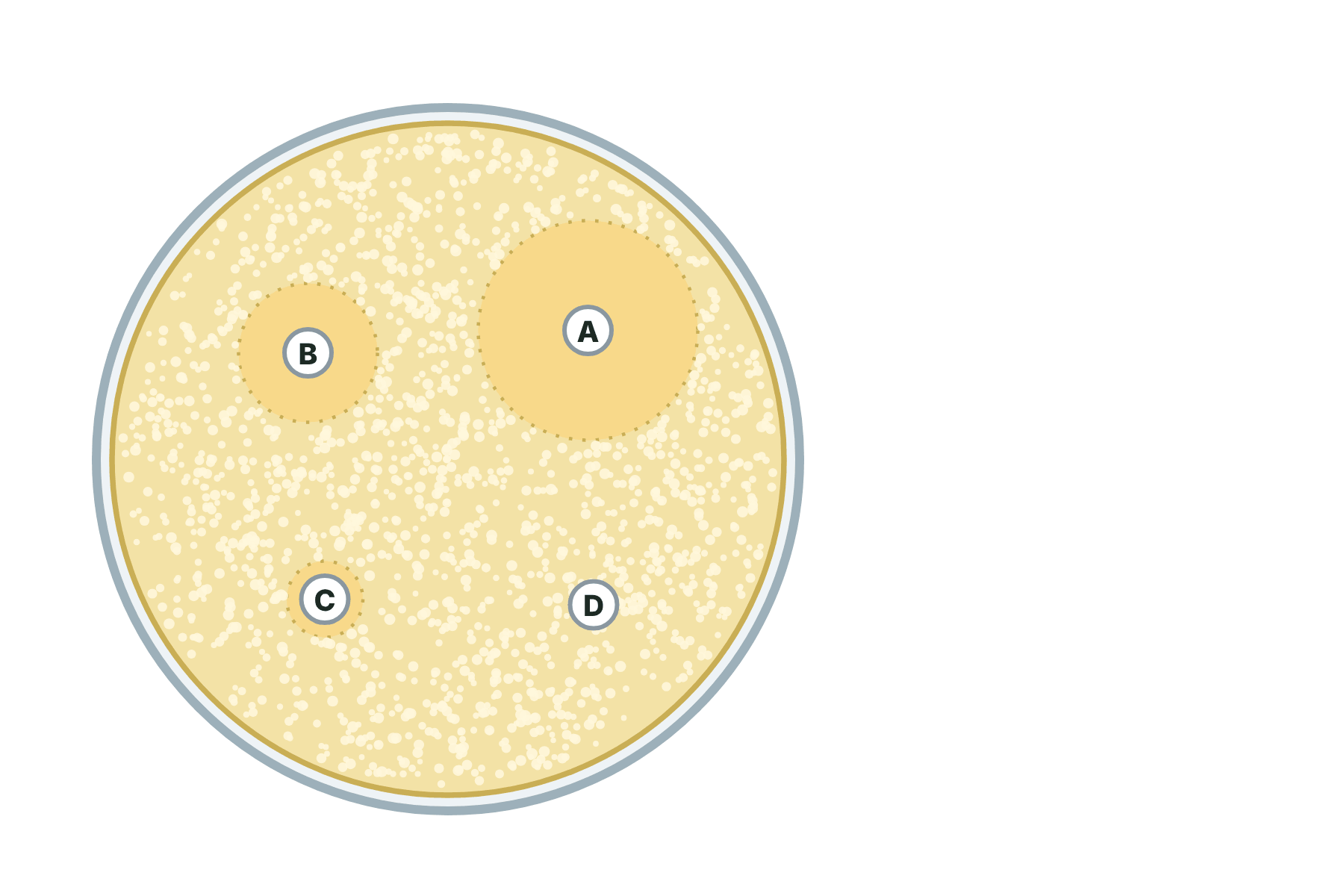 Which antibiotic is most effective here, and how can you tell?
 Disc A. It has the biggest clear zone, so it killed or stopped the growth of the most bacteria.