Flashcards · Biology
Blood, Blood Vessels and the Heart
-
What are the four components of blood?
Plasma, red blood cells, white blood cells and platelets.
-
What is plasma mostly made of?
Water.
-
Name four things that plasma carries.
Any four of: carbon dioxide, glucose, amino acids, urea, hormones, mineral ions, heat.
-
What is the job of a red blood cell?
To carry oxygen from the lungs to the cells.
-
What is haemoglobin?
A red protein containing iron that combines with oxygen.
-
What does haemoglobin form in the lungs?
Oxyhaemoglobin, by combining with oxygen.
-
Why does a red blood cell have no nucleus?
To make more room for haemoglobin, so it can carry more oxygen.
-
Why is a red blood cell a biconcave disc?
It has a large surface area for its volume, so oxygen diffuses in and out quickly.
-
Why can red blood cells squeeze through capillaries?
They are small and flexible.
-
Does a white blood cell have a nucleus?
Yes.
-
What do phagocytes do?
They engulf and digest pathogens, which is called phagocytosis.
-
Why can a phagocyte surround a pathogen?
It can change shape.
-
What do lymphocytes make?
Antibodies.
-
What are platelets?
Small fragments of cells with no nucleus.
-
What is the job of platelets?
To help the blood to clot at a wound.
-
Why is a clot useful?
It stops blood loss and keeps pathogens out of the wound.
-
Which is more numerous, red or white blood cells?
Red blood cells, about 5 million per cubic millimetre against about 7000.
-
What is the formula for magnification?
\(\text{magnification} = \text{image size} \div \text{actual size}\).
-
Which mineral ion is needed to make haemoglobin?
Iron.
-
What is the common mistake about red blood cells?
Saying they have a nucleus, or that they carry carbon dioxide. They have no nucleus and mainly carry oxygen.
-
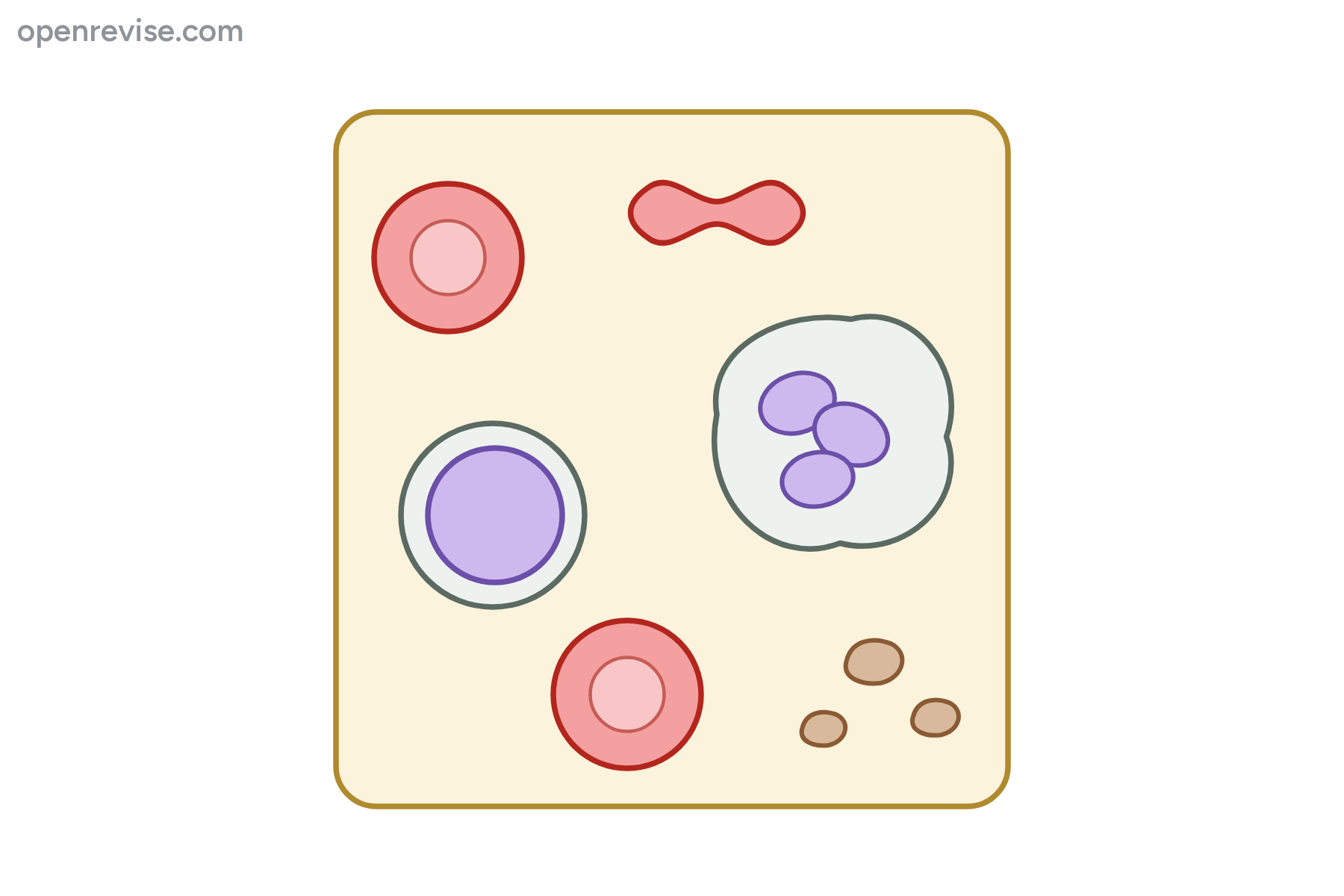 Name each type of blood cell in this diagram and say what each does.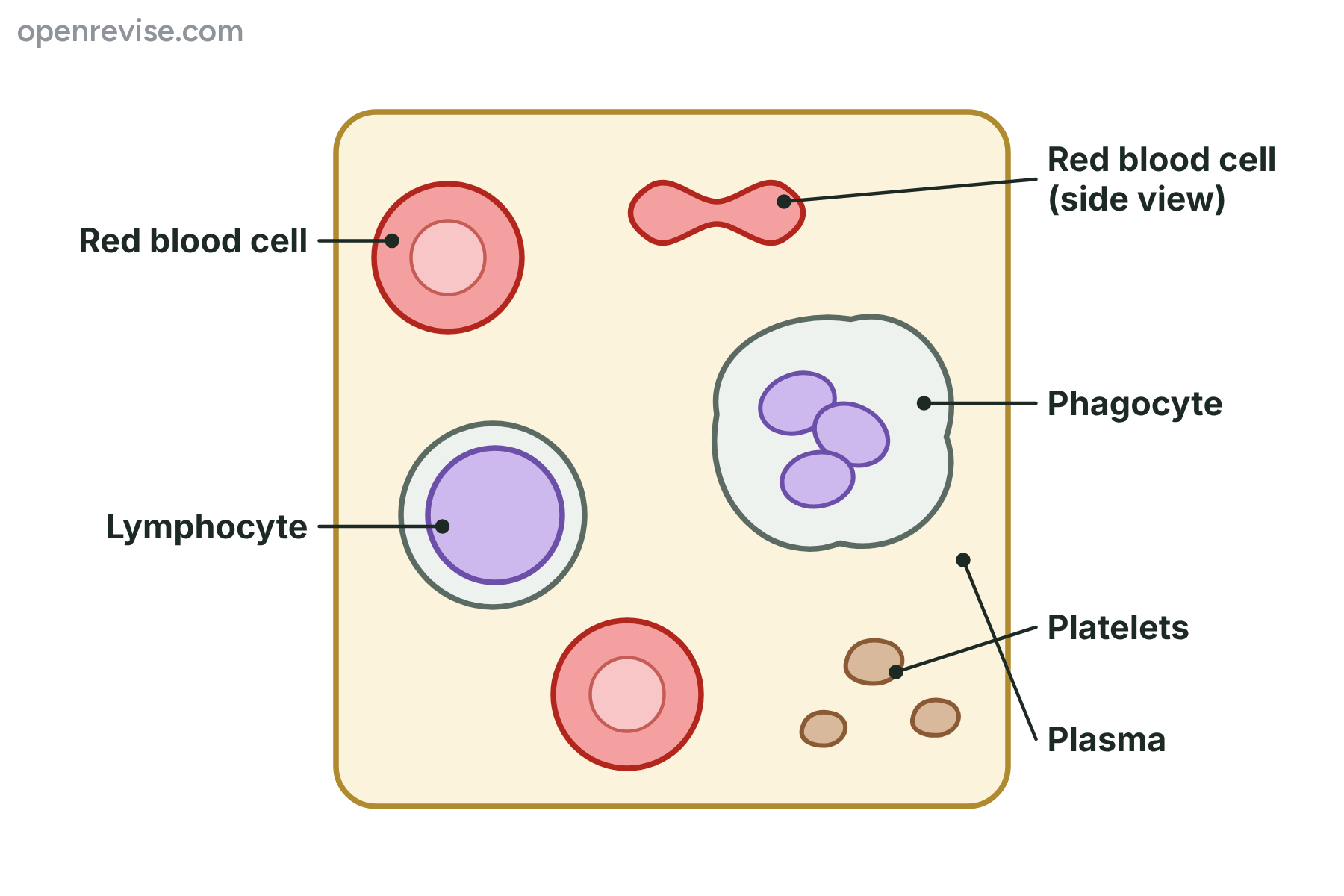
The red cells carry oxygen using haemoglobin. The cell with the lobed nucleus is a phagocyte, which engulfs pathogens. The cell with the large round nucleus is a lymphocyte, which makes antibodies. The small fragments are platelets, which help the blood to clot.
-
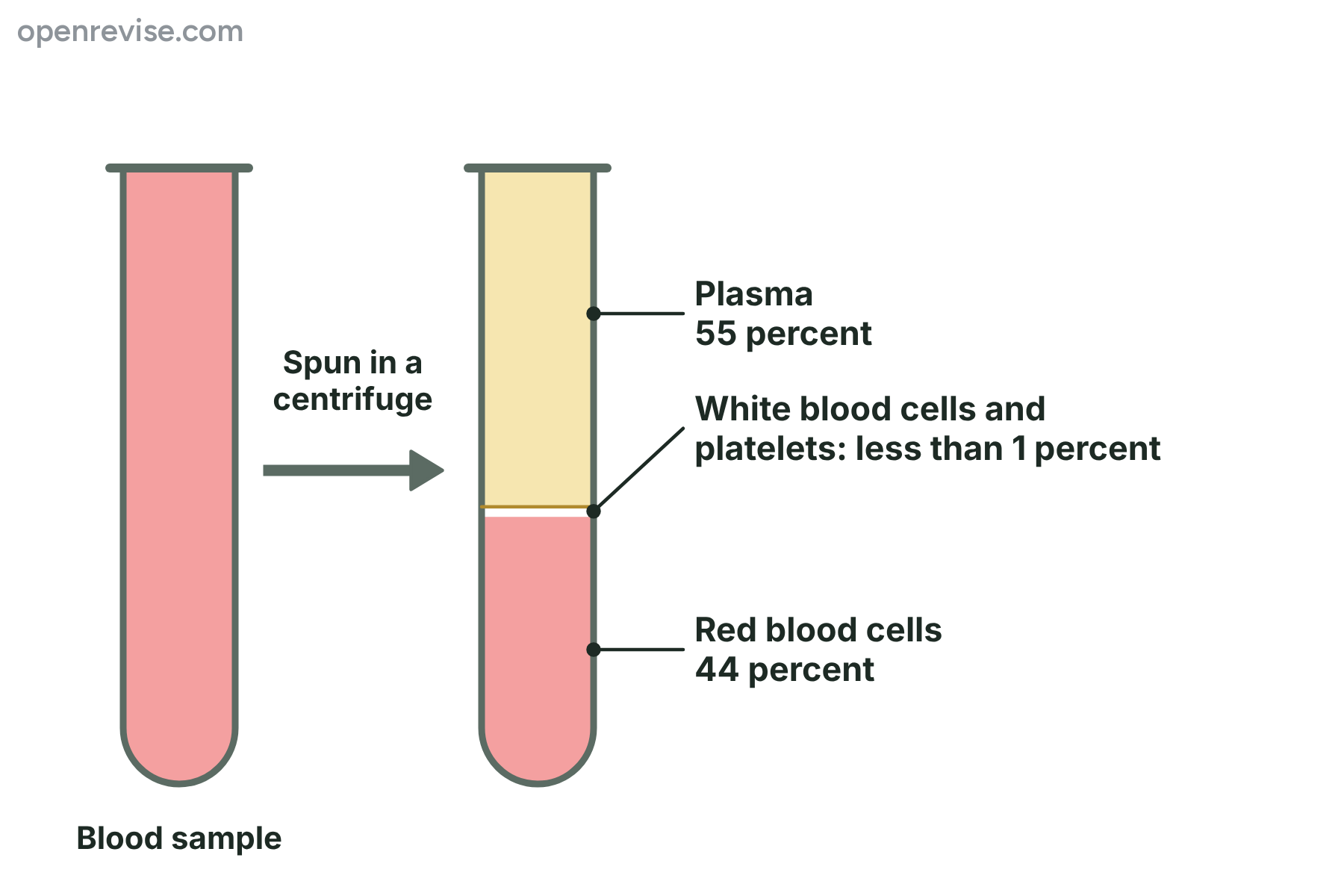 What percentage of the blood is plasma, and what makes up the rest?
 About 55 percent is plasma. About 44 percent is red blood cells, and less than 1 percent is white blood cells and platelets.
-
Which direction does blood flow in arteries?
Away from the heart.
-
Which direction does blood flow in veins?
Towards the heart.
-
What is the function of capillaries?
To allow substances to be exchanged between the blood and the cells.
-
Why do arteries have thick walls?
To withstand the high pressure of the blood from the heart.
-
What do the elastic fibres in an artery do?
They stretch and recoil to smooth the flow and keep the pressure up.
-
What is the lumen?
The space inside a blood vessel.
-
Why is the lumen of an artery narrow?
It helps to keep the pressure high.
-
Why do veins have a wide lumen?
The blood has little resistance, so it flows easily at low pressure.
-
Why do veins have valves?
To stop the blood flowing backwards.
-
What helps to push blood along the veins in the legs?
The squeezing of the leg muscles.
-
Why are capillary walls one cell thick?
So that the diffusion distance is very short.
-
Why are capillaries so narrow?
Red blood cells pass through in single file, close to the wall, so oxygen exchange is fast.
-
Why does the blood flow slowly through the capillaries?
The total space in the capillary network is large. It gives time for exchange.
-
Which artery carries deoxygenated blood?
The pulmonary artery, to the lungs.
-
Which vein carries oxygenated blood?
The pulmonary vein, from the lungs.
-
What is your pulse?
The stretching and recoil of an artery wall with each heartbeat.
-
How do you calculate the rate of blood flow?
Volume of blood divided by the time.
-
A vessel image is 40 mm across at \(\times 8\) magnification. What is the actual size?
\(40 \div 8 = 5\ \text{mm}\).
-
Why does a cut artery spurt but a cut vein ooze?
Arteries have high pressure and pulse with the heartbeat. Veins have low pressure.
-
What is the usual mistake with arteries and veins?
Saying arteries carry oxygenated blood and veins deoxygenated. It is the direction of flow that matters.
-
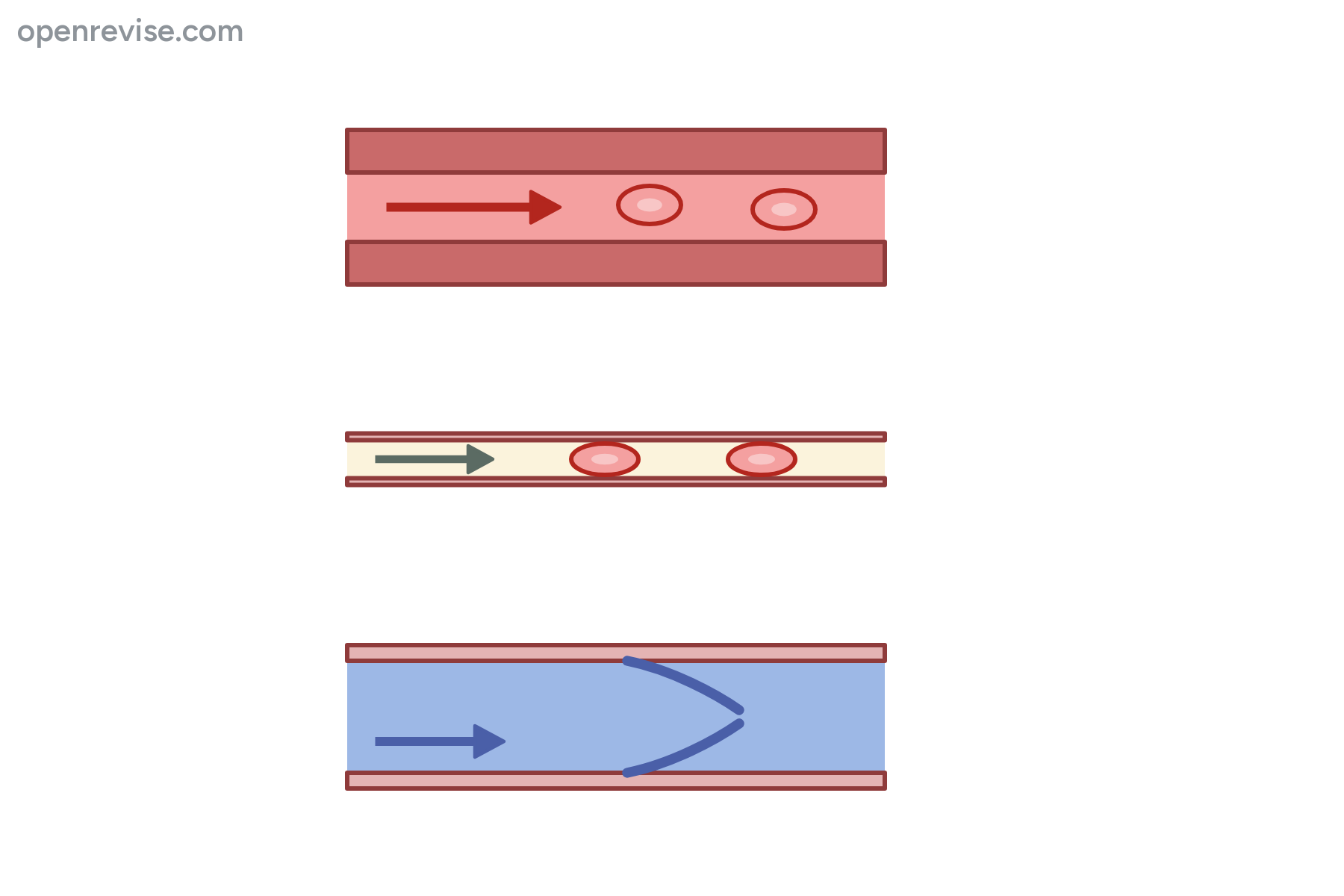 Name the three vessels in this diagram, and say how each is adapted.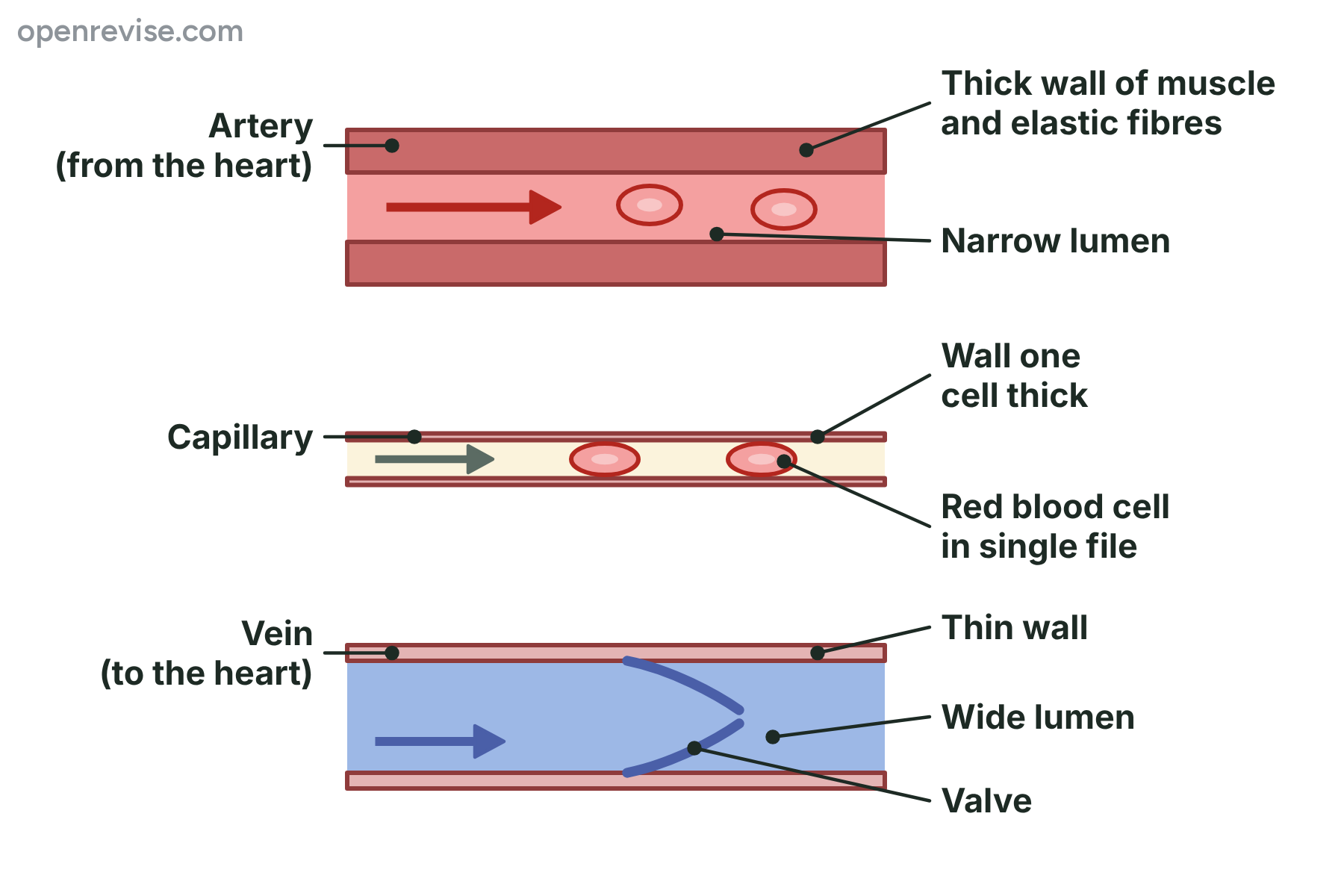
Top is an artery with a thick muscular, elastic wall and a narrow lumen for high pressure. Middle is a capillary, with a wall one cell thick for fast exchange. Bottom is a vein, with a thin wall, a wide lumen and a valve to stop backflow.
-
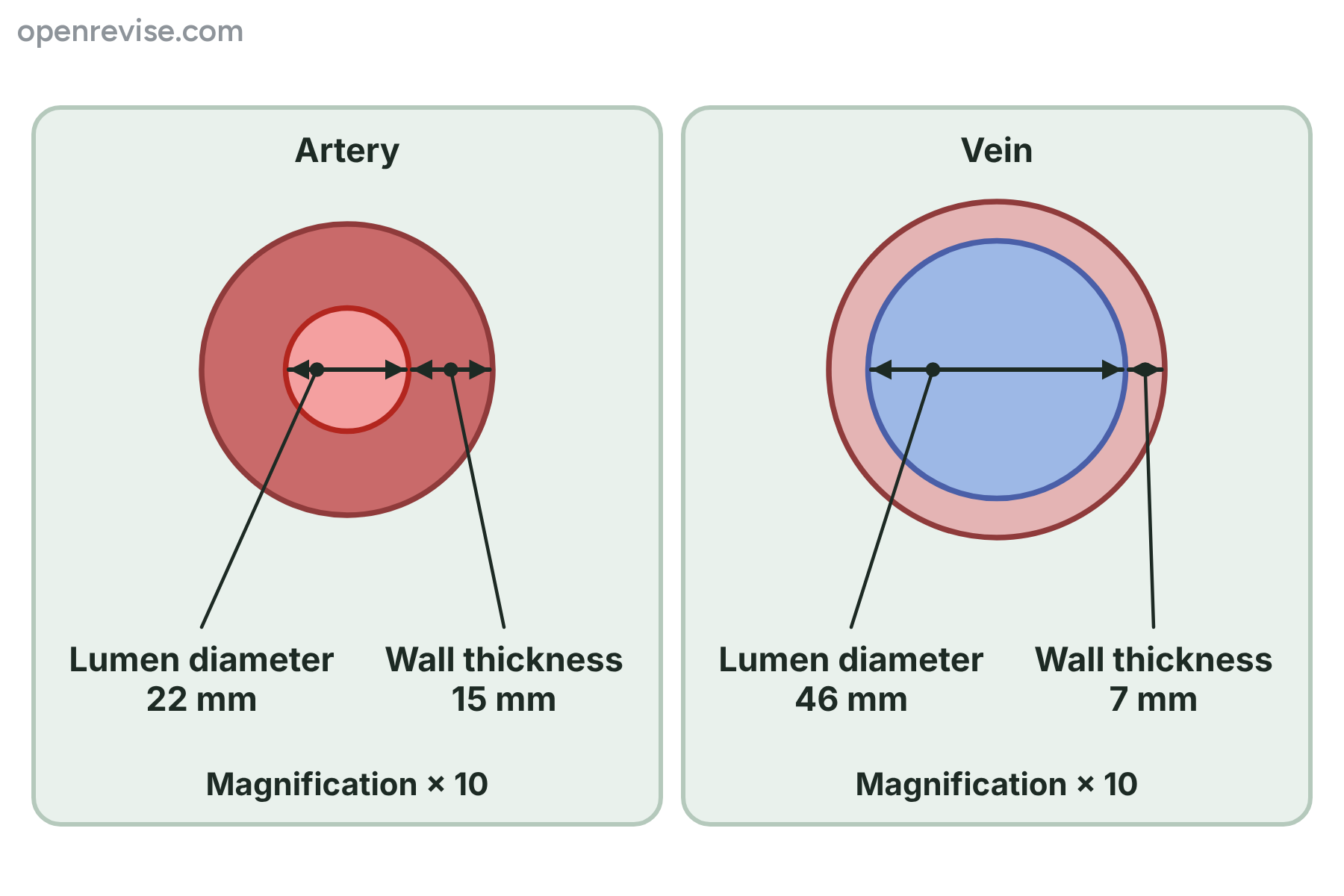 Calculate the actual lumen diameter of the artery.
 Actual size equals image size divided by magnification, so \(22 \div 10 = 2.2\ \text{mm}\).
-
How many chambers does the human heart have?
Four: two atria and two ventricles.
-
What do the atria do?
They receive blood from the veins and pass it to the ventricles.
-
What do the ventricles do?
They pump blood out of the heart into the arteries.
-
Why are the walls of the atria thin?
They only push blood a short distance into the ventricles.
-
What is the septum?
The wall of muscle between the two sides of the heart.
-
What does the septum prevent?
The mixing of oxygenated and deoxygenated blood.
-
Which chamber has the thickest wall?
The left ventricle.
-
Why is the wall of the left ventricle thick?
It pumps blood at high pressure all round the body.
-
Why is the wall of the right ventricle thinner?
It only pumps blood to the lungs, which needs a lower pressure.
-
Where does the vena cava take blood?
It brings deoxygenated blood from the body to the right atrium.
-
Where does the pulmonary artery take blood?
From the right ventricle to the lungs, and it is deoxygenated.
-
Where does the pulmonary vein take blood?
From the lungs to the left atrium, and it is oxygenated.
-
Where does the aorta take blood?
From the left ventricle to the body, and it is oxygenated.
-
What do the coronary arteries do?
They supply the heart muscle with oxygen and glucose.
-
What do the atrioventricular valves do?
They stop blood flowing back from the ventricles into the atria.
-
What do the semilunar valves do?
They stop blood flowing back from the arteries into the ventricles.
-
Why does the heart have valves?
To make the blood flow one way only.
-
Name the route of blood through the heart.
Vena cava, right atrium, right ventricle, pulmonary artery, lungs, pulmonary vein, left atrium, left ventricle, aorta.
-
Why is the circulation described as double?
Blood passes through the heart twice on each complete trip, once to the lungs and once to the body.
-
Why is a double circulation better than a single one?
Blood pressure is raised again after the lungs, so oxygen reaches the body faster, and oxygenated blood is kept apart.
-
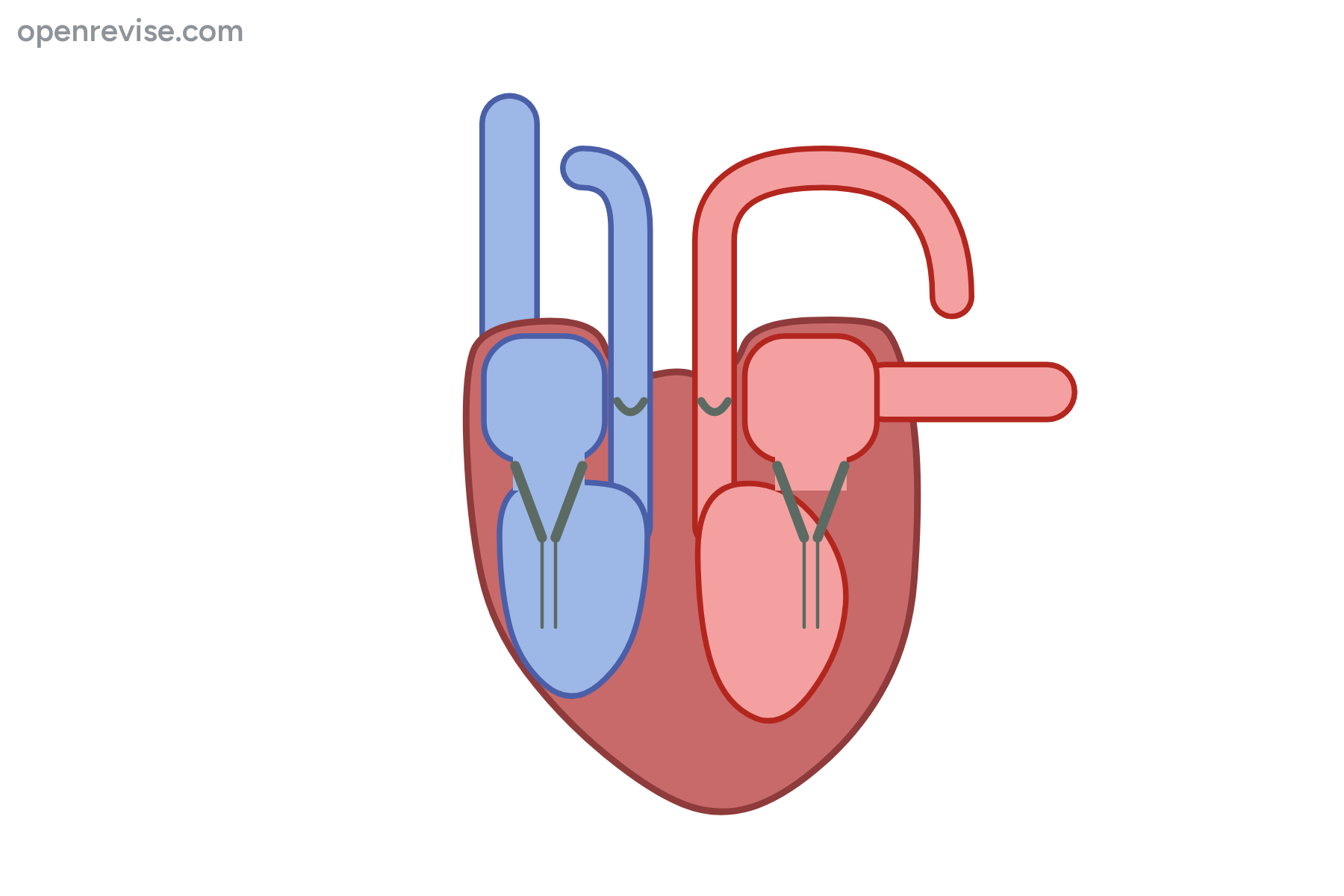 Name the labelled chambers, vessels and valves in this diagram, and say which wall is thickest.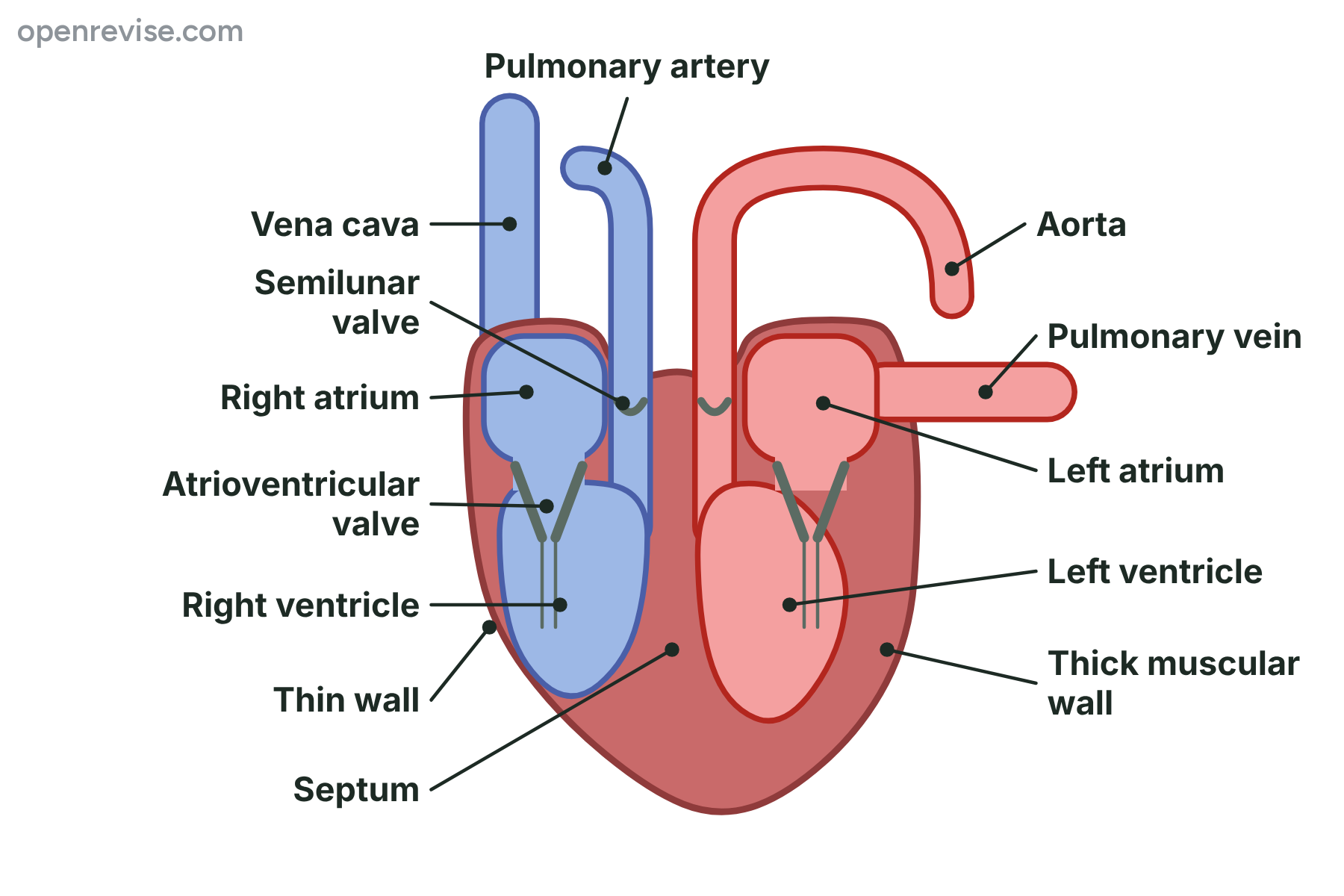
The blue chambers on the left are the right atrium and right ventricle, with the vena cava and pulmonary artery. The pink ones on the right are the left atrium and left ventricle, with the pulmonary vein and aorta. The left ventricle has the thickest wall.
-
 Describe the route of the blood in this diagram, and say where gas exchange happens.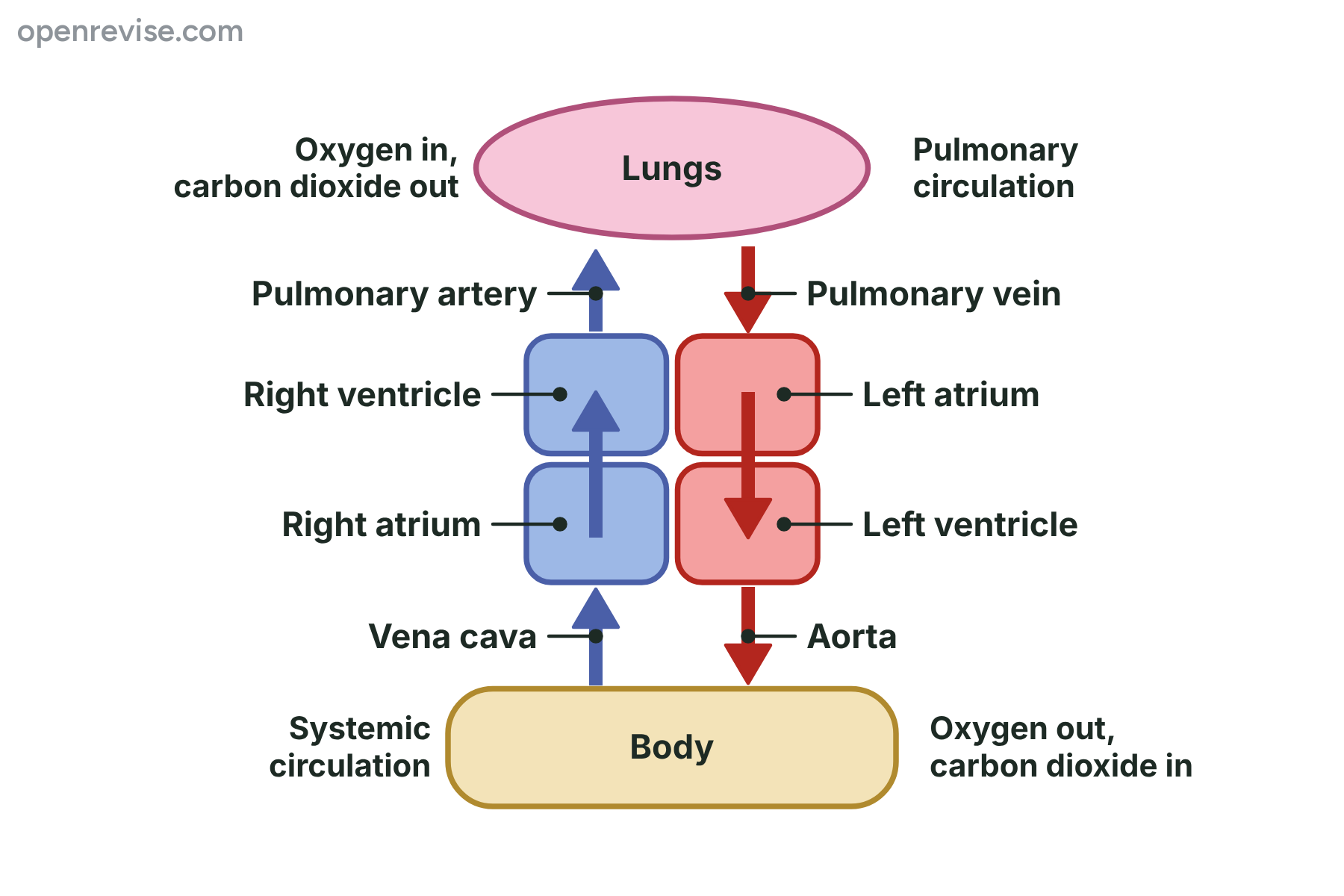
Blood goes from the body in the vena cava to the right atrium and right ventricle, then in the pulmonary artery to the lungs, where it picks up oxygen. It returns in the pulmonary vein to the left atrium and left ventricle, then goes out in the aorta to the body.
-
What is heart rate?
The number of times the heart beats in one minute.
-
What is the unit of heart rate?
Beats per minute (bpm).
-
What is stroke volume?
The volume of blood pumped out of a ventricle in one beat.
-
What is the unit of stroke volume?
cm\(^3\) (per beat).
-
What is cardiac output?
The volume of blood pumped out of the heart in one minute.
-
What are the units of cardiac output?
cm\(^3\) per minute or dm\(^3\) per minute.
-
What is the equation for cardiac output?
Cardiac output = stroke volume \(\times\) heart rate.
-
How do you find the stroke volume?
Divide the cardiac output by the heart rate.
-
How do you find the heart rate?
Divide the cardiac output by the stroke volume.
-
How many cm\(^3\) are there in 1 dm\(^3\)?
1000.
-
What is a typical resting cardiac output?
About 5 dm\(^3\) per minute, or 5000 cm\(^3\) per minute.
-
A person has a stroke volume of 60 cm\(^3\) and a heart rate of 80 bpm. What is the cardiac output?
\(60 \times 80 = 4800\ \text{cm}^3\) per minute.
-
You count 18 beats in 15 seconds. What is the heart rate?
\(18 \times 4 = 72\) beats per minute.
-
Why does heart rate increase during exercise?
The muscles need more oxygen and glucose, and the nervous system and adrenaline make the heart beat faster.
-
Why does stroke volume increase during exercise?
The heart muscle contracts more strongly.
-
What happens to cardiac output during exercise?
It increases, because both heart rate and stroke volume increase.
-
What is the recovery time?
How long the heart rate takes to return to its resting value after exercise.
-
Why do athletes have a lower resting heart rate?
Their larger stroke volume means that fewer beats give the same cardiac output.
-
How does training change the heart?
The heart muscle becomes stronger, so the stroke volume is larger.
-
What is the usual mistake in cardiac output calculations?
Mixing units, such as multiplying cm\(^3\) by beats per minute and then writing the answer in dm\(^3\).
-
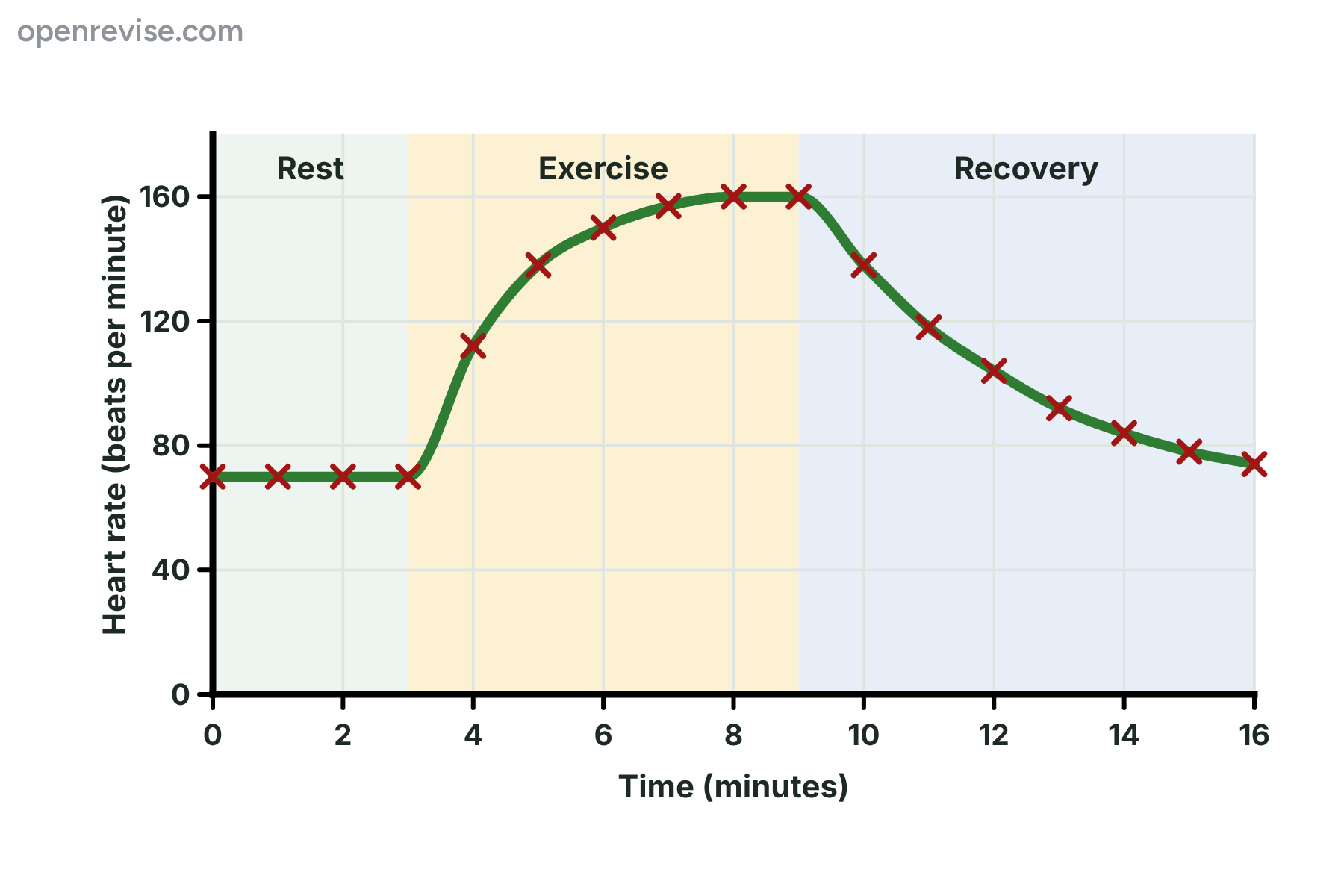 Describe what happens to the heart rate in each part of this graph.
 At rest the heart rate is steady at about 70 beats per minute. During exercise it rises quickly and then levels off at about 160. During recovery it falls slowly and takes several minutes to return to the resting rate.
-
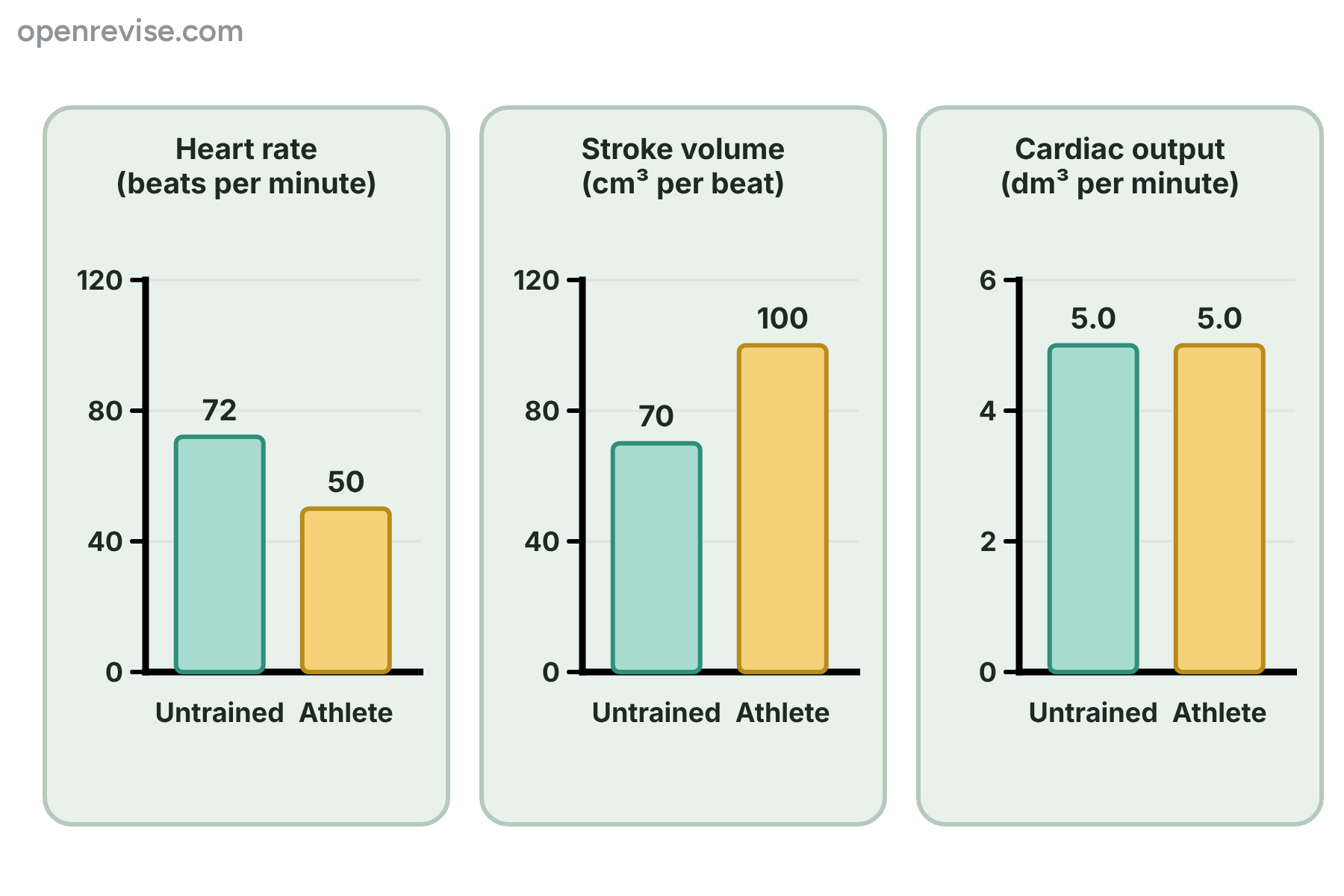 Why does the athlete have a lower heart rate but the same cardiac output?
 The athlete has a larger stroke volume, so each beat pumps out more blood. Cardiac output is stroke volume times heart rate, so fewer beats give the same cardiac output.