Flashcards · Biology
Exchange Surfaces and Gas Exchange
-
Name two substances that cells need to take in.
Any two of: oxygen, dissolved food molecules, water, mineral ions.
-
Name two waste substances that have to be removed from the body.
Any two of: carbon dioxide, urea, excess water, excess mineral ions.
-
Where is urea made, and where is it removed from the body?
It is made in the liver and removed by the kidneys in the urine.
-
Why do cells need oxygen?
For aerobic respiration, which releases energy from glucose.
-
How does carbon dioxide leave the body of a human?
It diffuses from the cells into the blood, is carried to the lungs and is breathed out.
-
Which dissolved food molecules are absorbed in the small intestine?
Glucose, amino acids, fatty acids and glycerol.
-
What is the formula for the surface area of a cube?
\(6 \times \text{side} \times \text{side}\).
-
What is the formula for the volume of a cube?
\(\text{side} \times \text{side} \times \text{side}\).
-
How do you calculate a surface area to volume ratio?
Divide the surface area by the volume.
-
What is the surface area to volume ratio of a 2 cm cube?
3 : 1, because \(24 \div 8 = 3\).
-
What happens to the ratio when an organism gets bigger?
It gets smaller, because the volume increases faster than the surface area.
-
What happens to the surface area and the volume of a cube when its sides double?
The surface area is 4 times bigger and the volume is 8 times bigger.
-
Why does a single-celled organism not need a transport system?
It has a large ratio and a short diffusion distance, so diffusion across the cell surface is fast enough.
-
Why can diffusion alone not supply a large animal?
The ratio is small and the diffusion distance to cells deep inside is long, so diffusion is far too slow.
-
Name the two adaptations that large organisms have.
Exchange surfaces and a transport system.
-
What is the job of the transport system?
To carry substances quickly between the exchange surfaces and every cell.
-
Why are flatworms and leaves flat?
A flat shape has a large ratio, so exchange across the surface is fast enough.
-
What is the usual mistake with ratio questions?
Dividing the volume by the surface area, instead of the surface area by the volume.
-
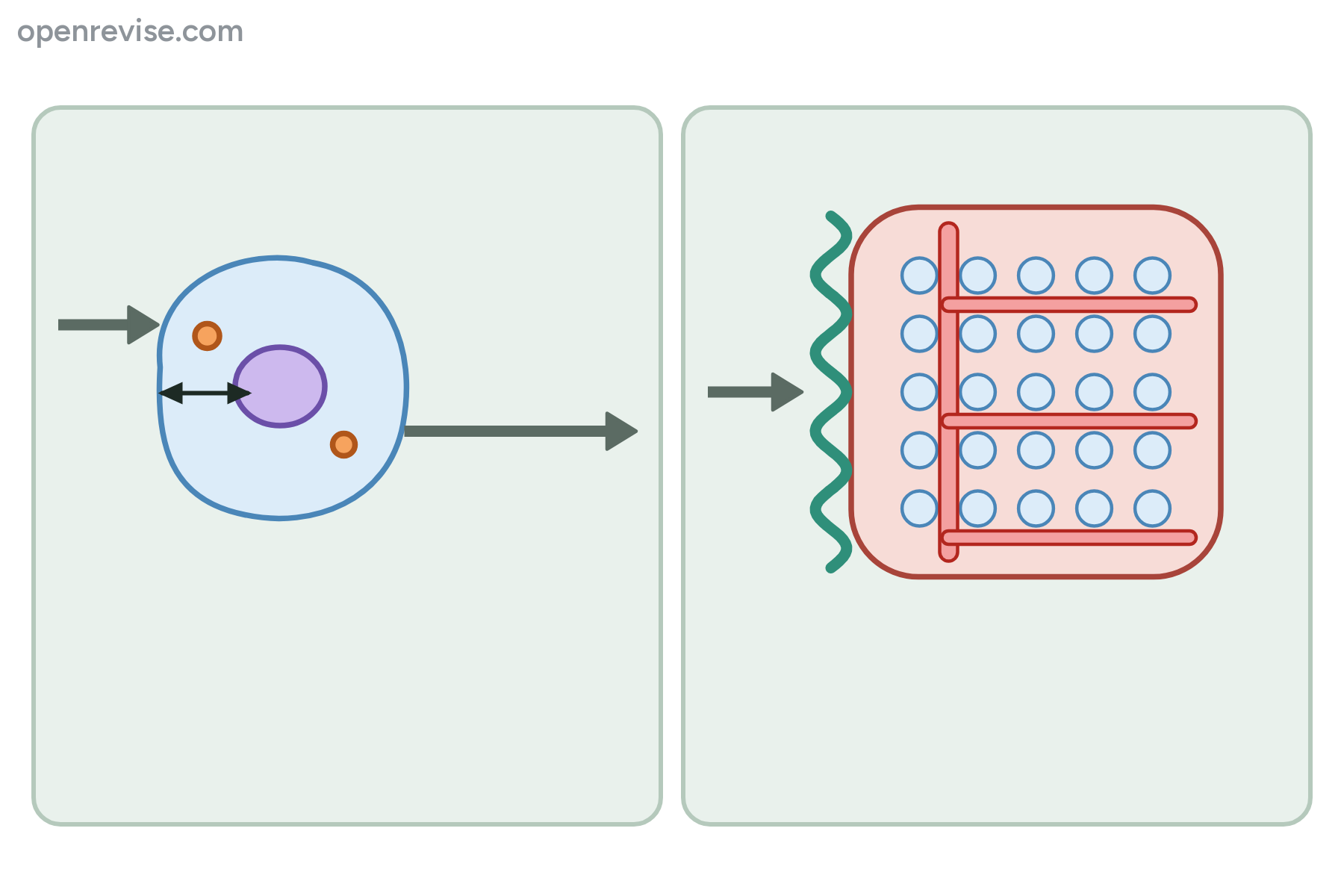 Label the exchange surface, the blood vessel and the cell deep inside the body, and say why this organism needs them.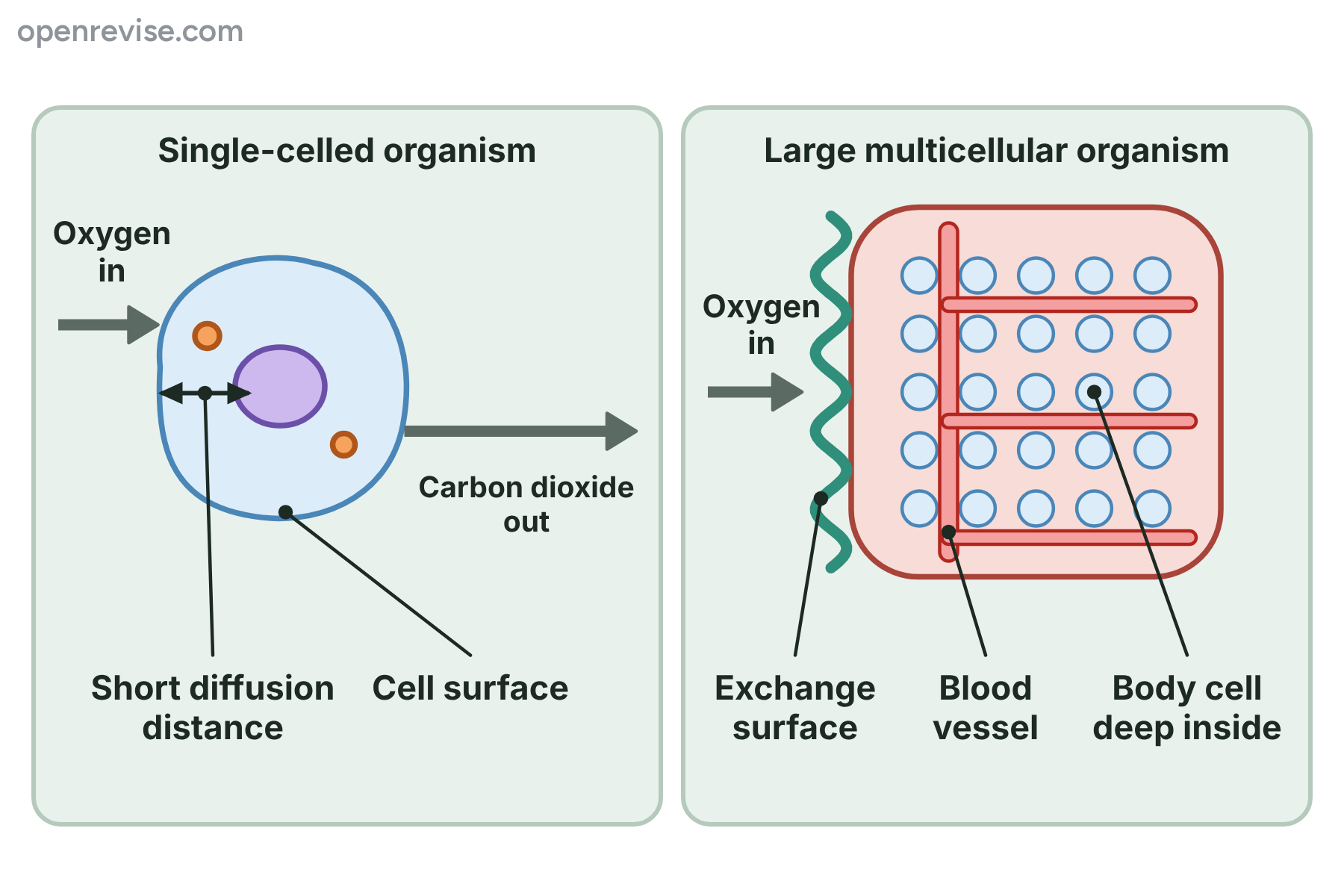
The wavy line is the exchange surface, the red tube is a blood vessel in the transport system and the circle in the middle is a body cell deep inside. A large organism has a small surface area to volume ratio and a long diffusion distance, so it needs both.
-
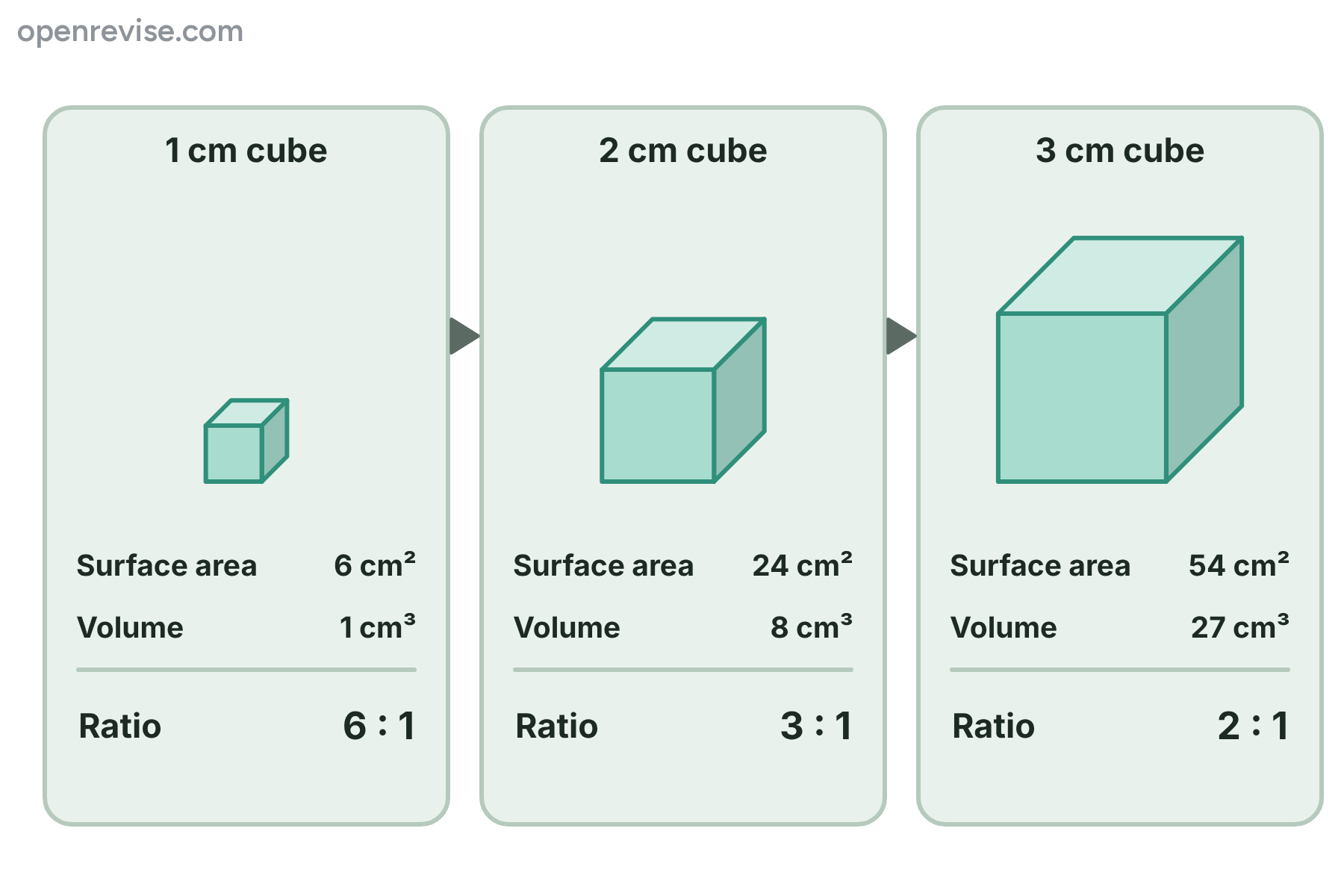 What pattern do the surface area to volume ratios show as the cube gets bigger, and why?
 The ratio falls from 6 : 1 to 3 : 1 to 2 : 1. The volume grows faster than the surface area, so bigger organisms have a smaller ratio.
-
What are the tiny air sacs in the lungs called?
Alveoli.
-
Name the airways in order, from the mouth to the gas exchange surface.
Trachea, bronchus, bronchiole, alveolus.
-
What keeps the trachea open?
Rings of cartilage.
-
How many bronchi are there?
Two, one to each lung.
-
Which gas diffuses into the blood in the alveoli?
Oxygen.
-
Which gas diffuses out of the blood in the alveoli?
Carbon dioxide.
-
Does gas exchange in the alveoli need energy?
No. It happens by diffusion.
-
Why does oxygen diffuse into the blood and not out of it?
The oxygen concentration in the alveolus is higher than in the blood arriving from the body.
-
What do red blood cells use to carry oxygen?
Haemoglobin.
-
How thick is the wall of an alveolus?
One cell thick.
-
How thick is the wall of a capillary?
One cell thick.
-
Why do thin walls make gas exchange faster?
The diffusion distance is shorter, so the gases cross more quickly.
-
Why does a large number of alveoli help?
It gives a large surface area, so more gas can diffuse at once.
-
How does the blood supply keep the concentration gradient steep?
Flowing blood carries oxygen away and brings in carbon dioxide, so the gradients are kept up.
-
How does ventilation keep the concentration gradient steep?
It brings fresh air with a high oxygen concentration and removes air with carbon dioxide.
-
Roughly what percentage of inhaled air is oxygen, and of exhaled air?
About 21 percent inhaled and about 16 percent exhaled.
-
Why is a moist lining useful?
Oxygen dissolves in the film of water before it diffuses across the wall.
-
What is the common mistake about gas exchange?
Saying that the lungs make oxygen or that gases are pumped across. They simply diffuse down concentration gradients.
-
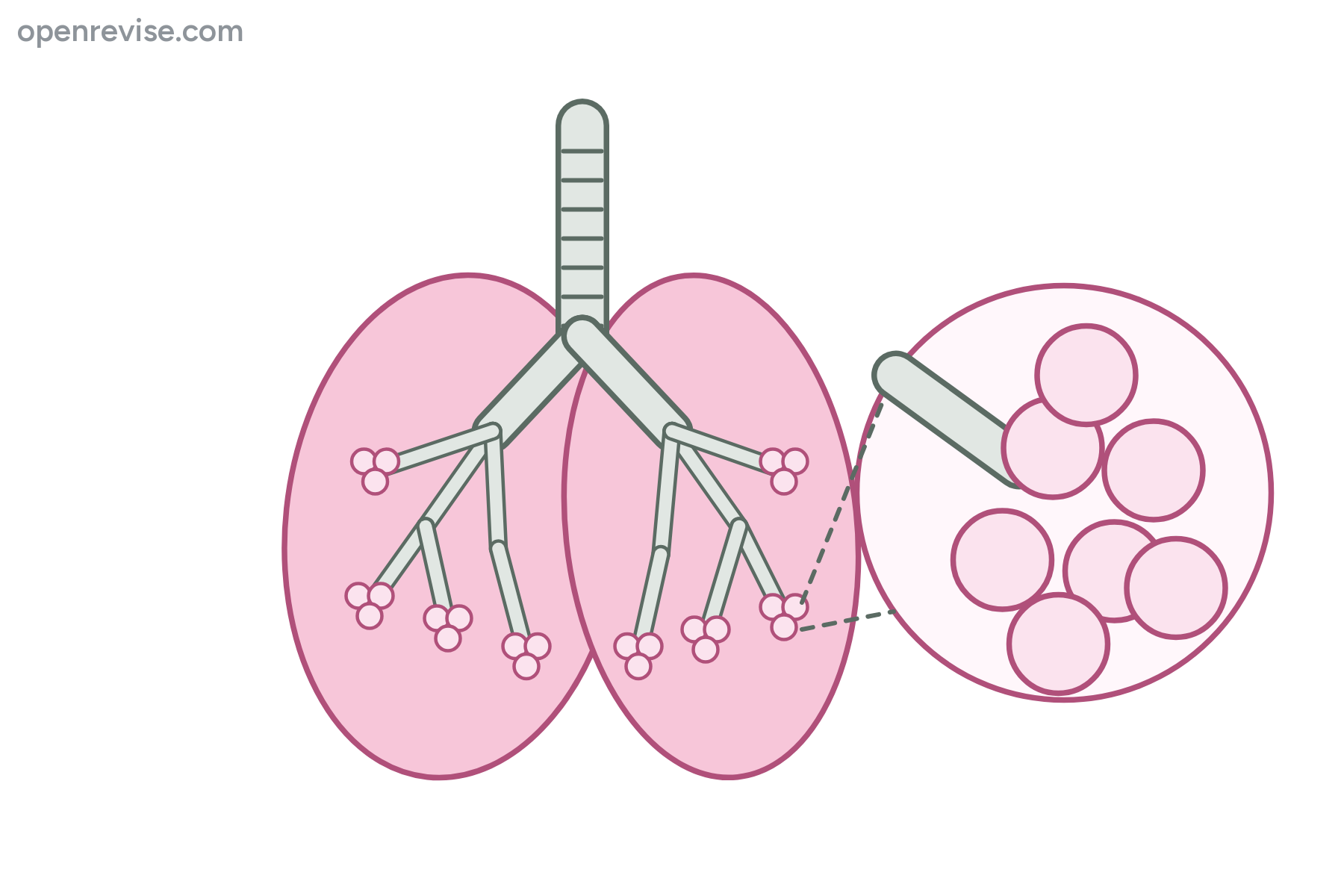 Name the structures of the airways in this diagram, and say where gas exchange happens.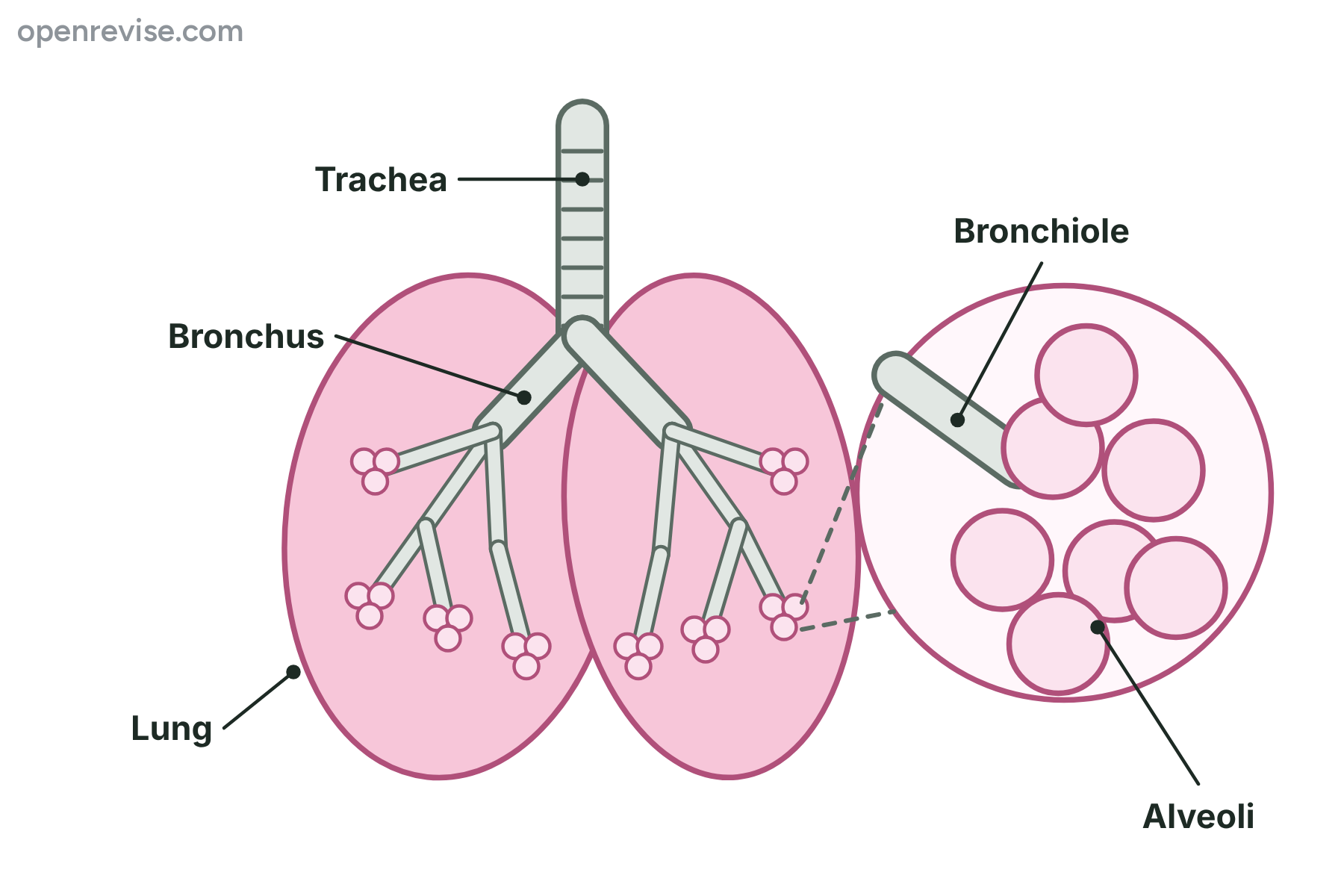
The tube down the middle is the trachea, which splits into two bronchi. The bronchi branch into bronchioles, which end in alveoli. Gas exchange happens in the alveoli.
-
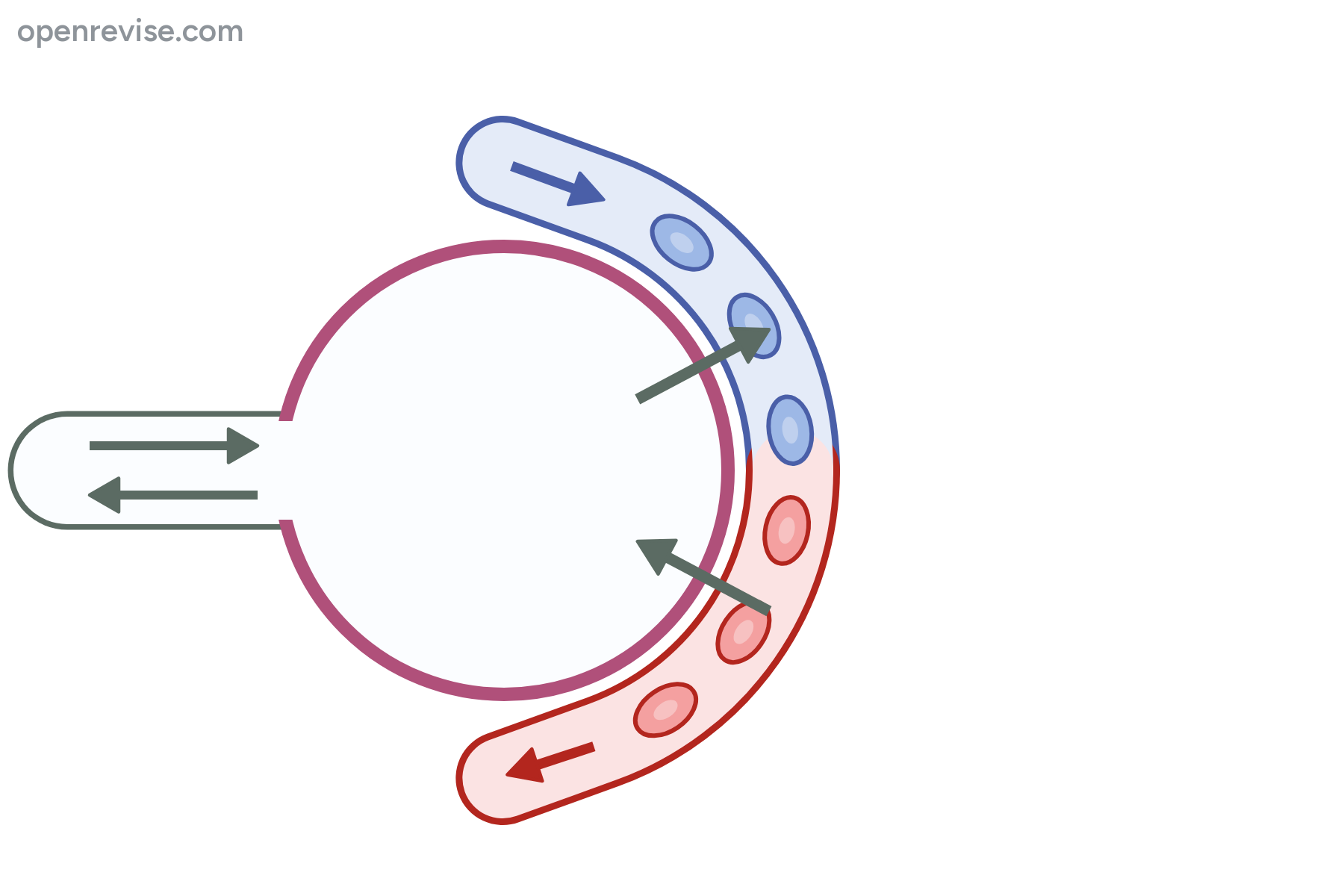 Describe how oxygen and carbon dioxide move in this diagram, and say why the walls are drawn so thin.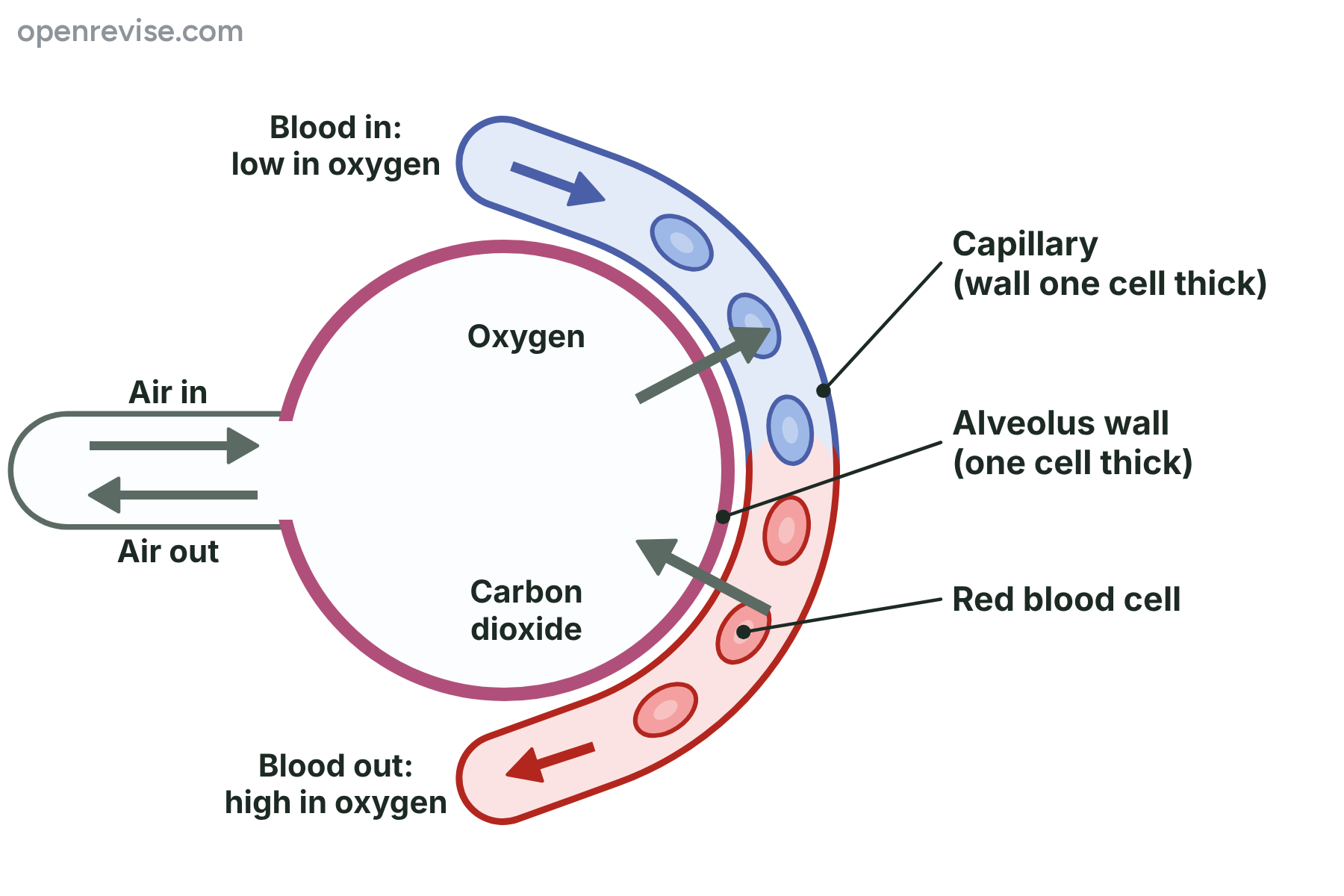
Oxygen diffuses from the air in the alveolus into the blood, and carbon dioxide diffuses from the blood into the alveolus. The walls of the alveolus and capillary are one cell thick, so the diffusion distance is very short.
-
Name three factors that affect the rate of diffusion.
The surface area, the concentration gradient and the diffusion distance (thickness).
-
What happens to the rate of diffusion if the surface area is bigger?
It increases, because more particles can cross at once.
-
What happens to the rate of diffusion if the concentration difference is bigger?
It increases, because the net movement is greater.
-
What happens to the rate of diffusion if the membrane is thicker?
It decreases, because the particles have further to go.
-
What is Fick's law in words?
The rate of diffusion is proportional to the surface area times the concentration difference, divided by the thickness of the membrane.
-
What does the symbol \(\propto\) mean?
Is proportional to.
-
If the surface area doubles, what happens to the rate?
It doubles.
-
If the thickness doubles, what happens to the rate?
It halves.
-
If the concentration difference triples, what happens to the rate?
It triples.
-
What shape is the graph of rate against concentration difference?
A straight line through the origin.
-
What shape is the graph of rate against thickness?
A curve that falls steeply and then levels off.
-
What are arbitrary units?
Units used for comparing values, such as the answer to a Fick's law calculation.
-
Calculate the relative rate for area 8, difference 15 and thickness 4.
\(8 \times 15 \div 4 = 30\) arbitrary units.
-
Why does a thin barrier suit an exchange surface?
The diffusion distance is short, so the rate is high.
-
How do blood and breathing keep the gradient steep in the lungs?
The blood carries oxygen away and breathing brings in fresh air.
-
How are villi adapted for absorbing food?
A large surface area, a wall one cell thick and a rich blood supply.
-
Why does temperature affect diffusion?
Particles have more energy at a higher temperature, so they move and diffuse faster.
-
What is the common mistake with Fick's law?
Multiplying by the thickness instead of dividing by it.
-
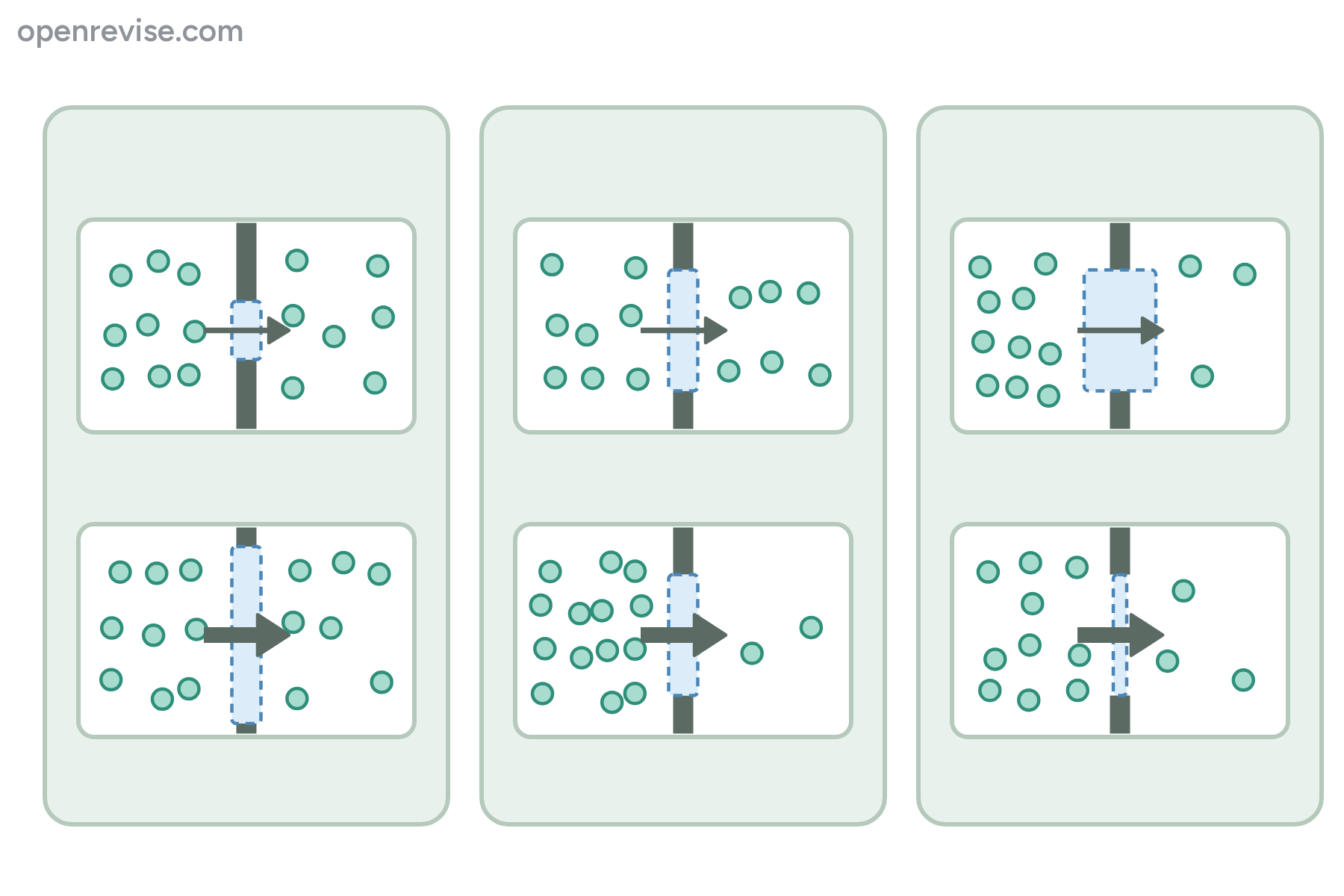 Describe what each pair of boxes shows about the rate of diffusion.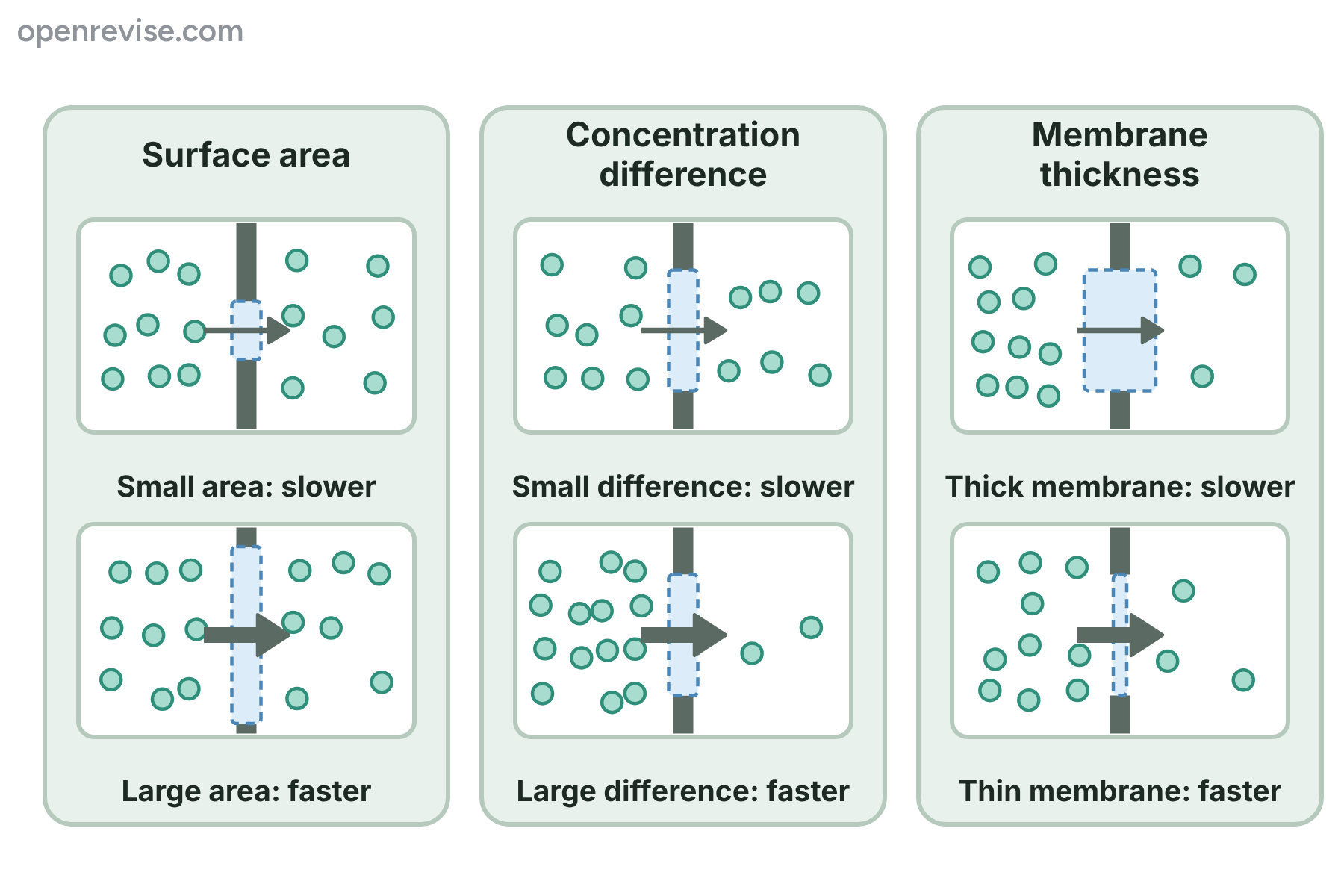
Left: a larger area makes diffusion faster. Middle: a bigger concentration difference makes diffusion faster. Right: a thinner membrane makes diffusion faster.
-
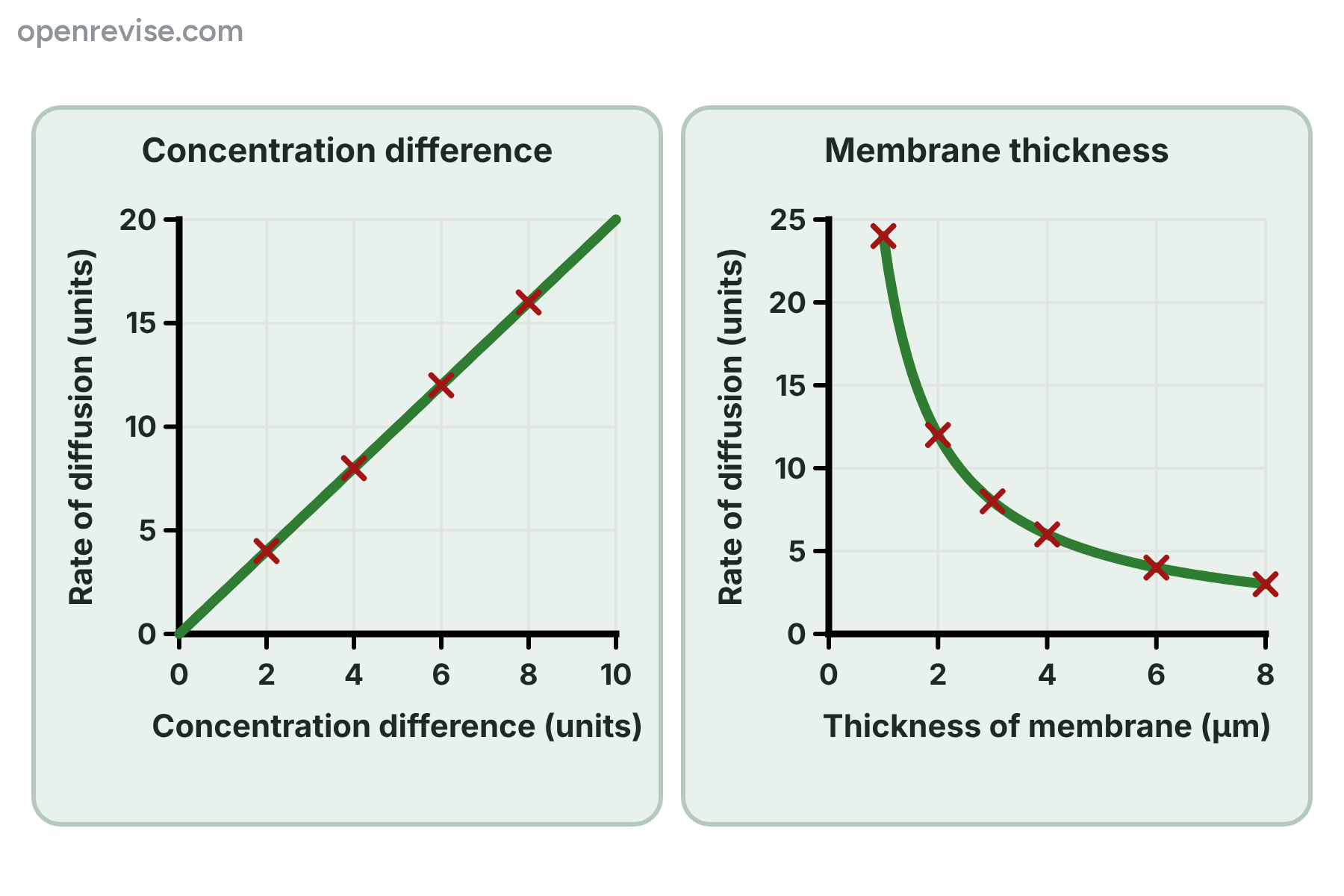 Describe the relationship shown by each graph.
 Rate of diffusion is directly proportional to the concentration difference: a straight line through the origin. Rate of diffusion is inversely proportional to thickness: doubling the thickness halves the rate.