Exam questions · Biology
Exchange Surfaces and Gas Exchange
- 24 exam questions
- 76 marks
- 24 quick checks
Why Organisms Need Exchange Surfaces and Transport Systems
Just this lesson-
1 State [1 mark]
Name the waste substance that is made in the liver and carried in the blood to the kidneys.
Show answerHide answer
Model answer
Urea.
Mark scheme
- Urea — 1 mark
-
2 Name [2 marks]
Name two waste substances that have to be removed from the body of a mammal.
Show answerHide answer
Model answer
Carbon dioxide and urea. Excess water or excess mineral ions are also accepted.
Mark scheme
- Carbon dioxide — 1 mark
- Urea (or excess water or excess ions) — 1 mark
-
3 Calculate [2 marks]
A cube has sides of 4 cm. Calculate its surface area to volume ratio. Give your answer in the form X : 1.
Show answerHide answer
Model answer
Surface area is \(6 \times 4 \times 4 = 96\ \text{cm}^2\). Volume is \(4 \times 4 \times 4 = 64\ \text{cm}^3\). The ratio is \(96 \div 64 = 1.5\), so 1.5 : 1.
Mark scheme
- Surface area 96 and volume 64 — 1 mark
- 1.5 : 1 — 1 mark
-
4 Name [3 marks]
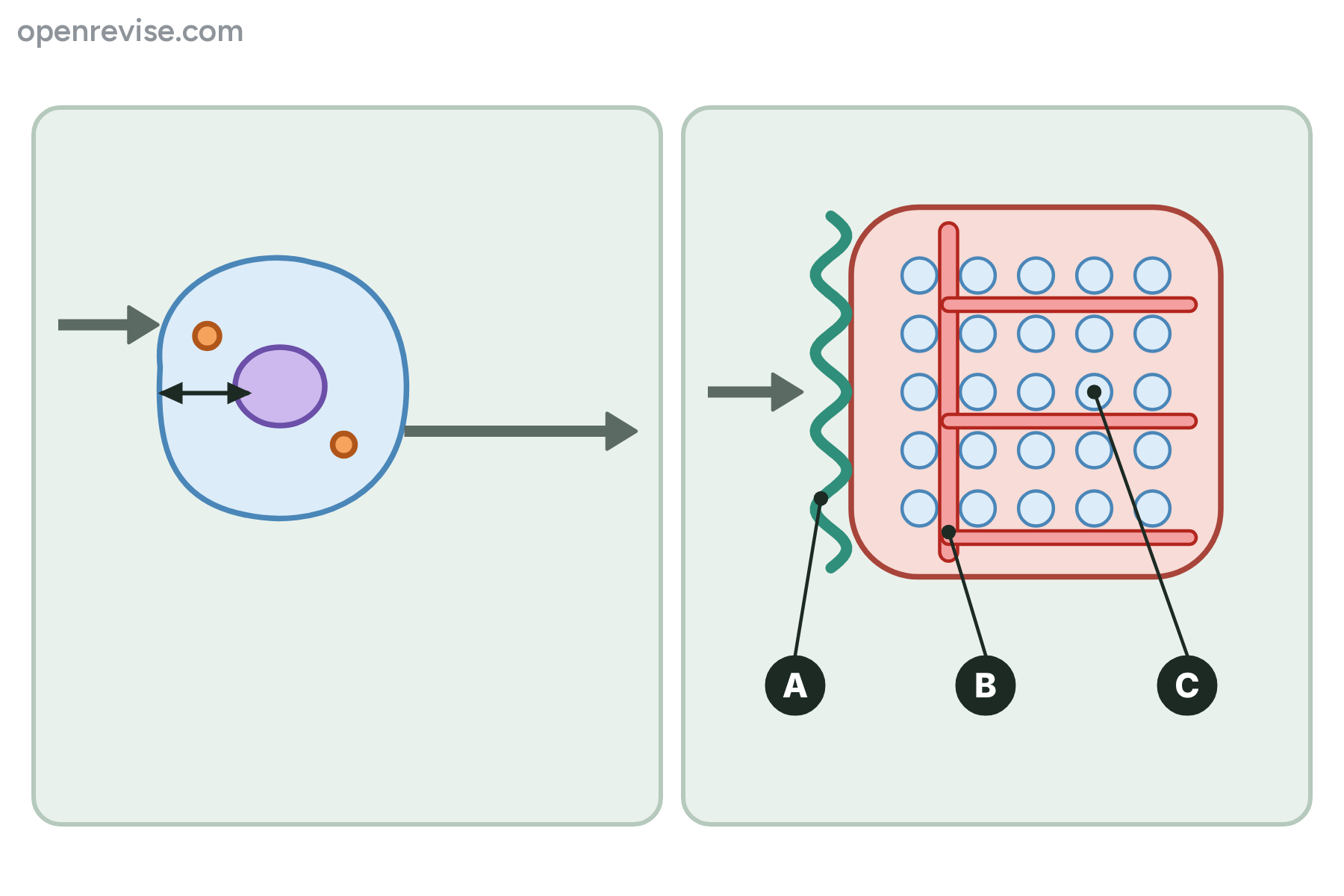
The diagram shows a single-celled organism and a large multicellular organism. Name the parts of the large organism labelled A, B and C.
Show answerHide answer
Model answer
A is the exchange surface. B is a blood vessel, which is part of the transport system. C is a body cell, deep inside the organism.
Mark scheme
- A: exchange surface — 1 mark
- B: blood vessel (or transport system) — 1 mark
- C: body cell (or cell) — 1 mark
-
5 Calculate [3 marks]
Organism P can be modelled as a cube with sides of 0.2 cm. Organism Q can be modelled as a cube with sides of 3 cm. Calculate the surface area to volume ratio of each organism and work out how many times bigger the ratio is for P than for Q.
Show answerHide answer
Model answer
P has a surface area of \(6 \times 0.2 \times 0.2 = 0.24\ \text{cm}^2\) and a volume of \(0.2 \times 0.2 \times 0.2 = 0.008\ \text{cm}^3\), so its ratio is \(0.24 \div 0.008 = 30\), which is 30 : 1. Q has a surface area of \(6 \times 3 \times 3 = 54\ \text{cm}^2\) and a volume of \(27\ \text{cm}^3\), so its ratio is \(54 \div 27 = 2\), which is 2 : 1. P's ratio is \(30 \div 2 = 15\) times bigger.
Mark scheme
- P: 30 : 1 — 1 mark
- Q: 2 : 1 — 1 mark
- 15 times bigger — 1 mark
-
6 Explain [3 marks]
Explain why a single-celled organism does not need a transport system.
Show answerHide answer
Model answer
A single-celled organism has a large surface area compared with its volume. No part of the cell is far from the surface, so the diffusion distance is short. Oxygen and other substances can therefore diffuse across the cell membrane fast enough to reach every part of the cell.
Mark scheme
- It has a large surface area to volume ratio — 1 mark
- The diffusion distance is short — 1 mark
- Substances diffuse in and out fast enough across the surface — 1 mark
-
7 Explain [4 marks]
A blue whale is a very large animal. Explain why it needs both an exchange surface and a transport system.
Show answerHide answer
Model answer
A whale has a very small surface area compared with its volume, so its skin could not take in enough oxygen for all of its cells. Most of its cells are a long way from the surface, and diffusion over a long distance is far too slow. The lungs are an exchange surface that provides a large surface area for taking in oxygen and removing carbon dioxide. The transport system, the blood pumped by the heart, then carries the oxygen quickly to all of the cells and carries the carbon dioxide back.
Mark scheme
- Small surface area to volume ratio — 1 mark
- Long diffusion distance, so diffusion alone is too slow — 1 mark
- Exchange surface gives a large area for oxygen and carbon dioxide to cross — 1 mark
- Transport system carries substances quickly to and from all the cells — 1 mark
-
8 Explain [6 marks]
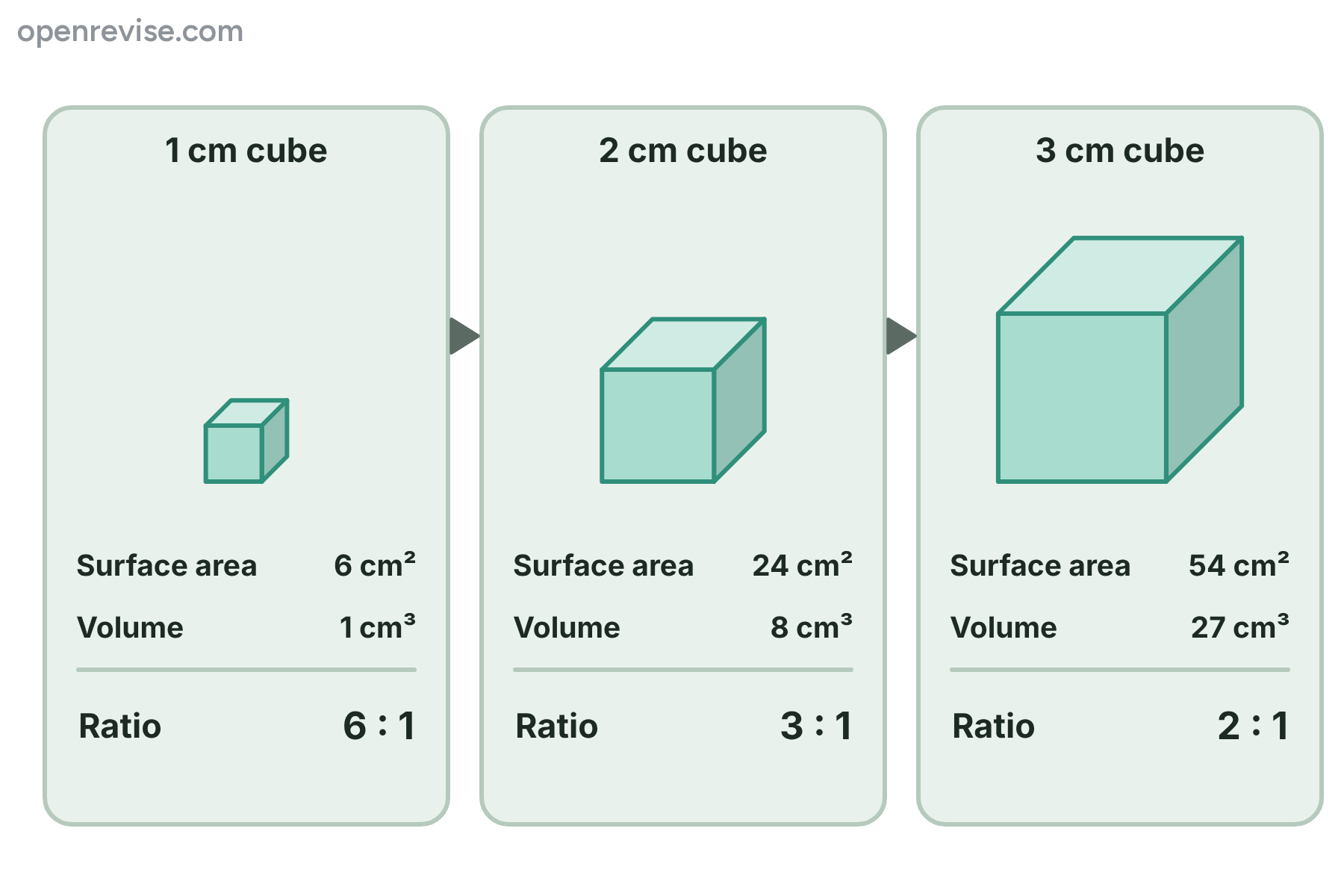
The diagram shows three cubes that are used as models of organisms of different sizes. Use the diagram and your own knowledge to explain why a large multicellular animal needs specialised exchange surfaces and a transport system, but a very small organism does not.
Show answerHide answer
Model answer
The diagram shows that as the cube gets bigger the surface area to volume ratio falls, from 6 : 1 to 2 : 1. A large animal is like the large cube, so it has a small surface area compared with its volume, and its outer surface is too small to take in enough oxygen for all its cells. Its cells are also deep inside the body, so the diffusion distance is long and diffusion alone is too slow. It therefore needs an exchange surface, such as the lungs, which has a large surface area, to take in oxygen and remove carbon dioxide. It also needs a transport system, the blood pumped by the heart, to carry oxygen and other substances quickly to every cell. A very small organism is like the small cube. Its large ratio and short diffusion distance mean that diffusion across its surface is fast enough, so it needs neither.
Mark scheme
- Ratio falls as size increases (6 : 1 to 2 : 1) — 1 mark
- A large animal has a small surface area compared with its volume — 1 mark
- Cells deep inside, so a long diffusion distance and diffusion alone is too slow — 1 mark
- Exchange surface with a large surface area, such as the lungs — 1 mark
- Transport system (blood and heart) carries substances to and from all cells — 1 mark
- A small organism has a large ratio and short distance, so diffusion across its surface is enough — 1 mark
Quick check
-
1
Which of these is a waste substance that is made in the liver?
Show answerHide answer
B: Urea
Urea is made in the liver from excess amino acids and is removed by the kidneys in the urine.
-
2
What is the surface area to volume ratio of a cube with sides of 2 cm?
Show answerHide answer
D: 3 : 1
The surface area is \(6 \times 4 = 24\ \text{cm}^2\) and the volume is \(8\ \text{cm}^3\), so the ratio is \(24 \div 8 = 3\), which is 3 : 1.
-
3
What happens to the surface area to volume ratio of an organism as it gets bigger?
Show answerHide answer
A: It gets smaller
The volume increases faster than the surface area, so the ratio gets smaller.
-
4
Why does a single-celled organism not need a transport system?
Show answerHide answer
C: Its diffusion distance is short
It has a large surface area to volume ratio and a short diffusion distance, so diffusion across the surface is fast enough.
-
5
A cube has a surface area of 150 cm\(^2\) and a volume of 125 cm\(^3\). What is its surface area to volume ratio?
Show answerHide answer
B: 1.2 : 1
Surface area divided by volume is \(150 \div 125 = 1.2\), so the ratio is 1.2 : 1.
-
6
Which pair of substances is taken into the body from the small intestine?
Show answerHide answer
A: Glucose and amino acids
Digestion leaves small soluble molecules such as glucose and amino acids, which are absorbed into the blood, together with mineral ions and water.
-
7
Which statement best explains why a large animal needs a transport system?
Show answerHide answer
D: Diffusion is too slow over long distances
Cells deep inside a large body are too far from the surface for diffusion to supply them, so the blood carries substances to and from them.
-
8
When the length of each side of a cube doubles, what happens to its volume?
Show answerHide answer
C: It is 8 times bigger
Volume depends on the side cubed, and \(2^3 = 8\), so the volume is 8 times bigger. The surface area is only 4 times bigger.
Alveoli and Gas Exchange
Just this lesson-
1 State [1 mark]
Name the tiny air sacs in the lungs where gas exchange takes place.
Show answerHide answer
Model answer
Alveoli.
Mark scheme
- Alveoli (alveolus) — 1 mark
-
2 Name [3 marks]
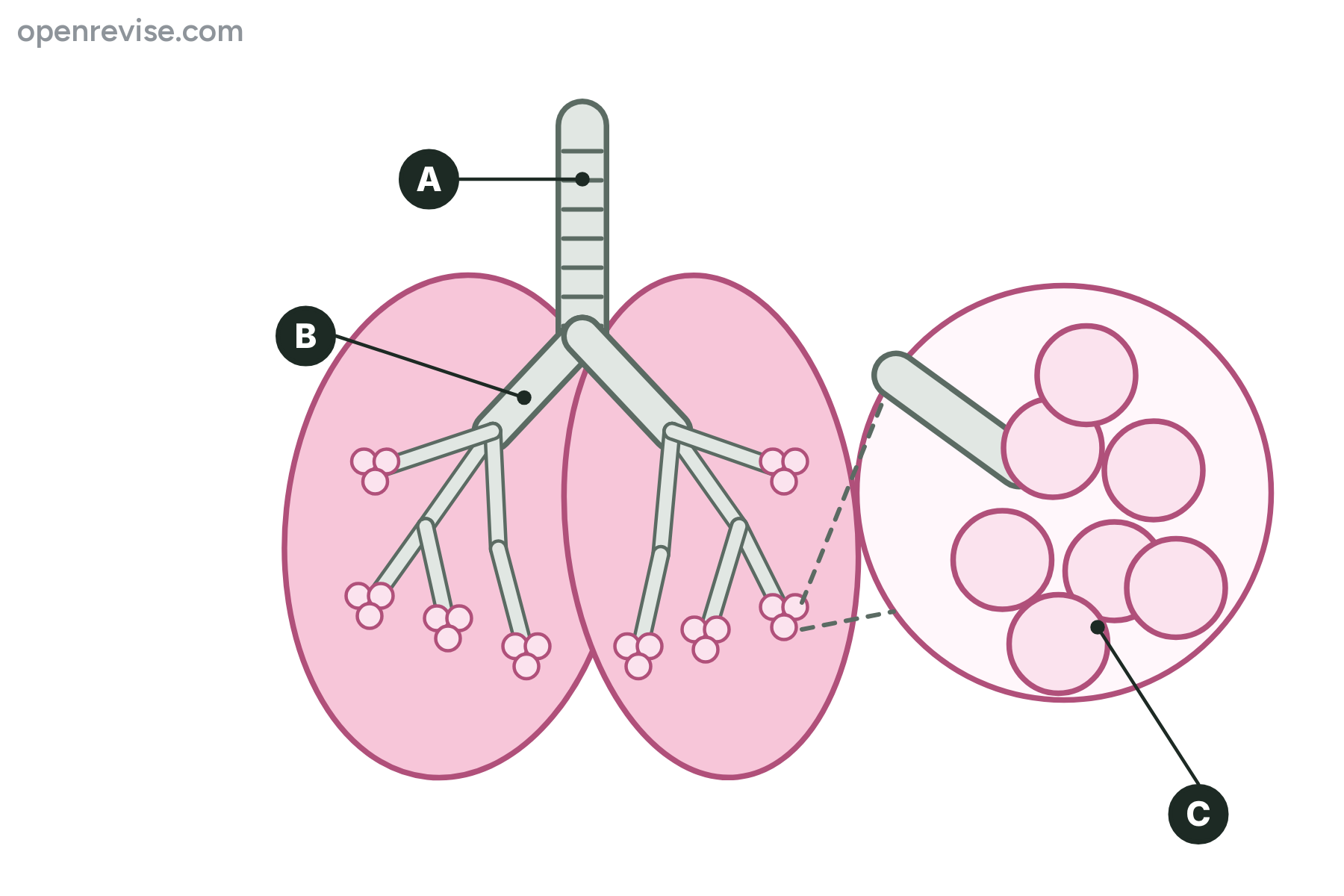
The diagram shows the human lungs. Name the parts labelled A, B and C.
Show answerHide answer
Model answer
A is the trachea. B is a bronchus. C is an alveolus.
Mark scheme
- A: trachea — 1 mark
- B: bronchus — 1 mark
- C: alveolus — 1 mark
-
3 Name [3 marks]
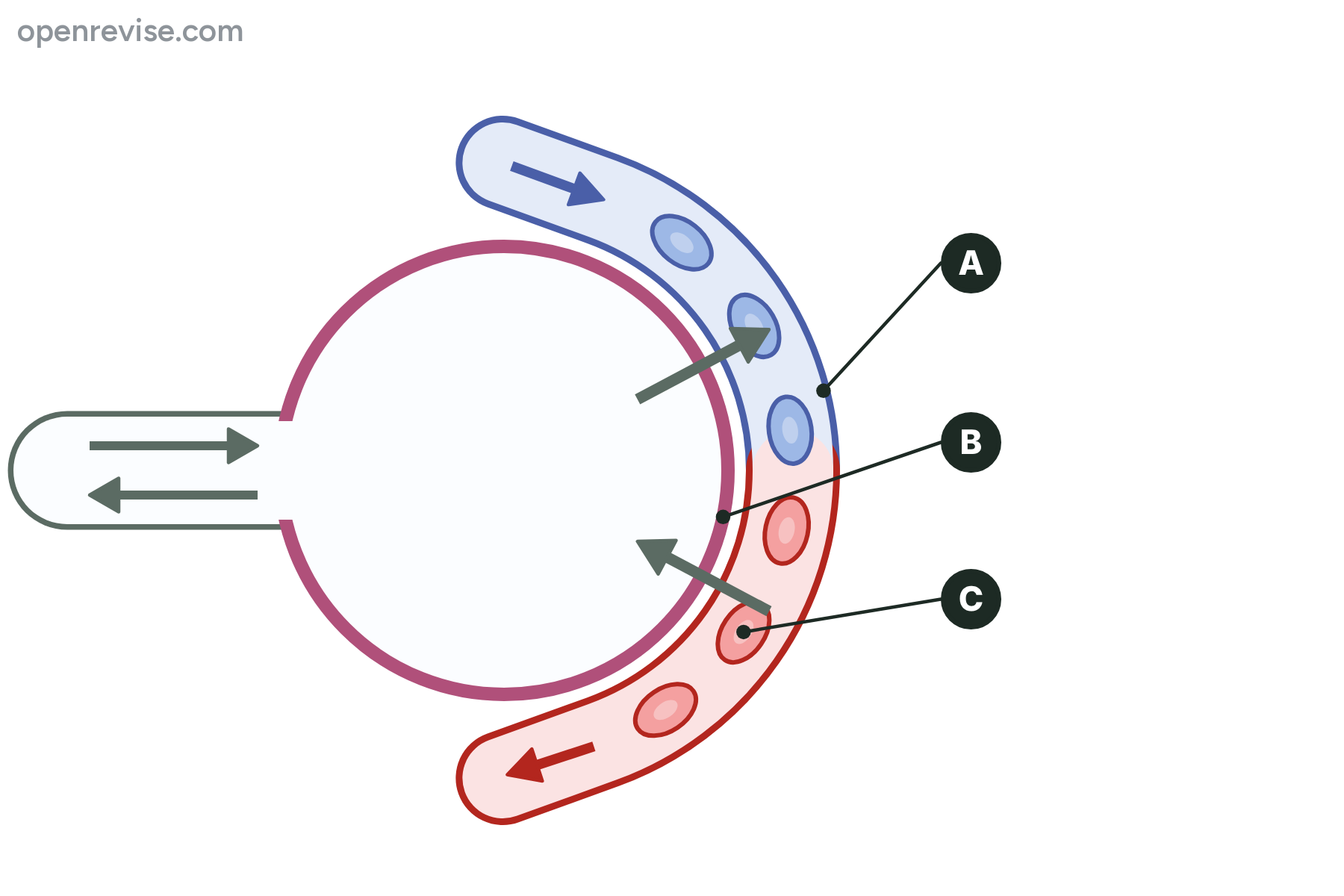
The diagram shows an alveolus and a capillary. Name the parts labelled A, B and C.
Show answerHide answer
Model answer
A is the capillary (or the wall of the capillary). B is the wall of the alveolus. C is a red blood cell.
Mark scheme
- A: capillary — 1 mark
- B: alveolus wall — 1 mark
- C: red blood cell — 1 mark
-
4 Describe [4 marks]
Describe the route taken by oxygen from the air outside the body to the blood in the capillaries of the lungs.
Show answerHide answer
Model answer
The oxygen is breathed in through the nose or mouth and passes down the trachea. It then passes through a bronchus and a bronchiole into an alveolus. In the alveolus it diffuses across the thin wall of the alveolus and the wall of the capillary into the blood.
Mark scheme
- Down the trachea — 1 mark
- Through a bronchus and then a bronchiole — 1 mark
- Into an alveolus — 1 mark
- Diffuses across the walls of the alveolus and capillary into the blood — 1 mark
-
5 Explain [4 marks]
Explain how the alveoli are adapted for gas exchange.
Show answerHide answer
Model answer
There are millions of alveoli, which give the lungs a very large surface area for diffusion. The walls of the alveoli and the capillaries are one cell thick, so the diffusion distance is short. Each alveolus is surrounded by a rich supply of capillaries, and the flowing blood keeps the concentration gradient steep. Ventilation brings in fresh air with a high concentration of oxygen and removes carbon dioxide, which also keeps the gradient steep.
Mark scheme
- A very large surface area from many alveoli — 1 mark
- Thin walls give a short diffusion distance — 1 mark
- A rich blood supply keeps the concentration gradient steep — 1 mark
- Ventilation keeps the concentration gradient steep — 1 mark
-
6 Explain [3 marks]
Explain why the blood flowing past the alveoli helps oxygen to diffuse into the blood.
Show answerHide answer
Model answer
The flowing blood carries the oxygen away from the alveolus, so the concentration of oxygen in the blood stays lower than in the air. The blood arriving has a low oxygen concentration because the cells have used it up. This keeps the concentration gradient steep, so oxygen continues to diffuse into the blood quickly.
Mark scheme
- Blood carries oxygen away — 1 mark
- The oxygen concentration in the blood stays lower than in the alveolus — 1 mark
- So the concentration gradient is kept steep and diffusion stays fast — 1 mark
-
7 Calculate [2 marks]
A sample of inhaled air contains 21 percent oxygen. The exhaled air contains 17 percent oxygen. Calculate the percentage of the oxygen in the inhaled air that has been taken into the blood. Give your answer to 2 significant figures.
Show answerHide answer
Model answer
The change is \(21 - 17 = 4\). Then \(4 \div 21 \times 100 = 19.04\), which is 19 percent.
Mark scheme
- \(4 \div 21 \times 100\) — 1 mark
- 19 percent — 1 mark
-
8 Explain [6 marks]
A person has pulmonary fibrosis, a disease in which the walls of the alveoli become thick and scarred. Explain why the person becomes breathless when they exercise.
Show answerHide answer
Model answer
The thick, scarred walls of the alveoli make the diffusion distance longer, so oxygen diffuses into the blood more slowly. Less oxygen reaches the red blood cells, so less oxygen is carried to the muscles. During exercise the muscle cells need much more oxygen for aerobic respiration to release the energy for contraction, and carbon dioxide is made faster. Because the lungs cannot supply enough oxygen, the muscles cannot respire aerobically fast enough. The person has to breathe faster and deeper to try to keep the concentration gradient steep, which makes them feel breathless and tired quickly.
Mark scheme
- Thicker walls make a longer diffusion distance — 1 mark
- Oxygen diffuses into the blood more slowly — 1 mark
- Less oxygen is carried to the muscles — 1 mark
- Exercise increases the demand for oxygen for aerobic respiration — 1 mark
- Supply cannot meet the demand, so less energy is released — 1 mark
- The person breathes faster to try to keep the gradient steep, which causes breathlessness — 1 mark
Quick check
-
1
Which of these is the correct order of the airways, from the mouth to the gas exchange surface?
Show answerHide answer
C: Trachea, bronchus, bronchiole, alveolus
Air passes down the trachea, then through a bronchus and a bronchiole, and reaches the alveoli.
-
2
How does oxygen cross from the alveolus into the blood?
Show answerHide answer
A: By diffusion
Oxygen moves by diffusion, down its concentration gradient, so no energy is needed.
-
3
How many cells thick are the wall of an alveolus and the wall of a capillary?
Show answerHide answer
D: One each
Both walls are one cell thick, which gives a very short diffusion distance.
-
4
Which feature of the alveoli gives a large surface area?
Show answerHide answer
B: The very large number of them
There are hundreds of millions of alveoli, which together have an area of about 70 square metres.
-
5
What is the main effect of ventilation on gas exchange?
Show answerHide answer
C: It keeps the concentration gradients steep
Breathing replaces the air in the alveoli, which keeps the concentration of oxygen high and carbon dioxide low in the air, so the gradients stay steep.
-
6
Which statement about the blood arriving at the alveoli is correct?
Show answerHide answer
A: It is low in oxygen and high in carbon dioxide
The blood has come from the body, where oxygen has been used up and carbon dioxide has been made, so it is low in oxygen and high in carbon dioxide.
-
7
Why does a person with emphysema have less oxygen in their blood?
Show answerHide answer
D: Their alveoli have a smaller surface area
The walls between the alveoli break down, so the surface area for diffusion falls and less oxygen can cross.
-
8
Inhaled air has 21 percent oxygen and exhaled air has 16 percent oxygen. What is the best explanation of the difference?
Show answerHide answer
B: Oxygen has diffused into the blood
Some of the oxygen has diffused from the alveoli into the blood, so there is less in the air that is breathed out.
Factors Affecting the Rate of Diffusion and Fick's Law
Just this lesson-
1 Name [3 marks]
Name the three factors that are included in Fick's law and that affect the rate of diffusion across a membrane.
Show answerHide answer
Model answer
The surface area of the membrane, the concentration difference (gradient) and the thickness of the membrane (the diffusion distance).
Mark scheme
- Surface area — 1 mark
- Concentration difference (gradient) — 1 mark
- Thickness of the membrane (diffusion distance) — 1 mark
-
2 Describe [2 marks]
Describe what happens to the rate of diffusion across a membrane when the membrane becomes twice as thick. All other factors stay the same.
Show answerHide answer
Model answer
The rate of diffusion decreases. It is halved, because the rate is inversely proportional to the thickness.
Mark scheme
- The rate decreases — 1 mark
- It halves (or is half as fast) — 1 mark
-
3 Calculate [2 marks]
A membrane has a surface area of 8 cm\(^2\), a concentration difference of 15 units and a thickness of 4 \(\mu\)m. Use Fick's law to calculate the relative rate of diffusion.
Show answerHide answer
Model answer
Rate \(= (8 \times 15) \div 4 = 120 \div 4 = 30\) arbitrary units.
Mark scheme
- \(8 \times 15 \div 4\) — 1 mark
- 30 (arbitrary units) — 1 mark
-
4 Calculate [3 marks]
A membrane has a rate of diffusion of 60 units. The surface area of the membrane then triples, the concentration difference doubles and the thickness triples. Calculate the new rate of diffusion.
Show answerHide answer
Model answer
Surface area tripling multiplies the rate by 3 and the concentration difference doubling multiplies it by 2. The thickness tripling divides it by 3. So the new rate is \(60 \times 3 \times 2 \div 3 = 120\) units.
Mark scheme
- Area and concentration difference multiply the rate (\(\times 3\) and \(\times 2\)) — 1 mark
- Thickness divides the rate (\(\div 3\)) — 1 mark
- 120 units — 1 mark
-
5 Explain [3 marks]
Explain how blood flow keeps the rate of diffusion of oxygen into the blood high in the lungs.
Show answerHide answer
Model answer
The blood flowing through the capillaries carries the oxygen away from the alveoli. This keeps the concentration of oxygen in the blood lower than in the alveolus. This maintains a steep concentration gradient, and the rate of diffusion is proportional to the concentration difference.
Mark scheme
- Blood carries oxygen away from the alveoli — 1 mark
- This keeps the oxygen concentration in the blood low, so the concentration gradient stays steep — 1 mark
- A steep gradient gives a faster rate of diffusion — 1 mark
-
6 Calculate [3 marks]
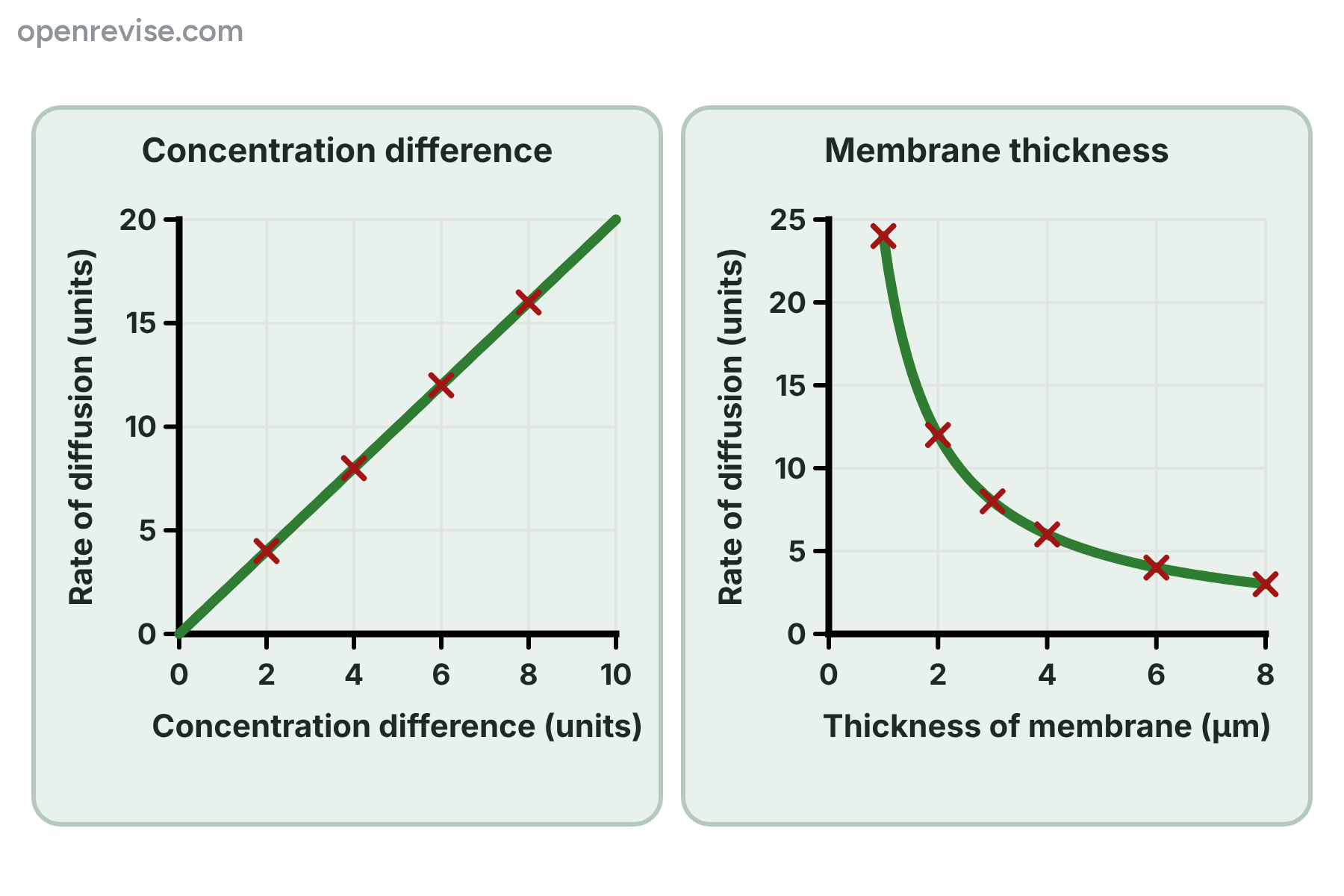
The graphs show the rate of diffusion across a membrane. In the right-hand graph the surface area and the concentration difference are kept constant. Use the right-hand graph to find the rate of diffusion when the thickness is 3 micrometres, and to find how the rate changes when the thickness doubles from 2 micrometres to 4 micrometres.
Show answerHide answer
Model answer
At a thickness of 3 micrometres the rate is 8 units. At 2 micrometres the rate is 12 units and at 4 micrometres it is 6 units, so doubling the thickness halves the rate, from 12 to 6 units.
Mark scheme
- 8 units at 3 micrometres — 1 mark
- 12 units at 2 micrometres and 6 units at 4 micrometres — 1 mark
- The rate halves when the thickness doubles — 1 mark
-
7 Calculate [4 marks]
In a healthy alveolus the relative values are surface area 70, concentration difference 60 and thickness 0.5. In a person with emphysema the alveolar walls have broken down, so the surface area is 42. The other values are unchanged. Calculate the percentage decrease in the rate of diffusion.
Show answerHide answer
Model answer
Healthy rate \(= 70 \times 60 \div 0.5 = 8400\). Emphysema rate \(= 42 \times 60 \div 0.5 = 5040\). The decrease is \(8400 - 5040 = 3360\), so the percentage decrease is \(3360 \div 8400 \times 100 = 40\) percent.
Mark scheme
- Healthy rate 8400 — 1 mark
- Emphysema rate 5040 — 1 mark
- Decrease of 3360 — 1 mark
- 40 percent — 1 mark
-
8 Explain [6 marks]
Use Fick's law to explain how the lungs are adapted for efficient gas exchange, and explain why a person with a lung disease that thickens the alveolus walls has less oxygen in their blood.
Show answerHide answer
Model answer
Fick's law says that the rate of diffusion is proportional to the surface area multiplied by the concentration difference, divided by the thickness. The lungs have hundreds of millions of alveoli, which give a very large surface area. The walls of the alveoli and capillaries are one cell thick, so the thickness is very small. A rich blood supply and ventilation keep the concentration difference large, because they carry oxygen away and bring in fresh air. All three make the rate of diffusion high. When the walls thicken, the thickness in the law increases, so the rate of diffusion falls and less oxygen diffuses into the blood in the same time.
Mark scheme
- Large surface area from many alveoli — 1 mark
- Thin walls give a small thickness — 1 mark
- Blood supply and ventilation keep a large concentration difference — 1 mark
- Rate is proportional to surface area times concentration difference divided by thickness — 1 mark
- Thicker walls increase the thickness, so the rate decreases — 1 mark
- So less oxygen diffuses into the blood — 1 mark
Quick check
-
1
Which change would make diffusion across a membrane faster?
Show answerHide answer
B: A larger surface area
A larger surface area lets more particles cross at the same time, so the rate of diffusion is faster.
-
2
The membrane thickness doubles and nothing else changes. What happens to the rate of diffusion?
Show answerHide answer
D: It halves
The rate is inversely proportional to the thickness, so doubling the thickness halves the rate.
-
3
Which expression is the correct form of Fick's law?
Show answerHide answer
A: Area times concentration difference, divided by thickness
The rate of diffusion is proportional to the surface area times the concentration difference, divided by the thickness of the membrane.
-
4
A membrane has surface area 6, concentration difference 20 and thickness 2. What is its relative rate of diffusion?
Show answerHide answer
C: 60
\(6 \times 20 \div 2 = 120 \div 2 = 60\).
-
5
What shape is the graph of rate of diffusion against concentration difference, if the other factors stay the same?
Show answerHide answer
B: A straight line through the origin
The rate is directly proportional to the concentration difference, so the graph is a straight line through the origin.
-
6
How does blood flow help gas exchange in the lungs?
Show answerHide answer
D: It keeps the concentration gradient steep
Blood carries away the oxygen that has diffused in, so the concentration of oxygen in the blood stays low and the gradient stays steep.
-
7
A cell membrane has a relative rate of 30. Its area doubles and its thickness doubles. What is the new rate?
Show answerHide answer
A: 30
Doubling the area doubles the rate and doubling the thickness halves it, so the rate does not change.
-
8
Which feature of a villus does not help to make diffusion faster?
Show answerHide answer
C: A wall many cells thick
A thick wall would increase the diffusion distance. Villi have a thin wall, a large surface area and a rich blood supply.