Flashcards · Biology
Respiration
-
What is respiration?
A series of chemical reactions in living cells that release energy from nutrient molecules such as glucose.
-
How often does respiration happen in a living cell?
Continuously, day and night.
-
What does exothermic mean?
A reaction that transfers energy to the surroundings.
-
Is respiration endothermic or exothermic?
Exothermic.
-
What is metabolism?
All of the chemical reactions that take place in a living organism.
-
Write the word equation for aerobic respiration.
glucose + oxygen → carbon dioxide + water (+ energy)
-
Write the balanced symbol equation for aerobic respiration.
C₆H₁₂O₆ + 6O₂ → 6CO₂ + 6H₂O (+ energy)
-
Where do most of the reactions of aerobic respiration take place?
In the mitochondria.
-
Why do muscle cells have many mitochondria?
They use a lot of energy, and mitochondria release it by aerobic respiration.
-
Do plants respire?
Yes, all of the time, in the light and in the dark.
-
Give three uses of the energy from respiration.
Building large molecules, muscle contraction, keeping warm, active transport (any three).
-
What is the difference between breathing and respiration?
Breathing moves air in and out of the lungs; respiration is the chemical reaction in cells that releases energy.
-
How does oxygen get from the lungs to respiring cells?
It diffuses into the blood, is carried by red blood cells and is pumped round by the heart.
-
What carries glucose to respiring cells?
The blood plasma.
-
How is carbon dioxide removed from the body?
It diffuses into the blood, is carried to the lungs and is breathed out.
-
Why do breathing rate and heart rate rise in exercise?
The muscle cells respire faster, so they need more oxygen and make more carbon dioxide.
-
Respiration and photosynthesis: which one is endothermic?
Photosynthesis takes in light energy. Respiration releases energy.
-
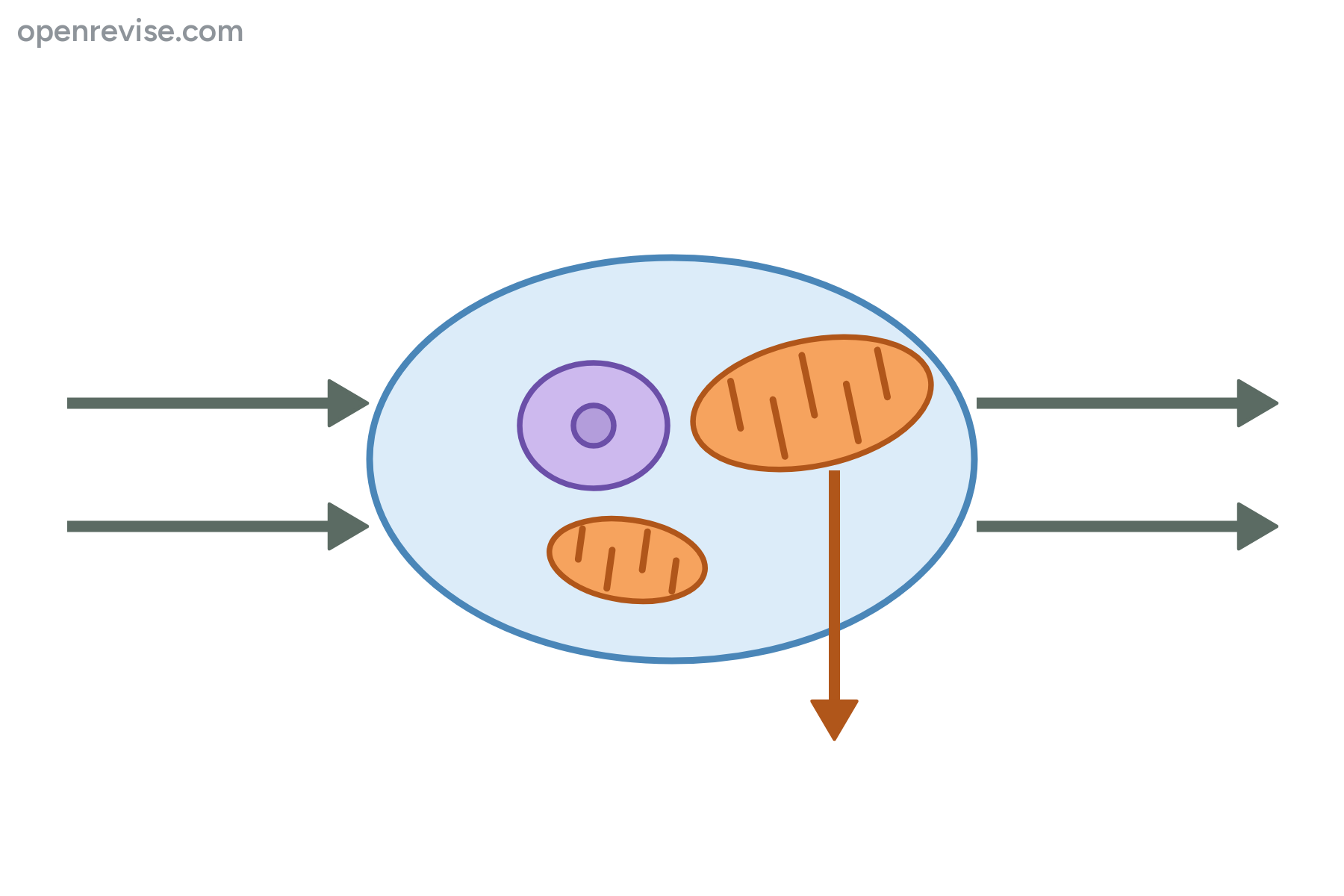 Name the three structures and the four substances shown, and say what is released.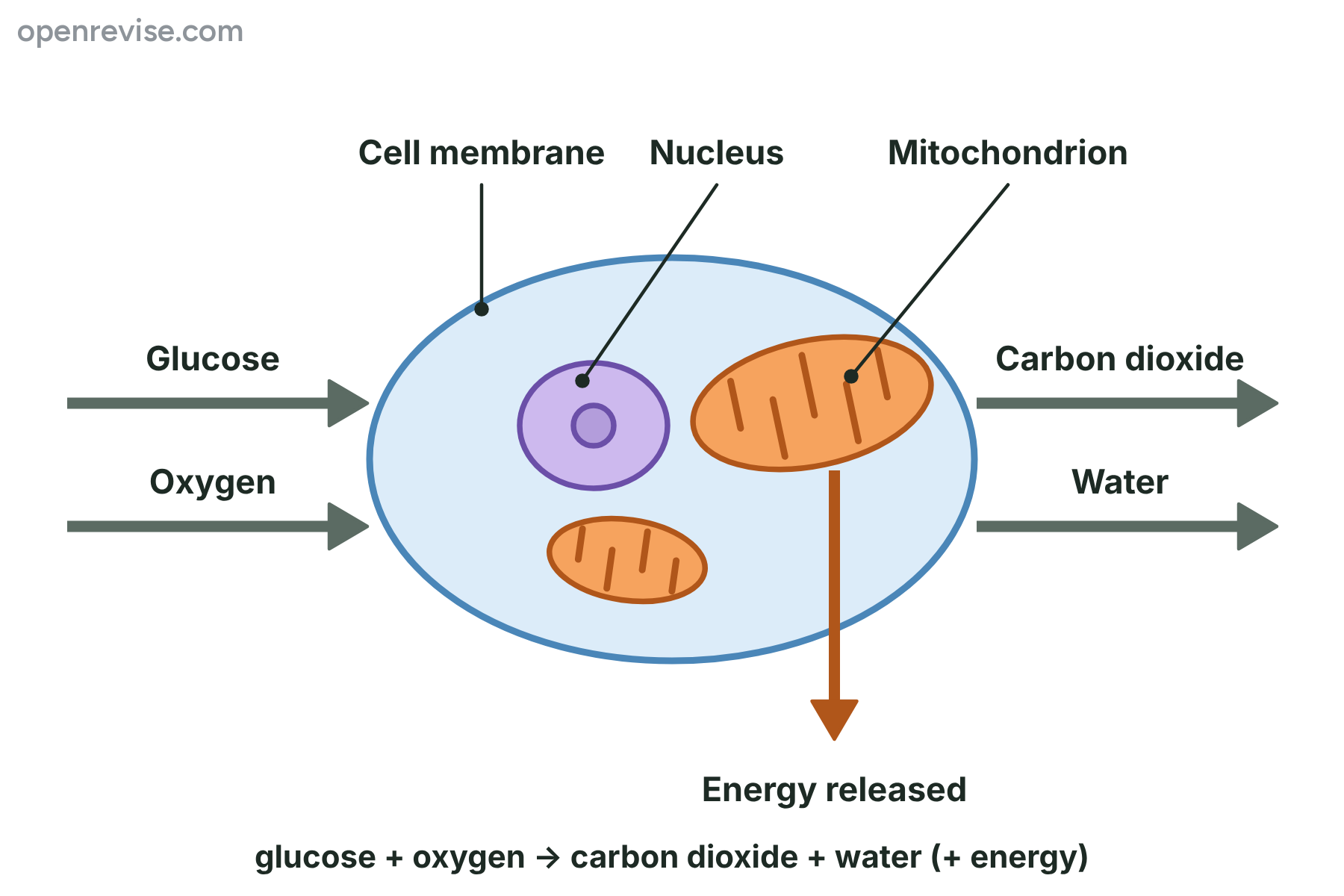
Structures: cell membrane, nucleus, mitochondrion. In: glucose and oxygen. Out: carbon dioxide and water. Energy is released from the mitochondrion.
-
Describe how oxygen reaches the respiring cells and how carbon dioxide leaves the body.
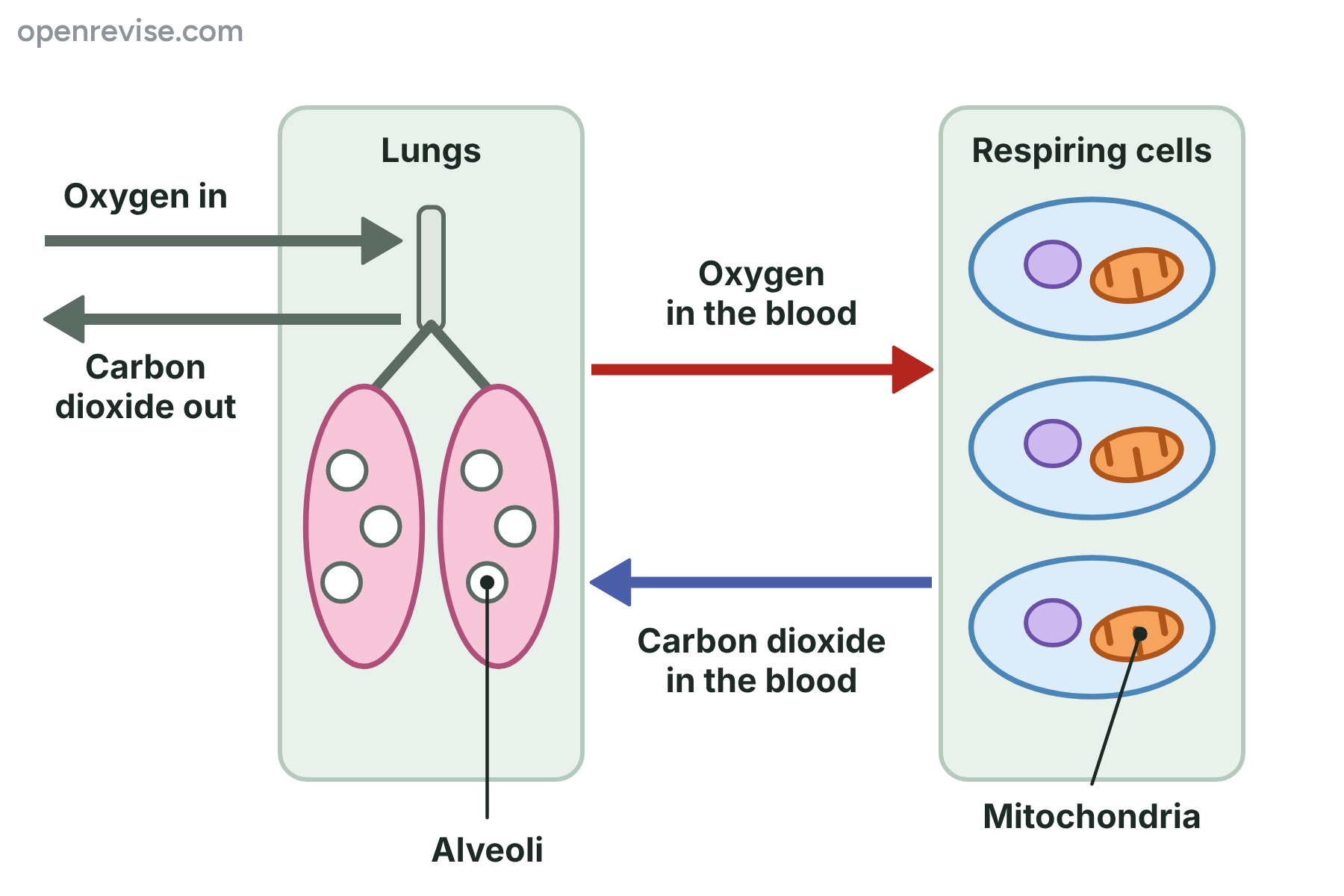
Oxygen is breathed into the lungs and diffuses into the blood at the alveoli. The blood carries it to the cells, where it is used in the mitochondria. Carbon dioxide diffuses into the blood, is carried to the lungs and is breathed out.
-
What is anaerobic respiration?
The release of energy from glucose without using oxygen.
-
Word equation for anaerobic respiration in muscles?
glucose → lactic acid (+ a small amount of energy)
-
Word equation for anaerobic respiration in yeast?
glucose → ethanol + carbon dioxide (+ a small amount of energy)
-
What is anaerobic respiration in yeast called?
Fermentation.
-
When do muscles respire anaerobically?
During vigorous exercise, when the blood cannot supply oxygen fast enough.
-
What causes muscle fatigue?
A build-up of lactic acid in the muscles.
-
What is the oxygen debt?
The extra oxygen needed after exercise to break down the lactic acid.
-
Where is lactic acid broken down?
In the liver, using oxygen.
-
Why do you keep panting after a sprint?
To take in the extra oxygen needed to repay the oxygen debt.
-
Which type of respiration releases more energy per glucose molecule?
Aerobic respiration.
-
Why does anaerobic respiration release less energy?
The glucose is only partly broken down, and the lactic acid or ethanol still holds energy.
-
Which type of respiration makes lactic acid, and which makes ethanol?
Muscles make lactic acid; yeast makes ethanol and carbon dioxide.
-
Why is carbon dioxide useful in baking?
It forms bubbles that make the dough rise.
-
Why is ethanol useful in brewing?
It makes beer and wine alcoholic.
-
Why do brewers seal the vessel?
To keep oxygen out, so that the yeast ferments instead of respiring aerobically.
-
What happens to heart rate and breathing rate during exercise?
Both increase, to supply the muscles with more oxygen and remove carbon dioxide.
-
How do you calculate a percentage increase?
Increase divided by the original value, times 100.
-
Where does anaerobic respiration take place in the cell?
In the cytoplasm.
-
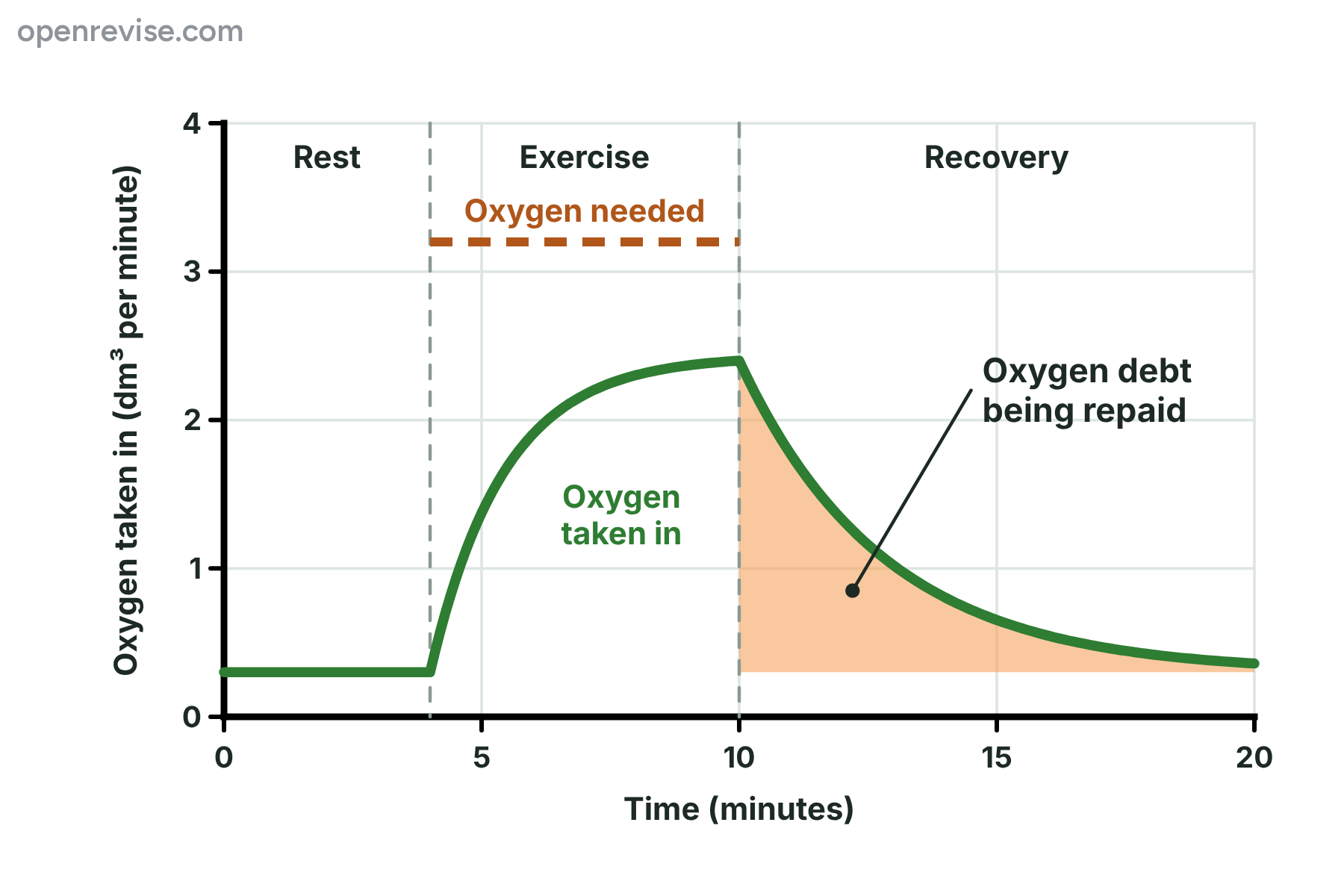 Describe what the shaded area on the graph shows.
 The shaded area is the oxygen debt being repaid. After vigorous exercise the body takes in extra oxygen to break down the lactic acid that built up in the muscles.
-
 Compare the three kinds of respiration. Name the products and say how much energy each releases.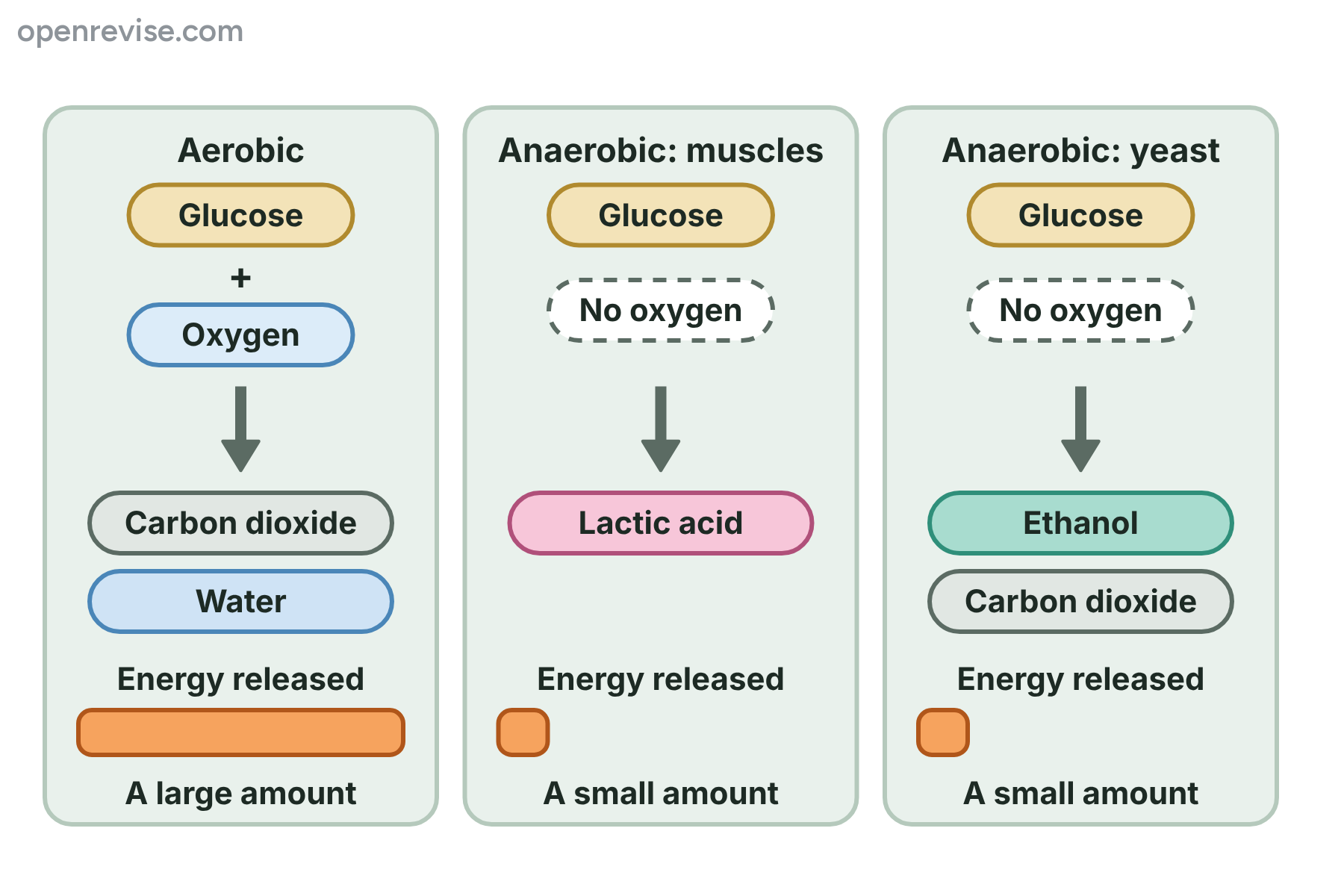
Aerobic: glucose + oxygen gives carbon dioxide + water and a large amount of energy. Muscles: glucose gives lactic acid and a small amount of energy. Yeast: glucose gives ethanol + carbon dioxide and a small amount of energy.
-
What does a respirometer measure?
The rate of respiration, by the oxygen consumed by living organisms.
-
What is the job of the soda lime?
It absorbs the carbon dioxide made by the organisms.
-
Why does the drop of coloured liquid move towards the tube?
Oxygen is used and the carbon dioxide is absorbed, so the volume and pressure of the gas fall.
-
What is the purpose of the cotton wool?
It keeps the organisms away from the soda lime.
-
What is the purpose of the water bath?
It keeps the tube at a steady chosen temperature.
-
Name two types of organism that can be used in a respirometer.
Germinating seeds and small invertebrates, such as woodlice or maggots.
-
Why are dry seeds not used?
They respire very slowly, so the drop would hardly move.
-
What is the independent variable in the temperature practical?
The temperature of the water bath.
-
What is the dependent variable?
The distance moved by the drop in a set time.
-
Name three variables that must be controlled.
Mass of organisms, volume of the apparatus, time, mass of soda lime, width of capillary tube.
-
What is in the control tube?
Glass beads, or boiled and cooled seeds, instead of living organisms.
-
Why leave the tubes in the water bath before starting?
So the gas inside reaches the temperature of the water, which stops it changing volume and moving the drop.
-
How do you calculate the rate?
The distance moved divided by the time taken.
-
What is the formula for the volume moved along the capillary tube?
Volume = \(\pi r^2 h\), where r is the radius of the tube and h is the distance moved.
-
Why does the rate fall at a very high temperature?
The enzymes that control respiration are denatured.
-
What should you do with an anomalous result?
Repeat it, and leave it out of the mean.
-
Why is soda lime dangerous?
It is corrosive, so wear eye protection and gloves.
-
How should small animals be treated in the practical?
Handled gently, kept in the tube for a short time and returned unharmed.
-
 Name the labelled parts of the respirometer and say what each one does.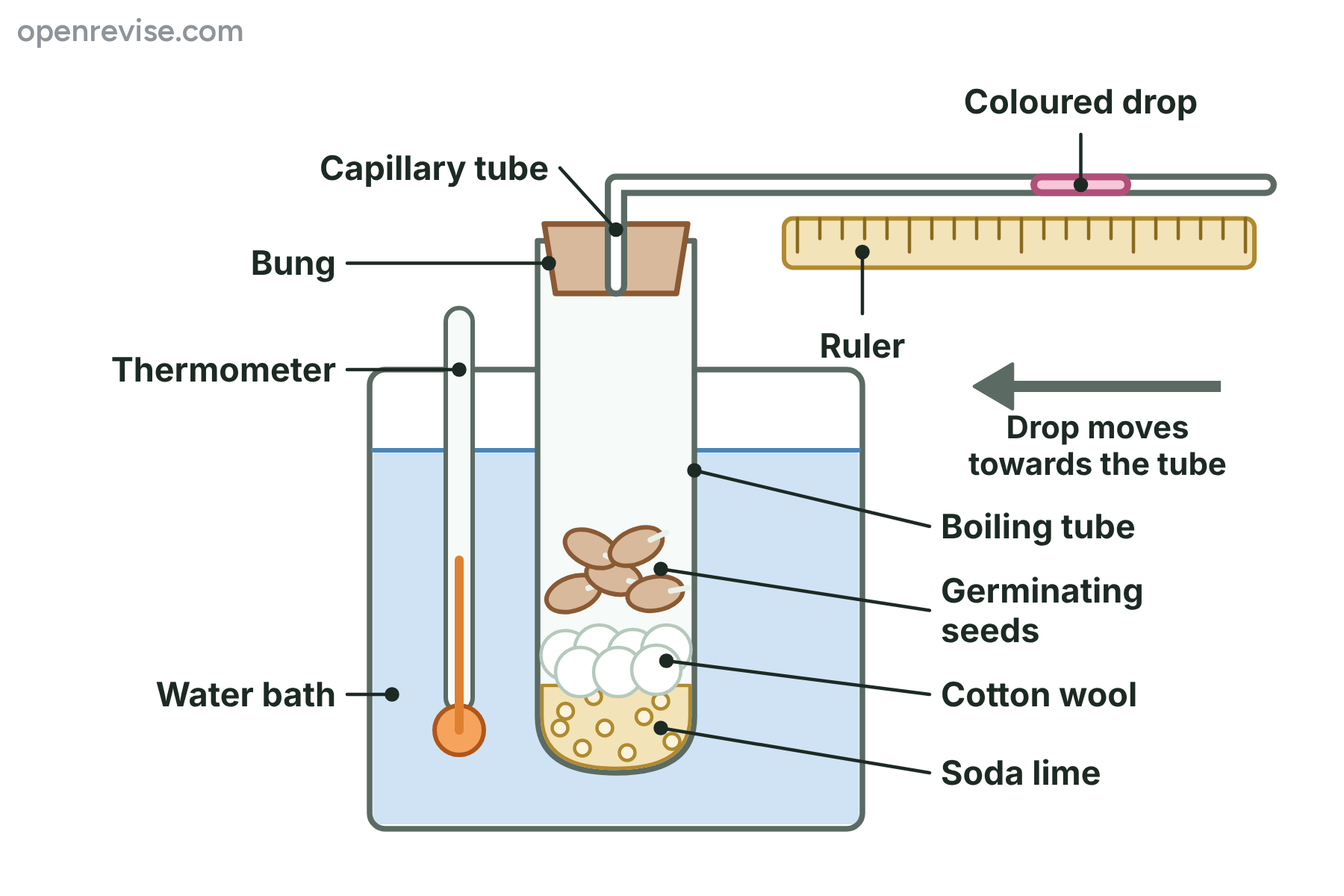
Soda lime absorbs carbon dioxide. Cotton wool keeps the seeds away from the soda lime. The seeds respire and use oxygen. The bung seals the tube. The coloured drop in the capillary tube moves as the volume of gas falls, and the ruler measures the distance. The water bath and thermometer keep the temperature steady.
-
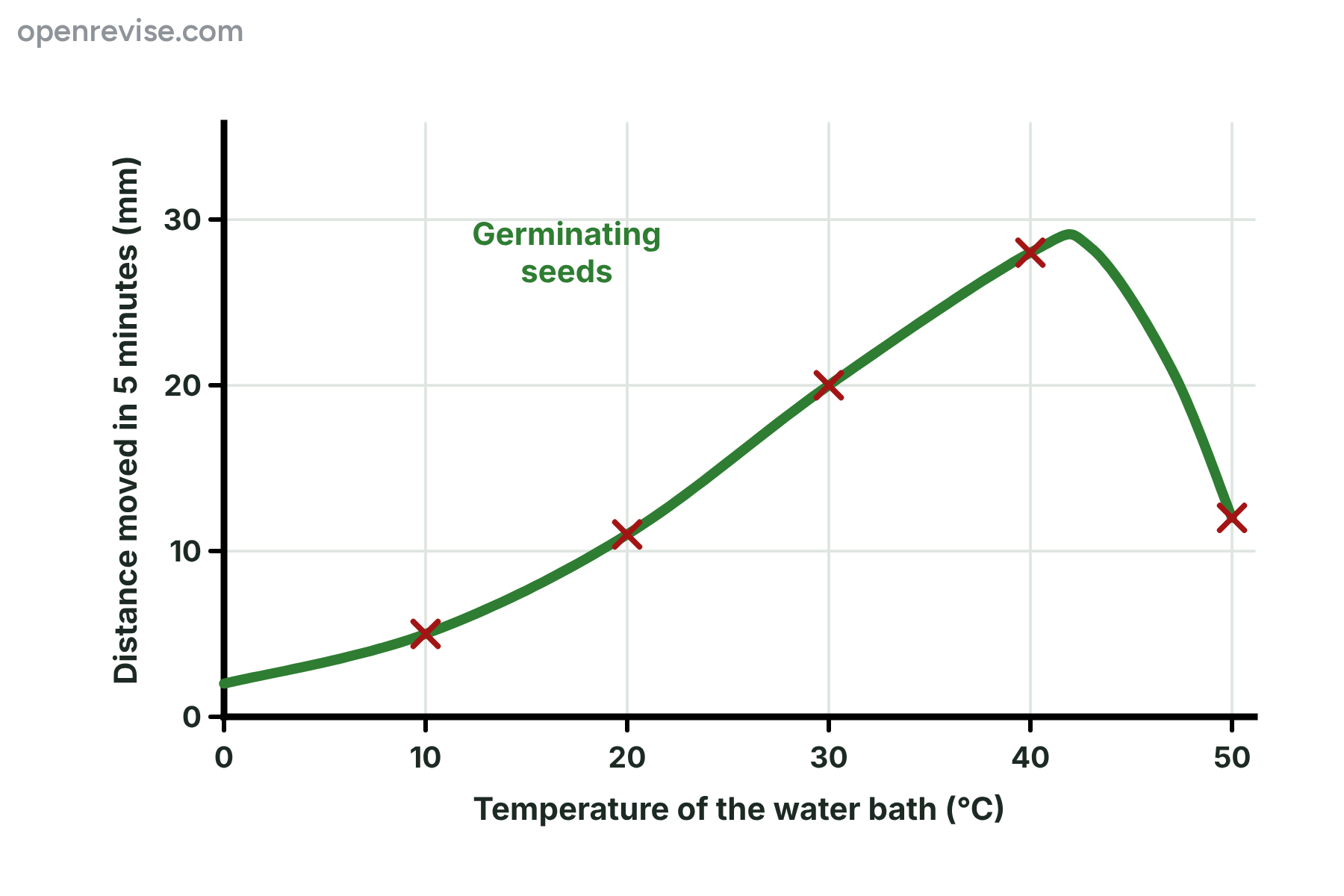 Describe and explain the pattern in these results.
 The distance moved, and so the rate of respiration, increases as the temperature rises from 10 to 40 degrees, because the enzymes work faster. At 50 degrees it falls because the enzymes are denatured.