Exam questions · Biology
Respiration
- 24 exam questions
- 74 marks
- 24 quick checks
Cellular Respiration and Aerobic Respiration
Just this lesson-
1 State [1 mark]
State where most of the reactions of aerobic respiration take place in a cell.
Show answerHide answer
Model answer
In the mitochondria.
Mark scheme
- Mitochondria (mitochondrion) — 1 mark
-
2 Write [2 marks]
Write the word equation for aerobic respiration.
Show answerHide answer
Model answer
glucose + oxygen → carbon dioxide + water
Mark scheme
- Glucose and oxygen on the left as the reactants — 1 mark
- Carbon dioxide and water on the right as the products — 1 mark
-
3 Name [3 marks]
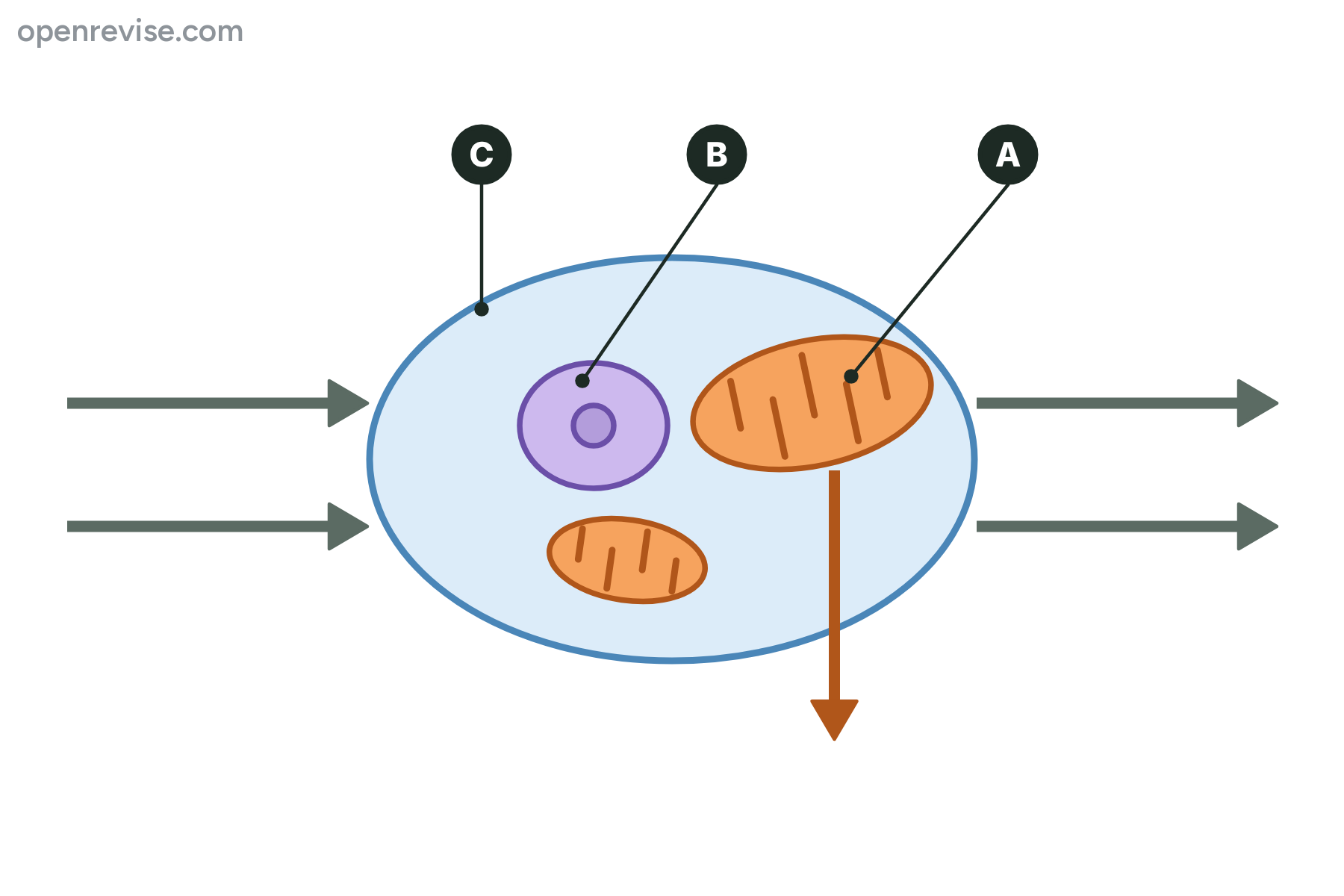
The diagram shows a cell. Name the parts labelled A, B and C.
Show answerHide answer
Model answer
A is a mitochondrion. B is the nucleus. C is the cell membrane.
Mark scheme
- A: mitochondrion — 1 mark
- B: nucleus — 1 mark
- C: cell membrane — 1 mark
-
4 Explain [2 marks]
Respiration is an exothermic reaction. Explain what this means and give one piece of evidence from living things that shows it.
Show answerHide answer
Model answer
An exothermic reaction transfers energy to the surroundings. For example, the body temperature of a mammal stays warm, and a pile of germinating seeds or a compost heap becomes warmer than the air around it, because the respiring cells release heat.
Mark scheme
- Energy is transferred to the surroundings (as heat) — 1 mark
- A suitable example such as a warm body, a compost heap or germinating seeds — 1 mark
-
5 Give [3 marks]
Give three ways in which the energy released by respiration is used in the human body.
Show answerHide answer
Model answer
Any three of: building larger molecules such as proteins from amino acids; muscle contraction for movement; keeping the body at a constant temperature; active transport of substances against a concentration gradient; cell division and growth.
Mark scheme
- First correct use — 1 mark
- Second correct use — 1 mark
- Third correct use — 1 mark
-
6 Explain [3 marks]
Muscle cells contain many more mitochondria than skin cells. Explain why.
Show answerHide answer
Model answer
Muscle cells need a lot of energy to contract. Most of the reactions of aerobic respiration take place in the mitochondria. Having many mitochondria means that more energy can be released every second to supply the muscle.
Mark scheme
- Muscle cells use a lot of energy (to contract) — 1 mark
- Mitochondria are where aerobic respiration takes place — 1 mark
- More mitochondria release more energy — 1 mark
-
7 Explain [4 marks]
Explain how the breathing system and the circulatory system work together to supply the cells with what they need for aerobic respiration.
Show answerHide answer
Model answer
Ventilation brings air into the lungs, and oxygen diffuses from the alveoli into the blood. Red blood cells carry the oxygen, and the heart pumps the blood around the body to the cells. The plasma carries glucose from digested food to the cells. The cells use the glucose and oxygen in the mitochondria, and the carbon dioxide they make diffuses into the blood and is carried back to the lungs to be breathed out.
Mark scheme
- Oxygen diffuses from the alveoli into the blood — 1 mark
- Red blood cells carry oxygen, and the heart pumps the blood to the cells — 1 mark
- Plasma carries glucose to the cells — 1 mark
- Carbon dioxide is carried back to the lungs and breathed out — 1 mark
-
8 Explain [3 marks]
A student put germinating peas in one vacuum flask and boiled peas in a second flask. Each flask had a thermometer. After two days the temperature in the flask with the germinating peas had risen by 4 degrees Celsius and the temperature in the flask with the boiled peas had not changed. Explain these results.
Show answerHide answer
Model answer
The germinating peas are alive, so they respire. Respiration is exothermic and transfers energy to the surroundings as heat, so the temperature rose. The boiled peas are dead and cannot respire, so no energy was released and the temperature did not change. The boiled peas are a control that shows the warming is caused by respiration.
Mark scheme
- Germinating peas respire — 1 mark
- Respiration is exothermic, so heat is released and the temperature rises — 1 mark
- Boiled peas are dead, so there is no respiration and no temperature change — 1 mark
Quick check
-
1
Which of these is the word equation for aerobic respiration?
Show answerHide answer
C: Glucose + oxygen → carbon dioxide + water
Aerobic respiration uses glucose and oxygen and makes carbon dioxide and water, releasing energy.
-
2
What does it mean to say that respiration is an exothermic reaction?
Show answerHide answer
B: It transfers energy to the surroundings
An exothermic reaction transfers energy to the surroundings, often as heat.
-
3
Which part of a cell contains most of the reactions of aerobic respiration?
Show answerHide answer
D: The mitochondrion
The mitochondria are the site of most of the reactions of aerobic respiration.
-
4
How often does respiration take place in a plant cell?
Show answerHide answer
A: All the time, day and night
Respiration occurs continuously in all living cells, so a plant cell respires in the dark as well as in the light.
-
5
Which of these is NOT a use of the energy released by respiration?
Show answerHide answer
B: Making glucose from carbon dioxide
Glucose is made by photosynthesis, which uses light energy. Respiration releases energy from glucose, it does not make it.
-
6
Why do the cells of a root hair contain many mitochondria?
Show answerHide answer
C: They use a lot of energy for active transport
Root hair cells use active transport to take in mineral ions, which needs energy released by respiration in the mitochondria.
-
7
What carries oxygen from the lungs to the respiring cells?
Show answerHide answer
A: Red blood cells
Red blood cells contain haemoglobin, which carries oxygen from the lungs to the cells.
-
8
During exercise a person breathes faster and their heart beats faster. What is the reason?
Show answerHide answer
D: The muscle cells need more oxygen and make more carbon dioxide
Muscle cells respire faster during exercise, so they need more oxygen and make more carbon dioxide.
Anaerobic Respiration
Just this lesson-
1 Write [2 marks]
Write the word equation for anaerobic respiration in human muscle cells.
Show answerHide answer
Model answer
glucose → lactic acid
Mark scheme
- Glucose as the reactant — 1 mark
- Lactic acid as the product — 1 mark
-
2 State [2 marks]
Yeast respires anaerobically when there is no oxygen. Name the two products of this process.
Show answerHide answer
Model answer
Ethanol and carbon dioxide.
Mark scheme
- Ethanol — 1 mark
- Carbon dioxide — 1 mark
-
3 Explain [3 marks]
Explain why anaerobic respiration releases less energy than aerobic respiration.
Show answerHide answer
Model answer
In aerobic respiration oxygen is used to break the glucose down completely into carbon dioxide and water, so most of its energy is released. In anaerobic respiration the glucose is only partly broken down, to lactic acid or to ethanol and carbon dioxide, so much of the energy is still held in those molecules and less is released.
Mark scheme
- Aerobic respiration breaks glucose down completely — 1 mark
- Anaerobic respiration breaks glucose down only partly — 1 mark
- The lactic acid or ethanol still contains energy that is not released — 1 mark
-
4 Explain [4 marks]
A baker mixes yeast, flour, sugar and water to make dough and leaves it in a warm place for an hour. The dough rises. Explain why.
Show answerHide answer
Model answer
The yeast respires the sugar anaerobically, because there is little oxygen in the dough, and this is fermentation. Fermentation makes ethanol and carbon dioxide. The carbon dioxide forms bubbles in the dough, which make it rise. The warm place makes the enzymes in the yeast work faster, so the fermentation and the rising are faster.
Mark scheme
- Yeast respires the sugar anaerobically (fermentation) — 1 mark
- Carbon dioxide is produced — 1 mark
- The carbon dioxide forms bubbles that make the dough rise — 1 mark
- Warmth makes the yeast enzymes work faster — 1 mark
-
5 Compare [4 marks]
Compare aerobic respiration and anaerobic respiration in human muscle cells.
Show answerHide answer
Model answer
Aerobic respiration needs oxygen but anaerobic respiration does not. Aerobic respiration breaks glucose down completely to carbon dioxide and water, but anaerobic respiration makes lactic acid. Aerobic respiration releases much more energy from each glucose molecule than anaerobic respiration. Aerobic respiration can continue for a long time, but anaerobic respiration causes lactic acid to build up and the muscles to tire.
Mark scheme
- Aerobic needs oxygen, anaerobic does not — 1 mark
- Aerobic makes carbon dioxide and water, anaerobic makes lactic acid — 1 mark
- Aerobic releases much more energy — 1 mark
- Anaerobic causes lactic acid build-up and muscle fatigue — 1 mark
-
6 Calculate [2 marks]
A student's pulse was 72 beats per minute at rest and 156 beats per minute immediately after exercise. Calculate the percentage increase in the pulse rate. Give your answer to the nearest whole number.
Show answerHide answer
Model answer
Increase = 156 − 72 = 84. \(84 \div 72 \times 100 = 116.7\), which is 117%.
Mark scheme
- \(84 \div 72 \times 100\) — 1 mark
- 117% — 1 mark
-
7 Explain [4 marks]
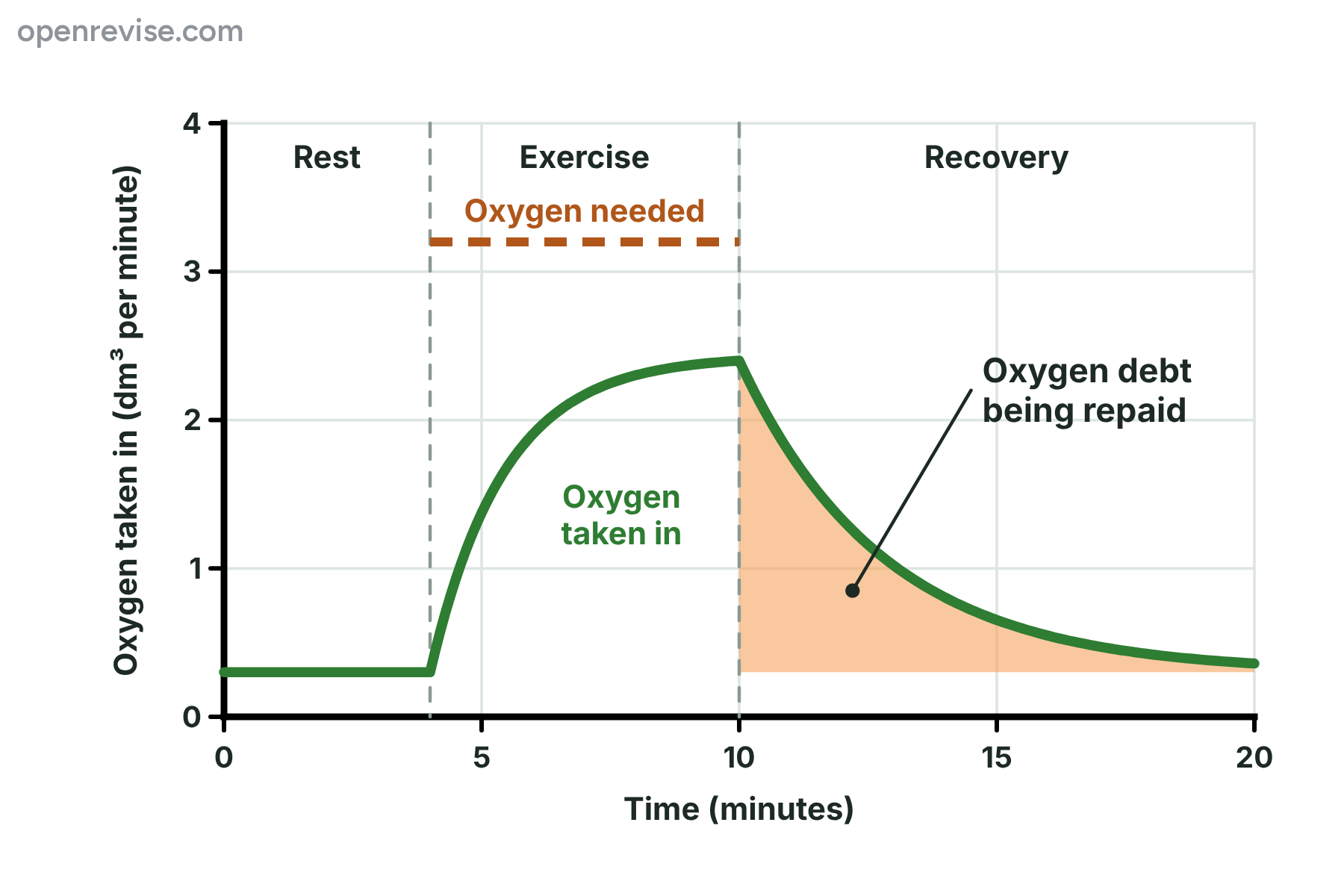
The graph shows the oxygen taken in by a person before, during and after exercise. (a) State the oxygen taken in at rest. (1) (b) Explain why the oxygen taken in is still higher than at rest 5 minutes after the exercise stops. (3)
Show answerHide answer
Model answer
(a) 0.3 dm³ per minute. (b) During the exercise the muscles did not get all the oxygen they needed, so they respired anaerobically and made lactic acid. After the exercise the person has an oxygen debt. Extra oxygen is needed to break down the lactic acid, so the oxygen taken in stays high until the debt has been repaid.
Mark scheme
- (a) 0.3 dm³ per minute — 1 mark
- Anaerobic respiration during exercise made lactic acid — 1 mark
- Extra oxygen is needed to break down the lactic acid (oxygen debt) — 1 mark
- Oxygen uptake stays high until the debt is repaid — 1 mark
-
8 Explain [6 marks]
A sprinter runs a 400 metre race. Explain what happens to her breathing rate, her heart rate and the respiration in her leg muscles during the race and in the five minutes after it.
Show answerHide answer
Model answer
During the race her leg muscles respire much faster, so her breathing rate and heart rate increase to bring more oxygen to the muscles and remove the carbon dioxide. The blood cannot deliver oxygen fast enough, so the muscles also respire anaerobically, making lactic acid, which causes muscle fatigue. After the race her breathing rate and heart rate stay high. She takes in extra oxygen to repay the oxygen debt, which is used to break down the lactic acid in the liver. Once the lactic acid has been removed, her heart rate and breathing rate return to their resting levels.
Mark scheme
- Breathing rate and heart rate increase during the race — 1 mark
- To supply more oxygen and remove carbon dioxide — 1 mark
- Muscles respire anaerobically because oxygen cannot be supplied fast enough — 1 mark
- Lactic acid is made and causes muscle fatigue — 1 mark
- After the race rates stay high to repay the oxygen debt — 1 mark
- Extra oxygen breaks down the lactic acid, then rates return to resting levels — 1 mark
Quick check
-
1
What is the word equation for anaerobic respiration in muscle cells?
Show answerHide answer
B: glucose → lactic acid
Muscle cells convert glucose to lactic acid when there is not enough oxygen, and no carbon dioxide is made.
-
2
Which two products does a yeast cell make by anaerobic respiration?
Show answerHide answer
C: Ethanol and carbon dioxide
Yeast ferments glucose to ethanol and carbon dioxide.
-
3
What causes muscle fatigue during a sprint?
Show answerHide answer
A: A build-up of lactic acid
Lactic acid builds up in the muscles when they respire anaerobically, and it makes them tire.
-
4
What is the oxygen debt?
Show answerHide answer
D: The extra oxygen needed after exercise to break down lactic acid
After vigorous exercise the extra oxygen is needed to break down the lactic acid.
-
5
Why does anaerobic respiration release less energy than aerobic respiration?
Show answerHide answer
B: The glucose is only partly broken down
Glucose is only partly broken down in anaerobic respiration, so lactic acid or ethanol still holds energy.
-
6
Why does bread dough rise when yeast is added?
Show answerHide answer
C: The yeast makes carbon dioxide bubbles
Yeast ferments the sugar, and the carbon dioxide it makes forms bubbles in the dough.
-
7
Where is lactic acid broken down after exercise?
Show answerHide answer
A: In the liver
The blood carries lactic acid to the liver, where it is broken down using oxygen.
-
8
What happens to the muscles during vigorous exercise?
Show answerHide answer
D: They also respire anaerobically
In vigorous exercise oxygen cannot be supplied fast enough, so the muscles also respire anaerobically and lactic acid builds up.
Core Practical: Investigating the Rate of Respiration
Just this lesson-
1 Explain [2 marks]
Explain why soda lime is placed in the tube of a respirometer.
Show answerHide answer
Model answer
The soda lime absorbs the carbon dioxide that the organisms make. This means that the only change in the volume of gas is the oxygen that is used up, so the movement of the drop shows the oxygen consumption.
Mark scheme
- It absorbs the carbon dioxide — 1 mark
- So only the oxygen used changes the volume of gas — 1 mark
-
2 Name [3 marks]
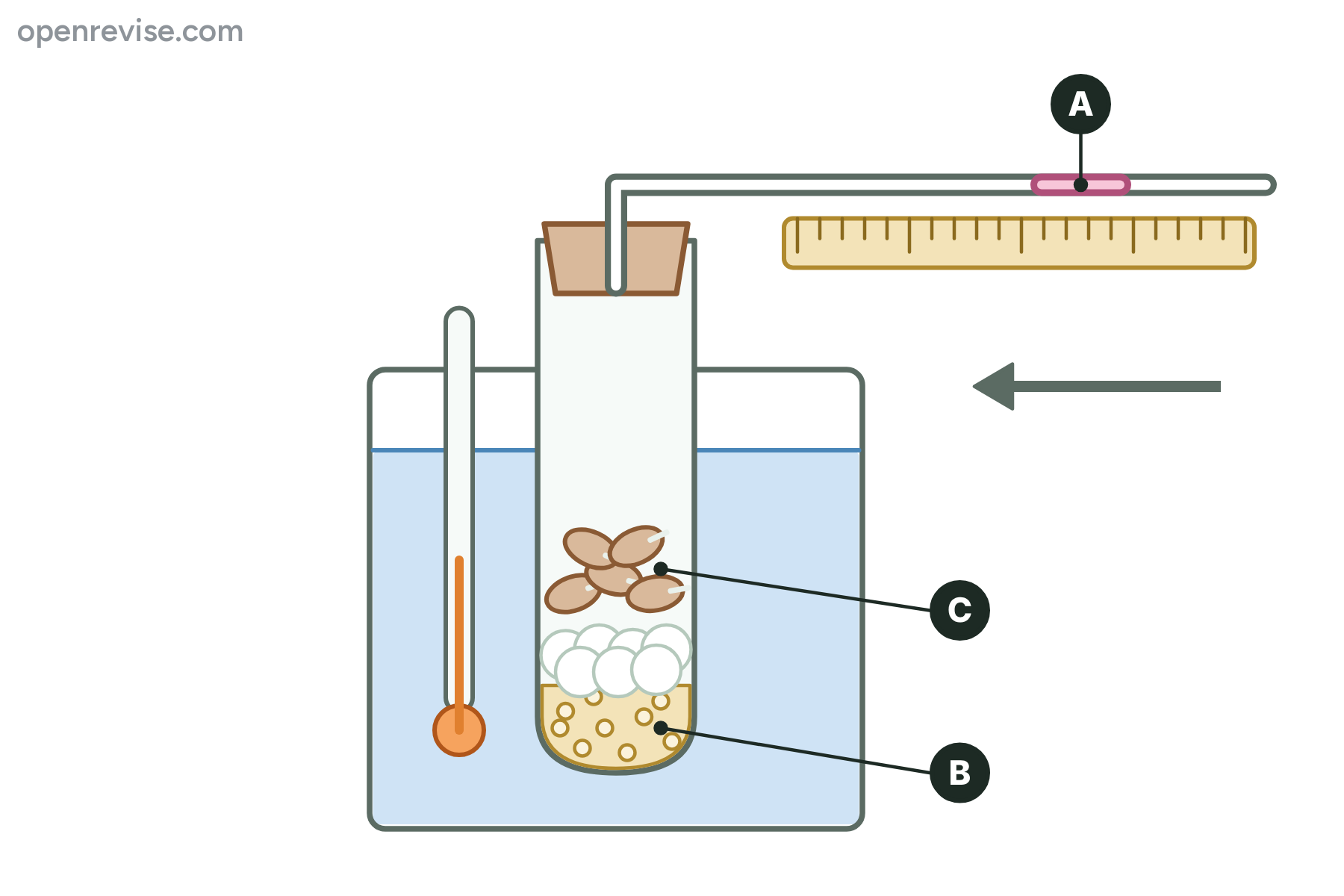
The diagram shows a respirometer. Name the parts labelled A, B and C.
Show answerHide answer
Model answer
A is the (drop of) coloured liquid. B is the soda lime. C is the germinating seeds.
Mark scheme
- A: coloured liquid (drop) — 1 mark
- B: soda lime — 1 mark
- C: (germinating) seeds — 1 mark
-
3 Explain [3 marks]
In a respirometer the drop of coloured liquid moves towards the tube containing the organisms. Explain why.
Show answerHide answer
Model answer
The organisms use oxygen in aerobic respiration. The carbon dioxide they make is absorbed by the soda lime. The volume of gas in the tube therefore falls, which lowers the pressure and pulls the drop of liquid towards the tube.
Mark scheme
- Oxygen is used by respiration — 1 mark
- The carbon dioxide is absorbed by the soda lime — 1 mark
- The volume (pressure) of gas falls, so the drop is drawn towards the tube — 1 mark
-
4 Explain [2 marks]
A second tube is set up in the same way but contains glass beads instead of seeds. Explain the purpose of this control tube.
Show answerHide answer
Model answer
It shows what happens when there is no respiration. If the drop in the control tube does not move, the movement of the drop in the seed tube is caused by respiration. If it does move, the cause is a change in temperature or air pressure, and the results can be corrected.
Mark scheme
- It contains no living organisms, so there is no respiration — 1 mark
- It shows that movement is caused by respiration, not by changes in temperature or pressure — 1 mark
-
5 Calculate [3 marks]
A student measured the distance moved by the drop at 30 degrees Celsius in 5 minutes three times: 22 mm, 26 mm and 24 mm. Calculate the mean rate of movement of the drop in mm per minute.
Show answerHide answer
Model answer
Mean distance = \((22 + 26 + 24) \div 3 = 24\) mm. Rate = \(24 \div 5 = 4.8\) mm per minute.
Mark scheme
- Mean distance \(= 24\) mm — 1 mark
- Divide by the time, \(24 \div 5\) — 1 mark
- 4.8 mm per minute (with the unit) — 1 mark
-
6 Calculate [3 marks]
The capillary tube in the respirometer has an internal radius of 0.5 mm. The drop moved 24 mm in 5 minutes. Calculate the volume of oxygen used per minute. Use volume = \(\pi r^2 h\). Give your answer to 2 significant figures.
Show answerHide answer
Model answer
Volume in 5 minutes = \(\pi \times 0.5^2 \times 24 = 18.85\) mm³. Volume per minute = \(18.85 \div 5 = 3.77\), which is 3.8 mm³ per minute.
Mark scheme
- \(\pi \times 0.5^2 \times 24 = 18.85\) mm³ — 1 mark
- Divide by 5 minutes — 1 mark
- 3.8 mm³ per minute — 1 mark
-
7 Explain [4 marks]
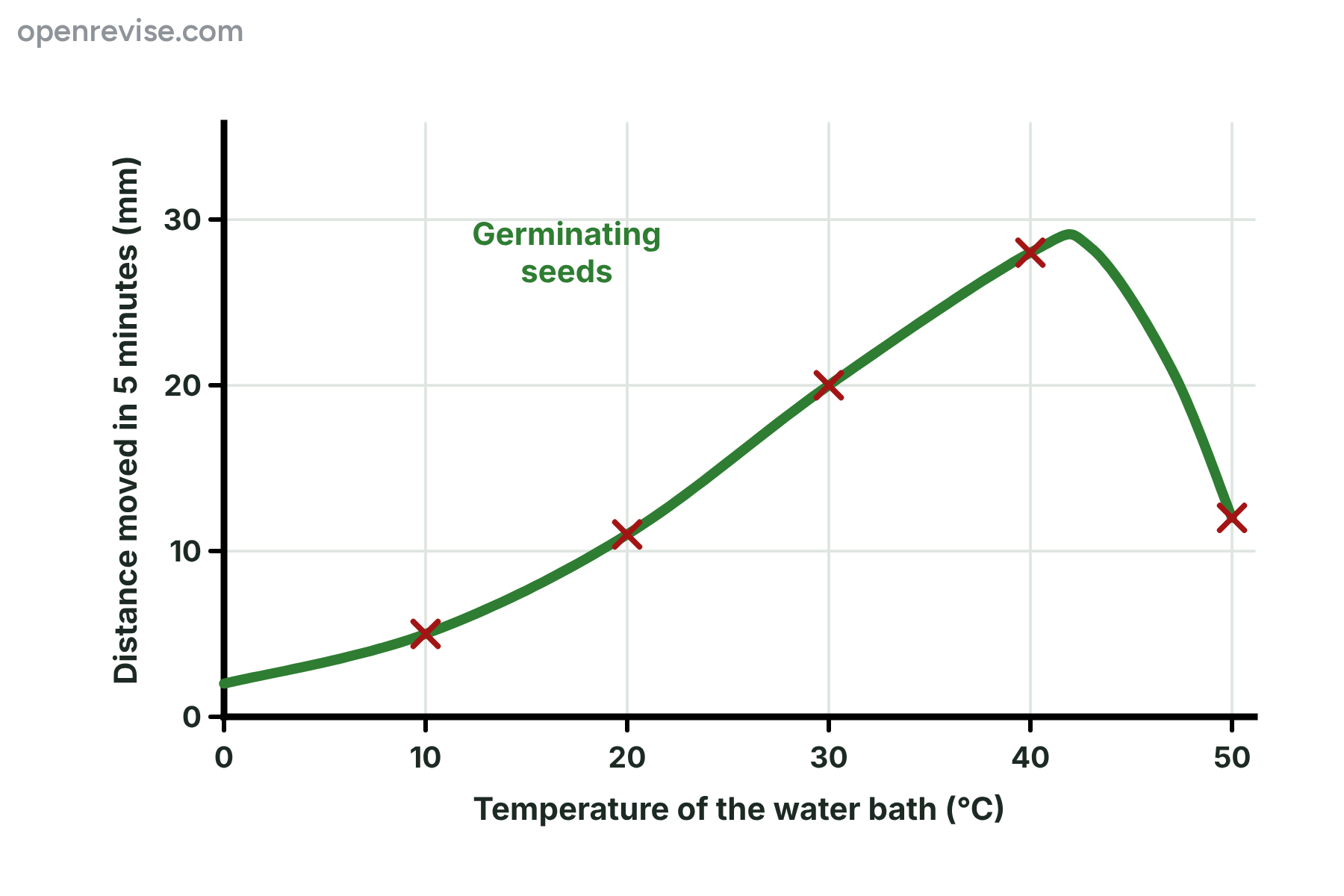
The graph shows the distance moved by the drop in a respirometer containing germinating seeds at five temperatures. (a) Describe the effect of increasing the temperature from 10 degrees Celsius to 40 degrees Celsius. (2) (b) Explain why the distance moved is less at 50 degrees Celsius than at 40 degrees Celsius. (2)
Show answerHide answer
Model answer
(a) The distance moved increases from 5 mm to 28 mm, so the rate of respiration increases as the temperature rises. (b) At 50 degrees Celsius the enzymes that control respiration are denatured, because their shape changes. The seeds respire more slowly and use less oxygen, so the drop moves less far.
Mark scheme
- (a) Distance (rate) increases as temperature increases — 1 mark
- (a) Data quoted, such as 5 mm to 28 mm — 1 mark
- (b) Enzymes are denatured at 50 degrees Celsius — 1 mark
- (b) Less respiration, so less oxygen is used and the drop moves less — 1 mark
-
8 Describe [6 marks]
Describe how you would use a respirometer to investigate the effect of temperature on the rate of respiration of germinating seeds. Include one safety precaution in your answer.
Show answerHide answer
Model answer
Put soda lime in the bottom of a boiling tube, add cotton wool and a measured mass of germinating seeds, and fit a bung with a capillary tube so that it is airtight. Set up a control tube with glass beads instead of seeds. Place the tubes in a water bath at the first temperature, for example 10 degrees Celsius, and leave them for five minutes. Add a drop of coloured liquid to the capillary tube and record its position. After a set time, such as five minutes, record the position again and calculate the distance moved. Repeat at 20, 30 and 40 degrees Celsius, keeping the mass of seeds, the apparatus and the time the same, and repeat each temperature to calculate a mean. Wear eye protection and gloves because soda lime is corrosive.
Mark scheme
- Soda lime, cotton wool and a measured mass of seeds in a tube with a capillary tube and a drop of coloured liquid — 1 mark
- A control tube with glass beads or boiled seeds — 1 mark
- Tubes placed in a water bath at a measured temperature and left to reach it — 1 mark
- Distance moved by the drop in a set time is measured — 1 mark
- Repeat at several temperatures with the other variables controlled, and calculate means — 1 mark
- A safety precaution, such as eye protection because soda lime is corrosive — 1 mark
Quick check
-
1
What is the purpose of the soda lime in a respirometer?
Show answerHide answer
C: To absorb the carbon dioxide
Soda lime absorbs carbon dioxide, so only the oxygen used changes the volume of gas.
-
2
In which direction does the coloured drop move as the organisms respire?
Show answerHide answer
A: Towards the tube with the organisms
Oxygen is used up and the carbon dioxide is absorbed, so the gas volume falls and the drop is drawn towards the tube.
-
3
What is the dependent variable in the temperature experiment?
Show answerHide answer
D: The distance moved by the drop
The temperature is the independent variable. The distance the drop moves in a set time is what is measured.
-
4
What should the control tube contain?
Show answerHide answer
B: Glass beads or boiled seeds
Glass beads or boiled seeds cannot respire, so any movement shows a change in temperature or pressure.
-
5
Why are the tubes left in the water bath for several minutes before starting?
Show answerHide answer
A: So that the gas inside reaches the water temperature
The gas in the tube has to reach the temperature of the water, otherwise it changes volume and moves the drop.
-
6
Why does the distance moved fall at a very high temperature such as 50 degrees Celsius?
Show answerHide answer
C: The enzymes are denatured
Enzymes that control respiration are denatured at high temperatures, so respiration slows down.
-
7
Which is the main safety hazard of soda lime?
Show answerHide answer
D: It is corrosive
Soda lime is corrosive, so eye protection and gloves are worn.
-
8
A drop moved 30 mm in 5 minutes. What is the rate of movement?
Show answerHide answer
B: 6 mm per minute
Rate is distance divided by time, so 30 divided by 5 gives 6 mm per minute.