Flashcards · Biology
What Happens in Cells
-
What is DNA?
A polymer that stores the genetic information of a cell.
-
What is a polymer?
A large molecule made of many smaller units joined together.
-
How many strands does DNA have?
Two.
-
What shape is a DNA molecule?
A double helix, a twisted ladder.
-
What joins the two strands of DNA?
Pairs of bases.
-
What is a gene?
A section of DNA that codes for a protein.
-
What is a chromosome?
A long, coiled DNA molecule that carries many genes.
-
What is the genome?
All of the genetic material of an organism.
-
Where is DNA found in a plant or animal cell?
In the nucleus, in the chromosomes.
-
Where is DNA found in a bacterial cell?
As a loop in the cytoplasm, and also in plasmids.
-
What is a plasmid?
A small ring of DNA found in bacterial cells.
-
What do genes code for?
Proteins.
-
Why is detergent added when extracting DNA?
It breaks down the cell membranes.
-
Why is cold ethanol added when extracting DNA?
DNA is not soluble in it, so it comes out of the solution as a white solid.
-
Who published the double helix model, and when?
Watson and Crick in 1953.
-
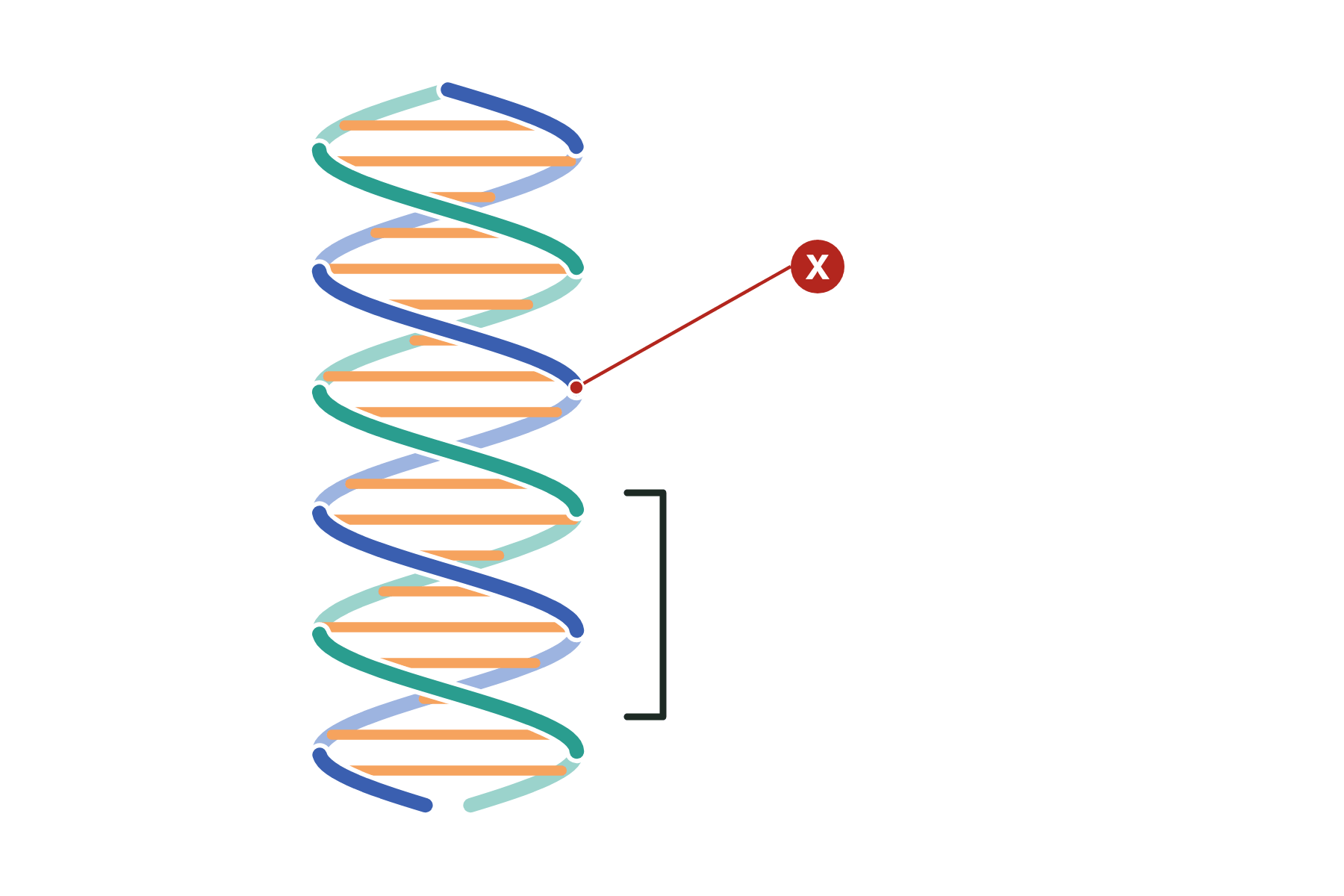 Name the part marked X.
 A strand. Each strand is a polymer, and two strands form the double helix.
-
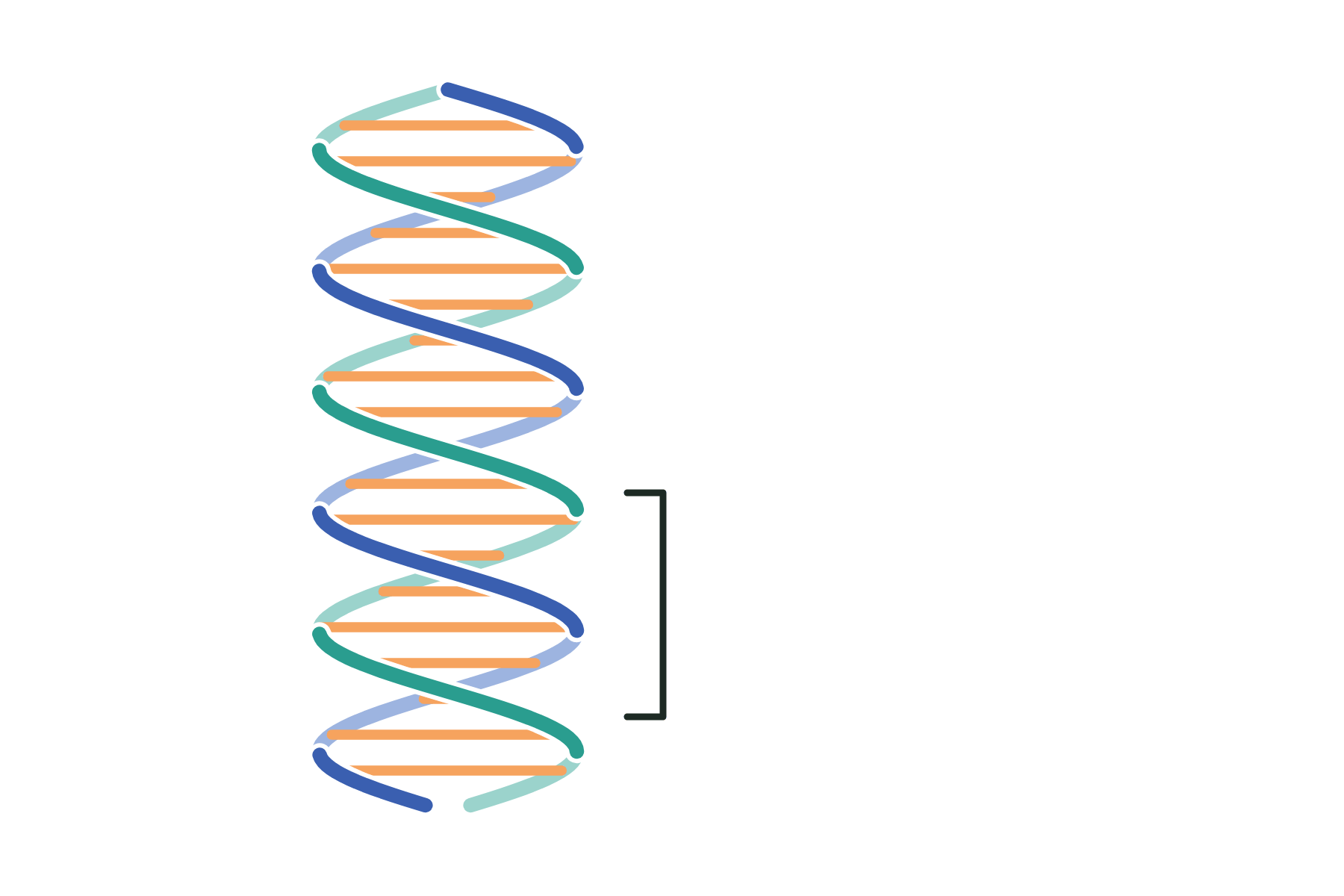 Label the parts of this DNA molecule.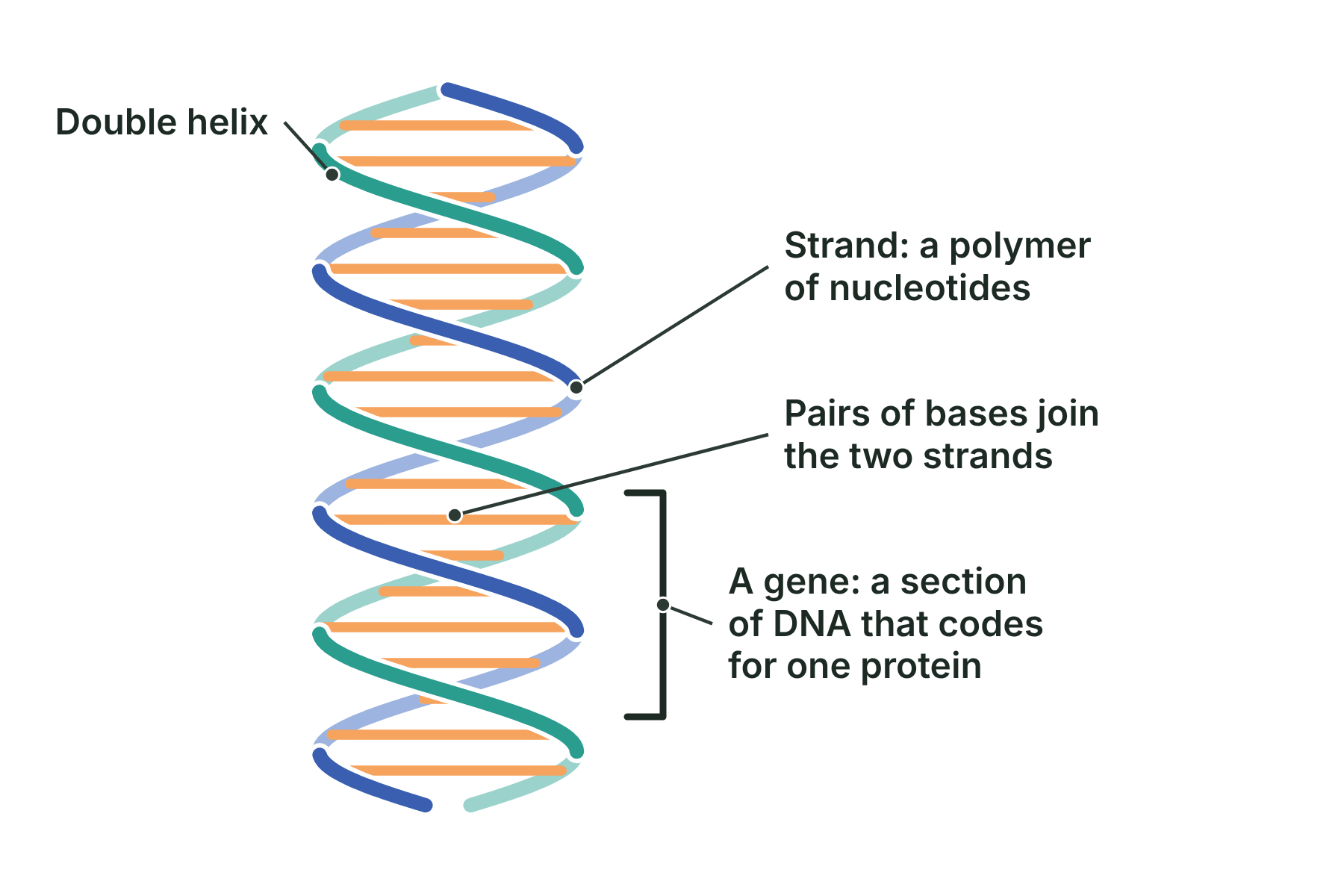
Two strands, joined by pairs of bases, form a double helix. The bracket marks a gene, a section of DNA that codes for one protein.
-
What are the four bases in DNA?
Adenine, thymine, guanine and cytosine (A, T, G and C).
-
What are the three parts of a nucleotide?
A phosphate group, a sugar and a base.
-
What forms the backbone of a DNA strand?
The sugars and phosphate groups.
-
Which base pairs with A?
T.
-
Which base pairs with G?
C.
-
What is complementary base pairing?
A always pairs with T, and G always pairs with C.
-
What holds the two strands of DNA together?
Weak bonds between pairs of bases.
-
What happens to the gene first in protein synthesis? (Higher tier)
The DNA unzips and a copy of the gene is made.
-
What is mRNA? (Higher tier)
A copy of a gene that carries the code to the ribosome.
-
What is transcription? (Higher tier)
Making the mRNA copy of a gene in the nucleus.
-
What is translation? (Higher tier)
Reading the mRNA at the ribosome and joining amino acids in order.
-
What does tRNA do? (Higher tier)
It carries amino acids to the ribosome.
-
What is a triplet? (Higher tier)
A group of three bases that codes for one amino acid.
-
How does DNA decide the order of amino acids? (Higher tier)
The order of triplets in the gene gives the order of amino acids.
-
Why can a change in a gene change a protein? (Higher tier)
A different base order can give different amino acids, so the protein folds into a different shape.
-
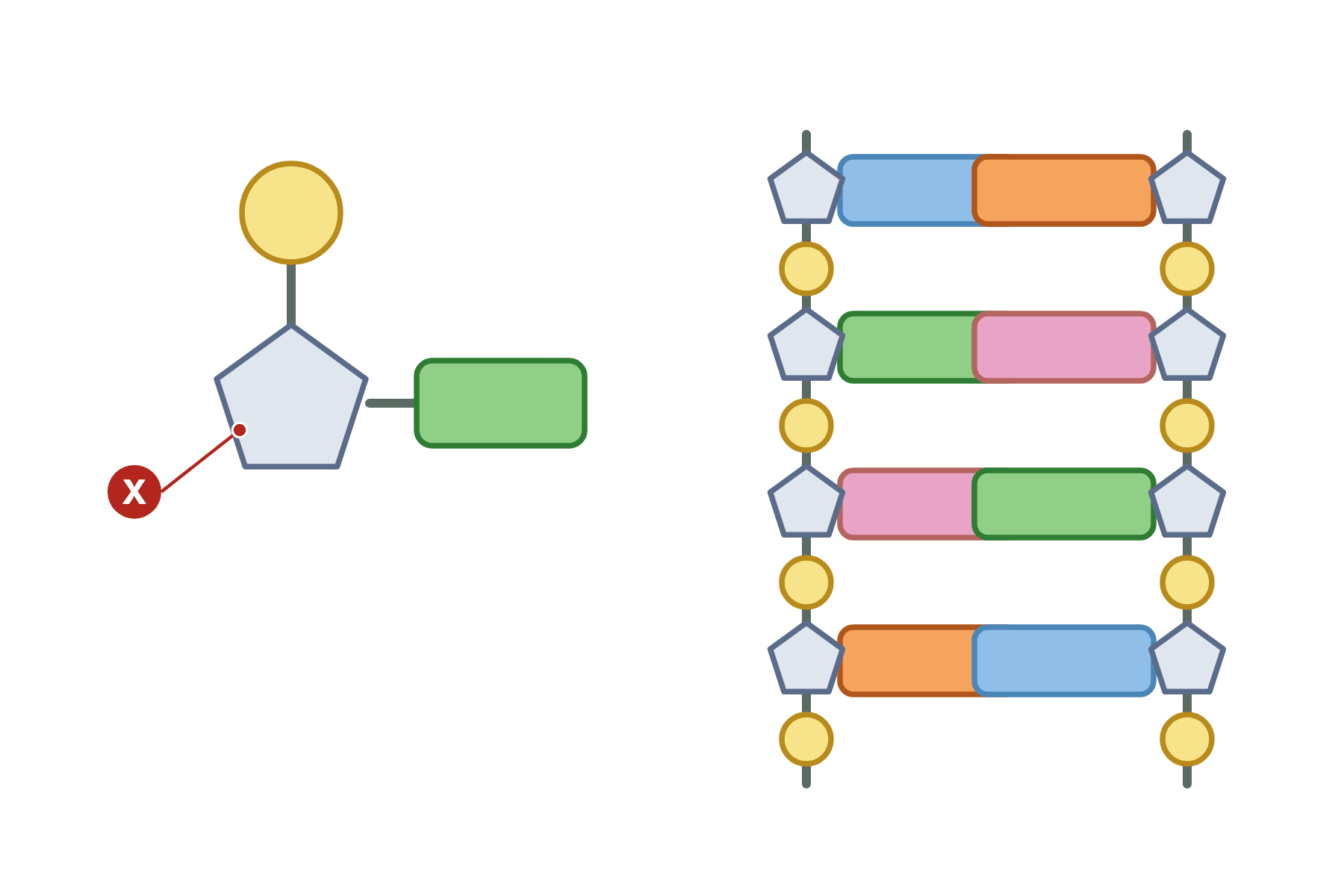 Name the part of the nucleotide marked X.
 The sugar. It joins to the phosphate group and to the base.
-
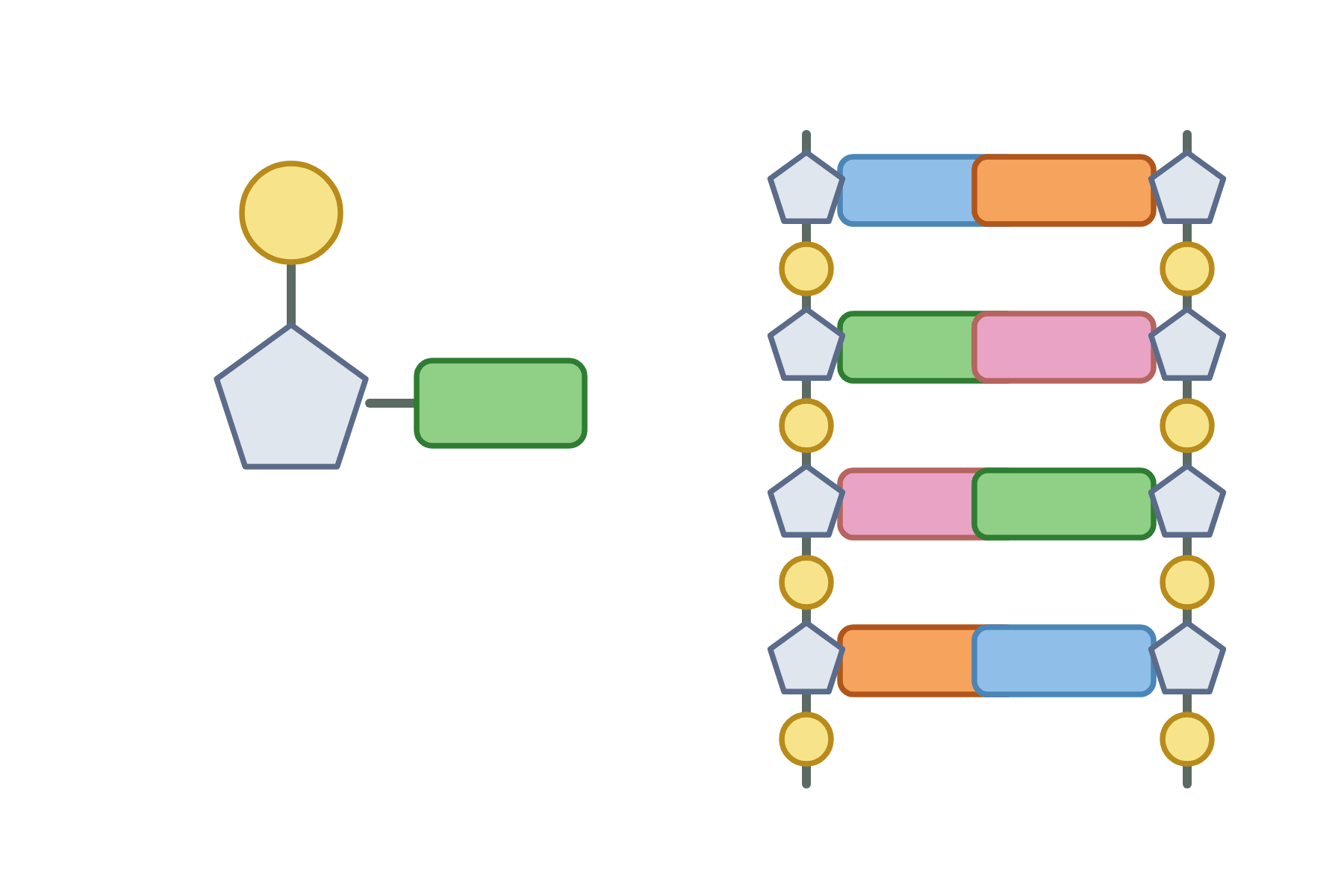 Label the nucleotide and say which bases pair.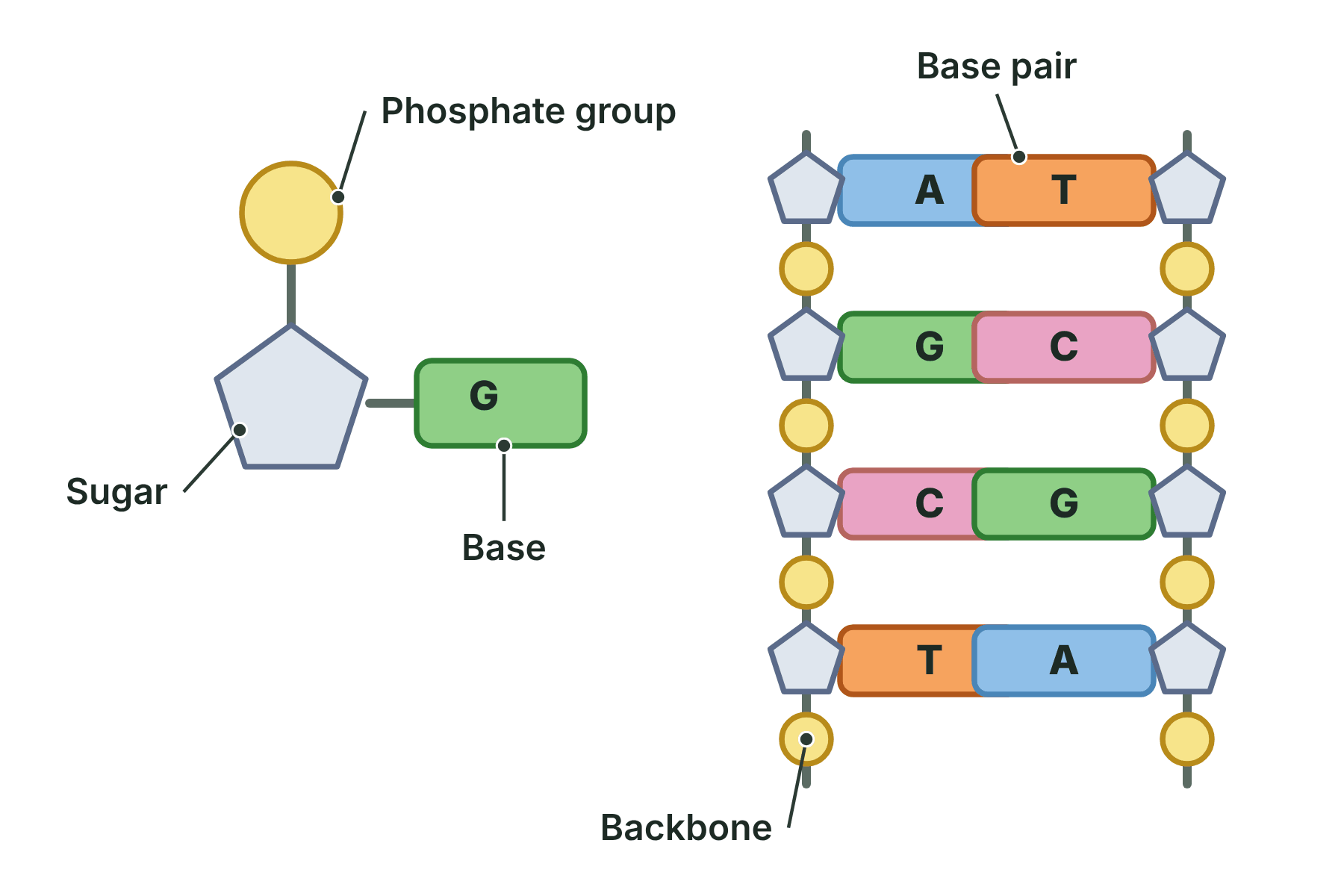
The nucleotide has a phosphate group, a sugar and a base. A pairs with T, and G pairs with C.
-
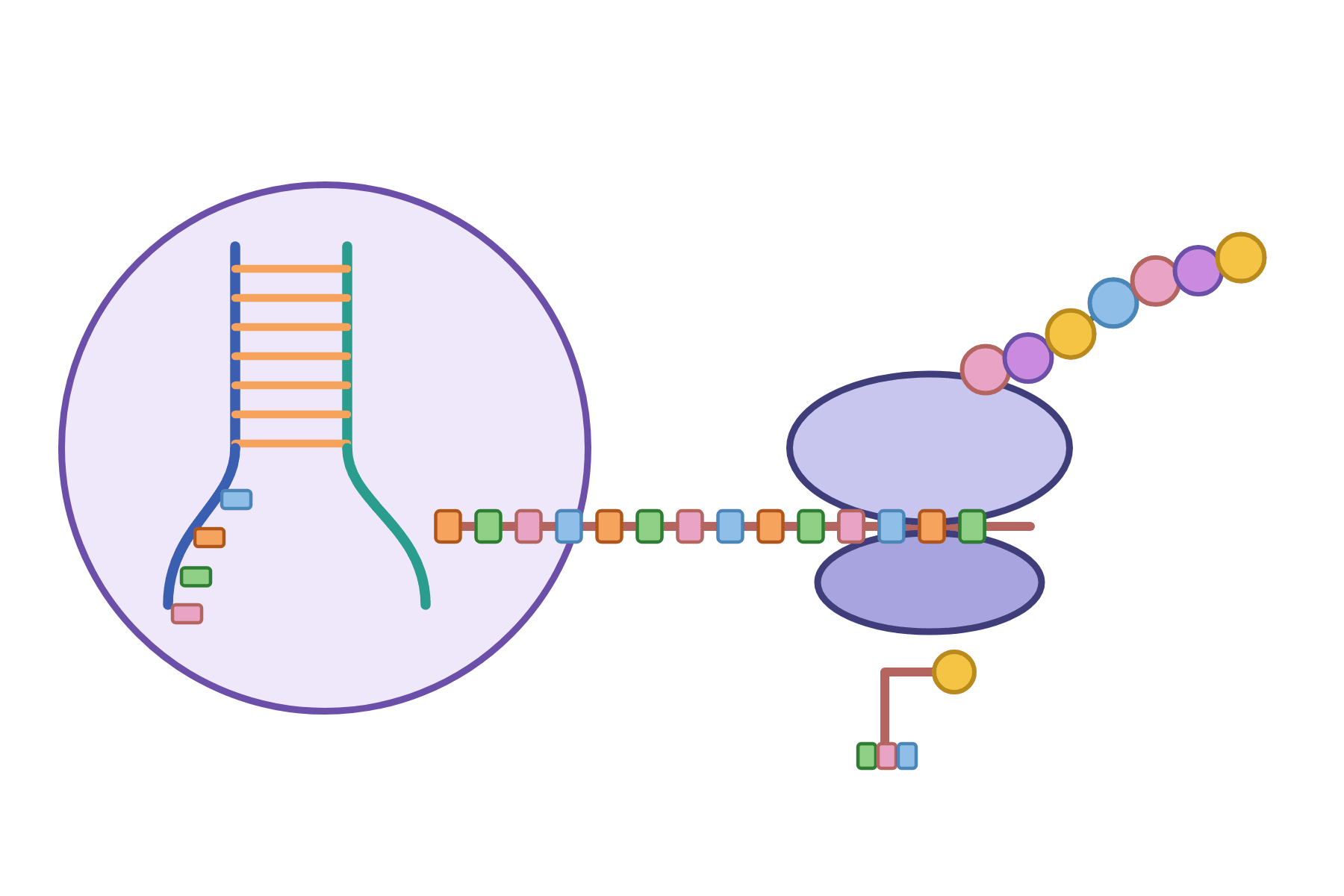 Describe what happens at each stage of protein synthesis.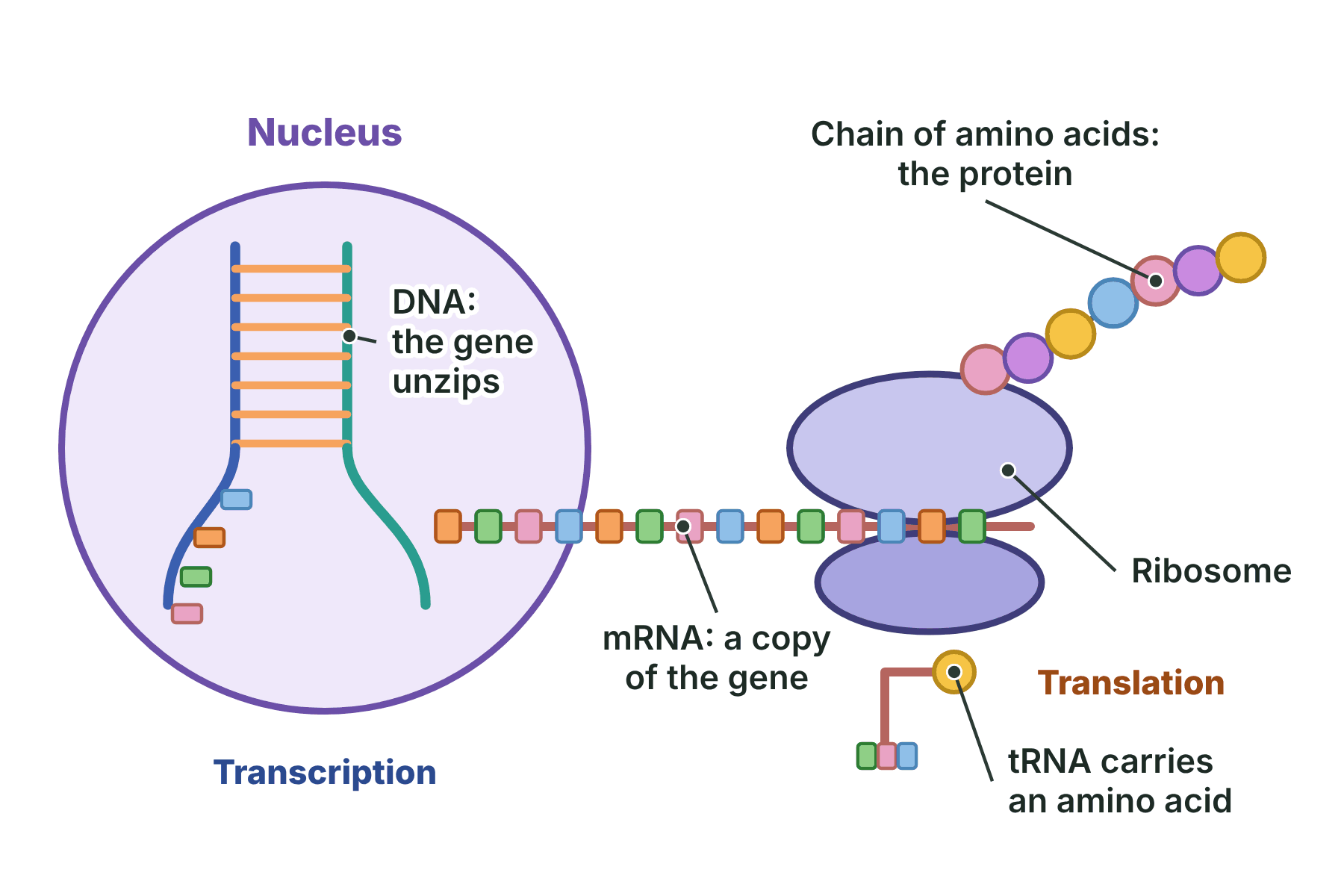
In the nucleus the gene is copied as mRNA (transcription). The mRNA leaves and is read by a ribosome. tRNA brings amino acids, which are joined in order (translation).
-
What is an enzyme?
A biological catalyst that speeds up a reaction in a living thing.
-
What is a catalyst?
A substance that speeds up a chemical reaction without being used up.
-
What are enzymes made of?
Protein.
-
Is an enzyme used up in a reaction?
No. It is unchanged at the end and can be used again.
-
What is the substrate?
The substance that an enzyme acts on.
-
What are the products?
The substances that are made in the reaction.
-
What is the active site?
The region of the enzyme into which the substrate fits.
-
What is an enzyme-substrate complex?
The enzyme and its substrate joined together while the reaction happens.
-
Why is an enzyme specific?
The shape of its active site fits only one substrate.
-
What is the lock and key model?
A model in which the substrate (key) fits the active site (lock) exactly.
-
Why is the lock and key model called simplified?
Real enzymes can change shape slightly, but the model treats the active site as rigid.
-
Why does a reaction speed up when it gets warmer?
The particles have more energy and collide more often.
-
What is the optimum temperature?
The temperature at which an enzyme works fastest.
-
What is the optimum temperature for many human enzymes?
About 37 to 40 °C.
-
What does denatured mean?
The enzyme has lost its shape, so the active site no longer fits the substrate.
-
What causes an enzyme to be denatured?
A temperature that is too high, or a pH that is too acidic or too alkaline.
-
Can a denatured enzyme be restored by cooling it?
No. The change in shape is permanent.
-
Does cold denature an enzyme?
No. The enzyme just works slowly, and speeds up again when warmed.
-
What is the optimum pH of pepsin?
About pH 2.
-
What is the optimum pH of amylase?
About pH 7.
-
How do you work out rate from the amount of product?
Rate = amount of product formed ÷ time taken.
-
How do you work out rate from the time taken?
Rate = 1 ÷ time. Using 1000 ÷ time gives easier numbers.
-
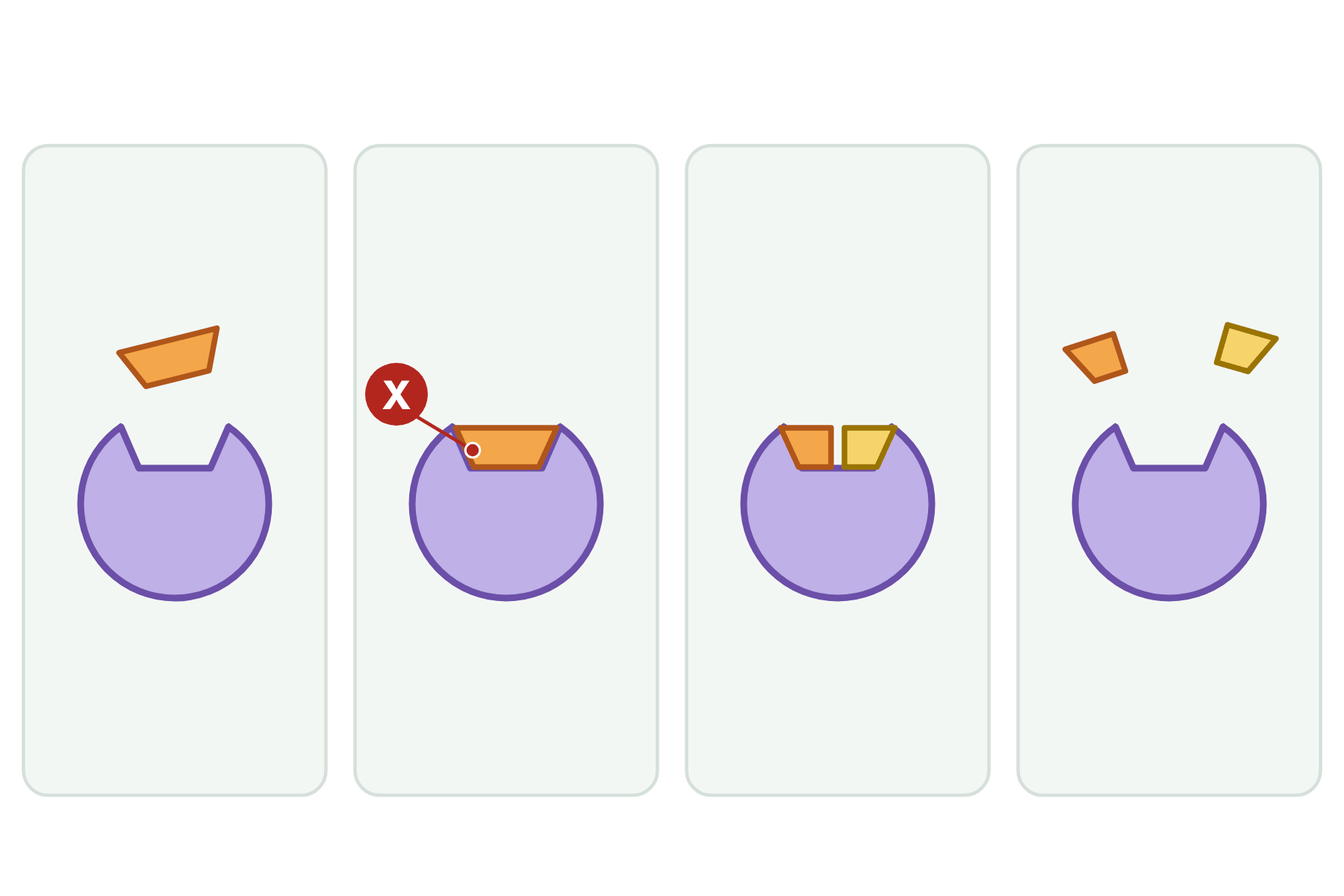 What is the region of the enzyme marked X, and why is it important?
 The active site. Its shape fits the substrate exactly, so only that substrate can bind and be changed.
-
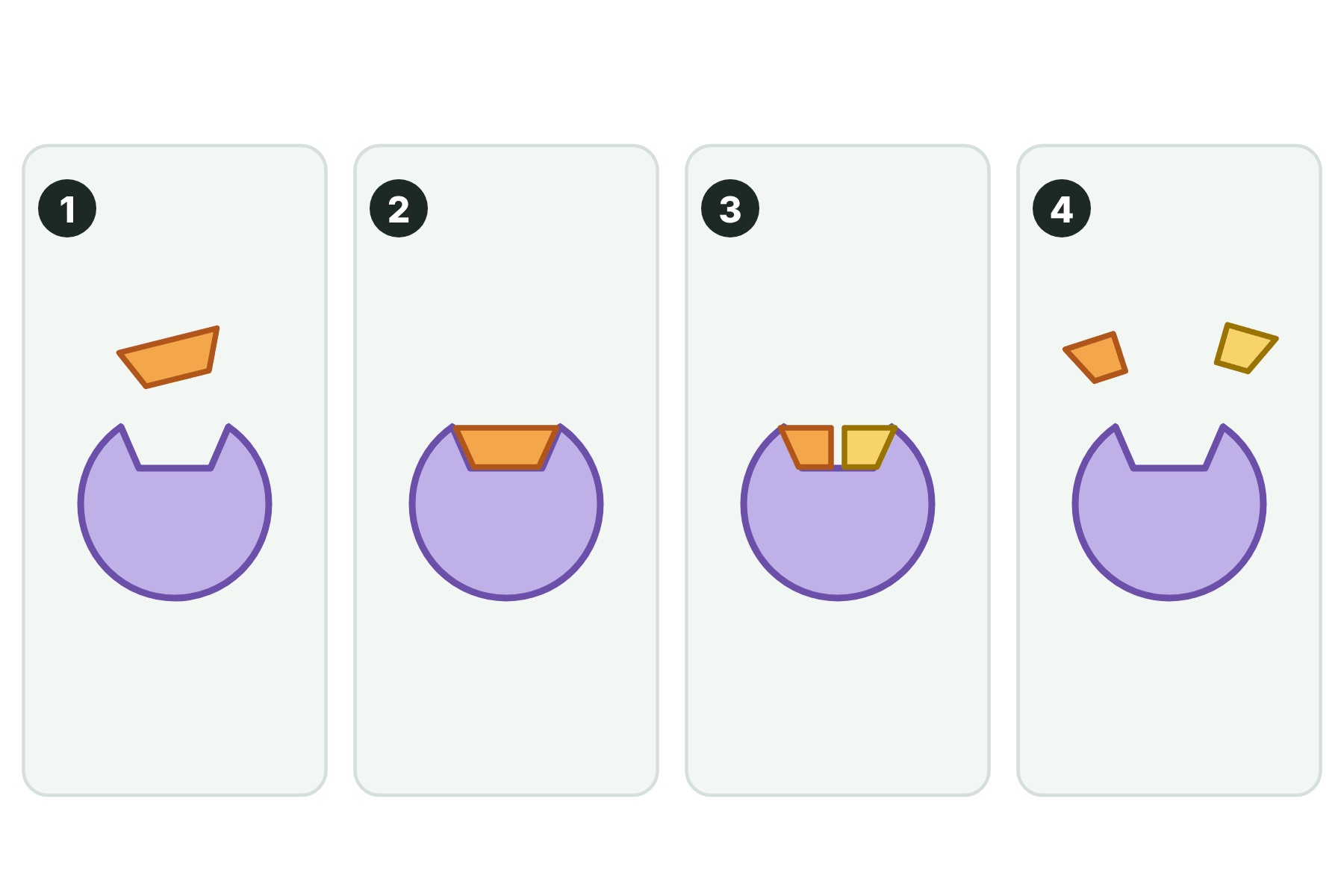 Describe what happens at each of the four stages.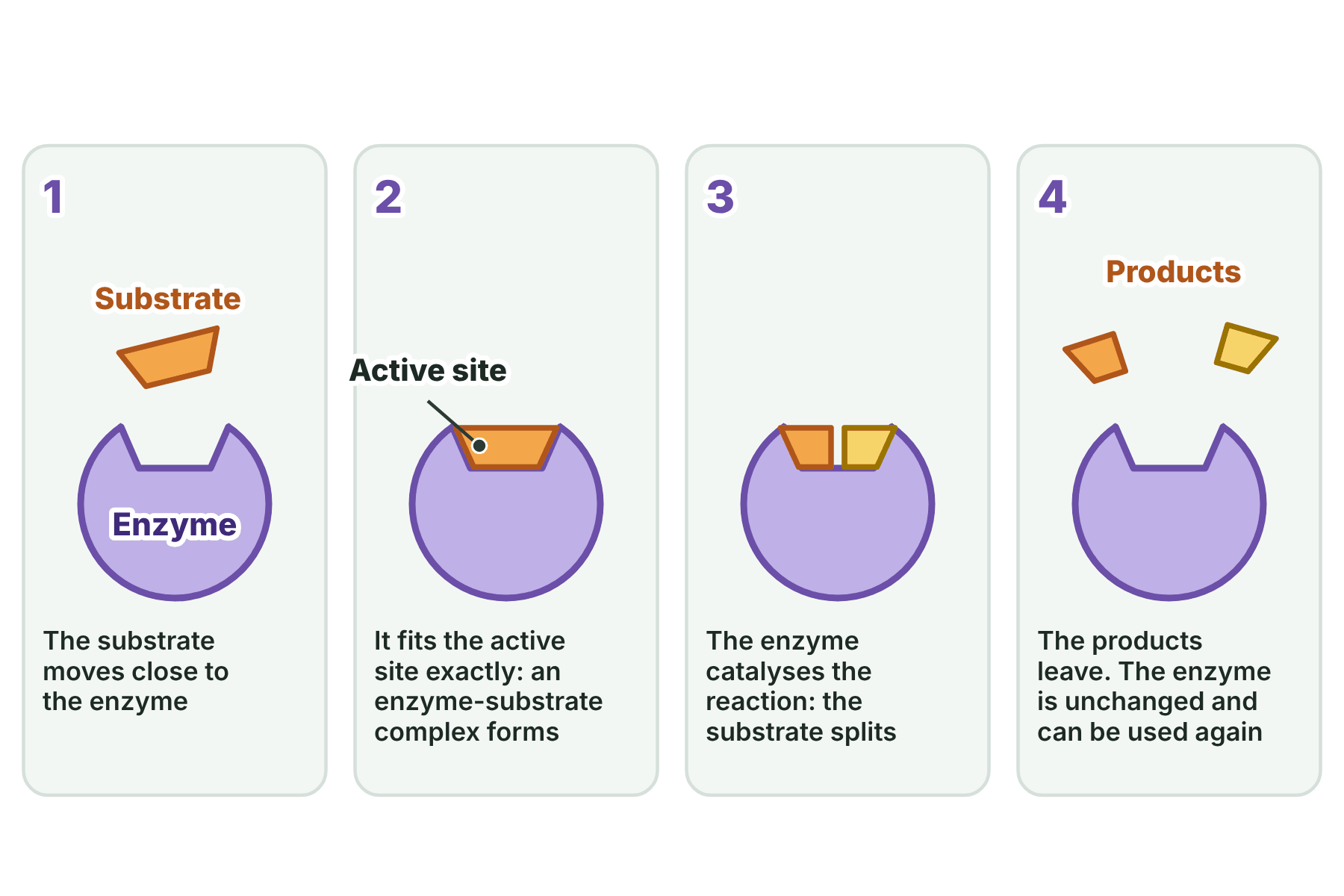
-
What happens to an enzyme when the temperature gets too high, and why does the reaction stop?
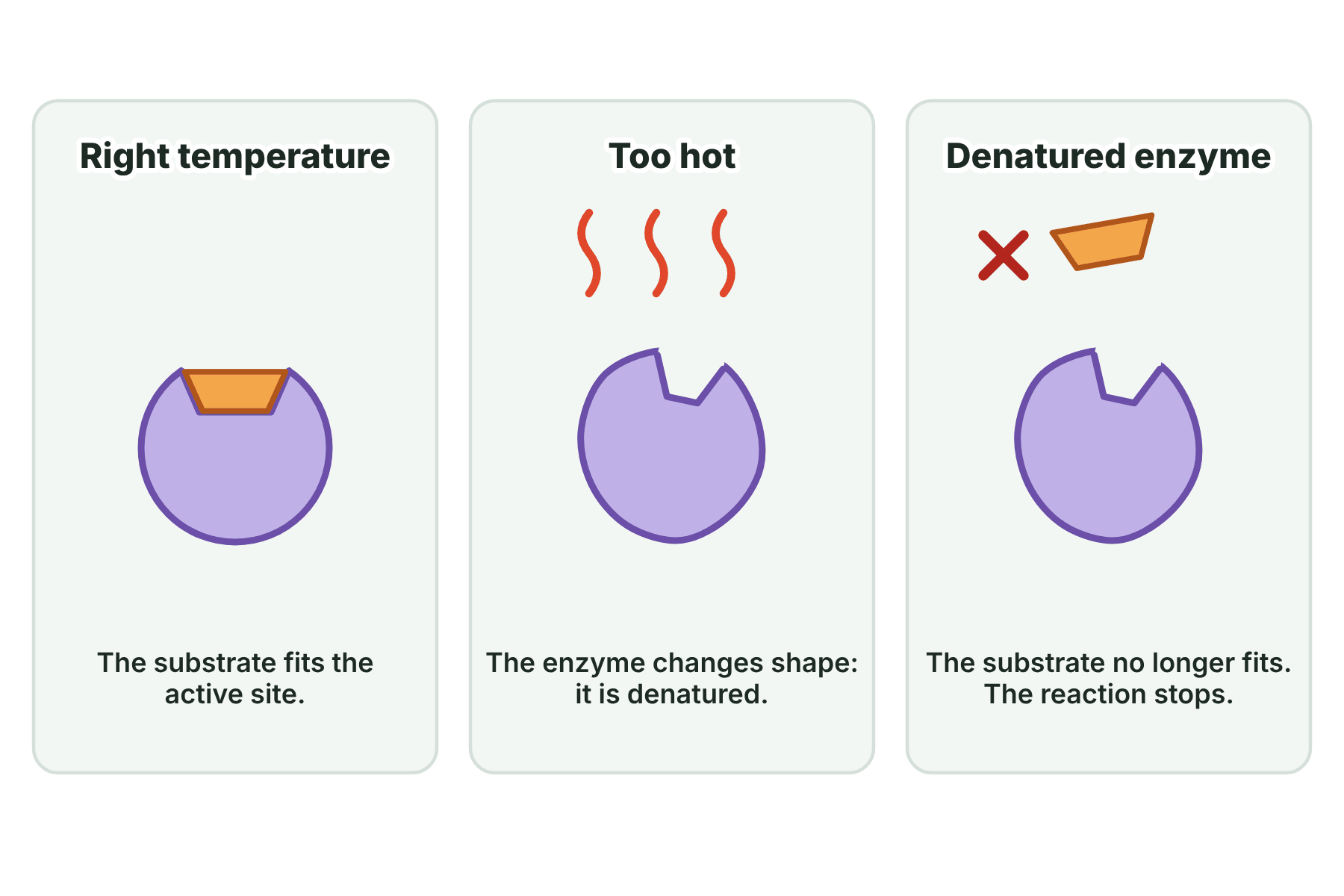
The enzyme is denatured: its bonds break and its shape changes, including the active site. The substrate no longer fits, so the reaction stops.
-
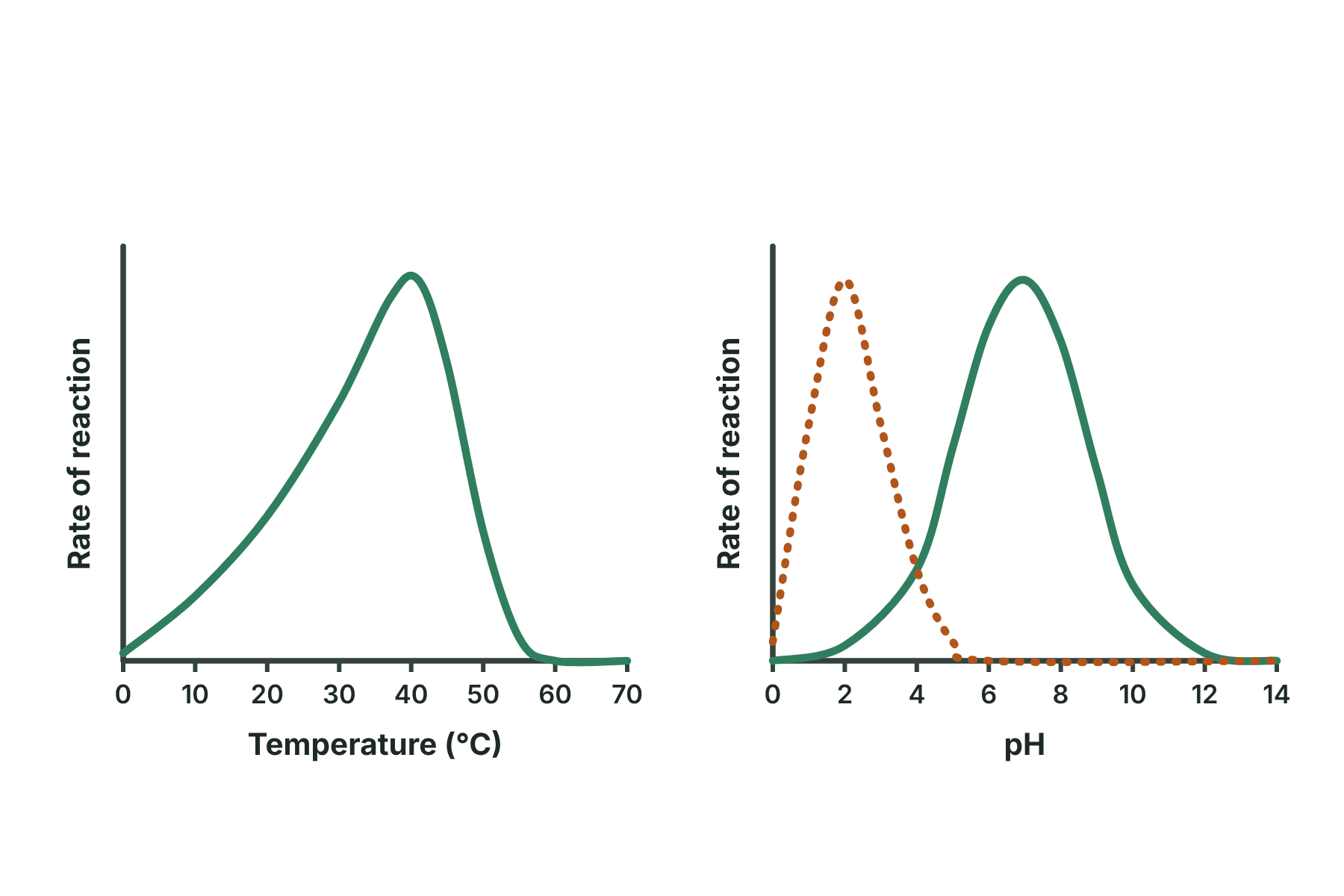 Sketch the shape of the temperature graph and the pH graph for an enzyme. Where is each optimum?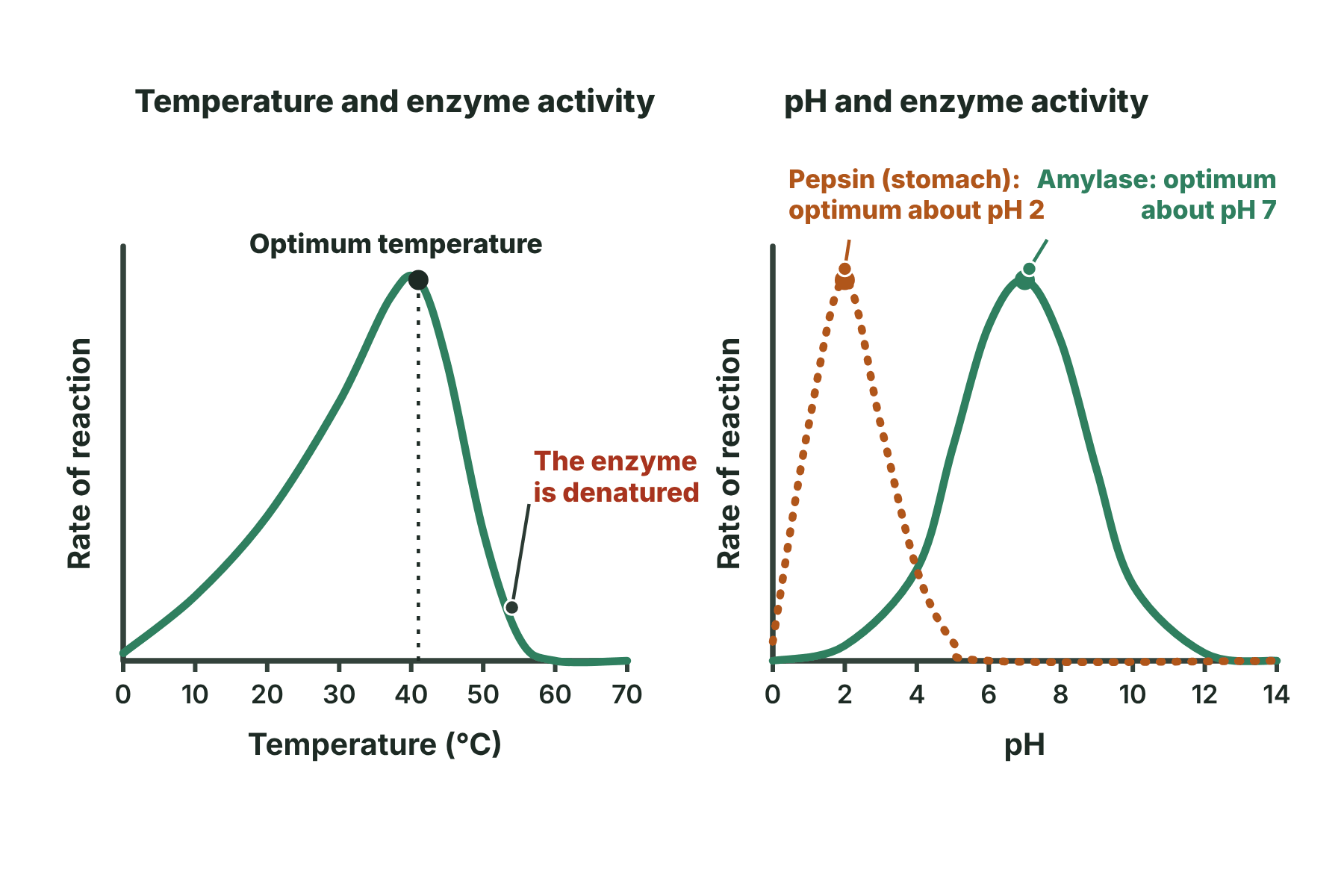
-
What is the aim of the amylase and pH investigation?
To find out how pH affects the rate at which amylase digests starch.
-
What is the independent variable?
The pH of the buffer.
-
What is the dependent variable?
The time taken for all the starch to be digested.
-
Name two control variables.
Any two of: temperature, volume of amylase, volume of starch, concentration of amylase, concentration of starch, volume of buffer.
-
Why is a buffer used?
It keeps the pH constant at the value being tested.
-
Why is a water bath used?
To keep the temperature the same in every test.
-
What temperature was the water bath in the method?
35 °C.
-
Why is iodine solution used?
It shows whether starch is still present: blue-black if it is, orange-brown if it is not.
-
What does a blue-black colour on the tile show?
Starch is still present.
-
What does an orange-brown colour show?
All the starch has been digested.
-
What is continuous sampling?
Taking a small sample at regular intervals while the reaction is happening.
-
How often is a sample taken in this method?
Every 30 seconds.
-
What is the spotting tile used for?
To hold drops of iodine, so that each sample can be tested.
-
Why are the starch and the amylase warmed in the water bath before mixing?
So they reach the same temperature before the reaction starts.
-
How do you work out the rate from the time taken?
Rate = 1000 ÷ time.
-
Does a shorter time mean a faster or a slower rate?
A faster rate.
-
At what pH is amylase fastest?
About pH 7.
-
Why does the rate fall at a high or low pH?
The active site changes shape and the enzyme is denatured, so the substrate no longer fits.
-
Why is each pH repeated at least three times?
To calculate a mean, spot anomalies and make the results more reliable.
-
Why is judging the colour by eye a weakness?
It is subjective. A colorimeter would be more reliable.
-
How could you find the optimum pH more precisely?
Test more values close to the optimum, such as 6.5, 7 and 7.5.
-
Why is amylase denatured in the stomach?
The stomach is very acidic, at about pH 2.
-
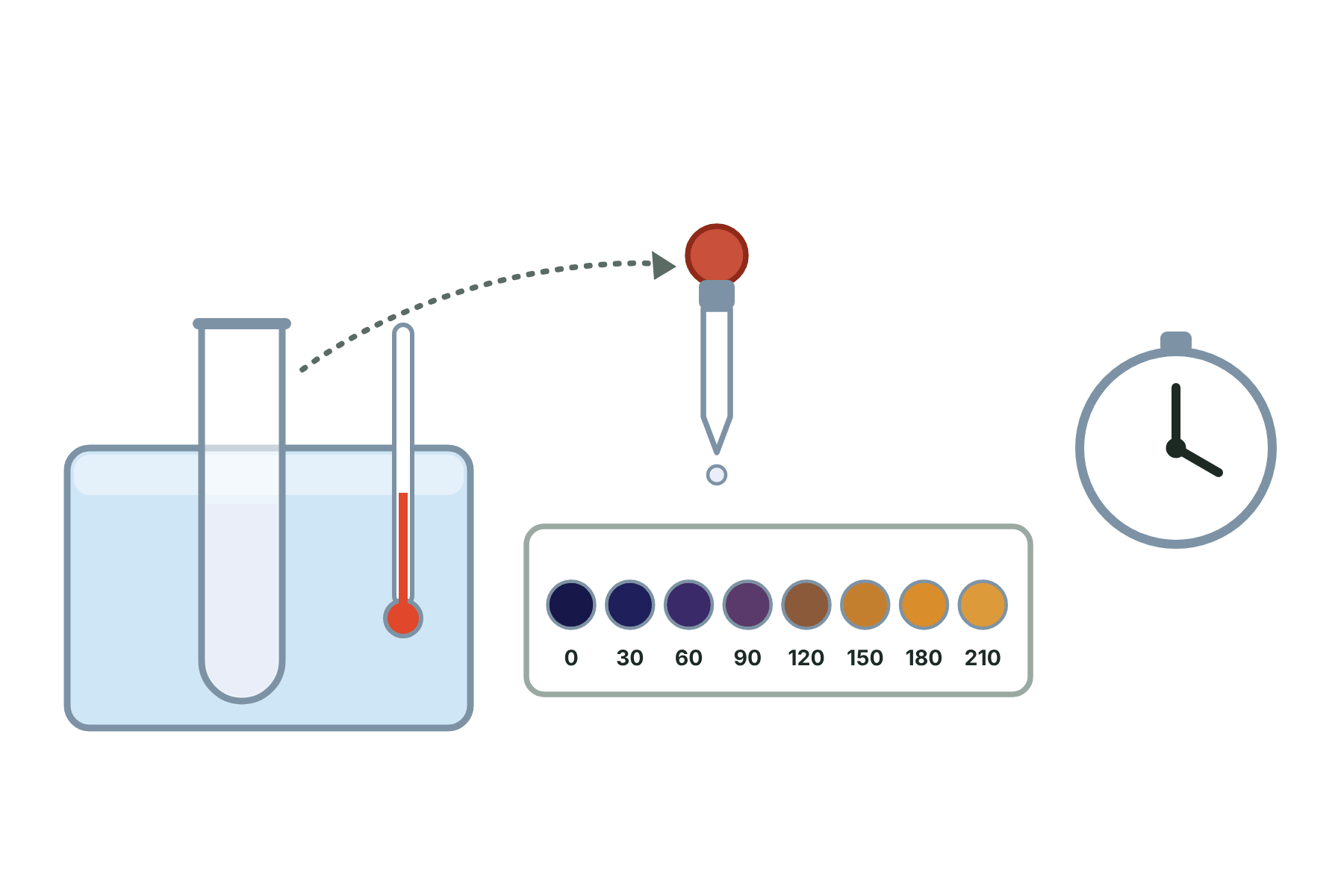 Name each piece of apparatus and say what it is used for.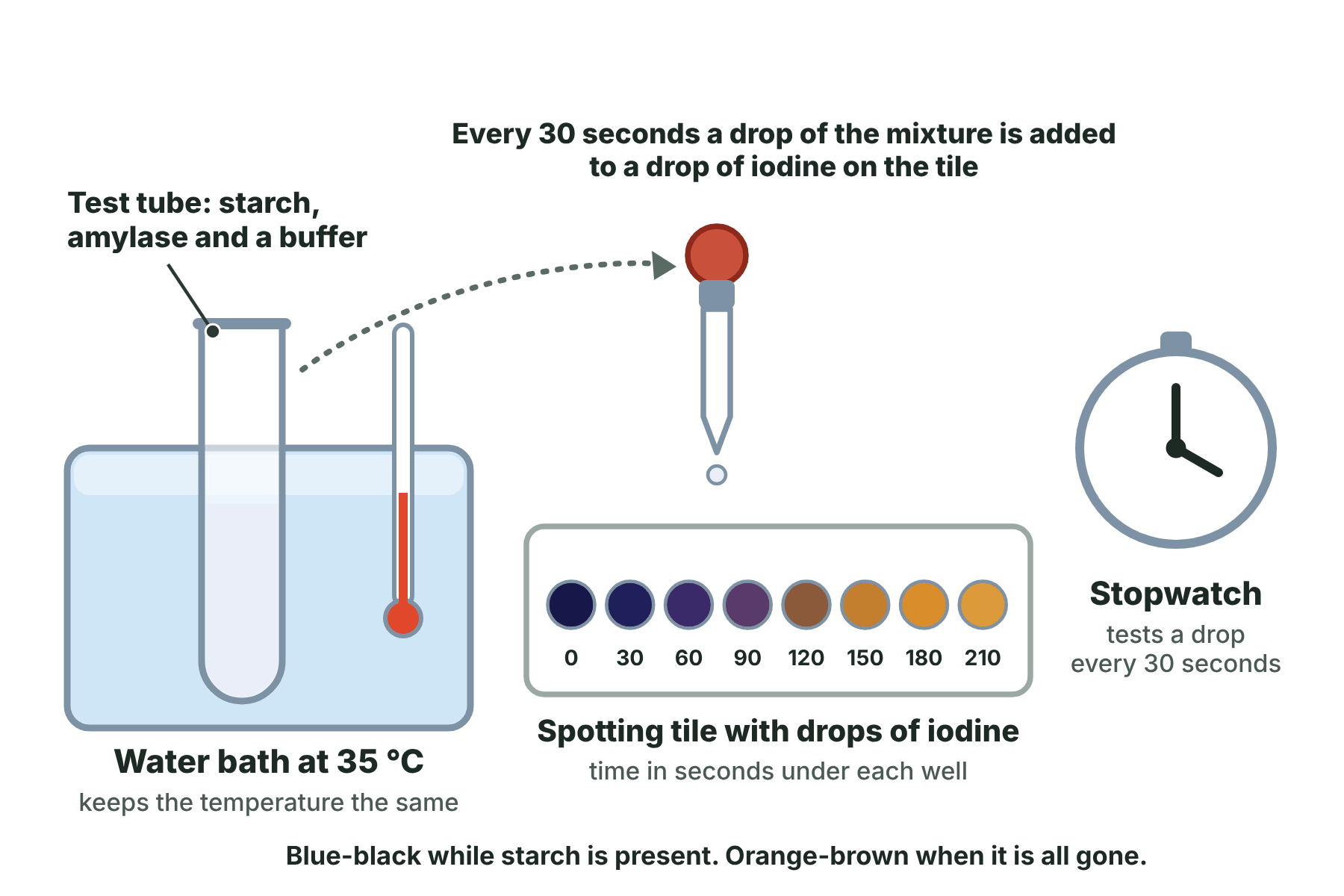
-
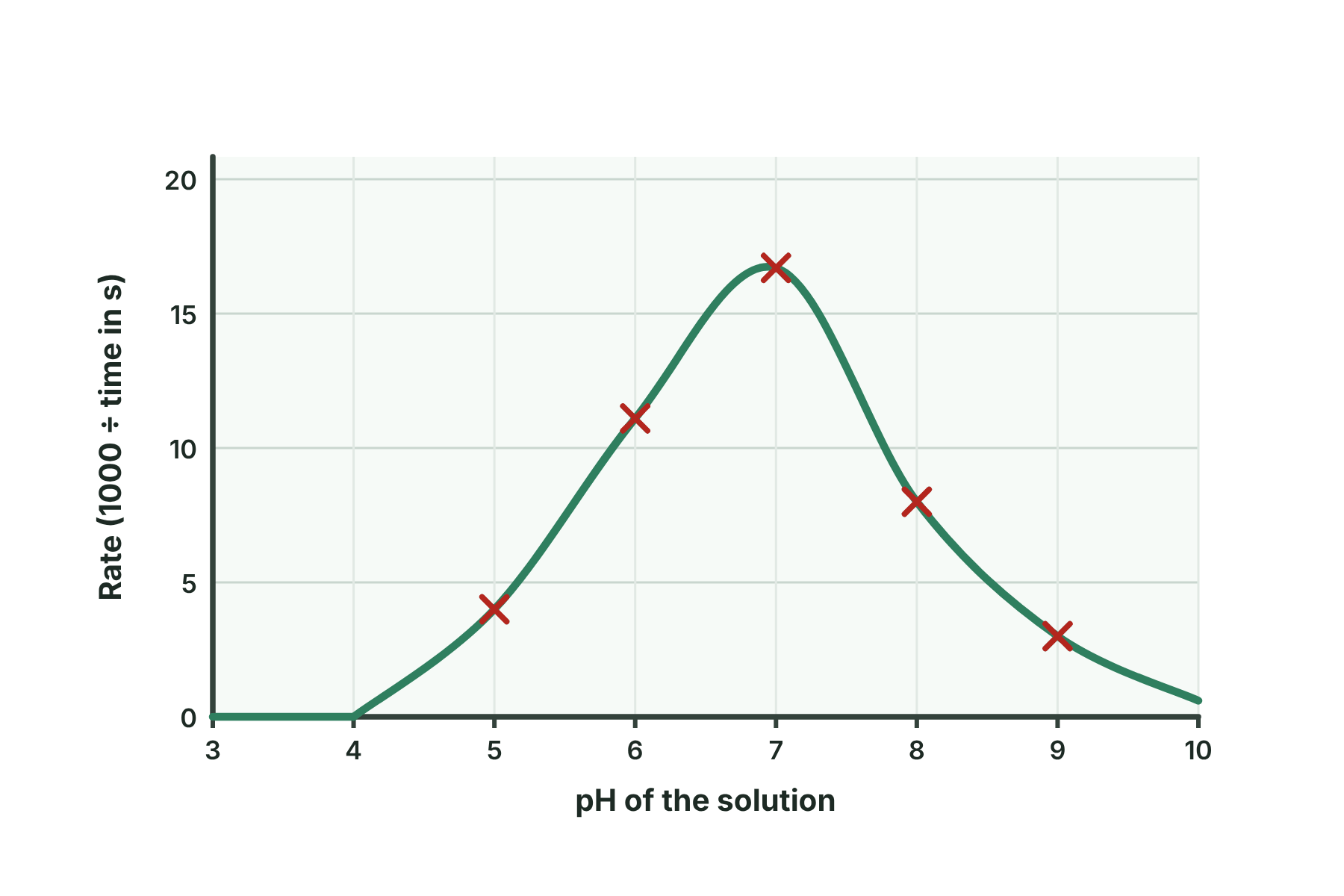 Describe the pattern shown in the graph, and give the optimum pH.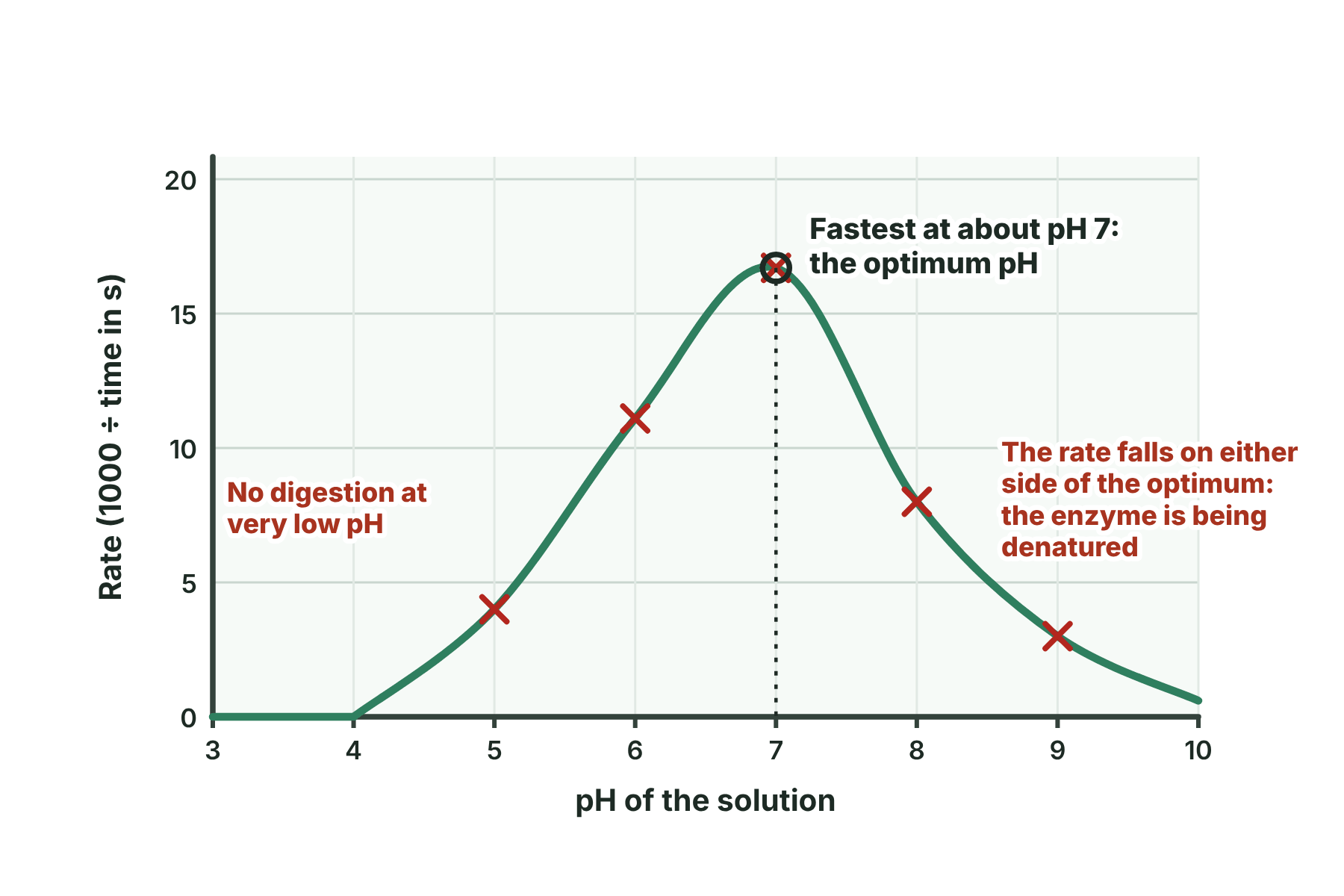
The rate increases as the pH rises from 5 to 7, is highest at about pH 7, and then falls at pH 8 and 9. The optimum pH is about 7.
-
At pH 8 the rate is 8.0. How long did the starch take to be digested?
Time = 1000 ÷ rate = 1000 ÷ 8.0 = 125 seconds.
-
Why is a drop of the mixture added to iodine every 30 seconds, and what do the colours tell you?
Each drop shows whether starch is still present. Blue-black means starch is still there. Orange-brown means all the starch has been digested, and the time is recorded.