Flashcards · Biology
Feeding the Human Race
-
What is food security?
Having access to enough safe, nutritious food, all of the time, to live a healthy life.
-
Roughly how many people were there in the world in 1960, and in 2020?
About 3.0 billion in 1960 and about 7.8 billion in 2020.
-
Why does a diet rich in meat need more land than a plant-based diet?
Energy is lost between trophic levels, so more crops are needed to make the same amount of food energy as meat.
-
Why do wealthier populations raise the demand for farmland?
They tend to eat more meat and dairy foods, and the animals have to be fed on crops.
-
Give two reasons why new pests and pathogens reach new countries.
Global trade and travel carry them, and a warming climate lets them survive in new places.
-
What is Ug99?
A strain of wheat stem rust fungus, found in Uganda in 1999, that infects many resistant wheat varieties.
-
How can pests and pathogens become resistant to chemicals?
Resistant individuals survive treatment, reproduce and pass on the resistance, so the resistant type becomes common.
-
Name three effects of climate change on crops.
Drought, flooding and higher temperatures that shorten or spoil the growing season.
-
How does the loss of topsoil affect food production?
The soil is less fertile, so crop yields fall.
-
What does sustainable mean in farming?
Producing enough food now without harming the ability to produce food in the future.
-
What are agricultural inputs?
The things farmers provide or buy, such as seed, fertiliser, pesticide, feed, fuel and water.
-
Why do rising fertiliser prices threaten food security?
Farmers buy less, so crop yields fall and food becomes more expensive.
-
How is a percentage increase calculated?
Increase divided by the original value, multiplied by 100.
-
How do you work out food produced per person?
Divide the total mass of food produced by the population.
-
Why can a rise in the world's food production still leave people hungry?
The extra food may not reach the people who need it, or may not keep up with a larger population.
-
Why can eutrophication make farming unsustainable?
Fertiliser run-off pollutes water and harms ecosystems, which are needed for farming in the long run.
-
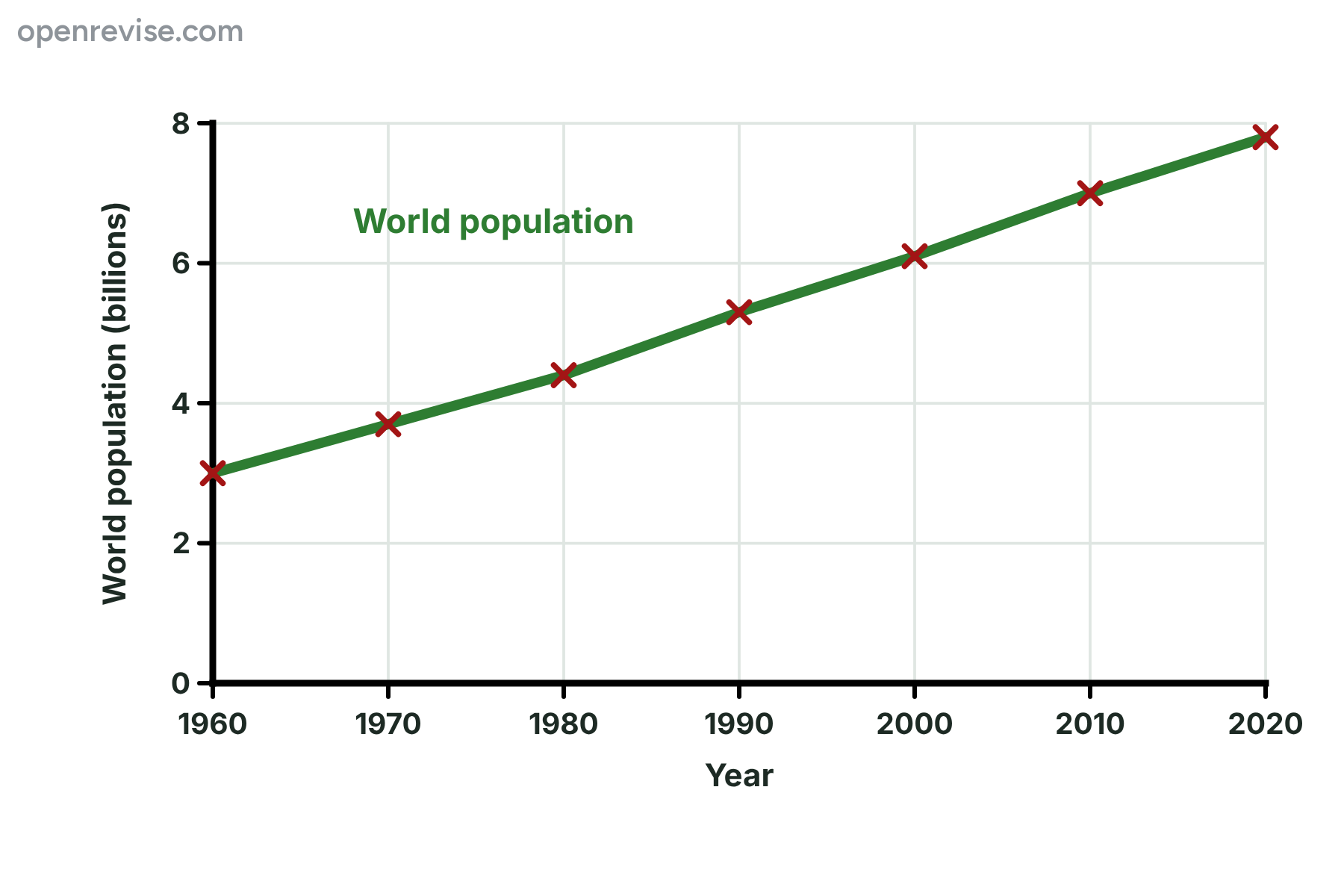 Describe the trend in the world population shown in this graph.
 The population rises steadily throughout, from about 3.0 billion in 1960 to about 7.8 billion in 2020, so it has more than doubled. A rising population raises the demand for food.
-
Which three minerals are in an NPK fertiliser?
Nitrate, phosphate and potassium.
-
Why do crops need nitrate?
To make amino acids and then proteins for growth.
-
Give one advantage of using fertilisers.
They raise the yield, so more food is produced from the same land.
-
What is eutrophication?
Too many mineral ions in water, which causes an algal bloom and then a loss of oxygen.
-
Why do fish die in a eutrophic lake?
Bacteria use up the oxygen when they break down the dead plants, so the fish suffocate.
-
What is a herbicide?
A pesticide that kills weeds.
-
Why can pesticides harm food chains?
Some are not broken down and build up in the bodies of animals along the chain, and they kill harmless insects as well.
-
Why may a pesticide stop working?
Pests with resistance survive, breed and pass on the resistance.
-
What is hydroponics?
Growing plants with their roots in a nutrient solution instead of soil.
-
Why is air bubbled through a hydroponics tank?
So that the roots have oxygen for respiration.
-
Give two advantages of hydroponics.
Exact control of minerals and conditions, high yields, and crops can be grown where the soil is poor.
-
Give two disadvantages of hydroponics.
It is expensive to set up and run, and a failure or infection can lose the whole crop.
-
What is biological control?
Using living organisms, such as predators, to reduce the numbers of a pest.
-
Name a predator used to control aphids.
The ladybird, or its larvae.
-
Give one problem with biological control.
It is slow, it will not remove the pest completely, or the control species may harm other organisms.
-
What went wrong when cane toads were released in Australia?
They did not control the beetles, but they bred, spread and poisoned native predators.
-
What does the Bt gene do in a crop?
It makes the crop produce a protein that kills the caterpillars that eat it.
-
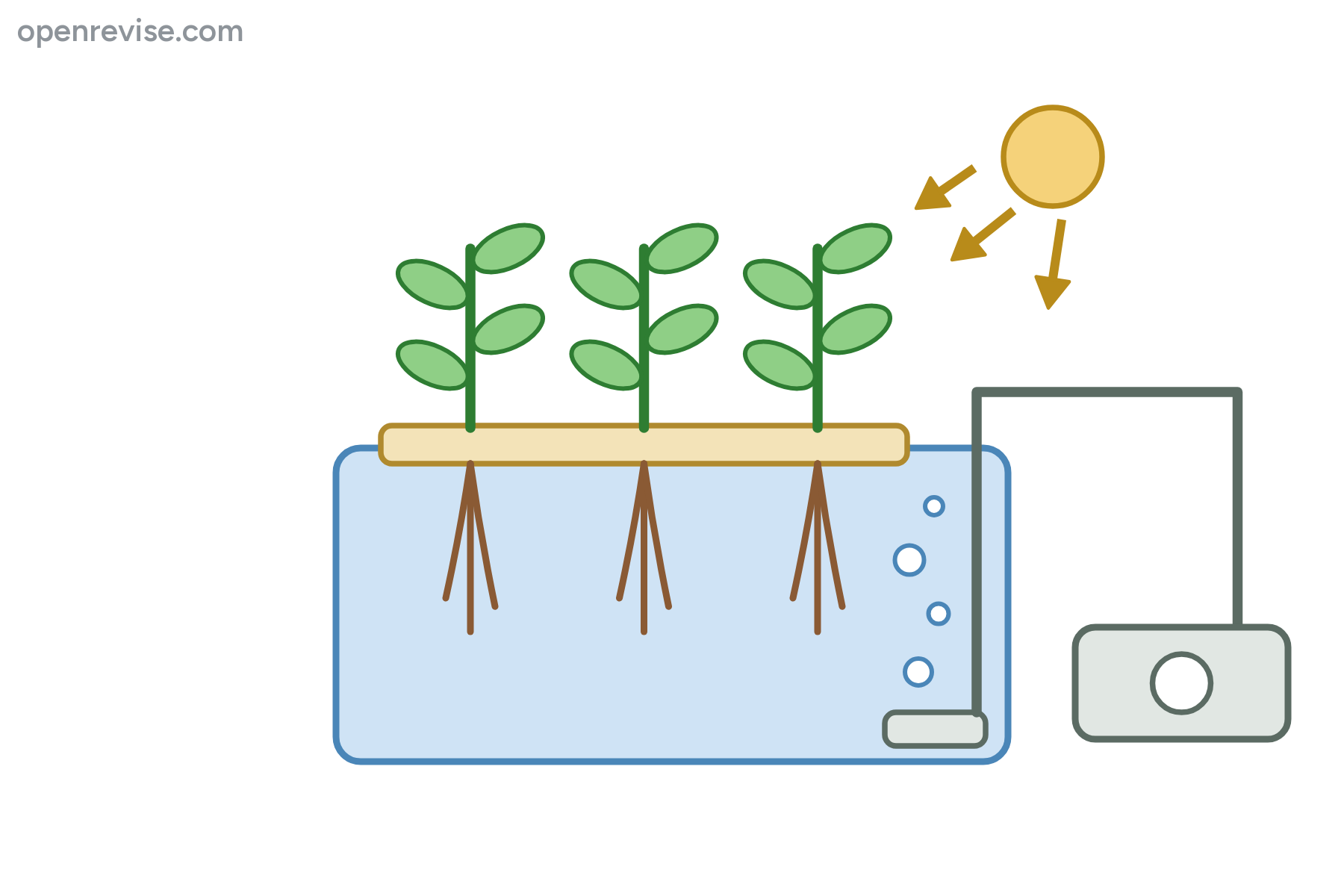 Label the parts of this hydroponics set-up and say what each one does.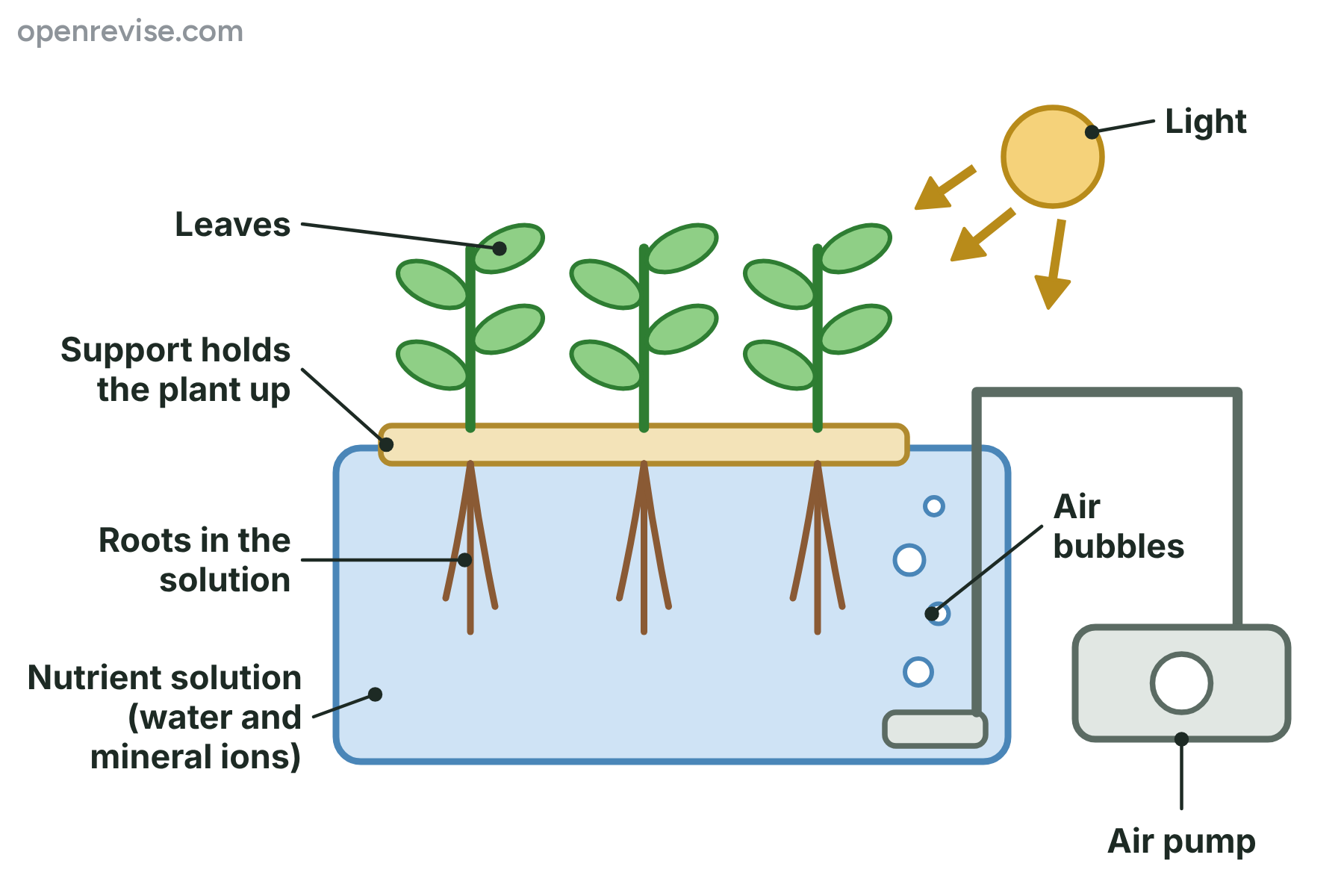
The support holds the plants up. The roots take mineral ions from the nutrient solution. The air pump bubbles air through the solution so that the roots get oxygen for respiration. Light is needed for photosynthesis.
-
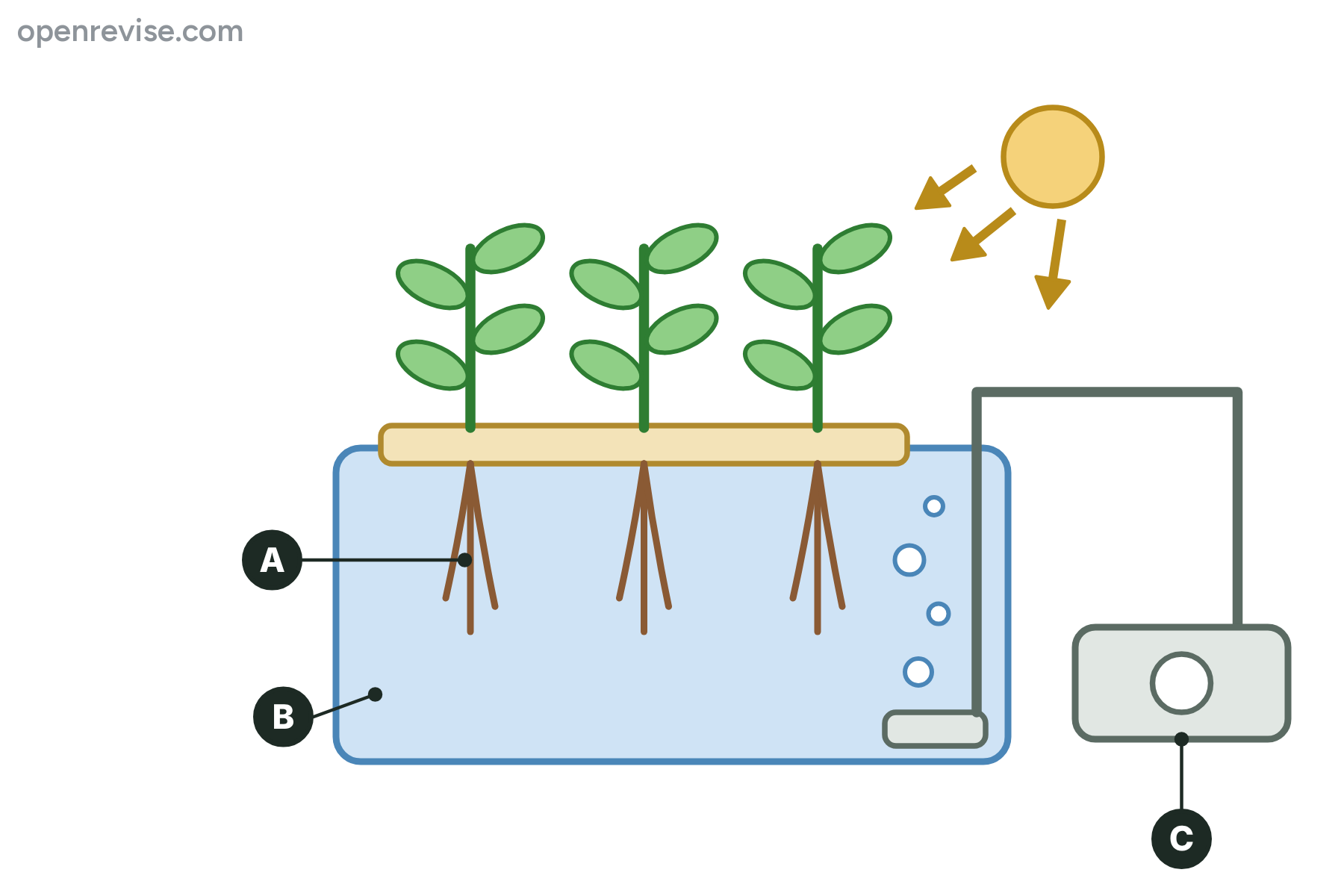 Name the parts of the hydroponics set-up marked A, B and C.
 A is the roots. B is the nutrient solution (water with mineral ions). C is the air pump.
-
What is selective breeding?
People choosing parents with wanted characteristics and breeding them for many generations.
-
What is another name for selective breeding?
Artificial selection.
-
What is the first step of selective breeding?
Decide on the characteristic that is wanted.
-
What do you do with the offspring in selective breeding?
Select the ones with the characteristic and breed from them, repeating over many generations.
-
Why are modern wheat varieties bred with short stems?
The plants do not fall over in wind and rain, and more energy goes into the grain.
-
Give two characteristics selected in crop plants.
Higher yield, disease resistance, larger fruit, sweetness or seedlessness.
-
Which wild plant did cabbage, broccoli and kale come from?
The wild cabbage (wild mustard).
-
Give two characteristics selected in dairy cattle.
A high milk yield and resistance to disease.
-
Give one example of selective breeding in chickens.
Breeding hens that lay many eggs, or chickens that grow fast for meat.
-
What is inbreeding?
Breeding closely related individuals.
-
What happens to variation when there is inbreeding?
It falls, because there are fewer different alleles in the population.
-
Why do inherited disorders become more common with inbreeding?
Offspring are more likely to inherit two copies of a harmful recessive allele.
-
Why is a crop with little variation at risk?
A single disease could infect every plant, because none has an allele for resistance.
-
Give one welfare problem caused by selective breeding.
Fast-growing chickens may have leg problems, or high-yielding cows may have udder infections.
-
How does selective breeding differ from natural selection?
People choose which organisms breed, instead of the environment.
-
How do you calculate a percentage increase?
Increase divided by the starting value, multiplied by 100.
-
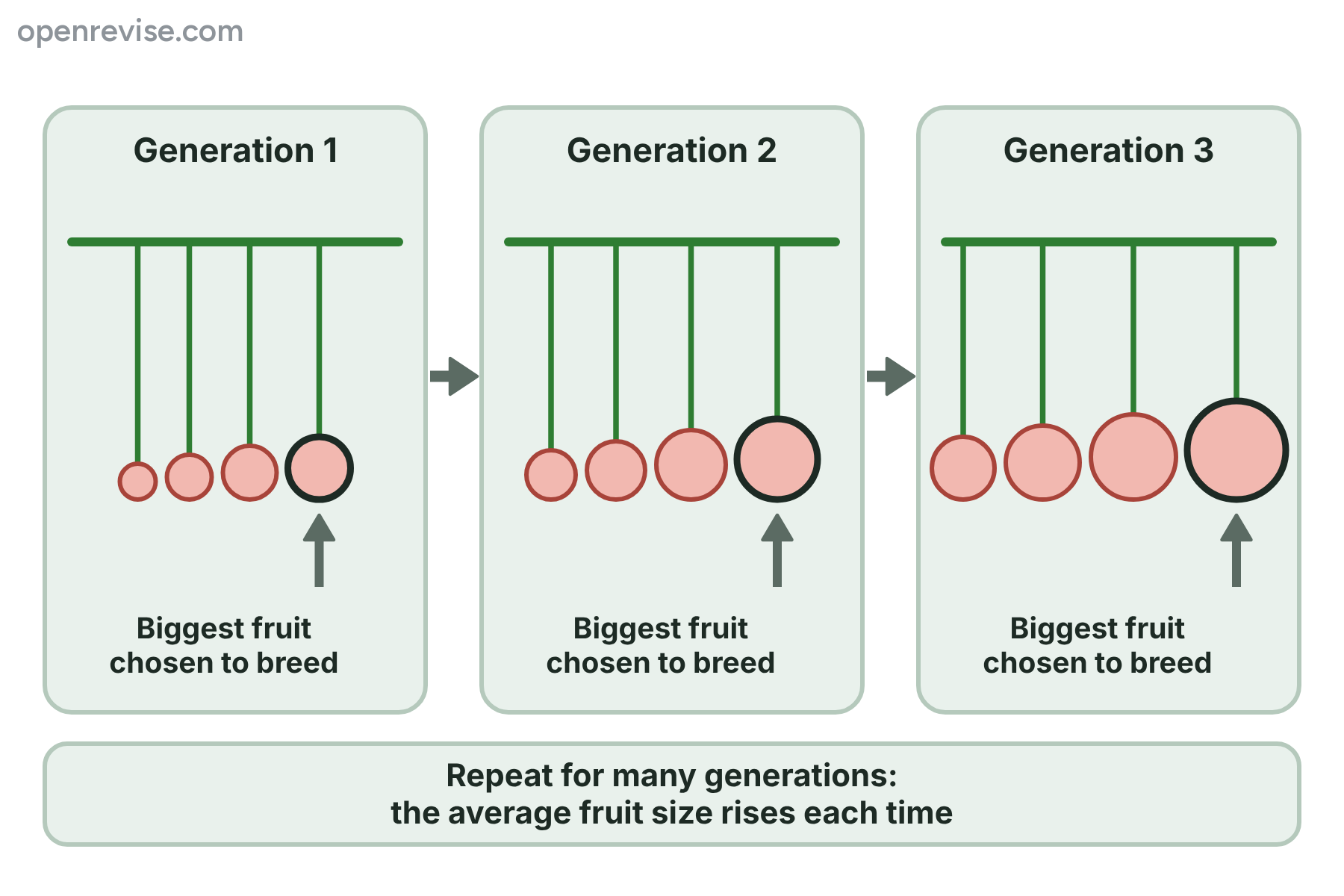 Describe what is happening in this diagram.
 In each generation the biggest fruit is chosen as the parent of the next generation. Over many generations the average fruit size increases.
-
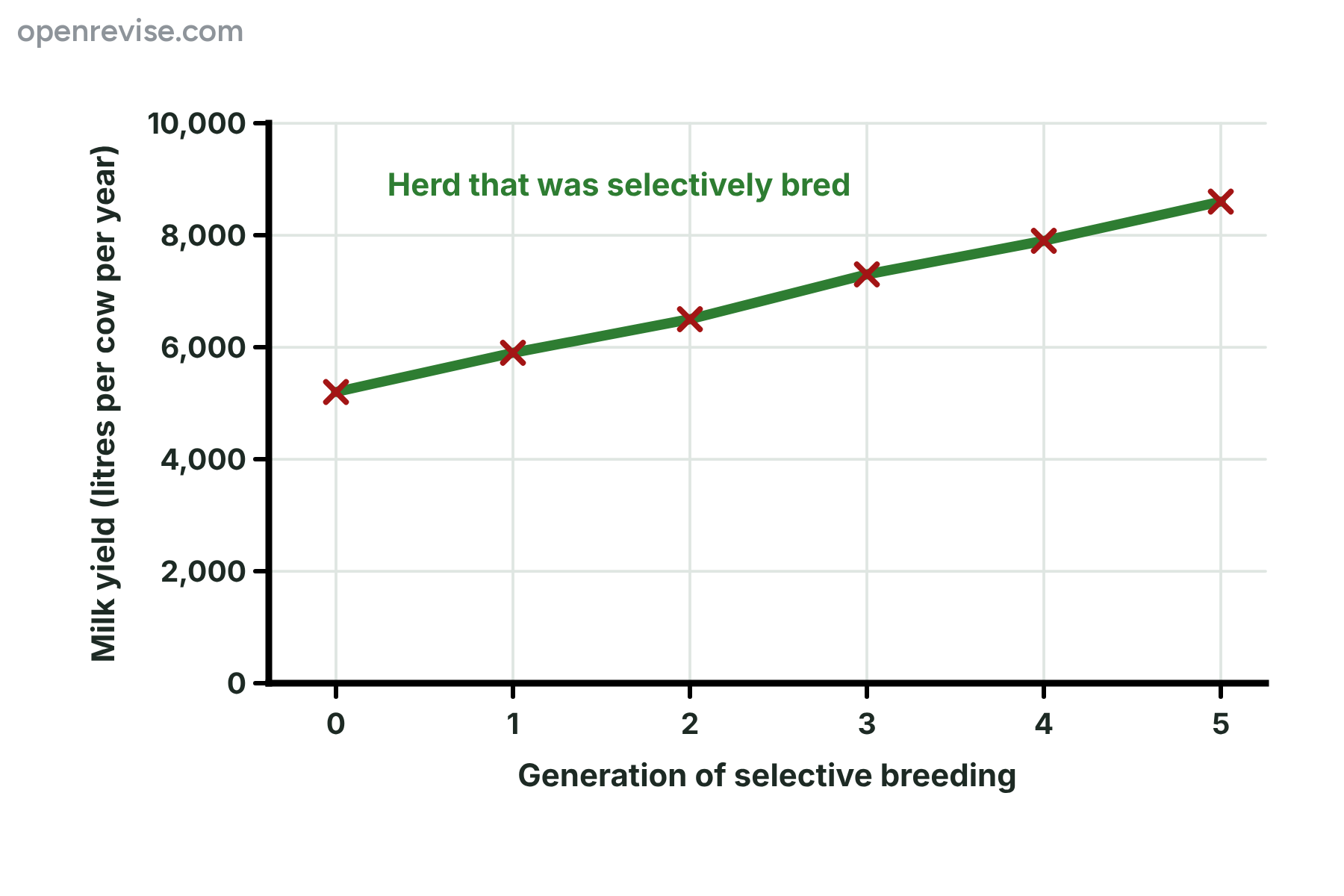 Calculate the percentage increase in milk yield from generation 0 to generation 5.
 The increase is 8 600 minus 5 200, which is 3 400 litres. Then 3 400 divided by 5 200, multiplied by 100, gives 65%.
-
What is genetic engineering?
Modifying the genome of an organism by inserting a gene to give it a desirable characteristic.
-
What does GM stand for?
Genetically modified.
-
Where can the gene for genetic engineering come from?
Any species, not only the same species as the recipient.
-
What do enzymes do in genetic engineering?
They cut the gene out of the DNA of the donor.
-
What does a recipient cell do with the new gene?
It makes the protein that the gene codes for.
-
Why is a gene put into an embryo or a single cell at an early stage?
So that mitosis copies it into every cell of the organism.
-
How can the characteristic reach the next generation?
The gene is in the genome, so it is inherited by offspring.
-
What is the Bt gene used for?
To make crops produce a protein that kills caterpillars that eat them.
-
Why are herbicide-resistant crops useful?
The farmer can spray the field to kill weeds without killing the crop.
-
What was papaya in Hawaii given resistance to?
Ringspot virus.
-
Why do people with type 1 diabetes need insulin?
Their bodies cannot make enough, so the blood glucose level rises too high.
-
Where did insulin come from before genetic engineering?
The pancreases of pigs and cattle.
-
What is inserted into the bacteria to make insulin?
The human insulin gene.
-
Where are GM bacteria grown to make insulin?
In large tanks called fermenters.
-
Give two advantages of insulin made by GM bacteria.
It is identical to human insulin, it is cheap and plentiful, and no animals are used.
-
How is genetic engineering different from selective breeding?
A gene is moved in one step, instead of choosing parents over many generations.
-
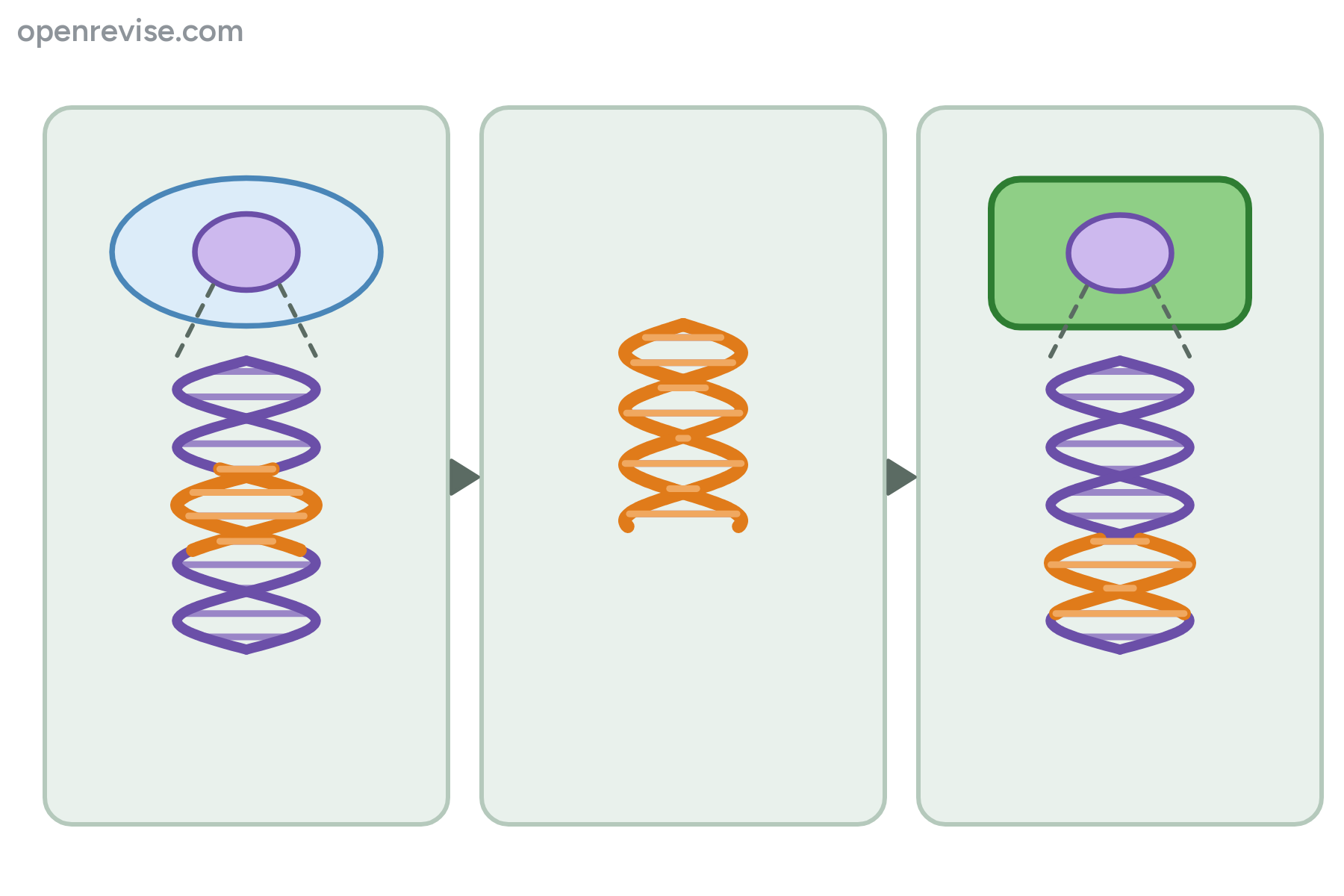 Describe what is happening at each stage of the diagram.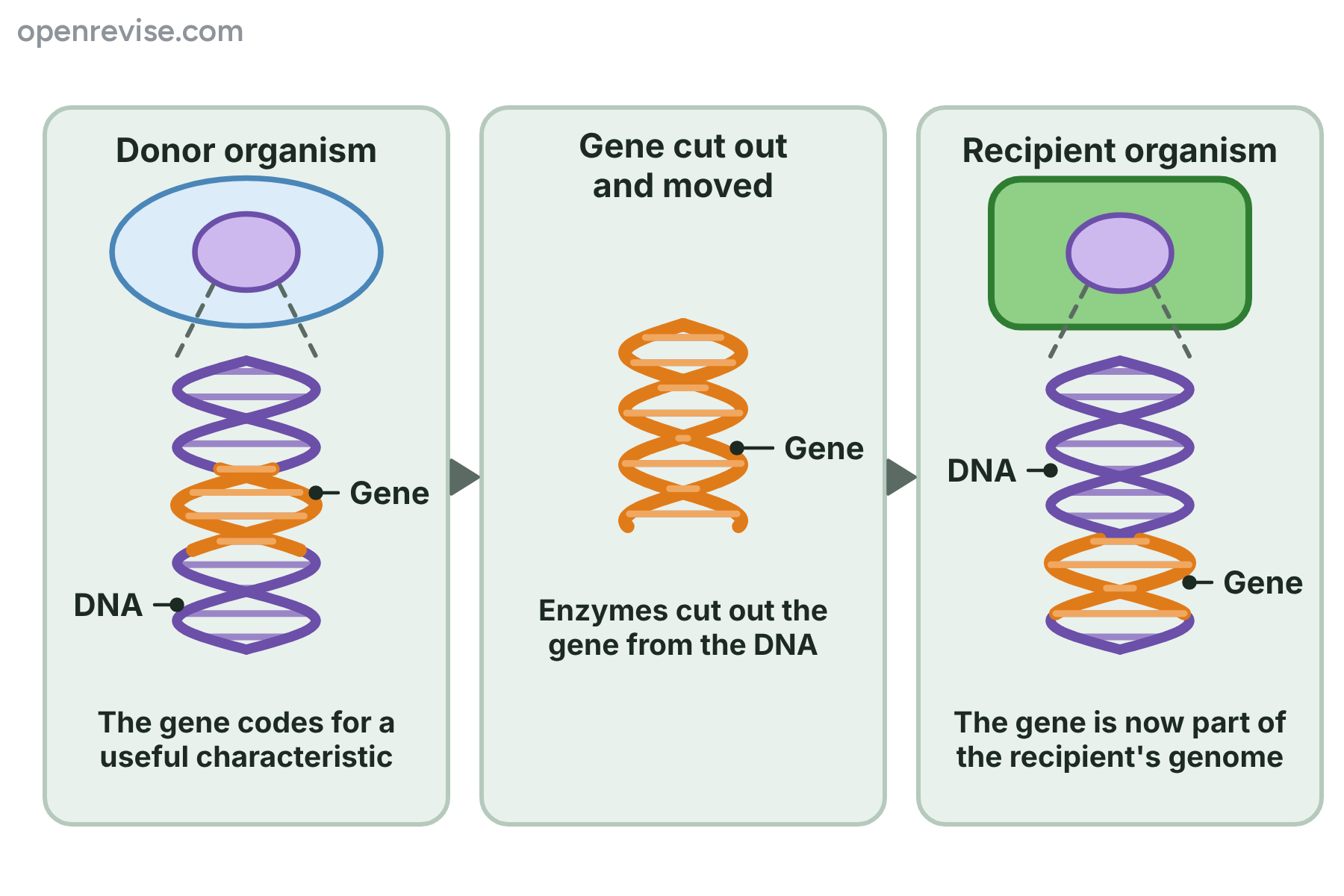
A gene is found in the DNA of the donor organism. It is cut out using enzymes. It is inserted into the DNA of the recipient cell, so that the recipient makes the protein for the new characteristic.
-
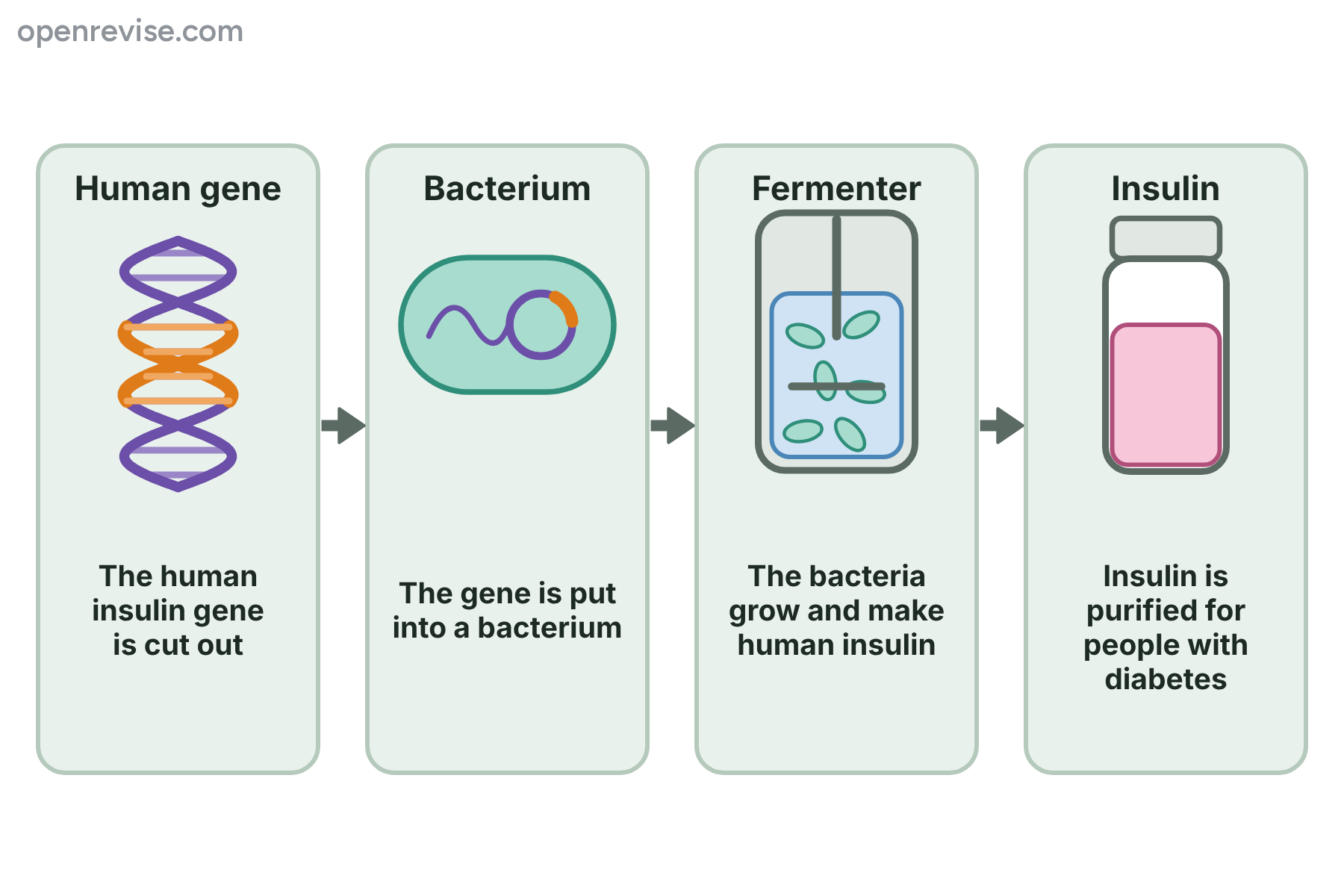 Describe how insulin is made by genetically engineered bacteria.
 The human insulin gene is cut out and put into a bacterium. The bacteria grow in a fermenter, and they make human insulin. The insulin is collected and purified for people with diabetes.
-
What does a restriction enzyme do?
Cuts DNA at a specific sequence of bases.
-
What are sticky ends?
Short stretches of unpaired bases left at the ends of cut DNA, which can pair with matching ends.
-
Why is the same restriction enzyme used to cut the gene and the plasmid?
So that their sticky ends are complementary and can pair.
-
Which bases would pair with the sticky end A-A-T-T?
T-T-A-A.
-
What does DNA ligase do?
It joins the DNA strands, sealing the gene into the plasmid.
-
What is recombinant DNA?
DNA made by joining DNA from two different sources.
-
What is a vector?
A carrier, such as a plasmid, that takes a gene into a host cell.
-
What is a plasmid?
A small circular loop of DNA in bacteria, separate from the main chromosome.
-
Why are bacteria used as hosts?
They are simple, they reproduce very quickly and they can be grown cheaply in fermenters.
-
Do all the bacteria take up the plasmid?
No, only a small fraction do.
-
What is an antibiotic resistance marker?
A gene on the plasmid that lets the bacteria that carry it survive an antibiotic.
-
How does the antibiotic select the right bacteria?
Bacteria without the plasmid are killed or cannot grow, while those with it survive.
-
What is a colony?
A visible group of identical bacteria grown from one cell on agar.
-
Where do restriction enzymes come from naturally?
Bacteria, which use them to cut up the DNA of viruses.
-
What is the final step after selection?
The selected bacteria are grown in a fermenter, where they multiply and make the protein.
-
Why does ligase matter?
Without it the gene could fall out of the plasmid again.
-
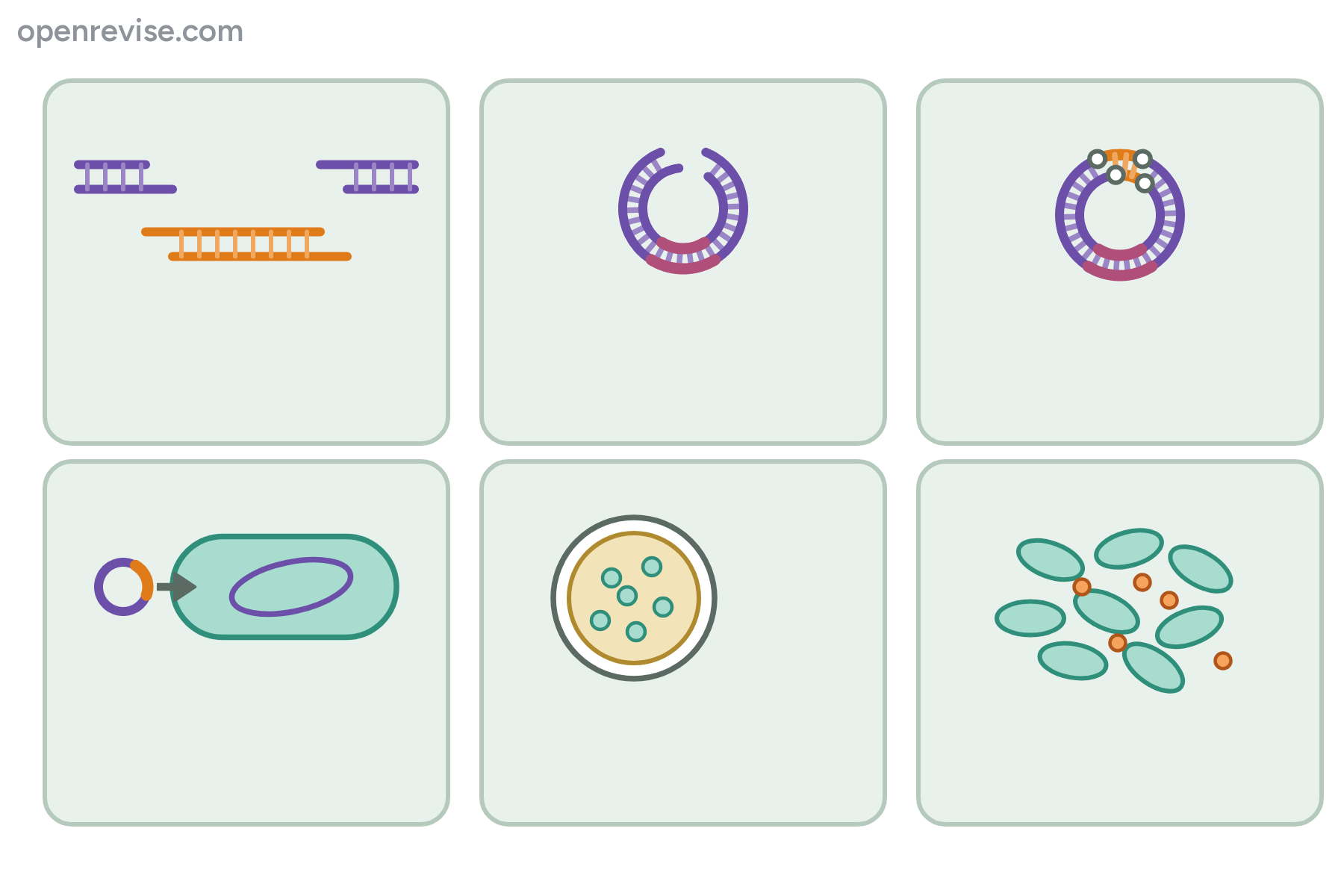 Describe what is happening in each of the six steps.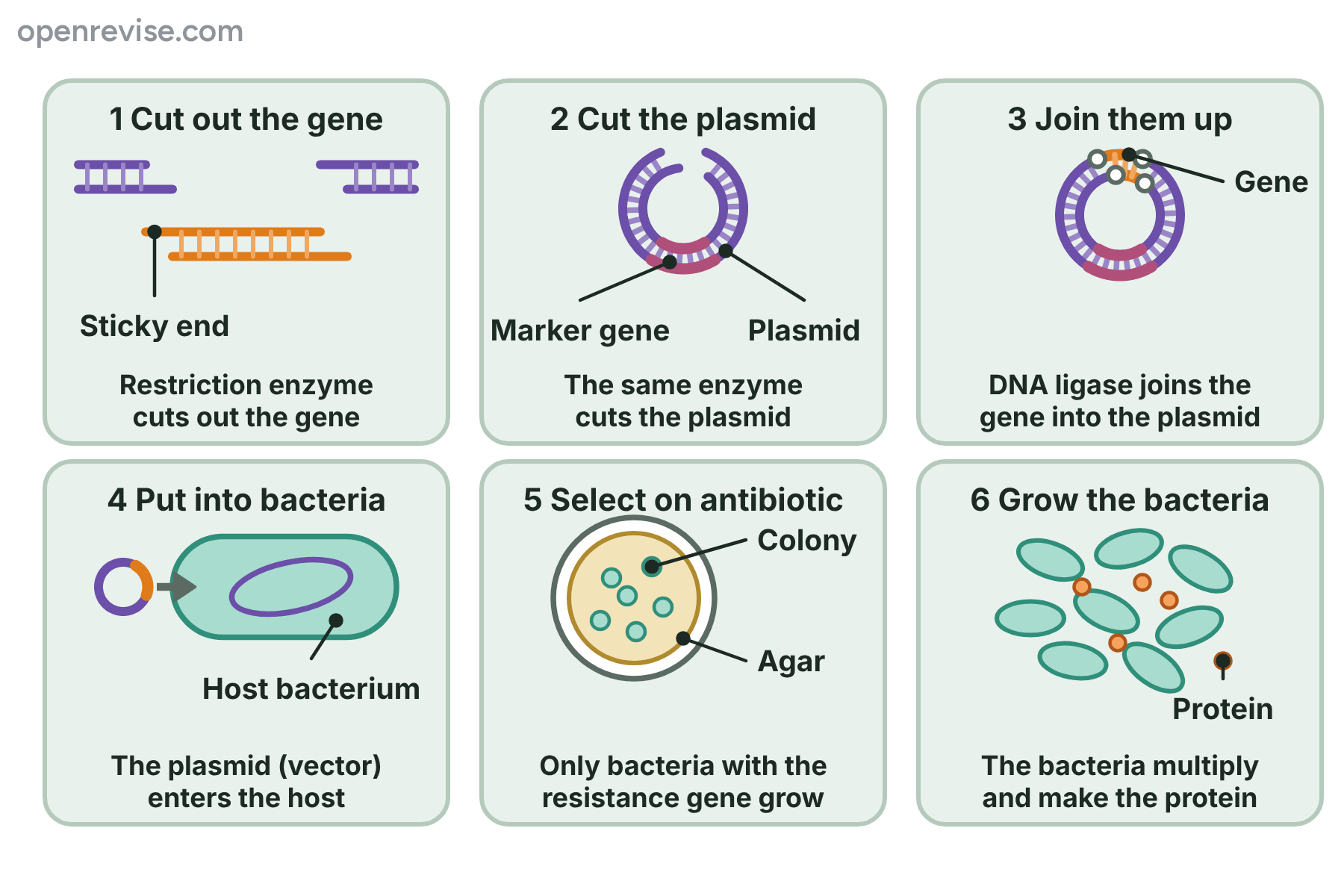
1 A restriction enzyme cuts out the gene, leaving sticky ends. 2 The same enzyme cuts the plasmid. 3 DNA ligase joins the gene into the plasmid. 4 The plasmid enters the host bacterium. 5 Only bacteria with the resistance marker grow on antibiotic agar. 6 The bacteria multiply and make the protein.
-
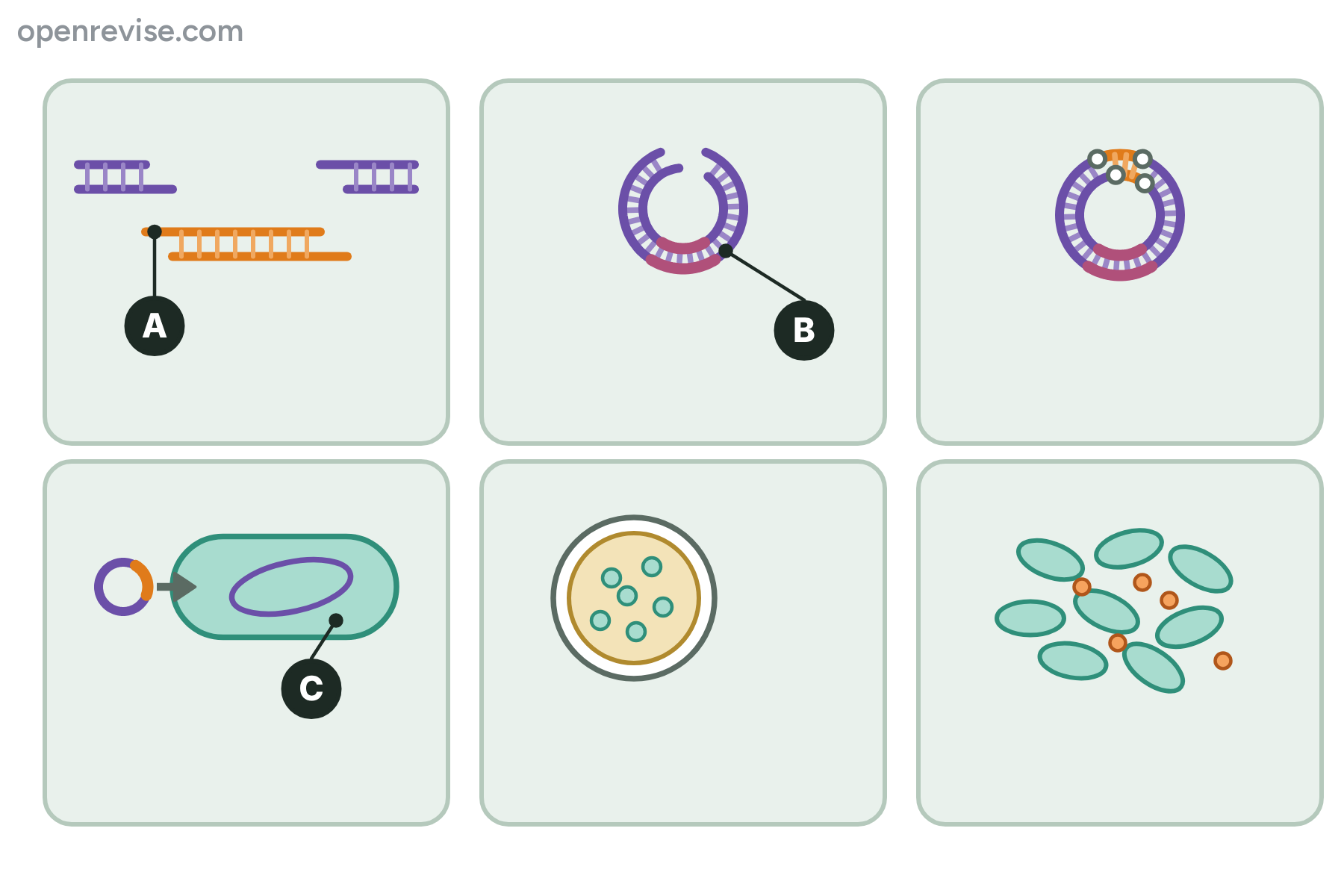 Name the parts marked A, B and C.
 A is a sticky end. B is a plasmid (the vector). C is the host bacterium.
-
Give two benefits of GM crops.
A higher yield and less pesticide, or more nutritious crops, or crops that survive drought.
-
Why does a Bt crop need fewer insecticide sprays?
It makes a protein that kills the caterpillars that eat it.
-
How can GM crops help in drought-prone areas?
They can be engineered to tolerate drought, so food can be grown on poorer land.
-
What is gene flow?
The spread of a gene to other populations, for example by pollen from a GM crop to a wild relative.
-
Why is gene flow a risk?
A wild plant could gain resistance to a herbicide and become hard to control.
-
How can GM crops harm other organisms?
The toxin or herbicide could harm harmless insects or plants that are not the target.
-
How can pests become resistant to the Bt protein?
Resistant pests survive and reproduce, so the resistance becomes more common.
-
What is a superweed?
A weed that has become resistant to a herbicide.
-
Why is GM seed a concern for poor farmers?
It is more costly, and it is often patented, so new seed may have to be bought each year.
-
Why do some people want long-term studies of GM food?
The effects on health and ecosystems might take years to show.
-
Give one ethical objection to GM crops.
It is wrong to alter genomes or to move genes between species, or companies should not own life forms.
-
Give one ethical argument for GM crops.
It would be wrong not to use a technology that could reduce hunger and malnutrition.
-
What is the difference between a practical and an ethical consideration?
Practical: what will work, cost and happen. Ethical: what is right or wrong.
-
Why might organic farmers object to GM crops?
Pollen from GM crops could cross-pollinate their crops.
-
Why can growing one GM variety over a large area be a risk?
It reduces genetic variation, so a new disease could damage the whole crop.
-
What should a good evaluation answer finish with?
A conclusion that follows from the benefits and risks that have been explained.
-
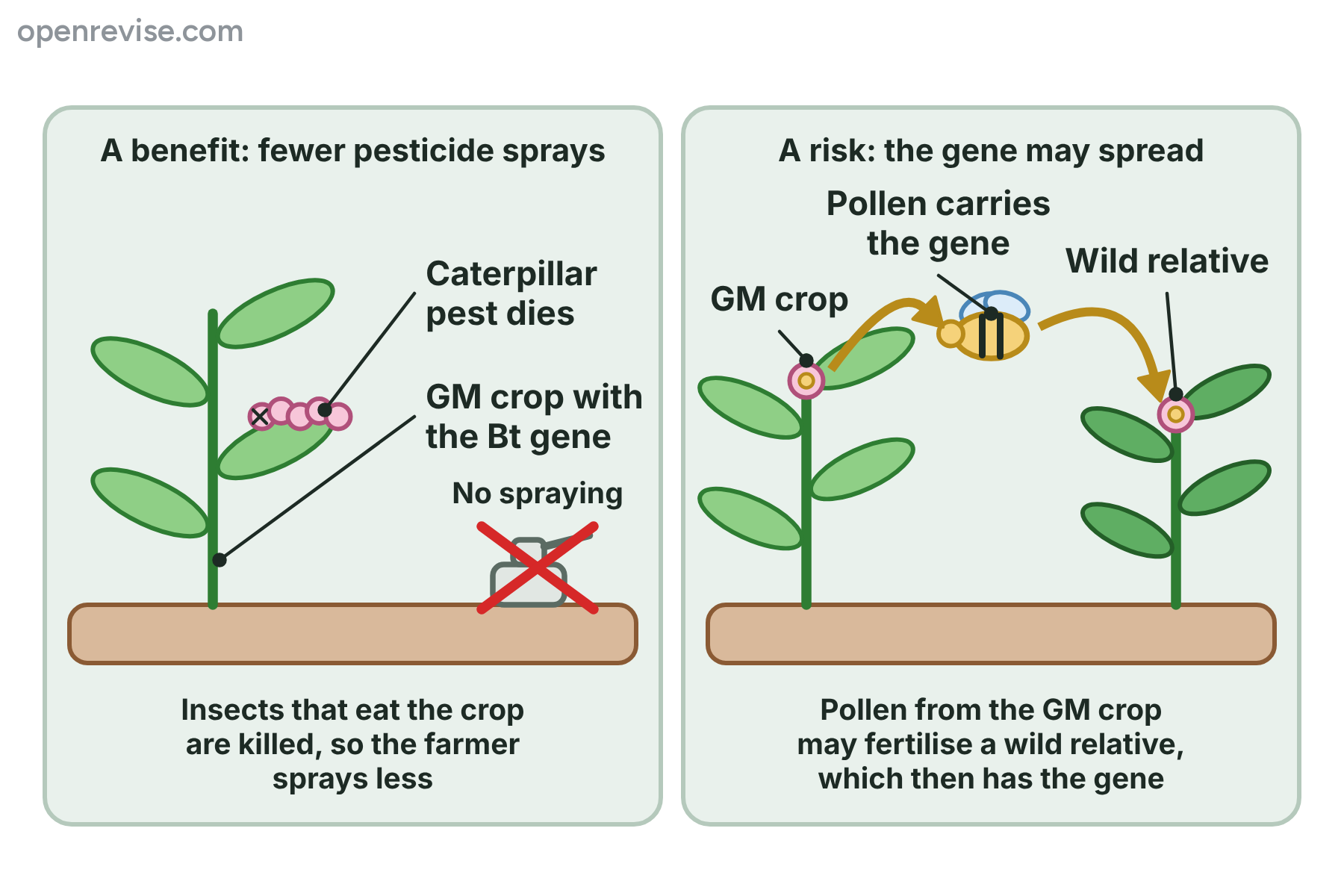 Describe one benefit and one risk of GM crops shown in the diagram.
 Benefit: the crop makes a protein that kills caterpillar pests, so the farmer needs to spray less. Risk: pollen from the GM crop may fertilise a wild relative, so the gene spreads into wild plants.
-
What is biotechnology?
Using living organisms, or parts of them, to make useful products.
-
Which fungus is used to make mycoprotein?
Fusarium venenatum.
-
What does the fungus use as an energy source in a fermenter?
Glucose syrup.
-
Why is a nitrogen source added to the fermenter?
The fungus needs nitrogen to make proteins.
-
Why is air bubbled through the fermenter?
To supply oxygen for aerobic respiration, and to mix the contents.
-
Why is the fermenter cooled?
The fungus releases heat, and the temperature must stay near the optimum of about 30 degrees Celsius.
-
Why is the fermenter sterilised?
To stop other microorganisms from growing and spoiling the product.
-
Give two advantages of mycoprotein as a food.
High in protein and fibre, low in fat, and it needs less land than farming animals.
-
Give one concern about mycoprotein.
Some people are allergic to it, or it needs costly equipment and energy.
-
What are hyphae?
The thin threads that make up the body of a fungus.
-
Which type of organism is used to make human insulin?
Genetically modified bacteria.
-
What is golden rice?
A GM rice that makes beta-carotene in its grains.
-
Why is golden rice useful?
The body turns beta-carotene into vitamin A, which reduces vitamin A deficiency.
-
Give one concern about golden rice.
Ethical or environmental objections to GM crops, or that a varied diet would be a better solution.
-
How can a GM salmon help to produce more food?
It has an extra growth hormone gene, so it grows to market size in about half the time.
-
What can GM goats be used for?
To make human proteins, such as antithrombin, in their milk.
-
Give one concern about GM livestock.
Animal welfare, or escaped GM fish breeding with wild fish.
-
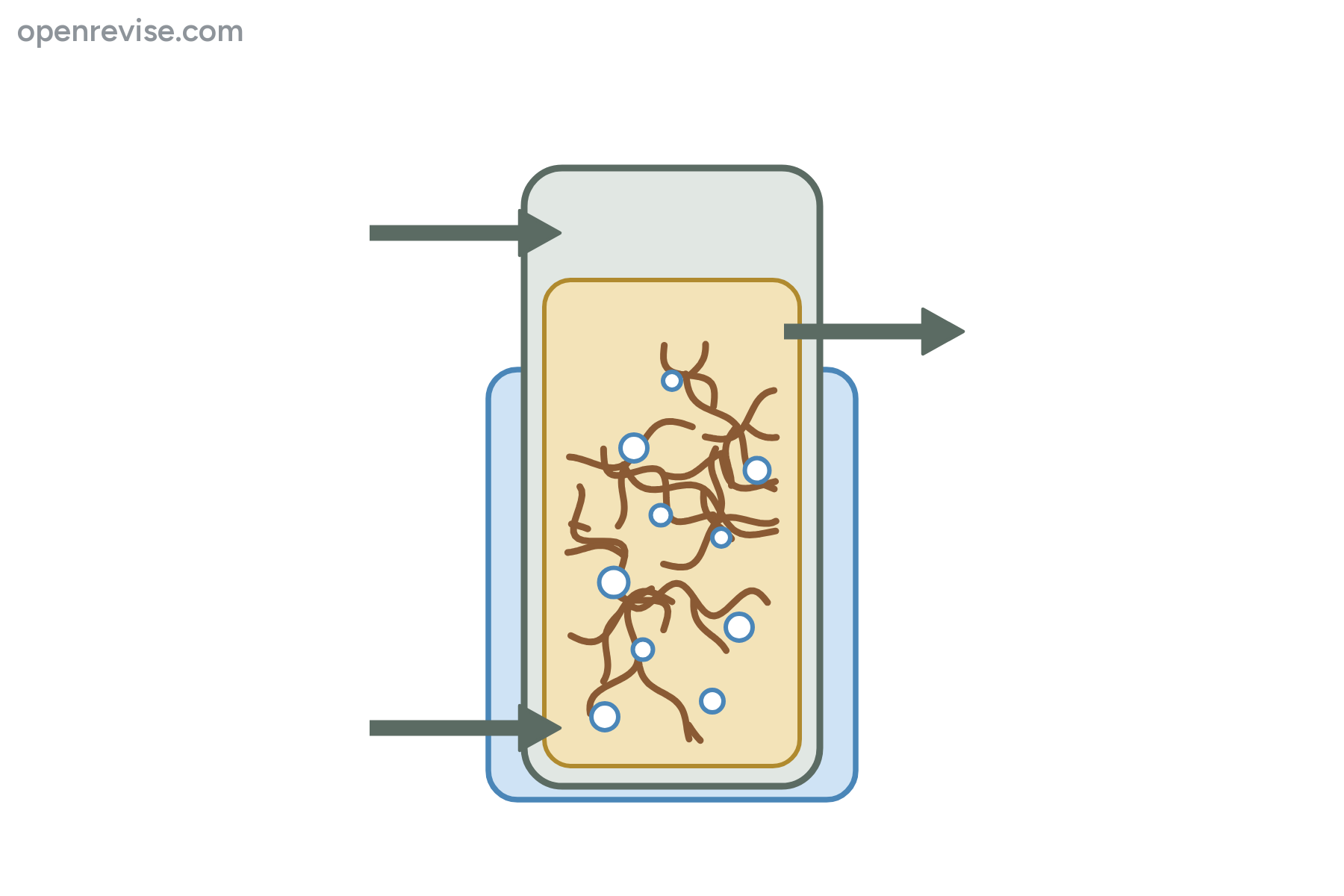 Name each part of the fermenter and say why it is needed.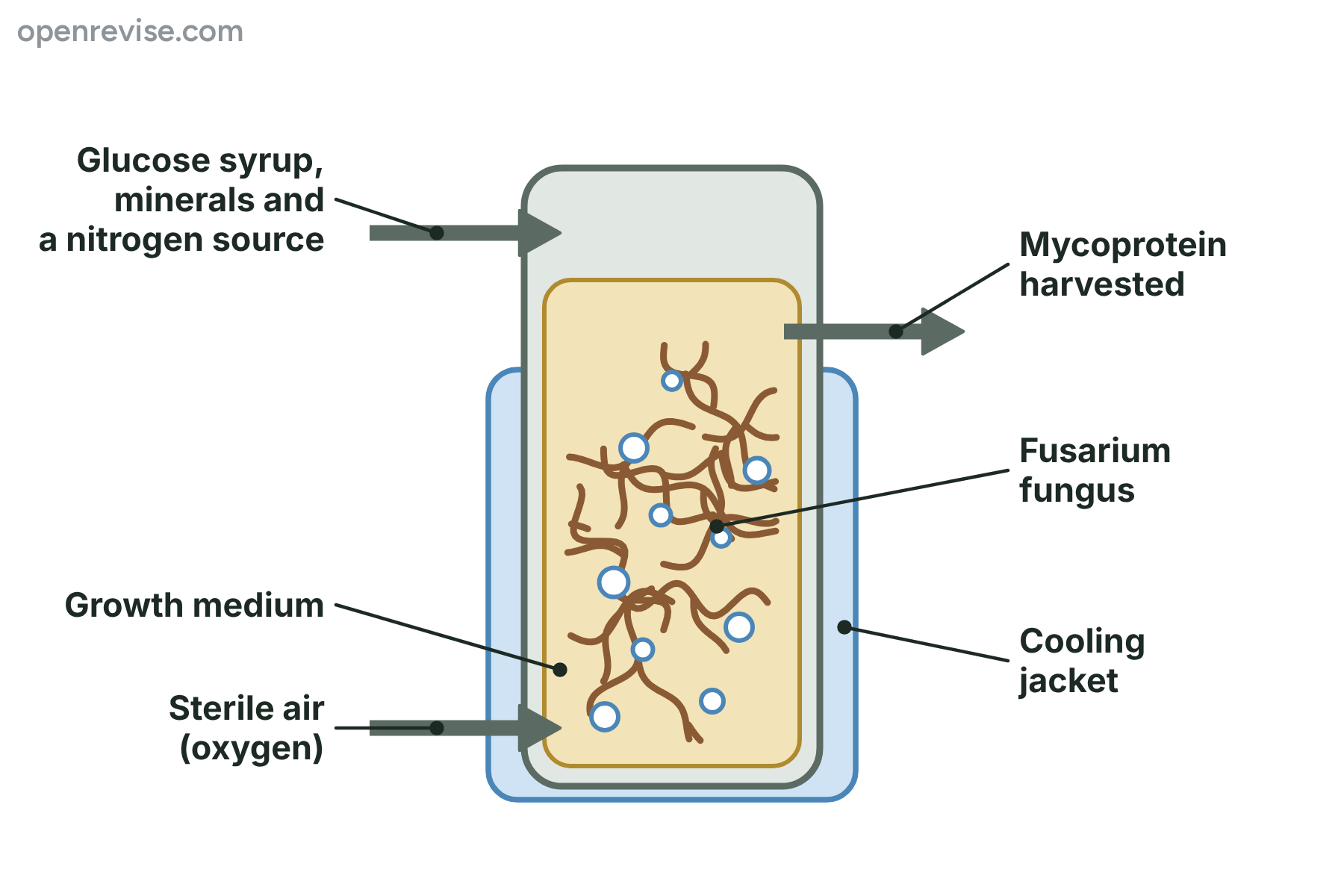
The inlet at the top left supplies glucose, minerals and a nitrogen source for growth. The air inlet supplies oxygen for respiration and mixes the contents. The cooling jacket keeps the temperature at the optimum. The outlet on the right lets the mycoprotein be harvested.
-
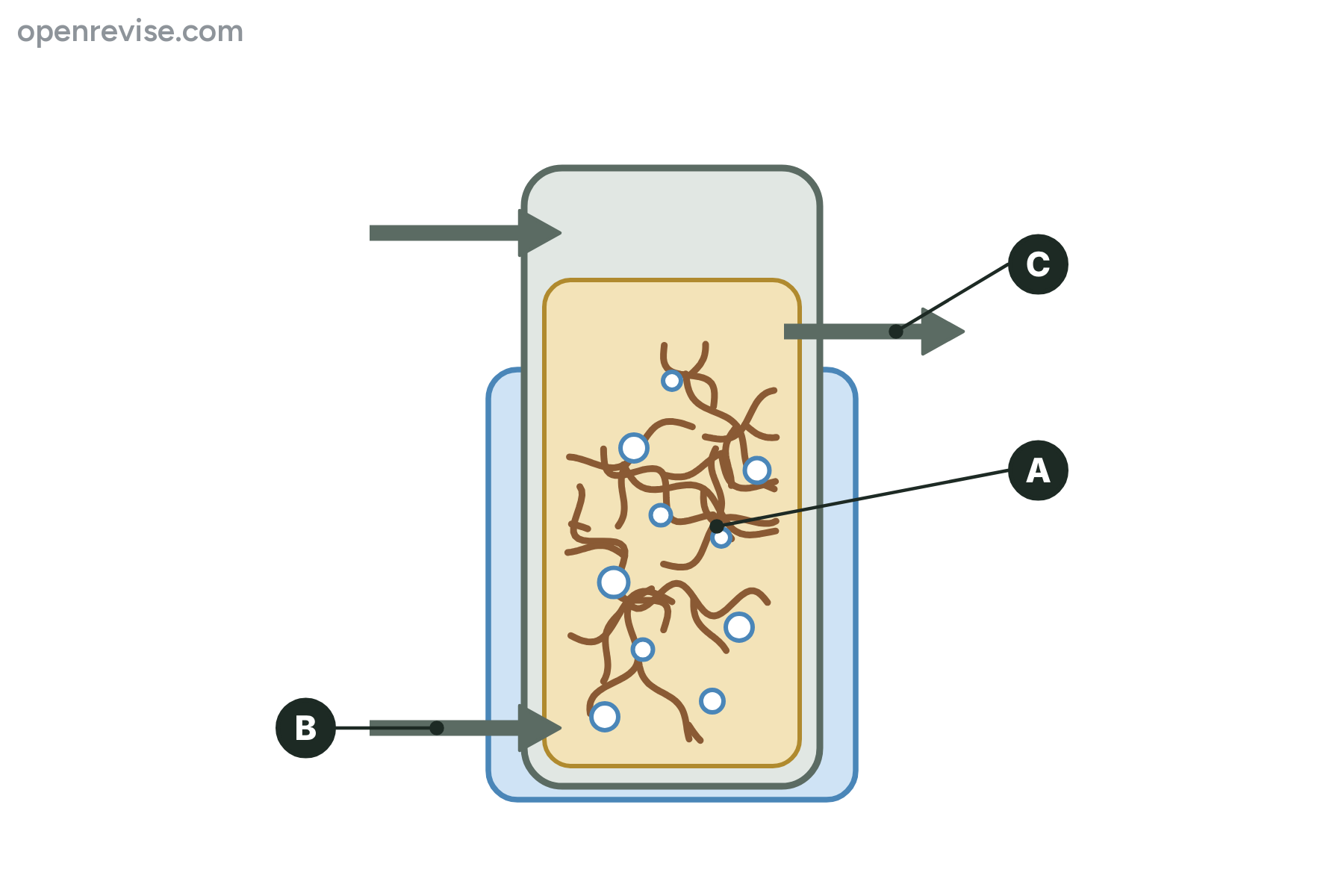 Name the parts of the fermenter marked A, B and C.
 A is the fungus (Fusarium). B is the sterile air inlet. C is the outlet where the mycoprotein is harvested.