Exam questions · Biology
Feeding the Human Race
- 55 exam questions
- 174 marks
- 56 quick checks
Food Security
Just this lesson-
1 State [1 mark]
State one reason why a rising human population threatens food security.
Show answerHide answer
Model answer
There are more people to feed, so more food has to be grown (and more land is needed).
Mark scheme
- More people need more food, which may be more than can be produced — 1 mark
-
2 Give [2 marks]
Give two ways in which new pests or pathogens can reduce the amount of food produced.
Show answerHide answer
Model answer
Pests eat the leaves, stems or roots of crops, so the yield falls. Pathogens such as fungi cause disease, which damages the crop or kills the plants.
Mark scheme
- Pests eat or damage the crop, so yield falls — 1 mark
- Pathogens cause disease, which damages or kills plants — 1 mark
-
3 Explain [3 marks]
Explain why the increase in meat eating in wealthier countries makes it harder to feed the world.
Show answerHide answer
Model answer
Animals are one trophic level further along the food chain than plants. A large amount of the energy in their feed is lost as heat and in waste. So it takes much more land and many more crops to produce meat than to produce the same energy as plant foods, and this land could have fed more people.
Mark scheme
- Meat comes from animals higher up the food chain — 1 mark
- Much of the energy in feed is lost, so it is an inefficient way to use crops — 1 mark
- More land and crops are needed per person, leaving less food for others — 1 mark
-
4 Describe [3 marks]
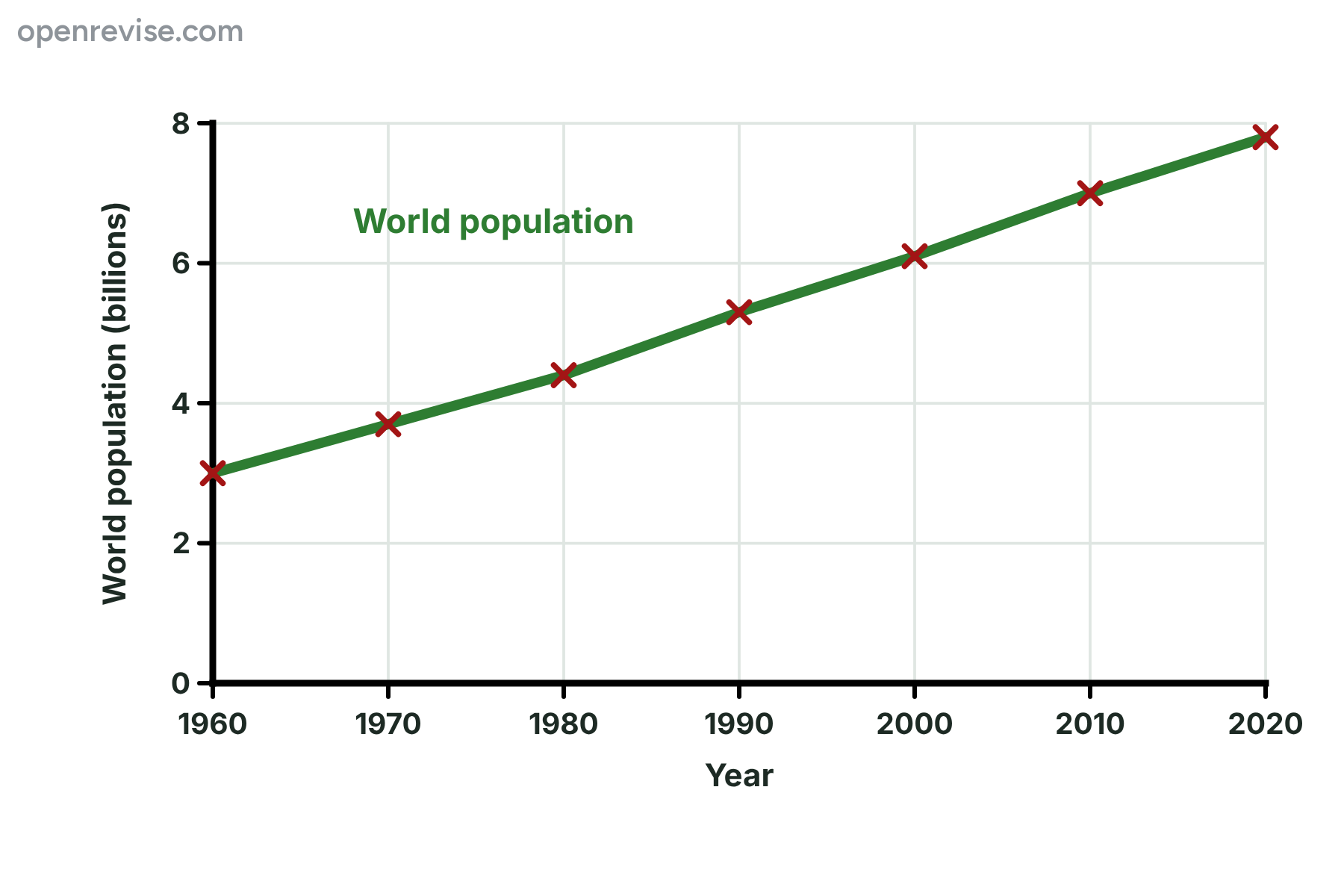
The graph shows the size of the world population from 1960 to 2020. Describe the trend shown by the graph.
Show answerHide answer
Model answer
The population increased throughout the period, from 3.0 billion in 1960 to 7.8 billion in 2020. It rose by about 0.7 to 0.9 billion in every ten years, so the number of extra people added each decade stayed high. The population more than doubled in sixty years.
Mark scheme
- The population increases all the way from 1960 to 2020 — 1 mark
- Quotes figures with units, such as 3.0 billion to 7.8 billion — 1 mark
- Says that it more than doubled, or that the rise is steady and continuing — 1 mark
-
5 Calculate [3 marks]
Use the graph to calculate the percentage increase in the world population between 1980 and 2020.
Show answerHide answer
Model answer
Population in 1980 is 4.4 billion and in 2020 is 7.8 billion. The increase is \(7.8 - 4.4 = 3.4\) billion. The percentage increase is \(\frac{3.4}{4.4} \times 100 = 77\%\) (to 2 significant figures).
Mark scheme
- Reads both values correctly: 4.4 and 7.8 — 1 mark
- \(3.4 \div 4.4 \times 100\) — 1 mark
- 77% (accept 77.3%) — 1 mark
-
6 Calculate [3 marks]
In 2000 a country had a population of 25 million and produced 7.5 million tonnes of food. In 2020 the population was 30 million and 8.1 million tonnes of food were produced. Calculate the mass of food produced per person in each year, and state what the figures show about food security in the country. (1 tonne = 1000 kg)
Show answerHide answer
Model answer
In 2000: \(7\,500\,000\,000 \div 25\,000\,000 = 300\) kg per person. In 2020: \(8\,100\,000\,000 \div 30\,000\,000 = 270\) kg per person. The food produced per person has fallen, so food production is not keeping up with the rising population and the country is less food secure.
Mark scheme
- 300 kg per person in 2000 — 1 mark
- 270 kg per person in 2020 — 1 mark
- Food per person has fallen, so food security is reduced — 1 mark
-
7 Explain [4 marks]
A farmer in a poor country finds that the price of fertiliser and fuel has doubled and that the rains have failed for two years. Explain how these changes could affect food security in the farmer's region.
Show answerHide answer
Model answer
The fertiliser is too expensive, so the farmer buys less, and the crop gets fewer mineral ions, so the yield is lower. Dearer fuel makes ploughing and transport more expensive, and so raises the price of the food. A drought means that the crops do not get enough water, so they grow poorly or die, and so less food is grown. Less food and higher prices mean that fewer people can get enough to eat.
Mark scheme
- Fertiliser too expensive, so less is used and yield falls — 1 mark
- Fuel cost raises the cost of farming and the price of food — 1 mark
- Drought (environmental change) means crops get too little water and yields fall — 1 mark
- Less food and higher prices mean fewer people can afford enough food — 1 mark
-
8 Discuss [6 marks]
The human population is expected to reach nearly 10 billion by 2050. Discuss the biological factors that could make it difficult to feed this population in a sustainable way.
Show answerHide answer
Model answer
More people means a greater demand for food, and as people become wealthier they eat more meat and dairy foods. Meat takes more land and more crops to produce than plant foods, because energy is lost at every trophic level, so the demand for farmland rises even faster than the population. At the same time the supply is threatened. New pests and pathogens can spread to new countries in trade and travel and destroy crops, and they can become resistant to pesticides. Environmental change, such as drought, flooding and rising temperatures, lowers yields, and soil can be lost or made less fertile. Growing more food has to be sustainable. Using more fertiliser, pesticide and water is expensive for farmers, can pollute rivers and harm biodiversity, and may not be possible for ever. So the food supply must be increased without using up the soil, the water and the habitats that future farming depends on.
Mark scheme
- Level 3 (5 to 6 marks): several different factors are explained, with links to both demand and supply and a clear reference to sustainability or cost — A logical, well-structured answer in which the factors are linked to food security
- Level 2 (3 to 4 marks): two or three factors are explained, but the link to food production or sustainability is partial — Some reasoning, but not every point is developed
- Level 1 (1 to 2 marks): one or two factors are named or described with little explanation — A list of factors with no link to the amount of food
- Possible points: rising population; more meat and dairy foods; energy lost between trophic levels; new pests and pathogens; resistance; climate change; soil loss; cost of inputs — Content that can earn credit at any level
Quick check
-
1
Which statement defines food security?
Show answerHide answer
C: Access to enough safe, nutritious food at all times
Food security is having access to enough safe, nutritious food at all times to live a healthy life.
-
2
Why does eating more meat increase the demand for farmland?
Show answerHide answer
A: Animals need crops, and energy is lost when it passes through them
Animals are higher up the food chain, so energy is lost and more crops are needed to produce meat than plant foods.
-
3
Which of these is an example of environmental change that could reduce crop yields?
Show answerHide answer
D: A long drought
Drought is a change in the environment that leaves crops without enough water.
-
4
Why do new pests and pathogens often reach new countries?
Show answerHide answer
B: Because of trade, travel and a warming climate
Trade and travel carry them across the world, and a warmer climate lets them survive in new places.
-
5
The population of a country rises from 20 million to 25 million. What is the percentage increase?
Show answerHide answer
C: 25%
The increase is 5 million, and 5 divided by 20, multiplied by 100, gives 25%.
-
6
A country produced 600 000 tonnes of food for 2 million people. How much food is that per person?
Show answerHide answer
B: 300 kg
600 000 tonnes is 600 000 000 kg, and dividing by 2 000 000 people gives 300 kg per person.
-
7
Which of these is an agricultural input?
Show answerHide answer
D: Pesticide sprayed on the crop
Seed, fertiliser, pesticide, feed, fuel and water are inputs that a farmer has to provide.
-
8
What is meant by sustainable farming?
Show answerHide answer
A: Producing food without harming future food production
Sustainable farming meets needs now without making it harder for future generations to produce food.
Agricultural Solutions to the Demands of the Growing Population
Just this lesson-
1 Describe [2 marks]
Describe what is meant by biological control.
Show answerHide answer
Model answer
The use of living organisms to control a pest. For example, a predator such as a ladybird is released to eat aphids, or a parasite is used to kill the pest.
Mark scheme
- Using a living organism (not a chemical) — 1 mark
- To reduce the numbers of a pest, with an example such as a predator or parasite — 1 mark
-
2 Name [3 marks]
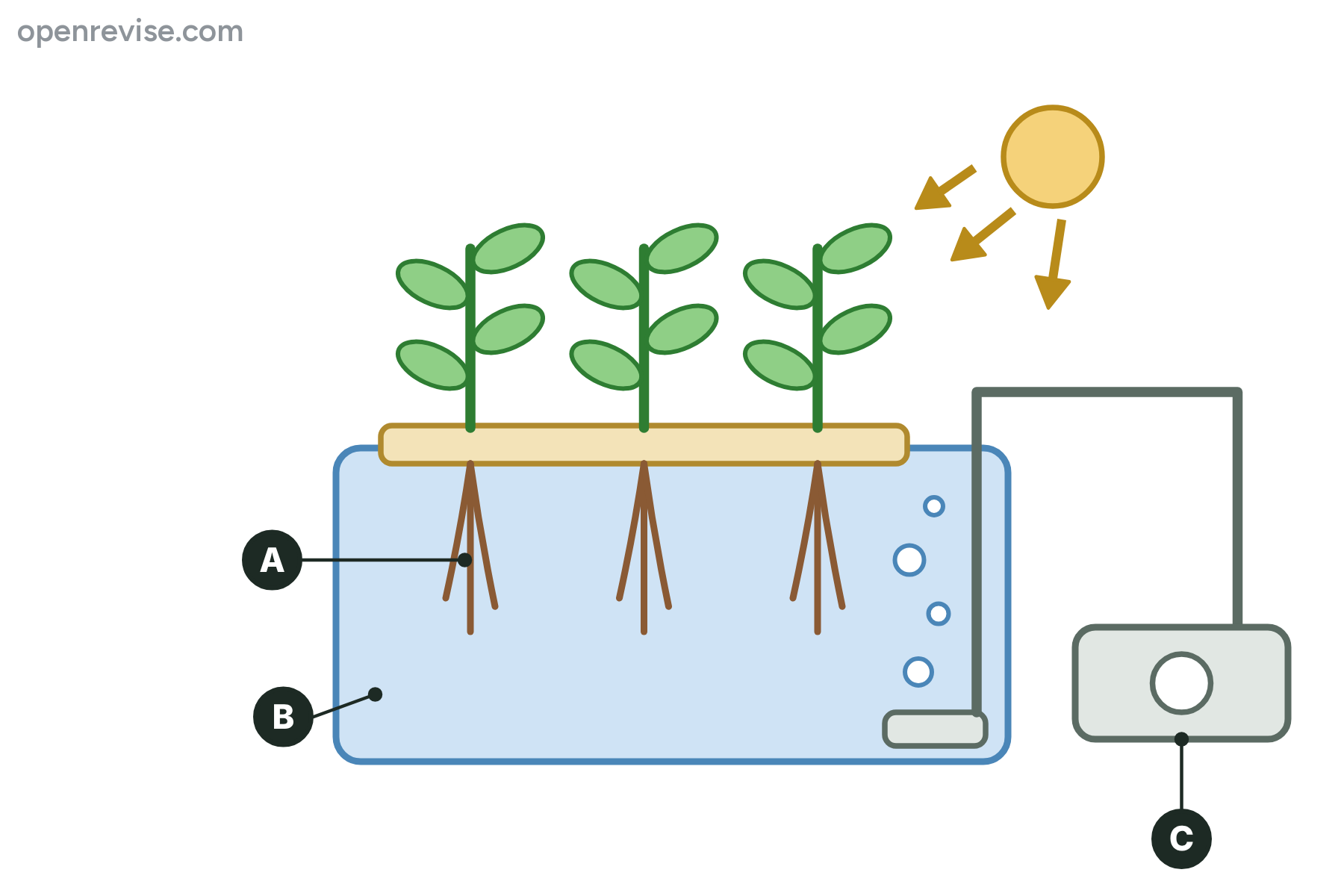
The diagram shows a hydroponics system. Name the parts labelled A, B and C.
Show answerHide answer
Model answer
A is the roots. B is the nutrient solution. C is the air pump.
Mark scheme
- A: roots — 1 mark
- B: nutrient solution (water containing mineral ions) — 1 mark
- C: air pump — 1 mark
-
3 Give [2 marks]
Give two advantages of growing crops by hydroponics instead of in soil.
Show answerHide answer
Model answer
The farmer can control the amount of each mineral ion, the pH and the temperature, so that the plants grow as fast as possible. Crops can be grown all year round or in places where the soil is poor, because the plants do not need soil.
Mark scheme
- Exact control of minerals, pH and temperature gives high yields — 1 mark
- Can be grown where soil is poor or there is little space — 1 mark
- (Also accept: no soil pests, less water used, grown all year round) — Any two different advantages
-
4 Explain [3 marks]
Explain why a farmer adds nitrate fertiliser to a field of wheat.
Show answerHide answer
Model answer
Wheat needs nitrate to make amino acids, which are joined together to make proteins for growth. The soil may not contain enough nitrate because the previous crop has taken it out. So the fertiliser makes the wheat grow larger and faster, and increases the yield.
Mark scheme
- Nitrate is needed to make amino acids and proteins — 1 mark
- The soil is short of nitrate, because crops remove it — 1 mark
- So the plants grow faster and the yield is higher — 1 mark
-
5 Explain [4 marks]
Fertiliser from a farmer's field is washed into a nearby lake. Explain how this can cause the fish in the lake to die.
Show answerHide answer
Model answer
The mineral ions in the fertiliser make algae grow very fast, forming a layer over the surface of the water. This blocks the light, so the plants below cannot photosynthesise and they die. Bacteria decompose the dead plants and use up oxygen in respiration. The fish do not get enough oxygen, so they die.
Mark scheme
- Extra minerals make the algae grow quickly (an algal bloom) — 1 mark
- The light is blocked, so the plants die — 1 mark
- Bacteria decompose the dead matter and use up the oxygen — 1 mark
- The fish suffocate, because of the lack of oxygen — 1 mark
-
6 Explain [3 marks]
A farmer used the same insecticide on a field for ten years. It now kills far fewer insects. Explain why it has become less effective.
Show answerHide answer
Model answer
Some insects in the population had a variation that made them resistant to the insecticide. These insects survived the spray and reproduced, and they passed the resistance on to their offspring. Over the years the proportion of resistant insects increased, so the insecticide killed fewer of them.
Mark scheme
- Some insects were resistant (variation) — 1 mark
- The resistant insects survive, breed and pass on the resistance — 1 mark
- The proportion of resistant insects increases over time — 1 mark
-
7 Calculate [3 marks]
Source: A farm grew lettuce in two ways for one year. In the soil, 1200 kg of lettuce were harvested from 400 square metres. In a hydroponics unit, 1500 kg of lettuce were harvested from 50 square metres. Calculate the mass of lettuce produced per square metre by each method, and the number of times greater the yield is with hydroponics.
Show answerHide answer
Model answer
Soil: \(1200 \div 400 = 3\) kg per square metre. Hydroponics: \(1500 \div 50 = 30\) kg per square metre. The hydroponic yield is \(30 \div 3 = 10\) times greater.
Mark scheme
- 3 kg per square metre in soil — 1 mark
- 30 kg per square metre with hydroponics — 1 mark
- 10 times greater — 1 mark
-
8 Evaluate [6 marks]
A greenhouse farmer has a problem with aphids on a tomato crop. The farmer can spray with an insecticide or release ladybirds. Evaluate the two methods of control.
Show answerHide answer
Model answer
The insecticide acts quickly and kills nearly all of the aphids, so the tomato crop is protected at once. However, it may kill harmless insects such as pollinators, it can leave residues on the tomatoes, and the aphids can become resistant to it, so it will have to be sprayed again and a new chemical may be needed. The ladybirds are a natural predator, so there are no chemical residues, nothing is poisoned and the aphids do not become resistant. But the ladybirds work more slowly, they do not completely remove the aphids, and they may fly away or have to be bought again. In a closed greenhouse the ladybirds are likely to stay with the crop, so biological control is the better choice if the farmer can wait for it to work, with a spray used only if the infestation becomes severe.
Mark scheme
- Level 3 (5 to 6 marks): advantages and disadvantages of both methods are explained, and a justified conclusion is reached — A balanced comparison with a clear judgement
- Level 2 (3 to 4 marks): advantages and disadvantages of one method or limited points for both — Some explanation but not balanced
- Level 1 (1 to 2 marks): simple statements about one or both methods — Statements without reasoning
- Possible points: speed; residues; resistance; effect on other organisms; cost; sustainability — Content that can earn credit at any level
Quick check
-
1
Which ions are in an NPK fertiliser?
Show answerHide answer
B: Nitrate, phosphate and potassium
NPK fertilisers supply nitrate, phosphate and potassium.
-
2
What is the first step in eutrophication?
Show answerHide answer
D: Minerals run off into the water and algae grow quickly
Minerals from fertiliser run off the field into the water, and then cause the algae to grow very fast.
-
3
Why is air bubbled through the nutrient solution in a hydroponics tank?
Show answerHide answer
C: To give the roots oxygen for respiration
The roots need oxygen for respiration, and the bubbles supply it.
-
4
Which of these is a disadvantage of hydroponics?
Show answerHide answer
A: It is expensive to set up and run
Hydroponics needs expensive equipment, power and skill, so the costs are high.
-
5
Which of these is an example of biological control?
Show answerHide answer
D: Releasing ladybirds to eat aphids
Ladybirds eat aphids, so they reduce the pest using a living organism instead of a chemical.
-
6
Why are some pesticides a problem for food chains?
Show answerHide answer
B: They build up in animals along the food chain
Some are not broken down, so they build up in the bodies of animals at the top of the chain.
-
7
What was the main problem with releasing cane toads in Australia?
Show answerHide answer
C: They spread widely and poisoned native animals
They did not control the beetles but bred and spread, and their poison kills native animals that eat them.
-
8
What is the Bt gene used for in genetically engineered maize?
Show answerHide answer
A: To make the plant produce a protein that kills caterpillars
The Bt gene makes the maize produce a protein that kills caterpillars, so less pesticide is needed.
Selective Breeding of Plants and Animals
Just this lesson-
1 State [1 mark]
State one characteristic that a farmer could select for when breeding dairy cattle.
Show answerHide answer
Model answer
A high milk yield (also accept: disease resistance, fertility, calm temperament).
Mark scheme
- Any suitable characteristic, such as a high milk yield — 1 mark
-
2 Describe [4 marks]
Describe how selective breeding is used to produce wheat plants that have a higher yield.
Show answerHide answer
Model answer
The breeder chooses the wheat plants that have the highest yield of grain and breeds them together. From their offspring the plants with the highest yield are selected again and bred. This is repeated for many generations, until the wheat plants all give a high yield.
Mark scheme
- Choose plants with a high yield — 1 mark
- Breed them together — 1 mark
- Select the best offspring and breed from them — 1 mark
- Repeat over many generations — 1 mark
-
3 Describe [3 marks]
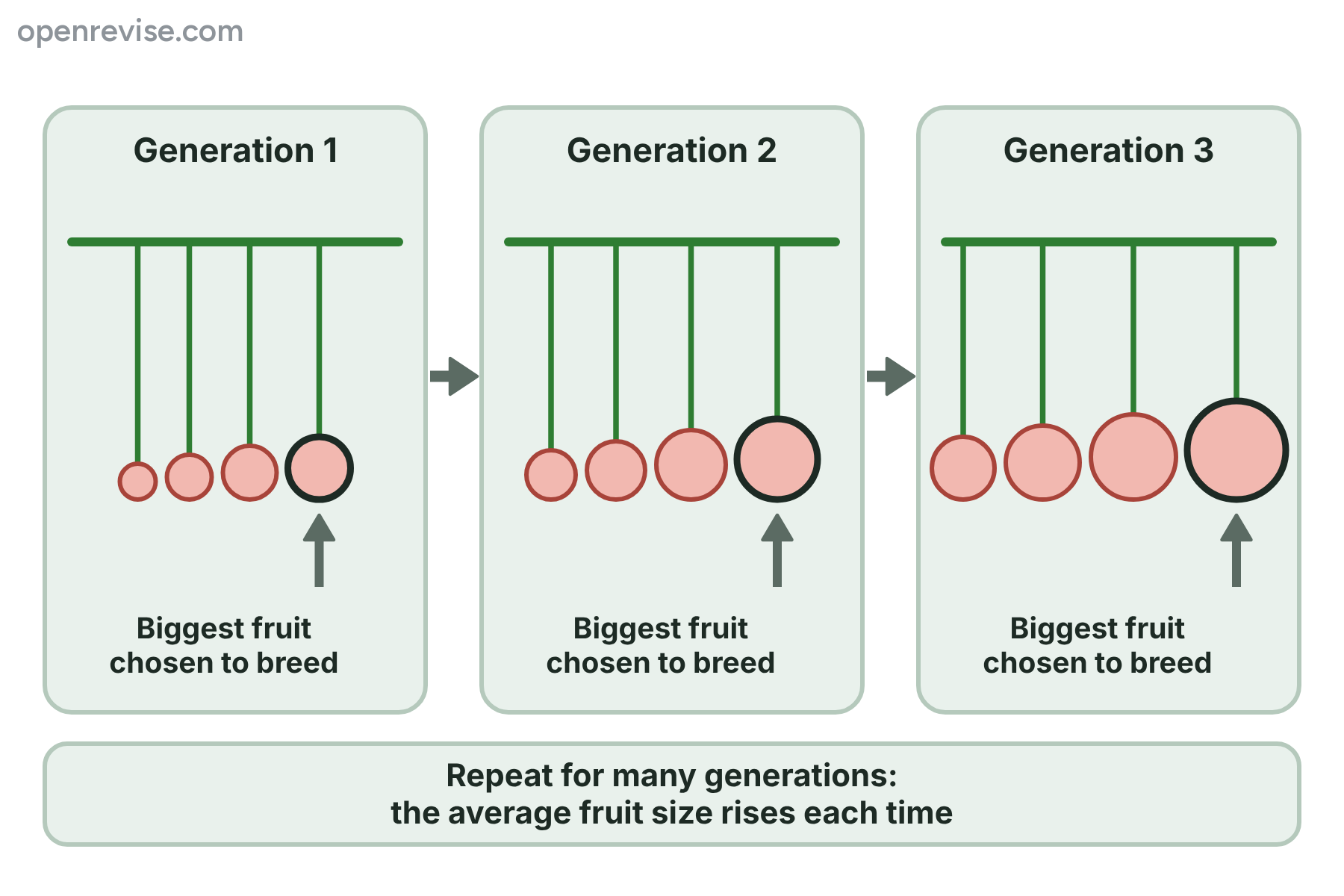
The diagram shows part of a selective breeding programme for a fruit crop. Describe what the breeder did and what happened to the size of the fruit.
Show answerHide answer
Model answer
In each generation the breeder chose the biggest fruit and bred from the plant that produced it. The fruit in each generation was bigger on average than in the generation before, so after three generations the fruits were much larger than the first ones.
Mark scheme
- Chose the plant with the biggest fruit to breed from — 1 mark
- Repeated in each generation — 1 mark
- The average fruit size increased with each generation — 1 mark
-
4 Calculate [3 marks]
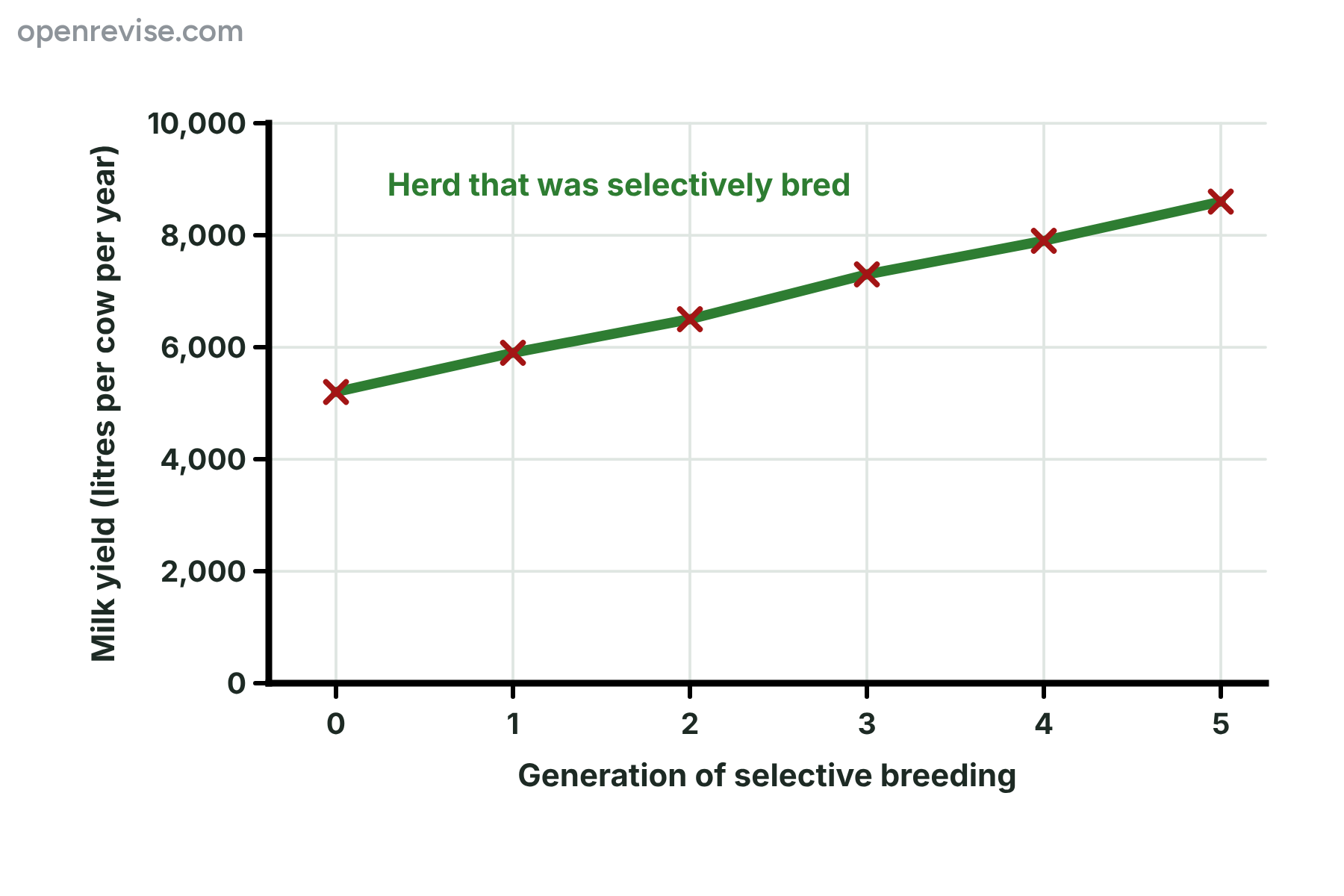
The graph shows the mean milk yield of a herd of cows over five generations of selective breeding. Calculate the percentage increase in the mean milk yield from generation 0 to generation 5. Give your answer to the nearest whole number.
Show answerHide answer
Model answer
Increase = 8600 - 5200 = 3400 litres. Percentage increase = \(\frac{3400}{5200} \times 100 = 65.4\%\), which is 65% to the nearest whole number.
Mark scheme
- Reads 5 200 and 8 600 correctly and finds the increase of 3 400 — 1 mark
- \(3400 \div 5200 \times 100\) — 1 mark
- 65% — 1 mark
-
5 Explain [3 marks]
A breeder has bred a pedigree dog for many generations using only a few closely related parents. Explain why the dogs are likely to suffer from inherited disorders.
Show answerHide answer
Model answer
Breeding closely related dogs is inbreeding. It reduces the variation in the population, because there are fewer different alleles. The offspring are therefore more likely to inherit two copies of the same harmful recessive allele, and so they develop the inherited disorder.
Mark scheme
- Inbreeding (breeding closely related individuals) — 1 mark
- Reduces the variation or the number of different alleles — 1 mark
- Offspring are more likely to inherit two copies of a harmful recessive allele — 1 mark
-
6 Explain [4 marks]
A banana farmer grows a single variety of banana plant over a very large area. Explain why one new disease could destroy the whole crop.
Show answerHide answer
Model answer
The plants have been bred from one variety, so there is very little variation between them and they are genetically very similar. If one plant is not resistant to the disease, then none of the others will be either, because they all carry the same alleles. The pathogen can spread easily from plant to plant. There are no resistant plants left to breed from, so the whole crop could be lost.
Mark scheme
- The plants are genetically similar, with little variation — 1 mark
- None of the plants has an allele for resistance — 1 mark
- The disease spreads easily between the plants — 1 mark
- So the whole crop is lost, with no resistant plants left — 1 mark
-
7 Compare [3 marks]
Compare selective breeding with natural selection.
Show answerHide answer
Model answer
In selective breeding, people choose which individuals will breed, whereas in natural selection the environment decides which individuals survive and reproduce. Selective breeding picks features that people want, such as a high yield, whereas natural selection favours features that help the organism to survive. Both processes change the alleles in a population over many generations, because the individuals chosen pass on their alleles.
Mark scheme
- People choose the parents, but in natural selection the environment does — 1 mark
- Selective breeding is for the characteristics that people want, natural selection is for survival — 1 mark
- Both change the population over many generations by passing on alleles — 1 mark
-
8 Evaluate [6 marks]
Selective breeding has made modern dairy cows produce much more milk than their ancestors. Evaluate the use of selective breeding in dairy cattle.
Show answerHide answer
Model answer
Selective breeding has increased milk yields a great deal, so a farmer can produce more milk from fewer cows, and food is cheaper and more of it is available, which helps food security. Cows can also be selected for disease resistance, which reduces the cost of treating illness. However, the process takes many generations, and it often uses a few top bulls, so the herd becomes inbred and there is less variation. This makes the herd more vulnerable to a new disease, and it can allow harmful alleles to spread. Very high milk yields have also been linked with udder infections and lameness, which is a welfare problem. Overall, selective breeding has brought great benefits, but breeders should select for health and fertility as well as milk yield and avoid using closely related animals.
Mark scheme
- Level 3 (5 to 6 marks): advantages and disadvantages are both explained, and a supported conclusion is reached — A balanced answer with a clear judgement
- Level 2 (3 to 4 marks): some advantages and some disadvantages, with limited explanation — Points made, but not fully developed
- Level 1 (1 to 2 marks): one or two simple points, such as a higher yield or inbreeding — Little explanation or no link to the question
- Possible points: higher yield; cheaper food; disease resistance; takes many generations; inbreeding; less variation; welfare — Content that can earn credit at any level
Quick check
-
1
What is selective breeding?
Show answerHide answer
C: Choosing the parents with wanted characteristics
In selective breeding people choose parents with wanted characteristics and breed them over many generations.
-
2
A farmer wants a bigger tomato. What should the farmer do first?
Show answerHide answer
A: Breed the plants with the biggest tomatoes together
Parents with the characteristic are selected first. The best offspring are then bred, and the steps repeated.
-
3
Which of these came from the wild cabbage by selective breeding?
Show answerHide answer
D: Broccoli
Broccoli, cabbage, kale and cauliflower were all bred from one wild plant.
-
4
Why do modern wheat plants have short stems?
Show answerHide answer
B: So they stay upright and put more energy into the grain
Short stems stop the plants from being blown over, and more energy is put into making grain.
-
5
What is inbreeding?
Show answerHide answer
B: Breeding closely related individuals
Inbreeding is breeding between closely related individuals, which reduces variation.
-
6
Why is a crop with little variation at risk from disease?
Show answerHide answer
C: Because no plant may be resistant
If no plant has an allele for resistance, a new disease can infect all of them.
-
7
A herd's mean milk yield rose from 4 000 to 5 000 litres. What is the percentage increase?
Show answerHide answer
A: 25%
The rise is 1 000 litres, and 1 000 divided by 4 000, multiplied by 100, is 25%.
-
8
Which of these is a possible disadvantage of selective breeding in animals?
Show answerHide answer
D: Leg problems in fast-growing chickens
Features such as very rapid growth or very high milk yield can cause health and welfare problems.
Genetic Engineering
Just this lesson-
1 Describe [2 marks]
Describe what is meant by genetic engineering.
Show answerHide answer
Model answer
Genetic engineering is a process that changes the genome of an organism. A gene is inserted into the organism (often from another species) to give it a desirable characteristic.
Mark scheme
- Modifying the genome of an organism — 1 mark
- By inserting a gene to give a desirable characteristic — 1 mark
-
2 Describe [3 marks]
The diagram shows how genetically engineered bacteria are used to make human insulin. Describe how the insulin is produced.
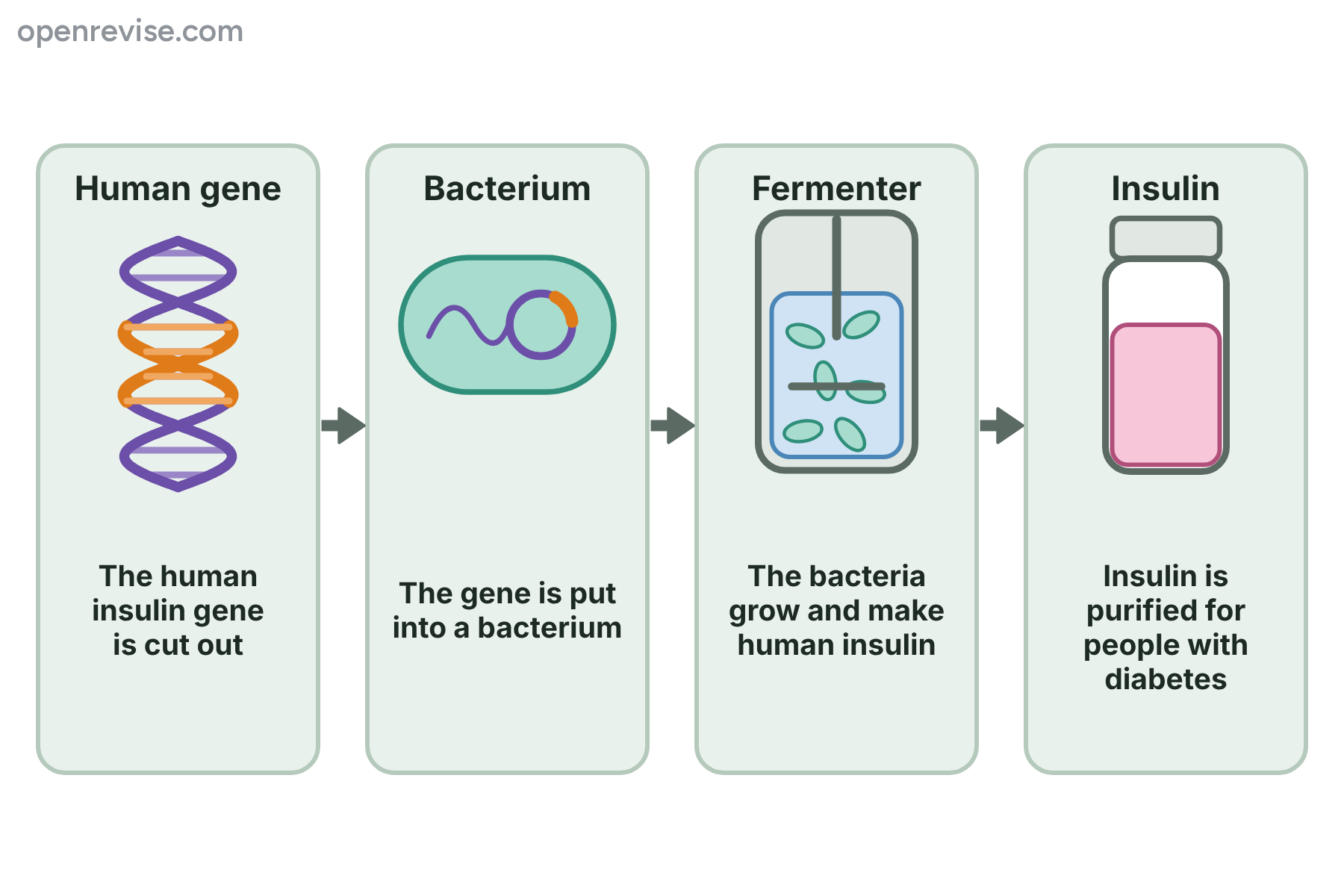
Show answerHide answer
Model answer
The human insulin gene is cut out of human DNA and inserted into a bacterium. The bacteria are grown in a fermenter, where they divide and make human insulin. The insulin is collected and purified so that it can be used by people with diabetes.
Mark scheme
- The human insulin gene is cut out and put into bacteria — 1 mark
- The bacteria grow and make insulin in a fermenter — 1 mark
- The insulin is collected and purified — 1 mark
-
3 Give [2 marks]
Give two differences between genetic engineering and selective breeding.
Show answerHide answer
Model answer
In genetic engineering a chosen gene is put directly into the genome, but in selective breeding the parents with the wanted characteristics are chosen and bred. Genetic engineering can use a gene from any species and can make the change in one step, whereas selective breeding needs many generations and can only use alleles that already exist in the species.
Mark scheme
- A gene is transferred directly, not through breeding — 1 mark
- Can use genes from other species, or takes one step instead of many generations — 1 mark
-
4 Explain [3 marks]
A gene for resistance to a pest is inserted into a single cell from a maize plant. The cell is grown into a whole plant. Explain why every cell in the new plant has the gene.
Show answerHide answer
Model answer
The cell divides by mitosis to grow into the plant. Mitosis produces genetically identical cells, so the gene is copied each time. All the cells in the plant therefore contain the new gene.
Mark scheme
- The cell divides by mitosis — 1 mark
- Mitosis makes genetically identical cells, or the DNA is copied — 1 mark
- So every cell in the plant has the inserted gene — 1 mark
-
5 Explain [4 marks]
Maize can be genetically engineered to contain the Bt gene from a bacterium. Explain how this could increase the yield of the maize crop.
Show answerHide answer
Model answer
The Bt gene is cut out of the bacterium and inserted into the maize cells. The maize cells then make the protein that the gene codes for. This protein harms the caterpillars that eat the maize plants. So fewer plants are damaged by the pest, and more of the crop survives to be harvested, which increases the yield.
Mark scheme
- The gene is inserted into the maize cells — 1 mark
- The maize makes the protein coded for by the gene — 1 mark
- The protein kills or harms caterpillars that eat the plant — 1 mark
- Less damage by pests, so a higher yield — 1 mark
-
6 Explain [3 marks]
Before 1982 insulin for people with diabetes was taken from the pancreases of pigs. Explain two advantages of using insulin made by genetically engineered bacteria instead.
Show answerHide answer
Model answer
The bacteria make human insulin, which is identical to the person's own, so it is less likely to cause a reaction than pig insulin. The bacteria reproduce quickly, so a very large amount of insulin can be made cheaply.
Mark scheme
- It is human insulin, identical to the person's own — 1 mark
- So there is less risk of a reaction (or it works better) — 1 mark
- A second advantage, such as large amounts made quickly and cheaply, or no animals used — 1 mark
-
7 Describe [4 marks]
Describe the main stages in producing a crop plant that is genetically engineered to resist an insect pest.
Show answerHide answer
Model answer
A gene that makes a protein that harms the pest is found in another organism, such as the Bt gene in a bacterium. The gene is cut out of the DNA of the donor using enzymes. It is inserted into the DNA of a plant cell. The cell is then grown into a whole plant, which makes the protein in all of its cells and can be tested to see whether it resists the pest.
Mark scheme
- Find a gene for pest resistance in another organism — 1 mark
- Cut it out with enzymes — 1 mark
- Insert it into plant cells — 1 mark
- Grow the cells into plants (and test them) — 1 mark
Quick check
-
1
What is genetic engineering?
Show answerHide answer
B: Changing the genome by inserting a gene
Genetic engineering modifies the genome of an organism, by inserting a gene, to give it a desirable characteristic.
-
2
Why can a gene from a bacterium be used in a maize plant?
Show answerHide answer
C: The maize cells make the protein that the gene codes for
The gene is put into the genome of the maize cells, which then make the protein that the gene codes for.
-
3
Why is a new gene usually inserted into a cell at an early stage?
Show answerHide answer
A: So that it is copied into every cell by mitosis
Mitosis copies the gene into every new cell, so that every cell in the adult organism has it.
-
4
What does the Bt gene do in maize?
Show answerHide answer
D: It makes the maize produce a protein that kills caterpillars
The Bt gene makes the maize produce a protein that harms the caterpillars that feed on it.
-
5
Where are GM bacteria that make insulin grown?
Show answerHide answer
B: In a fermenter
Large tanks called fermenters give the bacteria the conditions to grow and make insulin.
-
6
Which is an advantage of insulin made by GM bacteria, compared with insulin from pigs?
Show answerHide answer
C: It is identical to human insulin
Bacteria make human insulin, which is identical to the person's own, so there is less chance of a reaction.
-
7
How is genetic engineering different from selective breeding?
Show answerHide answer
A: A gene is moved directly, in one step
Genetic engineering moves a chosen gene in one step, while selective breeding takes many generations.
-
8
Which of these organisms is genetically modified?
Show answerHide answer
D: A bacterium that makes human insulin
Bacteria with the human insulin gene have had their genome changed by genetic engineering.
The Steps of Genetic Engineering (Higher tier)
Just this lesson-
1 Name [1 mark]
Name the type of enzyme that is used to cut a gene out of DNA.
Show answerHide answer
Model answer
A restriction enzyme.
Mark scheme
- Restriction enzyme — 1 mark
-
2 Name [3 marks]
The diagram shows the steps in genetic engineering. Name the parts labelled A, B and C.
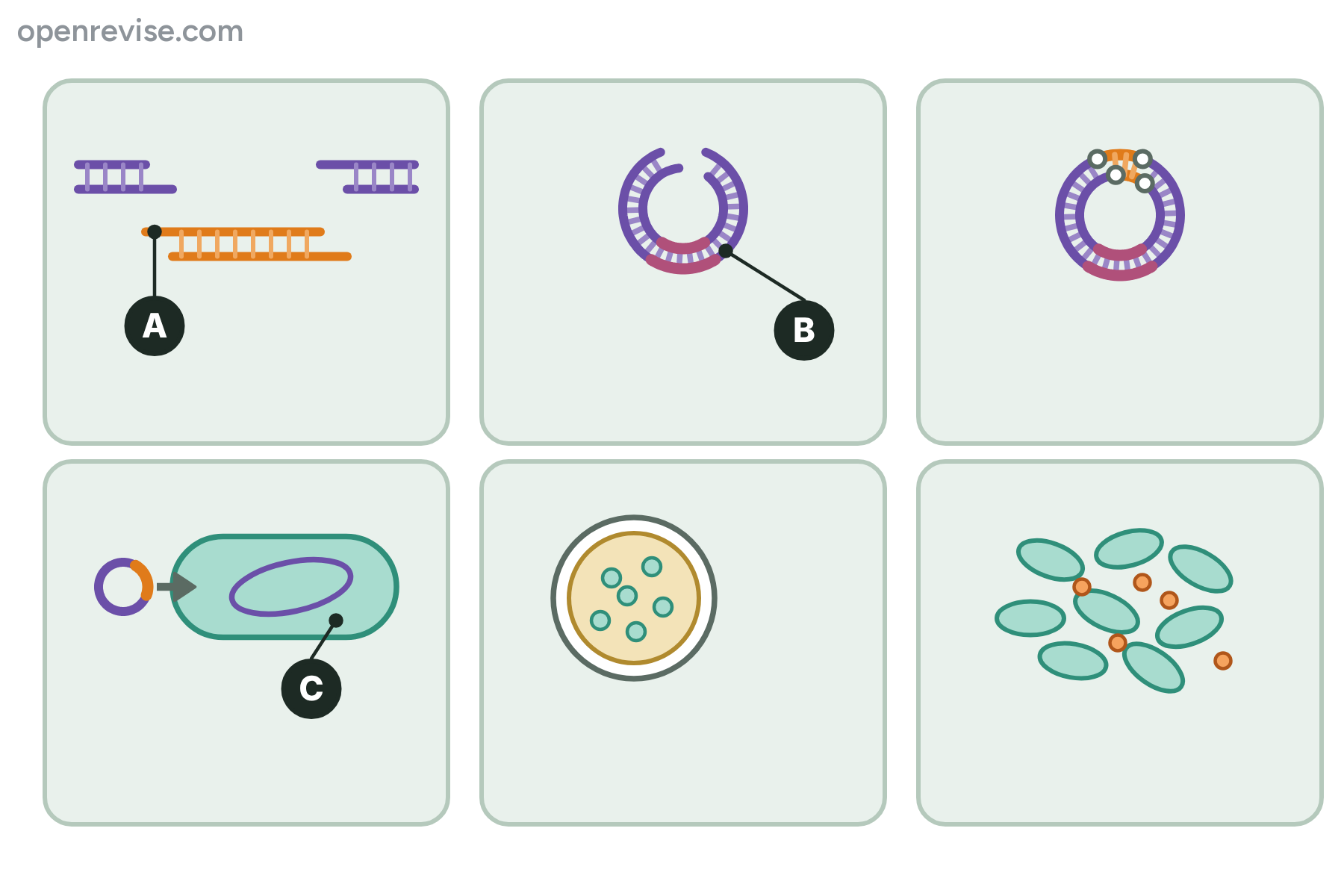
Show answerHide answer
Model answer
A is a sticky end. B is a plasmid. C is a (host) bacterium.
Mark scheme
- A: sticky end — 1 mark
- B: plasmid — 1 mark
- C: bacterium (host bacterium) — 1 mark
-
3 Describe [2 marks]
Describe what is meant by sticky ends.
Show answerHide answer
Model answer
Sticky ends are short stretches of unpaired bases at the ends of a piece of DNA cut by a restriction enzyme. They can pair up with other sticky ends that have complementary bases.
Mark scheme
- Short stretches of unpaired bases at the cut ends of DNA — 1 mark
- That can pair with complementary sticky ends — 1 mark
-
4 Explain [3 marks]
Explain why the same restriction enzyme is used to cut the gene and to cut the plasmid.
Show answerHide answer
Model answer
The restriction enzyme cuts at a particular sequence of bases, so it leaves the same sticky ends on the gene and on the plasmid. These sticky ends are complementary, so they can pair by complementary base pairing. Then the gene can be joined to the plasmid.
Mark scheme
- Cuts at the same specific sequence — 1 mark
- So that the sticky ends are complementary — 1 mark
- So the gene and the plasmid can pair up and be joined — 1 mark
-
5 Explain [2 marks]
Explain the role of DNA ligase in genetic engineering.
Show answerHide answer
Model answer
DNA ligase joins the gene to the plasmid. It seals the strands of the DNA together, to make a recombinant plasmid.
Mark scheme
- Joins the gene and the plasmid DNA together — 1 mark
- To make a recombinant plasmid (a permanent join) — 1 mark
-
6 Explain [4 marks]
After the plasmids were added, the bacteria were spread on agar containing an antibiotic. Explain how this identifies the bacteria that have taken up the plasmid.
Show answerHide answer
Model answer
The plasmid contains an antibiotic resistance marker gene. Bacteria that have taken up the plasmid are resistant to the antibiotic, so they survive and divide to form colonies. The bacteria without the plasmid are not resistant, so they are killed or cannot grow. The colonies on the agar are therefore made of bacteria that carry the plasmid.
Mark scheme
- The plasmid carries an antibiotic resistance marker — 1 mark
- Bacteria with the plasmid are resistant and survive — 1 mark
- Bacteria without the plasmid are killed or cannot grow — 1 mark
- The colonies that grow contain the plasmid — 1 mark
-
7 Calculate [2 marks]
Source: Bacteria were treated with recombinant plasmids and spread on two plates. Plate X had no antibiotic in the agar and grew 250 colonies. Plate Y had antibiotic in the agar and grew 15 colonies. Calculate the percentage of the bacteria that took up the plasmid.
Show answerHide answer
Model answer
\(\frac{15}{250} \times 100 = 6\%\)
Mark scheme
- \(15 \div 250\) — 1 mark
- 6% — 1 mark
-
8 Describe [6 marks]
Describe how bacteria can be genetically engineered to make human insulin.
Show answerHide answer
Model answer
The human insulin gene is cut out of human DNA using a restriction enzyme, which leaves sticky ends. A plasmid, which is the vector, is cut open with the same restriction enzyme, so its sticky ends are complementary to those of the gene. The gene and the plasmid are mixed, and the sticky ends pair up. DNA ligase joins the gene to the plasmid and makes a recombinant plasmid. The plasmids are put into host bacteria. The bacteria are grown on agar containing an antibiotic. The plasmid carries an antibiotic resistance marker, so only the bacteria that took up the plasmid survive. These bacteria are grown in a fermenter, where they multiply and make insulin, which is then collected and purified.
Mark scheme
- Level 3 (5 to 6 marks): all main steps described in the right order with correct terms, including how the bacteria are selected — A clear, logical sequence with accurate use of restriction enzyme, sticky ends, ligase, plasmid and marker
- Level 2 (3 to 4 marks): most of the steps are described, but one or more are missing or the order or terms are not fully correct — Some detail, but not complete
- Level 1 (1 to 2 marks): one or two steps are mentioned, with little detail — Limited description
- Possible points: restriction enzyme cuts gene; sticky ends; same enzyme cuts plasmid; ligase joins; recombinant plasmid; host bacteria; antibiotic resistance marker; selection; fermenter — Content that can earn credit at any level
Quick check
-
1
What does a restriction enzyme do?
Show answerHide answer
B: Cuts DNA at a specific base sequence
A restriction enzyme cuts DNA at a specific sequence of bases.
-
2
What is the role of DNA ligase?
Show answerHide answer
D: To join the gene into the plasmid
Ligase joins the gene and the plasmid into one molecule of recombinant DNA.
-
3
Which bases will pair with the sticky end G-G-C-C?
Show answerHide answer
A: C-C-G-G
G pairs with C and C pairs with G, so G-G-C-C pairs with C-C-G-G.
-
4
What is a plasmid used for in genetic engineering?
Show answerHide answer
C: To carry the gene into the bacterium
A plasmid is used as a vector, to carry the gene into the host bacterium.
-
5
Why is the antibiotic resistance marker needed?
Show answerHide answer
B: To show which bacteria have the plasmid
Only the bacteria that took up the plasmid are resistant, so they can be picked out on agar containing the antibiotic.
-
6
Why is the same restriction enzyme used on the gene and the plasmid?
Show answerHide answer
D: So that the sticky ends are complementary
The same enzyme leaves complementary sticky ends, which can pair and be joined.
-
7
What is recombinant DNA?
Show answerHide answer
A: DNA made by joining DNA from two sources
Recombinant DNA is made by joining DNA from two different sources.
-
8
What happens to bacteria without the plasmid on antibiotic agar?
Show answerHide answer
C: They are killed or cannot grow
They do not have the resistance marker, so they are killed or cannot grow.
Benefits and Risks of Gene Technology in Agriculture
Just this lesson-
1 State [1 mark]
State one benefit of growing a crop that has been genetically modified to resist insect pests.
Show answerHide answer
Model answer
Less insecticide has to be used (or a higher yield, or lower costs).
Mark scheme
- Any one suitable benefit, such as less pesticide or a higher yield — 1 mark
-
2 Describe [2 marks]
Look at the diagram. Describe one possible risk of growing GM crops that is shown in the diagram.
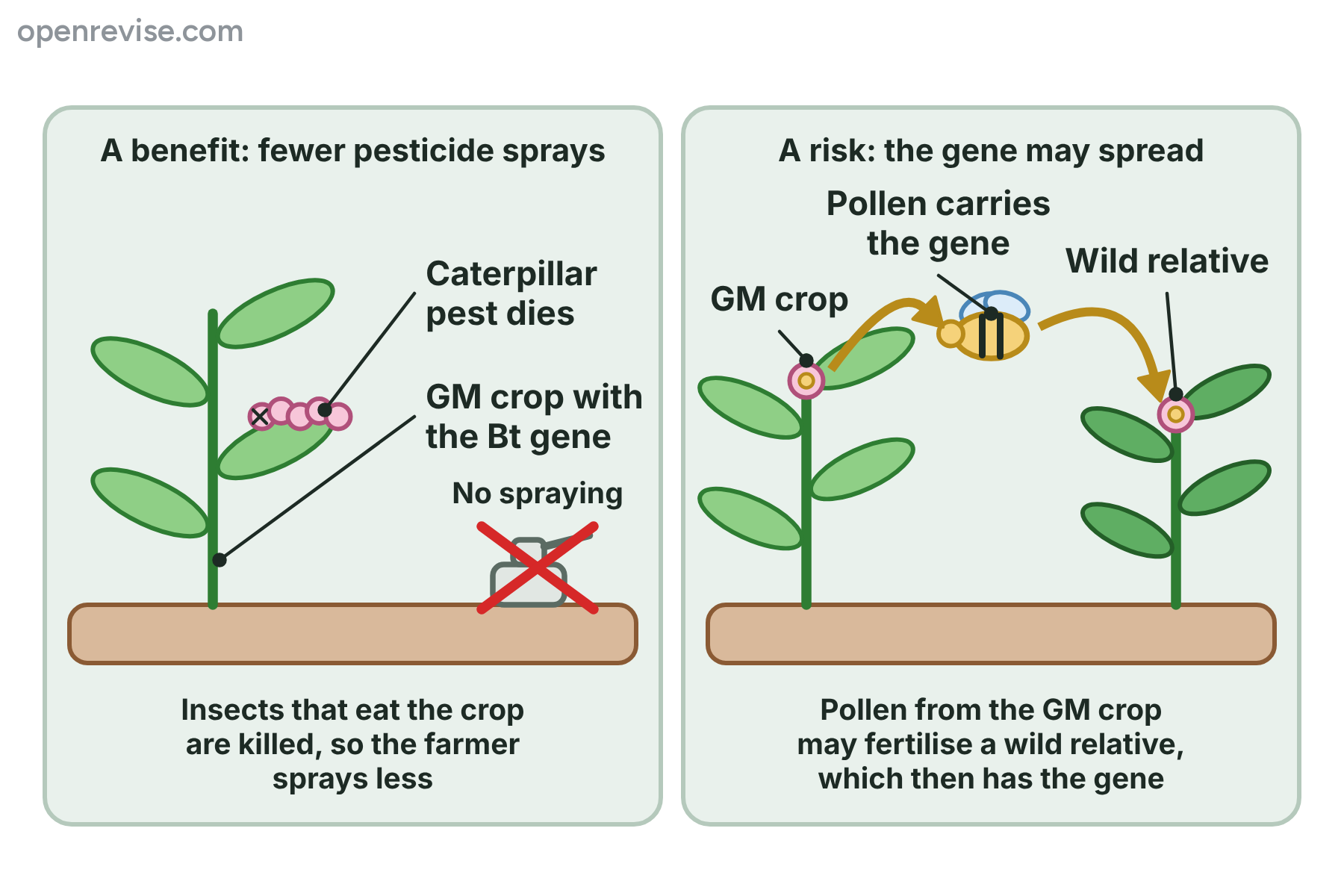
Show answerHide answer
Model answer
Pollen from the GM crop is carried by a bee to a wild relative of the crop. The gene may spread into the wild plant, which could then have the new characteristic, such as resistance to a herbicide.
Mark scheme
- Pollen carried from the GM crop to a wild relative — 1 mark
- The gene may spread to the wild plants, with a possible harm — 1 mark
-
3 Explain [3 marks]
A farmer grows Bt maize for many years. Explain why the insect pests may become resistant to the Bt protein.
Show answerHide answer
Model answer
Some of the insects have a variation that makes them resistant to the Bt protein. These insects survive when they eat the maize, and they reproduce. They pass on the resistance to their offspring, so the proportion of resistant insects increases, and the Bt protein no longer controls the pest.
Mark scheme
- Some insects are resistant (variation) — 1 mark
- They survive, reproduce and pass on the resistance — 1 mark
- The proportion of resistant insects increases over time — 1 mark
-
4 Calculate [3 marks]
Source: In a trial, 20 fields were planted with a GM maize that is resistant to a herbicide and 20 fields with non-GM maize. The mean yield of the GM maize was 10.4 tonnes per hectare. The mean yield of the non-GM maize was 8.0 tonnes per hectare. Calculate the percentage increase in the mean yield of the GM maize compared with the non-GM maize.
Show answerHide answer
Model answer
Increase = 10.4 - 8.0 = 2.4 tonnes per hectare. Percentage increase = \(\frac{2.4}{8.0} \times 100 = 30\%\).
Mark scheme
- \(10.4 - 8.0 = 2.4\) — 1 mark
- \(2.4 \div 8.0 \times 100\) — 1 mark
- 30% — 1 mark
-
5 Explain [3 marks]
Farmers can use herbicide to kill the weeds in a field of herbicide-resistant GM soya without killing the soya. Explain one benefit of this and one problem that it could cause.
Show answerHide answer
Model answer
The weeds are killed and no longer compete with the soya for light, water and minerals, so the yield is higher (benefit). However, if the same herbicide is used year after year, weeds that are resistant to it survive and reproduce, so the resistance becomes common, and the herbicide stops working (problem).
Mark scheme
- Benefit: weeds are killed, so there is less competition and a higher yield — 1 mark
- Problem: weeds with resistance survive and reproduce — 1 mark
- The resistant weeds become common, so the herbicide stops working — 1 mark
-
6 Explain [4 marks]
Some people object to the use of genetic engineering in agriculture. Explain one practical consideration and one ethical consideration that people may raise.
Show answerHide answer
Model answer
A practical consideration is that the gene could spread by pollen to wild relatives, and so produce plants that are hard to control. This is about what could happen in the environment. An ethical consideration is whether it is right to alter the genome of an organism, or move genes between species, because some people think that it is unnatural. This is about right and wrong, instead of what will happen.
Mark scheme
- A practical consideration, such as gene flow, harm to other organisms or cost — 1 mark
- Explanation of why this matters — 1 mark
- An ethical consideration, such as the right to alter genes, ownership by companies or consumer choice — 1 mark
- Explanation of why people think it is a concern — 1 mark
-
7 Explain [3 marks]
Explain why growing one GM variety of a crop over a very large area could be a risk.
Show answerHide answer
Model answer
All of the plants have the same genes, so there is little variation. If a new pest or disease appears, and the variety has no resistance to it, then all of the plants could be damaged. Much of the crop could be lost, and food supplies would be threatened.
Mark scheme
- Little genetic variation, because all the plants are alike — 1 mark
- A new disease or pest could infect all of them — 1 mark
- A large part of the crop could be lost — 1 mark
-
8 Evaluate [6 marks]
The world needs to produce more food. Evaluate the use of genetically modified crops to help to feed the growing human population.
Show answerHide answer
Model answer
GM crops could help to feed more people because they can be given resistance to pests and diseases, so less of the crop is lost and the yield is higher. Some are engineered to tolerate drought or to contain extra vitamins, so food can be grown on poor land and may be more nutritious. Crops that make their own insecticide mean that farmers spray less, which saves money and reduces damage to wildlife. However, there are risks. The gene could spread by pollen to wild plants, and pests and weeds can become resistant, so the benefit may not last. A protein that kills pests may harm harmless insects, and seed is more expensive and sometimes patented, so poor farmers may not benefit. Some people also object to changing the genes of organisms, and the long-term effects on health are still being studied. Overall, GM crops can be a useful way of helping to improve yields, so long as they are carefully tested, regulated and monitored, and used alongside other approaches.
Mark scheme
- Level 3 (5 to 6 marks): several benefits and several risks are explained and linked to evidence or to people, and a supported conclusion is reached — A balanced evaluation with a clear judgement
- Level 2 (3 to 4 marks): benefits and risks are described, but explanation is limited, or the answer is unbalanced — Some reasoning, but no supported conclusion
- Level 1 (1 to 2 marks): a few simple statements about GM crops — Points made without explanation
- Possible points: higher yield; less pesticide; nutrition; drought tolerance; gene flow; non-target harm; resistance; cost and patents; ethics; uncertainty — Content that can earn credit at any level
Quick check
-
1
Which of these is a possible benefit of a GM crop?
Show answerHide answer
B: Less pesticide needs to be sprayed
A crop that resists pests needs fewer sprays, which also reduces damage to wildlife and saves money.
-
2
What is gene flow?
Show answerHide answer
C: Genes spreading to other plants by pollen
Gene flow is the spread of genes between populations, for example by pollen from a GM crop to wild plants.
-
3
Which of these is an ethical consideration about GM crops?
Show answerHide answer
A: Whether it is right to alter the genome of a living organism
Whether it is right to change the genes of living things is a question of right and wrong.
-
4
Why do some people want GM foods to be labelled?
Show answerHide answer
D: So that people can choose what to buy
Labelling lets consumers know what they are eating, so that they can choose non-GM food if they prefer.
-
5
What is a superweed?
Show answerHide answer
B: A weed that is resistant to a herbicide
A superweed has become resistant to a herbicide because the herbicide has been used repeatedly.
-
6
Which is a possible risk of a protein that kills pests in a GM crop?
Show answerHide answer
C: It could harm other insects that are not pests
The protein could harm harmless insects that eat the crop or its pollen.
-
7
The yield of a GM crop is 6.0 tonnes per hectare and a non-GM crop gives 5.0. What is the percentage increase?
Show answerHide answer
A: 20%
The increase is 1.0, and 1.0 divided by 5.0, multiplied by 100, is 20%.
-
8
Why can planting one GM variety over a huge area be a risk?
Show answerHide answer
D: A new disease could damage all of the plants
There is little genetic variation, so a new disease could damage the whole crop.
Biotechnology and Food Production
Just this lesson-
1 Name [1 mark]
Name the fungus that is grown in fermenters to make mycoprotein.
Show answerHide answer
Model answer
Fusarium (Fusarium venenatum).
Mark scheme
- Fusarium — 1 mark
-
2 Name [3 marks]
The diagram shows a fermenter that is used to make mycoprotein. Name the parts labelled A, B and C.
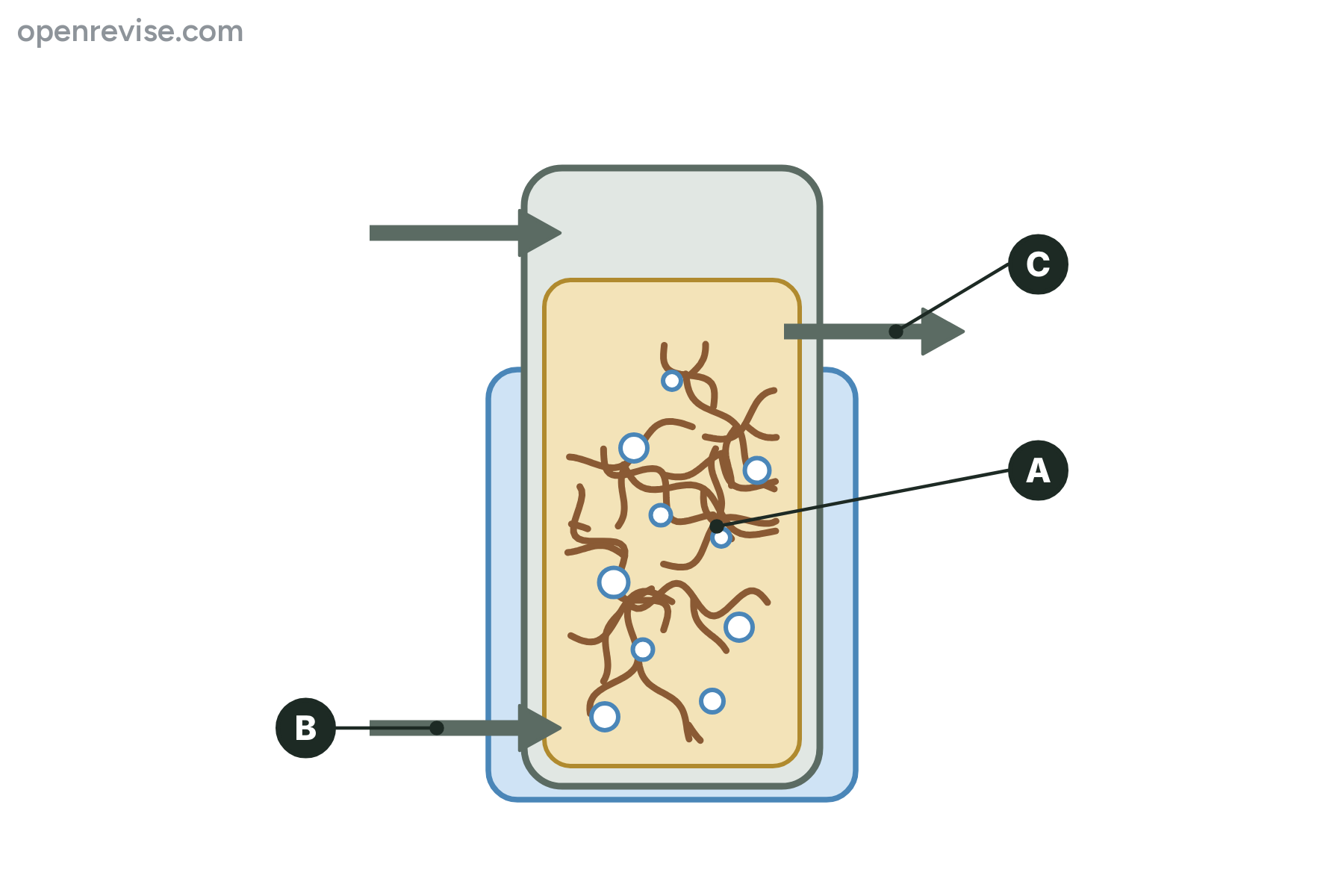
Show answerHide answer
Model answer
A is the fungus (Fusarium). B is the (sterile) air inlet. C is the outlet through which the mycoprotein is harvested.
Mark scheme
- A: fungus (Fusarium) — 1 mark
- B: sterile air (oxygen) inlet — 1 mark
- C: outlet (harvesting the mycoprotein) — 1 mark
-
3 Explain [3 marks]
Sterile air is bubbled through the fermenter, and the fermenter has a cooling jacket. Explain why.
Show answerHide answer
Model answer
The air supplies oxygen that the fungus needs for aerobic respiration, to release energy for growth, and it mixes the contents. Respiration releases heat, so the fermenter has to be cooled to keep it at the optimum temperature. If it were too hot, the enzymes of the fungus would be damaged and the fungus would grow slowly or die.
Mark scheme
- Air supplies oxygen for respiration — 1 mark
- Respiration releases heat, so cooling is needed — 1 mark
- To keep the temperature at the optimum, so that the enzymes work and the fungus grows well — 1 mark
-
4 Describe [3 marks]
Describe how golden rice could help to reduce vitamin A deficiency.
Show answerHide answer
Model answer
Golden rice has been genetically engineered with genes that make the grains produce beta-carotene. When people eat it, the body turns the beta-carotene into vitamin A. People who eat mainly rice, which normally has no beta-carotene, can then get vitamin A.
Mark scheme
- Genes have been added by genetic engineering — 1 mark
- The grains make beta-carotene, which the body turns into vitamin A — 1 mark
- It gives vitamin A to people whose diet is mainly rice — 1 mark
-
5 Calculate [3 marks]
Source: A fermenter is fed with 450 kg of glucose in one day. It produces 135 kg of mycoprotein in that day. Calculate the percentage of the mass of the glucose that is converted to mycoprotein, and calculate the mass of glucose needed to make 1 kg of mycoprotein.
Show answerHide answer
Model answer
\(\frac{135}{450} \times 100 = 30\%\). The mass of glucose needed per kilogram of mycoprotein is \(450 \div 135 = 3.3\) kg (to 2 significant figures).
Mark scheme
- \(135 \div 450 \times 100\) — 1 mark
- 30% — 1 mark
- \(450 \div 135 = 3.3\) kg of glucose — 1 mark
-
6 Explain [4 marks]
Explain two advantages of using mycoprotein, instead of beef, as a source of protein for a growing human population.
Show answerHide answer
Model answer
Fungi grow very quickly and can double their mass in a few hours, so a lot of protein is produced in a small space, but beef animals take years to grow and need a lot of land. Mycoprotein is made without the loss of energy that happens at each stage of the food chain when plants are fed to cattle, so less land and fewer crops are needed to make the same amount of protein. Mycoprotein is also low in fat and high in fibre, which is healthier than a diet high in fat.
Mark scheme
- The fungus grows quickly, so protein is produced quickly in a small space — 1 mark
- Explanation: a high yield of protein compared with the time and land needed for beef — 1 mark
- A second advantage, such as less land or fewer crops needed, because energy is not lost in a food chain — 1 mark
- Explanation or another advantage, such as low fat and high fibre — 1 mark
-
7 Discuss [4 marks]
A company breeds GM salmon that grow to market size in half the usual time. Discuss one benefit and two concerns about the use of GM livestock.
Show answerHide answer
Model answer
A benefit is that the fish grow faster, so they need less time and less feed to reach market size, and more food is produced. One concern is that the GM fish may have health problems or suffer, which is an animal welfare problem. Another concern is that if they escape from their tanks, they could breed with wild salmon and spread the gene, which would damage the wild population and the ecosystem.
Mark scheme
- Benefit: faster growth, so less feed and time needed — 1 mark
- Benefit explained, such as more food produced from the same resources — 1 mark
- Concern 1, with an explanation, such as animal welfare — 1 mark
- Concern 2, with an explanation, such as escape and breeding with wild fish — 1 mark
-
8 Evaluate [6 marks]
Evaluate biotechnological solutions, such as mycoprotein, golden rice and GM livestock, to the demands of a growing human population.
Show answerHide answer
Model answer
Mycoprotein makes a high protein, low fat food from a fungus grown in fermenters. It needs much less land than cattle, so it could supply more protein to a growing population. However, the fermenters are expensive to run, they need energy and sterile conditions, and a few people are allergic to it. Golden rice makes beta-carotene, which the body turns into vitamin A, and so could reduce blindness and illness in areas where rice is the main food. But some people object to GM crops on ethical or environmental grounds, and it supplies only one nutrient, so a varied diet may be a better solution. GM livestock, such as fast-growing fish, produce more food from less feed, but there are concerns about animal welfare, escape and breeding with wild populations. Overall, these solutions can help, particularly mycoprotein, which does not rely on gene technology, and they will be most useful if they are carefully regulated and used with other approaches, such as more sustainable farming.
Mark scheme
- Level 3 (5 to 6 marks): at least two solutions evaluated with benefits and concerns, linked to food supply, and a supported conclusion — A balanced judgement based on explained points
- Level 2 (3 to 4 marks): benefits and concerns for one or two solutions, with some explanation, but limited balance or no conclusion — Points explained in part
- Level 1 (1 to 2 marks): simple statements about one or two solutions — A list of ideas with little explanation
- Possible points: less land; protein; fermenter cost; allergies; vitamin A; ethics; animal welfare; escape; cost — Content that can earn credit at any level
Quick check
-
1
Which organism is grown to make mycoprotein?
Show answerHide answer
B: Fusarium
Mycoprotein is made from the fungus Fusarium.
-
2
Why is a nitrogen source added to the mycoprotein fermenter?
Show answerHide answer
D: To allow the fungus to make proteins
The fungus needs nitrogen to make amino acids and so proteins.
-
3
Why is the fermenter cooled?
Show answerHide answer
A: Respiration releases heat that would raise the temperature
Respiration by the fungus releases heat, and the temperature has to stay near the optimum for growth.
-
4
What do hyphae make up?
Show answerHide answer
C: The body of a fungus
Hyphae are the thin threads that make up the body of a fungus, and they are what is harvested as mycoprotein.
-
5
What does the body make from the beta-carotene in golden rice?
Show answerHide answer
B: Vitamin A
The body turns beta-carotene into vitamin A.
-
6
What is one use of GM goats?
Show answerHide answer
C: To make a human protein in their milk
Goats have been given the human gene for antithrombin, so that they make this medicine in their milk.
-
7
A fermenter converts 200 kg of glucose into 50 kg of mycoprotein. What percentage of the glucose mass is converted?
Show answerHide answer
A: 25%
50 divided by 200 is 0.25, which is 25%.
-
8
What is a possible concern about GM fish that escape into the wild?
Show answerHide answer
D: They could breed with wild fish and spread the gene
They could breed with wild fish and spread the new gene, which may harm the wild population.