Flashcards · Biology
Monitoring and Maintaining the Environment
-
What is abundance?
The number of individuals of a species in an area.
-
What is distribution?
Where in a habitat a species is found.
-
Why do ecologists take samples?
Counting every organism is impossible and may damage the habitat.
-
What is a quadrat?
A square frame that marks off a known area for counting.
-
Why are quadrats placed at random?
To avoid bias, so that the sample is representative of the area.
-
How are random positions chosen?
With a random number generator or random number tables, giving coordinates on a grid.
-
When do you use percentage cover instead of counting?
For plants that cannot be counted as individuals, such as grass or moss.
-
What is a transect?
A line laid across a habitat, along which samples are taken.
-
When is a transect used?
When there is a gradient in the environment, to show how the distribution of organisms changes.
-
Name two abiotic factors that could be measured along a transect.
Any two of light intensity, soil moisture, pH and temperature.
-
What is a pooter used for?
Collecting small insects by sucking them into a jar without harming them.
-
What does a pitfall trap catch?
Small animals that walk on the ground, such as beetles.
-
What is an identification key?
A set of paired statements that leads to the name of an organism.
-
How do you calculate a mean?
Add up the values and divide by the number of values.
-
Why use at least 10 quadrats?
The more quadrats there are, the less an unusual result affects the mean.
-
What is the 50th percentile?
The median, the value below which half of the results fall.
-
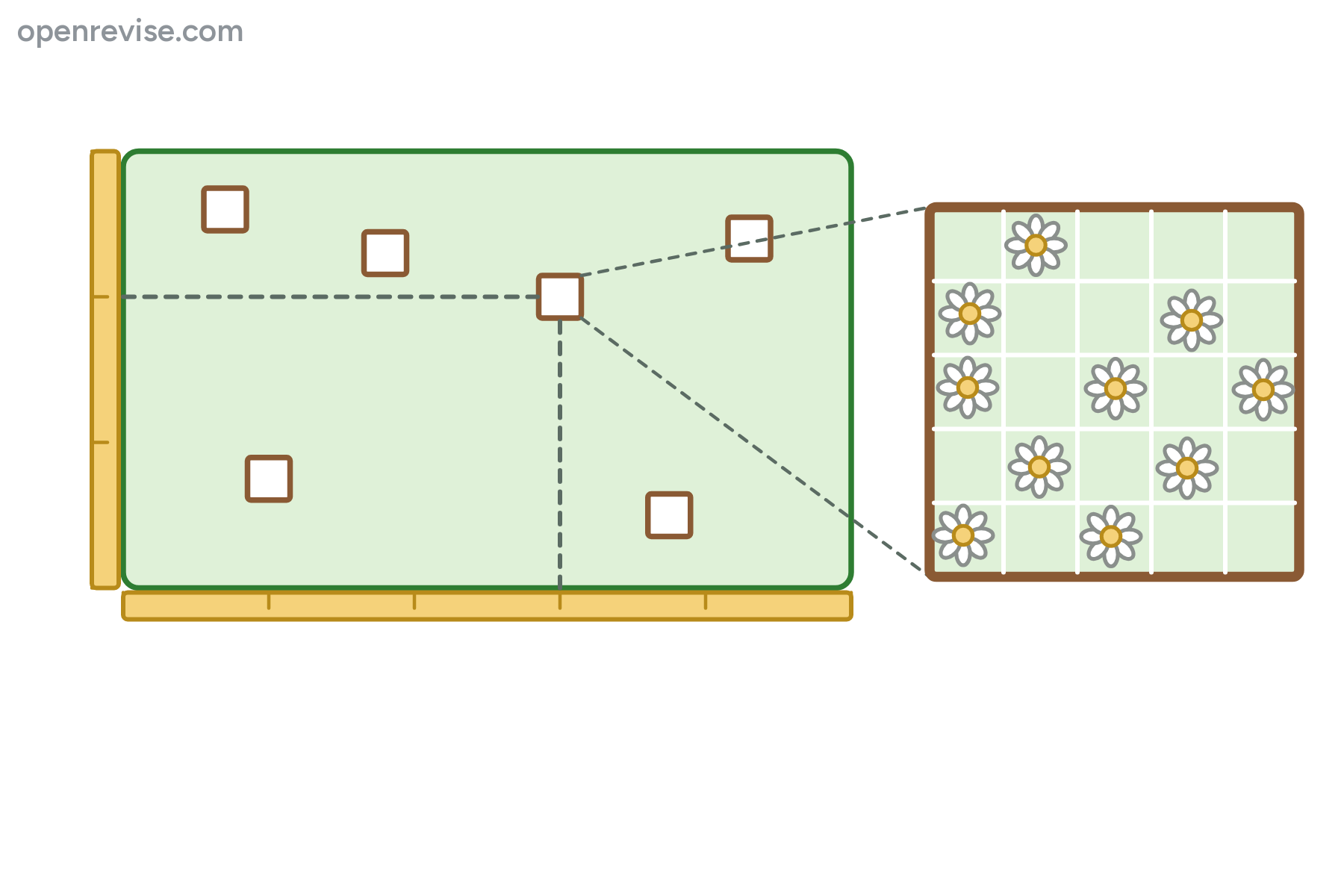 Describe how this method is used to sample the abundance of a plant in a field.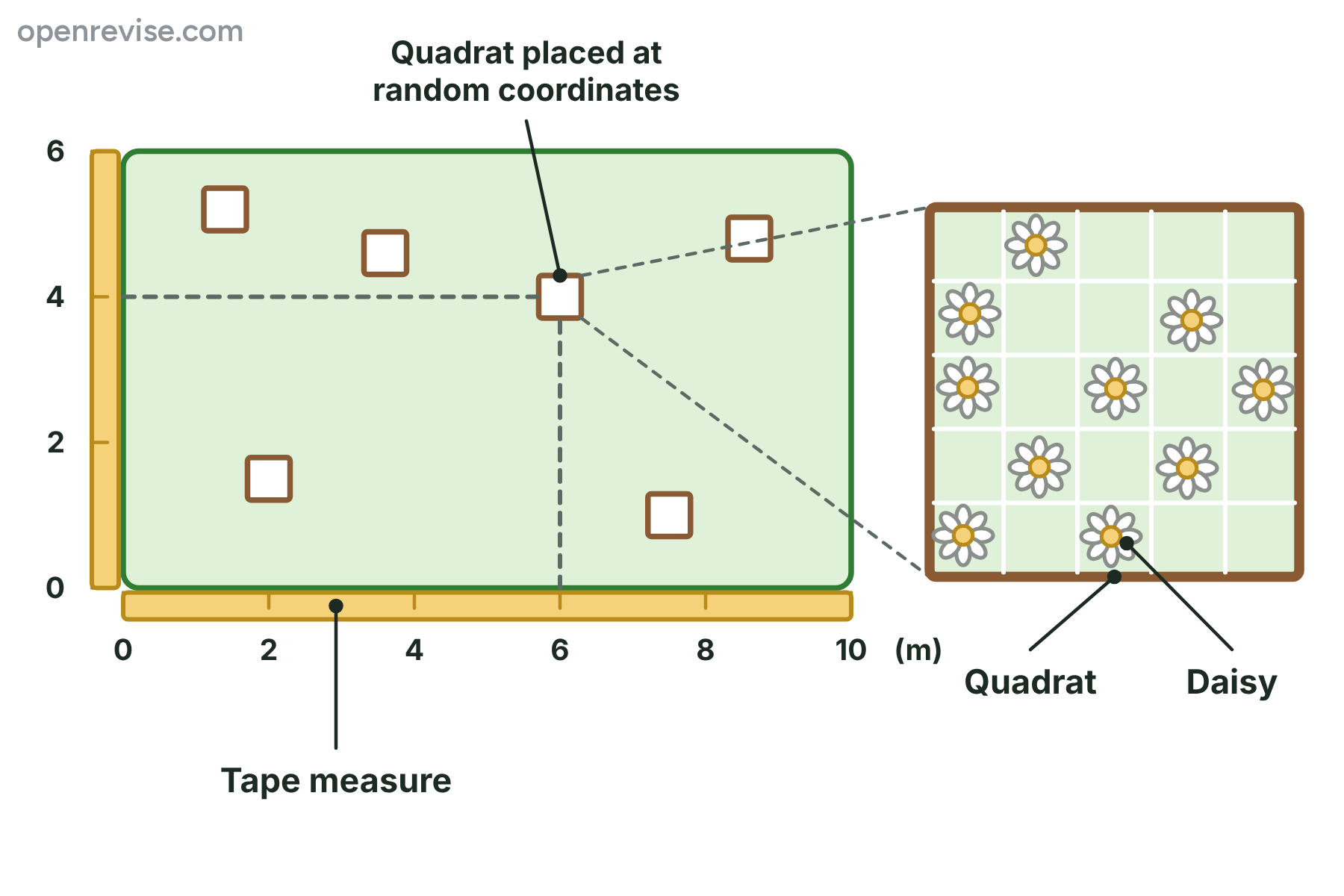
Lay tape measures along two sides to make a grid. Use random numbers as coordinates, place a quadrat at each, count the daisies in it and repeat at least 10 times. Then calculate the mean.
-
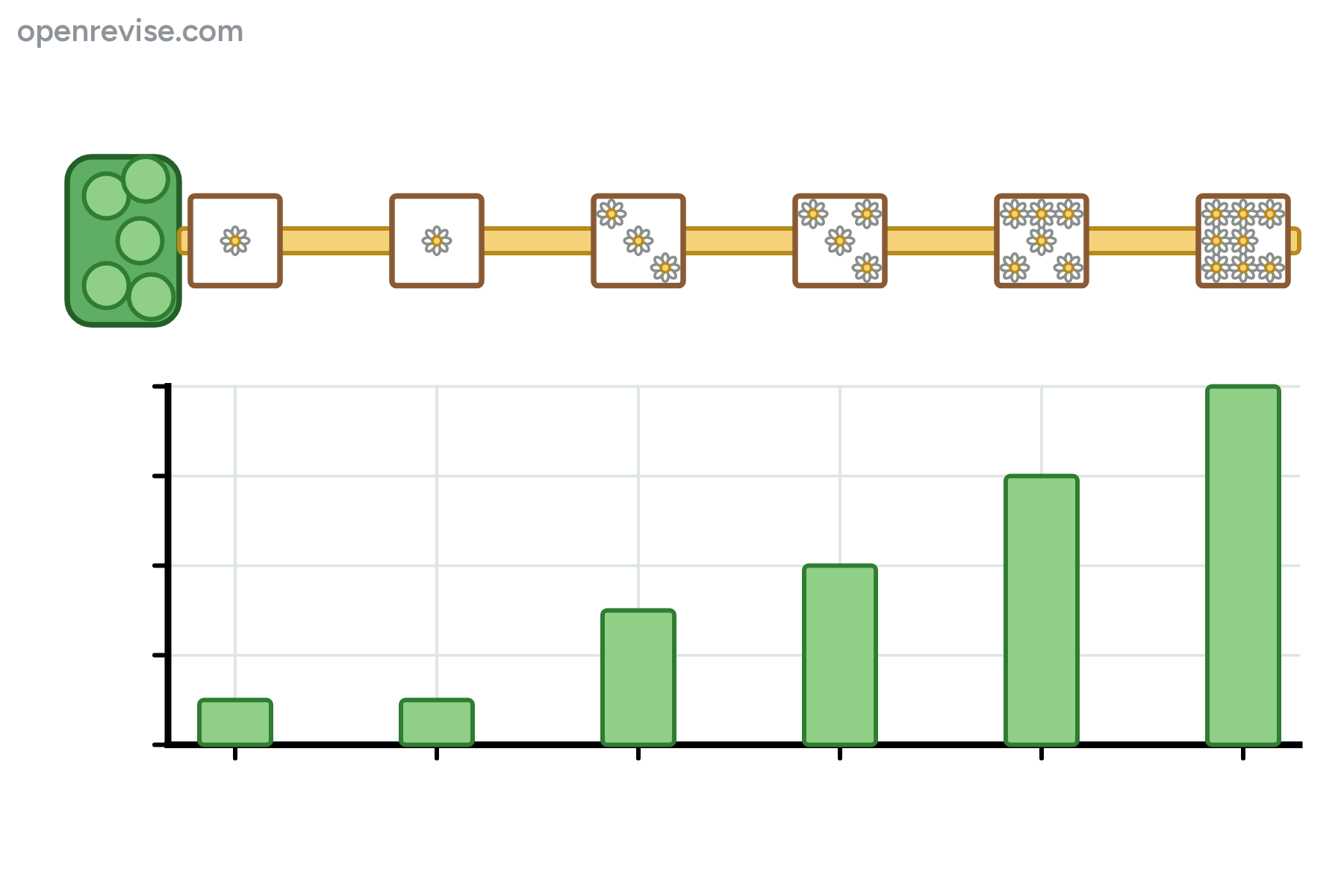 What does this transect show about the distribution of the daisies?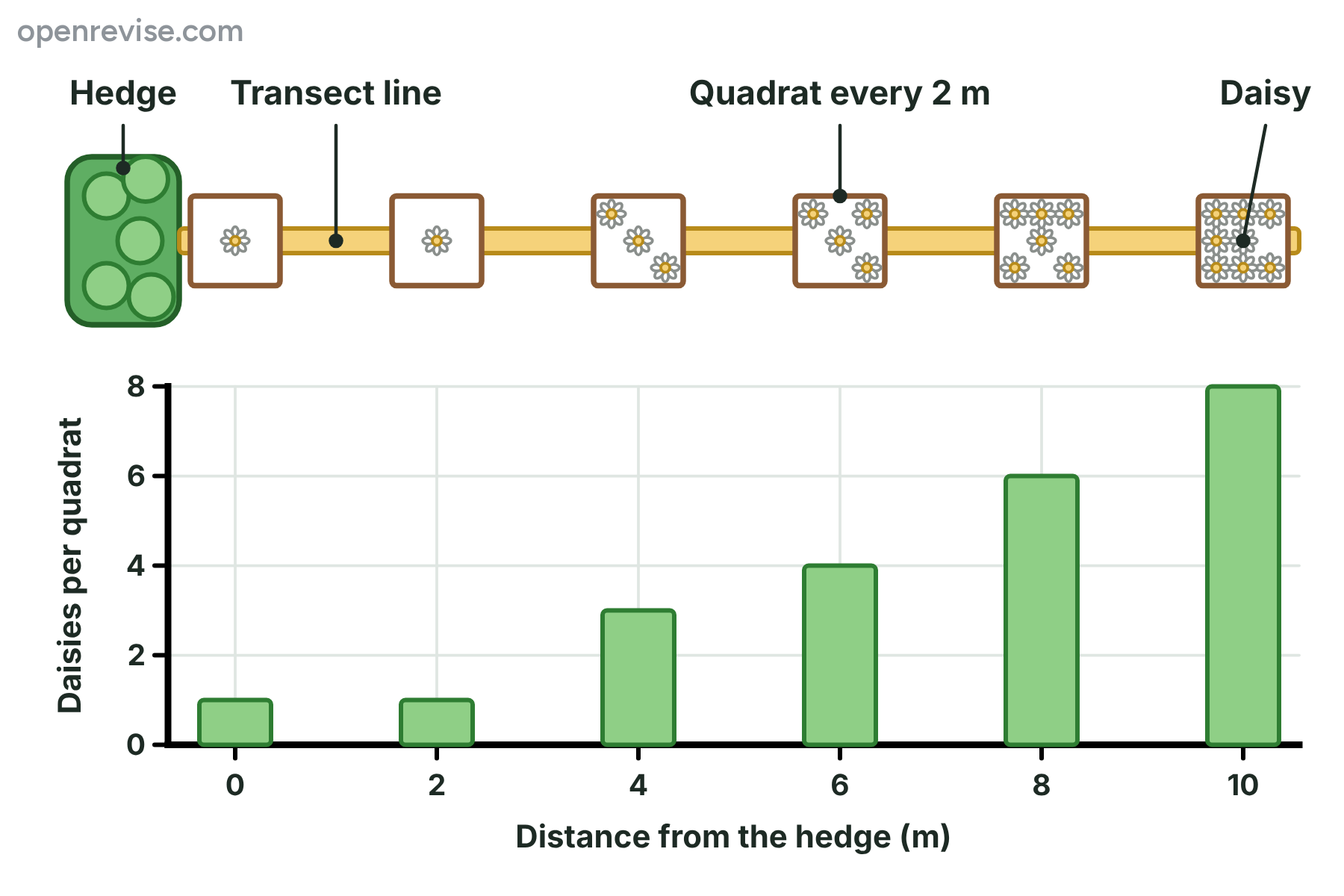
The number of daisies rises with distance from the hedge, from 1 per quadrat next to it to 8 at 10 m. This could be because there is more light and water away from the hedge.
-
What do you multiply the mean per quadrat by to scale up?
The number of quadrats that would fit in the whole area.
-
How do you find how many quadrats fit in the area?
Total area divided by the area of one quadrat.
-
What is the area of a 0.5 m by 0.5 m quadrat?
0.25 square metres.
-
A mean of 4 per 0.25 m squared quadrat: how many per square metre?
16.
-
When is capture-recapture used?
To estimate the population of animals that move about.
-
What happens to the animals in the first sample?
They are counted, marked and released.
-
Why wait before the second sample?
So the marked animals can mix with the rest of the population.
-
What is counted in the second sample?
The total number caught, and how many of them are marked.
-
State the capture-recapture equation.
Population = (first sample × second sample) ÷ number of marked animals in the second sample.
-
Give a harmless way to mark a snail.
A small dot of non-toxic paint on the shell.
-
Name two assumptions of capture-recapture.
No births, deaths or movements between samples, and the marks stay on and are harmless (any two).
-
What is the effect if marks rub off?
Fewer marked animals are found, so the population is overestimated.
-
Why do small samples give less reliable estimates?
A small change in the number counted has a big effect on the estimate.
-
Why does a patchy habitat cause errors with quadrats?
The quadrats may land on more patches or fewer patches than average.
-
How can the estimate be made more reliable?
Use larger samples or more quadrats, and repeat and take the mean.
-
Why do fisheries use capture-recapture?
To estimate fish numbers so that they can set sustainable catches.
-
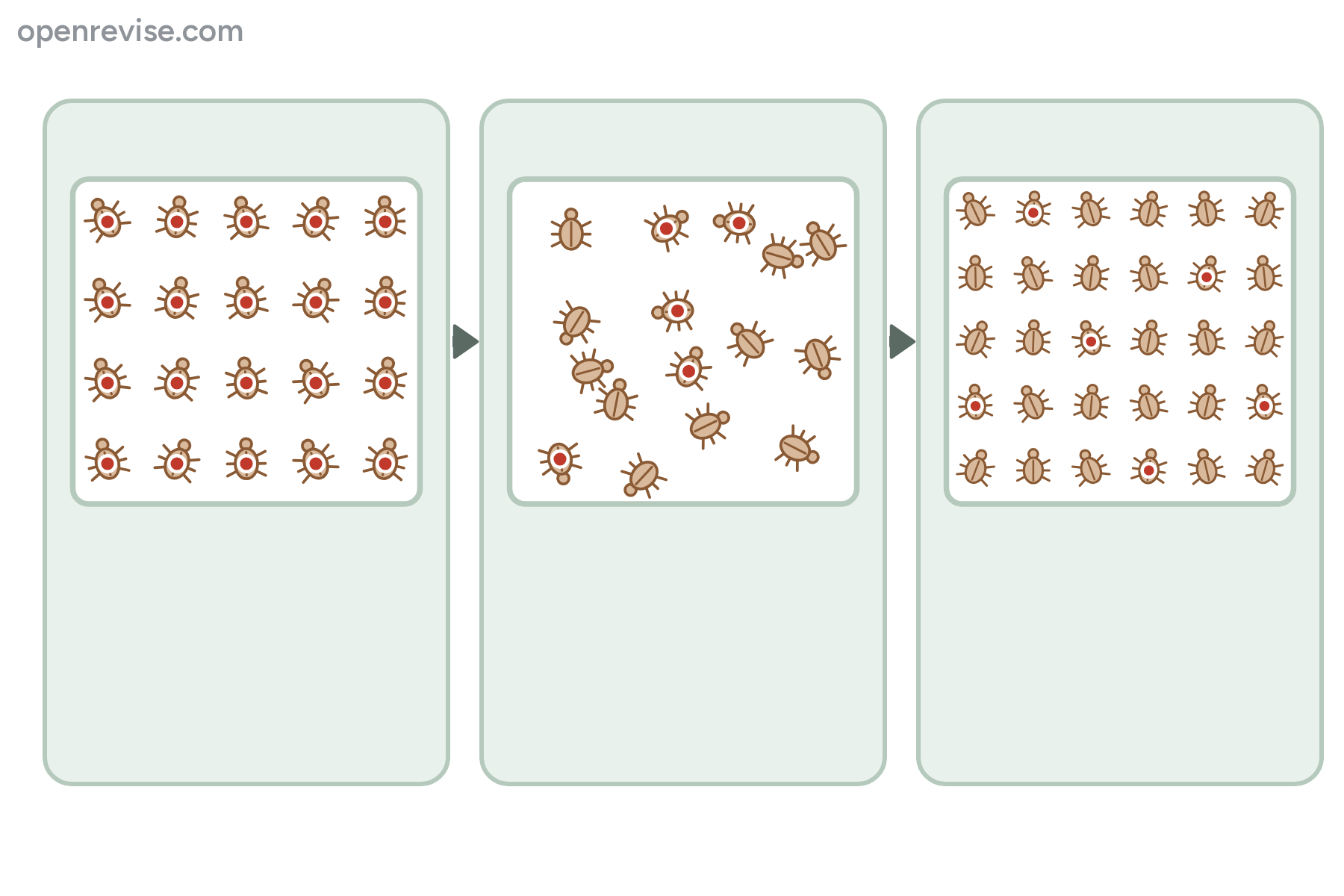 Describe what is done at each of steps 1, 2 and 3, and how the population size is found.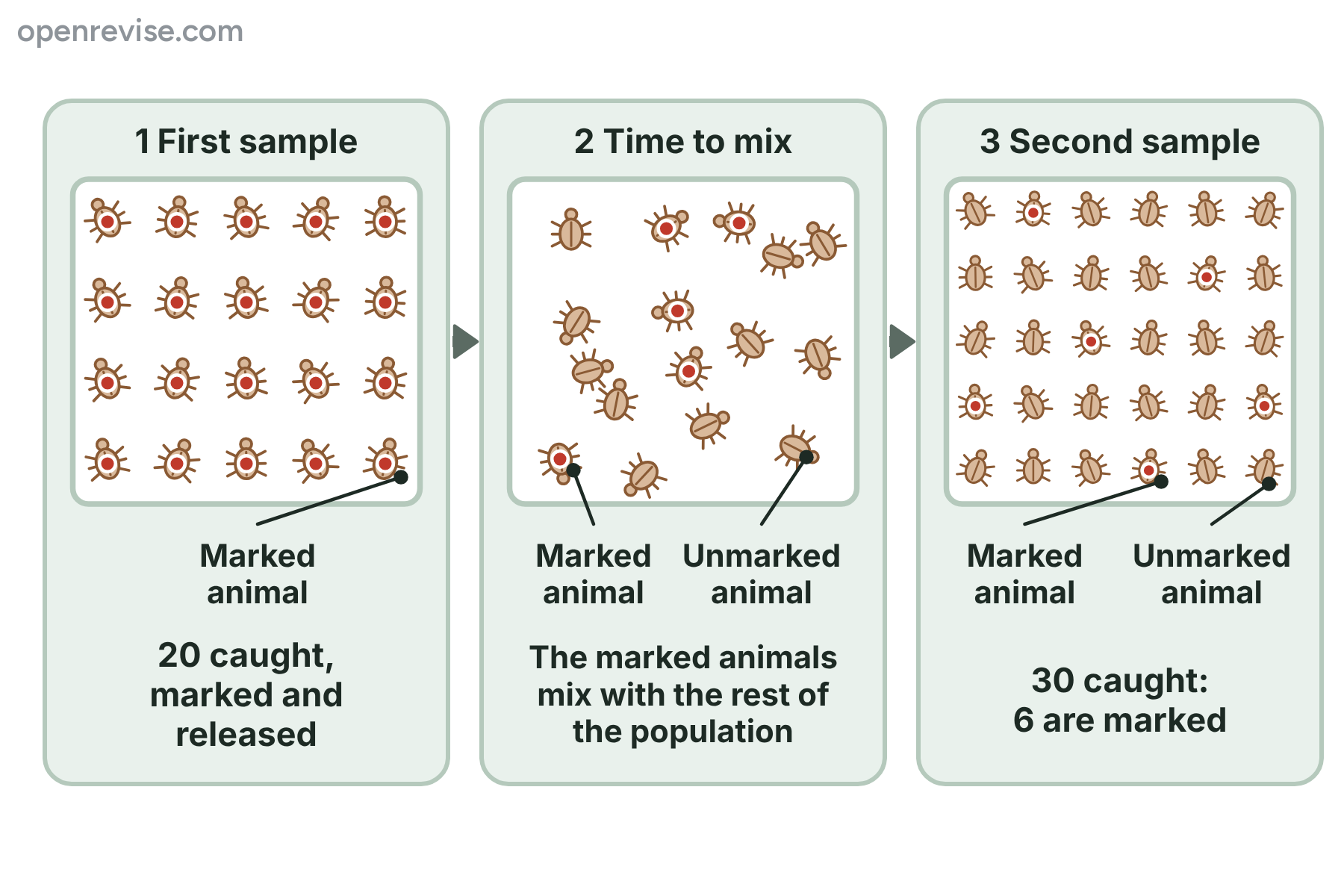
1 Catch 20 animals, mark them and release them. 2 Wait for them to mix with the population. 3 Catch another sample, of 30, and count those that are marked, which is 6. Population = 20 × 30 ÷ 6 = 100.
-
What is biodiversity?
The variety of living organisms in a habitat, or on Earth.
-
Name three ways in which land is used that destroy habitats.
Building, farming, quarrying and draining wetlands (any three).
-
What is deforestation?
The clearing of large areas of forest.
-
Why does deforestation reduce biodiversity?
The habitats and food of many species are destroyed.
-
Why are tropical rainforests important for biodiversity?
They hold more than half of all species, though they cover a small part of the land.
-
Give an example of a species that was driven to extinction by hunting.
The passenger pigeon.
-
What is overfishing?
Catching fish faster than they can breed.
-
What causes eutrophication?
Fertiliser or sewage running into water, which supplies extra nutrients.
-
Why do the plants in a pond die in an algal bloom?
The algae block the light, so they cannot photosynthesise.
-
Why do fish die in eutrophication?
Bacteria that decompose the dead plants use up the oxygen in the water.
-
What is an introduced species?
A species brought by humans to a place where it did not live before.
-
How did the grey squirrel harm the red squirrel?
It competes for food and carries a disease that kills red squirrels.
-
Name two methods of conservation.
Nature reserves, captive breeding, habitat restoration, laws (any two).
-
What does captive breeding aim to do?
Breed rare animals so they can be released into the wild.
-
What does CITES do?
It bans international trade in endangered species.
-
Why does losing one species affect others?
Species are interdependent, for example as food or shelter.
-
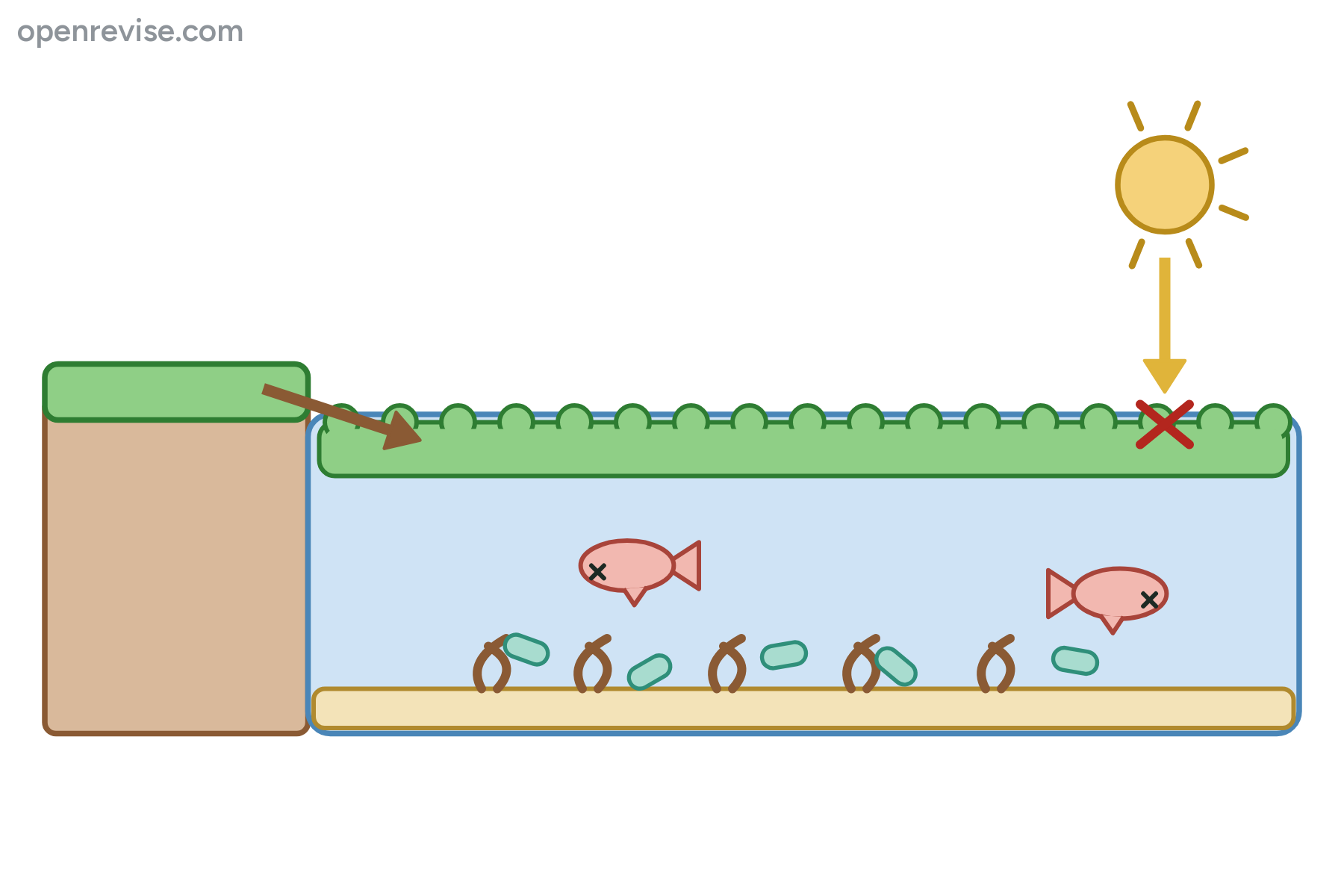 Describe how fertiliser from a field can lead to the death of fish in a pond.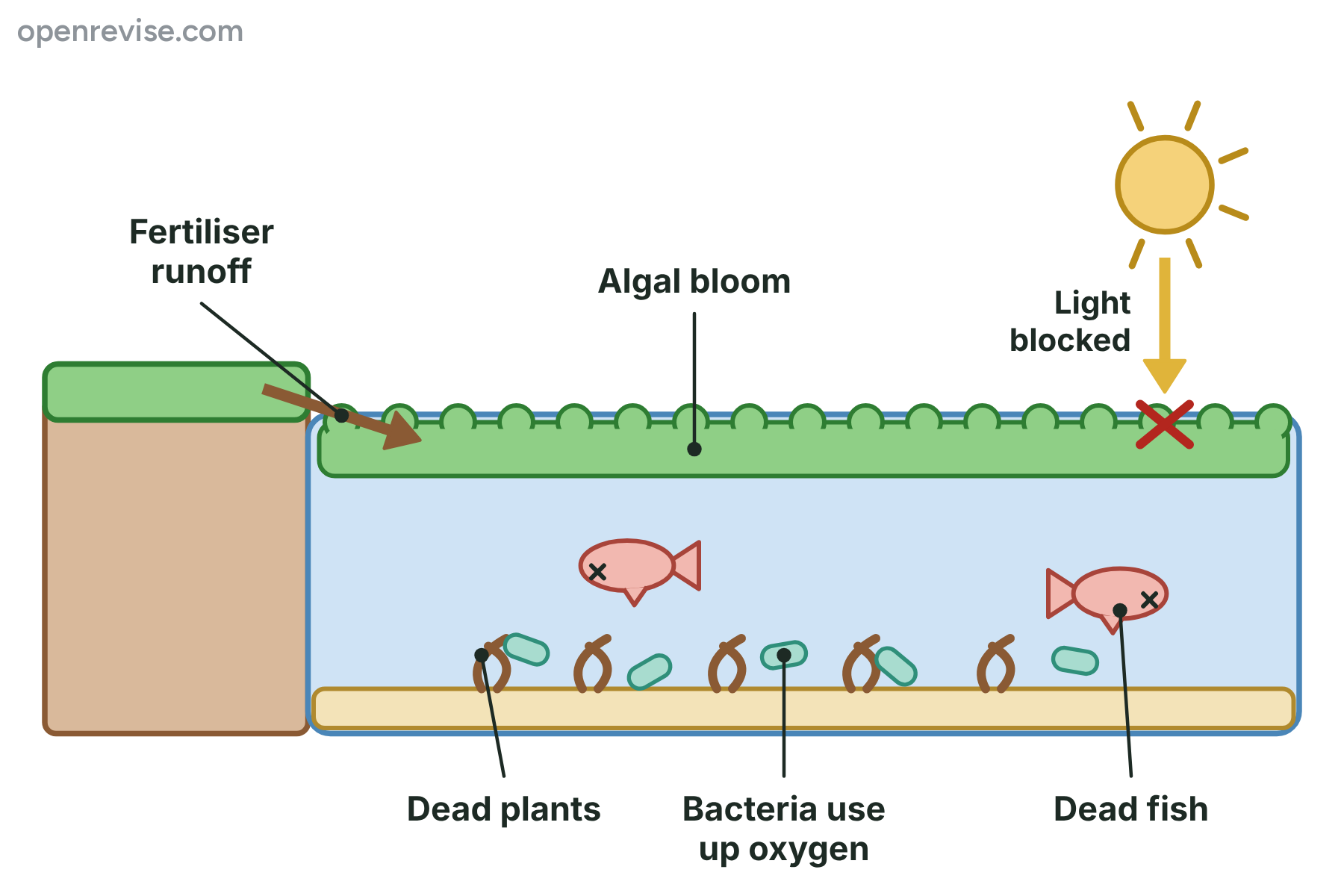
Fertiliser runs into the pond and the algae grow fast. They block the light, so the plants die. Bacteria decompose the dead plants and use up the oxygen, so the fish suffocate.