Viewing as
Teaching this? The teacher view adds 2 files, the mark schemes and the model answers.
History · Crime and punishment in early modern England
The Gunpowder Plot, 1605
The Catholic plot to blow up James I and Parliament, why the plotters were punished so severely, and what it meant for Catholics afterwards.
Learning Objectives
- 1Explain why a group of Catholics plotted to kill James I in 1605.
- 2Describe how the plot was discovered and how the plotters were punished.
- 3Explain why the punishment was so severe, and what the consequences were for Catholics.
Setting the Scene
When James I became king in 1603, English Catholics hoped he would treat them better than Elizabeth had. He did not, and recusancy fines continued. A small group of Catholics led by Robert Catesby decided to kill the king, his government and Parliament in one explosion, and put a Catholic monarch on the throne.
- 1603 James I becomes king of England.
- 1604 The plotters rent a cellar beneath the House of Lords.
- 26 Oct 1605 Lord Monteagle receives an anonymous warning letter.
- 4-5 Nov 1605 Guy Fawkes is caught guarding 36 barrels of gunpowder.
- 8 Nov 1605 Catesby and Thomas Percy are killed at Holbeach House.
- Jan 1606 The surviving plotters are tried and executed.
How the Plot Unravelled
The plot failed before it could be carried out.
-
1
The plan
Blow up the House of Lords at the State Opening of Parliament on 5 November 1605, killing the king.
-
2
The warning
Lord Monteagle, a Catholic, received an anonymous letter telling him to stay away from Parliament.
-
3
The search
The cellars were searched late on 4 November, and Guy Fawkes was found with 36 barrels of gunpowder.
-
4
Interrogation
James I allowed Fawkes to be tortured in the Tower of London; he gave up the names of the other plotters.
-
5
Capture
The plotters fled to the Midlands; Catesby and Percy were killed at Holbeach House on 8 November.
The Monteagle Letter
The letter warned a Catholic lord to stay away - and when it was shown to the government, it led directly to the search that caught Guy Fawkes.
I would advise you, as you tender your life, to devise some excuse to shift your attendance at this parliament... they shall receive a terrible blow this parliament and yet they shall not see who hurts them.
The Conspirators
The plot involved thirteen conspirators. Robert Catesby was the leader; Guy Fawkes, an experienced soldier, was chosen to guard and light the gunpowder.
Key plotters
- Robert Catesby Leader of the plot; killed at Holbeach House.
- Guy Fawkes Caught with the gunpowder; tortured and executed.
- Thomas Percy Rented the cellar; killed at Holbeach House.
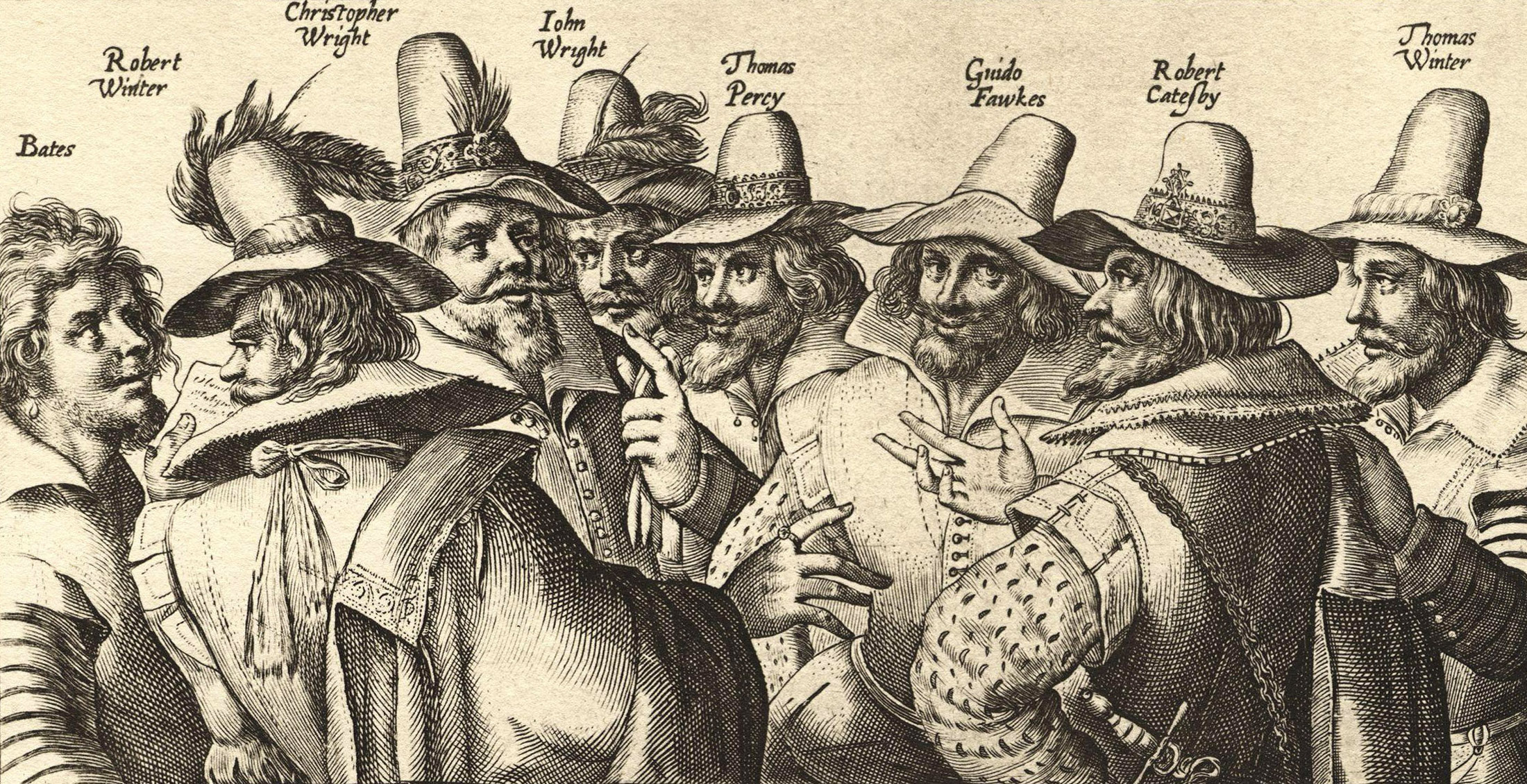
Eight of the thirteen conspirators, engraved in 1605.
Trial and Punishment
The punishment was designed to be seen.
-
The trial
The surviving plotters were tried in Westminster Hall on 27 January 1606 and all were found guilty of high treason.
-
The sentence
They were sentenced to be hanged, drawn and quartered - the traditional punishment for treason.
-
The executions
Four were executed in St Paul's Churchyard on 30 January and four, including Fawkes, at Westminster on 31 January 1606.
-
Display
Their heads were put on display in London as a warning to others.
Why Was the Punishment So Severe?
Several reasons combined.
-
Treason
Plotting to kill the monarch was the most serious crime of all, and hanging, drawing and quartering was its set punishment.
-
The scale
The plot aimed to kill the king, his family, the government and Parliament in one blow.
-
Deterrence
A public, brutal execution warned other Catholics not to try anything similar.
-
Royal authority
James wanted to show his power as a new king from Scotland.
Consequences for Catholics
The actions of a few were used to justify harsher treatment of all Catholics.
-
Popish Recusants Act
The Popish Recusants Act of 1606 made Catholics swear an oath of allegiance to the king and increased pressure on recusants.
-
Restrictions
Catholics were barred from professions such as the law, and from holding office.
-
Suspicion
Catholics were seen as potential traitors for the rest of the century.
-
Celebration
The Observance of 5th November Act (1606) ordered an annual day of thanksgiving for the king's survival.
Summary & Exam Focus
- Catholic plotters led by Catesby tried to blow up James I on 5 November 1605.
- The Monteagle letter led to the discovery of Guy Fawkes and the gunpowder.
- The plotters were hanged, drawn and quartered for high treason in January 1606.
- The plot led to harsher laws against Catholics, including the Popish Recusants Act.
Exam focus
Explain why the Gunpowder plotters were punished so severely. (12 marks) (12 marks)
Go beyond "it was treason" - explain why this treason was seen as so dangerous and what the government wanted the punishment to achieve.
Key terms
The vocabulary this lesson expects you to use. Each one is linked from the first place it appears above.
- Gunpowder Plot
- The 1605 Catholic plan to blow up James I and Parliament.
- High treason
- Plotting to harm or overthrow the monarch.
- Hanged, drawn and quartered
- The punishment for treason: hanged, cut open and cut into four.
- Monteagle letter
- The anonymous warning that led to the plot's discovery.
- Popish Recusants Act
- The 1606 law that increased restrictions on Catholics.
- Oath of allegiance
- A promise of loyalty to the king that Catholics had to swear.
Downloads
Free to keep, print and annotate.
- The Gunpowder Plot 1605.pptx Built from the lesson script on 23 September 2026. View
- The Gunpowder Plot 1605 - Completed Notes.docx The full notes for the lesson, every gap filled in - to check against, or to revise from. Built from the lesson script on 23 September 2026. View
- The Gunpowder Plot 1605 - Exam Questions.docx Built from the lesson script on 23 September 2026. View
Something here looks wrong?
Tell us what and we will go and look. It goes to whoever writes these pages, nobody else, and we do not ask who you are — so there is nothing to sign and nothing comes back to you.