Maths · Circle Theorems
Viewing as
Teacher view: every answer and mark scheme set out in full.
Same Segment and Cyclic Quadrilaterals
Using equal angles in the same segment and the opposite angles of a cyclic quadrilateral.
Learning Objectives
- 1Use the theorem that angles in the same segment are equal.
- 2Use the theorem that opposite angles of a cyclic quadrilateral add up to \(180^\circ\).
- 3Spot the right theorem from the shape of the diagram.
- 4Write clear reasons, and use algebra in angle problems.
Angles made by the same chord
The angle made by a chord at a point on the circumference does not change as the point moves around the same side of the chord, so all such angles are equal. Four points on a circle also make a cyclic quadrilateral, whose opposite angles add up to \(180^\circ\). These are the two theorems that deal with angles on the circumference. They are very common in questions that combine several theorems, so the first step in every question is to decide which theorem each angle belongs to.
Angles in the same segment
A chord splits a circle into two segments, and angles made by the chord in the same segment are equal.
-
The theorem
Angles in the same segment are equal.
-
Same chord
The two angles must be made from the same two end points of the chord, and both be on the same side of it.
-
Using it
If angle \(ACB = 38^\circ\), then angle \(ADB = 38^\circ\) for any other point \(D\) in the same segment.
-
The reason
"Angles in the same segment are equal."
The same segment
Both angles are made by the chord \(AB\) from points on the same side of it. So \(x = 40^\circ\), because angles in the same segment are equal.
Checking the diagram
- Same chord Both angles use the lines to \(A\) and to \(B\).
- Same side \(C\) and \(D\) are both above the chord.
- Different sides If the points are on opposite sides of the chord, the theorem for a cyclic quadrilateral applies instead.
- Equal The angles are equal, so you can copy the value across.
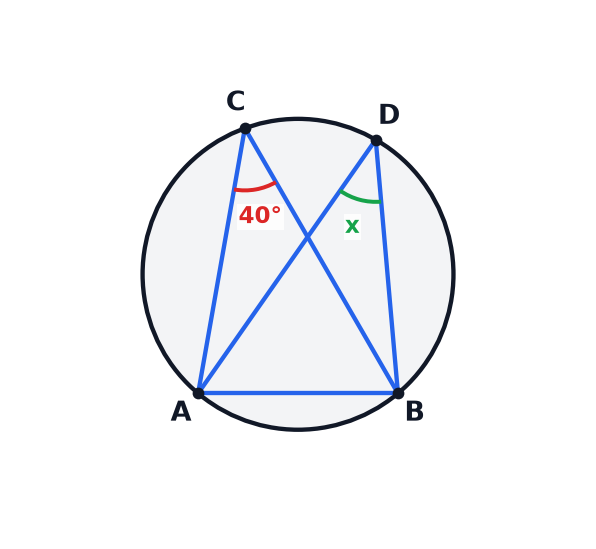
Same segment problem
\(A\), \(B\), \(C\) and \(D\) are points on a circle. Angle \(ACB = 38^\circ\) and angle \(CAD = 29^\circ\), and \(CD\) and \(AB\) meet at \(E\). Explain why angle \(ADB = 38^\circ\).
Show the solutionHide the solution
- 1 Identify the chord Both angles \(ACB\) and \(ADB\) are made by the chord \(AB\).
- 2 Same side \(C\) and \(D\) are on the same side of \(AB\).
- 3 Apply the theorem Angles in the same segment are equal, so \(ADB = ACB\).
- 4 Write it Angle \(ADB = 38^\circ\).
AnswerAngle \(ADB = 38^\circ\), because angles in the same segment are equal
Cyclic quadrilaterals
A cyclic quadrilateral has all four corners on a circle.
-
The theorem
Opposite angles of a cyclic quadrilateral add up to \(180^\circ\).
-
Using it
If angle \(ABC = 74^\circ\), then angle \(ADC = 180^\circ - 74^\circ = 106^\circ\).
-
The reason
"Opposite angles of a cyclic quadrilateral add up to \(180^\circ\)."
-
An exterior angle
An exterior angle of a cyclic quadrilateral equals the interior opposite angle.
A cyclic quadrilateral
The angle at \(D\) is opposite the angle at \(B\), so \(x = 180^\circ - 74^\circ = 106^\circ\). The angle at \(C\) is opposite the angle at \(A\), so \(y = 180^\circ - 95^\circ = 85^\circ\).
Opposite pairs
- Pair them up \(A\) with \(C\), and \(B\) with \(D\).
- Each pair The two angles add up to \(180^\circ\).
- Check the total The four angles of any quadrilateral add up to \(360^\circ\): \(74 + 106 + 95 + 85 = 360\).
- All on the circle All four corners must be on the circle.
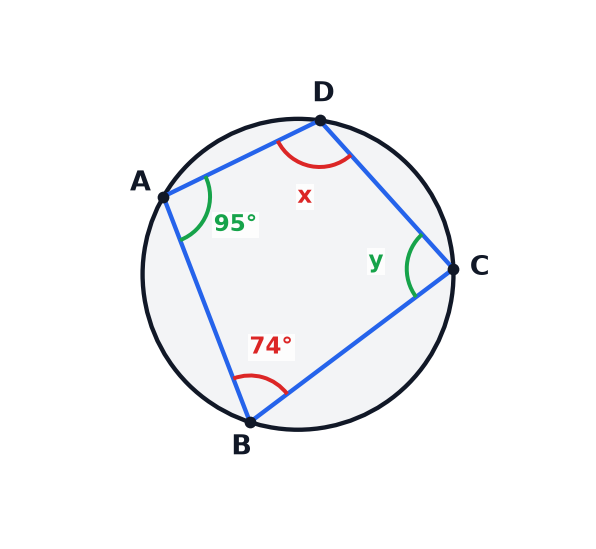
A cyclic quadrilateral with algebra
\(ABCD\) is a cyclic quadrilateral. Angle \(A = 2x + 10\) and angle \(C = 3x - 20\). Work out the value of \(x\) and the size of angle \(A\).
Show the solutionHide the solution
- 1 Opposite angles Angles \(A\) and \(C\) are opposite, so they add up to \(180^\circ\).
- 2 Equation \((2x + 10) + (3x - 20) = 180\), so \(5x - 10 = 180\).
- 3 Solve \(5x = 190\), so \(x = 38\).
- 4 Angle \(A\) \(2 \times 38 + 10 = 86^\circ\), and angle \(C = 3 \times 38 - 20 = 94^\circ\), and \(86 + 94 = 180\).
Answer\(x = 38\) and angle \(A = 86^\circ\)
Test yourself
-
1
What do angles in the same segment do?
Show answerHide answer
They are equal.
-
2
What do opposite angles of a cyclic quadrilateral add up to?
Show answerHide answer
\(180^\circ\).
-
3
What is a cyclic quadrilateral?
Show answerHide answer
A quadrilateral with all four corners on a circle.
-
4
How do you check that angles are in the same segment?
Show answerHide answer
They are made by the same chord, on the same side.
-
5
What is an exterior angle of a cyclic quadrilateral equal to?
Show answerHide answer
The interior opposite angle.
Exam technique: choosing a theorem
Decide which theorem applies before writing anything.
-
Look for four points
Four points on a circle make a cyclic quadrilateral.
-
Look for the same chord
Two angles on the same side of a chord are equal.
-
Write the reason in full
"Opposite angles of a cyclic quadrilateral add up to \(180^\circ\)."
-
Check with totals
The angles of a quadrilateral add up to \(360^\circ\).
Summary and exam focus
- Angles in the same segment are equal.
- Opposite angles of a cyclic quadrilateral add up to \(180^\circ\).
- Choose the theorem from the diagram, and give its exact reason.
- Use algebra when angles are given as expressions.
Exam focus
\(ABCD\) is a cyclic quadrilateral. Angle \(ABC = 74^\circ\). Work out angle \(ADC\), and give a reason. (2 marks) (2 marks)
\(ADC\) is opposite \(ABC\), so \(ADC = 180 - 74 = 106^\circ\). Write the reason in full: "Opposite angles of a cyclic quadrilateral add up to \(180^\circ\)."
Key terms
The words this lesson expects you to use. Each one is linked from the first place it appears above.
- Segment
- The part of a circle cut off by a chord.
- Same segment
- The same side of a chord.
- Cyclic quadrilateral
- A quadrilateral with all four corners on a circle.
- Opposite angles
- Angles in opposite corners of a quadrilateral.
- Exterior angle
- An angle between a side extended and the next side.
- Interior opposite angle
- The inside angle at the opposite corner.
- Supplementary
- Adding up to \(180^\circ\).
- Equation
- A statement that two expressions are equal.
- Reason
- A statement of the theorem that justifies an angle.
Questions and answers
15 questions set on this lesson, with the mark schemes and model answers open.
Not drawn accurately. \(A\), \(B\), \(C\) and \(D\) are points on the circumference of a circle. Angle \(ACB = 52^\circ\). Work out the size of angle \(ADB\). Give a reason for your answer. [2 marks]
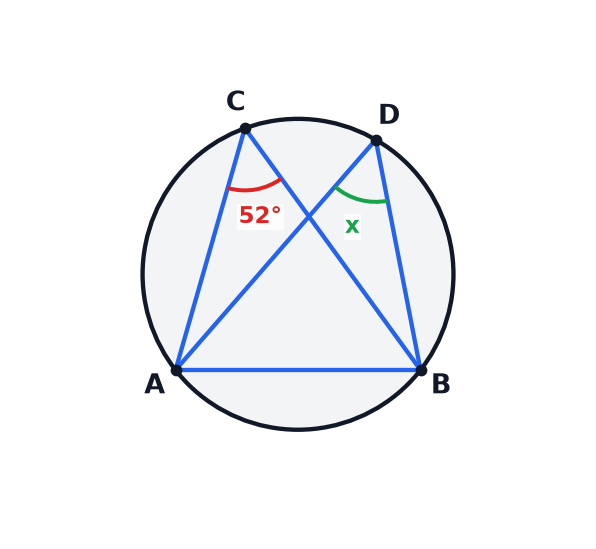
Mark scheme — 2 marks available
- \(52\) — B1
- Angles in the same segment are equal — Q1
Model answer
Angle \(ADB = 52^\circ\), because angles in the same segment are equal.
Not drawn accurately. \(ABCD\) is a cyclic quadrilateral. Angle \(BAD = 106^\circ\) and angle \(ABC = 78^\circ\). (a) Work out the size of angle \(BCD\). Give a reason for your answer. [2 marks] (b) Work out the size of angle \(ADC\). [2 marks]
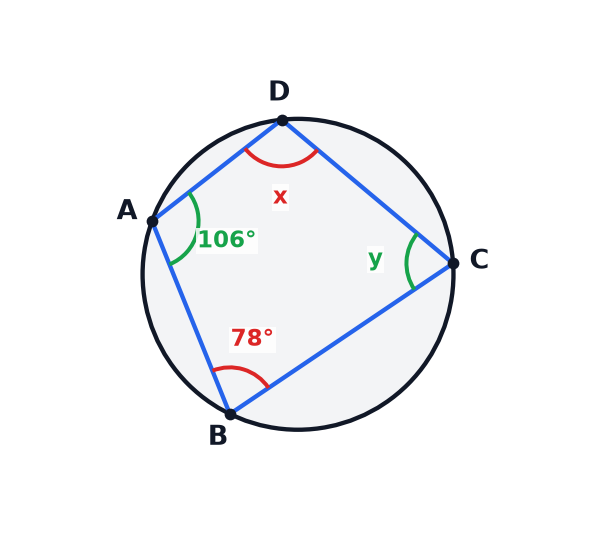
Mark scheme — 4 marks available
- (a) \(74\) — B1
- (a) Opposite angles of a cyclic quadrilateral add up to 180 degrees — Q1
- (b) \(180 - 78\) — M1
- (b) \(102\) — A1
Model answer
(a) \(BCD = 180 - 106 = 74^\circ\), because opposite angles of a cyclic quadrilateral add up to \(180^\circ\). (b) \(ADC = 180 - 78 = 102^\circ\).
\(ABCD\) is a cyclic quadrilateral. Angle \(A = 4x - 5\) and angle \(C = 2x + 35\). Work out the value of \(x\). [3 marks]
Mark scheme — 3 marks available
- \((4x - 5) + (2x + 35) = 180\) — M1
- \(6x + 30 = 180\) or \(6x = 150\) — M1
- \(25\) — A1
Model answer
Opposite angles add up to \(180^\circ\), so \(4x - 5 + 2x + 35 = 180\). Then \(6x = 150\) and \(x = 25\).
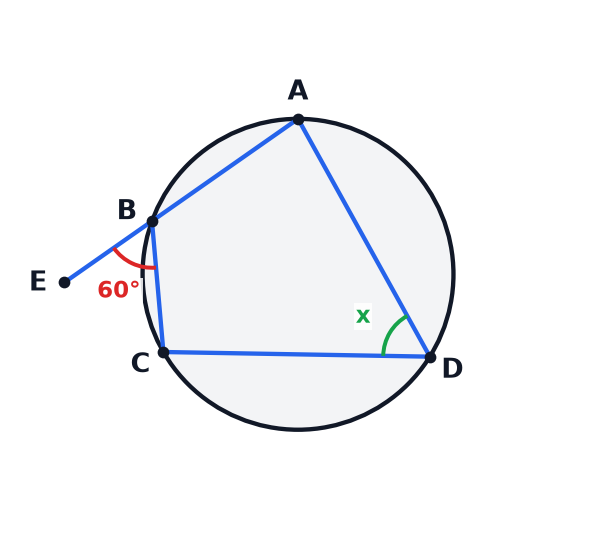
Not drawn accurately. \(ABCD\) is a cyclic quadrilateral. The side \(AB\) is extended to the point \(E\). Angle \(CBE = 60^\circ\). (a) Work out the size of angle \(ABC\). [1 mark] (b) Work out the size of angle \(ADC\). Give a reason for your answer. [2 marks]
Mark scheme — 3 marks available
- (a) \(120\) — B1
- (b) \(60\) — B1
- (b) Opposite angles of a cyclic quadrilateral add up to 180 degrees — Q1
Model answer
(a) \(ABC = 180 - 60 = 120^\circ\), because angles on a straight line add up to \(180^\circ\). (b) \(ADC = 180 - 120 = 60^\circ\), because opposite angles of a cyclic quadrilateral add up to \(180^\circ\).
\(A\), \(B\), \(C\) and \(D\) are points on the circumference of a circle. The lines \(AC\) and \(BD\) cross at \(E\). Angle \(CAD = 29^\circ\) and angle \(ABC = 97^\circ\). (a) Work out the size of angle \(CBD\). Give a reason for your answer. [2 marks] (b) Work out the size of angle \(ADC\). Give a reason for your answer. [2 marks]
Mark scheme — 4 marks available
- (a) \(29\) — B1
- (a) Angles in the same segment are equal — Q1
- (b) \(83\) — B1
- (b) Opposite angles of a cyclic quadrilateral add up to 180 degrees — Q1
Model answer
(a) \(CBD = 29^\circ\), because angles in the same segment are equal. (b) \(ADC = 180 - 97 = 83^\circ\), because opposite angles of a cyclic quadrilateral add up to \(180^\circ\).
\(ABCD\) is a parallelogram. Angle \(A = 70^\circ\). Show that \(ABCD\) cannot be a cyclic quadrilateral. [3 marks]
Mark scheme — 3 marks available
- Opposite angles of a parallelogram are equal, so \(C = 70^\circ\) — M1
- \(70 + 70 = 140\) — M1
- States that 140 is not 180, so the quadrilateral is not cyclic — Q1
Model answer
Opposite angles of a parallelogram are equal, so angle \(C = 70^\circ\). Then \(70 + 70 = 140\), which is not \(180^\circ\), so the opposite angles do not add up to \(180^\circ\) and \(ABCD\) is not cyclic.
Two angles are in the same segment of a circle. One is \(47^\circ\). What is the other?
Why: Angles in the same segment are equal.
What do opposite angles of a cyclic quadrilateral add up to?
Why: This is the cyclic quadrilateral theorem.
A cyclic quadrilateral has an angle of \(112^\circ\). What is the opposite angle?
Why: \(180 - 112 = 68\).
What is a cyclic quadrilateral?
Why: “Cyclic” means all the corners lie on one circle.
In a cyclic quadrilateral \(ABCD\), \(\angle A = 2x + 10\) and \(\angle C = 3x + 20\). What is \(x\)?
Why: \(5x + 30 = 180\), so \(5x = 150\) and \(x = 30\).
\(ABCD\) is cyclic and the side \(AB\) is extended to \(E\). Angle \(CBE = 70^\circ\). What is angle \(ADC\)?
Why: An exterior angle of a cyclic quadrilateral equals the interior opposite angle.
Which of these must be true for the angles \(ACB\) and \(ADB\) to be equal?
Why: Angles in the same segment are made on the same side of a chord.
A quadrilateral has opposite angles of \(95^\circ\) and \(80^\circ\). Can it be cyclic?
Why: Opposite angles of a cyclic quadrilateral must add up to \(180^\circ\), and \(95 + 80 = 175\).
\(A\), \(B\), \(C\) and \(D\) are on a circle, with \(AC\) and \(BD\) meeting at \(E\). Angle \(CAD = 36^\circ\). What is angle \(CBD\)?
Why: Angles \(CAD\) and \(CBD\) are made by the chord \(CD\) on the same side, so they are equal.