Maths · Further Trigonometry
Viewing as
Teacher view: every answer and mark scheme set out in full.
Trigonometry in 3D and Mixed Problems
Finding lengths and angles in cuboids and pyramids, and combining Pythagoras and the sine and cosine rules.
Learning Objectives
- 1Find the length of a diagonal of a cuboid using Pythagoras' theorem in three dimensions.
- 2Find the angle between a line and a plane using right-angled trigonometry.
- 3Use trigonometry in pyramids, and mix the sine rule, the cosine rule and Pythagoras in one problem.
- 4Draw out the right-angled triangle that you need, and label it clearly.
Trigonometry in three dimensions
Three-dimensional problems look hard because the diagram is a flat picture of a solid. The method is to find a right-angled triangle inside the solid, redraw it on its own with its true lengths, and then use Pythagoras' theorem or trigonometry as usual. The angle between a line and a plane is the angle between the line and its shadow on the plane, which is found using a right-angled triangle. Mixed problems also use the sine rule and the cosine rule in non-right-angled triangles.
A cuboid
The line \(AC\) is the diagonal of the base, and \(AG\) is the diagonal of the cuboid. The triangle \(ACG\) has a right angle at \(C\), because \(CG\) is vertical and \(AC\) lies in the base. The angle \(\theta\) between \(AG\) and the base is the angle \(GAC\).
Finding the angle
- Base diagonal \(AC^2 = 4^2 + 3^2 = 25\), so \(AC = 5\) cm.
- Right-angled triangle Triangle \(ACG\) has \(AC = 5\) and \(CG = 5\), with a right angle at \(C\).
- The angle \(\tan\theta = \dfrac{CG}{AC} = \dfrac{5}{5} = 1\), so \(\theta = 45^\circ\).
- The diagonal \(AG^2 = 5^2 + 5^2 = 50\), so \(AG = 5\sqrt{2}\) cm.
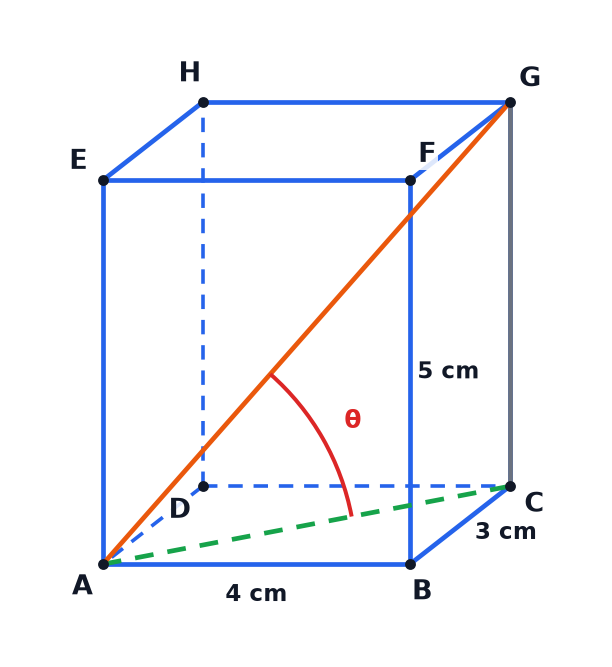
Diagonals and angles in a cuboid
Break the problem into two right-angled triangles, one flat and one upright.
-
Base diagonal
For a base of length \(l\) and width \(w\), \(\text{diagonal}^2 = l^2 + w^2\).
-
Space diagonal
\(d^2 = l^2 + w^2 + h^2\).
-
Angle to the base
Use the base diagonal as the adjacent side and the height as the opposite side.
-
Always
Redraw the triangle in two dimensions, and mark the right angle.
A space diagonal
A cuboid has length 12 cm, width 4 cm and height 3 cm. Work out the length of the diagonal from one corner to the opposite corner.
Show the solutionHide the solution
- 1 Base diagonal \(AC^2 = 12^2 + 4^2 = 144 + 16 = 160\).
- 2 Add the height \(d^2 = 160 + 3^2 = 169\).
- 3 Square root \(d = 13\) cm.
- 4 Shortcut \(d^2 = l^2 + w^2 + h^2 = 144 + 16 + 9 = 169\).
Answer13 cm
A square-based pyramid
The apex \(V\) is directly above the centre \(M\) of the base. The triangle \(VMA\) has a right angle at \(M\), because \(VM\) is vertical. The angle between the edge \(VA\) and the base is the angle \(VAM\).
Finding the angle
- Base diagonal \(AC^2 = 6^2 + 6^2 = 72\), so \(AC = 6\sqrt{2}\) cm.
- Half of it \(AM = 3\sqrt{2}\) cm.
- Right-angled triangle \(VM = 3\sqrt{2}\) and \(AM = 3\sqrt{2}\), with a right angle at \(M\).
- The angle \(\tan\theta = \dfrac{3\sqrt{2}}{3\sqrt{2}} = 1\), so \(\theta = 45^\circ\).
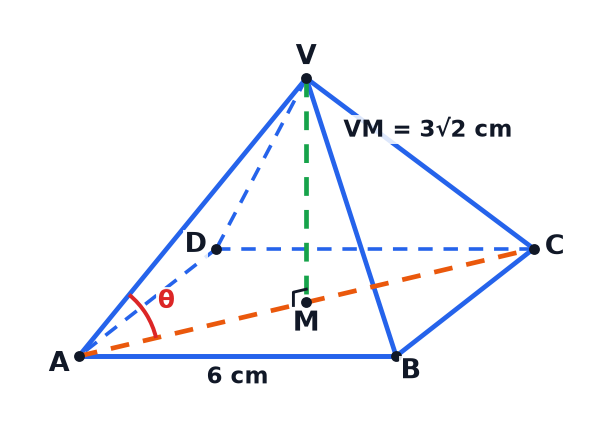
Mixed problems
Many problems combine several ideas, so plan the route before calculating.
-
Right-angled triangle
Use SOH CAH TOA or Pythagoras.
-
Any triangle
Use the sine rule with a matching pair, or the cosine rule with two sides and the included angle.
-
Several steps
Work out a length in one triangle, then use it in the next.
-
Bearings
A bearing question can often be set up as a triangle, with the angle found from the bearings.
Two triangles
\(ABCD\) is a quadrilateral. \(AB = 4\) cm, \(BC = 4\) cm and angle \(ABC = 90^\circ\). \(CD = 4\) cm and angle \(ACD = 90^\circ\). Work out the length of \(AD\).
Show the solutionHide the solution
- 1 First triangle \(AC^2 = 4^2 + 4^2 = 32\), so \(AC = 4\sqrt{2}\) cm.
- 2 Second triangle Triangle \(ACD\) has a right angle at \(C\), so \(AD^2 = AC^2 + CD^2\).
- 3 Substitute \(AD^2 = 32 + 16 = 48\).
- 4 Simplify \(AD = \sqrt{48} = 4\sqrt{3}\) cm.
Answer\(AD = 4\sqrt{3}\) cm
Test yourself
-
1
What is the formula for a space diagonal?
Show answerHide answer
\(d^2 = l^2 + w^2 + h^2\).
-
2
How do you find the angle between a line and a plane?
Show answerHide answer
Use the right-angled triangle formed by the line, its shadow on the plane, and the vertical.
-
3
What is the foot of the height in a square-based pyramid?
Show answerHide answer
The centre of the base.
-
4
What do you do first in a 3D problem?
Show answerHide answer
Find and redraw a right-angled triangle.
-
5
Which rule do you use if there is no right angle?
Show answerHide answer
The sine rule or the cosine rule.
Exam technique: 3D problems
Planning gets the marks.
-
Redraw
Draw each triangle by itself, with its true lengths.
-
Mark the right angle
This shows which side is the hypotenuse.
-
Keep exact values
Leave surds until the end, so that the answer is exact.
-
Sensible answers
Check that the lengths are reasonable, and that a space diagonal is longer than any edge.
Summary and exam focus
- Find a right-angled triangle inside the solid, and redraw it.
- The space diagonal of a cuboid is \(\sqrt{l^2 + w^2 + h^2}\).
- The angle between a line and a plane is found using the vertical height and the shadow on the plane.
- Mixed problems combine Pythagoras, SOH CAH TOA, and the sine and cosine rules.
Exam focus
A cuboid has a base 4 cm by 3 cm and a height of 5 cm. Work out the angle between the diagonal \(AG\) and the base. (4 marks) (4 marks)
The base diagonal is \(\sqrt{4^2 + 3^2} = 5\) cm. In the right-angled triangle, \(\tan\theta = \dfrac{5}{5} = 1\), so \(\theta = 45^\circ\).
Key terms
The words this lesson expects you to use. Each one is linked from the first place it appears above.
- Space diagonal
- A line from one corner of a cuboid to the opposite corner.
- Plane
- A flat surface.
- Apex
- The top point of a pyramid.
- Cuboid
- A solid with six rectangular faces.
- Pyramid
- A solid with a flat base and sloping triangular faces meeting at the apex.
- Hypotenuse
- The longest side of a right-angled triangle.
- Exact value
- A value written with surds, not as a decimal.
- Angle between a line and a plane
- The angle between the line and its shadow on the plane.
- Perpendicular
- At \(90^\circ\).
Questions and answers
15 questions set on this lesson, with the mark schemes and model answers open.
Not drawn accurately. The diagram shows a cuboid. Work out the length of the diagonal \(AG\). [3 marks]
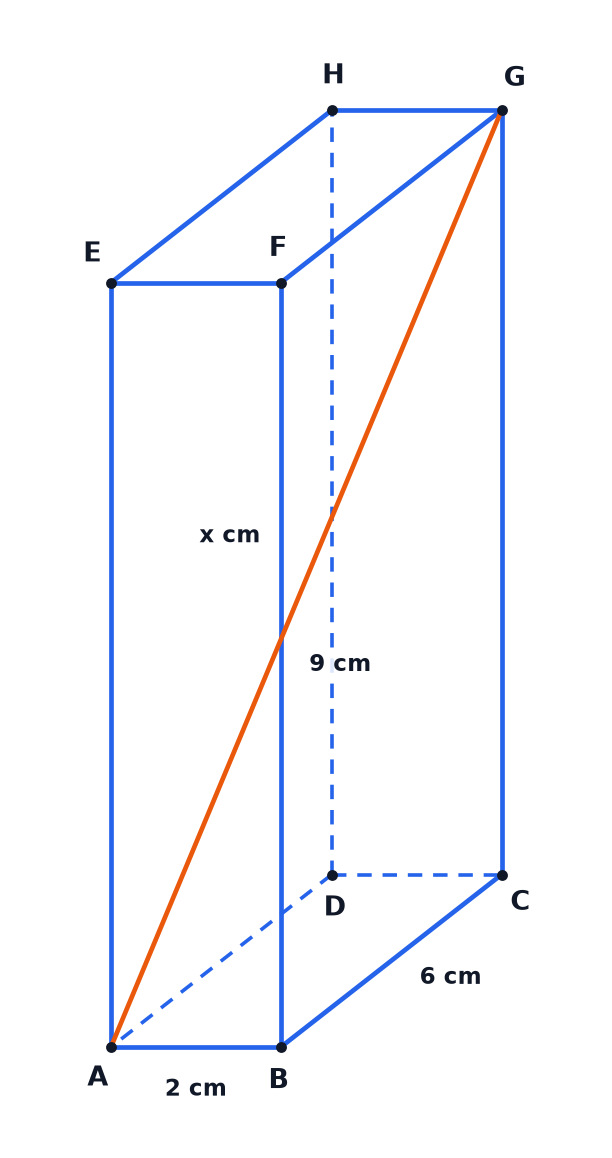
Mark scheme — 3 marks available
- \(2^2 + 6^2 + 9^2\), or a base diagonal \(AC^2 = 2^2 + 6^2\) then \(AG^2 = AC^2 + 9^2\) — M1
- \(121\) — M1
- \(11\) — A1
Model answer
\(AG^2 = 2^2 + 6^2 + 9^2 = 4 + 36 + 81 = 121\), so \(AG = 11\) cm.
Not drawn accurately. The diagram shows a cuboid. Work out the size of angle \(\theta\), the angle between \(AG\) and the base \(ABCD\). [4 marks]
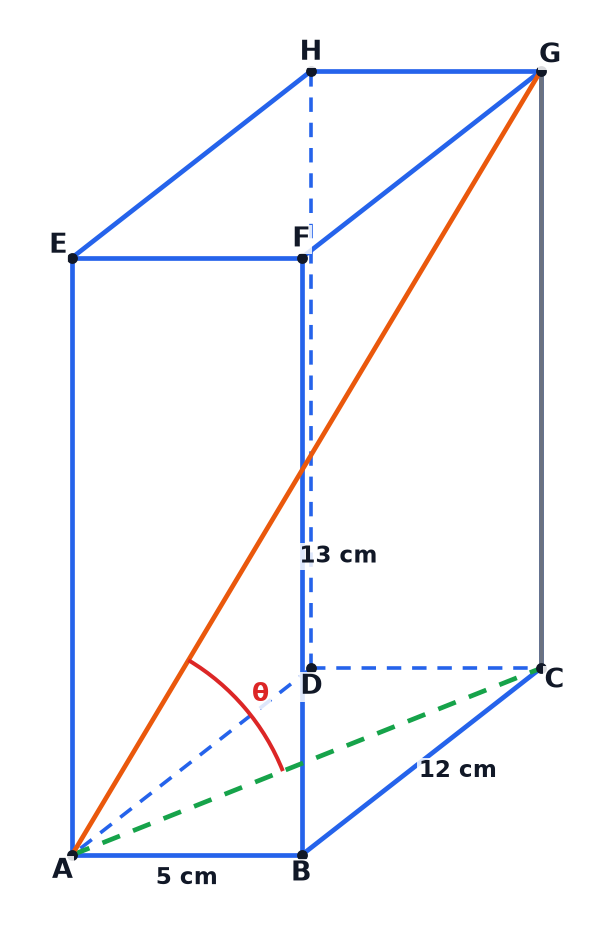
Mark scheme — 4 marks available
- \(AC = 13\) — B1
- \(\tan\theta = \dfrac{13}{13}\) — M1
- \(\tan\theta = 1\) — A1
- \(45\) — A1
Model answer
\(AC^2 = 5^2 + 12^2 = 169\), so \(AC = 13\) cm. In the right-angled triangle \(ACG\), \(\tan\theta = \dfrac{CG}{AC} = \dfrac{13}{13} = 1\), so \(\theta = 45^\circ\).
Not drawn accurately. The diagram shows a pyramid with a square base \(ABCD\). The apex \(V\) is directly above the centre \(M\) of the base. All the edges are 8 cm long. (a) Work out the exact height \(VM\) of the pyramid. [3 marks] (b) Work out the size of angle \(\theta\), the angle between \(VA\) and the base. [2 marks]
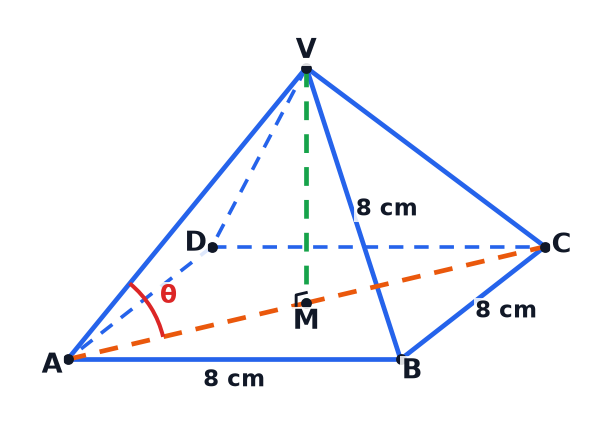
Mark scheme — 5 marks available
- (a) \(AM = 4\sqrt{2}\) — M1
- (a) \(VM^2 = 8^2 - 32\) — M1
- (a) \(4\sqrt{2}\) — A1
- (b) \(\cos\theta = \dfrac{4\sqrt{2}}{8}\) or \(\tan\theta = 1\) — M1
- (b) \(45\) — A1
Model answer
(a) \(AC^2 = 8^2 + 8^2 = 128\), so \(AM = \dfrac{1}{2}AC = 4\sqrt{2}\). \(VM^2 = 8^2 - (4\sqrt{2})^2 = 64 - 32 = 32\), so \(VM = 4\sqrt{2}\) cm. (b) \(\cos\theta = \dfrac{AM}{VA} = \dfrac{4\sqrt{2}}{8} = \dfrac{\sqrt{2}}{2}\), so \(\theta = 45^\circ\).
A boat sails 30 km from \(P\) to \(Q\) on a bearing of \(090^\circ\). It then sails 50 km from \(Q\) to \(R\) on a bearing of \(150^\circ\). Work out the distance \(PR\). [4 marks]
Mark scheme — 4 marks available
- Angle \(PQR = 120^\circ\) — M1
- \(PR^2 = 30^2 + 50^2 - 2 \times 30 \times 50 \times \cos 120^\circ\) — M1
- \(4900\) — A1
- \(70\) — A1
Model answer
The bearing of \(P\) from \(Q\) is \(270^\circ\), so angle \(PQR = 270 - 150 = 120^\circ\). \(PR^2 = 30^2 + 50^2 - 2 \times 30 \times 50 \times \cos 120^\circ = 900 + 2500 + 1500 = 4900\), so \(PR = 70\) km.
\(BT\) is a vertical tower on horizontal ground. The angle of elevation of \(T\) from a point \(A\) is \(30^\circ\), and from a point \(C\) is \(45^\circ\). Angle \(ABC = 90^\circ\) and \(AC = 60\) m. Work out the height of the tower. [5 marks]
Mark scheme — 5 marks available
- \(BA = h\sqrt{3}\), or \(\tan 30^\circ = \dfrac{h}{BA}\) — B1
- \(BC = h\) — B1
- \(AC^2 = BA^2 + BC^2 = 4h^2\) — M1
- \(4h^2 = 3600\) — M1
- \(30\) — A1
Model answer
Let \(BT = h\). \(BA = \dfrac{h}{\tan 30^\circ} = h\sqrt{3}\) and \(BC = \dfrac{h}{\tan 45^\circ} = h\). In the right-angled triangle \(ABC\), \(AC^2 = 3h^2 + h^2 = 4h^2 = 3600\), so \(h^2 = 900\) and \(h = 30\) m.
\(ABCDEFGH\) is a cube with edges of length 6 cm. Show that triangle \(ACF\) is equilateral, and write down the size of angle \(CAF\). [3 marks]
Mark scheme — 3 marks available
- \(AC^2 = 6^2 + 6^2 = 72\), so \(AC = 6\sqrt{2}\) — M1
- \(AF\) and \(CF\) are also face diagonals, so all three sides are \(6\sqrt{2}\) — B1
- Equilateral, so angle \(CAF = 60^\circ\) — Q1
Model answer
\(AC\), \(AF\) and \(CF\) are diagonals of faces of the cube. \(AC^2 = 6^2 + 6^2 = 72\), so \(AC = 6\sqrt{2}\). The other two face diagonals are the same length, so the triangle is equilateral and angle \(CAF = 60^\circ\).
What is the formula for the space diagonal of a cuboid?
Why: Use Pythagoras' theorem twice.
A rectangle is 4 cm by 3 cm. What is the length of its diagonal?
Why: \(\sqrt{16 + 9} = 5\).
Where is the apex of a square-based pyramid?
Why: For a right pyramid the apex is above the centre.
A cuboid has edges 2 cm, 3 cm and 6 cm. What is the length of the space diagonal?
Why: \(\sqrt{4 + 9 + 36} = \sqrt{49} = 7\).
What is the angle between a line and a plane?
Why: The shadow of the line on the plane is used.
A cuboid has a base 4 cm by 3 cm and a height of 5 cm. What is \(\tan\theta\), where \(\theta\) is the angle between the diagonal \(AG\) and the base?
Why: The base diagonal is 5 cm and the height is 5 cm, so \(\tan\theta = \dfrac{5}{5} = 1\).
A cube has edges of length 2 cm. What is the length of its space diagonal?
Why: \(\sqrt{4 + 4 + 4} = \sqrt{12} = 2\sqrt{3}\).
A square-based pyramid has a base with side 6 cm and a height of \(3\sqrt{2}\) cm. What is the angle between a sloping edge and the base?
Why: Half the base diagonal is \(3\sqrt{2}\), the same as the height, so \(\tan\theta = 1\).
In a 3D problem, which triangle contains the angle between the space diagonal of a cuboid and the base?
Why: The vertical edge is perpendicular to the base, so the triangle is right-angled.