Maths · Geometry and Measures
Viewing as
Teacher view: every answer and mark scheme set out in full.
Area, Perimeter and Circles
Areas of standard shapes and compound shapes, and the circumference and area of circles, semicircles and sectors.
Learning Objectives
- 1Calculate the perimeter and area of rectangles, triangles, parallelograms and trapezia.
- 2Find the area and perimeter of compound shapes by splitting them or subtracting.
- 3Calculate the circumference and area of circles, giving answers in terms of \(\pi\) when asked.
- 4Find the arc length and area of a sector, and the area of a semicircle (Higher tier for sector formulae).
Perimeter, area and what they mean
Perimeter is the distance around the outside of a shape, and it is measured in units such as cm or m. Area is the amount of surface inside, and it is measured in square units such as cm\(^2\) or m\(^2\). Mixing these up is the classic error, so decide which one the question wants before you start. On a non-calculator paper the numbers are chosen to work out neatly, and circle questions often ask for the answer "in terms of \(\pi\)", so \(\pi\) stays in the answer.
The area formulae
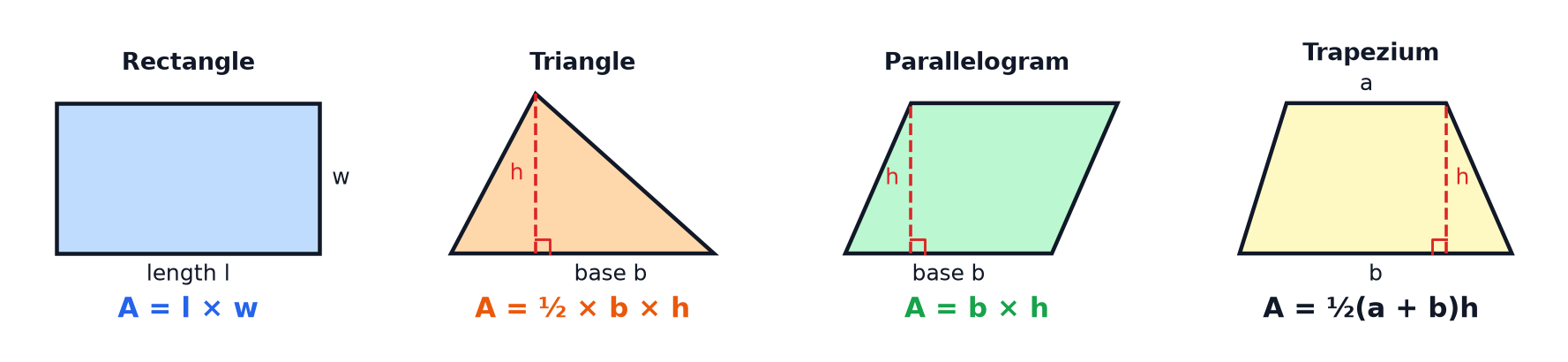
The height in each formula is the perpendicular height, which meets the base at a right angle. It is not the slanted side.
The formulae to know
- Rectangle \(A = l \times w\).
- Triangle \(A = \dfrac{1}{2} \times b \times h\).
- Parallelogram \(A = b \times h\).
- Trapezium \(A = \dfrac{1}{2}(a + b)h\), where \(a\) and \(b\) are the parallel sides.
Area of a trapezium
A trapezium has parallel sides of length 7 cm and 13 cm. The distance between them is 6 cm. Work out the area.
Show the solutionHide the solution
- 1 Use the formula \(A = \dfrac{1}{2}(a + b)h\).
- 2 Substitute \(\dfrac{1}{2} \times (7 + 13) \times 6\).
- 3 Work out the bracket \(7 + 13 = 20\), so \(\dfrac{1}{2} \times 20 \times 6\).
- 4 Calculate \(10 \times 6 = 60\).
- 5 Units 60 cm\(^2\).
Answer60 cm\(^2\)
Compound shapes
A compound shape is made from simpler shapes joined together. The method is to split it up or to subtract a piece.
-
Split into rectangles
Draw a line to cut the shape into rectangles, find each area, and add them.
-
Subtract
Imagine a larger rectangle around the shape, then take away the missing part.
-
Find missing lengths
Add or subtract the lengths on opposite sides. If the long side is 10 and the short side is 6, the missing piece is \(10 - 6 = 4\).
-
Perimeter
Add every outside edge, including the ones you worked out. Do not count the lines you drew inside.
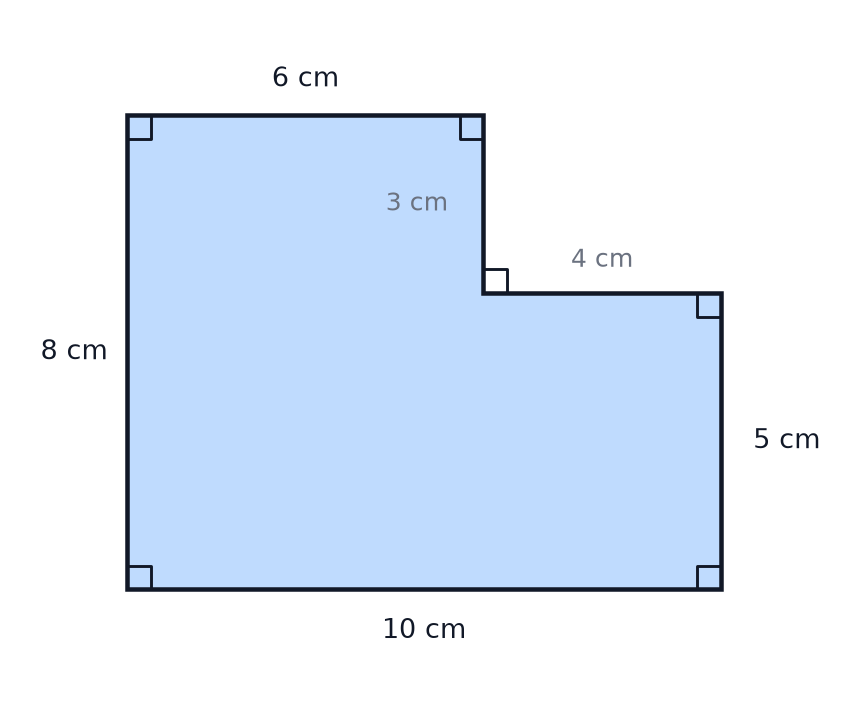
An L-shape
The 4 cm and 3 cm lengths are not given, so you must find them: \(10 - 6 = 4\) and \(8 - 5 = 3\). Then split the shape into two rectangles.
Working it out
- Bottom rectangle \(10 \times 5 = 50\) cm\(^2\).
- Top rectangle \(6 \times 3 = 18\) cm\(^2\).
- Total area \(50 + 18 = 68\) cm\(^2\).
- Perimeter \(10 + 5 + 4 + 3 + 6 + 8 = 36\) cm.
The circle and its parts
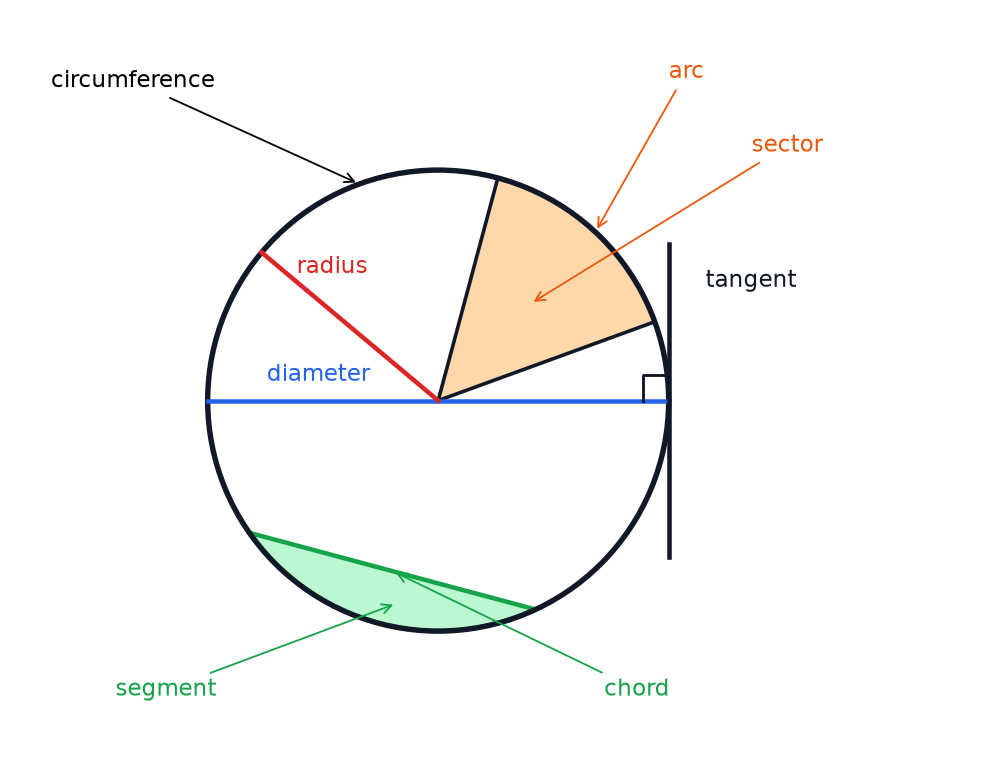
Learn the names, because exam questions use them without explanation.
-
Radius and diameter
The radius goes from the centre to the edge, and the diameter goes right across through the centre. Diameter \(= 2 \times\) radius.
-
Circumference
The distance around the circle, which is the perimeter of a circle.
-
Arc
A part of the circumference.
-
Chord
A straight line joining two points on the circumference.
-
Sector
A slice of a circle between two radii and an arc.
-
Segment
The piece of a circle cut off by a chord.
-
Tangent
A straight line that touches the circle at one point.
Parts of a circle
The tangent meets the radius at a right angle. A sector is shaped like a slice of pizza, and a segment is the part between a chord and an arc.
The key link
- Diameter and radius \(d = 2r\) and \(r = \dfrac{d}{2}\). Check which one the question gives you.
- Tangent It is perpendicular to the radius at the point where they meet.
- Chord against diameter The diameter is the longest chord.
Circumference and area
Both formulae use \(\pi\), which is a little more than 3.14. On a non-calculator paper, leave the answer in terms of \(\pi\) unless told to use a value.
-
Circumference
\(C = \pi d\) or \(C = 2\pi r\).
-
Area
\(A = \pi r^2\). Square the radius first, then multiply by \(\pi\).
-
The common mistake
Using the diameter in the area formula. Always halve the diameter to get the radius first.
-
In terms of \(\pi\)
A radius of 5 cm gives an area of \(\pi \times 25 = 25\pi\) cm\(^2\), and a circumference of \(2 \times \pi \times 5 = 10\pi\) cm.
Circle in terms of pi
A circle has diameter 14 cm. Work out its circumference and its area. Give your answers in terms of \(\pi\).
Show the solutionHide the solution
- 1 Circumference \(C = \pi d = \pi \times 14 = 14\pi\) cm.
- 2 Find the radius \(r = 14 \div 2 = 7\) cm.
- 3 Area \(A = \pi r^2 = \pi \times 7^2 = 49\pi\) cm\(^2\).
- 4 Check the units Circumference is a length (cm) and area is in square units (cm\(^2\)).
AnswerCircumference \(14\pi\) cm, area \(49\pi\) cm\(^2\)
Semicircles, sectors and arcs
A sector is a fraction of a whole circle, so find the fraction first and then multiply.
-
Semicircle
Half of a circle, so half of the area, \(\dfrac{1}{2}\pi r^2\). Its perimeter includes the straight edge, so it is \(\pi r + 2r\).
-
The fraction
A sector with angle \(\theta\) is \(\dfrac{\theta}{360}\) of the circle.
-
Arc length
\(\dfrac{\theta}{360} \times 2\pi r\).
-
Sector area
\(\dfrac{\theta}{360} \times \pi r^2\).
-
Perimeter of a sector
Arc length plus two radii. It is easy to forget the radii.
Area and arc of a sector
(Higher tier) A sector of a circle has radius 9 cm and angle \(80^\circ\). Work out the area of the sector and the length of its arc. Give your answers in terms of \(\pi\).
Show the solutionHide the solution
- 1 Find the fraction \(\dfrac{80}{360} = \dfrac{2}{9}\).
- 2 Area \(\dfrac{2}{9} \times \pi \times 9^2 = \dfrac{2}{9} \times 81\pi = 18\pi\) cm\(^2\).
- 3 Arc length \(\dfrac{2}{9} \times 2 \times \pi \times 9 = \dfrac{2}{9} \times 18\pi = 4\pi\) cm.
- 4 Units cm\(^2\) for the area and cm for the arc length.
AnswerArea \(18\pi\) cm\(^2\), arc length \(4\pi\) cm
What the AQA exam gives you
AQA gives very few formulae in the exam, so most of the formulae in this lesson have to be remembered.
-
Not given
AQA expects you to know the area of a trapezium \(\dfrac{1}{2}(a + b)h\) and the circumference and area of a circle, \(2\pi r = \pi d\) and \(\pi r^2\).
-
Also not given
The areas of a rectangle, triangle and parallelogram, and the arc length and sector area formulae, so learn them all.
-
Check the units
A formula from memory needs the right letters and the right units, so write both.
Test yourself
-
1
What is the area of a triangle?
Show answerHide answer
\(\dfrac{1}{2} \times\) base \(\times\) perpendicular height.
-
2
What is the formula for the area of a circle?
Show answerHide answer
\(A = \pi r^2\).
-
3
What is the formula for the circumference of a circle?
Show answerHide answer
\(C = \pi d\) or \(2\pi r\).
-
4
What is the area of a circle with radius 4 cm, in terms of \(\pi\)?
Show answerHide answer
\(16\pi\) cm\(^2\).
-
5
What is a sector?
Show answerHide answer
A slice of a circle, bounded by two radii and an arc.
Exam technique: area and perimeter
These are formula questions, so the marks are for method and accuracy.
-
Write the formula
State \(A = \pi r^2\) before you substitute.
-
Say what you are finding
Label each part of a compound shape \(A\), \(B\) and so on, then add them.
-
Radius, not diameter
Circle in the question? Check which one is given.
-
Keep \(\pi\) in the answer
If the question says "in terms of \(\pi\)", an answer such as 3.14 loses the mark.
Summary and exam focus
- Perimeter is the distance round the outside, area is the surface inside.
- Know the area formulae for rectangles, triangles, parallelograms and trapezia.
- Split compound shapes into simple shapes or subtract a piece, and find any missing lengths.
- Circumference is \(\pi d\) and area is \(\pi r^2\), with the radius being half the diameter.
- Sectors are a fraction \(\dfrac{\theta}{360}\) of a circle (Higher tier).
Exam focus
A circle has radius 6 cm. Work out the area of the circle. Give your answer in terms of \(\pi\). (2 marks) (2 marks)
Square the radius first: \(6^2 = 36\), then write \(36\pi\) cm\(^2\). A common slip is to calculate \((\pi \times 6)^2\) or to double 6 to get 12. State the units as cm\(^2\).
Key terms
The words this lesson expects you to use. Each one is linked from the first place it appears above.
- Perimeter
- The total distance around the outside of a shape.
- Area
- The amount of surface inside a shape, measured in square units.
- Compound shape
- A shape made up of simpler shapes joined together.
- Perpendicular height
- The height of a shape measured at a right angle to its base.
- Circumference
- The distance around a circle.
- Radius
- The distance from the centre of a circle to its edge.
- Diameter
- The distance across a circle through its centre, twice the radius.
- Sector
- A slice of a circle between two radii and an arc.
- In terms of pi
- An answer that keeps the symbol \(\pi\) instead of using its decimal value.
Questions and answers
15 questions set on this lesson, with the mark schemes and model answers open.
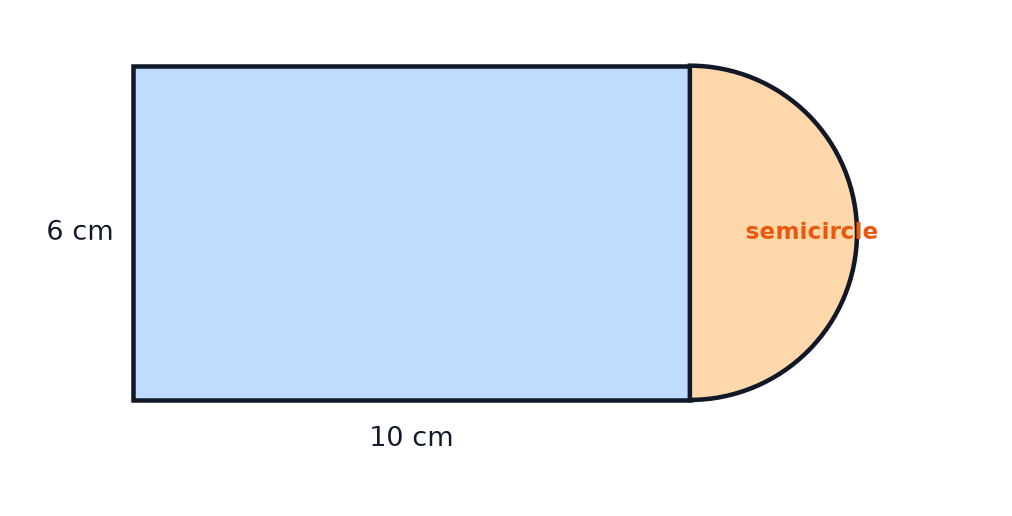
The diagram shows a rectangle with a semicircle attached to one side. Give your answers in terms of \(\pi\). (a) Work out the area of the shape. [3 marks] (b) Work out the perimeter of the shape. [2 marks]
Mark scheme — 5 marks available
- (a) \(60\) found — M1
- (a) \(\dfrac{1}{2} \times \pi \times 3^2\) or \(4.5\pi\) — M1
- (a) \(60 + 4.5\pi\) — A1
- (b) \(3\pi\) or \(26\) found — M1
- (b) \(26 + 3\pi\) — A1
Model answer
(a) The rectangle has area \(10 \times 6 = 60\) cm\(^2\). The semicircle has radius 3 cm, so its area is \(\dfrac{1}{2} \times \pi \times 3^2 = 4.5\pi\) cm\(^2\). The total is \(60 + 4.5\pi\) cm\(^2\). (b) The curved edge is \(\dfrac{1}{2} \times \pi \times 6 = 3\pi\), and the straight edges are \(10 + 10 + 6 = 26\). The perimeter is \(26 + 3\pi\) cm.
A parallelogram has a base of 12 cm, a slanted side of 8 cm and a perpendicular height of 7 cm. Work out the area of the parallelogram.
Mark scheme — 2 marks available
- \(12 \times 7\) — M1
- 84 cm\(^2\) — A1
Model answer
Area \(=\) base \(\times\) perpendicular height \(= 12 \times 7 = 84\) cm\(^2\). The slanted side is not needed.
A rectangle is 14 cm by 9 cm. A smaller rectangle measuring 6 cm by 4 cm is cut out of one corner. (a) Work out the area of the shape that is left. [2 marks] (b) Show that the perimeter of the shape is 46 cm. [2 marks]
Mark scheme — 4 marks available
- (a) \(14 \times 9 - 6 \times 4\) — M1
- (a) 102 — A1
- (b) \(14 + 9 + 14 + 9\) or the shape's edges added — M1
- (b) 46 with a reason or full working — Q1
Model answer
(a) \(14 \times 9 - 6 \times 4 = 126 - 24 = 102\) cm\(^2\). (b) Cutting a rectangle out of a corner does not change the perimeter, because the two new edges replace two edges of the same total length: \(2 \times (14 + 9) = 46\) cm.
The circumference of a circle is \(20\pi\) cm. Work out the area of the circle. Give your answer in terms of \(\pi\).
Mark scheme — 3 marks available
- \(2\pi r = 20\pi\) or \(r = 10\) — M1
- \(\pi \times 10^2\) — M1
- \(100\pi\) cm\(^2\) — A1
Model answer
\(2\pi r = 20\pi\), so \(r = 10\) cm. The area is \(\pi \times 10^2 = 100\pi\) cm\(^2\).
A circular pond has a radius of 4 m. A path 1 m wide goes all the way round the pond. Work out the area of the path. Give your answer in terms of \(\pi\).
Mark scheme — 3 marks available
- \(\pi \times 5^2\) or \(\pi \times 4^2\) — M1
- \(25\pi - 16\pi\) — M1
- \(9\pi\) m\(^2\) — A1
Model answer
The pond and path together have radius 5 m, so their area is \(\pi \times 25 = 25\pi\). The pond has area \(\pi \times 16 = 16\pi\). The path is \(25\pi - 16\pi = 9\pi\) m\(^2\).
A sector of a circle has radius 10 cm and angle \(72^\circ\). Give your answers in terms of \(\pi\). (a) Work out the length of the arc. [2 marks] (b) Work out the perimeter of the sector. [2 marks]
Mark scheme — 4 marks available
- (a) \(\dfrac{72}{360} \times 20\pi\) — M1
- (a) \(4\pi\) — A1
- (b) \(4\pi + 10 + 10\) — M1
- (b) \(20 + 4\pi\) — A1
Model answer
(a) \(\dfrac{72}{360} = \dfrac{1}{5}\), and the circumference is \(2\pi \times 10 = 20\pi\), so the arc is \(4\pi\) cm. (b) The perimeter is the arc plus two radii: \(4\pi + 10 + 10 = 20 + 4\pi\) cm.
A triangle has base 10 cm and perpendicular height 6 cm. What is its area?
Why: \(\dfrac{1}{2} \times 10 \times 6 = 30\) cm\(^2\).
A trapezium has parallel sides of 7 cm and 13 cm, and a height of 6 cm. What is its area?
Why: \(\dfrac{1}{2}(7 + 13) \times 6 = 60\). Forgetting the half gives 120.
A parallelogram has base 9 cm, slanted side 5 cm and perpendicular height 4 cm. What is its area?
Why: \(\text{base} \times \text{perpendicular height} = 9 \times 4 = 36\). The slanted side is not used.
A circle has radius 5 cm. What is its area, in terms of \(\pi\)?
Why: \(\pi r^2 = \pi \times 25 = 25\pi\).
A circle has diameter 14 cm. What is its circumference, in terms of \(\pi\)?
Why: \(C = \pi d = 14\pi\).
A circle has diameter 10 cm. What is its area, in terms of \(\pi\)?
Why: The radius is \(10 \div 2 = 5\), so \(A = \pi \times 5^2 = 25\pi\). Using 10 as the radius gives \(100\pi\).
A rectangle measures 12 cm by 7 cm. A rectangle 5 cm by 3 cm is cut from one corner. What is the area of the remaining shape?
Why: \(12 \times 7 = 84\) and \(5 \times 3 = 15\), so \(84 - 15 = 69\).
A sector has radius 9 cm and angle \(80^\circ\). What is its area, in terms of \(\pi\)?
Why: \(\dfrac{80}{360} \times \pi \times 81 = \dfrac{2}{9} \times 81\pi = 18\pi\).
A sector has radius 6 cm and angle \(60^\circ\). What is the length of its arc, in terms of \(\pi\)?
Why: \(\dfrac{60}{360} \times 2 \times \pi \times 6 = \dfrac{1}{6} \times 12\pi = 2\pi\).