Maths · Number Without a Calculator
Viewing as
Teacher view: every answer and mark scheme set out in full.
Factors, Multiples and Primes
Prime factors, HCF and LCM: how to find them without a calculator and how to use them to solve problems.
Learning Objectives
- 1Identify factors, multiples, primes, square numbers and cube numbers.
- 2Write a number as a product of its prime factors using a factor tree.
- 3Find the highest common factor (HCF) and lowest common multiple (LCM) of two numbers.
- 4Solve problems that involve repeating events using HCF and LCM.
The building blocks of number
Every whole number greater than 1 is either prime or can be written as a product of primes in exactly one way. That unique recipe is what makes HCF and LCM questions work, and it is why so many non-calculator questions are really prime factor questions in disguise. Learn the vocabulary first, because the exam will use the words without explaining them.
Factors, multiples and primes
Three words that are easy to mix up and are tested constantly.
-
Factor
A whole number that divides exactly into another. The factors of 18 are 1, 2, 3, 6, 9 and 18, and they always come in pairs: \(1\times18\), \(2\times9\), \(3\times6\).
-
Multiple
A number in the times table of another. The multiples of 7 are 7, 14, 21, 28 and so on, and the list never ends.
-
Prime number
A number with exactly two factors, 1 and itself. The primes below 30 are 2, 3, 5, 7, 11, 13, 17, 19, 23 and 29. 2 is the only even prime and 1 is not prime.
-
Squares and cubes
Square numbers are \(n \times n\): 1, 4, 9, 16, 25 up to \(15^2 = 225\). Cube numbers are \(n\times n\times n\): 1, 8, 27, 64, 125 and \(10^3 = 1000\).
Quick tests for divisibility
These save time when you are deciding whether a number can be divided exactly, especially in a non-calculator exam.
-
2, 5 and 10
A number is divisible by 2 if it ends in an even digit, by 5 if it ends in 0 or 5, and by 10 if it ends in 0.
-
3 and 9
Add up the digits. If the digit sum is a multiple of 3 the number is divisible by 3, and if it is a multiple of 9 the number is divisible by 9. For 4527 the digit sum is 18, so it divides by both 3 and 9.
-
4
If the last two digits make a number divisible by 4, the whole number is. For 3 716, 16 divides by 4, so 3 716 does too.
Prime factors with a factor tree
A factor tree splits a number into two factors again and again until every branch ends in a prime. Any pair of factors will do to start, because the final set of primes is always the same.
Building the tree
- Split Write any two factors that multiply to the number, such as \(360 = 36 \times 10\).
- Keep going Keep splitting every number that is not prime. Circle each prime when you reach it.
- Collect Write the circled primes in order as a product and use indices to shorten it: \(360 = 2^3 \times 3^2 \times 5\).
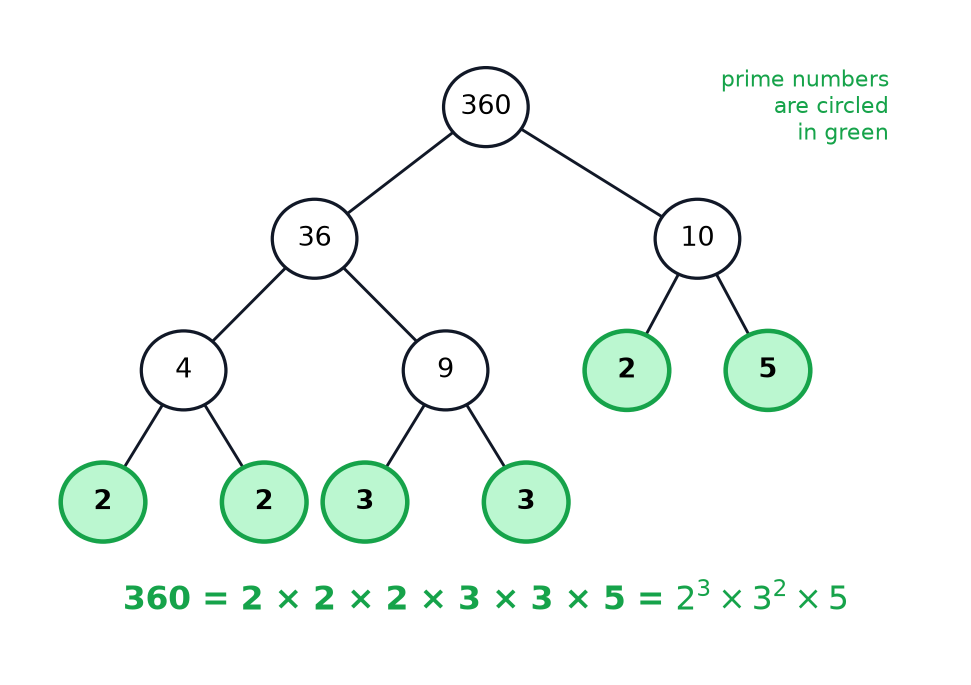
Prime factor decomposition
Write 140 as a product of its prime factors. Give your answer in index form.
Show the solutionHide the solution
- 1 Split into factors \(140 = 14 \times 10\).
- 2 Split again \(14 = 2 \times 7\) and \(10 = 2 \times 5\). All of 2, 7, 2 and 5 are prime.
- 3 Collect and order \(140 = 2 \times 2 \times 5 \times 7\).
- 4 Use indices \(140 = 2^2 \times 5 \times 7\).
Answer\(2^2 \times 5 \times 7\)
Finding the HCF and LCM from prime factors
Put the prime factors of each number into two overlapping circles, with the shared primes in the middle. The middle multiplies to the HCF and everything multiplies to the LCM.
Reading the diagram
- HCF Multiply the numbers in the overlap: \(2 \times 2 \times 3 = 12\).
- LCM Multiply every number in the diagram once: \(2 \times 2 \times 3 \times 2 \times 3 = 72\).
- Check The HCF must divide into both numbers and the LCM must be a multiple of both.
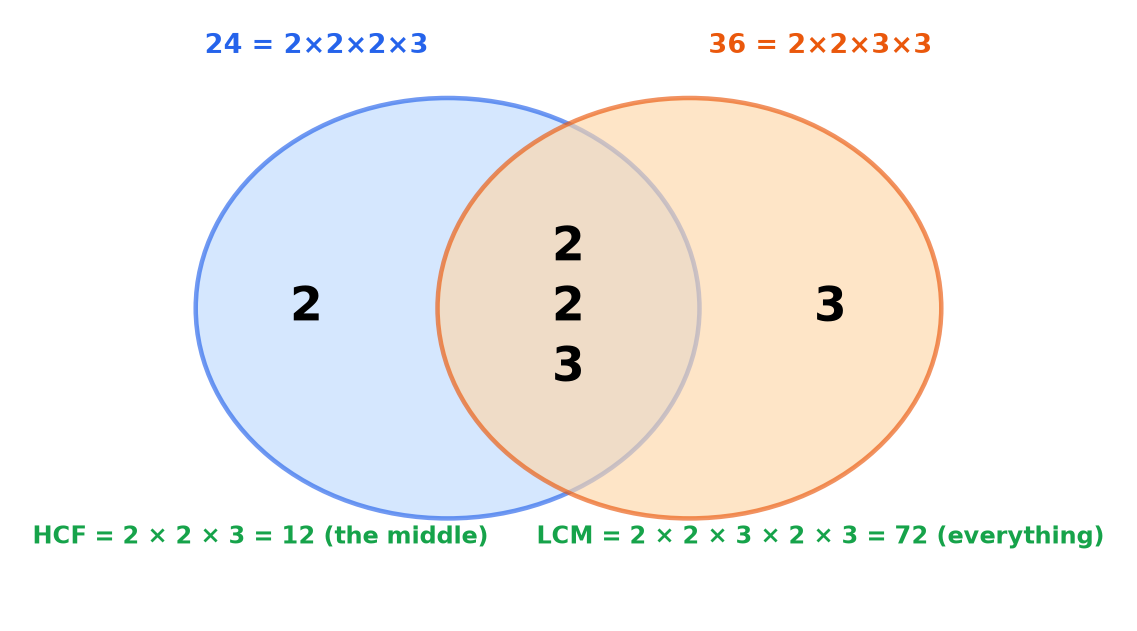
HCF and LCM using prime factors
\(60 = 2^2 \times 3 \times 5\) and \(84 = 2^2 \times 3 \times 7\). Find the HCF and the LCM of 60 and 84.
Show the solutionHide the solution
- 1 HCF: take the common primes Both numbers share \(2^2\) and \(3\). Use the lower power of each prime that appears in both.
- 2 Multiply for the HCF \(2^2 \times 3 = 12\).
- 3 LCM: take every prime Use the higher power of each prime that appears in either number: \(2^2 \times 3 \times 5 \times 7\).
- 4 Multiply for the LCM \(4 \times 3 = 12\), \(12 \times 5 = 60\), \(60 \times 7 = 420\).
AnswerHCF = 12, LCM = 420
A repeating-events problem
A red bus leaves a station every 12 minutes and a blue bus every 18 minutes. Both leave at 09:00. When do they next leave together?
Show the solutionHide the solution
- 1 Spot the LCM The buses leave together at times that are multiples of 12 and of 18, so you need the lowest common multiple.
- 2 Find it \(12 = 2^2 \times 3\) and \(18 = 2 \times 3^2\), so the LCM is \(2^2 \times 3^2 = 36\).
- 3 Answer in context 36 minutes after 09:00 is 09:36.
Answer09:36
HCF or LCM?
Highest Common Factor
- The biggest number that divides into both numbers
- Never bigger than the smaller number
- Use it to share things into equal groups or simplify a fraction
Lowest Common Multiple
- The smallest number that both numbers divide into
- Never smaller than the bigger number
- Use it for events that repeat at different intervals
Listing factors and multiples systematically
A methodical list stops you missing factors, which is the most common way to lose marks.
-
Factor pairs
Work through 1, 2, 3 and so on in order, writing each pair, and stop when the pairs meet. The factors of 36 come from \(1 \times 36\), \(2 \times 18\), \(3 \times 12\), \(4 \times 9\) and \(6 \times 6\).
-
Multiples
Count up in steps of the number. The multiples of 7 are 7, 14, 21, 28 and so on, and the 12th multiple of 7 is 84.
-
Common multiples
Write the first few multiples of each number and find the first one in both lists. Multiples of 4 and 6 share 12, 24, 36 and so on.
-
Choosing the right idea
Look for words such as "greatest" and "divides exactly", which point to the HCF, or "smallest" and "at the same time", which point to the LCM.
Testing whether a number is prime
You do not need to try every number to decide whether a number is prime.
-
Test small primes only
To test whether \(n\) is prime you only need to try the primes up to \(\sqrt{n}\). For 97, \(\sqrt{97}\) is just under 10, so test 2, 3, 5 and 7. None divides exactly, so 97 is prime.
-
Use divisibility tests first
91 passes the tests for 2, 3 and 5, but \(91 = 7 \times 13\), so it is not prime. It is a favourite trap.
-
Odd does not mean prime
9, 15, 21 and 27 are all odd but not prime, and 2 is even but prime.
-
Primes to recognise
The primes up to 50 are 2, 3, 5, 7, 11, 13, 17, 19, 23, 29, 31, 37, 41, 43 and 47.
Prime factors, squares and cubes
The prime factorisation of a number shows at a glance whether it is a perfect square or cube.
-
Perfect squares
A number is a perfect square if every index in its prime factorisation is even. \(36 = 2^2 \times 3^2\) is a square, but \(72 = 2^3 \times 3^2\) is not.
-
Square roots
Halve every index. \(\sqrt{2^2 \times 3^4} = 2 \times 3^2 = 18\).
-
Perfect cubes
A number is a perfect cube if every index is a multiple of 3. \(216 = 2^3 \times 3^3 = 6^3\).
-
Making a square
Multiply by whatever makes every index even. \(72 \times 2 = 144 = 2^4 \times 3^2 = 12^2\).
The smallest multiplier to make a square
Find the smallest whole number that 72 must be multiplied by to give a square number.
Show the solutionHide the solution
- 1 Write 72 as a product of primes \(72 = 2^3 \times 3^2\).
- 2 Look for odd indices The index of 3 is 2, which is even, but the index of 2 is 3, which is odd.
- 3 Fix the odd index Multiply by one more 2 to make \(2^4\), giving \(2^4 \times 3^2 = 144\).
- 4 Check \(144 = 12^2\), so the multiplier is 2.
Answer2
Sharing equally with the HCF
A teacher has 48 red pens and 72 blue pens. She makes identical packs using all of the pens. What is the greatest number of packs she can make, and how many pens of each colour are in each pack?
Show the solutionHide the solution
- 1 Spot the HCF The greatest number of identical packs is the highest common factor of 48 and 72.
- 2 Find it \(48 = 2^4 \times 3\) and \(72 = 2^3 \times 3^2\), so the HCF is \(2^3 \times 3 = 24\).
- 3 Work out each pack \(48 \div 24 = 2\) red pens and \(72 \div 24 = 3\) blue pens.
Answer24 packs, each with 2 red and 3 blue pens
Test yourself
-
1
List the factors of 24.
Show answerHide answer
1, 2, 3, 4, 6, 8, 12 and 24.
-
2
Write 60 as a product of prime factors.
Show answerHide answer
\(2^2 \times 3 \times 5\).
-
3
What is the HCF of 12 and 30?
Show answerHide answer
6.
-
4
What is the LCM of 4 and 10?
Show answerHide answer
20.
-
5
Is 1 a prime number?
Show answerHide answer
No. A prime number has exactly two factors, and 1 has only one.
Exam technique: HCF and LCM questions
These questions are usually 2 to 5 marks, with most of the marks for showing the method.
-
Label your answers
Write "HCF = 12" and "LCM = 72" so the examiner can see which is which.
-
Show the prime factor lists
Method marks are given for correct prime factorisations even if you slip later.
-
Use index form when asked
"Give your answer in index form" means \(2^3 \times 3\), not \(2 \times 2 \times 2 \times 3\).
-
Check your answer
The HCF must divide exactly into both numbers, and the LCM must be a multiple of both.
Summary and exam focus
- A prime has exactly two factors; 1 is not prime and 2 is the only even prime.
- Break a number into primes with a factor tree and write the answer in index form, such as \(360 = 2^3 \times 3^2 \times 5\).
- HCF uses the common primes, taking the lower power of each; LCM uses every prime, taking the higher power of each.
- Questions about things that repeat or come together again are LCM questions; questions about sharing equally or simplifying are HCF questions.
- Always finish a context question with a sentence or a unit, such as a time or a number of items.
Exam focus
Write 360 as a product of its prime factors. Hence find the highest common factor of 360 and 420. (5 marks) (5 marks)
Write 420 as a product of its prime factors as well, then compare the two lists side by side and underline the common primes before you multiply. Using the word "Hence" means the factorisation is meant to be used, so do not start again from scratch.
Key terms
The words this lesson expects you to use. Each one is linked from the first place it appears above.
- Common factor
- A number that is a factor of two or more different numbers.
- Factor
- A whole number that divides exactly into another number.
- Multiple
- A number in the times table of a given number.
- Prime number
- A number greater than 1 with exactly two factors, 1 and itself.
- Prime factor
- A factor that is also a prime number.
- Product of prime factors
- A number written as prime numbers multiplied together, such as \(12 = 2^2 \times 3\).
- Highest common factor (HCF)
- The largest number that divides exactly into two or more numbers.
- Lowest common multiple (LCM)
- The smallest number that is a multiple of two or more numbers.
- Square number
- The result of multiplying a whole number by itself.
- Cube number
- The result of multiplying a whole number by itself and then by itself again.
Questions and answers
16 questions set on this lesson, with the mark schemes and model answers open.
Write down a multiple of 7 that is between 50 and 60.
Mark scheme — 1 mark available
- 56 — B1
Model answer
\(7 \times 8 = 56\), so 56 is the only multiple of 7 between 50 and 60.
Write down all the prime numbers between 40 and 50.
Mark scheme — 2 marks available
- Two correct primes and no more than one incorrect number — B1
- 41, 43 and 47 only — B1
Model answer
\(41, 43, 47\). The other numbers are not prime: \(42\), \(44\), \(46\), \(48\) are even, \(45\) is a multiple of 5 and \(49 = 7 \times 7\).
Write 252 as a product of its prime factors. Give your answer in index form.
Mark scheme — 3 marks available
- A correct first step, such as a factor tree starting with a correct pair of factors — M1
- \(2 \times 2 \times 3 \times 3 \times 7\) in any order — A1
- \(2^2 \times 3^2 \times 7\) — A1
Model answer
\(252 = 4 \times 63 = 2 \times 2 \times 7 \times 9 = 2 \times 2 \times 3 \times 3 \times 7 = 2^2 \times 3^2 \times 7\).
(a) Find the highest common factor (HCF) of 36 and 60. [2 marks] (b) Find the lowest common multiple (LCM) of 36 and 60. [2 marks]
Mark scheme — 4 marks available
- (a) Correct list of factors, or the prime factors of both numbers — M1
- (a) 12 — A1
- (b) Correct list of multiples, or a product that uses every prime once at its highest power — M1
- (b) 180 — A1
Model answer
\(36 = 2^2 \times 3^2\) and \(60 = 2^2 \times 3 \times 5\). (a) HCF \(= 2^2 \times 3 = 12\). (b) LCM \(= 2^2 \times 3^2 \times 5 = 180\).
Is 91 a prime number? You must show your working.
Mark scheme — 2 marks available
- Finds a factor of 91 other than 1 and 91, such as \(91 \div 7 = 13\) — M1
- No, with \(7 \times 13\) — Q1
Model answer
No. \(91 = 7 \times 13\), so 91 has factors other than 1 and itself.
Lighthouse A flashes every 15 seconds. Lighthouse B flashes every 20 seconds. They both flash at 8 pm. At what time do they next flash together?
Mark scheme — 3 marks available
- A list of multiples of each, or a prime factor method — M1
- 60 seconds — A1
- 8.01 pm — B1
Model answer
The LCM of 15 and 20 is 60. Multiples of 15: 15, 30, 45, 60. Multiples of 20: 20, 40, 60. They next flash together after 60 seconds, which is at 8.01 pm.
The highest common factor (HCF) of two numbers is 12. Their lowest common multiple (LCM) is 180. One of the numbers is 36. Work out the other number.
Mark scheme — 3 marks available
- \(12 \times 180 = 2160\) — M1
- \(2160 \div 36\) — M1
- 60 — A1
Model answer
For any two numbers, the product of the numbers equals the HCF multiplied by the LCM. So \(36 \times n = 12 \times 180 = 2160\), and \(n = 2160 \div 36 = 60\).
What is the smallest whole number that 72 must be multiplied by to give a square number?
Why: \(72 = 2^3 \times 3^2\). The index of 2 is odd, so multiply by 2 to get \(144 = 12^2\).
A teacher has 48 red pens and 72 blue pens. What is the greatest number of identical packs that she can make using all of the pens?
Why: The answer is the HCF of 48 and 72, which is 24.
Which of these numbers is prime?
Why: 59 has no factors other than 1 and 59. 51 = 3 × 17, 57 = 3 × 19 and 63 = 7 × 9.
What is the highest common factor (HCF) of 18 and 30?
Why: The common factors are 1, 2, 3 and 6, and the highest of these is 6.
What is the lowest common multiple (LCM) of 6 and 8?
Why: Multiples of 8 are 8, 16, 24 and 24 is the first one that is also a multiple of 6.
Which of these is 72 written as a product of its prime factors?
Why: 72 = 8 × 9 = 2 × 2 × 2 × 3 × 3 = \(2^3 \times 3^2\).
How many factors does 20 have?
Why: The factors are 1, 2, 4, 5, 10 and 20, which makes six.
Which of these numbers is divisible by 9?
Why: The digits of 4527 add up to 18, which is a multiple of 9.
Two lights flash every 8 seconds and every 12 seconds. They flash together now. After how many seconds will they next flash together?
Why: The LCM of 8 and 12 is 24, so they next flash together after 24 seconds.