Maths · Number Without a Calculator
Viewing as
Teacher view: every answer and mark scheme set out in full.
Fractions, Decimals and Percentages
Converting between the three forms, finding percentages by hand, and solving percentage change and reverse percentage problems.
Learning Objectives
- 1Convert between fractions, decimals and percentages, including common equivalents.
- 2Find a percentage of an amount without a calculator.
- 3Increase and decrease by a percentage using a multiplier, and calculate a percentage change.
- 4Solve reverse percentage problems to find an original value.
Per cent means out of 100
A percentage is a fraction with a denominator of 100, so 35% means \(\frac{35}{100}\), which is also 0.35. On a non-calculator paper you are expected to move between the three forms confidently and to find percentages mentally by splitting them into 10%, 5% and 1% chunks. Percentages are also the most common context for real-life questions on both tiers.
Fractions, decimals and percentages are the same thing
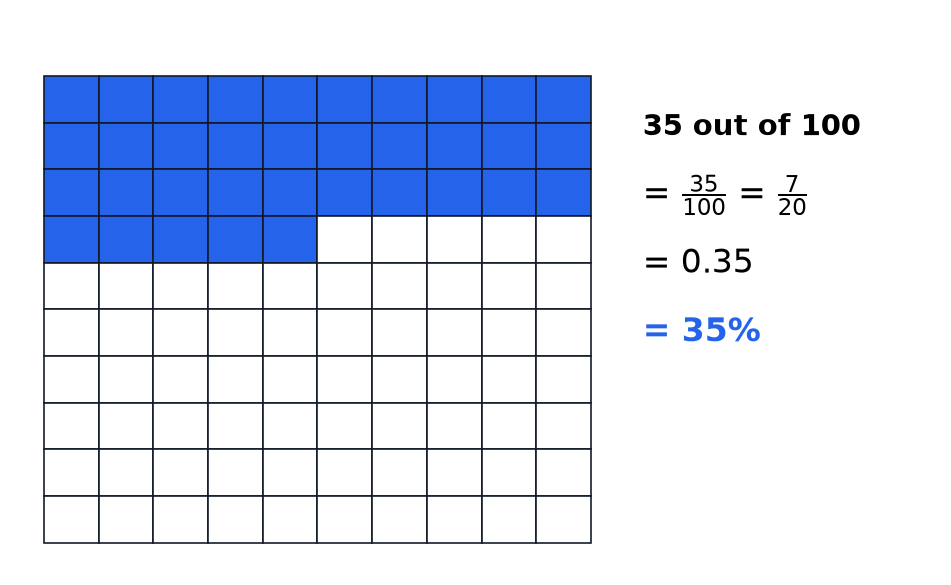
Each square in the grid is 1% of the whole. Shading 35 of them gives the percentage 35%, the decimal 0.35 and the fraction \(\frac{35}{100}\), which simplifies to \(\frac{7}{20}\).
Moving between the forms
- Percentage to decimal Divide by 100: \(35\% = 0.35\).
- Decimal to fraction Write it over 10, 100 or 1000 and simplify: \(0.35 = \frac{35}{100} = \frac{7}{20}\).
- Fraction to percentage Divide the top by the bottom, then multiply by 100: \(\frac{3}{8} = 0.375 = 37.5\%\).
The conversion route
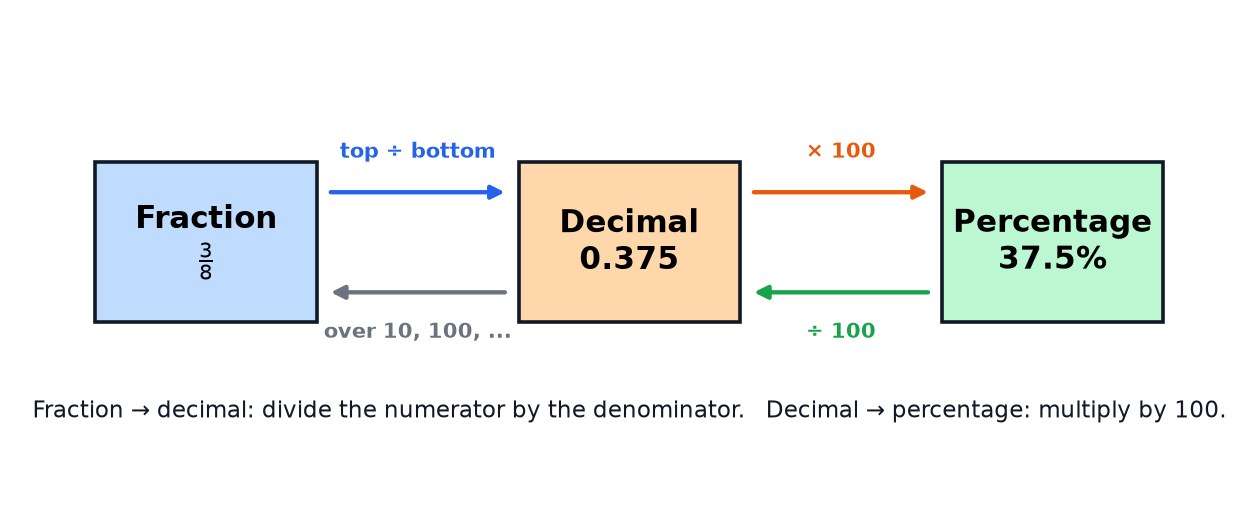
Fraction to decimal means top divided by bottom, then times 100 for a percentage.
Equivalents to know without working them out
These come up so often that recalling them saves time and avoids errors.
-
Halves and quarters
\(\frac{1}{2} = 0.5 = 50\%\), \(\frac{1}{4} = 0.25 = 25\%\) and \(\frac{3}{4} = 0.75 = 75\%\).
-
Fifths and tenths
\(\frac{1}{5} = 0.2 = 20\%\) and \(\frac{1}{10} = 0.1 = 10\%\). Multiply for the others: \(\frac{3}{5} = 60\%\).
-
Eighths
\(\frac{1}{8} = 0.125 = 12.5\%\), so \(\frac{3}{8} = 37.5\%\) and \(\frac{5}{8} = 62.5\%\).
-
Thirds
\(\frac{1}{3} = 0.333\ldots = 33\frac{1}{3}\%\) and \(\frac{2}{3} = 66\frac{2}{3}\%\). Thirds are recurring, so keep them as fractions where you can.
Percentage of an amount without a calculator
Build any percentage out of 10%, 5% and 1%.
-
10% first
Divide by 10. 10% of £240 is £24. Then 20% is double, 30% is triple, and 5% is half of 10%.
-
Build the percentage
\(35\%\) of £240 is \(30\% + 5\% = £72 + £12 = £84\).
-
Use a multiplier
\(15\%\) of 80 is \(0.15 \times 80 = 12\). The multiplier is the percentage divided by 100.
-
Use a fraction
Where you know the equivalent, use it: 25% of 60 is \(\frac{1}{4} \times 60 = 15\).
An awkward percentage
Work out 17.5% of £640 without a calculator.
Show the solutionHide the solution
- 1 Find 10% \(640 \div 10 = 64\).
- 2 Find 5% Half of 10%: \(64 \div 2 = 32\).
- 3 Find 2.5% Half of 5%: \(32 \div 2 = 16\).
- 4 Add \(17.5\% = 10\% + 5\% + 2.5\% = 64 + 32 + 16 = £112\).
Answer£112
Percentage change
Increasing or decreasing by a percentage is one multiplication when you use a multiplier.
-
Multiplier for an increase
Add the percentage to 100% and divide by 100. An increase of 12% has multiplier \(1.12\).
-
Multiplier for a decrease
Subtract the percentage from 100% and divide by 100. A decrease of 8% has multiplier \(0.92\).
-
Percentage change
Use \(\frac{\text{change}}{\text{original}} \times 100\). A rise from £40 to £47 is \(\frac{7}{40} \times 100 = 17.5\%\).
-
Always divide by the original
The percentage change is measured against the starting value, not the new one.
Increasing by a percentage
A television costs £480 before VAT. VAT of 20% is added. Work out the total price.
Show the solutionHide the solution
- 1 Find 20% \(10\% = £48\), so \(20\% = £96\).
- 2 Add it on \(£480 + £96 = £576\).
- 3 Or use a multiplier \(480 \times 1.2 = 576\), which gives the same answer.
Answer£576
Reverse percentages
The value you are given is the price after the change, so it is not 100%. Work out what percentage it is, divide to find 1%, then scale up to 100%.
The reverse method
- Find what the new value is as a percentage After a 20% increase the new value is 120% of the original.
- Divide to find 1% \(84 \div 120 = 0.70\), so 1% is £0.70.
- Scale up \(100\% = 0.70 \times 100 = £70\).
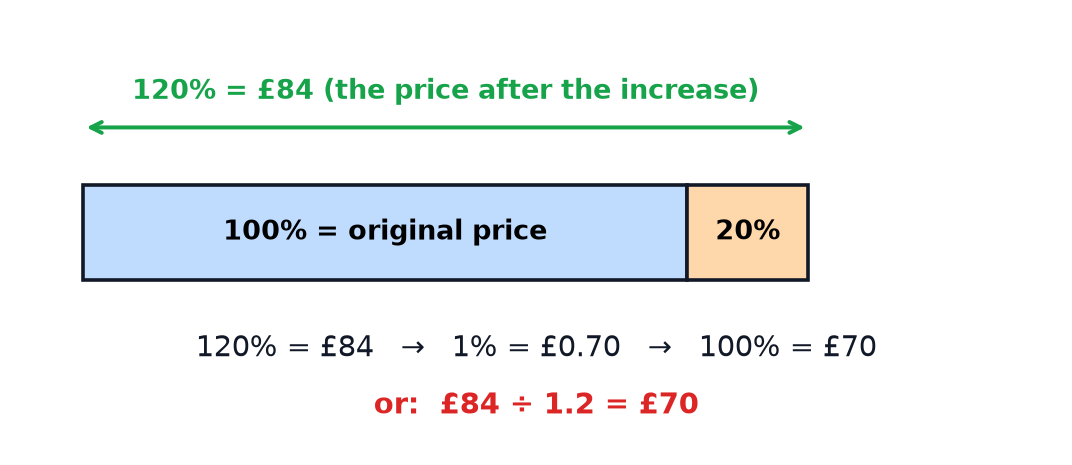
Finding the original price
In a sale all prices are reduced by 25%. A coat costs £63 in the sale. Work out the original price.
Show the solutionHide the solution
- 1 Decide what £63 represents A 25% reduction leaves 75% of the original, so \(75\% = £63\).
- 2 Find 25% \(63 \div 3 = 21\), so \(25\% = £21\).
- 3 Find 100% \(4 \times 21 = £84\). Check: 25% of 84 is 21 and \(84 - 21 = 63\).
Answer£84
Increase by 20% or undo a 20% increase?
Increase by 20%
- Multiplier is 1.2
- Multiply the original by 1.2
- Used when you know the starting amount
Reverse a 20% increase
- The same multiplier 1.2 is used, but the other way
- Divide the new amount by 1.2
- Used when you are given the final amount
Terminating and recurring decimals
Some fractions give decimals that stop, and some give decimals that go on for ever.
-
Terminating
A terminating decimal ends, such as \(\dfrac{3}{8} = 0.375\). A fraction in its simplest form terminates only if its denominator has no prime factors other than 2 and 5.
-
Recurring
A recurring decimal repeats for ever, shown with a dot over the repeating digit: \(\dfrac{1}{3} = 0.333\ldots = 0.\dot{3}\).
-
Converting by division
Divide the numerator by the denominator, adding zeros after the decimal point as you need them. \(3 \div 8 = 0.375\).
-
Which is which?
\(\dfrac{7}{20}\) terminates because \(20 = 2^2 \times 5\), but \(\dfrac{1}{6}\) recurs because 6 has the prime factor 3.
Converting a fraction to a decimal
Write \(\dfrac{5}{8}\) as a decimal without a calculator.
Show the solutionHide the solution
- 1 Set up the division \(5 \div 8\) written as \(5.000 \div 8\).
- 2 Divide step by step \(50 \div 8 = 6\) remainder 2, so the first digit is 6. \(20 \div 8 = 2\) remainder 4, so the next digit is 2. \(40 \div 8 = 5\), so the last digit is 5.
- 3 Write the answer \(0.625\).
- 4 Or use a known fact \(\dfrac{1}{8} = 0.125\), so \(\dfrac{5}{8} = 5 \times 0.125 = 0.625\).
Answer0.625
One quantity as a percentage of another
To say what percentage one quantity is of another, write it as a fraction of the second quantity first.
-
Method
Divide the first quantity by the second, then multiply by 100. 36 out of 80 is \(\dfrac{36}{80} = 0.45 = 45\%\).
-
Same units
Convert first. 45 cm out of 2 m is 45 out of 200, which is 22.5%.
-
Comparing
Percentages make different totals comparable, such as 36 out of 45 (80%) against 29 out of 40 (72.5%).
-
Over 100%
A percentage can be above 100%. 30 out of 20 is 150%.
Comparing test results with percentages
Sam scored 36 out of 45 in a test. Tia scored 29 out of 40 in a different test. Who did better?
Show the solutionHide the solution
- 1 Sam as a percentage \(\dfrac{36}{45} = \dfrac{4}{5} = 80\%\).
- 2 Tia as a percentage \(\dfrac{29}{40} = 0.725 = 72.5\%\).
- 3 Compare 80% is bigger than 72.5%, so Sam did better.
AnswerSam
Simple interest
Simple interest is the same amount added every year, calculated on the original amount only.
-
The idea
The interest is not recalculated on the growing total, so it is the same every year.
-
Method
Find the interest for one year, then multiply by the number of years. 3% of \(\pounds 2000\) is \(\pounds 60\) each year, so after 4 years the interest is \(\pounds 240\).
-
Total
Add the interest to the original amount: \(\pounds 2000 + \pounds 240 = \pounds 2240\).
-
Not the same as compound interest
With compound interest the interest itself earns interest, so the amount grows faster.
A simple interest problem
Anna invests \(\pounds 800\) for 3 years at \(4\%\) simple interest per year. Work out the total amount at the end of 3 years.
Show the solutionHide the solution
- 1 Find 1% \(800 \div 100 = 8\).
- 2 Find 4% \(4 \times 8 = \pounds 32\) interest each year.
- 3 Multiply by the years \(3 \times 32 = \pounds 96\).
- 4 Add to the original \(800 + 96 = \pounds 896\).
Answer\(\pounds 896\)
Test yourself
-
1
Write \(\dfrac{7}{20}\) as a percentage.
Show answerHide answer
35%, because \(\dfrac{7}{20} = \dfrac{35}{100}\).
-
2
Find 10% of \(\pounds 35\).
Show answerHide answer
\(\pounds 3.50\).
-
3
What is the multiplier for a 15% increase?
Show answerHide answer
1.15.
-
4
Write \(0.\dot{3}\) as a fraction.
Show answerHide answer
\(\dfrac{1}{3}\).
-
5
Increase 80 by 25%.
Show answerHide answer
100, because 25% of 80 is 20.
Exam technique: percentage questions
Most of the marks on percentage questions are for choosing the right calculation.
-
Build percentages from 10%
Write "10% = ..." on its own line. It gives a clear method mark and helps you check.
-
Use the original amount
Percentage change is always the change divided by the original value, not the new value.
-
Reverse percentages
If you are given the value after a change, do not simply subtract the percentage. Find 1% or divide by the multiplier.
-
Include units
Money answers need a pound sign and two decimal places where there are pence.
Summary and exam focus
- Percentage, decimal and fraction are three ways to write the same number, so learn the common equivalents.
- Build percentages from 10%, 5% and 1% or use a multiplier.
- Increase with a multiplier above 1 and decrease with a multiplier below 1.
- Percentage change is the change divided by the original, multiplied by 100.
- For reverse percentages, the amount you are given is the percentage after the change, so find 1% and scale up, or divide by the multiplier.
Exam focus
In a sale, the normal price of a bike is reduced by 30%. The sale price is £56. Work out the normal price. (3 marks) (3 marks)
Write down what the sale price is as a percentage (70%) before doing any arithmetic. Candidates who take 30% of £56 and add it on lose all three marks, because 56 is not the original amount.
Key terms
The words this lesson expects you to use. Each one is linked from the first place it appears above.
- Recurring decimal
- A decimal with one or more digits that repeat for ever, shown with a dot above them.
- Percentage
- A number written as a fraction of 100, using the symbol %.
- Per cent
- Out of every hundred.
- Equivalent
- Having the same value but written in a different form.
- Multiplier
- The number you multiply by to apply a percentage change, such as 1.2 for a 20% increase.
- Percentage increase
- A rise in a quantity written as a percentage of its original value.
- Percentage decrease
- A fall in a quantity written as a percentage of its original value.
- Percentage change
- The change divided by the original amount, multiplied by 100.
- Reverse percentage
- A problem where you are given the value after a change and must find the original.
- Original value
- The amount before a percentage increase or decrease is applied.
Questions and answers
17 questions set on this lesson, with the mark schemes and model answers open.
Write \(0.45\) as a percentage.
Mark scheme — 1 mark available
- 45% — B1
Model answer
Multiply by 100: \(0.45 \times 100 = 45\%\).
Write \(\dfrac{3}{20}\) as a percentage.
Mark scheme — 2 marks available
- \(\dfrac{15}{100}\) or \(0.15\) — M1
- 15% — A1
Model answer
\(\dfrac{3}{20} = \dfrac{15}{100} = 15\%\).
Work out \(35\%\) of 480. You must show your working.
Mark scheme — 3 marks available
- Finds 10% (48) or 5% (24) — M1
- Adds correct parts, such as 144 + 24 — M1
- 168 — A1
Model answer
\(10\% = 48\), so \(30\% = 144\). \(5\% = 24\). Then \(35\% = 144 + 24 = 168\).
Write these in order of size. Start with the smallest. \(\dfrac{2}{5}\) \(0.38\) \(41\%\)
Mark scheme — 2 marks available
- At least two converted to a common form — M1
- \(0.38,\ \dfrac{2}{5},\ 41\%\) — A1
Model answer
\(\dfrac{2}{5} = 0.4\) and \(41\% = 0.41\). The order is \(0.38,\ \dfrac{2}{5},\ 41\%\).
A phone costs \(\pounds 250\). In a sale the price is reduced by \(18\%\). Work out the sale price.
Mark scheme — 3 marks available
- Finds 10% or 1% correctly — M1
- \(18\% = 45\) or \(250 \times 0.82\) — M1
- \(\pounds 205\) — A1
Model answer
\(10\% = 25\) and \(8\% = 20\), so \(18\% = 45\). The sale price is \(250 - 45 = \pounds 205\).
The price of a ticket rises from \(\pounds 25\) to \(\pounds 28\). Work out the percentage increase.
Mark scheme — 3 marks available
- \(28 - 25 = 3\) — M1
- \(\dfrac{3}{25} \times 100\) or \(\dfrac{3}{25} = 0.12\) — M1
- 12% — A1
Model answer
The increase is \(28 - 25 = \pounds 3\). \(\dfrac{3}{25} \times 100 = 12\%\).
After a \(20\%\) increase, a water bill is \(\pounds 144\). Work out the bill before the increase.
Mark scheme — 3 marks available
- Recognises that 144 is 120% — M1
- \(144 \div 12 = 12\) (10%) or \(144 \div 1.2\) — M1
- \(\pounds 120\) — A1
Model answer
\(144\) is \(120\%\) of the original bill. \(120\% = 144\), so \(10\% = 12\) and \(100\% = \pounds 120\).
Which of these fractions is a recurring decimal?
Why: 6 has the prime factor 3, so \(\dfrac{1}{6} = 0.1\dot{6}\) recurs. The others have denominators with only the prime factors 2 and 5.
£500 is invested for 4 years at 3% simple interest per year. How much interest is earned in total?
Why: 3% of £500 is £15 a year, and \(15 \times 4 = £60\).
Write 0.035 as a percentage.
Why: Multiply by 100: \(0.035 \times 100 = 3.5\%\).
Write \(\dfrac{3}{8}\) as a percentage.
Why: \(3 \div 8 = 0.375\), and \(0.375 \times 100 = 37.5\%\).
What is 15% of 60?
Why: 10% is 6 and 5% is 3, so 15% is 9.
What is the multiplier for a decrease of 8%?
Why: 100% − 8% = 92%, which is 0.92.
Increase £60 by 25%.
Why: 25% of 60 is 15, and 60 + 15 = 75.
After a 20% decrease, a price is £48. What was the original price?
Why: The sale price is 80% of the original, so the original is 48 ÷ 0.8 = £60.
A price rises from 40 to 50. What is the percentage increase?
Why: The change is 10, and \(\dfrac{10}{40} \times 100 = 25\%\). It is divided by the original, not the new price.
Write 12.5% as a fraction in its simplest form.
Why: \(12.5\% = \dfrac{12.5}{100} = \dfrac{1}{8}\).