Maths · Ratio and Proportion
Viewing as
Teacher view: every answer and mark scheme set out in full.
Direct and Inverse Proportion
Solving proportion problems with the unitary method, best buys and exchange rates, and recognising direct and inverse proportion.
Learning Objectives
- 1Recognise direct and inverse proportion from a situation, a table or a graph.
- 2Solve direct proportion problems using the unitary method, including recipes, currency and best buys.
- 3Solve inverse proportion problems by finding the total and dividing.
- 4Write and use \(y = kx\) and \(y = \dfrac{k}{x}\) to solve proportion problems (Higher tier).
Two ways quantities can be linked
Proportion describes how two quantities change together. In direct proportion they rise and fall together, such as the cost of pens and the number you buy. In inverse proportion one rises as the other falls, such as the number of painters and the days a job takes. Deciding which one a question is about is half of the work, and the unitary method, finding the value of one, then scaling, solves most of the rest.
Direct proportion
In direct proportion, doubling one quantity doubles the other, so their ratio never changes.
-
The idea
If 5 pens cost \(\pounds 3.50\), then 10 pens cost \(\pounds 7.00\). The cost per pen is always the same.
-
Unitary method
Find the value of one item, then multiply. \(3.50 \div 5 = 0.70\), so 1 pen costs 70p and 8 pens cost \(8 \times 0.70 = \pounds 5.60\).
-
Recipes
If 300 g of flour makes enough for 4 people, then 1 person needs \(300 \div 4 = 75\) g and 10 people need 750 g.
-
On a graph
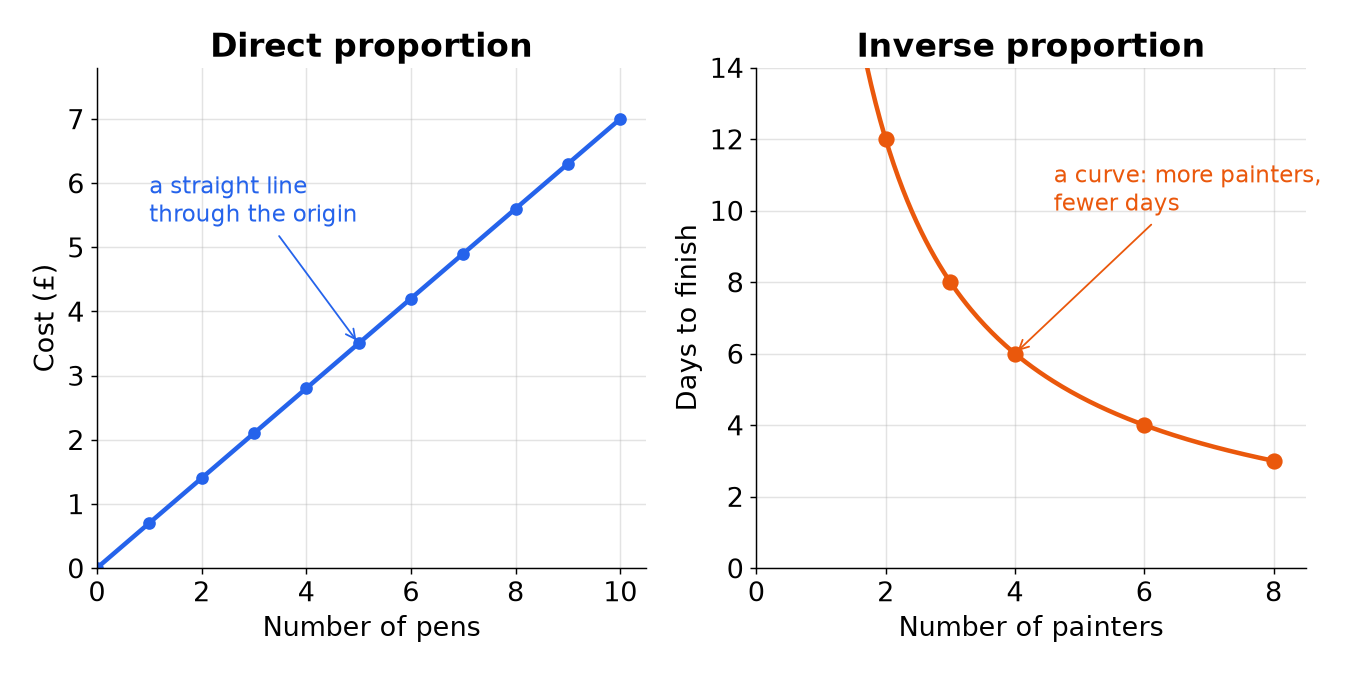
Direct proportion gives a straight line that passes through the origin, because zero of one means zero of the other.
Direct and inverse proportion on graphs
The shape of the graph tells you which kind of proportion you have. A straight line through the origin means direct proportion, and a curve that falls and flattens means inverse proportion.
Reading the graphs
- Direct Straight line through \((0, 0)\), so \(y \div x\) is always the same.
- Inverse A curve that never touches the axes, so \(x \times y\) is always the same.
- Test it Check two or three pairs of values before you decide.
The unitary method
7 notebooks cost \(\pounds 10.50\). How much do 12 notebooks cost?
Show the solutionHide the solution
- 1 Find the cost of one \(10.50 \div 7 = \pounds 1.50\).
- 2 Scale up \(12 \times 1.50 = \pounds 18.00\).
- 3 Check 12 is a bit less than double 7, so the cost should be a bit less than double \(\pounds 10.50\), which is \(\pounds 21\). \(\pounds 18\) is sensible.
Answer\(\pounds 18\)
Best buys
To decide which size is better value, compare the price of the same amount of each.
-
Price per unit
Divide the price by the amount. 500 g for \(\pounds 1.20\) is \(120 \div 500 = 0.24\)p per gram, and 750 g for \(\pounds 1.65\) is \(165 \div 750 = 0.22\)p per gram.
-
Same amount
Or scale both to a common amount. 1500 g is \(3 \times \pounds 1.20 = \pounds 3.60\) for the smaller pack and \(2 \times \pounds 1.65 = \pounds 3.30\) for the larger.
-
Write a conclusion
Say which is better value and give the numbers that show it: "The 750 g pack is better value because it costs 22p per 100 g, compared with 24p per 100 g."
-
Be fair
Compare like with like. A larger pack is not always cheaper per gram.
Currency and rates
An exchange rate is a direct proportion.
-
Using a rate
If \(\pounds 1 = \$1.25\), then \(\pounds 80 = 80 \times 1.25 = \$100\).
-
Going back
To change dollars to pounds, divide. \(\$150 \div 1.25 = \pounds 120\).
-
Use a sense check
Dollars are worth less than pounds, so you should get more dollars than pounds.
-
Other rates
Wages per hour, cost per kilogram and miles per gallon are all rates and use the same method.
Inverse proportion
In inverse proportion, one quantity falls as the other rises, and their product stays the same.
-
The idea
If 3 painters take 8 days, the total work is \(3 \times 8 = 24\) painter-days. Doubling the painters halves the time.
-
Method
Find the total, then divide by the new number. 6 painters take \(24 \div 6 = 4\) days.
-
Spotting it
Look for a fixed job: a wall to paint, a journey of fixed distance, or a fixed amount of food shared among more people.
-
Not always a whole number
5 painters take \(24 \div 5 = 4.8\) days.
An inverse proportion problem
It takes 3 painters 8 days to paint a building. How long would it take 6 painters, working at the same rate?
Show the solutionHide the solution
- 1 Find the total work \(3 \times 8 = 24\) painter-days.
- 2 Divide by the new number of painters \(24 \div 6 = 4\).
- 3 Sense check Twice as many painters should take half as long. Half of 8 is 4.
Answer4 days
Is it proportional?
A table of values can show whether two quantities are in direct proportion.
-
The test
Divide \(y\) by \(x\) for each pair. If the answer is always the same, the quantities are in direct proportion.
-
A proportional table
\((2, 6)\), \((5, 15)\), \((7, 21)\) all give \(y \div x = 3\).
-
A table that is not
\((3, 9)\) gives 3 but \((5, 13)\) gives 2.6, so they are not proportional.
-
Adding the same amount is not proportion
A taxi with a fixed charge plus a rate per mile is not in direct proportion to the distance.
Writing proportion as a formula (Higher tier)
The symbol \(\propto\) means "is proportional to", and a constant \(k\) turns it into an equation.
-
Direct
\(y \propto x\) means \(y = kx\). If \(y = 15\) when \(x = 3\), then \(k = 5\), so \(y = 5x\) and when \(x = 8\), \(y = 40\).
-
Inverse
\(y \propto \dfrac{1}{x}\) means \(y = \dfrac{k}{x}\). If \(y = 4\) when \(x = 6\), then \(k = 24\), so when \(x = 8\), \(y = 3\).
-
Squares
\(y \propto x^2\) means \(y = kx^2\). If \(y = 20\) when \(x = 2\), then \(k = 5\), so when \(x = 3\), \(y = 45\).
-
Method
Write the equation with \(k\), substitute the known pair to find \(k\), rewrite with the value of \(k\), and then use it.
Proportional to a square (Higher tier)
\(y\) is directly proportional to \(x^2\). When \(x = 4\), \(y = 48\). Find \(y\) when \(x = 5\), and find \(x\) when \(y = 27\).
Show the solutionHide the solution
- 1 Write the equation \(y = kx^2\).
- 2 Find \(k\) \(48 = k \times 16\), so \(k = 3\) and \(y = 3x^2\).
- 3 Find \(y\) when \(x = 5\) \(y = 3 \times 25 = 75\).
- 4 Find \(x\) when \(y = 27\) \(27 = 3x^2\), so \(x^2 = 9\) and \(x = 3\).
Answer\(y = 75\) and \(x = 3\)
Direct and inverse proportion
Direct proportion
- Both quantities rise or fall together
- \(y \div x\) is always the same
- The graph is a straight line through the origin
Inverse proportion
- One quantity rises as the other falls
- \(x \times y\) is always the same
- The graph is a curve that falls and flattens
Test yourself
-
1
5 pens cost \(\pounds 3.50\). What do 8 pens cost?
Show answerHide answer
\(\pounds 5.60\), because one pen costs 70p.
-
2
4 people need 300 g of flour. How much for 10 people?
Show answerHide answer
750 g.
-
3
3 painters take 8 days. How long do 4 painters take?
Show answerHide answer
6 days, because \(3 \times 8 = 24\) and \(24 \div 4 = 6\).
-
4
\(\pounds 1 = \$1.25\). How many dollars is \(\pounds 80\)?
Show answerHide answer
\(\$100\).
-
5
What does a direct proportion graph look like?
Show answerHide answer
A straight line through the origin.
Exam technique: proportion questions
The question usually tells you which kind of proportion it is, but not always.
-
Say what you are finding
Write "cost of 1 notebook" before the division, so the method is clear.
-
Show a sense check
Direct proportion answers should be bigger when the quantity is bigger. Inverse answers should be smaller.
-
Best buys need a conclusion
Calculate both unit prices and then say which pack is better value, with a reason.
-
Use the units
Convert pounds and pence consistently before you divide.
Summary and exam focus
- In direct proportion both quantities rise together and \(y \div x\) is constant, so the graph is a straight line through the origin.
- The unitary method finds the value of one, then multiplies.
- For a best buy, compare the cost of the same amount of each pack and write a conclusion.
- In inverse proportion \(x \times y\) is constant, so find the total and divide by the new quantity.
- On the Higher tier, \(y = kx\) and \(y = \dfrac{k}{x}\) are found by substituting a known pair to get \(k\).
Exam focus
5 kg of potatoes cost \(\pounds 3.20\). Work out the cost of 12 kg of potatoes. (3 marks) (3 marks)
Find the cost of 1 kg first and write it down, rather than going straight to 12 kg. Dividing \(3.20 \div 5 = 0.64\) and then multiplying by 12 shows the method clearly and earns the marks even if the final multiplication slips.
Key terms
The words this lesson expects you to use. Each one is linked from the first place it appears above.
- Direct proportion
- A relationship in which two quantities increase or decrease at the same rate, so their ratio stays the same.
- Inverse proportion
- A relationship in which one quantity increases as the other decreases, so their product stays the same.
- Unitary method
- Finding the value of one unit first, then scaling up to the amount needed.
- Best buy
- The pack or size that costs least for the same amount.
- Unit price
- The cost of one unit, such as the price per gram or per item.
- Exchange rate
- The amount of one currency that you get for one unit of another.
- Constant of proportionality
- The fixed number \(k\) that links two quantities in direct proportion, so that \(y = kx\).
- Rate
- A comparison of two different kinds of quantity, such as pounds per hour.
- Proportional to
- The meaning of \(\propto\): changing in a fixed relationship with another quantity.
Questions and answers
15 questions set on this lesson, with the mark schemes and model answers open.
Here are the ingredients for 4 people: 300 g of rice, 120 g of peas and 2 onions. Work out the amounts needed for 10 people.
Mark scheme — 3 marks available
- Scale factor 2.5, or the amounts for 2 people found — M1
- Two of the three amounts correct — A1
- 750 g, 300 g and 5 onions — A1
Model answer
The scale factor is \(10 \div 4 = 2.5\). Rice: \(300 \times 2.5 = 750\) g. Peas: \(120 \times 2.5 = 300\) g. Onions: \(2 \times 2.5 = 5\).
7 notebooks cost \(\pounds 10.50\). Work out the cost of 12 of these notebooks.
Mark scheme — 2 marks available
- \(10.50 \div 7 = 1.50\) — M1
- \(\pounds 18\) — A1
Model answer
One notebook costs \(10.50 \div 7 = \pounds 1.50\), so 12 cost \(12 \times 1.50 = \pounds 18\).
Here are two offers for tea bags. Offer A (80 tea bags) costs \(\pounds 2.40\) Offer B (240 tea bags) costs \(\pounds 6.60\) Which offer is better value for money? You must show your working.
Mark scheme — 3 marks available
- A method to compare, such as the cost of one tea bag or the cost of 240 tea bags for offer A — M1
- 3p and 2.75p, or \(\pounds 7.20\) and \(\pounds 6.60\) — A1
- Offer B, with a correct comparison — Q1
Model answer
Offer A: \(240 \div 80 = 3\) pence per tea bag. Offer B: \(660 \div 240 = 2.75\) pence per tea bag. Offer B is cheaper per tea bag, so it is better value.
\(\pounds 1 = \euro 1.25\). Work out how many pounds you get for \(\euro 200\).
Mark scheme — 2 marks available
- \(200 \div 1.25\) — M1
- \(\pounds 160\) — A1
Model answer
\(200 \div 1.25 = 160\), so you get \(\pounds 160\).
5 machines take 12 hours to make a batch of parts. All the machines work at the same rate. How long would 4 machines take to make the same batch?
Mark scheme — 2 marks available
- \(5 \times 12 = 60\) — M1
- 15 hours — A1
Model answer
The batch needs \(5 \times 12 = 60\) machine-hours, and \(60 \div 4 = 15\) hours.
\(y\) is directly proportional to the square of \(x\). When \(x = 3\), \(y = 18\). (a) Work out the value of \(y\) when \(x = 5\). (3 marks) (b) Work out the positive value of \(x\) when \(y = 32\). (1 mark)
Mark scheme — 4 marks available
- (a) \(y = kx^2\) with \(k = 2\) found — M1
- (a) \(2 \times 5^2\) — M1
- (a) 50 — A1
- (b) 4 — B1
Model answer
(a) \(y = kx^2\), so \(18 = k \times 9\) and \(k = 2\). When \(x = 5\), \(y = 2 \times 25 = 50\). (b) \(32 = 2x^2\), so \(x^2 = 16\) and \(x = 4\).
5 pens cost \(\pounds 3.50\). How much do 8 pens cost?
Why: One pen costs \(3.50 \div 5 = 0.70\). Then 8 pens cost \(8 \times 0.70 = 5.60\).
A recipe for 4 people uses 300 g of flour. How much flour is needed for 10 people?
Why: For one person, \(300 \div 4 = 75\) g. For 10 people, \(75 \times 10 = 750\) g.
Which of these shows that \(y\) is directly proportional to \(x\)?
Why: In direct proportion \(y\) is a constant multiple of \(x\), so \(y = 3x\), which makes a straight line through the origin.
6 workers take 10 days to build a wall. How long would 15 workers take, working at the same rate?
Why: The job takes \(6 \times 10 = 60\) worker-days. With 15 workers it takes \(60 \div 15 = 4\) days.
Which pack of cereal is the best value?
Why: The cost per 100 g is 40p, 38p, 39.5p and 39p. The 750 g pack is the cheapest per 100 g.
\(\pounds 1 = \euro 1.20\). How many euros do you get for \(\pounds 50\)?
Why: Multiply by the exchange rate: \(50 \times 1.2 = 60\).
Two taps fill a tank in 30 minutes. How long would 5 identical taps take?
Why: This is inverse proportion. The total is \(2 \times 30 = 60\) tap-minutes, so 5 taps need \(60 \div 5 = 12\) minutes.
\(y\) is directly proportional to \(x\). \(y = 12\) when \(x = 3\). Work out \(y\) when \(x = 7\).
Why: \(y = kx\) and \(12 = 3k\), so \(k = 4\). Then \(y = 4 \times 7 = 28\).
\(y\) is inversely proportional to \(x\). \(y = 6\) when \(x = 4\). Work out \(y\) when \(x = 3\).
Why: \(y = \dfrac{k}{x}\) and \(6 = \dfrac{k}{4}\), so \(k = 24\). Then \(y = \dfrac{24}{3} = 8\).