Maths · Ratio and Proportion
Viewing as
Teacher view: every answer and mark scheme set out in full.
Repeated Percentage Change and Compound Interest
Using multipliers for percentage change, compound interest and depreciation, and working back to the original amount.
Learning Objectives
- 1Use a multiplier to increase or decrease an amount by a percentage in one step.
- 2Solve repeated percentage change problems, including compound interest and depreciation.
- 3Compare simple interest with compound interest.
- 4Find the original amount after a percentage change (Higher tier).
Percentages that build on each other
A single percentage change is easy, but real life often repeats it: a bank adds interest every year, and a car loses value every year. The important idea is that each change is applied to the new amount, not the original, so the changes cannot just be added together. A multiplier turns the whole calculation into repeated multiplication, which is quick and tidy, even without a calculator when the numbers are chosen well.
Percentage multipliers
A multiplier is the single number you multiply by to apply a percentage change in one step.
-
Increase
Add the percentage to 100% and write it as a decimal. An increase of 15% gives \(115\% = 1.15\).
-
Decrease
Subtract the percentage from 100% and write it as a decimal. A decrease of 15% gives \(85\% = 0.85\).
-
Some to know
\(+10\% = 1.1\), \(+25\% = 1.25\), \(+5\% = 1.05\), \(-10\% = 0.9\), \(-20\% = 0.8\), \(-2\% = 0.98\).
-
Why it works
Increasing by 15% means you keep 100% and gain a further 15%, which is 115% of the original amount.
A single change with a multiplier
A phone costs £400. In a sale the price is reduced by 15%. Work out the sale price.
Show the solutionHide the solution
- 1 Find the multiplier \(100\% - 15\% = 85\%\), so the multiplier is 0.85.
- 2 Multiply \(400 \times 0.85\).
- 3 Calculate \(400 \times 0.85 = 340\).
- 4 Write the answer £340.
Answer£340
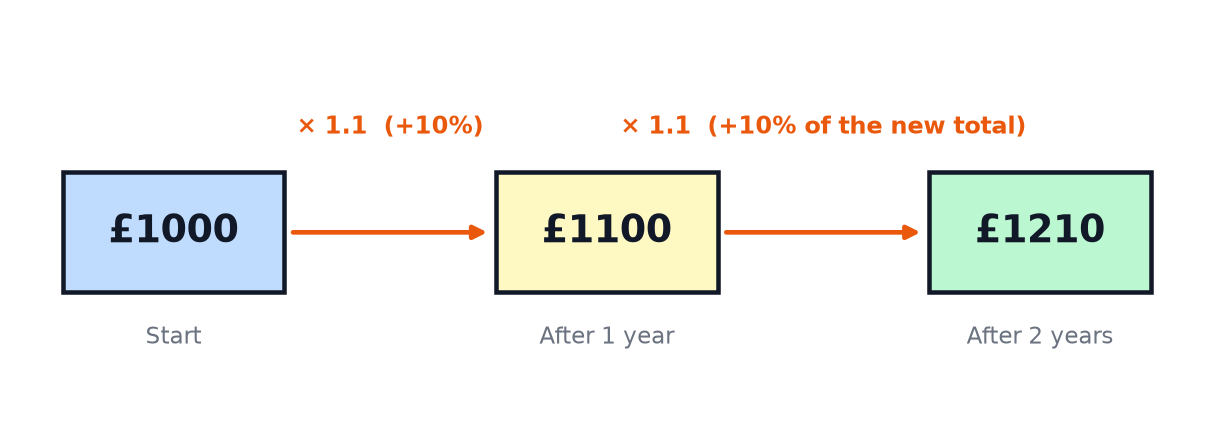
Two steps of growth
In the second year the 10% is taken from £1100, not from £1000, so the increase is £110 rather than £100. The same multiplier is used each time.
What to notice
- Same multiplier each year \(1000 \times 1.1 = 1100\) and \(1100 \times 1.1 = 1210\).
- Not 20% The total increase after two years is £210, which is 21%, not 20%.
- Shortcut \(1000 \times 1.1 \times 1.1 = 1000 \times 1.1^2 = 1210\).
Repeated percentage change
To apply the same percentage change \(n\) times, raise the multiplier to the power \(n\).
-
The formula
New amount \(=\) original amount \(\times\) multiplier\(^n\).
-
Growth
A multiplier above 1, such as 1.05, gives growth. This is compound interest, or population increase.
-
Decay
A multiplier below 1, such as 0.8, gives decay. This is depreciation of a car, or a falling population.
-
Different percentages
If the percentage changes each year, multiply by a different multiplier each time: \(\times 1.05 \times 1.03\).
Compound interest
Sam invests £2000 at 5% compound interest per year. Work out the value of the investment after 2 years.
Show the solutionHide the solution
- 1 Find the multiplier \(100\% + 5\% = 105\%\), so the multiplier is 1.05.
- 2 Apply it twice \(2000 \times 1.05^2\).
- 3 Work out the power \(1.05^2 = 1.1025\), so \(2000 \times 1.1025 = 2205\).
- 4 Or do it year by year \(2000 \times 1.05 = 2100\), then \(2100 \times 1.05 = 2205\).
- 5 Write the answer £2205.
Answer£2205
Depreciation
A car is worth £12 000. Its value falls by 20% each year. Work out its value after 2 years.
Show the solutionHide the solution
- 1 Find the multiplier \(100\% - 20\% = 80\%\), so the multiplier is 0.8.
- 2 Apply it twice \(12\,000 \times 0.8 = 9600\), then \(9600 \times 0.8 = 7680\).
- 3 Write the answer £7680.
- 4 Check The car is worth less each year, and the fall in the second year (£1920) is smaller than in the first (£2400), as it should be.
Answer£7680
Simple and compound interest
There are two ways a bank can pay interest, and the difference is what the interest is calculated on.
-
Simple interest
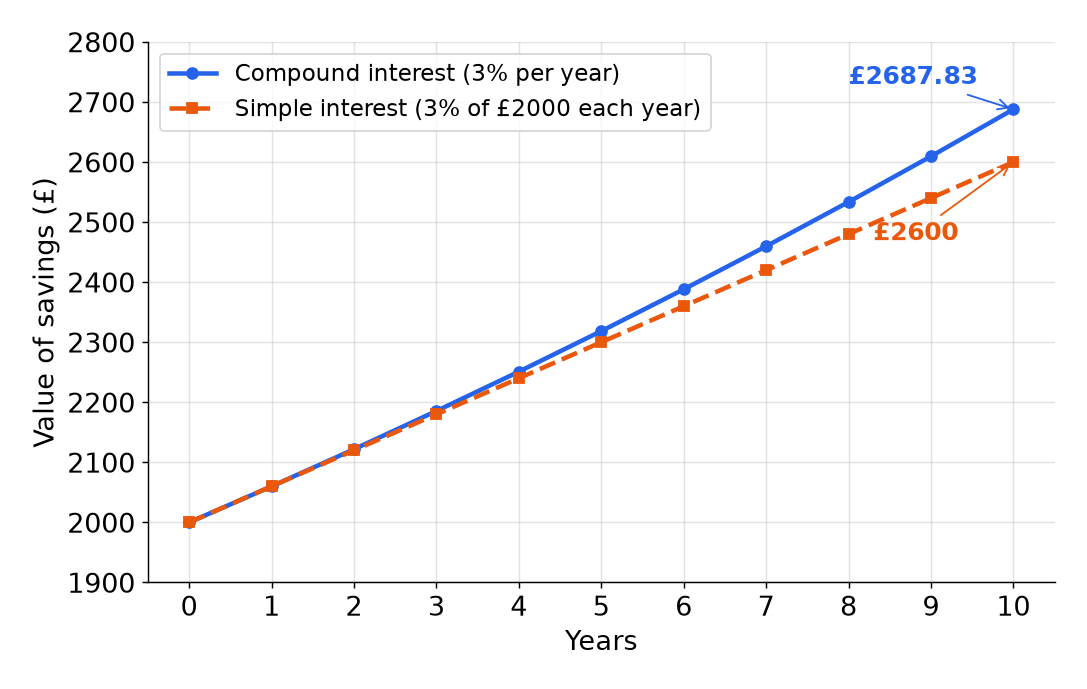
The same amount is added every year, because it is always a percentage of the original amount. 3% of £2000 is £60 a year.
-
Compound interest
Interest is added to the account and then earns interest itself, so the amount added grows each year.
-
Which is bigger
After the first year they are the same. After that compound interest is always larger.
-
Reading questions
Unless the question says "simple", assume compound interest.
Compound interest against simple interest
The simple interest line is straight because the same £60 is added each year. The compound interest line curves upwards because each year's interest is a little larger than the year before.
Reading the graph
- Straight against curved Simple interest is a constant amount each year, so the graph is a straight line.
- The gap grows After 10 years the compound account has £87.83 more than the simple one.
- Same start Both are £2060 after one year.
Finding the original amount (Higher tier)
Sometimes you are told the amount after a change and asked for the amount before. You work backwards by dividing by the multiplier.
-
Divide, do not subtract
If an amount after a 20% increase is £90, the original is \(90 \div 1.2 = 75\), not \(90 - 20\%\) of 90.
-
Same for repeated change
After two 10% increases the amount is \(1.1^2 = 1.21\) times the original, so divide by 1.21.
-
Check by going forwards
Multiply your answer by the multiplier and you should get the amount in the question.
Working back to the original
(Higher tier) After a 25% increase, a house is worth £150 000. Work out its value before the increase.
Show the solutionHide the solution
- 1 Find the multiplier \(100\% + 25\% = 125\%\), so the multiplier is 1.25.
- 2 Divide by it \(150\,000 \div 1.25\).
- 3 Calculate \(150\,000 \div 1.25 = 120\,000\).
- 4 Check \(120\,000 \times 1.25 = 150\,000\). Correct.
Answer£120 000
What the Edexcel exam gives you
Edexcel prints a formulae page in the question paper, so some formulae are given to you.
-
Compound interest is given
The formulae page shows total accrued \(= P\left(1 + \dfrac{r}{100}\right)^n\), where \(P\) is the amount invested, \(r\) is the percentage rate and \(n\) is the number of times it is compounded, such as the number of years.
-
You can still use multipliers
The multiplier method in this lesson gives the same answer, and it also works for decay and for rates that change each year.
-
Not given
Simple interest and percentage change are not on the page, so learn how to do them.
Test yourself
-
1
What is the multiplier for an increase of 8%?
Show answerHide answer
1.08.
-
2
What is the multiplier for a decrease of 12%?
Show answerHide answer
0.88.
-
3
How do you apply a 5% increase three times?
Show answerHide answer
Multiply by \(1.05^3\).
-
4
What is the difference between simple and compound interest?
Show answerHide answer
Simple interest is always calculated on the original amount, while compound interest is calculated on the amount at the start of each year.
-
5
How do you find the original amount after a percentage increase?
Show answerHide answer
Divide by the multiplier.
Exam technique: repeated percentage change
Show the multiplier and the power, because a final answer alone can score no marks if it is wrong.
-
Write the multiplier
"\(\times 1.05\)" is a mark in itself.
-
Keep every decimal until the end
Rounding the multiplier too early changes the answer.
-
Read the wording
"Compound" and "each year" mean repeat the multiplier, and "simple" means the same amount each year.
-
Give money to 2 decimal places
A final answer of £2205.0 or £2205.123 loses the mark.
Summary and exam focus
- A multiplier applies a percentage change in one step: 1.15 for +15% and 0.85 for \(-15\%\).
- Repeated change uses multiplier\(^n\), and each change is applied to the new amount.
- Compound interest grows faster than simple interest after the first year.
- To find the original amount after a change, divide by the multiplier (Higher tier).
Exam focus
Aisha invests £2000 for 2 years at 4% per year compound interest. Work out the total interest she earns. (3 marks) (3 marks)
Use \(2000 \times 1.04^2 = 2163.20\) and then subtract the £2000 to get £163.20. The question asks for the interest, not the total value, so the last subtraction is worth a mark. Show the multiplier clearly.
Key terms
The words this lesson expects you to use. Each one is linked from the first place it appears above.
- Multiplier
- The number you multiply by to apply a percentage change in one step.
- Compound interest
- Interest calculated on the original amount plus any interest already added.
- Simple interest
- Interest calculated only on the original amount, giving the same amount each year.
- Depreciation
- The fall in value of an item, such as a car, over time.
- Growth
- An increase over time, with a multiplier greater than 1.
- Decay
- A decrease over time, with a multiplier less than 1.
- Principal
- The amount of money first invested or borrowed.
- Original amount
- The starting value before a percentage change is applied.
- Per annum
- Each year.
Questions and answers
15 questions set on this lesson, with the mark schemes and model answers open.
A coat costs \(\pounds 80\). In a sale the price is reduced by 15%. Work out the sale price of the coat.
Mark scheme — 3 marks available
- 10% \(= 8\) or 5% \(= 4\) or 15% \(= 12\) seen — M1
- \(80 - 12\) or \(80 \times 0.85\) — M1
- \(\pounds 68\) — A1
Model answer
10% of 80 is 8 and 5% is 4, so 15% is 12. The sale price is \(80 - 12 = \pounds 68\).
Sam invests \(\pounds 5000\) for 2 years at 4% per year compound interest. Work out the value of his investment at the end of 2 years.
Mark scheme — 3 marks available
- \(5000 \times 1.04\) or \(5000 \times 1.04^2\) — M1
- \(5200 \times 1.04\) or \(5200 + 208\) — M1
- \(\pounds 5408\) — A1
Model answer
After year 1: \(5000 \times 1.04 = 5200\). After year 2: \(5200 \times 1.04 = 5408\). The value is \(\pounds 5408\).
The value of a car is \(\pounds 9000\). Each year the value of the car falls by 10% of its value at the start of that year. Work out the value of the car after 2 years.
Mark scheme — 3 marks available
- \(9000 \times 0.9\) or \(9000 - 900\) — M1
- \(8100 \times 0.9\) or \(8100 - 810\) — M1
- \(\pounds 7290\) — A1
Model answer
After year 1: \(9000 \times 0.9 = 8100\). After year 2: \(8100 \times 0.9 = 7290\). The value is \(\pounds 7290\).
Mia invests \(\pounds 1000\) for 3 years at 5% per year simple interest. Ben invests \(\pounds 1000\) for 3 years at 5% per year compound interest. Who has more money at the end of the 3 years? You must show your working.
Mark scheme — 4 marks available
- Simple interest \(\pounds 50\) a year or \(\pounds 1150\) — M1
- \(1000 \times 1.05\) and \(1050 \times 1.05\) or \(1000 \times 1.05^3\) — M1
- \(\pounds 1157.63\) or \(\pounds 1157.625\) — A1
- Ben, with a correct comparison — C1
Model answer
Mia: \(5\%\) of 1000 is 50, so after 3 years she has \(1000 + 3 \times 50 = \pounds 1150\). Ben: \(1000 \times 1.05 = 1050\), then \(1050 \times 1.05 = 1102.50\), then \(1102.50 \times 1.05 = 1157.625\), so about \(\pounds 1157.63\). Ben has more.
In a sale, all prices are reduced by 20%. The sale price of a bag is \(\pounds 68\). Work out the original price of the bag.
Mark scheme — 3 marks available
- 80% or 0.8 seen — M1
- \(68 \div 0.8\) or \(68 \div 80 \times 100\) — M1
- \(\pounds 85\) — A1
Model answer
The sale price is 80% of the original, so the multiplier is 0.8. The original price is \(68 \div 0.8 = \pounds 85\).
The population of a town increases by 10% each year. At the start of 2024 the population was 20 000. (a) Work out the population at the start of 2026. (3 marks) (b) Show that the population increased by 21% over the two years. (1 mark)
Mark scheme — 4 marks available
- (a) \(20\,000 \times 1.1\) — M1
- (a) \(22\,000 \times 1.1\) — M1
- (a) \(24\,200\) — A1
- (b) \(1.1^2 = 1.21\) or \(24\,200 \div 20\,000 = 1.21\) — C1
Model answer
(a) After 1 year: \(20\,000 \times 1.1 = 22\,000\). After 2 years: \(22\,000 \times 1.1 = 24\,200\). (b) \(1.1^2 = 1.21\), which is an increase of 21%. Check: \(24\,200 \div 20\,000 = 1.21\).
What is the multiplier for an increase of 15%?
Why: An increase of 15% gives \(100\% + 15\% = 115\%\), which is 1.15.
What is the multiplier for a decrease of 12%?
Why: \(100\% - 12\% = 88\%\), which is 0.88.
A phone costs \(\pounds 400\). The price is reduced by 15%. What is the new price?
Why: \(400 \times 0.85 = 340\).
\(\pounds 1000\) increases by 10% each year for 2 years. What is it worth after 2 years?
Why: \(1000 \times 1.1 = 1100\) and \(1100 \times 1.1 = 1210\). The second increase is 10% of the new amount.
\(\pounds 2000\) is invested at 5% compound interest per year. What is it worth after 2 years?
Why: \(2000 \times 1.05^2 = 2000 \times 1.1025 = 2205\). The simple interest answer would be \(\pounds 2200\).
A car worth \(\pounds 12\,000\) loses 20% of its value each year. What is it worth after 2 years?
Why: \(12\,000 \times 0.8 = 9600\) and \(9600 \times 0.8 = 7680\). Taking 40% off in one go would give \(\pounds 7200\).
Which statement about interest is correct?
Why: Compound interest is paid on interest already earned, so it grows faster than simple interest, which is always paid on the original amount.
After a 25% increase, a house is worth \(\pounds 150\,000\). What was it worth before the increase?
Why: The multiplier is 1.25, so the original is \(150\,000 \div 1.25 = 120\,000\).
A population of 8000 falls by 10% each year. What is the population after 2 years?
Why: \(8000 \times 0.9^2 = 8000 \times 0.81 = 6480\).