Maths · Ratio and Proportion
Viewing as
Teacher view: every answer and mark scheme set out in full.
Speed, Distance, Time and Density
Using speed, distance and time, reading distance-time graphs, and calculating density and pressure.
Learning Objectives
- 1Use speed \(= \dfrac{\text{distance}}{\text{time}}\) and rearrange it to find distance or time, converting between hours, minutes and decimals.
- 2Calculate average speed for a journey in more than one stage.
- 3Draw and interpret distance-time graphs.
- 4Use density \(= \dfrac{\text{mass}}{\text{volume}}\), and pressure \(= \dfrac{\text{force}}{\text{area}}\) (Higher tier).
Compound measures
A compound measure compares two different quantities, so it is written with "per" or a division sign: kilometres per hour, grams per cubic centimetre, newtons per square metre. In every case you divide one measure by the other. The exam trap is not the division but the units: a time of 2 hours 30 minutes is not 2.30 hours, and mixing the two is the most common way to lose marks in this topic.
The speed, distance and time triangle
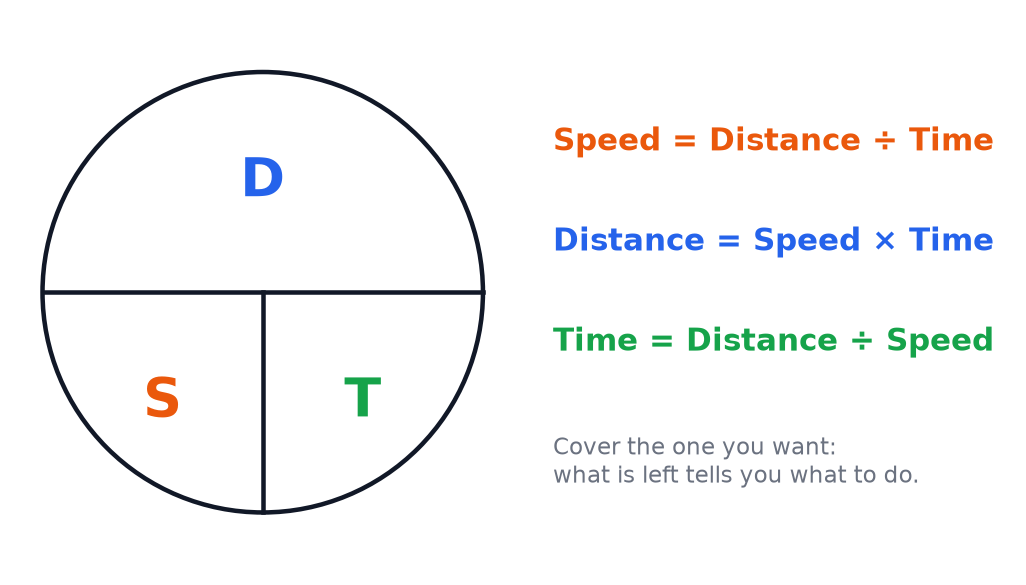
The triangle has distance on top and speed and time underneath. Cover the quantity you want to find: if the two left are side by side you multiply, and if one is above the other you divide.
Using the triangle
- To find speed Cover S, and you are left with \(D\) over \(T\), so \(S = D \div T\).
- To find distance Cover D, and you are left with \(S\) and \(T\) side by side, so \(D = S \times T\).
- To find time Cover T, and you are left with \(D\) over \(S\), so \(T = D \div S\).
Speed, distance and time
Speed is how far you go in one unit of time.
-
The units match
If distance is in kilometres and time is in hours, speed is in km/h. For metres and seconds, speed is in m/s.
-
Changing minutes to hours
30 minutes is 0.5 hours, 45 minutes is 0.75 hours, 20 minutes is \(\dfrac{1}{3}\) hour, and 1 hour 12 minutes is 1.2 hours because \(12 \div 60 = 0.2\).
-
Changing back
2.5 hours is 2 hours 30 minutes, and 0.75 hours is 45 minutes. Multiply the decimal part by 60 to get minutes.
-
Always check it makes sense
A car cannot travel at 600 km/h. If your speed looks silly, a unit is wrong.
Finding speed
A car travels 150 km in 2 hours 30 minutes. Work out its average speed in km/h.
Show the solutionHide the solution
- 1 Convert the time to hours 2 hours 30 minutes \(= 2.5\) hours.
- 2 Use speed \(=\) distance \(\div\) time \(150 \div 2.5\).
- 3 Calculate \(150 \div 2.5 = 60\).
- 4 Give the units 60 km/h.
Answer60 km/h
Finding time
A train travels 90 km at an average speed of 60 km/h. How long does the journey take? Give your answer in hours and minutes.
Show the solutionHide the solution
- 1 Use time \(=\) distance \(\div\) speed \(90 \div 60 = 1.5\) hours.
- 2 Convert the decimal \(0.5\) hours \(= 30\) minutes.
- 3 Write the answer 1 hour 30 minutes.
Answer1 hour 30 minutes
Average speed
Average speed for a whole journey is the total distance divided by the total time. It is not the average of the speeds.
-
Total distance over total time
Add up all the distances and all the times first.
-
A common mistake
Averaging two speeds, such as \(\dfrac{30 + 60}{2} = 45\), is wrong when the times are different.
-
Example
60 km at 30 km/h takes 2 hours, and 60 km at 60 km/h takes 1 hour. The total is 120 km in 3 hours, so the average speed is 40 km/h.
-
Why
More time is spent going slowly, so the average is pulled towards the lower speed.
Reading a distance-time graph
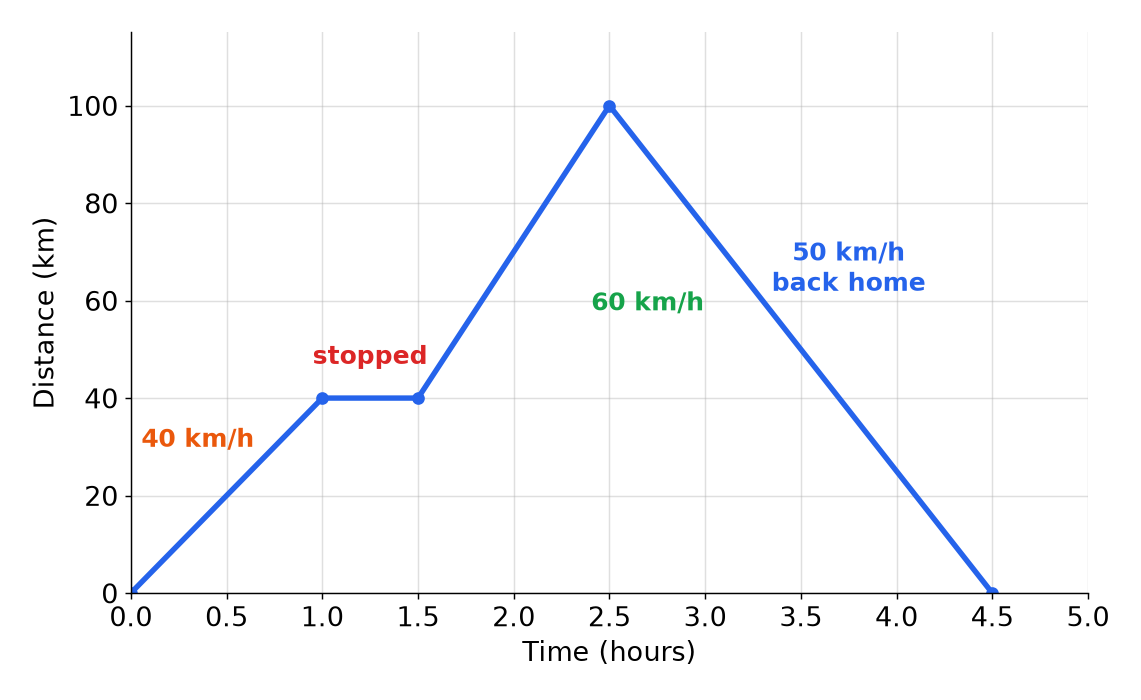
A distance-time graph shows how far from the start you are at each time. The steeper the line, the faster the speed, and a flat line means the object is not moving.
What the graph tells you
- Gradient is speed The gradient is the distance travelled divided by the time taken, which is the speed.
- Horizontal is stopped A flat line means the distance is not changing, so the speed is 0.
- Downward is returning A line that falls means the object is coming back towards the start.
Speeds from a distance-time graph
Using the graph above, work out the speed during the stage from 1.5 hours to 2.5 hours.
Show the solutionHide the solution
- 1 Read two points At 1.5 hours the distance is 40 km, and at 2.5 hours it is 100 km.
- 2 Distance travelled \(100 - 40 = 60\) km.
- 3 Time taken \(2.5 - 1.5 = 1\) hour.
- 4 Speed \(60 \div 1 = 60\) km/h.
Answer60 km/h
Density
Density tells you how much mass is packed into each unit of volume.
-
The formula
Density \(= \dfrac{\text{mass}}{\text{volume}}\), usually in g/cm\(^3\) or kg/m\(^3\).
-
Example
A metal block has mass 240 g and volume 30 cm\(^3\), so its density is \(240 \div 30 = 8\) g/cm\(^3\).
-
Rearranged
Mass \(=\) density \(\times\) volume, and volume \(=\) mass \(\div\) density.
-
Another triangle
Use the same layout as the speed triangle, with mass on top and density and volume underneath.
Using density
The density of a metal is 8 g/cm\(^3\). Work out the mass of 25 cm\(^3\) of the metal.
Show the solutionHide the solution
- 1 Choose the formula Mass \(=\) density \(\times\) volume.
- 2 Substitute \(8 \times 25\).
- 3 Calculate \(8 \times 25 = 200\).
- 4 Give the units 200 g.
Answer200 g
Pressure and changing units (Higher tier)
Pressure is another compound measure, and speeds can be given in different units.
-
Pressure
Pressure \(= \dfrac{\text{force}}{\text{area}}\), in newtons per square metre (N/m\(^2\)). A force of 600 N on an area of 0.5 m\(^2\) gives a pressure of \(600 \div 0.5 = 1200\) N/m\(^2\).
-
Changing km/h to m/s
Multiply by 1000 to get metres, and divide by 3600 for seconds. \(72\text{ km/h} = \dfrac{72 \times 1000}{3600} = 20\) m/s.
-
Changing m/s to km/h
Multiply by 3600 and divide by 1000, which is multiplying by 3.6. 15 m/s is \(15 \times 3.6 = 54\) km/h.
-
Check the units
Write the units on every line, and they tell you whether to multiply or divide.
Test yourself
-
1
What is the formula for speed?
Show answerHide answer
Speed \(=\) distance \(\div\) time.
-
2
What is 45 minutes as a decimal of an hour?
Show answerHide answer
0.75 hours.
-
3
How long does 90 km take at 60 km/h?
Show answerHide answer
1.5 hours, which is 1 hour 30 minutes.
-
4
What does a horizontal line on a distance-time graph mean?
Show answerHide answer
The object is stationary.
-
5
What is the formula for density?
Show answerHide answer
Density \(=\) mass \(\div\) volume.
Exam technique: compound measures
These questions are won by careful units and a clear formula.
-
Write the formula first
"Speed = distance ÷ time" shows the method before you substitute.
-
Convert time to hours
Do it as a separate line so you can check it.
-
Include the units in the answer
km/h, m/s or g/cm\(^3\), not just a number.
-
For average speed, use totals
Find the whole distance and the whole time before dividing.
Summary and exam focus
- Speed is distance divided by time, and the formula triangle gives distance and time too.
- Convert minutes to a decimal of an hour before you divide: 30 minutes is 0.5 hours.
- Average speed is total distance divided by total time.
- On a distance-time graph the gradient is the speed and a flat line means stopped.
- Density is mass divided by volume, and pressure is force divided by area (Higher tier).
Exam focus
Hira cycles 12 km in 45 minutes. Work out her average speed in km/h. (3 marks) (3 marks)
Change 45 minutes to 0.75 hours on a line of its own, then show \(12 \div 0.75 = 16\). The answer needs its unit, km/h. If you divide 12 by 45 you get 0.27, and a speed of 0.27 km/h should alert you that the units are wrong.
Key terms
The words this lesson expects you to use. Each one is linked from the first place it appears above.
- Compound measure
- A measure made by comparing two different quantities, such as speed (distance per time).
- Speed
- How far something travels in a unit of time, found by dividing distance by time.
- Average speed
- Total distance travelled divided by total time taken.
- Distance-time graph
- A graph showing the distance from the start against time, where the gradient is the speed.
- Gradient
- A measure of how steep a line is, found by dividing the change up by the change across.
- Density
- The mass of a material in each unit of volume, found by dividing mass by volume.
- Mass
- The amount of matter in an object, measured in grams or kilograms.
- Volume
- The amount of space an object takes up, measured in cubic units such as cm\(^3\).
- Pressure
- The force on each unit of area, found by dividing force by area.
Questions and answers
15 questions set on this lesson, with the mark schemes and model answers open.
A car travels 135 miles in 2 hours 30 minutes. Work out the average speed of the car in miles per hour.
Mark scheme — 3 marks available
- Time converted to 2.5 hours, or \(135 \div 5 = 27\) seen — M1
- \(135 \div 2.5\) or \(135 \times 2 \div 5\) — M1
- 54 mph — A1
Model answer
2 hours 30 minutes is 2.5 hours. Speed \(= 135 \div 2.5 = 54\) mph.
A cyclist travels at an average speed of 18 km/h for 2 hours 20 minutes. Work out the distance she travels.
Mark scheme — 3 marks available
- Time as \(2\dfrac{1}{3}\) or \(\dfrac{7}{3}\) hours — M1
- \(18 \times \dfrac{7}{3}\) or \(36 + 6\) — M1
- 42 km — A1
Model answer
2 hours 20 minutes is \(2\dfrac{1}{3}\) hours, so the distance is \(18 \times 2\dfrac{1}{3} = 36 + 6 = 42\) km.
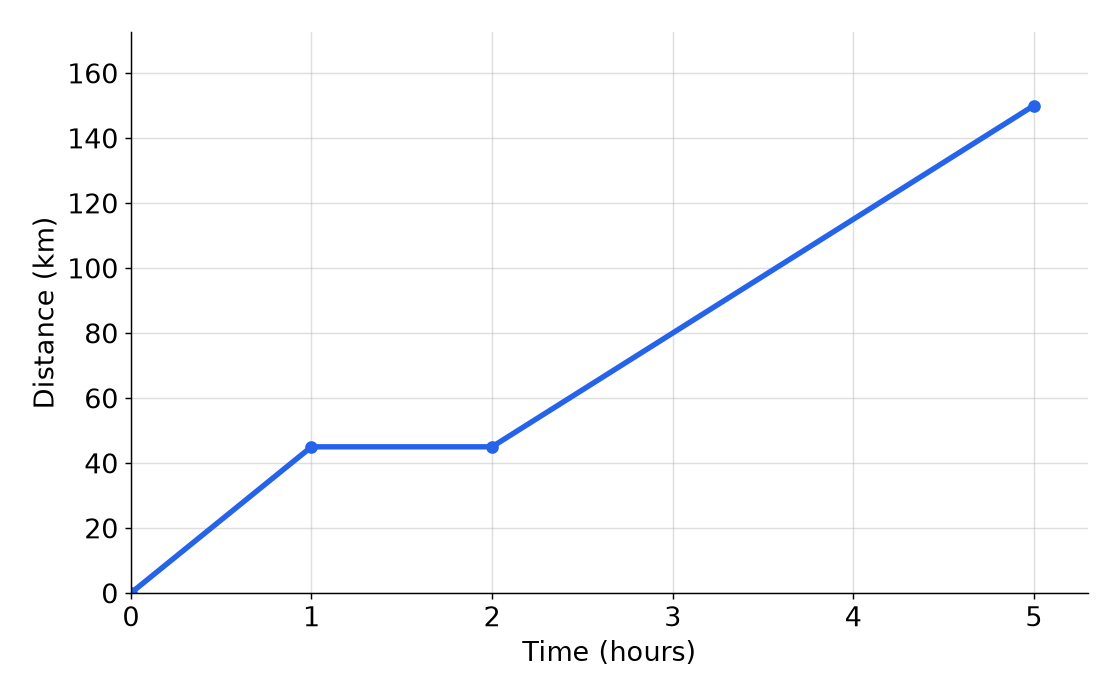
Anna drives from home to her gran's house. The graph shows her journey. (a) For how long did Anna stop? (1 mark) (b) Work out Anna's speed during the first hour of her journey. (1 mark) (c) Work out Anna's average speed for the whole journey. (3 marks)
Mark scheme — 5 marks available
- (a) 1 hour — B1
- (b) 45 km/h — B1
- (c) Total distance 150 km and total time 5 hours seen — M1
- (c) \(150 \div 5\) — M1
- (c) 30 km/h — A1
Model answer
(a) The flat part runs from 1 hour to 2 hours, so she stopped for 1 hour. (b) She travelled 45 km in 1 hour, so her speed was 45 km/h. (c) The whole journey was 150 km in 5 hours, so the average speed is \(150 \div 5 = 30\) km/h.
Raj drives 90 km at an average speed of 45 km/h. He then drives a further 90 km at an average speed of 90 km/h. Raj says, “My average speed for the whole journey was 67.5 km/h.” Is Raj correct? You must show your working.
Mark scheme — 4 marks available
- Times \(2\) hours and \(1\) hour found — M1
- Total distance \(180\) km and total time \(3\) hours — M1
- \(180 \div 3 = 60\) — A1
- No, with the correct average speed shown — C1
Model answer
The first part takes \(90 \div 45 = 2\) hours and the second part takes \(90 \div 90 = 1\) hour. The total is 180 km in 3 hours, so the average speed is \(180 \div 3 = 60\) km/h. Raj has averaged the two speeds, which is wrong, so he is not correct.
A block of wood has a volume of 400 cm\(^3\). The density of the wood is 0.6 g/cm\(^3\). Work out the mass of the block.
Mark scheme — 2 marks available
- \(0.6 \times 400\) — M1
- 240 g — A1
Model answer
Mass \(=\) density \(\times\) volume \(= 0.6 \times 400 = 240\) g.
(a) Change a speed of 54 km/h to metres per second. (2 marks) (b) A box exerts a force of 450 N on a floor. The area of the box in contact with the floor is 0.9 m\(^2\). Work out the pressure on the floor in N/m\(^2\). (2 marks)
Mark scheme — 4 marks available
- (a) \(54 \times 1000 \div 3600\) or \(54 \div 3.6\) — M1
- (a) 15 — A1
- (b) \(450 \div 0.9\) — M1
- (b) 500 — A1
Model answer
(a) \(54 \times 1000 \div 3600 = 15\) m/s. (b) Pressure \(=\) force \(\div\) area \(= 450 \div 0.9 = 500\) N/m\(^2\).
A car travels 150 km in 2 hours 30 minutes. What is its average speed?
Why: Write 2 hours 30 minutes as 2.5 hours. Then \(150 \div 2.5 = 60\) km/h.
What is 45 minutes as a decimal of an hour?
Why: \(45 \div 60 = 0.75\).
A train travels at 80 km/h for 3 hours 15 minutes. How far does it go?
Why: 3 hours 15 minutes is 3.25 hours, so the distance is \(80 \times 3.25 = 260\) km. Writing the time as 3.15 hours is a common error.
A cyclist rides 60 km at 30 km/h and then 60 km at 60 km/h. What is the average speed for the whole journey?
Why: The times are 2 hours and 1 hour. The total distance is 120 km and the total time is 3 hours, so \(120 \div 3 = 40\) km/h.
What does a horizontal line on a distance-time graph show?
Why: A flat line means the distance is not changing with time, so the speed is zero.
A metal block has mass 240 g and volume 30 cm\(^3\). What is its density?
Why: Density \(=\) mass \(\div\) volume \(= 240 \div 30 = 8\) g/cm\(^3\).
The density of a metal is 8 g/cm\(^3\). What is the mass of 25 cm\(^3\) of it?
Why: Mass \(=\) density \(\times\) volume \(= 8 \times 25 = 200\) g.
Change 72 km/h into metres per second.
Why: \(72 \times 1000 = 72\,000\) m per hour, and \(72\,000 \div 3600 = 20\) m/s.
A force of 600 N acts on an area of 0.5 m\(^2\). What is the pressure?
Why: Pressure \(=\) force \(\div\) area \(= 600 \div 0.5 = 1200\) N/m\(^2\).