Maths · Transformations and Similarity
Viewing as
Teacher view: every answer and mark scheme set out in full.
Rotations
Rotating shapes about a centre, describing a rotation fully, and finding the centre of a rotation.
Learning Objectives
- 1Rotate a shape about a centre through a given angle and direction.
- 2Describe a rotation fully by its centre, angle and direction.
- 3Find the centre of a rotation using tracing paper or by reasoning.
- 4Use the 90 degree and 180 degree patterns for the coordinates of rotated points.
Turning a shape
A rotation turns every point of a shape through the same angle about a fixed point called the centre of rotation. The shape keeps its size and its shape, so the image is congruent to the object, but it faces a different way unless the turn is a full circle. A rotation needs three details: the centre, the angle and the direction. Quarter turns and half turns are the common ones in an exam, and most questions give you tracing paper on the practical papers or ask for coordinates only, so you need both the drawing skill and the pattern for the numbers.
Three details of a rotation
A rotation is fully described by its centre, its angle and its direction.
-
Centre
The point that stays fixed, such as the origin or the point \((2, 1)\).
-
Angle
Usually \(90^\circ\), \(180^\circ\) or \(270^\circ\) in a non-calculator exam.
-
Direction
Clockwise or anticlockwise. A turn of \(180^\circ\) is the same in either direction, so the direction is not needed.
-
Distance from the centre
Each point stays the same distance from the centre, so it moves along part of a circle.
Rotating about the origin
The corner \((4, 1)\) turns to \((1, -4)\) and the corner \((1, 3)\) turns to \((3, -1)\). The triangle has turned a quarter of a full turn, clockwise, about the origin.
The 90 degree clockwise pattern
- Rule A point \((x, y)\) goes to \((y, -x)\) when it is turned \(90^\circ\) clockwise about the origin.
- Check \((4, 1)\) goes to \((1, -4)\), as in the diagram.
- Anticlockwise A \(90^\circ\) anticlockwise turn sends \((x, y)\) to \((-y, x)\).
- Half turn A \(180^\circ\) turn about the origin sends \((x, y)\) to \((-x, -y)\).
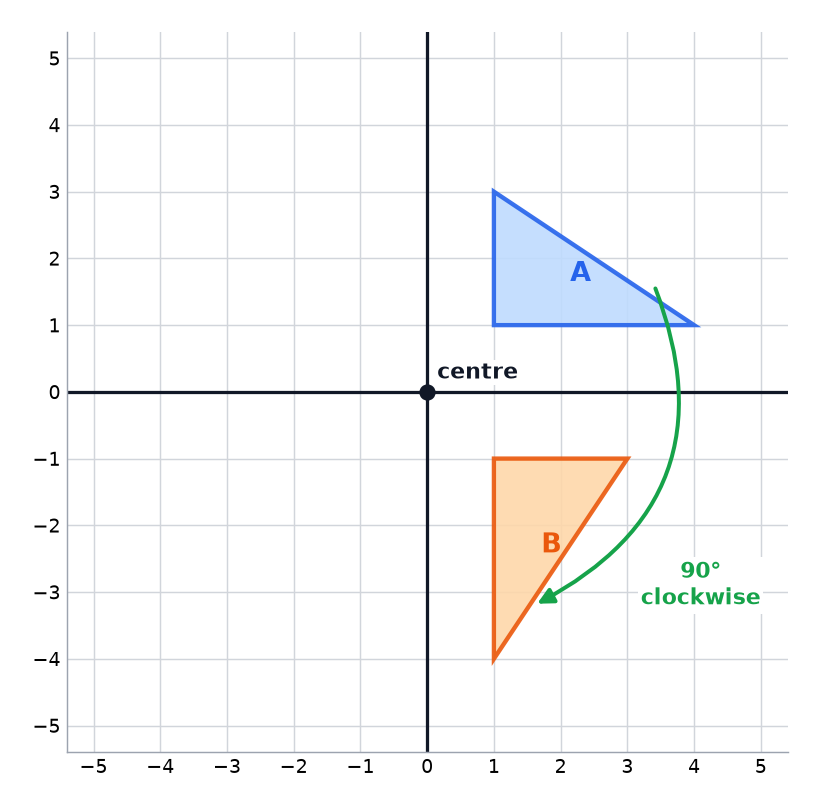
Rotating a point about the origin
Rotate the point \((2, 5)\) through \(90^\circ\) anticlockwise about the origin, and then \((2, 5)\) through \(180^\circ\) about the origin.
Show the solutionHide the solution
- 1 Anticlockwise rule A \(90^\circ\) anticlockwise turn sends \((x, y)\) to \((-y, x)\).
- 2 Apply it \((2, 5)\) goes to \((-5, 2)\).
- 3 Half turn rule A \(180^\circ\) turn sends \((x, y)\) to \((-x, -y)\).
- 4 Apply it \((2, 5)\) goes to \((-2, -5)\).
Answer\((-5, 2)\) and \((-2, -5)\)
Rotating about another centre
When the centre is not the origin, move each point round the centre rather than the origin.
-
Draw the radius
Join the centre to a corner, then turn that line through the angle, keeping its length.
-
Use the grid
For \(90^\circ\), swap the horizontal and vertical distances from the centre, with the right signs.
-
Example
A point 3 right and 1 up from the centre goes 1 right and 3 down after a \(90^\circ\) clockwise turn.
-
Tracing paper
Trace the shape, put the pencil on the centre, and turn the paper.
Describing a rotation and finding the centre
To describe a rotation you must find the centre as well as the angle and direction.
-
Angle and direction
Compare a side of the object with the same side of the image.
-
Finding the centre
The centre is the same distance from a point and its image, so it is on the perpendicular bisector of the line joining them. Find it for two different points and see where the lines cross.
-
Check with tracing paper
Put the pencil on your centre and turn the paper to see that the object lands on the image.
-
Full description
"Rotation of \(90^\circ\) clockwise about the point \((1, 0)\)" scores all three marks.
Describing a rotation
Triangle \(A\) has a corner at \((2, 1)\), and after a rotation the matching corner of triangle \(B\) is at \((2, -1)\). The triangle has turned through \(180^\circ\). Find the centre of the rotation.
Show the solutionHide the solution
- 1 Half turn A \(180^\circ\) rotation takes a point to the opposite side of the centre.
- 2 The centre is the midpoint The centre is halfway between a point and its image.
- 3 Calculate \(\left(\dfrac{2 + 2}{2}, \dfrac{1 + (-1)}{2}\right) = (2, 0)\).
- 4 Say it fully A rotation of \(180^\circ\) about the point \((2, 0)\).
Answer\((2, 0)\)
Test yourself
-
1
What three details describe a rotation?
Show answerHide answer
The centre, the angle and the direction.
-
2
What happens to \((x, y)\) in a \(180^\circ\) rotation about the origin?
Show answerHide answer
It goes to \((-x, -y)\).
-
3
What happens to \((x, y)\) in a \(90^\circ\) clockwise rotation about the origin?
Show answerHide answer
It goes to \((y, -x)\).
-
4
Why is no direction needed for a \(180^\circ\) rotation?
Show answerHide answer
A half turn is the same clockwise and anticlockwise.
-
5
Is the image of a rotation congruent to the object?
Show answerHide answer
Yes.
Exam technique: rotations
Take care with the direction and the centre.
-
Write all three details
Centre, angle and direction.
-
Use tracing paper
It is allowed, and it avoids mistakes with the direction.
-
Check one point
Turn one corner by hand and make sure it lands on the right image corner.
-
Remember the half turn
The direction does not matter, so do not lose time deciding.
Summary and exam focus
- A rotation turns a shape through an angle about a fixed centre, and the image is congruent to the object.
- A full description gives the centre, the angle and the direction.
- About the origin, a \(180^\circ\) turn sends \((x, y)\) to \((-x, -y)\) and a \(90^\circ\) clockwise turn sends it to \((y, -x)\).
- The centre of a rotation is the same distance from a point and its image.
Exam focus
Rotate the point \((3, 1)\) through \(90^\circ\) clockwise about the origin. Write down the coordinates of the image. (2 marks) (2 marks)
A \(90^\circ\) clockwise turn sends \((x, y)\) to \((y, -x)\), so \((3, 1)\) goes to \((1, -3)\). Check by sketching a quick diagram: the point starts to the right of the \(y\)-axis and ends below the \(x\)-axis.
Key terms
The words this lesson expects you to use. Each one is linked from the first place it appears above.
- Rotation
- A transformation that turns a shape about a fixed point.
- Centre of rotation
- The fixed point about which a shape is turned.
- Clockwise
- The direction of the hands of a clock.
- Anticlockwise
- The direction opposite to the hands of a clock.
- Quarter turn
- A rotation of \(90^\circ\).
- Half turn
- A rotation of \(180^\circ\).
- Angle of rotation
- The size of the turn, in degrees.
- Perpendicular bisector
- A line that cuts another line in half at right angles.
- Image
- The shape after a transformation.
Questions and answers
15 questions set on this lesson, with the mark schemes and model answers open.
Write down the coordinates of the image of the point \((3, -2)\) after a rotation of \(180^\circ\) about the origin.
Mark scheme — 2 marks available
- Both coordinates change sign — M1
- \((-3, 2)\) — A1
Model answer
A \(180^\circ\) rotation about the origin changes the sign of both coordinates, so the image is \((-3, 2)\).
Rotate triangle \(T\) through \(90^\circ\) clockwise about the point \(O\), the origin. (3 marks)
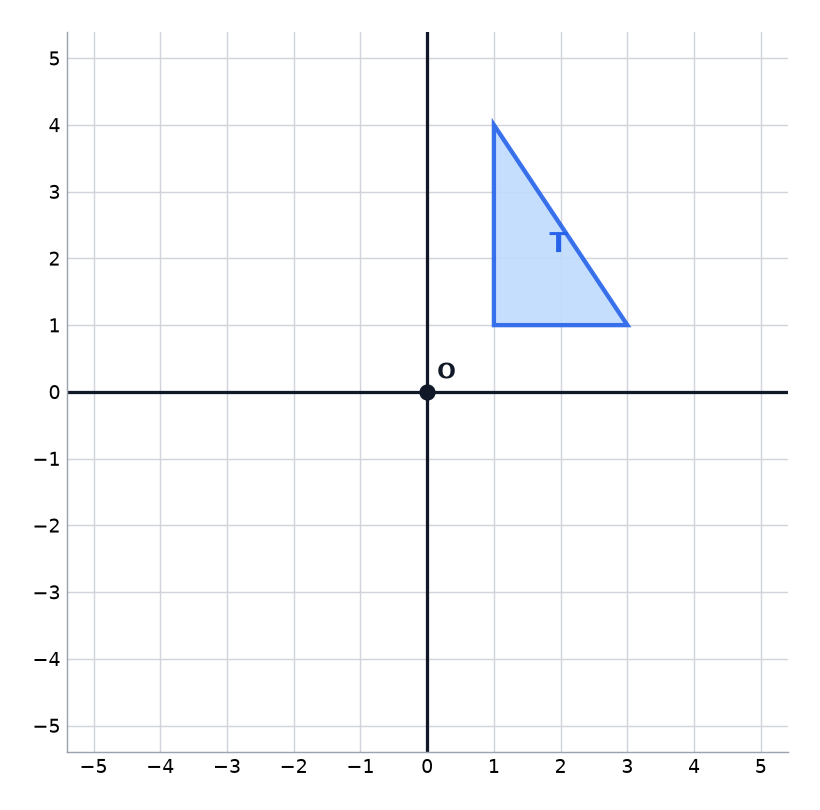
Mark scheme — 3 marks available
- Rotates at least two vertices by \(90^\circ\) about the origin — M1
- At least two vertices correct, such as \((1, -1)\) and \((1, -3)\) — A1
- Triangle with vertices \((1, -1)\), \((1, -3)\) and \((4, -1)\) — A1
Model answer
A \(90^\circ\) clockwise turn about the origin sends \((x, y)\) to \((y, -x)\). The vertices \((1, 1)\), \((3, 1)\) and \((1, 4)\) go to \((1, -1)\), \((1, -3)\) and \((4, -1)\).
Describe fully the single transformation that maps triangle \(A\) onto triangle \(B\).
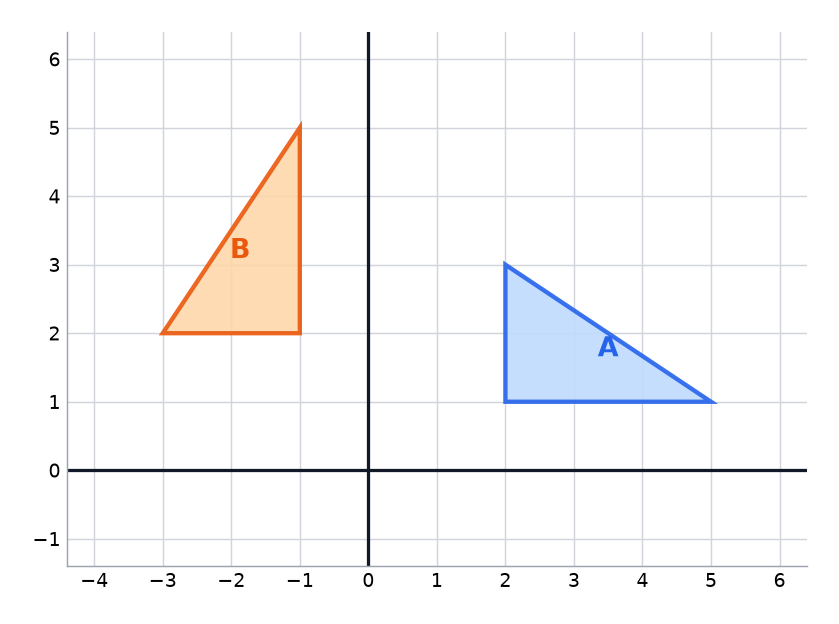
Mark scheme — 3 marks available
- Rotation — B1
- \(90^\circ\) anticlockwise — B1
- About the origin, or the point (0, 0) — B1
Model answer
The point \((2, 1)\) goes to \((-1, 2)\), and \((5, 1)\) goes to \((-1, 5)\). This is the rule \((x, y) \to (-y, x)\), which is a rotation of \(90^\circ\) anticlockwise about the origin.
A rotation of \(180^\circ\) maps the point \((1, 4)\) onto the point \((5, 0)\). Find the coordinates of the centre of the rotation.
Mark scheme — 2 marks available
- \(\dfrac{1 + 5}{2}\) or \(\dfrac{4 + 0}{2}\) — M1
- \((3, 2)\) — A1
Model answer
The centre of a \(180^\circ\) rotation is the midpoint of a point and its image: \(\left(\dfrac{1 + 5}{2}, \dfrac{4 + 0}{2}\right) = (3, 2)\).
The point \(P\) is \((4, 1)\). \(P\) is rotated through \(90^\circ\) clockwise about the origin to give \(Q\). \(Q\) is reflected in the \(x\)-axis to give \(R\). Write down the coordinates of \(R\).
Mark scheme — 3 marks available
- \(Q = (1, -4)\) — B1
- Changes the sign of the \(y\)-coordinate of their \(Q\) — M1
- \((1, 4)\) — A1
Model answer
The rotation sends \((x, y)\) to \((y, -x)\), so \(Q = (1, -4)\). Reflecting in the \(x\)-axis changes the sign of \(y\), so \(R = (1, 4)\).
The point \((3, 2)\) is rotated through \(90^\circ\) clockwise about the point \((1, 0)\). Work out the coordinates of the image.
Mark scheme — 3 marks available
- Position relative to the centre, \((2, 2)\) — M1
- Rotates it to \((2, -2)\) relative to the centre — M1
- \((3, -2)\) — A1
Model answer
The point is 2 right and 2 up from the centre. A \(90^\circ\) clockwise turn sends \((x, y)\) to \((y, -x)\), so the new position is 2 right and 2 down from the centre. The image is \((1 + 2, 0 - 2) = (3, -2)\).
What three details describe a rotation?
Why: A rotation is described by its centre, its angle and its direction.
What is the image of \((3, -2)\) in a \(180^\circ\) rotation about the origin?
Why: A \(180^\circ\) turn about the origin changes the sign of both coordinates.
What is the image of \((2, 5)\) in a \(90^\circ\) anticlockwise rotation about the origin?
Why: A \(90^\circ\) anticlockwise turn sends \((x, y)\) to \((-y, x)\).
What is the image of \((3, 1)\) in a \(90^\circ\) clockwise rotation about the origin?
Why: A \(90^\circ\) clockwise turn sends \((x, y)\) to \((y, -x)\).
Why is no direction needed to describe a \(180^\circ\) rotation?
Why: A half turn clockwise ends in the same place as a half turn anticlockwise.
Is the image of a rotation congruent to the object?
Why: A rotation does not change lengths or angles.
What is the image of \((-2, 4)\) in a \(90^\circ\) clockwise rotation about the origin?
Why: \((x, y)\) goes to \((y, -x)\), so \((-2, 4)\) goes to \((4, 2)\).
The point \((4, 3)\) is rotated through \(180^\circ\) about the point \((1, 1)\). What is the image?
Why: The point is 3 right and 2 up from the centre, so the image is 3 left and 2 down: \((1 - 3, 1 - 2) = (-2, -1)\).
A \(180^\circ\) rotation takes \((1, 5)\) to \((5, 1)\). What is the centre of rotation?
Why: The centre is the midpoint of a point and its image: \(\left(\dfrac{1 + 5}{2}, \dfrac{5 + 1}{2}\right) = (3, 3)\).