Maths · Vectors, Constructions and Loci
Viewing as
Teacher view: every answer and mark scheme set out in full.
Ruler-and-Compass Constructions
Constructing perpendicular bisectors, angle bisectors, perpendiculars and triangles with ruler and compasses.
Learning Objectives
- 1Construct the perpendicular bisector of a line and bisect an angle using a ruler and compasses.
- 2Construct a perpendicular to a line from a point on it and from a point not on it.
- 3Construct triangles from their sides and angles, and a \(60^\circ\) angle.
- 4Show all construction lines, and explain why the constructions work.
Drawing with exact methods
A construction is a drawing made with a ruler and a pair of compasses, with no protractor, so that the result is exact. The exam wants you to leave all the construction arcs on the page, because the arcs are the method, and a neat line with no arcs earns no marks. All the constructions in this lesson are used again in the loci questions in the next lesson. On the non-calculator paper, geometrical instruments are allowed, and the measurements are simple, so the marks depend on accuracy within 2 millimetres and on showing the arcs.
The perpendicular bisector
The perpendicular bisector of a line cuts it in half at right angles.
-
Compass width
Open the compasses to more than half the length of the line.
-
Two arcs
Draw an arc from each end of the line so that the arcs cross above and below.
-
Join
Draw a straight line through the two crossing points.
-
Why it works
Every point on the bisector is the same distance from both ends of the line.
Bisecting a line
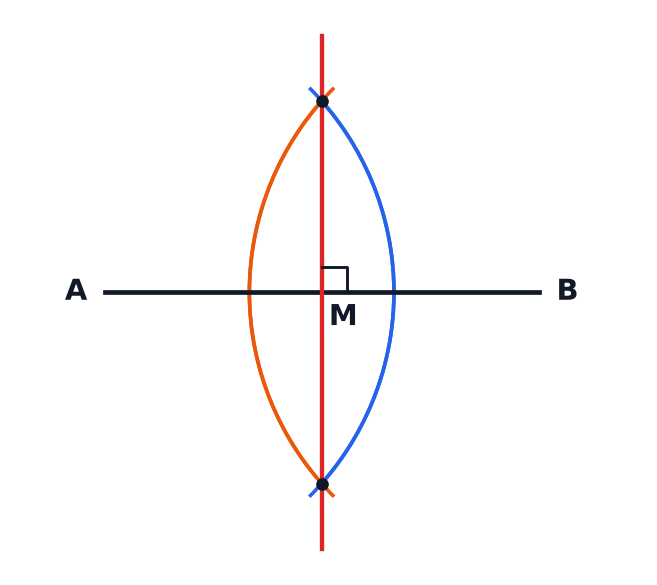
The same compass width is used from \(A\) and from \(B\). The line through the crossing points meets \(AB\) at its midpoint \(M\) and is at right angles to \(AB\).
Checking the construction
- Midpoint \(M\) is exactly halfway between \(A\) and \(B\).
- Right angle A set square or protractor should show \(90^\circ\) at \(M\).
- Keep the arcs Do not rub out the arcs, which show the method.
- Use The bisector is the set of points that are equidistant from \(A\) and \(B\).
Bisecting an angle
The angle bisector cuts an angle into two equal angles.
-
Arc on both arms
Put the compass point on the vertex and draw an arc that cuts both arms.
-
Two more arcs
From each of those points, draw arcs of the same width that cross inside the angle.
-
Join
Draw a line from the vertex through where the arcs cross.
-
Why it works
Every point on the bisector is the same distance from both arms.
Bisecting an angle
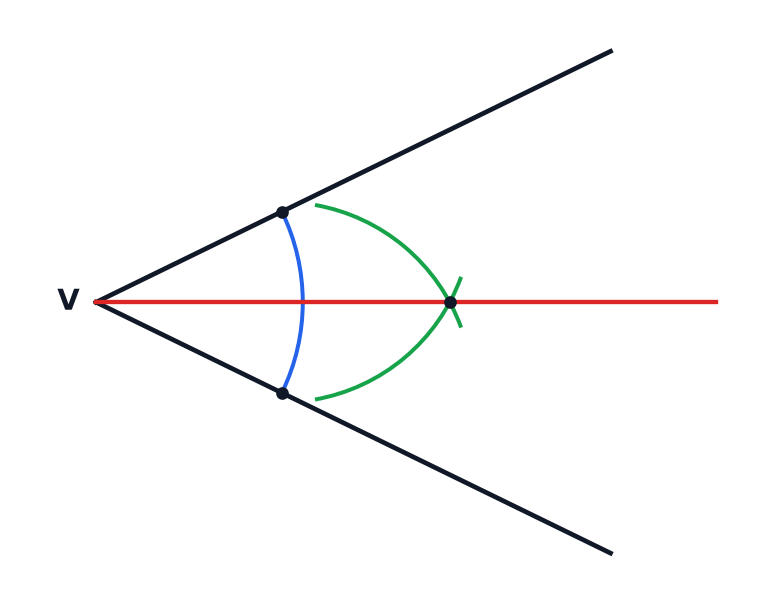
The first arc cuts both arms at the same distance from \(V\). The two crossing arcs are drawn with the same compass width, and the line through \(V\) and the crossing point makes two equal angles.
Checking the construction
- Equal angles Measure the two halves with a protractor: they should be equal.
- Arcs cross The crossing arcs should be clear, inside the angle.
- Compass width Keep it the same for the two crossing arcs.
- Use The bisector is the set of points that are the same distance from both lines.
Constructing a perpendicular from a point
Describe how to construct the perpendicular from a point \(P\) to a straight line \(l\), where \(P\) is not on the line.
Show the solutionHide the solution
- 1 Step 1 With the compass point on \(P\), draw an arc that cuts the line at two points, \(X\) and \(Y\).
- 2 Step 2 With the same width, or a larger one, draw arcs from \(X\) and \(Y\) that cross below the line.
- 3 Step 3 Draw a straight line from \(P\) through the crossing point.
- 4 Check The new line crosses \(l\) at \(90^\circ\), and it is the shortest distance from \(P\) to the line.
AnswerArc from \(P\) cutting \(l\) twice, two arcs from those points, and a line through \(P\) and the crossing point
Other constructions
These use the same ideas.
-
Perpendicular at a point on a line
Draw arcs on both sides of the point, then bisect that part of the line.
-
A \(60^\circ\) angle
Draw an arc from the end of a line, then an arc of the same radius from where it crosses. Join the end to the crossing point.
-
A triangle from three sides
Draw one side, then arcs of the other two lengths from its ends, and join to where they cross.
-
A \(30^\circ\) angle
Bisect a \(60^\circ\) angle.
Constructing a triangle
Describe how to construct a triangle \(ABC\) with \(AB = 6\) cm, \(BC = 5\) cm and \(AC = 4\) cm.
Show the solutionHide the solution
- 1 Draw the base Draw \(AB\) with a ruler, 6 cm long.
- 2 Arc from \(A\) Set the compasses to 4 cm, and draw an arc from \(A\).
- 3 Arc from \(B\) Set the compasses to 5 cm, and draw an arc from \(B\) that crosses the first arc.
- 4 Join The crossing point is \(C\), and joining it to \(A\) and \(B\) completes the triangle.
AnswerDraw \(AB\), then arcs of radius 4 cm from \(A\) and 5 cm from \(B\) to find \(C\)
Test yourself
-
1
What does a perpendicular bisector do to a line?
Show answerHide answer
Cuts it in half at right angles.
-
2
Which instrument measures angles?
Show answerHide answer
A protractor, which is not used in a construction.
-
3
What must you leave on your drawing?
Show answerHide answer
The construction arcs.
-
4
How is a \(60^\circ\) angle constructed?
Show answerHide answer
Using two arcs of the same radius, as in an equilateral triangle.
-
5
Why does the angle bisector work?
Show answerHide answer
Every point on it is the same distance from both arms.
Exam technique: constructions
Neat arcs earn the marks.
-
Use a sharp pencil
A fine line is easier to check.
-
Keep the compass width
It must not slip between two arcs that need to match.
-
Leave the arcs
Do not rub them out.
-
Label
Mark the points and lines the question names.
Summary and exam focus
- A perpendicular bisector is made with two pairs of matching arcs, and the line through their crossings.
- An angle bisector is made with an arc on both arms and two matching arcs inside the angle.
- Constructions use only a ruler and compasses, and the arcs must be left on.
- A triangle from three sides is made with two arcs that cross at the third corner.
Exam focus
Describe the construction of the perpendicular bisector of a line \(AB\) of length 8 cm. (3 marks) (3 marks)
Open the compasses to more than 4 cm and draw arcs from \(A\) and from \(B\) that cross above and below the line. Then join the two crossing points with a straight line. Mention that the same width is used from both ends.
Key terms
The words this lesson expects you to use. Each one is linked from the first place it appears above.
- Construction
- An accurate drawing made with a ruler and compasses.
- Bisect
- To cut into two equal parts.
- Perpendicular bisector
- A line that bisects another line at right angles.
- Angle bisector
- A line that divides an angle into two equal angles.
- Arc
- Part of a circle drawn with compasses.
- Compasses
- An instrument for drawing circles and arcs.
- Perpendicular
- At right angles.
- Equidistant
- The same distance from two or more things.
- Vertex
- The point where two lines meet to form an angle.
Questions and answers
15 questions set on this lesson, with the mark schemes and model answers open.
Use ruler and compasses to construct an angle of \(60^\circ\) at the point \(A\) on a line. You must show all your construction lines.
Mark scheme — 2 marks available
- Arc from A and an arc of the same radius from the crossing point — M1
- Line through \(A\) and the point where the arcs cross — A1
Model answer
Draw an arc with centre \(A\) that crosses the line at \(P\). With the same radius and centre \(P\), draw an arc that crosses the first arc at \(Q\). Join \(A\) to \(Q\). The angle \(PAQ\) is \(60^\circ\), because \(APQ\) is an equilateral triangle.
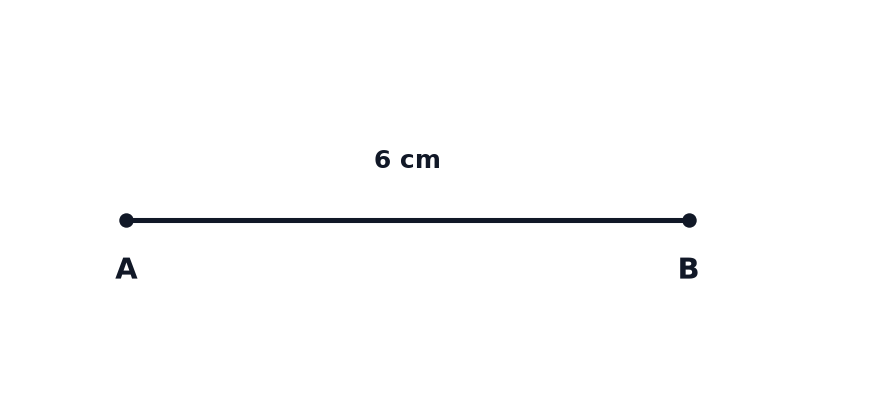
The diagram shows a line \(AB\) of length 6 cm. (a) Use ruler and compasses to construct the perpendicular bisector of \(AB\). You must show all your construction lines. (2 marks) (b) Write down the distance from \(A\) to the point where the bisector crosses \(AB\). (1 mark)
Mark scheme — 3 marks available
- (a) Arcs of equal radius from A and B, crossing above and below — M1
- (a) A straight line through the crossing points, with the arcs left on — A1
- (b) 3 cm — B1
Model answer
(a) Open the compasses to more than 3 cm. Draw arcs of the same radius from \(A\) and from \(B\), crossing above and below the line. Join the two crossing points with a straight line. (b) The bisector crosses \(AB\) at its midpoint, 3 cm from \(A\).
Use ruler and compasses to construct a triangle \(ABC\) with \(AB = 6\) cm, \(BC = 5\) cm and \(AC = 4\) cm. You must show all your construction lines.
Mark scheme — 3 marks available
- \(AB = 6\) cm drawn accurately — B1
- Arc of radius 4 cm from \(A\) and arc of radius 5 cm from \(B\) — M1
- Triangle completed, with \(C\) at the crossing — A1
Model answer
Draw \(AB\) 6 cm long. With the compasses set to 4 cm and the point on \(A\), draw an arc. With the compasses set to 5 cm and the point on \(B\), draw an arc that crosses the first. Join the crossing point \(C\) to \(A\) and \(B\).
\(M\) is a point on the perpendicular bisector of \(AB\). Explain why \(MA = MB\).
Mark scheme — 2 marks available
- States that the bisector cuts AB in half at a right angle — B1
- Uses congruent triangles, or states that points on the bisector are equidistant — B1
Model answer
The perpendicular bisector cuts \(AB\) in half at right angles. The two triangles formed by \(M\), \(A\), \(B\) and the midpoint have equal sides next to the right angle and a common side, so they are congruent and \(MA = MB\). More simply, every point on the perpendicular bisector is the same distance from \(A\) and \(B\).
Use ruler and compasses to construct an angle of \(30^\circ\). You must show all your construction lines.
Mark scheme — 3 marks available
- A construction of \(60^\circ\) — M1
- A bisector construction with arcs of equal radius — M1
- A \(30^\circ\) angle completed — A1
Model answer
Construct an angle of \(60^\circ\) with two arcs of the same radius. Then bisect the \(60^\circ\) angle by drawing an arc on both arms, then matching arcs from those points, and a line through the crossing. This gives two angles of \(30^\circ\).
Use ruler and compasses to construct an equilateral triangle with sides of 5 cm. You must show all your construction lines.
Mark scheme — 3 marks available
- A line of 5 cm drawn — B1
- Two arcs of radius 5 cm from the ends — M1
- Triangle completed — A1
Model answer
Draw a line \(AB\) of 5 cm. Set the compasses to 5 cm. Draw an arc from \(A\) and an arc from \(B\), crossing at \(C\). Join \(C\) to \(A\) and \(B\). All three sides are 5 cm.
What does the perpendicular bisector of a line do?
Why: Perpendicular means at right angles, and bisector means cuts in half.
What must you leave on your drawing in a construction?
Why: The arcs show the method, and earn the marks.
Which instruments do you use for a construction?
Why: Constructions use a ruler and a pair of compasses.
Which angle is constructed using two arcs of the same radius, as in an equilateral triangle?
Why: The triangle with three equal sides has three angles of \(60^\circ\).
A \(60^\circ\) angle is bisected. What is the size of each part?
Why: \(60 \div 2 = 30\).
Why must the compasses be opened to more than half the length of the line when constructing a perpendicular bisector?
Why: If the radius is too small the arcs do not meet.
What is true of every point on an angle bisector?
Why: The bisector is equidistant from the two arms.
A triangle has sides 6 cm, 5 cm and 4 cm. After drawing the 6 cm side \(AB\), how do you find \(C\) if \(AC = 4\) cm and \(BC = 5\) cm?
Why: The third corner is the point 4 cm from \(A\) and 5 cm from \(B\).
What is the shortest distance from a point to a line?
Why: The shortest path to a line meets it at a right angle.