Maths · Algebra
Viewing as
Teacher view: every answer and mark scheme set out in full.
Substitution and Rearranging Formulae
Substituting into formulae, writing your own, and changing the subject of a formula.
Learning Objectives
- 1Substitute positive and negative numbers into expressions and formulae.
- 2Write and use formulae to solve problems in context.
- 3Change the subject of a formula when the subject appears once.
- 4Rearrange harder formulae, including squares, roots and a subject that appears twice (Higher tier).
Formulae: rules with letters
A formula is a rule that links quantities, such as \(A = lw\) or \(v = u + at\). You will be asked to put numbers into formulae (substitution), to build your own formula from a situation, and to rearrange a formula so that a different letter is on its own. All three rely on the same idea: follow the order of operations carefully, and undo steps in reverse order.
Substitution
Replace each letter with its value and then work out the answer, using BIDMAS.
-
Use brackets for negatives
If \(a = -3\), then \(2a^2 = 2 \times (-3)^2 = 2 \times 9 = 18\). Writing \(-3^2\) would give \(-9\), which is wrong.
-
Powers before multiplying
\(3x^2\) means \(3 \times x^2\), so with \(x = 2\) it is \(3 \times 4 = 12\), whereas \((3x)^2 = 6^2 = 36\).
-
Formulae
In \(v = u + at\) with \(u = 5\), \(a = 2\) and \(t = 4\), the value is \(v = 5 + 2 \times 4 = 13\).
-
Context
A taxi costs \(C = 3 + 2m\) pounds for \(m\) miles, so a 10 mile journey costs \(3 + 20 = \pounds 23\).
Substituting with negatives
Work out the value of \(2a^2 - 3b\) when \(a = 3\) and \(b = -2\).
Show the solutionHide the solution
- 1 Write the substitution with brackets \(2 \times 3^2 - 3 \times (-2)\).
- 2 Powers first \(3^2 = 9\), so the expression is \(2 \times 9 - 3 \times (-2)\).
- 3 Multiply \(18 - (-6)\).
- 4 Subtract a negative \(18 + 6 = 24\).
Answer24
Substituting into a longer formula
Work out the value of \(s = ut + \tfrac{1}{2}at^2\) when \(u = 4\), \(a = 2\) and \(t = 3\).
Show the solutionHide the solution
- 1 Substitute \(s = 4 \times 3 + \tfrac{1}{2} \times 2 \times 3^2\).
- 2 Evaluate the power \(3^2 = 9\), so \(s = 12 + \tfrac{1}{2} \times 2 \times 9\).
- 3 Multiply \(\tfrac{1}{2} \times 2 \times 9 = 9\).
- 4 Add \(12 + 9 = 21\).
Answer21
Writing formulae
Turn a description into algebra by spotting what stays the same and what changes.
-
A fixed amount
A fixed charge is a number on its own, such as a call-out fee of \(\pounds 35\).
-
A rate
A cost per hour or per mile is multiplied by the variable, such as \(22h\).
-
Put them together
Cost \(C = 35 + 22h\) for \(h\) hours of work.
-
Use it both ways
Put in \(h = 4\) to find the cost. Put in a cost and solve to find the hours.
Rearranging with a function machine
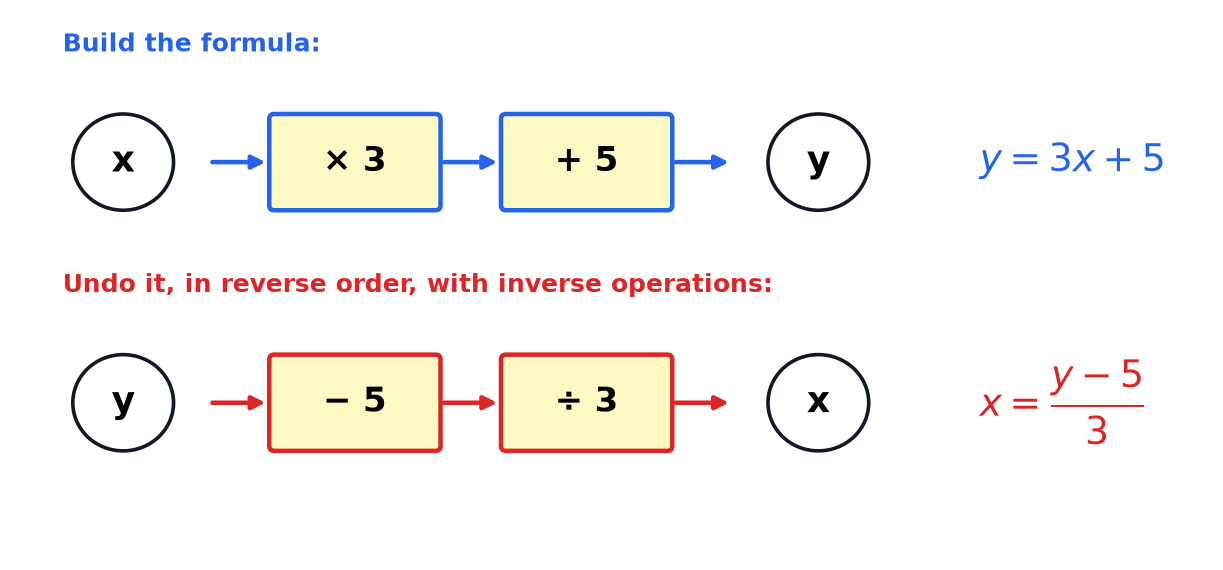
To change the subject, draw the function machine that builds the formula, then reverse it. Each operation is replaced by its inverse, and the order is reversed.
How to use it
- Build the formula \(x\) is multiplied by 3 and then 5 is added, so \(y = 3x + 5\).
- Reverse the machine Start from \(y\), subtract 5 and then divide by 3.
- Write the new formula \(x = \dfrac{y - 5}{3}\). The subtraction is done to the whole of \(y\), so it needs a bracket or a long fraction line.
Changing the subject
Rearranging uses the same steps as solving an equation, except that the answer is a formula.
-
The subject
The subject of a formula is the letter on its own on one side, such as \(y\) in \(y = 3x + 5\).
-
Do the same to both sides
Undo the operations in the reverse of the order they were applied, treating the other letters like numbers.
-
Fractions
If the subject is in a fraction, multiply both sides by the denominator first.
-
Check
Substitute numbers into both versions of the formula. If they agree, your rearrangement is right.
Making t the subject
Make \(t\) the subject of \(v = u + at\).
Show the solutionHide the solution
- 1 Subtract \(u\) from both sides \(v - u = at\).
- 2 Divide both sides by \(a\) \(\dfrac{v - u}{a} = t\).
- 3 Write with the subject on the left \(t = \dfrac{v - u}{a}\).
Answer\(t = \dfrac{v - u}{a}\)
Making x the subject of a fraction
Make \(x\) the subject of \(y = \dfrac{2x - 1}{3}\).
Show the solutionHide the solution
- 1 Multiply both sides by 3 \(3y = 2x - 1\).
- 2 Add 1 to both sides \(3y + 1 = 2x\).
- 3 Divide both sides by 2 \(x = \dfrac{3y + 1}{2}\).
- 4 Check If \(x = 5\) then \(y = \dfrac{9}{3} = 3\), and \(\dfrac{3 \times 3 + 1}{2} = 5\).
Answer\(x = \dfrac{3y + 1}{2}\)
Harder rearranging (Higher tier)
Squares, roots and a subject that appears twice need extra steps.
-
Squares and roots
To make \(r\) the subject of \(A = \pi r^2\), divide by \(\pi\) to get \(\dfrac{A}{\pi} = r^2\) and then take the square root: \(r = \sqrt{\dfrac{A}{\pi}}\).
-
Subject in two places
Multiply out any fractions, get every term containing the subject on one side, factorise the subject out, and then divide.
-
Take care with brackets
Subtract the whole of an expression using brackets, so that no signs go wrong.
A subject that appears twice
Make \(x\) the subject of \(y = \dfrac{x + 3}{x - 2}\).
Show the solutionHide the solution
- 1 Remove the fraction \(y(x - 2) = x + 3\).
- 2 Expand \(xy - 2y = x + 3\).
- 3 Collect the \(x\) terms on one side \(xy - x = 3 + 2y\).
- 4 Factorise \(x(y - 1) = 3 + 2y\).
- 5 Divide \(x = \dfrac{2y + 3}{y - 1}\).
Answer\(x = \dfrac{2y + 3}{y - 1}\)
Substituting and rearranging
Substituting
- Numbers replace the letters
- The answer is a single number
- Follow BIDMAS and use brackets for negative values
Rearranging
- The letters stay in place
- The answer is a new formula
- Undo operations in reverse order, using inverse operations
Using familiar formulae
Several formulae appear in both Maths and Science, and examiners expect you to recognise them.
-
Speed
\(s = \dfrac{d}{t}\). A car that travels 150 km in 2.5 hours has speed \(150 \div 2.5 = 60\) km/h.
-
Density
Density \(= \dfrac{\text{mass}}{\text{volume}}\). A block of mass 240 g and volume 30 cm\(^3\) has density 8 g/cm\(^3\).
-
Area of a trapezium
\(A = \tfrac{1}{2}(a + b)h\), where \(a\) and \(b\) are the parallel sides and \(h\) is the height.
-
Perimeter of a rectangle
\(P = 2(l + w)\), which can be rearranged to find a missing side.
Using a formula
The area of a trapezium is \(A = \tfrac{1}{2}(a + b)h\). Work out \(A\) when \(a = 7\), \(b = 11\) and \(h = 5\).
Show the solutionHide the solution
- 1 Substitute \(A = \tfrac{1}{2}(7 + 11) \times 5\).
- 2 Brackets first \(7 + 11 = 18\), so \(A = \tfrac{1}{2} \times 18 \times 5\).
- 3 Multiply \(\tfrac{1}{2} \times 18 = 9\), and \(9 \times 5 = 45\).
Answer45
Making a letter the subject when there are brackets
Make \(a\) the subject of \(P = 2(a + b)\).
Show the solutionHide the solution
- 1 Divide both sides by 2 \(\dfrac{P}{2} = a + b\).
- 2 Subtract \(b\) from both sides \(\dfrac{P}{2} - b = a\).
- 3 Write with the subject first \(a = \dfrac{P}{2} - b\), which is the same as \(a = \dfrac{P - 2b}{2}\).
Answer\(a = \dfrac{P}{2} - b\)
The subject is in a fraction term
Make \(x\) the subject of \(y = \dfrac{3x}{4} + 2\).
Show the solutionHide the solution
- 1 Subtract 2 from both sides \(y - 2 = \dfrac{3x}{4}\).
- 2 Multiply both sides by 4 \(4(y - 2) = 3x\).
- 3 Divide both sides by 3 \(x = \dfrac{4(y - 2)}{3}\).
Answer\(x = \dfrac{4(y - 2)}{3}\)
Squares and roots in formulae (Higher tier)
When the subject is squared, take a square root as the last step.
-
Isolate the squared term
To make \(u\) the subject of \(v^2 = u^2 + 2as\), subtract \(2as\) from both sides to get \(u^2 = v^2 - 2as\).
-
Take the square root of the whole side
\(u = \sqrt{v^2 - 2as}\). The root covers everything on the right-hand side.
-
Positive and negative roots
A square root can be positive or negative, but in context, such as a speed, you normally use the positive one.
-
Check with numbers
Put \(v = 5\), \(a = 2\) and \(s = 3\) into the original, which gives \(u^2 = 25 - 12 = 13\), and then check your rearranged formula gives \(\sqrt{13}\).
Substituting to find an unknown
Sometimes you are given the answer from a formula and must find the input.
-
Substitute what you know
If \(C = 12 + 8d\) and \(C = 84\), then \(84 = 12 + 8d\).
-
Solve the equation
\(72 = 8d\), so \(d = 9\).
-
Or rearrange first
\(d = \dfrac{C - 12}{8}\), then substitute \(C = 84\) to get \(d = 9\).
-
Choose the quicker method
Substituting first is usually faster for a single value, and rearranging is better if you need many values.
Test yourself
-
1
Work out \(3x^2\) when \(x = 4\).
Show answerHide answer
48.
-
2
Work out \(5 - 2a\) when \(a = -3\).
Show answerHide answer
11.
-
3
Make \(x\) the subject of \(y = x - 6\).
Show answerHide answer
\(x = y + 6\).
-
4
Make \(x\) the subject of \(y = 2x\).
Show answerHide answer
\(x = \dfrac{y}{2}\).
-
5
Make \(t\) the subject of \(d = st\).
Show answerHide answer
\(t = \dfrac{d}{s}\).
Exam technique: substitution and rearranging
Neat layout makes these questions straightforward.
-
Write the formula first
Then substitute, so that the examiner can see where each number came from.
-
Brackets for negatives
Always put a negative value in brackets when you substitute it.
-
One step per line
Rearranging is solving an equation with letters, so give each step its own line.
-
Check the subject
The subject must be on its own, and it must not appear on both sides of the final formula.
Summary and exam focus
- Put negative numbers in brackets when substituting, and remember that \(2a^2\) means \(2 \times a^2\).
- To write a formula, separate the fixed amount from the rate and combine them.
- To change the subject, reverse the function machine: use inverse operations in reverse order.
- Multiply by the denominator first when the subject sits in a fraction.
- On the Higher tier, collect the subject terms together and factorise when it appears twice.
Exam focus
Make \(a\) the subject of the formula \(v^2 = u^2 + 2as\). (3 marks) (3 marks)
Treat \(u^2\) and \(2s\) as if they were numbers, so you subtract \(u^2\) from both sides first and then divide both sides by \(2s\). Show each step on its own line, and write the final answer with \(a\) alone on the left.
Key terms
The words this lesson expects you to use. Each one is linked from the first place it appears above.
- Output
- The result of putting an input through a formula or a function machine.
- Substitute
- Replace a letter in an expression or formula with a number.
- Formula
- A rule that links quantities using letters.
- Subject of a formula
- The letter on its own on one side of the equals sign.
- Rearrange
- Change a formula so that a different letter is the subject.
- Variable
- A letter that can take different values.
- Inverse operation
- The operation that undoes another, such as division undoing multiplication.
- Function machine
- A diagram showing the operations applied to an input, in order, to give an output.
- Constant
- A quantity that has a fixed value and does not change.
- Evaluate
- Work out the numerical value of an expression.
Questions and answers
17 questions set on this lesson, with the mark schemes and model answers open.
Work out the value of \(4x - 3y\) when \(x = -2\) and \(y = 5\).
Mark scheme — 2 marks available
- \(-8\) or \(-15\) seen — M1
- \(-23\) — A1
Model answer
\(4 \times (-2) - 3 \times 5 = -8 - 15 = -23\).
Work out the value of \((a - 3)^2\) when \(a = -1\).
Mark scheme — 2 marks available
- \(-1 - 3 = -4\) — M1
- 16 — A1
Model answer
\((-1 - 3)^2 = (-4)^2 = 16\).
The formula \(F = \dfrac{9C}{5} + 32\) converts a temperature in degrees Celsius, \(C\), to degrees Fahrenheit, \(F\). (a) Work out \(F\) when \(C = -10\). [2 marks] (b) Make \(C\) the subject of the formula. [2 marks]
Mark scheme — 4 marks available
- (a) \(\dfrac{9 \times (-10)}{5}\) or \(-18\) — M1
- (a) 14 — A1
- (b) \(F - 32 = \dfrac{9C}{5}\) or \(5(F - 32) = 9C\) — M1
- (b) \(C = \dfrac{5(F - 32)}{9}\) — A1
Model answer
(a) \(F = \dfrac{9 \times (-10)}{5} + 32 = -18 + 32 = 14\). (b) Subtract 32 to get \(F - 32 = \dfrac{9C}{5}\). Multiply by 5 to get \(5(F - 32) = 9C\). Divide by 9 to get \(C = \dfrac{5(F - 32)}{9}\).
Make \(x\) the subject of \(y = 2(x + 3)\).
Mark scheme — 2 marks available
- \(\dfrac{y}{2} = x + 3\) or \(y = 2x + 6\) — M1
- \(x = \dfrac{y}{2} - 3\) or \(x = \dfrac{y - 6}{2}\) — A1
Model answer
Divide both sides by 2 to get \(\dfrac{y}{2} = x + 3\), then subtract 3 to get \(x = \dfrac{y}{2} - 3\). Alternatively, \(x = \dfrac{y - 6}{2}\).
Make \(b\) the subject of \(a = \dfrac{3b + 1}{c}\).
Mark scheme — 3 marks available
- \(ac = 3b + 1\) — M1
- \(ac - 1 = 3b\) — M1
- \(b = \dfrac{ac - 1}{3}\) — A1
Model answer
Multiply both sides by \(c\) to get \(ac = 3b + 1\). Subtract 1 to get \(ac - 1 = 3b\). Divide by 3 to get \(b = \dfrac{ac - 1}{3}\).
Make \(y\) the subject of \(x^2 + y^2 = r^2\).
Mark scheme — 3 marks available
- \(y^2 = r^2 - x^2\) — M1
- Takes the square root of the whole right-hand side — M1
- \(y = \sqrt{r^2 - x^2}\) — A1
Model answer
Subtract \(x^2\) from both sides to get \(y^2 = r^2 - x^2\). Take the square root of both sides to get \(y = \sqrt{r^2 - x^2}\).
Make \(x\) the subject of \(y = \dfrac{3x + 1}{x - 2}\).
Mark scheme — 4 marks available
- \(y(x - 2) = 3x + 1\) — M1
- \(xy - 2y = 3x + 1\) — M1
- \(xy - 3x = 1 + 2y\) and \(x(y - 3)\) — M1
- \(x = \dfrac{1 + 2y}{y - 3}\) — A1
Model answer
Multiply by \((x - 2)\): \(y(x - 2) = 3x + 1\). Expand: \(xy - 2y = 3x + 1\). Collect the \(x\) terms: \(xy - 3x = 1 + 2y\). Factorise: \(x(y - 3) = 1 + 2y\). So \(x = \dfrac{1 + 2y}{y - 3}\).
Make \(a\) the subject of \(P = 2(a + b)\).
Why: Divide both sides by 2 to get \(\dfrac{P}{2} = a + b\), then subtract \(b\).
Use \(A = \tfrac{1}{2}(a + b)h\) to work out \(A\) when \(a = 7\), \(b = 11\) and \(h = 5\).
Why: \(\tfrac{1}{2} \times 18 \times 5 = 45\).
Work out the value of \(2a + b\) when \(a = 4\) and \(b = -3\).
Why: \(2 \times 4 + (-3) = 8 - 3 = 5\).
Work out the value of \(x^2\) when \(x = -5\).
Why: \((-5) \times (-5) = 25\), because a negative multiplied by a negative is positive.
Work out the value of \(3x^2\) when \(x = -2\).
Why: The power is done first: \((-2)^2 = 4\), then \(3 \times 4 = 12\).
Make \(x\) the subject of \(y = x + 7\).
Why: Subtract 7 from both sides to get \(x = y - 7\).
Make \(x\) the subject of \(y = 4x - 1\).
Why: Add 1 to both sides to get \(y + 1 = 4x\), then divide by 4.
Make \(t\) the subject of \(v = u + at\).
Why: Subtract \(u\) from both sides to get \(v - u = at\), then divide by \(a\).
What is the value of \((2x)^2\) when \(x = 3\)?
Why: \(2x = 6\), and \(6^2 = 36\). Note that \(2x^2\) would be \(2 \times 9 = 18\).
Make \(r\) the subject of \(A = \pi r^2\).
Why: Divide by \(\pi\) to get \(r^2 = \dfrac{A}{\pi}\), then take the square root of both sides.