Maths · Calculator Skills
Viewing as
Teacher view: every answer and mark scheme set out in full.
Using Your Calculator
Setting the calculator up, entering calculations in the right order, and using the power, standard form and inverse trigonometry keys.
Learning Objectives
- 1Check the calculator is set up correctly before an exam.
- 2Use brackets, powers, roots and fractions keys to enter calculations in the right order.
- 3Enter numbers in standard form and use the inverse trigonometric functions.
- 4Round only at the end, and keep full calculator values in between.
A tool you need to use well
On a calculator paper, a calculator saves time but it does not do the thinking. Most lost marks are caused by entering a calculation in the wrong order, by rounding too early, or by having the calculator in the wrong mode. A few minutes learning how your own model works is a good use of revision time. The keys named here are on every scientific calculator allowed in GCSE exams, but the labels can differ slightly, so check yours with the examples.
The keys you need
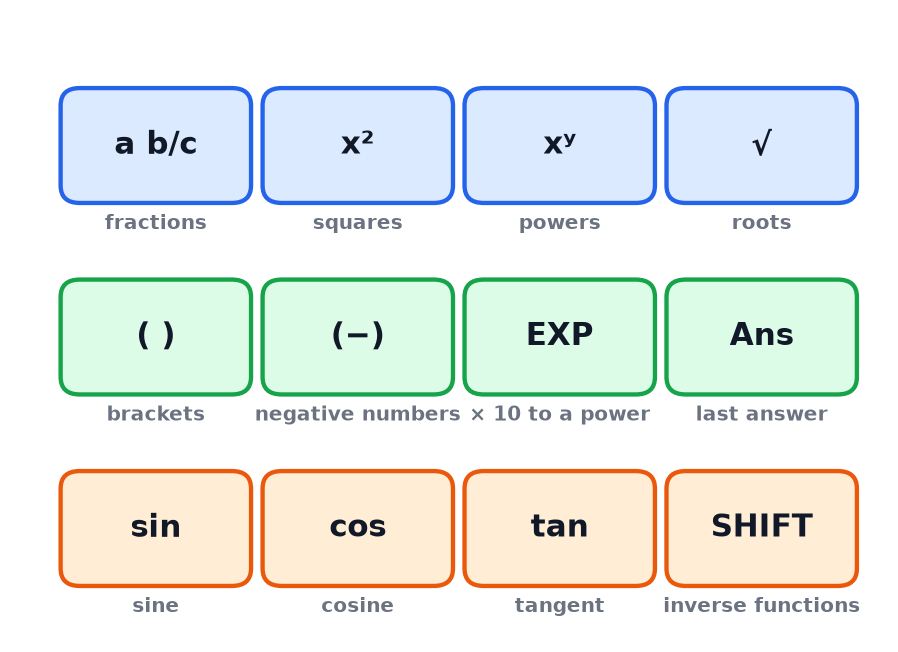
These are the keys used in most GCSE questions. Learn where each one is on your own calculator, and practise using them with the examples below.
What each key does
- Fractions and powers The fraction key enters \(\dfrac{a}{b}\) properly. The power key raises a number to any power, such as \(1.03^4\).
- Brackets Use them round the top and the bottom of a fraction, and round any part that must be worked out first.
- Negative numbers Use the negative key, not the subtract key, to enter a number such as \(-5\).
- Ans and EXP Ans recalls the last answer, and EXP enters a number in standard form.
Before you start
Two checks save marks.
-
Angle mode
The calculator must be in degrees for trigonometry. A small D or DEG shows on the screen.
-
Clear it
Clear any memory or old answers, so that Ans does not carry something unexpected into a new question.
-
Fresh batteries
Check that the display is clear and that the calculator is not in a strange mode, such as fractions where you expected decimals.
-
Know your model
Using the same calculator in the exam as in revision avoids surprises.
Order of working and brackets
The calculator follows the order of operations, but only if you enter the calculation correctly.
-
Fractions
For \(\dfrac{5.6 + 3.2}{4.1 - 1.7}\), put brackets round the top and the bottom: \((5.6 + 3.2) \div (4.1 - 1.7)\).
-
Powers
\(1500 \times 1.03^4\) works out the power first, then multiplies.
-
Roots
Use the root key with the whole expression inside the brackets, such as \(\sqrt{(8.4^2 + 5.1^2)}\).
-
Check
Estimate the answer first, so that a slip is spotted.
A calculation with brackets
Work out \(\dfrac{5.6 + 3.2}{4.1 - 1.7}\). Give your answer to 3 significant figures.
Show the solutionHide the solution
- 1 Top \(5.6 + 3.2 = 8.8\).
- 2 Bottom \(4.1 - 1.7 = 2.4\).
- 3 Divide \(8.8 \div 2.4 = 3.666\ldots\).
- 4 Round 3.67 to 3 significant figures.
Answer3.67
Powers, standard form and trigonometry
These need particular keys, and are the usual places to go wrong.
-
Compound interest
\(1500 \times 1.03^4 = 1688.26\ldots\), so the total value is \(\pounds 1688.26\).
-
Standard form
Use EXP: \(3.2\) EXP \(5\) enters \(3.2 \times 10^5\). Do not type \(\times 10\) then the power separately.
-
Finding an angle
If \(\tan\theta = \dfrac{7}{12}\), use SHIFT then tan: \(\theta = \tan^{-1}\left(\dfrac{7}{12}\right) = 30.3^\circ\).
-
Finding a side
If \(\sin 40^\circ = \dfrac{x}{9}\), then \(x = 9\sin 40^\circ = 5.78\ldots\).
Standard form and an angle
(a) Work out \((3.2 \times 10^5) \times (4.5 \times 10^{-3})\), giving your answer in standard form. (b) In a right-angled triangle the side opposite angle \(\theta\) is 7 cm and the adjacent side is 12 cm. Work out \(\theta\) to 1 decimal place.
Show the solutionHide the solution
- 1 Standard form The calculator gives 1440, which is \(1.44 \times 10^3\).
- 2 Choose the ratio Opposite and adjacent, so use tangent: \(\tan\theta = \dfrac{7}{12}\).
- 3 Inverse \(\theta = \tan^{-1}\left(\dfrac{7}{12}\right) = 30.256\ldots\).
- 4 Round \(30.3^\circ\) to 1 decimal place.
Answer(a) \(1.44 \times 10^3\). (b) \(30.3^\circ\)
Test yourself
-
1
What mode must the calculator be in for trigonometry?
Show answerHide answer
Degrees.
-
2
Which key enters a number in standard form?
Show answerHide answer
EXP, or the times ten to a power key.
-
3
Why do you use brackets on a fraction?
Show answerHide answer
So the top and bottom are each worked out before dividing.
-
4
When should you round?
Show answerHide answer
At the end, not between steps.
-
5
What does Ans do?
Show answerHide answer
Recalls the previous answer.
Exam technique: calculator papers
Show your working as well as the answer.
-
Write the calculation
Write down what you entered, such as \(1500 \times 1.03^4\), so that you can earn method marks even if you slip.
-
Do not round early
Keep the full display, or use Ans, and round only the final answer.
-
Check sense
Does the answer make sense, for example is a length shorter than the hypotenuse?
-
Give the accuracy asked
Write the answer to the number of decimal places or significant figures that the question asks for.
Summary and exam focus
- Check the calculator is in degree mode and that it is cleared.
- Use brackets, the power key and the fraction key carefully.
- Use EXP for standard form, and SHIFT with sin, cos or tan to find angles.
- Write your working and round only at the end.
Exam focus
Work out \(\sqrt{8.4^2 + 5.1^2}\). Give your answer correct to 3 significant figures. (2 marks) (2 marks)
\(8.4^2 + 5.1^2 = 70.56 + 26.01 = 96.57\), and \(\sqrt{96.57} = 9.827\ldots\), which is 9.83 to 3 significant figures. Write the unrounded value first.
Key terms
The words this lesson expects you to use. Each one is linked from the first place it appears above.
- Calculator mode
- The setting that decides how the calculator works, such as degrees.
- Brackets
- Symbols that show which part of a calculation is worked out first.
- Standard form
- A way to write numbers as \(a \times 10^n\) with \(1 \le a < 10\).
- Inverse function
- A function that reverses another, such as \(\tan^{-1}\).
- Significant figures
- The digits of a number that carry meaning, counted from the first non-zero digit.
- Decimal places
- The digits after the decimal point.
- Compound interest
- Interest that is added to the amount, so that it also earns interest.
- Estimate
- An approximate answer, found by rounding.
- Display
- The screen of the calculator.
Questions and answers
15 questions set on this lesson, with the mark schemes and model answers open.
Calculate \(\dfrac{8.3 + 4.7}{3.9 - 0.6}\). Give your answer correct to 3 significant figures. [2 marks]
Mark scheme — 2 marks available
- \(13\) and \(3.3\), or \(3.939\ldots\) — M1
- \(3.94\) — A1
Model answer
\(\dfrac{13}{3.3} = 3.939\ldots = 3.94\) to 3 significant figures.
Mia invests \(\pounds 3200\) for 6 years at 1.8% per year compound interest. Calculate the total value of her investment at the end of 6 years. Give your answer to the nearest penny. [3 marks]
Mark scheme — 3 marks available
- \(1.018^6\) — M1
- \(3200 \times 1.018^6\) — M1
- \(3561.53\) — A1
Model answer
\(3200 \times 1.018^6 = \pounds 3561.53\).
Calculate \((8.1 \times 10^{-3}) \times (5 \times 10^6)\). Give your answer in standard form. [2 marks]
Mark scheme — 2 marks available
- \(40\,500\) — M1
- \(4.05 \times 10^4\) — A1
Model answer
\(8.1 \times 10^{-3} \times 5 \times 10^6 = 40\,500 = 4.05 \times 10^4\).
\(XYZ\) is a right-angled triangle with the right angle at \(Z\). \(XY = 13\) cm and \(XZ = 8\) cm. Calculate the size of angle \(YXZ\). Give your answer correct to 1 decimal place. [3 marks]
Mark scheme — 3 marks available
- \(\cos YXZ = \dfrac{8}{13}\) — M1
- \(52.020\ldots\) — A1
- \(52.0\) — A1
Model answer
\(\cos YXZ = \dfrac{8}{13}\), so angle \(YXZ = \cos^{-1}\left(\dfrac{8}{13}\right) = 52.0^\circ\).
Calculate \(\sqrt{9.2^2 - 5.5^2}\). Give your answer correct to 3 significant figures. [3 marks]
Mark scheme — 3 marks available
- \(84.64 - 30.25 = 54.39\) — M1
- \(7.374\ldots\) — A1
- \(7.37\) — A1
Model answer
\(9.2^2 - 5.5^2 = 84.64 - 30.25 = 54.39\) and \(\sqrt{54.39} = 7.374\ldots = 7.37\).
A cyclist rides 126 miles in 2 hours 40 minutes. Calculate the average speed in miles per hour. Give your answer correct to 1 decimal place. [3 marks]
Mark scheme — 3 marks available
- \(2\dfrac{2}{3}\) hours or \(2.666\ldots\) — M1
- \(\dfrac{126}{2.666\ldots}\) — M1
- \(47.3\) — A1
Model answer
2 hours 40 minutes is \(2\dfrac{2}{3}\) hours. Average speed \(= \dfrac{126}{2\frac{2}{3}} = 47.25 = 47.3\) mph.
Which mode must a calculator be in to find angles in a GCSE trigonometry question?
Why: GCSE angles are measured in degrees.
Which key do you use to enter \(3.2 \times 10^5\)?
Why: EXP enters the times ten to a power part.
What does the Ans key do?
Why: Ans holds the previous result.
What should you type to work out \(\dfrac{5.6 + 3.2}{4.1 - 1.7}\)?
Why: Brackets are needed round both the top and the bottom.
What is \(1500 \times 1.03^4\) to the nearest penny?
Why: \(1.03^4 = 1.1255\ldots\), and \(1500 \times 1.1255\ldots = 1688.26\ldots\).
\(\tan\theta = \dfrac{7}{12}\). What is \(\theta\) to 1 decimal place?
Why: \(\theta = \tan^{-1}\left(\dfrac{7}{12}\right) = 30.256\ldots\).
What is \(\sqrt{8.4^2 + 5.1^2}\) to 3 significant figures?
Why: \(8.4^2 + 5.1^2 = 96.57\) and \(\sqrt{96.57} = 9.827\ldots\).
Why should you avoid rounding in the middle of a calculation?
Why: Rounding early builds up errors.
A train travels 215 km in 2 hours 36 minutes. What is its average speed to 1 decimal place?
Why: 2 hours 36 minutes is 2.6 hours, and \(215 \div 2.6 = 82.69\ldots\).