Maths · Number Without a Calculator
Viewing as
Teacher view: every answer and mark scheme set out in full.
Fractions
Simplifying, adding, subtracting, multiplying and dividing fractions and mixed numbers, exactly and without a calculator.
Learning Objectives
- 1Simplify, compare and order fractions, and convert between mixed numbers and improper fractions.
- 2Add and subtract fractions and mixed numbers.
- 3Multiply and divide fractions and mixed numbers.
- 4Find a fraction of an amount and solve fraction problems in context.
Exact answers on a non-calculator paper
Fractions are exact, which is why the non-calculator paper loves them: \(\frac{1}{3}\) can be written precisely as a fraction but never exactly as a decimal. Most marks go for choosing a sensible common denominator, carrying out each step neatly and giving the answer in its simplest form, in the form the question asks for.
Equivalent fractions and simplifying
A fraction can be written in many ways without changing its value.
-
Equivalent fractions
Multiply or divide the numerator and the denominator by the same number. \(\frac{3}{4} = \frac{6}{8} = \frac{15}{20}\) all have the same value.
-
Simplest form
Divide the top and bottom by their highest common factor. \(\frac{36}{48}\) has HCF 12, so it simplifies to \(\frac{3}{4}\).
-
Mixed numbers and improper fractions
To turn \(3\frac{2}{5}\) into an improper fraction, work out \(3 \times 5 + 2 = 17\) to get \(\frac{17}{5}\). To go back, divide the numerator by the denominator and write the remainder over it.
-
Comparing fractions
Write them over a common denominator and compare the numerators. \(\frac{5}{8}\) and \(\frac{3}{5}\) become \(\frac{25}{40}\) and \(\frac{24}{40}\), so \(\frac{5}{8}\) is larger.
Adding and subtracting fractions
You can only add or subtract fractions once the denominators match.
-
Common denominator
Use the lowest common multiple of the denominators to keep the numbers small. For \(\frac{3}{4} + \frac{5}{6}\) the LCM of 4 and 6 is 12.
-
Do the top, keep the bottom
Add or subtract the numerators and keep the denominator unchanged: \(\frac{9}{12} + \frac{10}{12} = \frac{19}{12}\), which is \(1\frac{7}{12}\). Never add the denominators.
-
Mixed numbers
Either convert to improper fractions, or deal with the whole numbers and the fractions separately. If the fraction part of the subtraction is too small, borrow 1 from the whole number.
Adding mixed numbers
Work out \(2\frac{3}{4} + 1\frac{5}{6}\). Give your answer as a mixed number.
Show the solutionHide the solution
- 1 Common denominator The LCM of 4 and 6 is 12, so \(\frac{3}{4} = \frac{9}{12}\) and \(\frac{5}{6} = \frac{10}{12}\).
- 2 Add the whole numbers \(2 + 1 = 3\).
- 3 Add the fractions \(\frac{9}{12} + \frac{10}{12} = \frac{19}{12} = 1\frac{7}{12}\).
- 4 Combine \(3 + 1\frac{7}{12} = 4\frac{7}{12}\).
Answer\(4\frac{7}{12}\)
Subtracting mixed numbers
Work out \(3\frac{1}{3} - 1\frac{3}{4}\).
Show the solutionHide the solution
- 1 Convert to improper fractions \(3\frac{1}{3} = \frac{10}{3}\) and \(1\frac{3}{4} = \frac{7}{4}\).
- 2 Common denominator \(\frac{10}{3} = \frac{40}{12}\) and \(\frac{7}{4} = \frac{21}{12}\).
- 3 Subtract \(\frac{40}{12} - \frac{21}{12} = \frac{19}{12}\).
- 4 Write as a mixed number \(\frac{19}{12} = 1\frac{7}{12}\).
Answer\(1\frac{7}{12}\)
Multiplying fractions with an area model
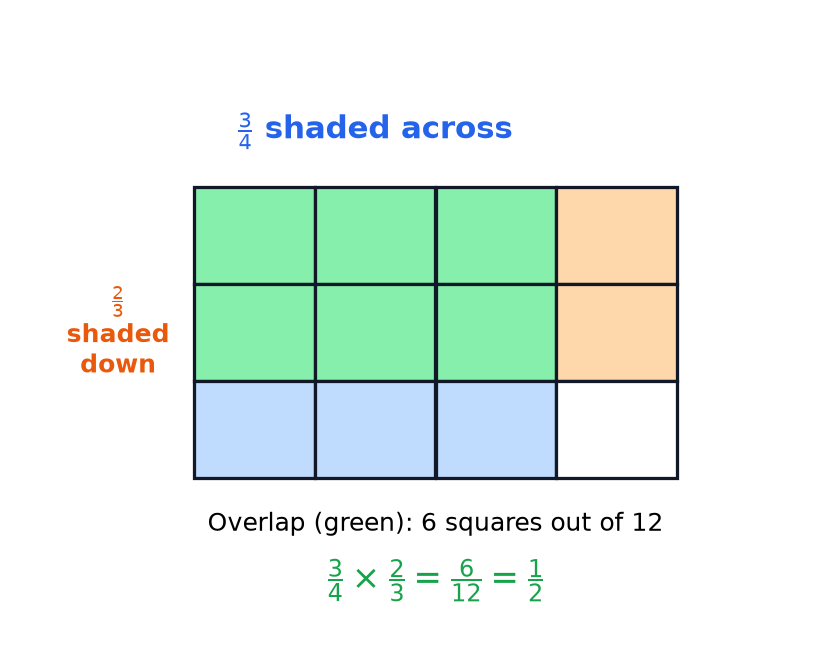
Multiplying fractions finds a fraction of a fraction, and the overlap of the two shaded parts is the answer. Here three quarters of two thirds covers 6 of the 12 squares.
What the picture shows
- Multiply the numerators \(3 \times 2 = 6\) squares in the overlap.
- Multiply the denominators \(4 \times 3 = 12\) squares in the whole shape.
- Simplify \(\frac{6}{12} = \frac{1}{2}\).
Multiplying and dividing fractions
These need no common denominator, which makes them quicker than adding.
-
Multiplying
Multiply the numerators and multiply the denominators. Cancel any common factors first to keep the numbers small: \(\frac{3}{8} \times \frac{4}{9} = \frac{1}{2} \times \frac{1}{3} = \frac{1}{6}\).
-
Dividing
Keep the first fraction, change the division to multiplication and flip the second fraction: \(\frac{2}{3} \div \frac{4}{5} = \frac{2}{3} \times \frac{5}{4} = \frac{10}{12} = \frac{5}{6}\).
-
Mixed numbers
Always turn mixed numbers into improper fractions before multiplying or dividing. A whole number can be written over 1.
-
Fraction of an amount
Divide by the denominator, then multiply by the numerator: \(\frac{3}{5}\) of 80 is \(80 \div 5 = 16\), then \(16 \times 3 = 48\).
Multiplying mixed numbers
Work out \(1\frac{2}{3} \times 2\frac{1}{4}\). Give your answer as a mixed number.
Show the solutionHide the solution
- 1 Improper fractions \(1\frac{2}{3} = \frac{5}{3}\) and \(2\frac{1}{4} = \frac{9}{4}\).
- 2 Cancel if you can 3 divides into the 3 and the 9, giving \(\frac{5}{1} \times \frac{3}{4}\).
- 3 Multiply across \(\frac{5 \times 3}{1 \times 4} = \frac{15}{4}\).
- 4 Convert back \(\frac{15}{4} = 3\frac{3}{4}\).
Answer\(3\frac{3}{4}\)
A fractions problem in context
A bakery bakes 640 cupcakes. \(\frac{3}{8}\) are sold in the morning and \(\frac{1}{4}\) of the rest are sold in the afternoon. How many are left?
Show the solutionHide the solution
- 1 Morning sales \(\frac{3}{8}\) of 640: \(640 \div 8 = 80\), and \(80 \times 3 = 240\).
- 2 What remains \(640 - 240 = 400\).
- 3 Afternoon sales \(\frac{1}{4}\) of the remaining 400 is \(400 \div 4 = 100\).
- 4 Left at the end \(400 - 100 = 300\) cupcakes.
Answer300
The big idea
Add and subtract over a common denominator; multiply and divide with no common denominator at all.
Mixing the two rules up is the most common way to lose marks on fractions.
One quantity as a fraction of another
These questions ask what fraction one amount is of another.
-
Same units
Convert both quantities to the same unit first. 35 minutes out of 2 hours is 35 out of 120 minutes.
-
Write and simplify
\(\dfrac{35}{120} = \dfrac{7}{24}\), after dividing the top and bottom by 5.
-
Part over whole
"What fraction of the class..." means the number in the group over the total number in the class.
-
Sense check
The fraction should be less than 1 unless the first quantity is bigger than the second.
Writing one amount as a fraction of another
Out of 40 students, 14 walk to school and 6 cycle. What fraction of the students walk or cycle? Give your answer in its simplest form.
Show the solutionHide the solution
- 1 Combine the groups \(14 + 6 = 20\) students walk or cycle.
- 2 Write as a fraction of the whole \(\dfrac{20}{40}\).
- 3 Simplify Divide the top and bottom by 20 to get \(\dfrac{1}{2}\).
Answer\(\dfrac{1}{2}\)
Finding the whole from a fraction
Reverse fraction problems give you the part and ask for the whole.
-
The idea
Divide the known amount by the numerator to find one part, then multiply by the denominator to find the whole.
-
Example
If \(\dfrac{3}{5}\) of a number is 36, one fifth is \(36 \div 3 = 12\), so the whole number is \(12 \times 5 = 60\).
-
Check
\(\dfrac{3}{5}\) of 60 is 36, which matches.
-
Common error
Do not multiply 36 by \(\dfrac{3}{5}\). That finds a fraction of the wrong number.
A reverse fraction problem
Priya spends \(\dfrac{2}{7}\) of her savings on a bike that costs \(\pounds 84\). How much were her savings?
Show the solutionHide the solution
- 1 Two sevenths is the bike \(\dfrac{2}{7}\) of the savings is \(\pounds 84\).
- 2 Find one seventh \(84 \div 2 = \pounds 42\).
- 3 Find the whole \(42 \times 7 = \pounds 294\).
- 4 Check \(\dfrac{2}{7}\) of 294 is \(294 \div 7 \times 2 = 84\).
Answer\(\pounds 294\)
Dividing a whole number by a fraction
Dividing by a fraction asks how many times that fraction fits into the number.
-
Meaning
\(6 \div \dfrac{2}{3}\) asks how many two-thirds fit into 6.
-
Method
Write 6 as \(\dfrac{6}{1}\) and flip the second fraction: \(\dfrac{6}{1} \times \dfrac{3}{2} = \dfrac{18}{2} = 9\).
-
Dividing by a whole number
\(\dfrac{3}{4} \div 3 = \dfrac{3}{4} \times \dfrac{1}{3} = \dfrac{1}{4}\).
-
Context
A 6 metre ribbon cut into pieces that are \(\dfrac{2}{3}\) of a metre long gives 9 pieces.
Common fraction mistakes
What students write
- \(\dfrac{1}{2} + \dfrac{1}{3} = \dfrac{2}{5}\)
- \(\dfrac{2}{3} \div \dfrac{4}{5} = \dfrac{8}{15}\)
- \(3\dfrac{1}{2} \times 2 = 6\dfrac{1}{2}\)
What is correct
- \(\dfrac{1}{2} + \dfrac{1}{3} = \dfrac{3}{6} + \dfrac{2}{6} = \dfrac{5}{6}\)
- \(\dfrac{2}{3} \div \dfrac{4}{5} = \dfrac{2}{3} \times \dfrac{5}{4} = \dfrac{5}{6}\)
- \(3\dfrac{1}{2} \times 2 = \dfrac{7}{2} \times 2 = 7\)
Test yourself
-
1
Simplify \(\dfrac{18}{30}\).
Show answerHide answer
\(\dfrac{3}{5}\), after dividing the top and bottom by 6.
-
2
Write \(2\dfrac{3}{4}\) as an improper fraction.
Show answerHide answer
\(\dfrac{11}{4}\).
-
3
What is \(\dfrac{1}{2}\) of \(\dfrac{3}{4}\)?
Show answerHide answer
\(\dfrac{3}{8}\).
-
4
What is \(\dfrac{3}{4} \div \dfrac{1}{4}\)?
Show answerHide answer
3, because there are three quarters in three quarters.
-
5
Find \(\dfrac{5}{6}\) of 48.
Show answerHide answer
40, because \(48 \div 6 = 8\) and \(8 \times 5 = 40\).
Exam technique: fractions
Fraction questions are marked for method, so tidy working earns marks even if the final answer slips.
-
Show the common denominator
Write each fraction in its new form before adding or subtracting.
-
Cancel before multiplying
It keeps the numbers small and reduces the chance of a slip.
-
Give the answer in the form asked
A mixed number, an improper fraction or a simplified fraction may each be requested.
-
Avoid decimals
Do not convert to decimals unless the question asks, because recurring decimals lose accuracy.
Summary and exam focus
- Simplify a fraction by dividing the top and bottom by their HCF.
- To add or subtract, rewrite over a common denominator, then add or subtract only the numerators.
- To multiply, multiply tops and bottoms; to divide, keep, change, flip.
- Convert mixed numbers to improper fractions before multiplying or dividing.
- To find a fraction of an amount, divide by the denominator and multiply by the numerator.
Exam focus
Work out \(2\frac{1}{4} \div 1\frac{1}{8}\). You must show all your working. (3 marks) (3 marks)
Convert both mixed numbers to improper fractions in your first line of working, then show the flipped second fraction in your second line. Cancel before you multiply and leave the answer as a whole number or fully simplified fraction.
Key terms
The words this lesson expects you to use. Each one is linked from the first place it appears above.
- Proportion
- A part compared with the whole, written as a fraction.
- Numerator
- The top number of a fraction, which counts the parts taken.
- Denominator
- The bottom number of a fraction, which shows how many equal parts make the whole.
- Equivalent fraction
- A fraction with a different numerator and denominator but the same value.
- Simplest form
- A fraction whose numerator and denominator have no common factor except 1.
- Improper fraction
- A fraction whose numerator is bigger than or equal to its denominator.
- Mixed number
- A number made of a whole number and a proper fraction, such as \(2\frac{3}{4}\).
- Common denominator
- A denominator shared by two or more fractions, found using a common multiple.
- Reciprocal
- The fraction turned upside down; a number multiplied by its reciprocal gives 1.
- Unit fraction
- A fraction with a numerator of 1.
Questions and answers
17 questions set on this lesson, with the mark schemes and model answers open.
Put these fractions in order, smallest first. \(\dfrac{5}{8}\) \(\dfrac{3}{5}\) \(\dfrac{7}{10}\)
Mark scheme — 2 marks available
- Converts to a common denominator, or to decimals (0.625, 0.6, 0.7) — M1
- \(\dfrac{3}{5}, \dfrac{5}{8}, \dfrac{7}{10}\) — A1
Model answer
Use a common denominator of 40: \(\dfrac{25}{40}\), \(\dfrac{24}{40}\) and \(\dfrac{28}{40}\). The order is \(\dfrac{3}{5},\ \dfrac{5}{8},\ \dfrac{7}{10}\).
Work out \(\dfrac{5}{6} - \dfrac{3}{8}\).
Mark scheme — 2 marks available
- \(\dfrac{20}{24}\) and \(\dfrac{9}{24}\) — M1
- \(\dfrac{11}{24}\) — A1
Model answer
The LCM of 6 and 8 is 24. \(\dfrac{20}{24} - \dfrac{9}{24} = \dfrac{11}{24}\).
Work out \(1\dfrac{2}{3} + 2\dfrac{3}{5}\). Give your answer as a mixed number.
Mark scheme — 3 marks available
- A common denominator of 15, or whole numbers and fractions dealt with separately using a common denominator — M1
- \(\dfrac{25}{15} + \dfrac{39}{15}\) or \(3 + \dfrac{10}{15} + \dfrac{9}{15}\) — M1
- \(4\dfrac{4}{15}\) — A1
Model answer
\(1\dfrac{2}{3} = \dfrac{5}{3} = \dfrac{25}{15}\) and \(2\dfrac{3}{5} = \dfrac{13}{5} = \dfrac{39}{15}\). Adding gives \(\dfrac{64}{15} = 4\dfrac{4}{15}\).
Work out \(3\dfrac{3}{4} \times 2\dfrac{2}{5}\).
Mark scheme — 3 marks available
- Both mixed numbers converted to improper fractions — M1
- \(\dfrac{15}{4} \times \dfrac{12}{5}\) or \(\dfrac{180}{20}\) — M1
- 9 — A1
Model answer
\(3\dfrac{3}{4} = \dfrac{15}{4}\) and \(2\dfrac{2}{5} = \dfrac{12}{5}\). Cancel: \(\dfrac{15}{4} \times \dfrac{12}{5} = \dfrac{3}{1} \times \dfrac{3}{1} = 9\).
Work out \(2\dfrac{1}{4} \div 1\dfrac{1}{8}\).
Mark scheme — 3 marks available
- Both mixed numbers converted to improper fractions — M1
- \(\dfrac{9}{4} \times \dfrac{8}{9}\) — M1
- 2 — A1
Model answer
\(2\dfrac{1}{4} = \dfrac{9}{4}\) and \(1\dfrac{1}{8} = \dfrac{9}{8}\). Then \(\dfrac{9}{4} \div \dfrac{9}{8} = \dfrac{9}{4} \times \dfrac{8}{9} = 2\).
In a class of 30 students, \(\dfrac{2}{5}\) walk to school and \(\dfrac{1}{3}\) come by bus. The rest are driven. How many students are driven to school? You must show your working.
Mark scheme — 3 marks available
- \(\dfrac{2}{5} \times 30 = 12\) or \(\dfrac{1}{3} \times 30 = 10\) — M1
- \(30 - 12 - 10\) — M1
- 8 — A1
Model answer
Walk: \(\dfrac{2}{5} \times 30 = 12\). Bus: \(\dfrac{1}{3} \times 30 = 10\). Driven: \(30 - 12 - 10 = 8\) students.
Lena says that \(\dfrac{1}{2} + \dfrac{1}{3} = \dfrac{2}{5}\). (a) Explain what Lena has done wrong. [1 mark] (b) Work out the correct answer. [2 marks]
Mark scheme — 3 marks available
- (a) States that she added the numerators and the denominators — B1
- (b) \(\dfrac{3}{6}\) and \(\dfrac{2}{6}\) — M1
- (b) \(\dfrac{5}{6}\) — A1
Model answer
(a) Lena has added the numerators and added the denominators, instead of finding a common denominator. (b) \(\dfrac{1}{2} + \dfrac{1}{3} = \dfrac{3}{6} + \dfrac{2}{6} = \dfrac{5}{6}\).
\(\dfrac{3}{5}\) of a number is 36. What is the number?
Why: \(36 \div 3 = 12\) is one fifth, so the whole number is \(12 \times 5 = 60\).
What fraction of 2 hours is 35 minutes? Give your answer in its simplest form.
Why: Convert to minutes: \(\dfrac{35}{120} = \dfrac{7}{24}\).
Work out \(\dfrac{1}{2} + \dfrac{1}{3}\).
Why: Use a common denominator of 6: \(\dfrac{3}{6} + \dfrac{2}{6} = \dfrac{5}{6}\).
What is \(\dfrac{3}{5}\) of 40?
Why: \(40 \div 5 = 8\), then \(8 \times 3 = 24\).
Work out \(\dfrac{2}{3} \div 4\).
Why: Dividing by 4 is multiplying by \(\dfrac{1}{4}\): \(\dfrac{2}{3} \times \dfrac{1}{4} = \dfrac{2}{12} = \dfrac{1}{6}\).
Write \(3\dfrac{2}{5}\) as an improper fraction.
Why: \(3 \times 5 + 2 = 17\), so the fraction is \(\dfrac{17}{5}\).
Which fraction is equal to \(\dfrac{18}{24}\)?
Why: The HCF of 18 and 24 is 6, and dividing both by 6 gives \(\dfrac{3}{4}\).
Work out \(\dfrac{3}{4} \times \dfrac{2}{9}\).
Why: Multiply across and simplify: \(\dfrac{6}{36} = \dfrac{1}{6}\).
What is the reciprocal of \(\dfrac{5}{7}\)?
Why: The reciprocal is the fraction turned upside down, which is \(\dfrac{7}{5}\).
Which of these fractions is the largest?
Why: As decimals they are 0.625, 0.667, 0.583 and 0.6, so \(\dfrac{2}{3}\) is the largest.