Maths · Number Without a Calculator
Viewing as
Teacher view: every answer and mark scheme set out in full.
Powers, Roots and Indices
Squares, cubes and roots to recall, the laws of indices, and zero, negative and fractional powers.
Learning Objectives
- 1Recall square numbers up to 15 squared, cube numbers and their roots.
- 2Use the laws of indices to simplify products, quotients and powers of powers.
- 3Evaluate zero and negative powers.
- 4Evaluate fractional powers, such as \(8^{\frac{2}{3}}\) (Higher tier).
Index notation
An index (or power) tells you how many copies of the base to multiply together, so \(2^5 = 2 \times 2 \times 2 \times 2 \times 2 = 32\). Indices turn up in factorisation, standard form, algebra and compound interest, so the laws in this lesson are used throughout GCSE Maths. On a non-calculator paper you are also expected to recall the squares, cubes and roots below without working them out.
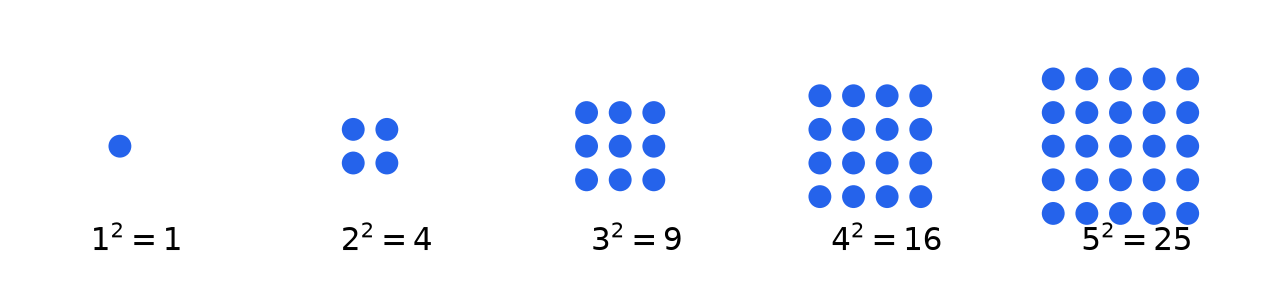
Square numbers as dot patterns
A square number is the number of dots in a square array, which is why multiplying a number by itself is called squaring. Roots go the other way: the square root of 25 is the side of the square, 5.
Numbers to recall
- Squares to 15 squared 1, 4, 9, 16, 25, 36, 49, 64, 81, 100, 121, 144, 169, 196, 225.
- Cubes 1, 8, 27, 64, 125 and \(10^3 = 1000\).
- Roots \(\sqrt{81} = 9\) and \(\sqrt[3]{64} = 4\). Roots undo powers.
Squares, cubes and roots
These must be instant recall: they are not worth the time to work out in an exam.
-
Squares
\(n^2 = n \times n\). \(13^2 = 169\) and \(15^2 = 225\) are the ones people forget.
-
Cubes
\(n^3 = n \times n \times n\). \(4^3 = 4 \times 4 \times 4 = 64\), which is not \(4 \times 3 = 12\).
-
Square roots
\(\sqrt{196} = 14\). Every positive number has two square roots, \(+14\) and \(-14\), but the \(\sqrt{\ }\) sign means the positive one.
-
Powers of 2 and 10
\(2^5 = 32\), \(2^8 = 256\), \(2^{10} = 1024\), and \(10^n\) is 1 followed by \(n\) zeros.
The laws of indices
The laws only work when the bases are the same.
-
Multiplying
\(a^m \times a^n = a^{m+n}\). Add the indices: \(3^4 \times 3^5 = 3^9\).
-
Dividing
\(a^m \div a^n = a^{m-n}\). Subtract the indices: \(7^8 \div 7^3 = 7^5\).
-
Power of a power
\((a^m)^n = a^{m \times n}\). Multiply the indices: \((2^3)^4 = 2^{12}\).
-
Different bases
\(2^3 \times 5^2\) cannot be combined using the laws, so work out each part separately: \(8 \times 25 = 200\).
Using the laws
Work out the value of \(\dfrac{2^4 \times 2^5}{2^6}\).
Show the solutionHide the solution
- 1 Multiply the top \(2^4 \times 2^5 = 2^{4+5} = 2^9\).
- 2 Divide \(2^9 \div 2^6 = 2^{9-6} = 2^3\).
- 3 Evaluate \(2^3 = 8\).
Answer8
Zero and negative powers
Extending the laws gives two special cases that appear on every paper.
-
Zero power
\(a^0 = 1\) for any \(a \neq 0\). It follows from the division law: \(a^3 \div a^3 = a^0\) and also \(= 1\).
-
Negative power
\(a^{-n} = \dfrac{1}{a^n}\). So \(2^{-3} = \dfrac{1}{8}\) and \(5^{-2} = \dfrac{1}{25}\).
-
A negative power is not a negative number
\(2^{-3}\) is small and positive. The minus sign means "take the reciprocal".
-
Fractions to a negative power
Flip the fraction, then use the positive power: \(\left(\dfrac{2}{3}\right)^{-2} = \left(\dfrac{3}{2}\right)^2 = \dfrac{9}{4}\).
Fractional powers (Higher tier)
The denominator of the power is a root, and the numerator is a power.
-
Half powers
\(a^{\frac{1}{2}} = \sqrt{a}\), so \(49^{\frac{1}{2}} = 7\).
-
Third powers
\(a^{\frac{1}{3}} = \sqrt[3]{a}\), so \(125^{\frac{1}{3}} = 5\).
-
General rule
\(a^{\frac{m}{n}} = \left(\sqrt[n]{a}\right)^m\). Take the root first, which keeps the numbers small.
A fractional and negative power
Work out the value of \(8^{-\frac{2}{3}}\).
Show the solutionHide the solution
- 1 Deal with the negative \(8^{-\frac{2}{3}} = \dfrac{1}{8^{\frac{2}{3}}}\).
- 2 Take the cube root first \(\sqrt[3]{8} = 2\).
- 3 Then apply the power of 2 \(2^2 = 4\), so \(8^{\frac{2}{3}} = 4\).
- 4 Finish \(8^{-\frac{2}{3}} = \dfrac{1}{4}\).
Answer\(\dfrac{1}{4}\)
Adding indices or multiplying them?
Multiplying powers with the same base
- \(a^m \times a^n = a^{m+n}\)
- Example: \(x^4 \times x^5 = x^9\)
- Add the indices
A power of a power
- \((a^m)^n = a^{mn}\)
- Example: \((x^4)^5 = x^{20}\)
- Multiply the indices
Estimating roots
When a number is not a perfect square or cube, you can still say roughly how big its root is.
-
Between two squares
\(\sqrt{40}\) lies between \(\sqrt{36} = 6\) and \(\sqrt{49} = 7\), so it is between 6 and 7.
-
Which is it closer to?
40 is closer to 36 than to 49, so \(\sqrt{40}\) is a little more than 6. The exact value is about 6.32.
-
Cube roots
\(\sqrt[3]{100}\) lies between \(\sqrt[3]{64} = 4\) and \(\sqrt[3]{125} = 5\).
-
Use in estimates
To estimate \(\sqrt{50} \times 2\), use \(\sqrt{50} \approx 7\), so the answer is about 14.
Writing a product as a single power
Write \(16 \times 8\) as a single power of 2.
Show the solutionHide the solution
- 1 Write each number as a power of 2 \(16 = 2^4\) and \(8 = 2^3\).
- 2 Multiply the powers \(2^4 \times 2^3 = 2^{4+3}\).
- 3 Write the answer \(2^7\), which equals 128.
Answer\(2^7\)
Finding an unknown index
Find the value of \(n\) in each equation: (a) \(2^n = 64\) and (b) \(3^n = \dfrac{1}{27}\).
Show the solutionHide the solution
- 1 Write the number as a power \(64 = 2^6\), so \(2^n = 2^6\) and \(n = 6\).
- 2 Deal with the fraction \(\dfrac{1}{27} = \dfrac{1}{3^3}\).
- 3 Use a negative index \(\dfrac{1}{3^3} = 3^{-3}\), so \(n = -3\).
Answer(a) \(n = 6\) (b) \(n = -3\)
Powers of 10 and place value
Powers of 10 link indices to place value, and they are the basis of standard form.
-
Positive powers
\(10^3 = 1000\) and \(10^6 = 1\,000\,000\). The index is the number of zeros.
-
Negative powers
\(10^{-2} = \dfrac{1}{100} = 0.01\) and \(10^{-3} = 0.001\).
-
Multiplying and dividing
\(4.5 \times 10^2 = 450\) and \(4.5 \div 10^2 = 0.045\). The digits move as many places as the index says.
-
Same laws
\(10^5 \times 10^{-2} = 10^3\), using the usual rule of adding the indices.
Common mistakes with indices
What students write
- \(2^3 = 6\)
- \(3^2 \times 3^4 = 9^6\)
- \(5^{-2} = -25\)
- \((2x)^2 = 2x^2\)
What is correct
- \(2^3 = 2 \times 2 \times 2 = 8\)
- \(3^2 \times 3^4 = 3^6\)
- \(5^{-2} = \dfrac{1}{25}\)
- \((2x)^2 = 4x^2\)
Test yourself
-
1
What is \(7^2\)?
Show answerHide answer
49.
-
2
What is \(\sqrt{144}\)?
Show answerHide answer
12.
-
3
Simplify \(a^6 \div a^2\).
Show answerHide answer
\(a^4\).
-
4
What is \(4^{-1}\)?
Show answerHide answer
\(\dfrac{1}{4}\).
-
5
Write \(10^{-2}\) as a decimal.
Show answerHide answer
0.01.
Exam technique: indices
Index questions are short, so marks are lost through carelessness rather than difficulty.
-
Name the law
Write "add the indices" or "multiply the indices" beside your working, and it is easier to spot the wrong one.
-
Same base first
Rewrite numbers with the same base, such as \(8 = 2^3\), before you use a law.
-
Answer in the form asked
"Write as a single power" means \(2^7\) and not 128, but "work out the value" means 128.
-
No calculator
Learn the squares, cubes and powers of 2 and 10 so that you do not have to work them out.
Summary and exam focus
- Recall squares to \(15^2\), cubes to \(5^3\) and \(10^3\), and the matching roots.
- To multiply powers of the same base, add the indices; to divide, subtract; for a power of a power, multiply.
- \(a^0 = 1\) and \(a^{-n} = \dfrac{1}{a^n}\), and a negative index does not make the number negative.
- Fractional indices mean roots: \(a^{\frac{1}{2}} = \sqrt{a}\) and \(a^{\frac{m}{n}} = (\sqrt[n]{a})^m\).
- The laws only work for the same base.
Exam focus
Work out the value of \(\left(\dfrac{1}{9}\right)^{-\frac{1}{2}}\). (2 marks) (2 marks)
Deal with the negative index first by flipping the fraction, which gives \(9^{\frac{1}{2}}\), then take the root. Writing the flipped fraction as your first line secures the method mark even if the root goes wrong.
Key terms
The words this lesson expects you to use. Each one is linked from the first place it appears above.
- Power of 10
- A number such as \(10^2\), \(10^3\) or \(10^{-2}\), where 10 is raised to a whole-number index.
- Index (power)
- The small raised number that shows how many times the base is multiplied by itself.
- Indices
- The plural of index.
- Base
- The number that is being multiplied by itself in a power, such as 2 in \(2^5\).
- Square number
- The result of multiplying a whole number by itself.
- Cube number
- The result of multiplying a whole number by itself twice.
- Square root
- A number that, when multiplied by itself, gives the original number.
- Cube root
- A number that, when multiplied by itself twice, gives the original number.
- Reciprocal
- One divided by the number; the reciprocal of \(a\) is \(\dfrac{1}{a}\).
- Laws of indices
- The rules for combining powers with the same base: add to multiply, subtract to divide, multiply for a power of a power.
Questions and answers
17 questions set on this lesson, with the mark schemes and model answers open.
Work out (a) \(11^2\) [1 mark] (b) \(\sqrt[3]{125}\) [1 mark]
Mark scheme — 2 marks available
- (a) 121 — B1
- (b) 5 — B1
Model answer
(a) \(11 \times 11 = 121\). (b) \(5 \times 5 \times 5 = 125\), so \(\sqrt[3]{125} = 5\).
Simplify (a) \(x^4 \times x^5\) [1 mark] (b) \(y^8 \div y^3\) [1 mark]
Mark scheme — 2 marks available
- (a) \(x^9\) — B1
- (b) \(y^5\) — B1
Model answer
(a) Add the indices: \(x^{4+5} = x^9\). (b) Subtract the indices: \(y^{8-3} = y^5\).
Work out the value of \(2^{-3} \times 4\). Give your answer as a fraction.
Mark scheme — 2 marks available
- \(2^{-3} = \dfrac{1}{8}\) or \(2^{-3} \times 2^2\) — M1
- \(\dfrac{1}{2}\) — A1
Model answer
\(2^{-3} = \dfrac{1}{8}\), so \(\dfrac{1}{8} \times 4 = \dfrac{4}{8} = \dfrac{1}{2}\). Alternatively, \(4 = 2^2\), so \(2^{-3} \times 2^2 = 2^{-1} = \dfrac{1}{2}\).
(a) Find the value of \(n\) when \(2^n = \dfrac{1}{32}\). [2 marks] (b) Find the value of \(n\) when \(3^n \times 3^4 = 3\). [1 mark]
Mark scheme — 3 marks available
- (a) \(32 = 2^5\) or \(\dfrac{1}{2^5}\) — M1
- (a) \(-5\) — A1
- (b) \(-3\) — B1
Model answer
(a) \(\dfrac{1}{32} = \dfrac{1}{2^5} = 2^{-5}\), so \(n = -5\). (b) \(n + 4 = 1\), so \(n = -3\).
Work out the value of (a) \(125^{\frac{1}{3}}\) [1 mark] (b) \(81^{\frac{3}{4}}\) [2 marks]
Mark scheme — 3 marks available
- (a) 5 — B1
- (b) \(\sqrt[4]{81} = 3\) or \(81^{\frac{1}{4}} = 3\) — M1
- (b) 27 — A1
Model answer
(a) The cube root of 125 is 5. (b) \(81^{\frac{1}{4}} = 3\), then \(3^3 = 27\).
Show that \(5^7 + 5^7 + 5^7 + 5^7 + 5^7 = 5^8\).
Mark scheme — 2 marks available
- \(5 \times 5^7\) — M1
- \(5^1 \times 5^7 = 5^8\) with a clear conclusion — A1
Model answer
There are five lots of \(5^7\), so the sum is \(5 \times 5^7 = 5^1 \times 5^7 = 5^{1+7} = 5^8\).
Simplify \((3a^2b^3)^2\).
Mark scheme — 2 marks available
- Two of \(9\), \(a^4\), \(b^6\) correct — M1
- \(9a^4b^6\) — A1
Model answer
Square every part: \(3^2 \times (a^2)^2 \times (b^3)^2 = 9a^4b^6\).
Between which two whole numbers does \(\sqrt{40}\) lie?
Why: \(6^2 = 36\) and \(7^2 = 49\), and 40 is between 36 and 49.
Write \(16 \times 8\) as a single power of 2.
Why: \(16 = 2^4\) and \(8 = 2^3\), so \(2^4 \times 2^3 = 2^7\).
What is the value of \(\sqrt{196}\)?
Why: 14 × 14 = 196.
What is the value of \(4^3\)?
Why: \(4 \times 4 \times 4 = 64\), not \(4 \times 3 = 12\).
Simplify \(a^5 \times a^3\).
Why: Add the indices when multiplying: \(a^{5+3} = a^8\).
Simplify \((3^2)^4\).
Why: For a power of a power, multiply the indices: \(3^{2 \times 4} = 3^8\).
What is the value of \(5^{-2}\)?
Why: A negative index means a reciprocal: \(5^{-2} = \dfrac{1}{5^2} = \dfrac{1}{25}\).
What is the value of \(7^0\)?
Why: Any non-zero number to the power 0 is 1.
Simplify \(2^6 \div 2^{-2}\).
Why: Subtract the indices: \(6 - (-2) = 8\), so the answer is \(2^8\).
What is the value of \(8^{\frac{1}{3}}\)?
Why: A power of one third means the cube root, and \(2 \times 2 \times 2 = 8\).