Maths · Algebra
Viewing as
Teacher view: every answer and mark scheme set out in full.
Solving Linear Equations and Inequalities
Solving equations with brackets, fractions and unknowns on both sides, forming equations, and solving inequalities.
Learning Objectives
- 1Solve linear equations using inverse operations, including equations with brackets and unknowns on both sides.
- 2Solve equations that contain fractions.
- 3Form equations from worded and geometric problems and solve them.
- 4Solve linear inequalities, show solutions on a number line and list integer solutions.
An equation is a balance
An equation says that two sides are equal, so whatever you do to one side you must do to the other to keep it balanced. Solving means finding the value of the unknown that makes the statement true. Written working matters here: examiners award method marks for each correct step, so a line-by-line layout with the same operation shown on both sides is worth the extra seconds.
Keeping the equation balanced
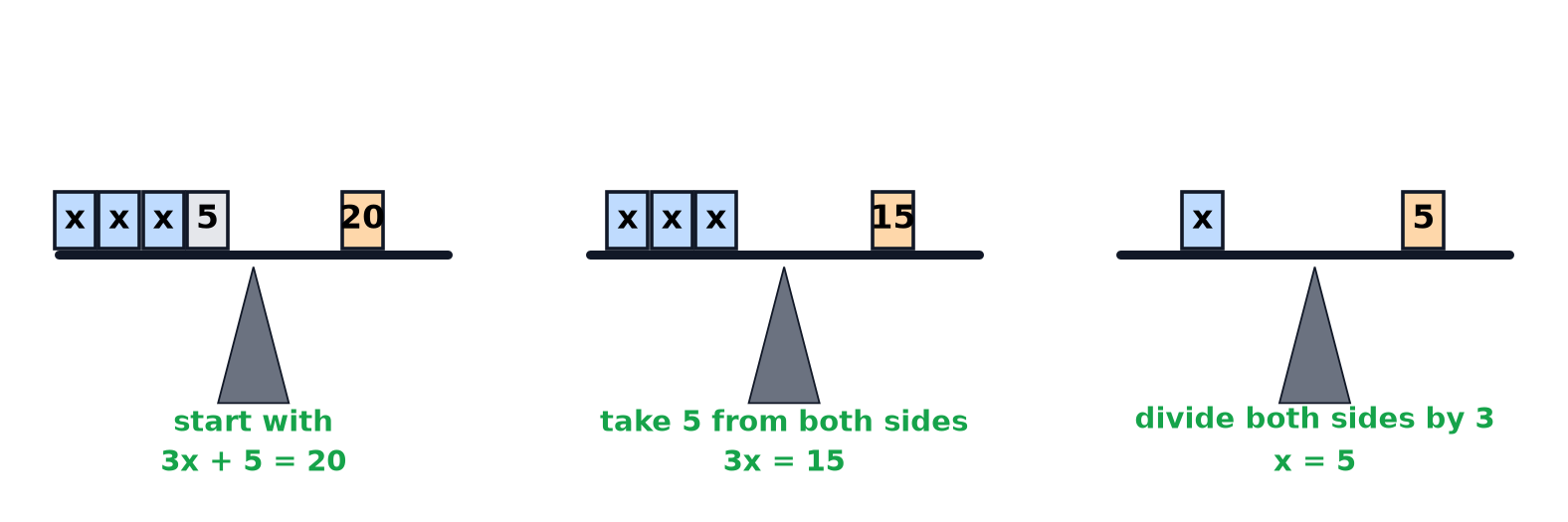
A balance stays level only if you do the same to both pans. Removing 5 from both sides and then dividing both sides by 3 leaves a single \(x\) balanced against 5.
The steps
- Undo the addition or subtraction Take 5 from both sides: \(3x = 15\).
- Undo the multiplication or division Divide both sides by 3: \(x = 5\).
- Check \(3 \times 5 + 5 = 20\), which is correct.
Solving by inverse operations
Undo the operations in reverse order, starting with the addition or subtraction.
-
One step
\(x + 7 = 12\) means subtract 7 from both sides, so \(x = 5\). \(x - 4 = 9\) means add 4, so \(x = 13\).
-
Two steps
\(3x - 4 = 11\). Add 4 to get \(3x = 15\), then divide by 3 to get \(x = 5\).
-
Fractions
\(\dfrac{x}{4} + 3 = 8\). Subtract 3 to get \(\dfrac{x}{4} = 5\), then multiply by 4 to get \(x = 20\).
-
A negative coefficient
\(5 - 2x = 11\). Subtract 5 to get \(-2x = 6\), then divide by \(-2\) to get \(x = -3\).
Unknowns on both sides
Solve \(5x + 3 = 2x + 18\).
Show the solutionHide the solution
- 1 Collect the \(x\) terms on one side Subtract \(2x\) from both sides: \(3x + 3 = 18\).
- 2 Remove the number from that side Subtract 3 from both sides: \(3x = 15\).
- 3 Divide \(x = 5\).
- 4 Check Left side: \(5 \times 5 + 3 = 28\). Right side: \(2 \times 5 + 18 = 28\). The sides match.
Answer\(x = 5\)
Equations with brackets
Solve \(3(2x - 1) = 4x + 9\).
Show the solutionHide the solution
- 1 Expand the bracket \(6x - 3 = 4x + 9\).
- 2 Collect the \(x\) terms Subtract \(4x\) from both sides: \(2x - 3 = 9\).
- 3 Add 3 \(2x = 12\).
- 4 Divide \(x = 6\). Check: \(3(2 \times 6 - 1) = 33\) and \(4 \times 6 + 9 = 33\).
Answer\(x = 6\)
Equations with fractions on both sides
Solve \(\dfrac{x + 5}{3} = \dfrac{x - 1}{2}\).
Show the solutionHide the solution
- 1 Multiply both sides by the denominators Multiply by 6, the common multiple of 3 and 2: \(2(x + 5) = 3(x - 1)\).
- 2 Expand the brackets \(2x + 10 = 3x - 3\).
- 3 Collect the \(x\) terms Subtract \(2x\) from both sides: \(10 = x - 3\).
- 4 Solve Add 3 to both sides: \(x = 13\). Check: \(\dfrac{18}{3} = 6\) and \(\dfrac{12}{2} = 6\).
Answer\(x = 13\)
Forming equations
Many exam questions describe a situation, and you must turn it into an equation first.
-
Choose a letter
Say what it stands for, such as "let the width be \(x\) cm".
-
Write each quantity
Express every other quantity in terms of \(x\), such as a length of \((3x + 2)\) cm.
-
Use the fact you are given
A perimeter, a total, the angle sum of a triangle (180°) or a statement that two things are equal gives you the equation.
-
Answer the question asked
Solving gives \(x\), but the question may ask for an area or an age, so reread it.
Forming and solving an equation
A rectangle has length \((3x + 2)\) cm and width \((x + 4)\) cm. Its perimeter is 52 cm. Work out the value of \(x\) and the length of the rectangle.
Show the solutionHide the solution
- 1 Write the perimeter Perimeter \(= 2 \times (\text{length} + \text{width}) = 2(3x + 2 + x + 4) = 2(4x + 6)\).
- 2 Make an equation \(2(4x + 6) = 52\), so \(4x + 6 = 26\).
- 3 Solve \(4x = 20\), so \(x = 5\).
- 4 Answer the question Length \(= 3 \times 5 + 2 = 17\) cm. The width is \(5 + 4 = 9\) cm, and \(2(17 + 9) = 52\) as required.
Answer\(x = 5\), length = 17 cm
Solving inequalities
Inequalities are solved like equations, with one important difference.
-
The symbols
\(<\) means less than, \(>\) means greater than, \(\leq\) means less than or equal to and \(\geq\) means greater than or equal to.
-
Solving
\(3x + 2 < 14\). Subtract 2 to get \(3x < 12\), then divide by 3 to get \(x < 4\).
-
The negative rule
If you multiply or divide both sides by a negative number, you must reverse the inequality sign. \(-2x > 6\) gives \(x < -3\).
-
Integer solutions
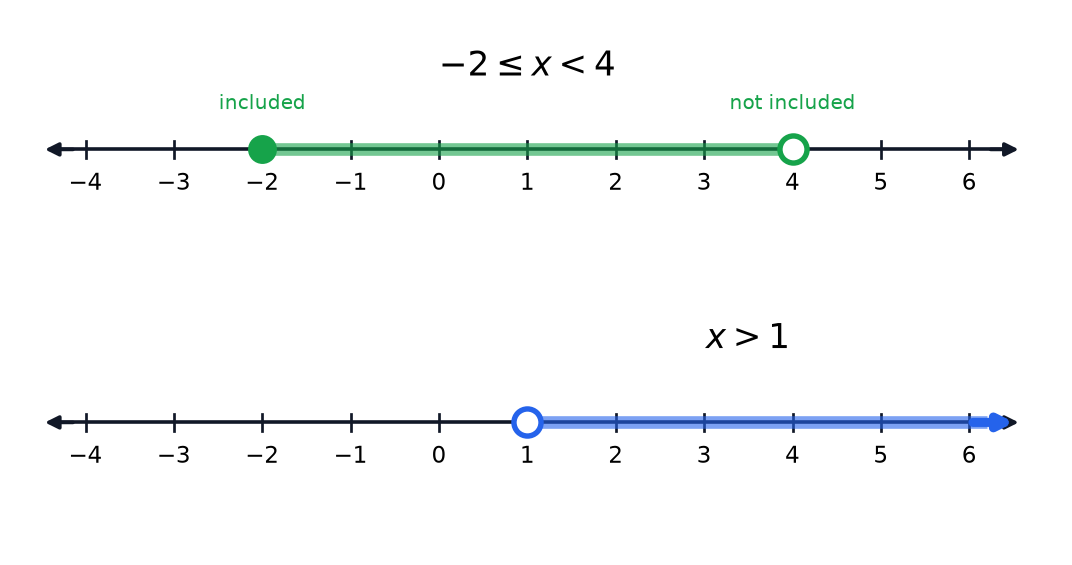
List the whole numbers that fit. \(-2 \leq x < 4\) has the integer solutions \(-2, -1, 0, 1, 2, 3\), and 4 is not included.
Inequalities on a number line
A filled circle shows that an end value is included, as with \(\leq\) and \(\geq\). An open circle shows that it is not included, as with \(<\) and \(>\).
Reading the lines
- Filled circle The value is included in the solution, so use \(\leq\) or \(\geq\).
- Open circle The value is not included, so use \(<\) or \(>\).
- Arrow The solution carries on for ever in that direction.
A double inequality
Solve \(-3 < 2x + 1 \leq 9\) and list the integer values of \(x\) that satisfy it.
Show the solutionHide the solution
- 1 Subtract 1 from every part \(-4 < 2x \leq 8\).
- 2 Divide every part by 2 \(-2 < x \leq 4\).
- 3 List the integers \(x\) must be bigger than \(-2\) but can equal 4, so the integers are \(-1, 0, 1, 2, 3, 4\).
Answer\(-2 < x \leq 4\), so \(x = -1, 0, 1, 2, 3, 4\)
Equations and inequalities
Solving an equation
- The solution is a particular value or values
- The equals sign stays throughout
- Check by substituting the answer back in
Solving an inequality
- The solution is a range of values
- The inequality sign stays, but reverses if you multiply or divide by a negative
- Show the answer on a number line, using open and filled circles
A method for any linear equation
The same order of steps works for every linear equation.
-
1
Expand any brackets
Multiply out so there are no brackets left.
-
2
Collect the unknowns
Add or subtract so that every term in \(x\) is on one side and every number is on the other.
-
3
Simplify each side
Collect like terms on each side.
-
4
Divide
Divide both sides by the coefficient of \(x\).
-
5
Check
Substitute your answer into the original equation.
Equations from consecutive numbers and ages
Word problems give you an equation when you choose a letter sensibly.
-
Consecutive integers
Three consecutive integers can be written \(n\), \(n + 1\) and \(n + 2\), and their sum is \(3n + 3\).
-
Consecutive even numbers
Write them as \(n\), \(n + 2\) and \(n + 4\), where \(n\) is even.
-
Ages
Let the youngest person's age be \(x\), and write the others in terms of \(x\).
-
Check
Put your answer back into the story to see whether it makes sense.
Consecutive numbers
Three consecutive whole numbers add up to 72. Find the three numbers.
Show the solutionHide the solution
- 1 Write the numbers Let the smallest be \(n\), so the numbers are \(n\), \(n + 1\) and \(n + 2\).
- 2 Make an equation \(n + (n + 1) + (n + 2) = 72\), so \(3n + 3 = 72\).
- 3 Solve \(3n = 69\), so \(n = 23\).
- 4 State the numbers 23, 24 and 25. Check: \(23 + 24 + 25 = 72\).
Answer23, 24 and 25
A fraction with an expression on top
Solve \(\dfrac{3x - 2}{4} = 4\).
Show the solutionHide the solution
- 1 Multiply both sides by 4 \(3x - 2 = 16\).
- 2 Add 2 to both sides \(3x = 18\).
- 3 Divide by 3 \(x = 6\).
- 4 Check \(\dfrac{3 \times 6 - 2}{4} = \dfrac{16}{4} = 4\).
Answer\(x = 6\)
Writing inequalities from words and number lines
Translating between words and symbols is often worth marks on its own.
-
Words to symbols
"At least 5" means \(x \geq 5\). "More than 3" means \(x > 3\). "Fewer than 12" means \(x < 12\). "No more than 20" means \(x \leq 20\).
-
Number lines
A filled circle at 2 with an arrow to the left means \(x \leq 2\).
-
Two limits
"\(x\) is greater than \(-1\) and at most 3" is written \(-1 < x \leq 3\).
-
Integer lists
Check each end value to see whether it is included.
An inequality with brackets and unknowns on both sides
Solve \(2(x + 3) \geq 3x - 1\).
Show the solutionHide the solution
- 1 Expand the bracket \(2x + 6 \geq 3x - 1\).
- 2 Collect the \(x\) terms on the side where they are bigger Subtract \(2x\) from both sides: \(6 \geq x - 1\).
- 3 Add 1 to both sides \(7 \geq x\).
- 4 Write with \(x\) first \(x \leq 7\). Collecting \(x\) on the right avoided dividing by a negative number.
Answer\(x \leq 7\)
Test yourself
-
1
Solve \(x + 9 = 4\).
Show answerHide answer
\(x = -5\).
-
2
Solve \(4x = 18\).
Show answerHide answer
\(x = 4.5\).
-
3
Solve \(3x - 5 = 10\).
Show answerHide answer
\(x = 5\).
-
4
Solve \(2(x + 1) = 10\).
Show answerHide answer
\(x = 4\).
-
5
Solve \(\dfrac{x}{3} = 7\).
Show answerHide answer
\(x = 21\).
Exam technique: equations and inequalities
Layout is half the battle in equations, and it is easy to keep tidy.
-
One step per line
Write each new line below the last, with the same operation applied to both sides.
-
Substitute to check
Put your answer back in. It takes seconds and shows you whether you have made an error.
-
Define your letter
In worded problems, say what \(x\) stands for before you write the equation.
-
Inequalities
Remember to reverse the sign when you multiply or divide by a negative, and read the question to see whether integers are needed.
Summary and exam focus
- Do the same to both sides, and undo the addition or subtraction before the multiplication or division.
- With unknowns on both sides, collect the \(x\) terms on one side first, and expand brackets before you collect.
- To form an equation, say what \(x\) stands for and use the fact in the question, such as a perimeter or an angle sum.
- Solve an inequality like an equation, but reverse the sign when multiplying or dividing by a negative number.
- A filled circle means included and an open circle means not included.
Exam focus
Solve \(4(x - 3) = 2x + 7\). (3 marks) (3 marks)
Expand the bracket first and write the new equation on its own line. Your answer may not be a whole number: \(x = 9.5\) is perfectly acceptable, so check by substituting rather than assuming something has gone wrong.
Key terms
The words this lesson expects you to use. Each one is linked from the first place it appears above.
- Boundary value
- The value at which an inequality changes from true to false, such as 4 in \(x < 4\).
- Equation
- A statement that two expressions are equal, which is true only for certain values of the unknown.
- Solve
- Find the value or values of the unknown that make an equation or inequality true.
- Inverse operation
- The operation that undoes another, such as subtraction undoing addition.
- Unknown
- A letter that stands for a number you need to find.
- Inequality
- A statement that compares two expressions using \(<\), \(>\), \(\leq\) or \(\geq\).
- Integer solutions
- The whole-number values that satisfy an inequality.
- Open circle
- The symbol on a number line showing that an end value is not included.
- Filled circle
- The symbol on a number line showing that an end value is included.
- Substitute
- Replace a letter with a number.
Questions and answers
17 questions set on this lesson, with the mark schemes and model answers open.
Solve \(5x + 7 = 32\).
Mark scheme — 2 marks available
- \(5x = 25\) or \(\dfrac{32 - 7}{5}\) — M1
- \(x = 5\) — A1
Model answer
Subtract 7 from both sides to get \(5x = 25\), then divide by 5 to get \(x = 5\).
Solve \(9 - 2x = 3x - 11\).
Mark scheme — 3 marks available
- \(9 = 5x - 11\) or \(20 - 2x = 3x\) — M1
- \(5x = 20\) — M1
- \(x = 4\) — A1
Model answer
Add \(2x\) to both sides to get \(9 = 5x - 11\). Add 11 to get \(20 = 5x\). So \(x = 4\). Check: \(9 - 8 = 1\) and \(12 - 11 = 1\).
Solve \(2(3x + 4) = 5(x + 2) + 3\).
Mark scheme — 3 marks available
- Expands correctly: \(6x + 8\) and \(5x + 10\) — M1
- \(6x + 8 = 5x + 13\) or \(x + 8 = 13\) — M1
- \(x = 5\) — A1
Model answer
Expand both sides: \(6x + 8 = 5x + 10 + 3\), which is \(6x + 8 = 5x + 13\). Subtract \(5x\): \(x + 8 = 13\). So \(x = 5\).
Solve \(\dfrac{3x + 1}{2} = x + 3\).
Mark scheme — 3 marks available
- \(3x + 1 = 2(x + 3)\) or equivalent — M1
- \(3x + 1 = 2x + 6\) — M1
- \(x = 5\) — A1
Model answer
Multiply both sides by 2 to get \(3x + 1 = 2(x + 3)\), which is \(3x + 1 = 2x + 6\). Subtract \(2x\) and 1: \(x = 5\).
Ben is \(x\) years old. His sister is 3 years older than Ben. Their mother is 4 times as old as Ben. The sum of their three ages is 69 years. Work out Ben's age and his mother's age.
Mark scheme — 4 marks available
- \(x + 3\) and \(4x\) as expressions for the sister and mother — M1
- \(x + (x + 3) + 4x = 69\) or equivalent — M1
- Ben is 11 — A1
- Mother is 44 — A1
Model answer
Ben is \(x\), his sister is \(x + 3\) and his mother is \(4x\). So \(x + (x + 3) + 4x = 69\), which gives \(6x + 3 = 69\), so \(6x = 66\) and \(x = 11\). Ben is 11 and his mother is \(4 \times 11 = 44\).
Solve \(2 - 3x \leq 14\).
Mark scheme — 3 marks available
- \(-3x \leq 12\) — M1
- Divides by \(-3\) and reverses the sign — M1
- \(x \geq -4\) — A1
Model answer
Subtract 2 from both sides to get \(-3x \leq 12\). Divide both sides by \(-3\) and reverse the inequality sign, giving \(x \geq -4\).
(a) Solve \(4x + 3 > 15\). [2 marks] (b) Write down the smallest integer that satisfies \(4x + 3 > 15\). [1 mark]
Mark scheme — 3 marks available
- (a) \(4x > 12\) — M1
- (a) \(x > 3\) — A1
- (b) 4 — B1
Model answer
(a) Subtract 3 to get \(4x > 12\), then divide by 4 to get \(x > 3\). (b) 3 is not included because the sign is \(>\), so the smallest integer is 4.
Three consecutive integers add up to 72. What is the smallest of them?
Why: Let the numbers be \(n\), \(n + 1\) and \(n + 2\). Then \(3n + 3 = 72\), so \(n = 23\).
Which inequality means "at most 20"?
Why: "At most 20" means 20 or less, which is \(x \leq 20\).
Solve \(2x + 7 = 19\).
Why: Subtract 7 to get \(2x = 12\), then divide by 2.
Solve \(5x - 3 = 2x + 9\).
Why: Subtract \(2x\) to get \(3x - 3 = 9\), add 3 to get \(3x = 12\), and divide by 3.
Solve \(3(x + 2) = 18\).
Why: Expand to get \(3x + 6 = 18\), so \(3x = 12\) and \(x = 4\).
Solve \(\dfrac{x}{5} - 2 = 3\).
Why: Add 2 to get \(\dfrac{x}{5} = 5\), then multiply both sides by 5.
Solve \(-2x > 6\).
Why: Dividing by \(-2\) reverses the inequality sign, so \(x < -3\).
Which list shows all the integers that satisfy \(-2 \leq x < 2\)?
Why: \(-2\) is included because of \(\leq\), but 2 is not included because of \(<\).
Which inequality is shown by an open circle at 5 with an arrow pointing to the right?
Why: An open circle means 5 is not included, and the arrow to the right means larger numbers, so \(x > 5\).
I think of a number, double it and subtract 3. The answer is 11. Which equation represents this?
Why: Doubling gives \(2x\) and subtracting 3 gives \(2x - 3\), which equals 11.