Maths · Further Trigonometry
Viewing as
Teaching this? The teacher view opens every answer and mark scheme.
The Cosine Rule
Using the cosine rule to find a side from two sides and the included angle, or an angle from three sides.
Learning Objectives
- 1Use the cosine rule to find a missing side.
- 2Use the cosine rule to find a missing angle.
- 3Know when to use the cosine rule rather than the sine rule.
- 4Use exact values of \(\cos 60^\circ\) and \(\cos 120^\circ\) without a calculator.
When the sine rule does not work
The sine rule needs a matching pair, a side and the angle opposite to it. If you know two sides and the angle between them, or all three sides, there is no matching pair, and you use the cosine rule instead. The cosine rule is like Pythagoras' theorem with an extra term that corrects for the angle not being a right angle. If the angle is \(90^\circ\), then \(\cos 90^\circ = 0\), and the rule becomes Pythagoras' theorem.
The cosine rule
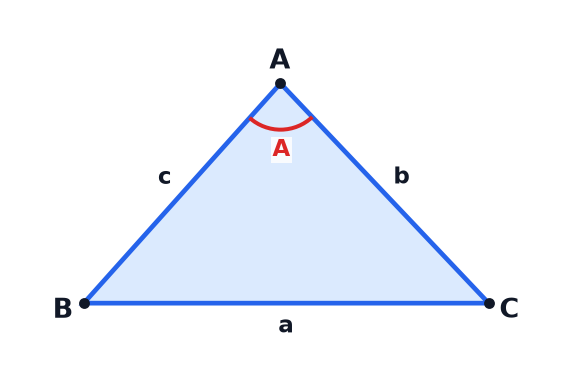
The side \(a\) is opposite the angle \(A\), and the angle \(A\) is between the sides \(b\) and \(c\). The cosine rule connects these three sides and this angle.
Using the labels
- The angle The angle \(A\) is between the sides \(b\) and \(c\).
- The side The side \(a\) is opposite that angle.
- Two sides and the included angle Gives the third side.
- Three sides Gives any angle.
Finding a side
Use the cosine rule when you know two sides and the angle between them.
-
The rule
\(a^2 = b^2 + c^2 - 2bc\cos A\).
-
Substitute
Write the numbers in before you simplify.
-
Take the square root
At the end, if the question asks for \(a\).
-
Check
The side opposite the largest angle is the longest.
Finding a side
In triangle \(ABC\), \(b = 5\) cm, \(c = 8\) cm and angle \(A = 60^\circ\). Work out the length of \(a\).
Show the solutionHide the solution
- 1 Choose the rule Two sides and the angle between them are known, so use the cosine rule.
- 2 Substitute \(a^2 = 5^2 + 8^2 - 2 \times 5 \times 8 \times \cos 60^\circ\).
- 3 Exact value \(\cos 60^\circ = \dfrac{1}{2}\), so \(a^2 = 25 + 64 - 40 = 49\).
- 4 Square root \(a = 7\) cm.
Answer\(a = 7\) cm
Finding an angle
Rearrange the rule to find an angle when you know all three sides.
-
The rule
\(\cos A = \dfrac{b^2 + c^2 - a^2}{2bc}\).
-
The side \(a\)
The angle \(A\) is opposite the side \(a\), which comes last in the numerator with a minus sign.
-
Negative cosine
If \(\cos A\) is negative the angle is obtuse.
-
Check
The angles should add up to \(180^\circ\).
Finding an angle
A triangle has sides of length 3 cm, 5 cm and 7 cm. Work out the largest angle.
Show the solutionHide the solution
- 1 The largest angle It is opposite the longest side, 7 cm. Call it \(A\), with \(a = 7\).
- 2 Substitute \(\cos A = \dfrac{3^2 + 5^2 - 7^2}{2 \times 3 \times 5} = \dfrac{9 + 25 - 49}{30}\).
- 3 Simplify \(\cos A = \dfrac{-15}{30} = -\dfrac{1}{2}\).
- 4 Exact value \(\cos 120^\circ = -\dfrac{1}{2}\), so \(A = 120^\circ\).
Answer\(120^\circ\)
Test yourself
-
1
What is the cosine rule for the side \(a\)?
Show answerHide answer
\(a^2 = b^2 + c^2 - 2bc\cos A\).
-
2
When do you use the cosine rule?
Show answerHide answer
With two sides and the included angle, or with three sides.
-
3
What is \(\cos 60^\circ\)?
Show answerHide answer
\(\dfrac{1}{2}\).
-
4
What is \(\cos 90^\circ\)?
Show answerHide answer
0.
-
5
What does the rule become if \(A = 90^\circ\)?
Show answerHide answer
Pythagoras' theorem.
Exam technique: choosing a rule
Pick the rule from the information you have.
-
Matching pair
If you know a side and its opposite angle, use the sine rule.
-
Two sides and the angle between
Use the cosine rule for the third side.
-
Three sides
Use the cosine rule for an angle.
-
Order of working
Square, multiply, subtract, in that order, and write each stage.
Summary and exam focus
- \(a^2 = b^2 + c^2 - 2bc\cos A\) finds a side.
- \(\cos A = \dfrac{b^2 + c^2 - a^2}{2bc}\) finds an angle.
- Use the exact values \(\cos 60^\circ = \dfrac{1}{2}\) and \(\cos 120^\circ = -\dfrac{1}{2}\) in non-calculator questions.
- The sine rule needs a matching pair, and the cosine rule does not.
Exam focus
In triangle \(ABC\), \(b = 6\) cm, \(c = 10\) cm and angle \(A = 120^\circ\). Work out the length of \(a\). (3 marks) (3 marks)
\(a^2 = 6^2 + 10^2 - 2 \times 6 \times 10 \times \cos 120^\circ = 36 + 100 + 60 = 196\), because \(\cos 120^\circ = -\dfrac{1}{2}\). So \(a = 14\) cm.
Key terms
The words this lesson expects you to use. Each one is linked from the first place it appears above.
- Cosine rule
- A rule linking three sides and one angle in any triangle.
- Included angle
- The angle between two given sides.
- Hypotenuse
- The longest side of a right-angled triangle.
- Obtuse angle
- An angle between \(90^\circ\) and \(180^\circ\).
- Acute angle
- An angle less than \(90^\circ\).
- Exact value
- A value written with fractions and surds.
- Subject
- The letter on its own on one side of a formula.
- Square root
- The number that multiplies by itself to give another.
- Substitute
- Replace letters with numbers.
You've finished the notes
Check your understanding
Test yourself while it is fresh. Start with the flashcards, then try the exam questions.
Something here looks wrong?
Tell us what and we will go and look. It goes to whoever writes these pages, nobody else, and we do not ask who you are — so there is nothing to sign and nothing comes back to you.