Maths · Further Trigonometry
Viewing as
Teaching this? The teacher view opens every answer and mark scheme.
The Sine Rule
Using the sine rule to find sides and angles in triangles without a right angle.
Learning Objectives
Triangles without a right angle
Right-angled trigonometry only works when the triangle has a right angle. Many triangles do not, and there are two rules that work in any triangle: the sine rule and the cosine rule. The sine rule is used when you know a side and its opposite angle, which is called a matching pair, together with one other side or angle. On a non-calculator paper, the angles are chosen so that the sines are exact values, such as \(30^\circ\), \(45^\circ\) and \(60^\circ\).
Labelling a triangle
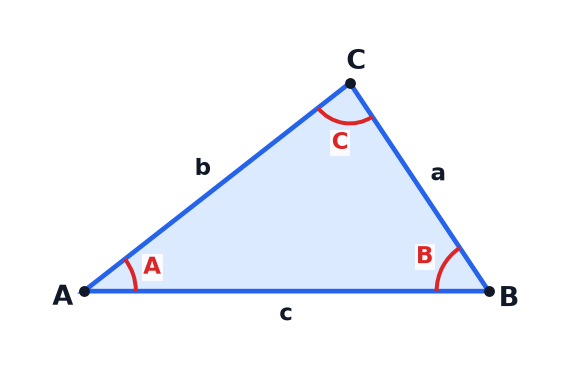
Each side has the same letter as the angle opposite to it, but in lower case. Side \(a\) is opposite angle \(A\), side \(b\) is opposite angle \(B\) and side \(c\) is opposite angle \(C\).
Using the labels
- Matching pair A side and the angle opposite it, such as \(a\) and \(A\).
- Capital letters These are angles.
- Small letters These are sides.
- Opposite The side is across the triangle from the angle, not touching it.
The sine rule
In any triangle, the ratio of a side to the sine of its opposite angle is the same for all three sides.
-
Finding a side
\(\dfrac{a}{\sin A} = \dfrac{b}{\sin B}\) , with the unknown side on the top.
-
Finding an angle
\(\dfrac{\sin A}{a} = \dfrac{\sin B}{b}\) , with the unknown angle on the top.
-
You need
A matching pair and one more side or angle.
-
Not for
Two sides and the angle between them, or three sides. Use the cosine rule for these.
Finding a side
In triangle \(ABC\), angle \(A = 30^\circ\), angle \(B = 45^\circ\) and \(a = 8\) cm. Work out the length of \(b\). Give your answer in the form \(k\sqrt{2}\).
Show the solutionHide the solution
- 1 Choose the rule The side \(a\) and angle \(A\) are a matching pair, and \(b\) is opposite \(B\), so use the sine rule.
- 2 Substitute \(\dfrac{b}{\sin 45^\circ} = \dfrac{8}{\sin 30^\circ}\).
- 3 Exact values \(\sin 45^\circ = \dfrac{\sqrt{2}}{2}\) and \(\sin 30^\circ = \dfrac{1}{2}\).
- 4 Solve \(b = \dfrac{8 \times \frac{\sqrt{2}}{2}}{\frac{1}{2}} = 8\sqrt{2}\) cm.
Answer\(b = 8\sqrt{2}\) cm
Finding an angle
Turn the rule upside down so that the sine of the unknown angle is on the top.
-
Write it
\(\dfrac{\sin B}{b} = \dfrac{\sin A}{a}\).
-
Rearrange
\(\sin B = \dfrac{b \sin A}{a}\).
-
Inverse sine
Find the angle from the exact values table.
-
Check
The largest angle is opposite the longest side.
Finding an angle
In triangle \(ABC\), angle \(A = 30^\circ\), \(a = 5\) cm and \(b = 10\) cm. Work out angle \(B\).
Show the solutionHide the solution
- 1 Set up \(\dfrac{\sin B}{10} = \dfrac{\sin 30^\circ}{5}\).
- 2 Substitute \(\sin B = \dfrac{10 \times \frac{1}{2}}{5} = 1\).
- 3 Inverse sine \(\sin B = 1\), so \(B = 90^\circ\).
- 4 Check \(b = 10\) is the longest side and is opposite the largest angle.
AnswerAngle \(B = 90^\circ\)
Test yourself
-
1
What does a matching pair mean in the sine rule?
Show answerHide answer
A side and the angle opposite to it.
-
2
Which side is opposite angle \(B\)?
Show answerHide answer
Side \(b\).
-
3
What is \(\sin 45^\circ\) as an exact value?
Show answerHide answer
\(\dfrac{\sqrt{2}}{2}\).
-
4
Which side is opposite the largest angle?
Show answerHide answer
The longest side.
-
5
When can you not use the sine rule?
Show answerHide answer
When you have no matching pair.
Exam technique: the sine rule
Choose the method first, and then write each step.
-
Sketch
Draw the triangle and label the sides and angles that you know.
-
Matching pair
If you can find a side and its opposite angle, use the sine rule.
-
Show the equation
Write the sine rule with the values substituted before rearranging.
-
Exact values
Write the exact values, then simplify, so that every mark is clear.
Summary and exam focus
- Each side is opposite the angle with the same letter.
- To find a side, use \(\dfrac{a}{\sin A} = \dfrac{b}{\sin B}\).
- To find an angle, use \(\dfrac{\sin A}{a} = \dfrac{\sin B}{b}\).
- You need a matching pair.
Exam focus
In triangle \(ABC\), angle \(A = 60^\circ\), angle \(B = 45^\circ\) and \(a = 6\sqrt{3}\) cm. Work out the length of \(b\). (3 marks) (3 marks)
Use \(\dfrac{b}{\sin 45^\circ} = \dfrac{6\sqrt{3}}{\sin 60^\circ}\). Then \(\sin 60^\circ = \dfrac{\sqrt{3}}{2}\), so \(b = \dfrac{6\sqrt{3} \times \frac{\sqrt{2}}{2}}{\frac{\sqrt{3}}{2}} = 6\sqrt{2}\) cm.
Key terms
The words this lesson expects you to use. Each one is linked from the first place it appears above.
- Sine rule
- A rule linking sides and the sines of the opposite angles in any triangle.
- Matching pair
- A side and the angle opposite to it.
- Opposite
- Across the triangle, not touching.
- Exact value
- A value written with fractions and surds.
- Acute angle
- An angle less than \(90^\circ\).
- Obtuse angle
- An angle between \(90^\circ\) and \(180^\circ\).
- Surd
- A root that cannot be written as a whole number or fraction.
- Subject
- The letter on its own on one side of a formula.
- Ratio
- A comparison of two quantities.
You've finished the notes
Check your understanding
Test yourself while it is fresh. Start with the flashcards, then try the exam questions.
Something here looks wrong?
Tell us what and we will go and look. It goes to whoever writes these pages, nobody else, and we do not ask who you are — so there is nothing to sign and nothing comes back to you.