Viewing as
Teacher view: planning notes, the answers to every question, and the teacher copies of the files.
Maths · Angles and trigonometry
Exterior angles of a polygon
Walk all the way round any polygon and you turn through exactly one full turn. So the exterior angles always add up to \(360^\circ\) - the quickest route to the angles of a regular polygon.
Teacher resources
The teacher copies: slides with the questions built in, the answers, and anything else attached to this lesson for whoever is teaching it.
- Exterior angles of a polygon - Teacher Slides.pptx Teacher The lesson slides with the teacher's notes on each slide, and every question and mark scheme built in. Built from the lesson script on 29 September 2026. View
- Exterior angles of a polygon - Teacher Notes.docx Teacher The complete notes with the teacher's notes and every model answer in full. Built from the lesson script on 29 September 2026. View
Student handouts
The same files the students see, to print or hand out.
- Exterior angles of a polygon.pptx Built from the lesson script on 29 September 2026. View
- Exterior angles of a polygon - Completed Notes.docx The full notes for the lesson, to revise from. Built from the lesson script on 29 September 2026. View
- Exterior angles of a polygon - Exam Questions.docx Built from the lesson script on 29 September 2026. View
Last Lesson and Before
Answer each one, then check.
-
1
Last lesson: what do the interior angles of a pentagon add up to?
Show answerHide answer
\(540^\circ\)
-
2
What do angles on a straight line add up to?
Show answerHide answer
\(180^\circ\)
-
3
Work out \(360 \div 8\).
Show answerHide answer
45
-
4
What is each interior angle of a regular hexagon?
Show answerHide answer
\(120^\circ\)
Learning Objectives
- 1Know that the exterior angles of any polygon add up to \(360^\circ\).
- 2Find the exterior angle of a regular polygon.
- 3Use interior angle + exterior angle = \(180^\circ\).
- 4Find the number of sides of a regular polygon from one of its angles.
A Full Turn
An exterior angle is the angle between one side and the extension of the next side. Walk round the shape and you turn by each exterior angle in turn - and arrive facing the way you started. That is one full turn, so the exterior angles add up to \(360^\circ\) for every polygon.
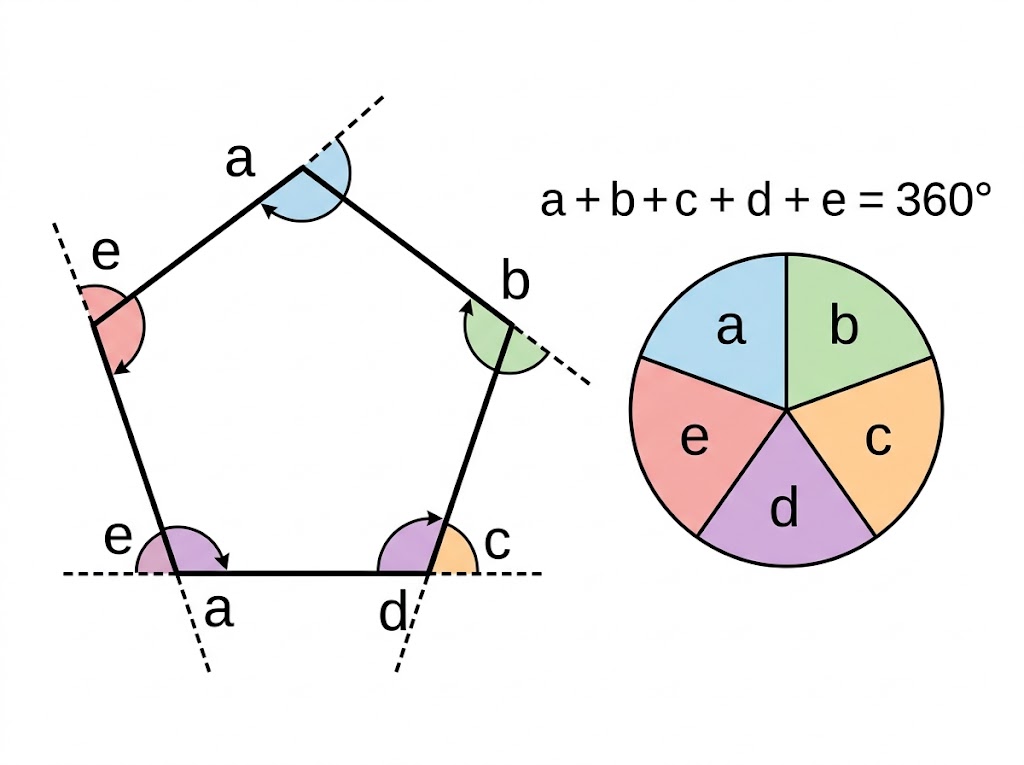
The exterior angles fit together to make one full turn.
Exterior Angle Facts
Two facts do almost all the work.
-
The sum
The exterior angles of any polygon add up to \(360^\circ\).
-
Interior and exterior
At each vertex, interior angle + exterior angle = \(180^\circ\) (angles on a straight line).
-
Regular polygon
Each exterior angle \(= \dfrac{360}{n}\).
-
Number of sides
\(n = \dfrac{360}{\text{exterior angle}}\).
Angles of a Regular Pentagon
Work out the exterior and interior angles of a regular pentagon.
Show the solutionHide the solution
- 1 Exterior angle \(360 \div 5 = 72^\circ\)
- 2 Interior angle: they add up to \(180^\circ\) \(180 - 72 = 108^\circ\)
- 3 Check with last lesson's formula \(540 \div 5 = 108^\circ\)
AnswerExterior \(72^\circ\), interior \(108^\circ\)
How Many Sides?
Each interior angle of a regular polygon is \(160^\circ\). How many sides does it have?
Show the solutionHide the solution
- 1 Find the exterior angle \(180 - 160 = 20^\circ\)
- 2 Exterior angles add up to \(360^\circ\) \(360 \div 20 = 18\)
Answer18 sides
Which Method?
Exterior angles are usually quicker for regular polygons.
-
1
Regular, angles wanted
Exterior \(= 360 \div n\), then interior \(= 180 -\) exterior.
-
2
Regular, sides wanted
Exterior \(= 180 -\) interior, then \(n = 360 \div\) exterior.
-
3
Irregular
Use the angle sum \((n - 2) \times 180\), or exterior angles adding up to \(360^\circ\).
-
4
Shapes joined together
Use angles around a point: they add up to \(360^\circ\).
Polygons Meeting at a Point
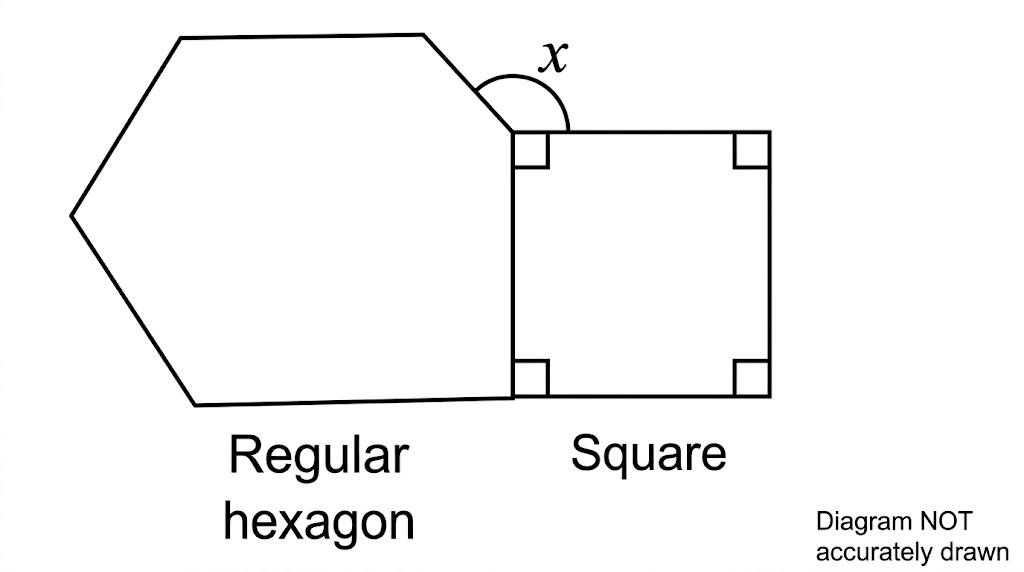
A regular hexagon and a square share a side, and meet at a point. Work out the angle \(x\) in the gap between them at that point.
Show the solutionHide the solution
- 1 Interior angle of a regular hexagon \(180 - 360 \div 6 = 120^\circ\)
- 2 Interior angle of a square \(90^\circ\)
- 3 Angles around a point add up to \(360^\circ\) \(x = 360 - 120 - 90 = 150\)
Answer\(x = 150^\circ\)
Impossible Polygons
For each angle, decide whether it could be the exterior angle of a regular polygon. If it could, say how many sides the polygon has: \(40^\circ\), \(50^\circ\), \(24^\circ\), \(70^\circ\), \(15^\circ\), \(1^\circ\).
1. Divide 360 by the angle.
2. A whole number means it is possible.
3. Write down the number of sides.
A good answer shows: \(40^\circ\): 9 sides. \(50^\circ\): no (7.2). \(24^\circ\): 15 sides. \(70^\circ\): no. \(15^\circ\): 24 sides. \(1^\circ\): 360 sides. An exterior angle works only if it divides exactly into 360.
Can I...?
- 1Recall that exterior angles add up to \(360^\circ\).
- 2Find the exterior angle of a regular polygon.
- 3Use interior + exterior = \(180^\circ\).
- 4Find the number of sides from an angle.
- 5Decide whether an angle is possible for a regular polygon.
- 6Solve problems with polygons meeting at a point.
Summary & Exam Focus
- Exterior angles of any polygon add up to \(360^\circ\).
- Regular polygon: exterior angle \(= 360 \div n\), and \(n = 360 \div\) exterior angle.
- Interior + exterior \(= 180^\circ\).
Exam focus
The diagram shows a regular hexagon and a square that share a side. Work out the size of angle \(x\). (3 marks) (3 marks)
For any regular polygon question, work out the exterior angle first: \(360 \div n\). Everything else follows from it.
Key terms
The vocabulary this lesson expects you to use. Each one is linked from the first place it appears above.
- Exterior angle
- The angle between one side of a polygon and the extension of the side next to it.
- Interior angle
- The angle inside a polygon at a vertex.
- Angles around a point
- Angles meeting at a point; they add up to \(360^\circ\).
- Regular polygon
- A polygon with all sides and all angles equal.
Questions and answers
7 questions set on this lesson, with the mark schemes and model answers open.
Work out the size of each exterior angle of a regular octagon.
Mark scheme — 2 marks available
- \(360 \div 8\) — M1
- \(45^\circ\) — A1
Model answer
\(360 \div 8 = 45^\circ\)
Each interior angle of a regular polygon is \(160^\circ\). Work out the number of sides of the polygon.
Mark scheme — 2 marks available
- \(180 - 160 = 20\) — M1
- 18 — A1
Model answer
Exterior angle \(180 - 160 = 20^\circ\). \(360 \div 20 = 18\) sides.
The diagram shows a regular hexagon and a square. They share a side. Work out the size of angle \(x\).
Mark scheme — 3 marks available
- \(120^\circ\) for the hexagon's interior angle — M1
- \(360 - 120 - 90\) — M1
- \(150^\circ\) — A1
Model answer
Interior angle of the hexagon: \(180 - 360 \div 6 = 120^\circ\). Interior angle of the square: \(90^\circ\). Angles around a point: \(x = 360 - 120 - 90 = 150^\circ\).
Ali says, "I have drawn a regular polygon with exterior angles of \(50^\circ\)." Explain why Ali cannot be right.
Mark scheme — 2 marks available
- \(360 \div 50\) — M1
- 7.2 and a statement that it is not a whole number — C1
Model answer
\(360 \div 50 = 7.2\). The number of sides must be a whole number, so no regular polygon has exterior angles of \(50^\circ\).
What do the exterior angles of a decagon add up to?
Why: The exterior angles of every polygon add up to \(360^\circ\).
A regular polygon has exterior angles of \(30^\circ\). How many sides does it have?
Why: \(360 \div 30 = 12\).
Each interior angle of a regular polygon is 4 times its exterior angle. How many sides does it have?
Why: Exterior \(e\), interior \(4e\): \(e + 4e = 180\), so \(e = 36\) and \(n = 360 \div 36 = 10\).