Viewing as
Teacher view: planning notes, the answers to every question, and the teacher copies of the files.
Maths · Angles and trigonometry
Trigonometry 2
Running trigonometry backwards to find a missing angle, the exact trig values you must know without a calculator, and angles of elevation and depression.
Teacher resources
The teacher copies: slides with the questions built in, the answers, and anything else attached to this lesson for whoever is teaching it.
- Trigonometry 2 - Teacher Slides.pptx Teacher The lesson slides with the teacher's notes on each slide, and every question and mark scheme built in. Built from the lesson script on 29 September 2026. View
- Trigonometry 2 - Teacher Notes.docx Teacher The complete notes with the teacher's notes and every model answer in full. Built from the lesson script on 29 September 2026. View
Student handouts
The same files the students see, to print or hand out.
- Trigonometry 2.pptx Built from the lesson script on 29 September 2026. View
- Trigonometry 2 - Completed Notes.docx The full notes for the lesson, to revise from. Built from the lesson script on 29 September 2026. View
- Trigonometry 2 - Exam Questions.docx Built from the lesson script on 29 September 2026. View
Last Lesson and Before
Answer each one, then check.
-
1
Last lesson: what does SOH CAH TOA stand for?
Show answerHide answer
\(\sin = \frac{\text{opp}}{\text{hyp}}\), \(\cos = \frac{\text{adj}}{\text{hyp}}\), \(\tan = \frac{\text{opp}}{\text{adj}}\)
-
2
Last lesson: \(\tan 45^\circ = \frac{x}{6}\). Find \(x\).
Show answerHide answer
6
-
3
Round 33.749 to 1 decimal place.
Show answerHide answer
33.7
-
4
Simplify \(\frac{6}{12}\).
Show answerHide answer
\(\frac{1}{2}\)
Learning Objectives
- 1Use inverse trig functions to find a missing angle.
- 2Know the exact values of sin, cos and tan for \(0^\circ\), \(30^\circ\), \(45^\circ\), \(60^\circ\) and \(90^\circ\).
- 3Solve problems with angles of elevation and depression.
Finding an Angle
To find an angle, use the inverse function: \(\sin^{-1}\), \(\cos^{-1}\) or \(\tan^{-1}\) (SHIFT then sin, cos or tan).
-
Label and choose
Exactly as before: the two sides you know pick the ratio.
-
Write the ratio as a fraction
\(\sin\theta = \dfrac{5}{9}\).
-
Inverse
\(\theta = \sin^{-1}\left(\dfrac{5}{9}\right)\).
-
Round
Angles are usually given to 1 decimal place.
Using Inverse Sine
A right-angled triangle has hypotenuse 9 cm. The side opposite angle \(\theta\) is 5 cm. Work out \(\theta\) to 1 decimal place.
Show the solutionHide the solution
- 1 Known: O = 5 and H = 9, so sine \(\sin\theta = \dfrac{5}{9}\)
- 2 Inverse sine \(\theta = \sin^{-1}\left(\dfrac{5}{9}\right)\)
- 3 Calculate \(\theta = 33.748\ldots\)
Answer\(33.7^\circ\)
Using Inverse Tangent
A right-angled triangle has sides 8 cm (opposite \(\theta\)) and 11 cm (adjacent to \(\theta\)). Work out \(\theta\) to 1 decimal place.
Show the solutionHide the solution
- 1 O and A, so tangent \(\tan\theta = \dfrac{8}{11}\)
- 2 Inverse tangent \(\theta = \tan^{-1}\left(\dfrac{8}{11}\right)\)
- 3 Calculate \(\theta = 36.027\ldots\)
Answer\(36.0^\circ\)
Where the Exact Values Come From
Half of an equilateral triangle of side 2 has sides 1, 2 and \(\sqrt{3}\) (by Pythagoras), so \(\sin 30^\circ = \frac{1}{2}\) and \(\tan 60^\circ = \sqrt{3}\). A right-angled isosceles triangle with shorter sides 1 has hypotenuse \(\sqrt{2}\), so \(\tan 45^\circ = 1\).
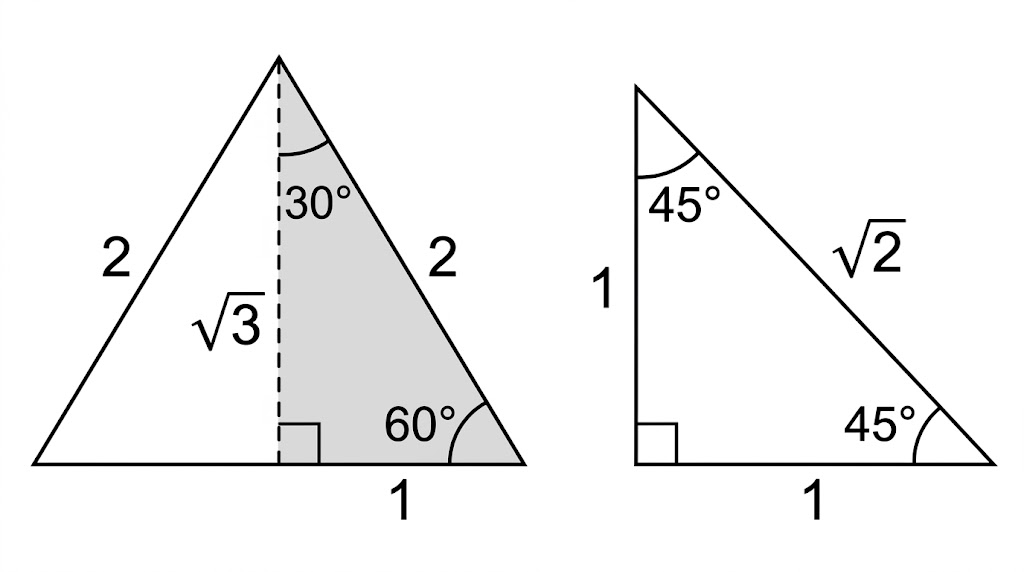
Half an equilateral triangle gives \(30^\circ\) and \(60^\circ\); half a square gives \(45^\circ\).
The Exact Values
-
\(0^\circ\)
sin: 0. cos: 1. tan: 0
-
\(30^\circ\)
sin: \(\frac{1}{2}\). cos: \(\frac{\sqrt{3}}{2}\). tan: \(\frac{1}{\sqrt{3}} = \frac{\sqrt{3}}{3}\)
-
\(45^\circ\)
sin: \(\frac{1}{\sqrt{2}} = \frac{\sqrt{2}}{2}\). cos: \(\frac{\sqrt{2}}{2}\). tan: 1
-
\(60^\circ\)
sin: \(\frac{\sqrt{3}}{2}\). cos: \(\frac{1}{2}\). tan: \(\sqrt{3}\)
-
\(90^\circ\)
sin: 1. cos: 0. tan: not defined
Exact Values Without a Calculator
A right-angled triangle has hypotenuse 10 cm and an angle of \(30^\circ\). Work out the side opposite the \(30^\circ\) angle. Do not use a calculator.
Show the solutionHide the solution
- 1 O and H, so sine \(x = 10\sin 30^\circ\)
- 2 Exact value \(\sin 30^\circ = \frac{1}{2}\)
- 3 Calculate \(x = 10 \times \frac{1}{2} = 5\)
Answer5 cm
Angles of Elevation and Depression
Both are always measured from the horizontal.
-
Angle of elevation
The angle you look UP through from the horizontal - from the ground to the top of a tree.
-
Angle of depression
The angle you look DOWN through from the horizontal - from a cliff top to a boat.
-
They are equal
The angle of depression from A to B equals the angle of elevation from B to A: they are alternate angles.
-
Draw it
Sketch the horizontal line, the right angle and the angle before you calculate.
The Height of a Tree
Jess stands 20 m from the foot of a tree on flat ground. The angle of elevation of the top of the tree from the ground where she stands is \(32^\circ\). Work out the height of the tree, to 1 decimal place.
Show the solutionHide the solution
- 1 Sketch: A = 20 (along the ground), O = height \(\tan 32^\circ = \dfrac{h}{20}\)
- 2 Multiply by 20 \(h = 20 \tan 32^\circ\)
- 3 Calculate \(h = 12.497\ldots\)
Answer12.5 m
Case study
Measuring Everest
In the 1800s the Great Trigonometrical Survey of India measured the whole subcontinent with triangles. From observation stations more than 160 km away, surveyors measured the angle of elevation of a remote Himalayan summit called Peak XV. In 1852 the mathematician Radhanath Sikdar worked through the calculations and found it was the highest mountain in the world. It was announced in 1856 as 29 002 feet (about 8840 m) and later named Everest. The modern figure, agreed by China and Nepal in 2020, is 8848.86 m - the 1850s trigonometry was out by less than 0.1%.
Measure the School
Make a simple clinometer from a protractor, a straw and a weight on a string. Stand a measured distance from a tall building or tree, measure the angle of elevation of the top, and work out its height. Remember to add your eye height.
1. Measure the distance to the base.
2. Measure the angle of elevation.
3. Calculate, then add your eye height.
A good answer shows: Height \(= d \tan\theta +\) eye height. For example, 20 m away, \(32^\circ\), eye height 1.5 m: \(20\tan 32^\circ + 1.5 = 14.0\) m.
Can I...?
- 1Find an angle using \(\sin^{-1}\), \(\cos^{-1}\) or \(\tan^{-1}\).
- 2Round an angle to 1 decimal place.
- 3Recall the exact values for \(0^\circ\), \(30^\circ\), \(45^\circ\), \(60^\circ\) and \(90^\circ\).
- 4Use exact values without a calculator.
- 5Draw a diagram for an elevation or depression problem.
- 6Solve elevation and depression problems.
Summary & Exam Focus
- Finding an angle: write the ratio, then use the inverse function.
- Learn the exact values table - they appear on the non-calculator paper.
- Elevation looks up and depression looks down, both from the horizontal.
Exam focus
A lighthouse stands on the edge of a cliff. The top of the lighthouse is 80 m above sea level. The angle of depression from the top of the lighthouse to a boat is \(25^\circ\). How far is the boat from the foot of the cliff? (3 marks) (3 marks)
Angles of depression are measured from the horizontal at the top - not from the vertical cliff. Use alternate angles to put the angle inside your triangle, at the boat.
Key terms
The vocabulary this lesson expects you to use. Each one is linked from the first place it appears above.
- Inverse function
- \(\sin^{-1}\), \(\cos^{-1}\) or \(\tan^{-1}\): finds the angle from a ratio.
- Exact value
- A trig value written exactly, as a fraction or surd, not a rounded decimal.
- Angle of elevation
- The angle measured up from the horizontal.
- Angle of depression
- The angle measured down from the horizontal.
- Clinometer
- An instrument for measuring angles of elevation.
Questions and answers
7 questions set on this lesson, with the mark schemes and model answers open.
A right-angled triangle has hypotenuse 12 cm. The side adjacent to angle \(\theta\) is 7 cm. Work out the size of angle \(\theta\). Give your answer to 1 decimal place.
Mark scheme — 2 marks available
- \(\cos\theta = \dfrac{7}{12}\) — M1
- \(54.3^\circ\) — A1
Model answer
\(\cos\theta = \dfrac{7}{12}\), so \(\theta = \cos^{-1}\left(\dfrac{7}{12}\right) = 54.31\ldots = 54.3^\circ\)
A right-angled triangle has an angle of \(60^\circ\). The hypotenuse is 14 cm. Work out the length of the side adjacent to the \(60^\circ\) angle.
Mark scheme — 2 marks available
- \(14\cos 60^\circ\) — M1
- 7 cm — A1
Model answer
\(x = 14\cos 60^\circ = 14 \times \frac{1}{2} = 7\) cm
A lighthouse stands on the edge of a cliff. The top of the lighthouse is 80 m above sea level. The angle of depression from the top of the lighthouse to a boat is \(25^\circ\). Work out the distance from the boat to the foot of the cliff. Give your answer to the nearest metre.
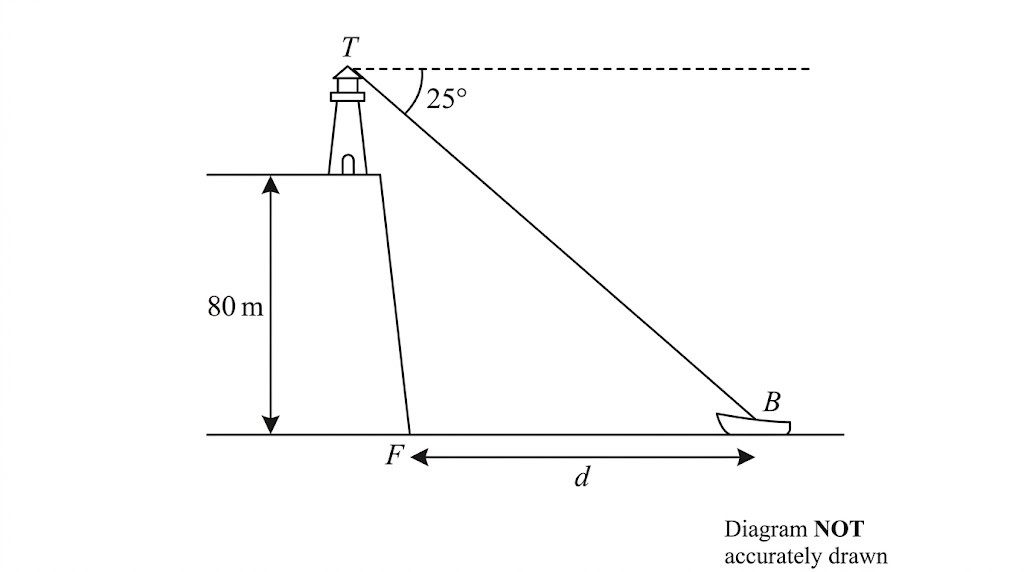
Mark scheme — 3 marks available
- \(25^\circ\) placed at the boat, or the angle \(65^\circ\) at T found — M1
- \(\tan 25^\circ = \dfrac{80}{d}\), or \(80\tan 65^\circ\) — M1
- 172 m — A1
Model answer
The angle of elevation of the top from the boat is also \(25^\circ\) (alternate angles). \(\tan 25^\circ = \dfrac{80}{d}\), so \(d = \dfrac{80}{\tan 25^\circ} = 171.56\ldots = 172\) m.
A kite string is 30 m long and is pulled tight. The string makes an angle of \(52^\circ\) with the horizontal ground. The string is held 1.2 m above the ground. (a) Work out the height of the kite above the ground, to 1 decimal place. (b) The wind drops, and the kite falls to a height of 15 m, with the same length of string, still held 1.2 m above the ground. Work out the new angle between the string and the horizontal.
Mark scheme — 4 marks available
- (a) \(30\sin 52^\circ\) — M1
- (a) 24.8 m — A1
- (b) \(\sin\theta = \dfrac{13.8}{30}\) — M1
- (b) \(27.4^\circ\) — A1
Model answer
(a) \(30\sin 52^\circ = 23.64\ldots\), plus 1.2 gives 24.8 m. (b) Height above the hand \(= 15 - 1.2 = 13.8\) m. \(\sin\theta = \dfrac{13.8}{30}\), \(\theta = \sin^{-1}(0.46) = 27.4^\circ\).
What is the exact value of \(\tan 45^\circ\)?
Why: A right-angled isosceles triangle has equal opposite and adjacent sides, so \(\tan 45^\circ = 1\).
A right-angled triangle has opposite side 4 cm and hypotenuse 7 cm. What is the angle, to 1 decimal place?
Why: \(\sin^{-1}\left(\frac{4}{7}\right) = 34.8^\circ\).
The angle of elevation of the top of a tower from a point P is \(40^\circ\). What is the angle of depression of P from the top of the tower?
Why: The horizontal at the top is parallel to the ground, so the two angles are alternate and equal.