Viewing as
Teaching this? The teacher view adds 2 files, the mark schemes and the model answers.
Maths · Area and volume
Units and accuracy
Converting units of area, volume and capacity - where 1 m really is 100 cm but 1 m² is 10 000 cm² - writing error intervals for rounded measurements, and at Higher, using bounds in calculations.
Last Lesson and Before
Answer each one, then check.
-
1
How many cm are in 1 m?
Show answerHide answer
100
-
2
How many mm are in 1 cm?
Show answerHide answer
10
-
3
Round 8.347 to 1 decimal place.
Show answerHide answer
8.3
-
4
Last lesson: area of a 3 m by 2 m rectangle?
Show answerHide answer
6 m²
Learning Objectives
- 1Convert between units of area.
- 2Convert between units of volume and capacity.
- 3Write the error interval for a rounded or truncated number.
- 4(Higher) Find upper and lower bounds of a calculation.
Why 1 m² Is 10 000 cm²
A square metre is 100 cm by 100 cm, so it holds \(100 \times 100 = 10\,000\) square centimetres. A cubic metre is \(100 \times 100 \times 100 = 1\,000\,000\) cubic centimetres.
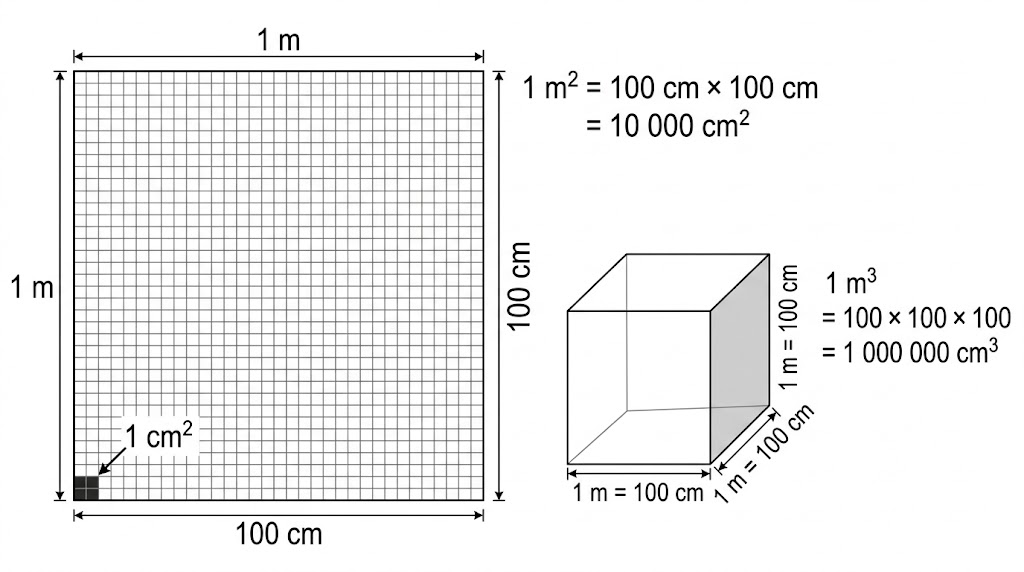
Square the length factor for area; cube it for volume.
Conversion Factors
-
mm and cm
Length: 1 cm = 10 mm. Area: 1 cm² = 100 mm². Volume or capacity: 1 cm³ = 1000 mm³
-
cm and m
Length: 1 m = 100 cm. Area: 1 m² = 10 000 cm². Volume or capacity: 1 m³ = 1 000 000 cm³
-
m and km
Length: 1 km = 1000 m. Area: 1 km² = 1 000 000 m². Volume or capacity: Rarely needed
-
Capacity
Length: -. Area: -. Volume or capacity: 1 cm³ = 1 ml; 1000 cm³ = 1 litre; 1 m³ = 1000 litres
Converting Area
Convert 3.5 m² into cm².
Show the solutionHide the solution
- 1 1 m² = 10 000 cm² Multiply by 10 000 (a smaller unit means more of them)
- 2 Calculate \(3.5 \times 10\,000 = 35\,000\)
Answer35 000 cm²
Converting Volume to Capacity
A tank holds 2 400 000 cm³ of water. Write this in m³ and in litres.
Show the solutionHide the solution
- 1 1 m³ = 1 000 000 cm³ \(2\,400\,000 \div 1\,000\,000 = 2.4\) m³
- 2 1 litre = 1000 cm³ \(2\,400\,000 \div 1000 = 2400\) litres
- 3 Check: 1 m³ = 1000 litres \(2.4 \times 1000 = 2400\)
Answer2.4 m³, which is 2400 litres
Error Intervals
If a length is 8.3 cm to 1 decimal place, it could be anything that rounds to 8.3.
-
The bounds
Half a unit either side: the lower bound is 8.25 and the upper bound is 8.35.
-
Error interval
\(8.25 \le l < 8.35\). The upper bound itself would round up to 8.4, so use \(<\).
-
To the nearest 10
70 to the nearest 10: \(65 \le x < 75\).
-
Truncation
4.7 truncated to 1 d.p. (digits chopped off): \(4.7 \le x < 4.8\).
An Error Interval
The mass of a parcel is 2.6 kg, correct to 1 decimal place. Write down the error interval for the mass \(m\).
Show the solutionHide the solution
- 1 The degree of accuracy 0.1 kg
- 2 Half of it 0.05 kg
- 3 Lower and upper bounds \(2.6 - 0.05 = 2.55\) and \(2.6 + 0.05 = 2.65\)
Answer\(2.55 \le m < 2.65\)
Which Bounds to Use
-
\(a + b\)
For the upper bound: upper + upper. For the lower bound: lower + lower
-
\(a - b\)
For the upper bound: upper − lower. For the lower bound: lower − upper
-
\(a \times b\)
For the upper bound: upper × upper. For the lower bound: lower × lower
-
\(a \div b\)
For the upper bound: upper ÷ lower. For the lower bound: lower ÷ upper
The Upper Bound of a Speed
A runner covers 100 m, measured to the nearest metre, in 12.5 s, measured to 1 decimal place. Work out the upper bound of the runner's average speed.
Show the solutionHide the solution
- 1 Bounds of the distance 99.5 m and 100.5 m
- 2 Bounds of the time 12.45 s and 12.55 s
- 3 Biggest speed: biggest distance ÷ smallest time \(\dfrac{100.5}{12.45} = 8.0722\ldots\)
Answer8.07 m/s (to 3 s.f.)
Fill the Room
Measure (or estimate) your classroom's length, width and height in metres. Work out its volume in m³ and in litres. Then work out its floor area in cm². Which of your answers are sensible to give exactly, and which should be rounded?
1. Measure in metres.
2. Convert with the right factor.
3. Decide how accurate your answer really is.
A good answer shows: For a 9 m by 7 m by 3 m room: volume 189 m³ = 189 000 litres; floor area 63 m² = 630 000 cm². With measurements to the nearest metre, the answers are only good to 2 significant figures at most.
Can I...?
- 1Convert between units of area.
- 2Convert between units of volume.
- 3Convert between volume and capacity.
- 4Write an error interval for a rounded number.
- 5Write an error interval for a truncated number.
- 6(Higher) Find the bounds of a calculation.
Summary & Exam Focus
- Area: square the length factor. Volume: cube it.
- 1 cm³ = 1 ml; 1000 cm³ = 1 litre; 1 m³ = 1000 litres.
- Error interval: half a unit either side, \(\le\) then \(<\).
- (Higher) Maximise or minimise each part of the calculation.
Exam focus
The length of a pencil is 14 cm, correct to the nearest centimetre. Write down the error interval for the length \(l\). (2 marks) (2 marks)
In an error interval the lower bound gets \(\le\) and the upper bound gets \(<\). Writing \(\le\) at both ends loses a mark.
Key terms
The vocabulary this lesson expects you to use. Each one is linked from the first place it appears above.
- Capacity
- How much a container holds, in ml or litres.
- Lower bound
- The smallest value that rounds to the given number.
- Upper bound
- The value where rounding switches up to the next number; the interval stops just below it.
- Error interval
- The range of possible values, e.g. \(8.25 \le l < 8.35\).
- Truncate
- Cut off digits without rounding.
Practice questions
Have a go at each one before you open its answer.
-
Question 1 Non-calculator 1 mark
Change 3.5 m² into cm².
Show answerHide answer
Model answer
\(3.5 \times 10\,000 = 35\,000\) cm²
Mark scheme
- 35 000 — B1
-
Question 2 Non-calculator 2 marks
A fish tank is a cuboid 80 cm long, 50 cm wide and 60 cm high. How many litres of water does it hold when full?
Show answerHide answer
Model answer
\(80 \times 50 \times 60 = 240\,000\) cm³. \(240\,000 \div 1000 = 240\) litres.
Mark scheme
- \(80 \times 50 \times 60\) — M1
- 240 litres — A1
-
Question 3 Non-calculator 2 marks
The length of a pencil, \(l\) cm, is 14 cm correct to the nearest centimetre. Write down the error interval for \(l\).
Show answerHide answer
Model answer
\(13.5 \le l < 14.5\)
Mark scheme
- 13.5 and 14.5 — B1
- \(13.5 \le l < 14.5\) — B1
-
Question 4 Calculator · Higher 3 marks
A runner covers a distance of 100 m, measured to the nearest metre, in a time of 12.5 s, measured to 1 decimal place. Work out the upper bound of the runner's average speed. Give your answer to 3 significant figures.
Show answerHide answer
Model answer
Upper bound \(= \dfrac{100.5}{12.45} = 8.0722\ldots = 8.07\) m/s
Mark scheme
- 100.5 or 12.45 seen — B1
- \(\dfrac{100.5}{12.45}\) — M1
- 8.07 — A1
Quick check
-
How many cm² are in 1 m²?
Show answerHide answer
D: 10 000
1 m² is 100 cm by 100 cm, which is \(100 \times 100 = 10\,000\) cm².
-
A length is 30 cm to the nearest 10 cm. What is the error interval?
Show answerHide answer
B: \(25 \le x < 35\)
Half of 10 is 5 either side: \(25 \le x < 35\).
-
(Higher) \(a = 6\) and \(b = 2\), both to the nearest whole number. What is the upper bound of \(a - b\)?
Show answerHide answer
C: 5
Upper bound of \(a\) minus lower bound of \(b\): \(6.5 - 1.5 = 5\).
Downloads
Free to keep, print and annotate.
- Units and accuracy.pptx Built from the lesson script on 29 September 2026. View
- Units and accuracy - Completed Notes.docx The full notes for the lesson, to revise from. Built from the lesson script on 29 September 2026. View
- Units and accuracy - Exam Questions.docx Built from the lesson script on 29 September 2026. View
Something here looks wrong?
Tell us what and we will go and look. It goes to whoever writes these pages, nobody else, and we do not ask who you are — so there is nothing to sign and nothing comes back to you.