Viewing as
Teaching this? The teacher view adds 2 files, the mark schemes and the model answers.
Maths · Equations and inequalities
More simultaneous equations
Solve simultaneous equations when neither pair of coefficients matches, by multiplying one or both equations first, and solve worded problems.
Warm-up
Answer each one, then check.
-
1
Solve \(x + y = 5\) and \(x - y = 1\).
Show answerHide answer
\(x = 3\), \(y = 2\)
-
2
Multiply \(2x + 3y = 5\) by 3.
Show answerHide answer
\(6x + 9y = 15\)
-
3
What is the lowest common multiple of 2 and 3?
Show answerHide answer
6
-
4
Solve \(4y = 12\).
Show answerHide answer
\(y = 3\)
-
5
What is \(-6 + 6\)?
Show answerHide answer
0
Learning Objectives
- 1Multiply one equation to match coefficients.
- 2Multiply both equations to match coefficients.
- 3Solve worded problems using two equations.
- 4Check that answers satisfy both equations.
Matching the Coefficients
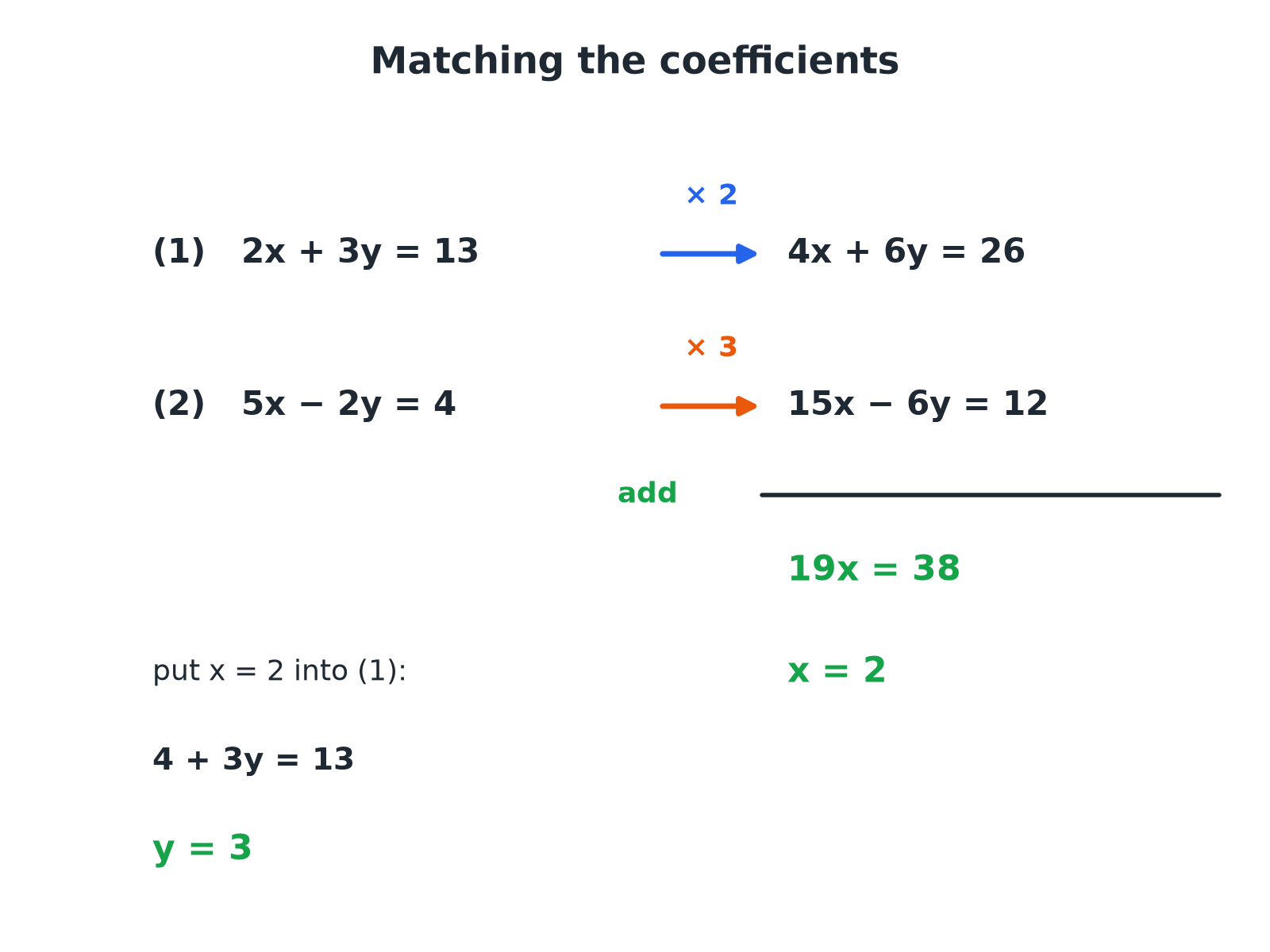
Multiply so that one pair of coefficients matches, then add or subtract.
Multiplying Before Eliminating
When no pair of coefficients matches.
-
1
Choose the unknown to eliminate
Look for the easiest pair of coefficients
-
2
Find the lowest common multiple
For 3 and 2 it is 6
-
3
Multiply each equation
So the coefficients of that unknown match
-
4
Add or subtract
Same signs subtract, opposite signs add
-
5
Solve, substitute, check
Two values, checked in both equations
Multiplying Both Equations
Solve \(2x + 3y = 13\) and \(5x - 2y = 4\).
Show the solutionHide the solution
- 1 Multiply (1) by 2 and (2) by 3 to match the y terms \(4x + 6y = 26\) and \(15x - 6y = 12\)
- 2 The y terms have opposite signs, so add \(19x = 38\)
- 3 Solve \(x = 2\)
- 4 Substitute into (1) \(4 + 3y = 13\), so \(y = 3\)
- 5 Check in (2) \(5 \times 2 - 2 \times 3 = 4\)
Answer\(x = 2\) and \(y = 3\)
Another Pair
Solve \(3x + 2y = 12\) and \(5x - 3y = 1\).
Show the solutionHide the solution
- 1 Multiply (1) by 3 and (2) by 2 \(9x + 6y = 36\) and \(10x - 6y = 2\)
- 2 Add \(19x = 38\), so \(x = 2\)
- 3 Substitute into (1) \(6 + 2y = 12\), so \(y = 3\)
- 4 Check in (2) \(10 - 9 = 1\)
Answer\(x = 2\) and \(y = 3\)
A Number Problem
The sum of two numbers is 25. Twice the first number plus three times the second number is 62. Find the numbers.
Show the solutionHide the solution
- 1 Let the numbers be \(x\) and \(y\) \(x + y = 25\) and \(2x + 3y = 62\)
- 2 Multiply the first by 2 \(2x + 2y = 50\)
- 3 Subtract from the second \(y = 12\)
- 4 Find x \(x = 25 - 12 = 13\)
AnswerThe numbers are 13 and 12.
A Cost Problem
3 apples and 2 bananas cost £1.80. 2 apples and 5 bananas cost £2.30. Find the cost of one apple and one banana.
Show the solutionHide the solution
- 1 Write the equations in pence \(3a + 2b = 180\) and \(2a + 5b = 230\)
- 2 Multiply (1) by 2 and (2) by 3 \(6a + 4b = 360\) and \(6a + 15b = 690\)
- 3 Subtract \(11b = 330\), so \(b = 30\)
- 4 Find a \(3a + 60 = 180\), so \(a = 40\)
AnswerAn apple costs 40p and a banana costs 30p.
Common Slips
Check every step.
-
Multiply every term
Both sides and every term of the equation.
-
Signs when subtracting
Subtracting \(-6y\) adds \(6y\).
-
Wrong equation for substitution
Substitute into either original equation, then check in the other.
-
Units
In a money problem, keep everything in pence or everything in pounds.
Spot the Method
For each pair, say how you would eliminate an unknown, then solve. (a) \(x + 2y = 8\) and \(3x - y = 3\) (b) \(3x + 4y = 25\) and \(5x - 2y = 7\) (c) \(2x + 5y = 16\) and \(3x - 2y = 5\).
1. Choose the unknown to eliminate.
2. Multiply to match.
3. Solve and check.
A good answer shows: (a) Multiply the second by 2: \(6x - 2y = 6\), add: \(7x = 14\), so \(x = 2\), \(y = 3\). (b) Multiply the second by 2: \(10x - 4y = 14\), add: \(13x = 39\), so \(x = 3\), \(y = 4\). (c) Multiply the first by 2 and the second by 5: \(4x + 10y = 32\) and \(15x - 10y = 25\), add: \(19x = 57\), so \(x = 3\), \(y = 2\).
Can I...?
- 1Multiply one equation to match coefficients.
- 2Multiply both equations.
- 3Choose add or subtract correctly.
- 4Find both unknowns.
- 5Check in both equations.
- 6Form equations from a worded problem.
- 7Work in consistent units.
- 8Explain each step.
Summary & Exam Focus
- Multiply so that one pair of coefficients matches.
- Same signs: subtract. Opposite signs: add.
- Substitute back and check in both equations.
- In problems, define the letters and write two equations.
Exam focus
Solve the simultaneous equations \(2x + 3y = 13\) and \(5x - 2y = 4\). (4 marks) (4 marks)
Multiply both equations so that the y-coefficients match (6 and 6), then add because the signs are opposite.
Key terms
The vocabulary this lesson expects you to use. Each one is linked from the first place it appears above.
- Simultaneous equations
- Equations that must both be true for the same unknown values.
- Elimination
- Removing an unknown by adding or subtracting.
- Lowest common multiple
- The smallest number that is a multiple of two numbers.
- Coefficient
- The number multiplying an unknown.
- Substitute
- Replace an unknown by its value.
- Check
- Put the answers back into both equations.
Practice questions
Have a go at each one before you open its answer.
-
Question 1 Non-calculator 4 marks
Solve the simultaneous equations \(2x + 3y = 13\) and \(5x - 2y = 4\).
Show answerHide answer
Model answer
Multiplying gives \(4x + 6y = 26\) and \(15x - 6y = 12\). Adding gives \(19x = 38\), so \(x = 2\). Then \(4 + 3y = 13\), so \(y = 3\).
Mark scheme
- Multiplying to match coefficients — M1
- \(19x = 38\) — M1
- \(x = 2\) — A1
- \(y = 3\) — A1
-
Question 2 Non-calculator 4 marks
Solve the simultaneous equations \(3x + 2y = 12\) and \(5x - 3y = 1\).
Show answerHide answer
Model answer
Multiplying gives \(9x + 6y = 36\) and \(10x - 6y = 2\). Adding gives \(19x = 38\), so \(x = 2\) and \(y = 3\).
Mark scheme
- Multiplying to match coefficients — M1
- \(19x = 38\) — M1
- \(x = 2\) — A1
- \(y = 3\) — A1
-
Question 3 Non-calculator 4 marks
The sum of two numbers is 25. Twice the first number plus three times the second number is 62. Work out the two numbers.
Show answerHide answer
Model answer
\(x + y = 25\) and \(2x + 3y = 62\). Subtracting twice the first from the second gives \(y = 12\), so \(x = 13\).
Mark scheme
- Forming both equations — M1
- A correct elimination step — M1
- \(y = 12\) — A1
- \(x = 13\) — A1
-
Question 4 Calculator 4 marks
3 apples and 2 bananas cost £1.80. 2 apples and 5 bananas cost £2.30. Work out the cost of one apple and the cost of one banana.
Show answerHide answer
Model answer
\(3a + 2b = 180\) and \(2a + 5b = 230\) (pence). Multiplying gives \(6a + 4b = 360\) and \(6a + 15b = 690\). Subtracting gives \(11b = 330\), \(b = 30\), and \(a = 40\). An apple costs 40p and a banana 30p.
Mark scheme
- Forming both equations — M1
- Multiplying to match — M1
- \(b = 30\) or \(a = 40\) — A1
- Both correct with units — A1
-
Question 5 Non-calculator 3 marks
Find the coordinates of the point where the lines \(y = 3x - 2\) and \(y = x + 4\) cross.
Show answerHide answer
Model answer
\(3x - 2 = x + 4\), so \(2x = 6\) and \(x = 3\). Then \(y = 7\). The point is \((3, 7)\).
Mark scheme
- Equating the two expressions — M1
- \(x = 3\) — A1
- \((3, 7)\) — A1
-
Question 6 Non-calculator 4 marks
Solve the simultaneous equations \(4x + y = 14\) and \(2x - 3y = 0\).
Show answerHide answer
Model answer
From the second, \(x = 1.5y\). Then \(6y + y = 14\), so \(y = 2\) and \(x = 3\). (Or multiply the first by 3 and add.)
Mark scheme
- A method to eliminate or substitute — M1
- \(7y = 14\) or \(14x = 42\) — M1
- \(y = 2\) — A1
- \(x = 3\) — A1
Quick check
-
To match the y-coefficients in \(2x + 3y = 13\) and \(5x - 2y = 4\), which multipliers do you use?
Show answerHide answer
B: 2 and 3
Multiply the first by 2 and the second by 3 to get \(6y\) and \(-6y\).
-
After matching, you have \(6y\) and \(-6y\). What do you do?
Show answerHide answer
A: Add the equations
The signs are opposite, so add the equations.
-
Solve \(x + y = 5\) and \(2x + y = 8\).
Show answerHide answer
C: \(x = 3, y = 2\)
Subtracting gives \(x = 3\), then \(y = 2\).
-
Two numbers add to 10 and differ by 4. What are they?
Show answerHide answer
D: 7 and 3
\(x + y = 10\) and \(x - y = 4\) give \(x = 7\) and \(y = 3\).
-
Why should you check your solution in both original equations?
Show answerHide answer
B: To catch mistakes
A slip in the working could still satisfy one equation, so checking both catches mistakes.
-
Which pair of equations has no solution?
Show answerHide answer
C: \(y = 2x + 1\) and \(y = 2x + 5\)
\(y = 2x + 1\) and \(y = 2x + 5\) are parallel, so they never meet.
Downloads
Free to keep, print and annotate.
- More simultaneous equations.pptx Built from the lesson script on 30 September 2026. View
- More simultaneous equations - Completed Notes.docx The full notes for the lesson, to revise from. Built from the lesson script on 30 September 2026. View
- More simultaneous equations - Exam Questions.docx Built from the lesson script on 30 September 2026. View
Something here looks wrong?
Tell us what and we will go and look. It goes to whoever writes these pages, nobody else, and we do not ask who you are — so there is nothing to sign and nothing comes back to you.