Viewing as
Teacher view: planning notes, the answers to every question, and the teacher copies of the files.
Maths · Equations and inequalities
Solving linear and quadratic simultaneous equations
Solve a linear equation and a quadratic equation together by substitution, find the points where a line meets a curve or circle, and show that a line is a tangent.
Teacher resources
The teacher copies: slides with the questions built in, the answers, and anything else attached to this lesson for whoever is teaching it.
- Solving linear and quadratic simultaneous equations - Teacher Slides.pptx Teacher The lesson slides with the teacher's notes on each slide, and every question and mark scheme built in. Built from the lesson script on 30 September 2026. View
- Solving linear and quadratic simultaneous equations - Teacher Notes.docx Teacher The complete notes with the teacher's notes and every model answer in full. Built from the lesson script on 30 September 2026. View
Student handouts
The same files the students see, to print or hand out.
- Solving linear and quadratic simultaneous equations.pptx Built from the lesson script on 30 September 2026. View
- Solving linear and quadratic simultaneous equations - Completed Notes.docx The full notes for the lesson, to revise from. Built from the lesson script on 30 September 2026. View
- Solving linear and quadratic simultaneous equations - Exam Questions.docx Built from the lesson script on 30 September 2026. View
Warm-up
Answer each one, then check.
-
1
Expand \((x + 1)^2\).
Show answerHide answer
\(x^2 + 2x + 1\)
-
2
Solve \(x^2 + x - 12 = 0\).
Show answerHide answer
\(x = 3\) or \(x = -4\)
-
3
Solve \(5x^2 = 20\).
Show answerHide answer
\(x = \pm 2\)
-
4
What is the equation of a circle with centre the origin and radius 5?
Show answerHide answer
\(x^2 + y^2 = 25\)
-
5
What is a tangent to a curve?
Show answerHide answer
A line that touches the curve at one point
Learning Objectives
- 1Solve a linear and a quadratic equation together by substitution.
- 2Solve a line with a circle \(x^2 + y^2 = r^2\).
- 3Find the points where a line meets a curve.
- 4Show that a line is a tangent by getting a repeated root.
Substitution Method
Get the linear equation into \(y = \dots\) or \(x = \dots\) first.
-
1
Rearrange the linear equation
So one unknown is on its own
-
2
Substitute into the quadratic
You now have a quadratic in one unknown
-
3
Rearrange to zero and solve
Factorise, or use the formula
-
4
Find the other unknown
Substitute each solution into the LINEAR equation
-
5
Write pairs
Each solution is a pair of coordinates
A Line Meeting a Curve
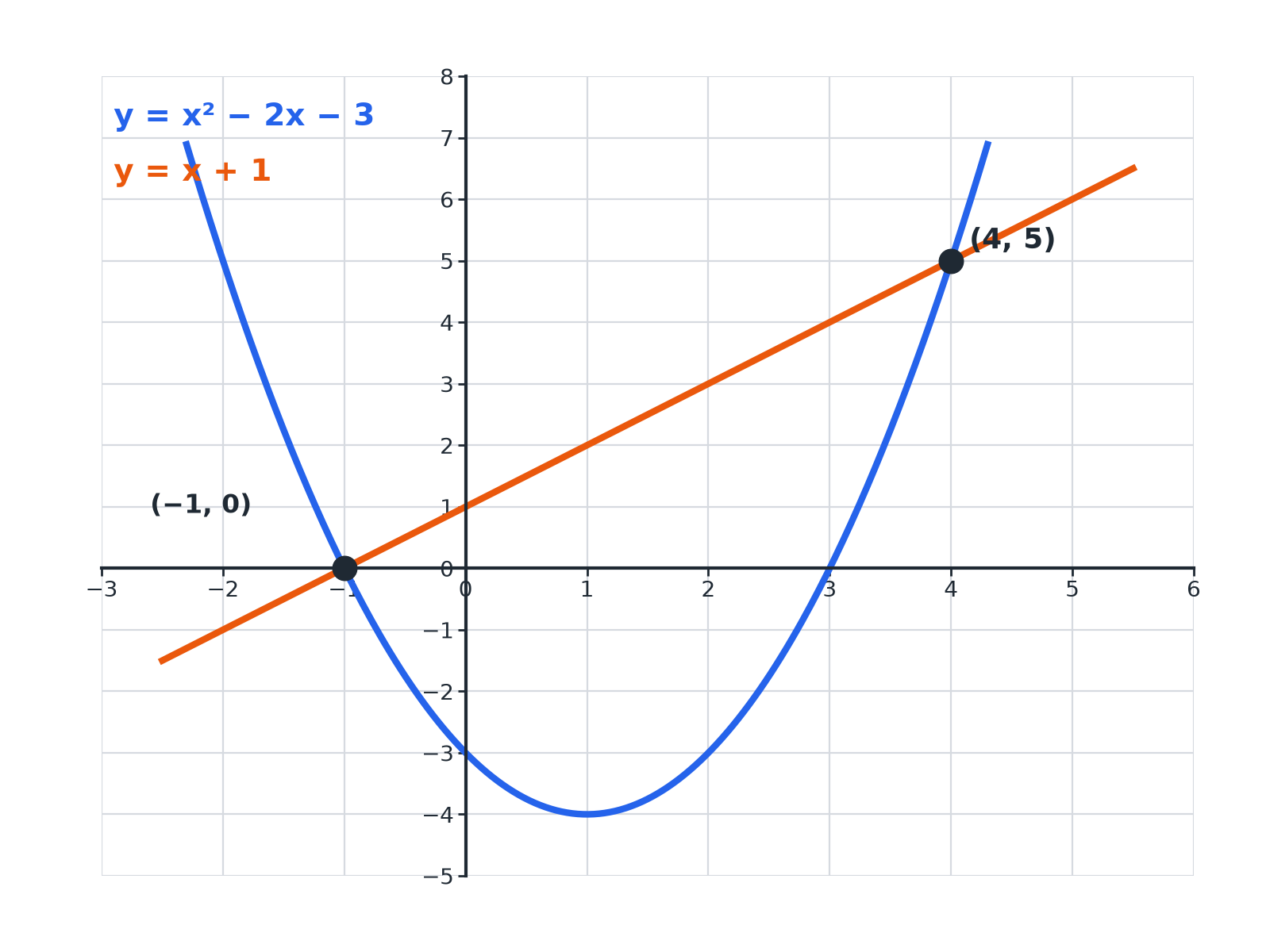
Two solutions mean the line crosses the curve twice.
A Line and a Parabola
Solve simultaneously \(y = x^2 - 2x - 3\) and \(y = x + 1\).
Show the solutionHide the solution
- 1 Set the y-values equal \(x^2 - 2x - 3 = x + 1\)
- 2 Rearrange to zero \(x^2 - 3x - 4 = 0\)
- 3 Factorise \((x - 4)(x + 1) = 0\), so \(x = 4\) or \(x = -1\)
- 4 Find y from the line \(y = x + 1\) \(x = 4\): \(y = 5\); \(x = -1\): \(y = 0\)
Answer\((4, 5)\) and \((-1, 0)\)
A Line and a Circle
Solve simultaneously \(x^2 + y^2 = 25\) and \(y = x + 1\).
Show the solutionHide the solution
- 1 Substitute \(y = x + 1\) \(x^2 + (x + 1)^2 = 25\)
- 2 Expand \(2x^2 + 2x + 1 = 25\), so \(2x^2 + 2x - 24 = 0\)
- 3 Divide by 2 and factorise \(x^2 + x - 12 = 0\), so \((x + 4)(x - 3) = 0\)
- 4 Find y \(x = 3\): \(y = 4\); \(x = -4\): \(y = -3\)
Answer\((3, 4)\) and \((-4, -3)\)
A Line and a Circle
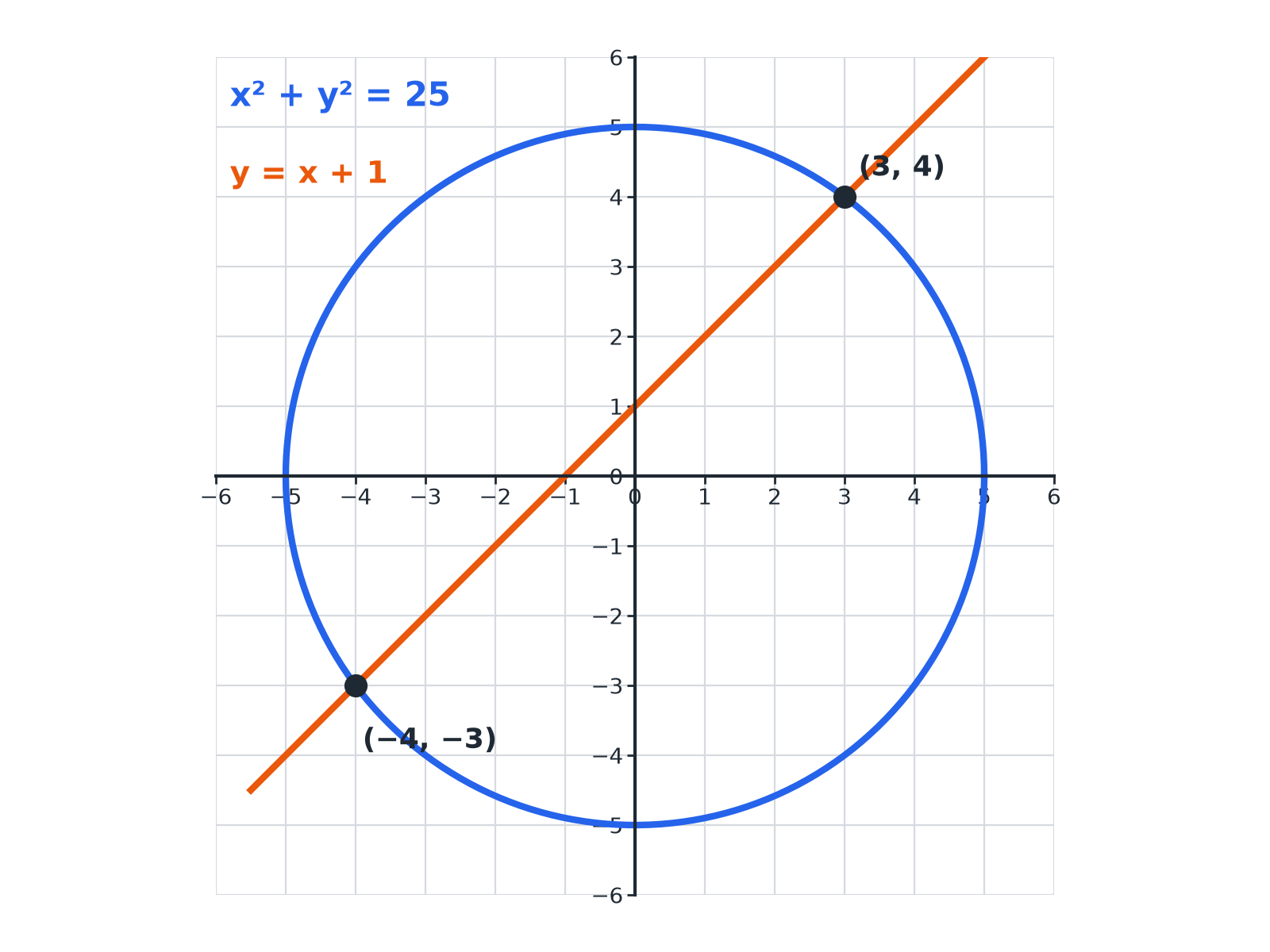
Substituting gives the two intersection points.
Another Circle Problem
Solve simultaneously \(x^2 + y^2 = 20\) and \(y = 2x\).
Show the solutionHide the solution
- 1 Substitute \(x^2 + 4x^2 = 20\)
- 2 Simplify \(5x^2 = 20\), so \(x^2 = 4\)
- 3 Solve \(x = 2\) or \(x = -2\)
- 4 Find y \(y = 4\) or \(y = -4\)
Answer\((2, 4)\) and \((-2, -4)\)
Showing a Line Is a Tangent
Show that the line \(y = 2x - 1\) is a tangent to the curve \(y = x^2\).
Show the solutionHide the solution
- 1 Set equal \(x^2 = 2x - 1\)
- 2 Rearrange \(x^2 - 2x + 1 = 0\)
- 3 Factorise \((x - 1)^2 = 0\)
- 4 One repeated solution The line touches the curve at one point only, \((1, 1)\)
AnswerThe equation has one repeated root \(x = 1\), so the line is a tangent.
How Many Solutions?
Two solutions
- The line crosses the curve at two points.
- The quadratic has two different roots.
- The discriminant \(b^2 - 4ac\) is positive.
One or no solutions
- One repeated root: the line is a tangent.
- No real roots: the line misses the curve.
- The discriminant is zero or negative.
Where Do They Meet?
Find the intersection points of each pair. (a) \(y = x^2\) and \(y = 3x - 2\) (b) \(x + y = 7\) and \(x^2 + y^2 = 25\) (c) \(y = x^2 + 1\) and \(y = 3x - 1\).
1. Substitute.
2. Solve the quadratic.
3. Find y for each x.
A good answer shows: (a) \(x^2 - 3x + 2 = 0\): \((1, 1)\) and \((2, 4)\). (b) \(y = 7 - x\): \(2x^2 - 14x + 24 = 0\), \(x^2 - 7x + 12 = 0\): \((3, 4)\) and \((4, 3)\). (c) \(x^2 - 3x + 2 = 0\): \((1, 2)\) and \((2, 5)\).
Can I...?
- 1Rearrange the linear equation.
- 2Substitute into the quadratic.
- 3Solve the resulting quadratic.
- 4Find both coordinates of each point.
- 5Solve a line and a circle.
- 6Show a line is a tangent.
- 7Give answers as coordinate pairs.
- 8Check by substituting.
Summary & Exam Focus
- Substitute the linear equation into the quadratic or the circle.
- Solve the quadratic in one unknown.
- Pair up each x with its y using the linear equation.
- A repeated root means the line is a tangent.
Exam focus
Solve the simultaneous equations \(y = x^2 - 2x - 3\) and \(y = x + 1\). (5 marks) (5 marks)
Substitute the linear equation into the quadratic. When you find each x, use the LINEAR equation to find the matching y.
Key terms
The vocabulary this lesson expects you to use. Each one is linked from the first place it appears above.
- Tangent
- A line that touches a curve at exactly one point.
- Repeated root
- A solution that occurs twice, such as \(x = 1\) in \((x - 1)^2 = 0\).
- Intersection
- A point where a line and a curve meet.
- Substitution
- Replacing a letter with an expression.
- Circle equation
- \(x^2 + y^2 = r^2\) for a circle centred on the origin.
- Discriminant
- \(b^2 - 4ac\); it shows the number of real roots.
Questions and answers
12 questions set on this lesson, with the mark schemes and model answers open.
Solve the simultaneous equations \(y = x^2 - 2x - 3\) and \(y = x + 1\).
Mark scheme — 5 marks available
- Equating — M1
- Rearranging to zero — M1
- Factorising — M1
- Both x values — A1
- Both correct pairs — A1
Model answer
\(x^2 - 2x - 3 = x + 1\), so \(x^2 - 3x - 4 = 0\) and \((x - 4)(x + 1) = 0\). \(x = 4\) or \(x = -1\). The solutions are \((4, 5)\) and \((-1, 0)\).
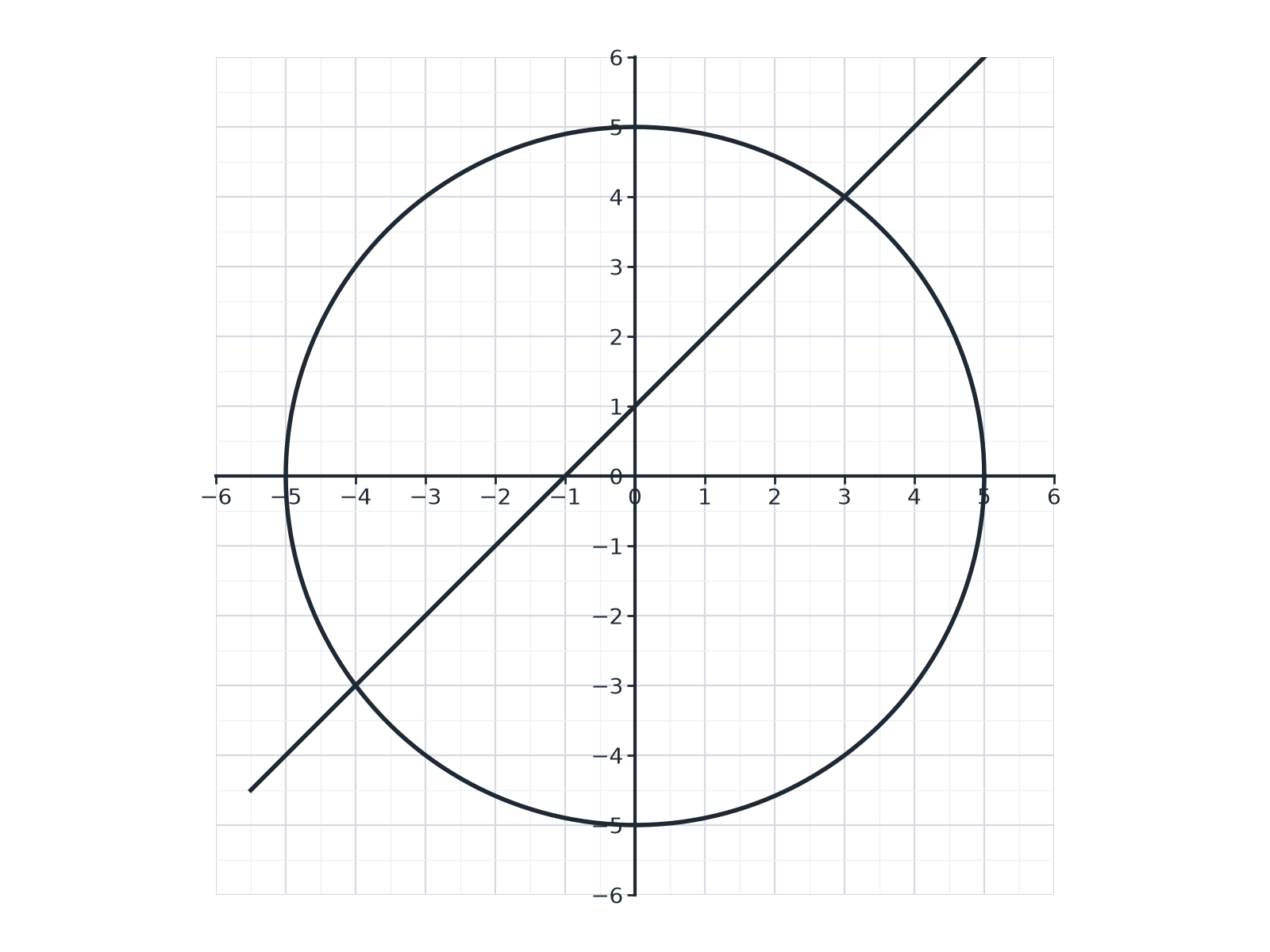
The circle \(x^2 + y^2 = 25\) and the line \(y = x + 1\) intersect at two points. Find the coordinates of the two points.
Mark scheme — 5 marks available
- Substituting — M1
- Simplifying to a quadratic — M1
- Solving — M1
- Both x values — A1
- Both correct pairs — A1
Model answer
\(x^2 + (x + 1)^2 = 25\), so \(2x^2 + 2x - 24 = 0\), \(x^2 + x - 12 = 0\), \((x + 4)(x - 3) = 0\). The points are \((3, 4)\) and \((-4, -3)\).
Solve the simultaneous equations \(x^2 + y^2 = 20\) and \(y = 2x\).
Mark scheme — 4 marks available
- Substituting — M1
- \(5x^2 = 20\) — M1
- \(x = 2\) and \(x = -2\) — A1
- Both pairs — A1
Model answer
\(x^2 + 4x^2 = 20\), so \(x^2 = 4\), \(x = \pm 2\). The solutions are \((2, 4)\) and \((-2, -4)\).
Show that the line \(y = 2x - 1\) is a tangent to the curve \(y = x^2\).
Mark scheme — 4 marks available
- Equating — M1
- Rearranging to \(x^2 - 2x + 1 = 0\) — M1
- \((x - 1)^2 = 0\) — M1
- Conclusion — C1
Model answer
\(x^2 = 2x - 1\), so \(x^2 - 2x + 1 = 0\) and \((x - 1)^2 = 0\). There is only one solution, \(x = 1\), so the line touches the curve at one point and is a tangent.
Solve the simultaneous equations \(x + y = 7\) and \(x^2 + y^2 = 25\).
Mark scheme — 5 marks available
- Rearranging and substituting — M1
- Expanding \((7 - x)^2\) — M1
- Solving — M1
- Both x values — A1
- Both correct pairs — A1
Model answer
\(y = 7 - x\), so \(x^2 + (7 - x)^2 = 25\), \(2x^2 - 14x + 24 = 0\), \(x^2 - 7x + 12 = 0\), \((x - 3)(x - 4) = 0\). The solutions are \((3, 4)\) and \((4, 3)\).
Solve the simultaneous equations \(y = x^2 + 1\) and \(y = 3x - 1\).
Mark scheme — 5 marks available
- Equating — M1
- Rearranging to zero — M1
- Factorising — M1
- Both x values — A1
- Both correct pairs — A1
Model answer
\(x^2 + 1 = 3x - 1\), so \(x^2 - 3x + 2 = 0\) and \((x - 1)(x - 2) = 0\). The solutions are \((1, 2)\) and \((2, 5)\).
To solve a line and a quadratic together, first...
Why: Substitute the linear equation into the quadratic.
After finding x for a line and curve, you find y using...
Why: The linear equation is simpler and avoids extra pairs.
The line meets a circle where \(x^2 + (x+1)^2 = 25\). What type of equation is this?
Why: It simplifies to a quadratic in x.
A line and a curve meet where \((x - 3)^2 = 0\). What does this show?
Why: A repeated root means one point of contact: the line is a tangent.
How many pairs of coordinates does a line and a circle usually give?
Why: Two intersection points, from two roots.
Solve \(y = x^2\) and \(y = 4\).
Why: \(x^2 = 4\), so \(x = \pm 2\): the points \((2, 4)\) and \((-2, 4)\).