Viewing as
Teacher view: planning notes, the answers to every question, and the teacher copies of the files.
Maths · Equations and inequalities
Solving linear inequalities
Solve linear inequalities, show solutions on a number line, list integer solutions, and at Higher tier show regions on a graph.
Teacher resources
The teacher copies: slides with the questions built in, the answers, and anything else attached to this lesson for whoever is teaching it.
- Solving linear inequalities - Teacher Slides.pptx Teacher The lesson slides with the teacher's notes on each slide, and every question and mark scheme built in. Built from the lesson script on 30 September 2026. View
- Solving linear inequalities - Teacher Notes.docx Teacher The complete notes with the teacher's notes and every model answer in full. Built from the lesson script on 30 September 2026. View
Student handouts
The same files the students see, to print or hand out.
- Solving linear inequalities.pptx Built from the lesson script on 30 September 2026. View
- Solving linear inequalities - Completed Notes.docx The full notes for the lesson, to revise from. Built from the lesson script on 30 September 2026. View
- Solving linear inequalities - Exam Questions.docx Built from the lesson script on 30 September 2026. View
Warm-up
Answer each one, then check.
-
1
Solve \(2x + 3 = 11\).
Show answerHide answer
\(x = 4\)
-
2
Solve \(5x = -20\).
Show answerHide answer
\(x = -4\)
-
3
Which is bigger, \(-3\) or \(-5\)?
Show answerHide answer
\(-3\)
-
4
What is the symbol for "less than or equal to"?
Show answerHide answer
\(\le\)
-
5
Solve \(\dfrac{x}{3} = 6\).
Show answerHide answer
\(x = 18\)
Learning Objectives
- 1Use the inequality symbols \(<\), \(>\), \(\le\) and \(\ge\).
- 2Show inequalities on a number line.
- 3Solve linear inequalities, including reversing the sign.
- 4Write down integer solutions and solve double inequalities.
Inequality Symbols
The open end of the symbol points at the bigger number.
-
\(x > 3\)
Meaning: x is greater than 3. Circle on a number line: Open circle at 3
-
\(x \ge 3\)
Meaning: x is greater than or equal to 3. Circle on a number line: Filled circle at 3
-
\(x < 3\)
Meaning: x is less than 3. Circle on a number line: Open circle at 3
-
\(x \le 3\)
Meaning: x is less than or equal to 3. Circle on a number line: Filled circle at 3
Inequalities on a Number Line
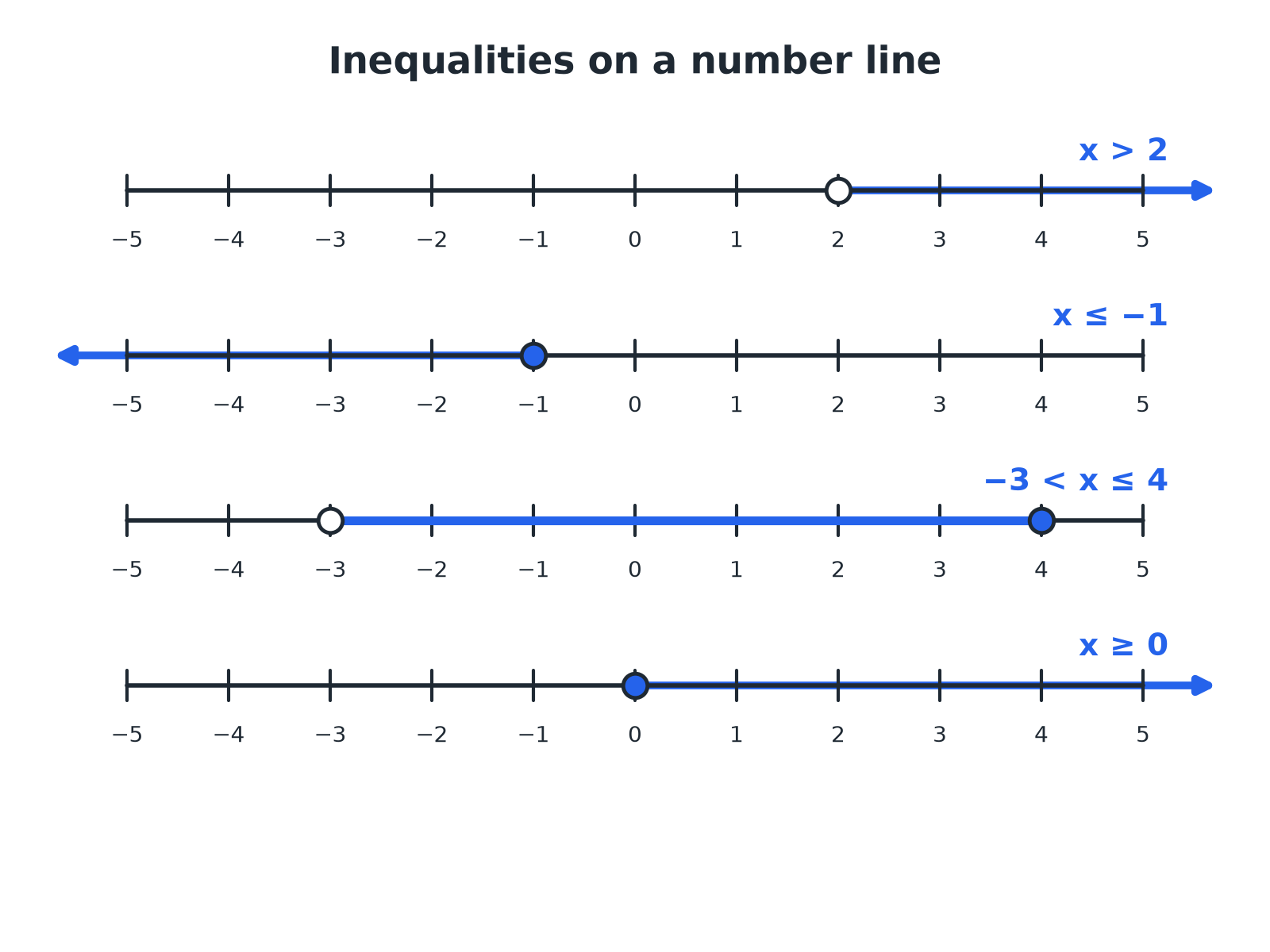
Open circle: not included. Filled circle: included.
Solving an Inequality
Solve \(3x + 2 \le 14\).
Show the solutionHide the solution
- 1 Subtract 2 from both sides \(3x \le 12\)
- 2 Divide both sides by 3 \(x \le 4\)
Answer\(x \le 4\)
THE ONE NEW RULE
When you multiply or divide an inequality by a negative number, reverse the inequality sign.
Otherwise solve exactly as you would an equation.
A Negative Coefficient
Solve \(5 - 2x > 11\).
Show the solutionHide the solution
- 1 Subtract 5 from both sides \(-2x > 6\)
- 2 Divide by \(-2\) and reverse the sign \(x < -3\)
- 3 Check with a value, \(x = -4\) \(5 - 2(-4) = 13 > 11\)
Answer\(x < -3\)
A Double Inequality
Solve \(5 < 2x - 1 \le 9\).
Show the solutionHide the solution
- 1 Add 1 to all three parts \(6 < 2x \le 10\)
- 2 Divide all three parts by 2 \(3 < x \le 5\)
Answer\(3 < x \le 5\)
Integer Solutions
List the integers that satisfy \(-2 < x \le 3\).
Show the solutionHide the solution
- 1 \(-2\) itself is not included Start at \(-1\)
- 2 3 is included End at 3
Answer\(-1, 0, 1, 2, 3\)
Shading a Region
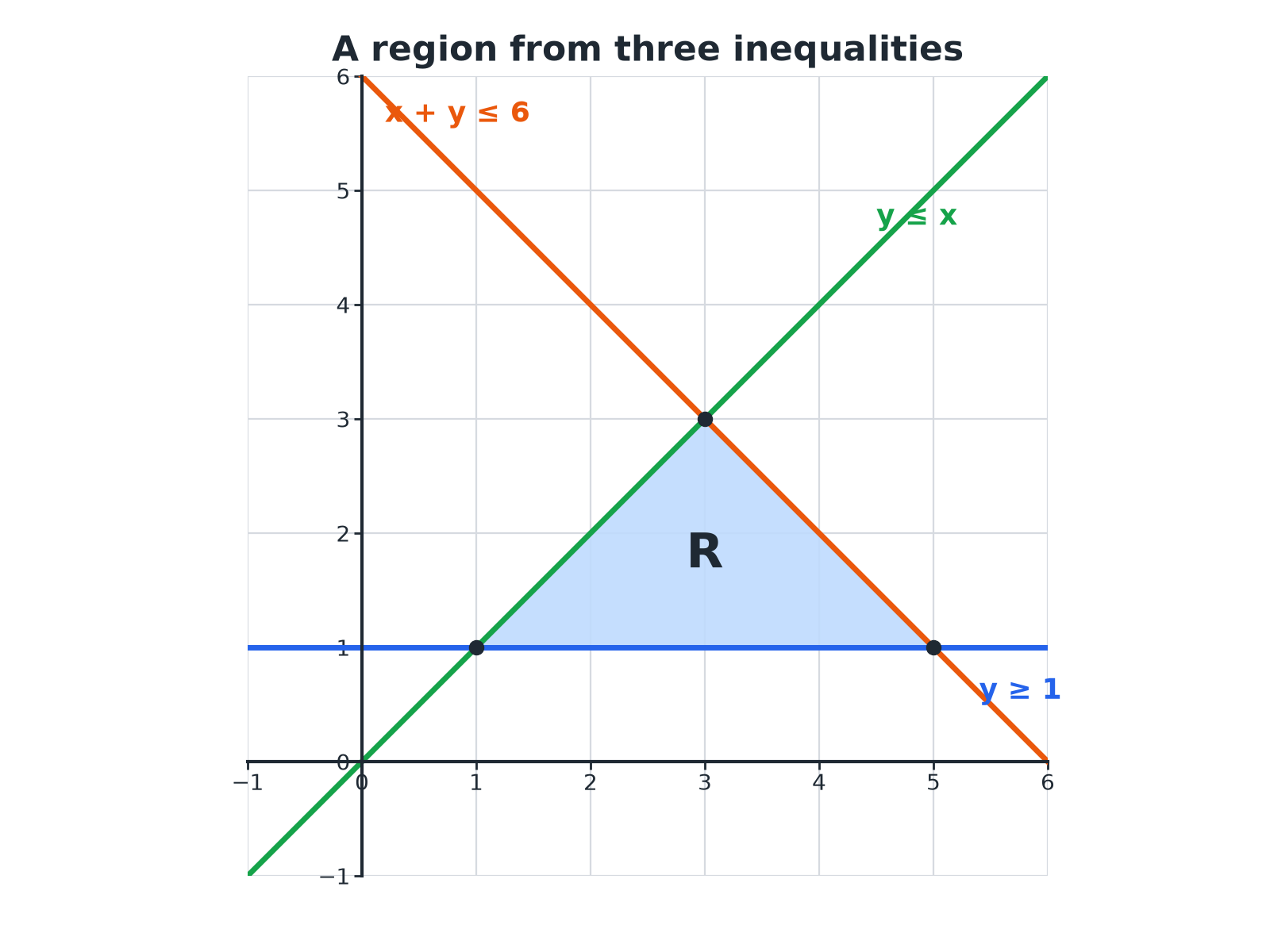
Solid line for \(\le\) or \(\ge\), dashed line for \(<\) or \(>\).
Showing an Inequality on a Graph
Draw the boundary, then decide which side to shade.
-
1
Draw the line
Replace the inequality sign with = and draw it
-
2
Solid or dashed
Solid for \(\le\) and \(\ge\); dashed for \(<\) and \(>\)
-
3
Test a point
For example \((0, 0)\), if it is not on the line
-
4
Shade the side that works
Shade the wanted region, or the unwanted region, as the question asks
A Region from Three Inequalities
A region R satisfies \(y \ge 1\), \(y \le x\) and \(x + y \le 6\). Find the vertices of R.
Show the solutionHide the solution
- 1 \(y = 1\) meets \(y = x\) \((1, 1)\)
- 2 \(y = 1\) meets \(x + y = 6\) \((5, 1)\)
- 3 \(y = x\) meets \(x + y = 6\) \(x + x = 6\), so \((3, 3)\)
AnswerR is a triangle with vertices \((1, 1)\), \((5, 1)\) and \((3, 3)\).
A Quadratic Inequality
Solve \(x^2 - x - 6 < 0\).
Show the solutionHide the solution
- 1 Factorise \((x - 3)(x + 2) < 0\)
- 2 The roots are \(x = 3\) and \(x = -2\)
- 3 The graph is U-shaped, below the axis between the roots \(-2 < x < 3\)
Answer\(-2 < x < 3\)
True or False?
Decide whether each statement is true or false, and correct it if it is false. (a) \(-3 > -2\) (b) \(x \ge 5\) includes 5 (c) if \(-x < 4\) then \(x < -4\) (d) the integers satisfying \(1 \le x < 4\) are 1, 2, 3, 4.
1. Use a number line.
2. Test values.
A good answer shows: (a) False: \(-3 < -2\). (b) True. (c) False: reversing the sign gives \(x > -4\). (d) False: 4 is not included, so the integers are 1, 2, 3.
Can I...?
- 1Use the four inequality symbols.
- 2Draw an inequality on a number line.
- 3Solve a linear inequality.
- 4Reverse the sign when multiplying by a negative.
- 5Solve a double inequality.
- 6List integer solutions.
- 7Shade a region on a graph (Higher).
- 8Solve a quadratic inequality (Higher).
Summary & Exam Focus
- Open circle for \(<\) and \(>\); filled circle for \(\le\) and \(\ge\).
- Solve like an equation, but reverse the sign when dividing by a negative.
- Double inequality: do the same to all three parts.
- Higher: solid boundary for \(\le\), \(\ge\); dashed for \(<\), \(>\).
Exam focus
Solve \(5 - 2x > 11\). (3 marks) (3 marks)
Dividing by a negative number flips the sign. Check your answer with a test value.
Key terms
The vocabulary this lesson expects you to use. Each one is linked from the first place it appears above.
- Inequality
- A statement that compares two values using \(<\), \(>\), \(\le\) or \(\ge\).
- Integer
- A whole number, positive, negative or zero.
- Solution set
- All the values that make an inequality true.
- Boundary line
- The line that separates a region on a graph.
- Region
- An area of a graph that satisfies one or more inequalities.
- Strict inequality
- One with \(<\) or \(>\), not including the boundary.
Questions and answers
12 questions set on this lesson, with the mark schemes and model answers open.
Solve \(3x + 2 \le 14\).
Mark scheme — 2 marks available
- \(3x \le 12\) — M1
- \(x \le 4\) — A1
Model answer
\(3x \le 12\), so \(x \le 4\).
Solve \(5 - 2x > 11\).
Mark scheme — 3 marks available
- \(-2x > 6\) — M1
- Dividing by \(-2\) — M1
- \(x < -3\) — A1
Model answer
\(-2x > 6\), so \(x < -3\).
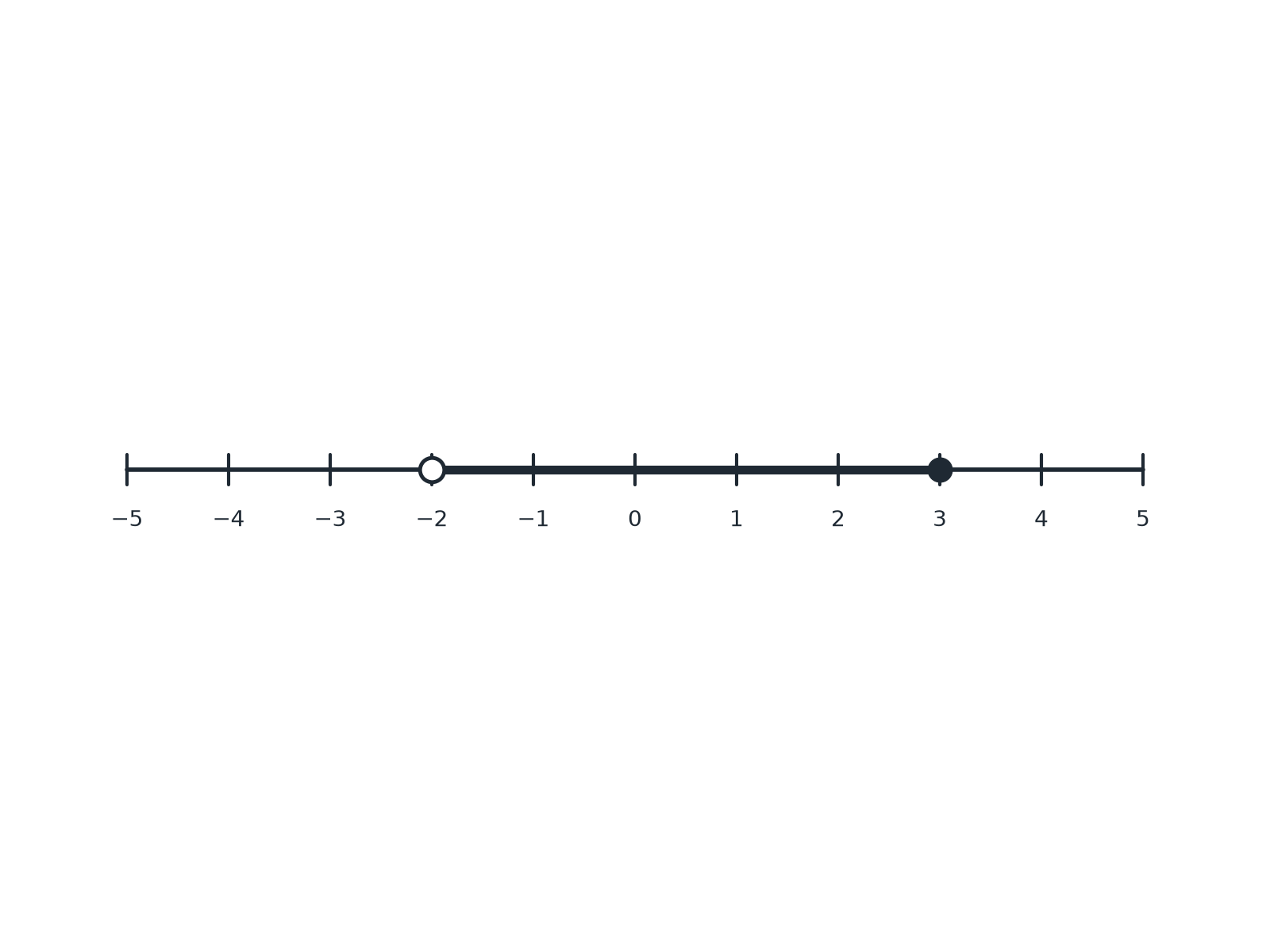
The number line shows an inequality. Write down the inequality.
Mark scheme — 2 marks available
- \(x \le 3\) or \(x > -2\) — B1
- \(-2 < x \le 3\) — B1
Model answer
\(-2 < x \le 3\).
\(n\) is an integer. Write down all the possible values of \(n\) when \(-2 < n \le 3\).
Mark scheme — 2 marks available
- At least four correct values — M1
- All correct — A1
Model answer
\(-1, 0, 1, 2, 3\).
Solve \(5 < 2x - 1 \le 9\).
Mark scheme — 3 marks available
- Adding 1 to all parts — M1
- Dividing all parts by 2 — M1
- \(3 < x \le 5\) — A1
Model answer
\(6 < 2x \le 10\), so \(3 < x \le 5\).
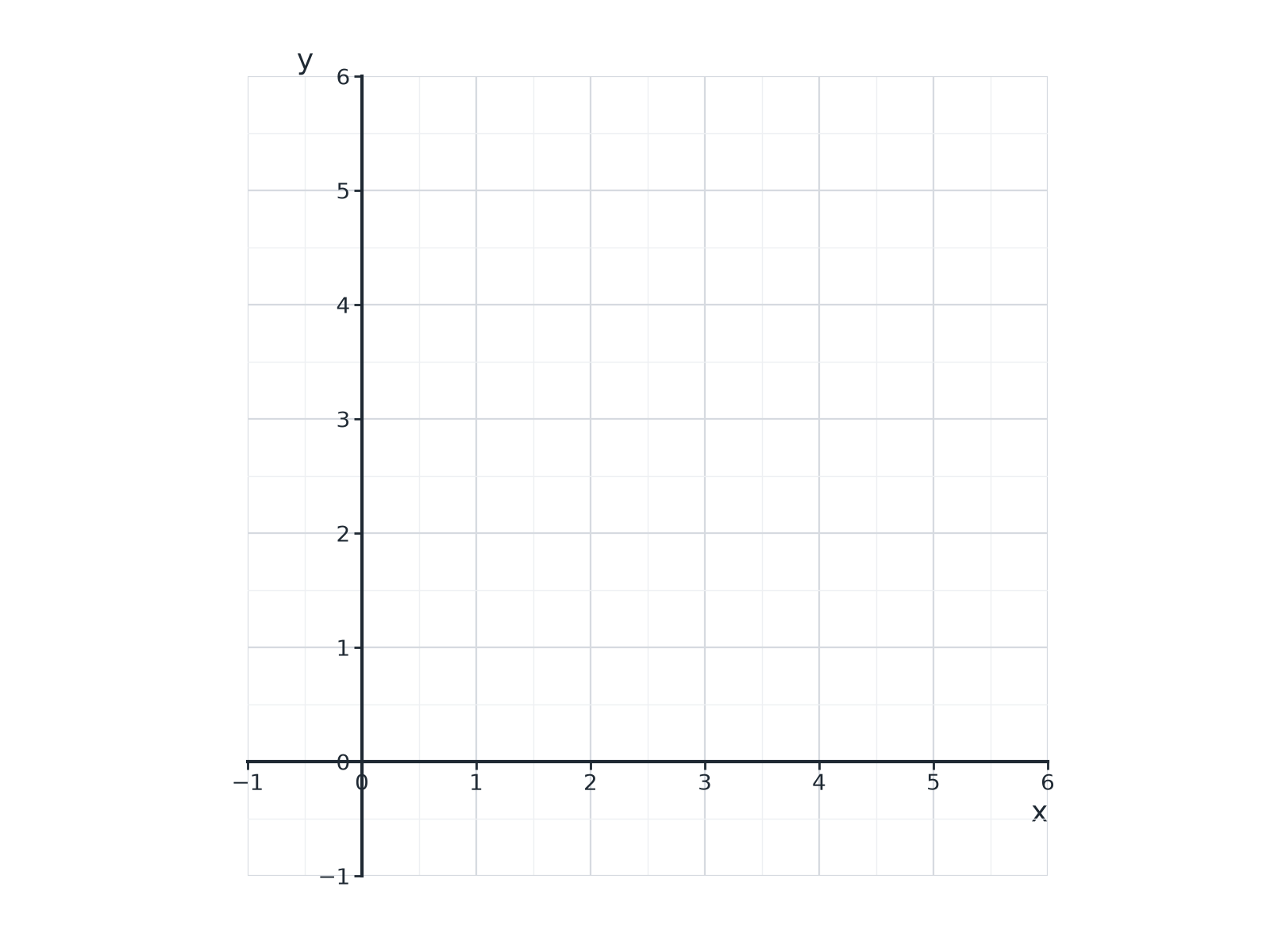
On the grid, the region R satisfies \(y \ge 1\), \(y \le x\) and \(x + y \le 6\). Mark the region R with an R.
Mark scheme — 4 marks available
- One line drawn correctly — M1
- All three lines drawn correctly — M1
- The correct region — M1
- R labelled — A1
Model answer
The lines \(y = 1\), \(y = x\) and \(x + y = 6\) are drawn; the triangle with vertices \((1, 1)\), \((5, 1)\) and \((3, 3)\) is labelled R.
Which symbol means "less than or equal to"?
Why: \(\le\) means less than or equal to.
Solve \(x + 5 > 8\).
Why: Subtract 5: \(x > 3\).
Solve \(-3x < 12\).
Why: Divide by \(-3\) and reverse the sign: \(x > -4\).
Which integers satisfy \(1 \le x < 4\)?
Why: 1 is included and 4 is not: 1, 2, 3.
On a number line, \(x \ge 2\) is shown with...
Why: A filled circle at 2 (included) and an arrow to the right.
Solve \(x^2 < 9\).
Why: \(x\) lies between the roots: \(-3 < x < 3\).