Viewing as
Teaching this? The teacher view adds 2 files, the mark schemes and the model answers.
Maths · Equations and inequalities
Solving quadratic equations 2
Solve harder quadratics by factorising when the coefficient of x squared is not 1, and use the quadratic formula when they do not factorise.
Warm-up
Answer each one, then check.
-
1
Solve \(x^2 - 5x + 6 = 0\).
Show answerHide answer
\(x = 2\) or \(x = 3\)
-
2
Expand \((2x + 1)(x + 3)\).
Show answerHide answer
\(2x^2 + 7x + 3\)
-
3
Work out \(\sqrt{81}\).
Show answerHide answer
9
-
4
Work out \(5^2 - 4 \times 1 \times 6\).
Show answerHide answer
1
-
5
Round 5.385 to 2 decimal places.
Show answerHide answer
5.39
Learning Objectives
- 1Factorise and solve \(ax^2 + bx + c = 0\).
- 2Use the quadratic formula.
- 3Give answers to a given accuracy or as surds.
- 4Decide which method to use.
Factorising \(ax^2 + bx + c\)
Use the product \(ac\) and the sum \(b\).
-
1
Multiply \(a\) by \(c\)
For \(2x^2 + 7x + 3\): \(2 \times 3 = 6\)
-
2
Find two numbers with that product and sum \(b\)
1 and 6 (they add to 7)
-
3
Split the middle term
\(2x^2 + x + 6x + 3\)
-
4
Factorise in pairs
\(x(2x + 1) + 3(2x + 1)\)
-
5
Write as two brackets
\((2x + 1)(x + 3)\)
A Harder Factorisation
Solve \(2x^2 + 7x + 3 = 0\).
Show the solutionHide the solution
- 1 Factorise \((2x + 1)(x + 3) = 0\)
- 2 Set each bracket to zero \(2x + 1 = 0\) or \(x + 3 = 0\)
- 3 Solve \(x = -\dfrac{1}{2}\) or \(x = -3\)
Answer\(x = -\dfrac{1}{2}\) or \(x = -3\)
Another Factorisation
Solve \(3x^2 - 10x + 8 = 0\).
Show the solutionHide the solution
- 1 \(ac = 24\); two numbers with product 24 and sum \(-10\) \(-4\) and \(-6\)
- 2 Split and factorise \(3x^2 - 4x - 6x + 8 = x(3x - 4) - 2(3x - 4)\)
- 3 Write as brackets \((3x - 4)(x - 2) = 0\)
- 4 Solve \(x = \dfrac{4}{3}\) or \(x = 2\)
Answer\(x = \dfrac{4}{3}\) or \(x = 2\)
THE QUADRATIC FORMULA
For \(ax^2 + bx + c = 0\), the solutions are \(x = \dfrac{-b \pm \sqrt{b^2 - 4ac}}{2a}\).
Learn it: it is not on the formulae sheet.
When It Will Not Factorise
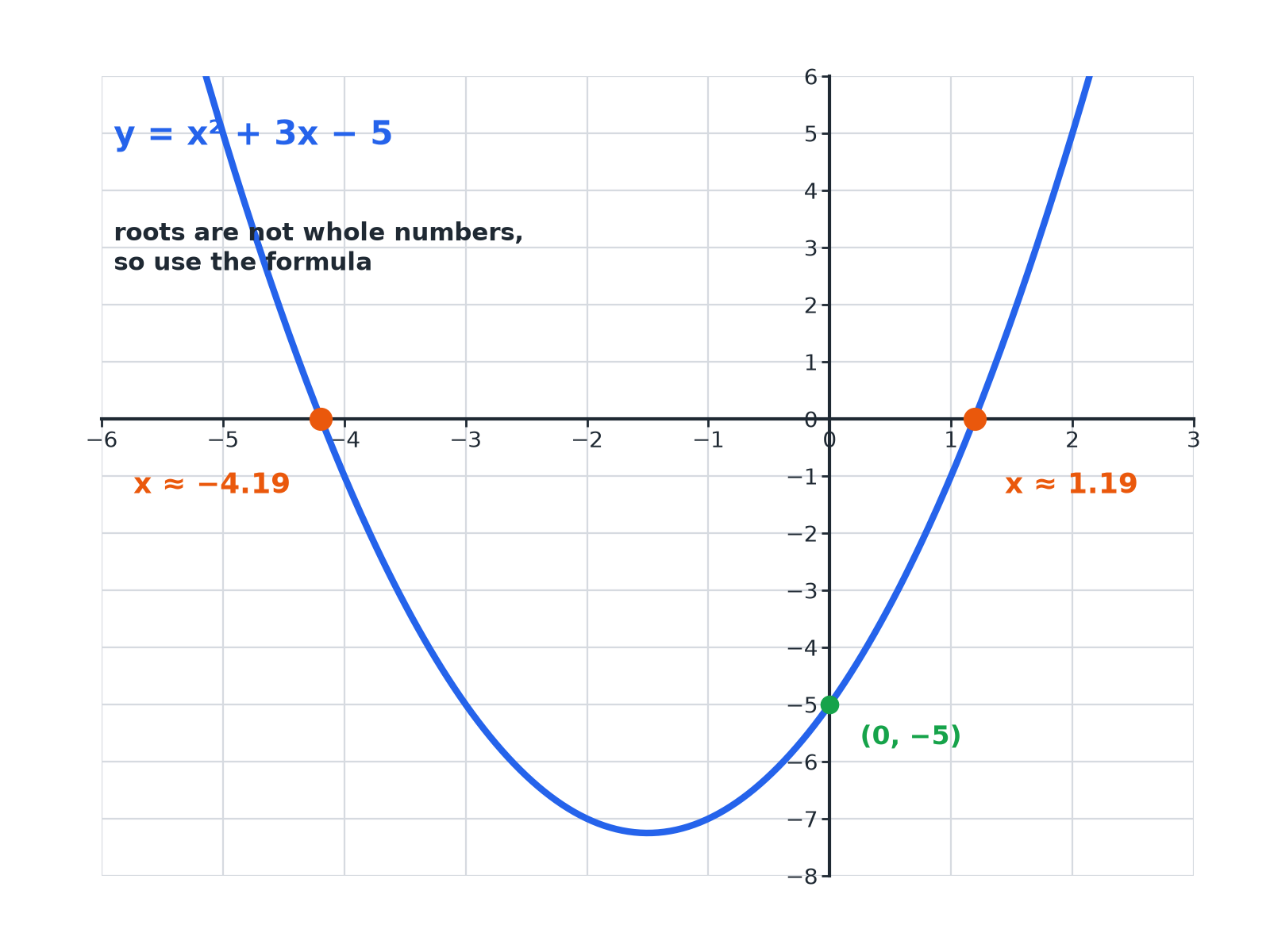
The roots are not whole numbers, so factorising will not work.
Using the Formula
Solve \(x^2 + 3x - 5 = 0\), giving your answers to 2 decimal places.
Show the solutionHide the solution
- 1 Identify \(a = 1\), \(b = 3\), \(c = -5\) Substitute into the formula
- 2 \(b^2 - 4ac\) \(9 - 4(1)(-5) = 9 + 20 = 29\)
- 3 Write the formula \(x = \dfrac{-3 \pm \sqrt{29}}{2}\)
- 4 Calculate \(\sqrt{29} = 5.385...\)
- 5 The two solutions \(x = 1.19\) or \(x = -4.19\)
Answer\(x = 1.19\) or \(x = -4.19\)
Leaving the Answer as a Surd
Solve \(x^2 - 6x + 2 = 0\), giving your answers in the form \(p \pm \sqrt{q}\).
Show the solutionHide the solution
- 1 \(a = 1\), \(b = -6\), \(c = 2\) \(b^2 - 4ac = 36 - 8 = 28\)
- 2 Formula \(x = \dfrac{6 \pm \sqrt{28}}{2}\)
- 3 Simplify \(\sqrt{28} = 2\sqrt{7}\) \(x = \dfrac{6 \pm 2\sqrt{7}}{2}\)
- 4 Divide through by 2 \(x = 3 \pm \sqrt{7}\)
Answer\(x = 3 + \sqrt{7}\) or \(x = 3 - \sqrt{7}\)
Which Method?
Factorising
- Quick when the numbers are simple.
- Works when the roots are rational.
- Gives exact answers.
The quadratic formula
- Always works.
- Needed for "give to 2 decimal places" or surds.
- Take care with the signs of \(b\) and \(c\).
Common Mistakes
The formula has plenty of places to slip.
-
Sign of b
The formula starts with \(-b\); if \(b = -6\), then \(-b = 6\).
-
The bracket
\(b^2\) must be squared before any minus: \((-6)^2 = 36\).
-
Dividing
Divide the WHOLE numerator by \(2a\), not just the surd.
-
Order of the calculation
Use brackets on the calculator for the top line.
Choose Your Method
For each equation, decide whether to factorise or use the formula, then solve it. (a) \(2x^2 - 5x - 12 = 0\) (b) \(x^2 + 4x - 3 = 0\) (to 2 d.p.) (c) \(x^2 - 10x + 25 = 0\).
1. Test for simple factors.
2. Otherwise use the formula.
A good answer shows: (a) \((2x + 3)(x - 4) = 0\): \(x = -1.5\) or 4. (b) Formula: \(\dfrac{-4 \pm \sqrt{28}}{2} = -2 \pm \sqrt{7}\): \(x = 0.65\) or \(-4.65\). (c) \((x - 5)^2 = 0\): \(x = 5\) (one repeated solution).
Can I...?
- 1Factorise \(ax^2 + bx + c\).
- 2Solve by factorising.
- 3Write down the quadratic formula.
- 4Identify \(a\), \(b\) and \(c\) correctly.
- 5Substitute carefully with brackets.
- 6Give answers to 2 decimal places.
- 7Give answers as surds.
- 8Choose between methods.
Summary & Exam Focus
- \(x = \dfrac{-b \pm \sqrt{b^2 - 4ac}}{2a}\).
- Factorise when the numbers are simple; otherwise use the formula.
- Watch the signs and divide the whole numerator by \(2a\).
- Check by substituting your answers into the original equation.
Exam focus
Solve \(x^2 + 3x - 5 = 0\). Give your solutions correct to 2 decimal places. (3 marks) (3 marks)
Write \(a\), \(b\) and \(c\) first, and put brackets round negative numbers when you substitute.
Key terms
The vocabulary this lesson expects you to use. Each one is linked from the first place it appears above.
- Coefficient
- The number multiplying a variable, such as the 2 in \(2x^2\).
- Quadratic formula
- \(x = \dfrac{-b \pm \sqrt{b^2 - 4ac}}{2a}\).
- Discriminant
- The expression \(b^2 - 4ac\) under the square root.
- Surd
- A root that cannot be simplified to a whole number, such as \(\sqrt{7}\).
- Root
- A solution of an equation.
- Substitute
- Replace letters with numbers.
Practice questions
Have a go at each one before you open its answer.
-
Question 1 Non-calculator 3 marks
Solve \(2x^2 + 7x + 3 = 0\).
Show answerHide answer
Model answer
\((2x + 1)(x + 3) = 0\), so \(x = -\dfrac{1}{2}\) or \(x = -3\).
Mark scheme
- Correct factorisation — M1
- One solution — A1
- Both solutions — A1
-
Question 2 Non-calculator 3 marks
Solve \(3x^2 - 10x + 8 = 0\).
Show answerHide answer
Model answer
\((3x - 4)(x - 2) = 0\), so \(x = \dfrac{4}{3}\) or \(x = 2\).
Mark scheme
- Correct factorisation — M1
- One solution — A1
- Both solutions — A1
-
Question 3 Non-calculator 4 marks
Solve \(2x^2 - 5x - 12 = 0\).
Show answerHide answer
Model answer
\((2x + 3)(x - 4) = 0\), so \(x = -\dfrac{3}{2}\) or \(x = 4\).
Mark scheme
- \(2x^2 - 8x + 3x - 12\) — M1
- \((2x + 3)(x - 4)\) — M1
- One solution — A1
- Both solutions — A1
-
Question 4 Calculator 3 marks
Solve \(x^2 + 3x - 5 = 0\). Give your solutions correct to 2 decimal places.
Show answerHide answer
Model answer
\(x = \dfrac{-3 \pm \sqrt{9 + 20}}{2} = \dfrac{-3 \pm \sqrt{29}}{2}\), so \(x = 1.19\) or \(x = -4.19\).
Mark scheme
- Correct substitution into the formula — M1
- \(\dfrac{-3 \pm \sqrt{29}}{2}\) — A1
- \(1.19\) and \(-4.19\) — A1
-
Question 5 Calculator 3 marks
Solve \(3x^2 - 4x - 2 = 0\). Give your solutions correct to 2 decimal places.
Show answerHide answer
Model answer
\(x = \dfrac{4 \pm \sqrt{16 + 24}}{6} = \dfrac{4 \pm \sqrt{40}}{6}\), so \(x = 1.72\) or \(x = -0.39\).
Mark scheme
- Correct substitution — M1
- \(\dfrac{4 \pm \sqrt{40}}{6}\) — A1
- \(1.72\) and \(-0.39\) — A1
-
Question 6 Non-calculator 4 marks
Solve \(x^2 - 6x + 2 = 0\). Give your answers in the form \(p \pm \sqrt{q}\), where \(p\) and \(q\) are integers.
Show answerHide answer
Model answer
\(x = \dfrac{6 \pm \sqrt{36 - 8}}{2} = \dfrac{6 \pm \sqrt{28}}{2} = \dfrac{6 \pm 2\sqrt{7}}{2} = 3 \pm \sqrt{7}\).
Mark scheme
- Correct substitution — M1
- \(\sqrt{28}\) — A1
- \(2\sqrt{7}\) — M1
- \(3 \pm \sqrt{7}\) — A1
Quick check
-
In \(3x^2 + 5x - 2 = 0\), what is \(a\)?
Show answerHide answer
A: 3
\(a\) is the coefficient of \(x^2\): 3.
-
What is \(b^2 - 4ac\) for \(x^2 + 3x - 5 = 0\)?
Show answerHide answer
C: 29
\(9 - 4(1)(-5) = 9 + 20 = 29\).
-
Factorise \(2x^2 + 7x + 3\).
Show answerHide answer
B: \((2x + 1)(x + 3)\)
\((2x + 1)(x + 3)\) expands to \(2x^2 + 7x + 3\).
-
The formula gives \(x = \dfrac{6 \pm \sqrt{28}}{2}\). What is this in simplest form?
Show answerHide answer
D: \(3 \pm \sqrt{7}\)
\(\sqrt{28} = 2\sqrt{7}\), so divide through by 2: \(3 \pm \sqrt{7}\).
-
When is the quadratic formula most useful?
Show answerHide answer
A: When the roots are not whole numbers
When the equation will not factorise easily, especially if the answer must be to 2 decimal places.
-
The equation \(x^2 - 10x + 25 = 0\) has...
Show answerHide answer
B: One repeated solution
It is \((x - 5)^2 = 0\), one repeated solution \(x = 5\).
Downloads
Free to keep, print and annotate.
- Solving quadratic equations 2.pptx Built from the lesson script on 30 September 2026. View
- Solving quadratic equations 2 - Completed Notes.docx The full notes for the lesson, to revise from. Built from the lesson script on 30 September 2026. View
- Solving quadratic equations 2 - Exam Questions.docx Built from the lesson script on 30 September 2026. View
Something here looks wrong?
Tell us what and we will go and look. It goes to whoever writes these pages, nobody else, and we do not ask who you are — so there is nothing to sign and nothing comes back to you.