Viewing as
Teaching this? The teacher view adds 2 files, the mark schemes and the model answers.
Maths · Graphs
More graphs
Exponential growth and decay graphs \(y = ab^x\), circles centred at the origin \(x^2 + y^2 = r^2\), and the graphs of sine, cosine and tangent - with how to use each to find values and solve equations.
Last Lesson and Before
Answer each one, then check.
-
1
Work out \(2^{-1}\).
Show answerHide answer
\(\frac{1}{2}\)
-
2
Work out \(3 \times 2^4\).
Show answerHide answer
48
-
3
What is \(\sin 30^\circ\) exactly?
Show answerHide answer
\(\frac{1}{2}\)
-
4
A car worth £15 000 loses 12% of its value. What multiplier gives its new value?
Show answerHide answer
0.88
Learning Objectives
- 1Recognise, plot and use exponential graphs \(y = ab^x\).
- 2Find the values of \(a\) and \(b\) from points on an exponential graph.
- 3Recognise the equation of a circle centred at the origin.
- 4Recognise and sketch the graphs of \(y = \sin x\), \(y = \cos x\) and \(y = \tan x\).
- 5Use trig graphs to find a second solution to an equation.
Exponential Graphs
In \(y = ab^x\), the variable \(x\) is the power.
-
\(a\) is the \(y\)-intercept
When \(x = 0\), \(b^0 = 1\), so \(y = a\).
-
Growth
If \(b > 1\), the graph rises more and more steeply: \(y = 2^x\).
-
Decay
If \(0 < b < 1\), it falls towards zero: \(y = \left(\frac{1}{2}\right)^x\).
-
Never zero
The graph gets closer to the \(x\)-axis but never touches it - the \(x\)-axis is an asymptote.
A Table of Values for y = 2 to the power x
-
\(-2\)
\(2^x\): \(\frac{1}{4}\). y: 0.25
-
\(-1\)
\(2^x\): \(\frac{1}{2}\). y: 0.5
-
0
\(2^x\): 1. y: 1
-
1
\(2^x\): 2. y: 2
-
2
\(2^x\): 4. y: 4
-
3
\(2^x\): 8. y: 8
Finding a and b
The graph of \(y = ab^x\) passes through \((0, 3)\) and \((2, 12)\). Find \(a\) and \(b\).
Show the solutionHide the solution
- 1 Use \((0, 3)\): \(b^0 = 1\) \(3 = a \times 1\), so \(a = 3\)
- 2 Use \((2, 12)\) \(12 = 3 \times b^2\)
- 3 Solve \(b^2 = 4\), so \(b = 2\) (\(b\) must be positive)
Answer\(a = 3\), \(b = 2\), so \(y = 3 \times 2^x\)
Exponential Decay
A car is bought for £15 000. It loses 12% of its value each year. Its value after \(t\) years is \(V = 15\,000 \times 0.88^t\). Work out its value after 3 years.
Show the solutionHide the solution
- 1 Substitute \(t = 3\) \(V = 15\,000 \times 0.88^3\)
- 2 Calculate \(0.88^3 = 0.681472\)
- 3 Multiply \(15\,000 \times 0.681472 = 10\,222.08\)
Answer£10 222.08
Exponentials and a Circle
Every point on a circle centred at the origin is a distance \(r\) from the origin. By Pythagoras, \(x^2 + y^2 = r^2\). So \(x^2 + y^2 = 25\) has radius \(\sqrt{25} = 5\), and \((3, 4)\) lies on it because \(9 + 16 = 25\).
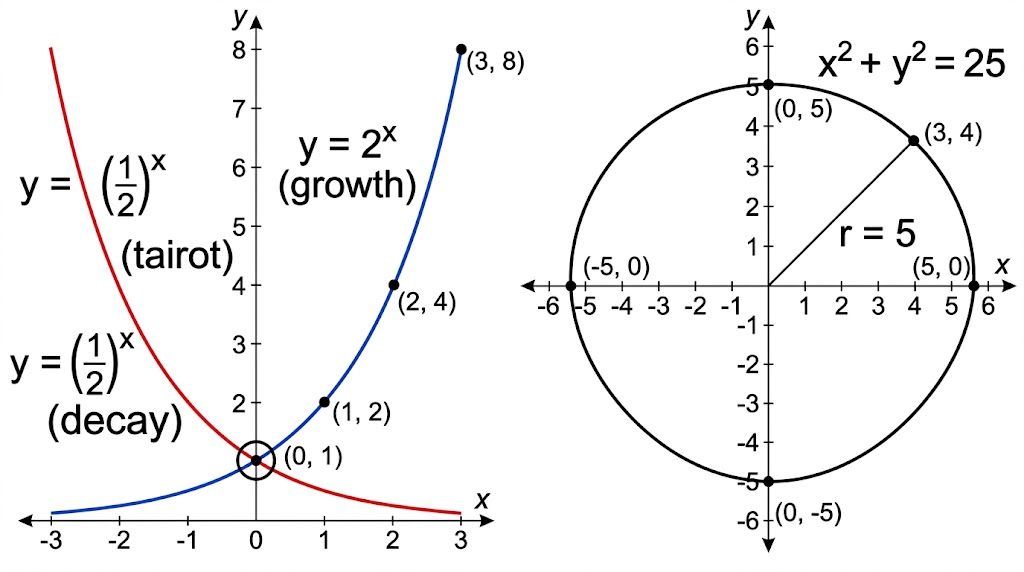
\(y = 2^x\) and \(y = \left(\frac{1}{2}\right)^x\) both pass through \((0, 1)\); \(x^2 + y^2 = 25\) is a circle of radius 5.
Circles
\(x^2 + y^2 = r^2\) is a circle with centre \((0, 0)\) and radius \(r\).
-
Radius from the equation
\(x^2 + y^2 = 49\) has radius 7.
-
Equation from the radius
Radius 6 gives \(x^2 + y^2 = 36\).
-
Is a point on it?
Substitute: \((4, 5)\) is on \(x^2 + y^2 = 41\) because \(16 + 25 = 41\).
-
Where it crosses the axes
At \((\pm r, 0)\) and \((0, \pm r)\).
The Trig Graphs
\(y = \sin x\) and \(y = \cos x\) are waves between \(-1\) and 1. The cosine graph is the sine graph shifted \(90^\circ\) to the left. \(y = \tan x\) has no value at \(90^\circ\) and \(270^\circ\), where it has asymptotes.
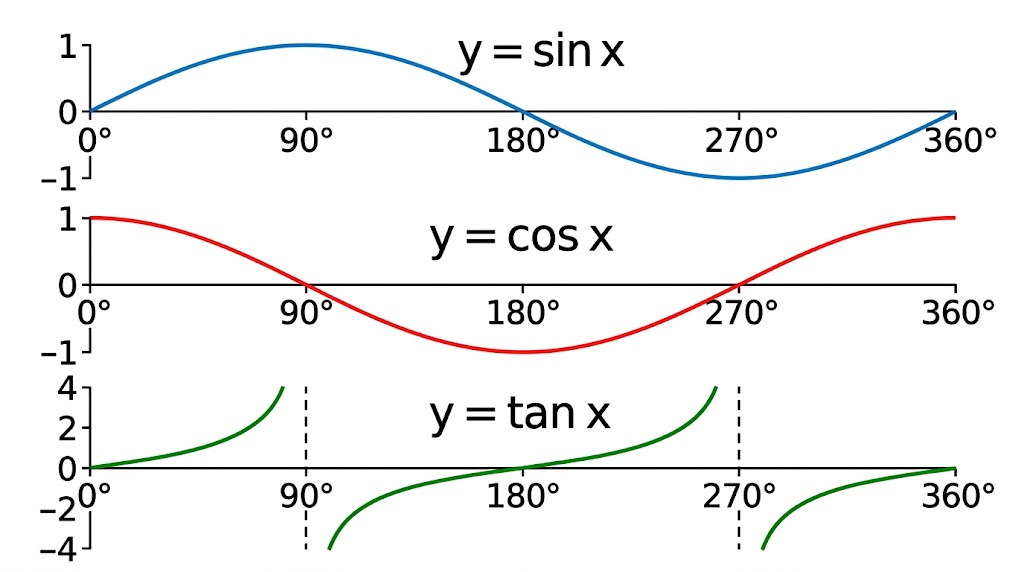
Sine and cosine repeat every \(360^\circ\); tangent every \(180^\circ\).
Key Points of the Trig Graphs
-
\(y = \sin x\)
Maximum: 1 at \(90^\circ\). Minimum: \(-1\) at \(270^\circ\). Crosses the x-axis: \(0^\circ\), \(180^\circ\), \(360^\circ\). Repeats every: \(360^\circ\)
-
\(y = \cos x\)
Maximum: 1 at \(0^\circ\) and \(360^\circ\). Minimum: \(-1\) at \(180^\circ\). Crosses the x-axis: \(90^\circ\), \(270^\circ\). Repeats every: \(360^\circ\)
-
\(y = \tan x\)
Maximum: None. Minimum: None. Crosses the x-axis: \(0^\circ\), \(180^\circ\), \(360^\circ\). Repeats every: \(180^\circ\)
A Second Solution
Solve \(\sin x = 0.5\) for \(0^\circ \le x \le 360^\circ\).
Show the solutionHide the solution
- 1 First solution from the calculator (or exact values) \(x = \sin^{-1}(0.5) = 30^\circ\)
- 2 The sine graph is symmetrical about \(x = 90^\circ\) \(180 - 30 = 150\)
- 3 Check: \(\sin x\) is negative from \(180^\circ\) to \(360^\circ\), so no more solutions Only two
Answer\(x = 30^\circ\) or \(x = 150^\circ\)
Bacteria Model
A colony of bacteria starts with 500 cells and doubles every hour. (a) Write a formula for the number \(N\) after \(t\) hours. (b) Make a table for \(t = 0\) to 5 and sketch the graph. (c) After how many whole hours does it first pass 10 000? (d) Why can't this model be right for ever?
1. Identify \(a\) and \(b\).
2. Make the table.
3. Question the model.
A good answer shows: (a) \(N = 500 \times 2^t\) (b) 500, 1000, 2000, 4000, 8000, 16 000 (c) after 5 hours (d) The bacteria would run out of space or food; real growth levels off.
Can I...?
- 1Plot an exponential graph.
- 2Tell growth from decay.
- 3Find \(a\) and \(b\) in \(y = ab^x\).
- 4Use an exponential formula in context.
- 5Find the radius of \(x^2 + y^2 = r^2\).
- 6Check whether a point is on a circle.
- 7Sketch the sine, cosine and tangent graphs.
- 8Find a second solution using a trig graph.
Summary & Exam Focus
- \(y = ab^x\): \(a\) is the \(y\)-intercept; \(b > 1\) growth, \(0 < b < 1\) decay.
- \(x^2 + y^2 = r^2\): circle, centre \((0, 0)\), radius \(r\).
- Sine and cosine: waves between \(-1\) and 1, repeating every \(360^\circ\). Tangent repeats every \(180^\circ\).
- Use symmetry of the graph to find a second solution.
Exam focus
The graph of \(y = ab^x\) passes through \((0, 3)\) and \((2, 12)\). Find the values of \(a\) and \(b\). (3 marks) (3 marks)
For \(y = ab^x\), always use the point with \(x = 0\) first - it gives \(a\) immediately, because \(b^0 = 1\).
Key terms
The vocabulary this lesson expects you to use. Each one is linked from the first place it appears above.
- Exponential
- A function where the variable is the power, such as \(y = 2^x\).
- Growth and decay
- An exponential that increases (\(b > 1\)) or decreases (\(0 < b < 1\)).
- Asymptote
- A line a graph approaches but never touches.
- Circle equation
- \(x^2 + y^2 = r^2\): centre the origin, radius \(r\).
- Period
- The interval after which a graph repeats.
Practice questions
Have a go at each one before you open its answer.
-
Question 1 Non-calculator · Higher 3 marks
The graph of \(y = ab^x\) passes through the points \((0, 3)\) and \((2, 12)\). Find the value of \(a\) and the value of \(b\).
Show answerHide answer
Model answer
\(3 = ab^0 = a\), so \(a = 3\). \(12 = 3b^2\), \(b^2 = 4\), \(b = 2\).
Mark scheme
- \(a = 3\) — B1
- \(12 = 3b^2\) — M1
- \(b = 2\) — A1
-
Question 2 Calculator · Higher 2 marks
A car is bought for £15 000. Its value after \(t\) years is \(V = 15\,000 \times 0.88^t\). (a) By what percentage does the value fall each year? (b) Work out the value after 3 years.
Show answerHide answer
Model answer
(a) 12% (b) \(15\,000 \times 0.88^3 = £10\,222.08\)
Mark scheme
- (a) 12% — B1
- (b) £10 222.08 — B1
-
Question 3 Non-calculator · Higher 3 marks
(a) Write down the radius of the circle \(x^2 + y^2 = 25\). (b) Show that the point \((3, -4)\) lies on the circle. (c) Write down the equation of the circle with centre \((0, 0)\) and radius 6.
Show answerHide answer
Model answer
(a) 5 (b) \(3^2 + (-4)^2 = 9 + 16 = 25\), so yes. (c) \(x^2 + y^2 = 36\)
Mark scheme
- (a) 5 — B1
- (b) \(9 + 16 = 25\) shown — B1
- (c) \(x^2 + y^2 = 36\) — B1
-
Question 4 Calculator · Higher 2 marks
One solution of \(\cos x = 0.5\) is \(x = 60^\circ\). Find the other solution between \(0^\circ\) and \(360^\circ\).
Show answerHide answer
Model answer
The cosine graph is symmetrical about \(x = 180^\circ\), so \(x = 360 - 60 = 300^\circ\).
Mark scheme
- Using symmetry, e.g. \(360 - 60\) — M1
- \(300^\circ\) — A1
Quick check
-
What is the \(y\)-intercept of \(y = 5 \times 3^x\)?
Show answerHide answer
C: 5
When \(x = 0\), \(3^0 = 1\), so \(y = 5\).
-
What is the radius of the circle \(x^2 + y^2 = 64\)?
Show answerHide answer
B: 8
\(r^2 = 64\), so \(r = 8\).
-
How often does the graph of \(y = \tan x\) repeat?
Show answerHide answer
D: Every \(180^\circ\)
Tangent has a period of \(180^\circ\); sine and cosine repeat every \(360^\circ\).
Downloads
Free to keep, print and annotate.
- More graphs.pptx Built from the lesson script on 29 September 2026. View
- More graphs - Completed Notes.docx The full notes for the lesson, to revise from. Built from the lesson script on 29 September 2026. View
- More graphs - Exam Questions.docx Built from the lesson script on 29 September 2026. View
Something here looks wrong?
Tell us what and we will go and look. It goes to whoever writes these pages, nobody else, and we do not ask who you are — so there is nothing to sign and nothing comes back to you.