Viewing as
Teaching this? The teacher view adds 2 files, the mark schemes and the model answers.
Maths · Transformations and constructions
3D solids
Name and describe 3D solids by their faces, edges and vertices, and draw and read plans and elevations.
Warm-up
Answer each one, then check.
-
1
How many faces does a cube have?
Show answerHide answer
6
-
2
What is the name of a 3D shape with a circular base and one curved surface ending at a point?
Show answerHide answer
A cone
-
3
What is the volume of a cuboid 2 by 3 by 4?
Show answerHide answer
24
-
4
What shape is the cross-section of a cylinder cut straight across?
Show answerHide answer
A circle
-
5
What is a polygon with 6 sides called?
Show answerHide answer
A hexagon
Learning Objectives
- 1Name common 3D solids.
- 2Count faces, edges and vertices.
- 3Draw and interpret plans and elevations.
- 4Use a 3D drawing to work out how many cubes make a solid.
Faces, Edges and Vertices
A face is a flat surface, an edge is where two faces meet, and a vertex is a corner.
-
Cuboid
Faces: 6. Edges: 12. Vertices: 8
-
Triangular prism
Faces: 5. Edges: 9. Vertices: 6
-
Square-based pyramid
Faces: 5. Edges: 8. Vertices: 5
-
Cylinder
Faces: 3. Edges: 2. Vertices: 0
-
Cone
Faces: 2. Edges: 1. Vertices: 1
-
Sphere
Faces: 1. Edges: 0. Vertices: 0
Naming Solids
The name comes from the shape of the base or cross-section.
-
Prism
The same cross-section all the way along: a triangular prism, a hexagonal prism.
-
Pyramid
A polygon base with triangular faces that meet at one apex.
-
Cylinder, cone, sphere
Solids with curved surfaces; a sphere is a perfect ball.
-
Tetrahedron
A pyramid with four triangular faces.
EULER'S FORMULA
For any solid with flat faces, faces plus vertices minus edges equals 2.
Cuboid: \(6 + 8 - 12 = 2\). Square-based pyramid: \(5 + 5 - 8 = 2\).
Plan and Elevations
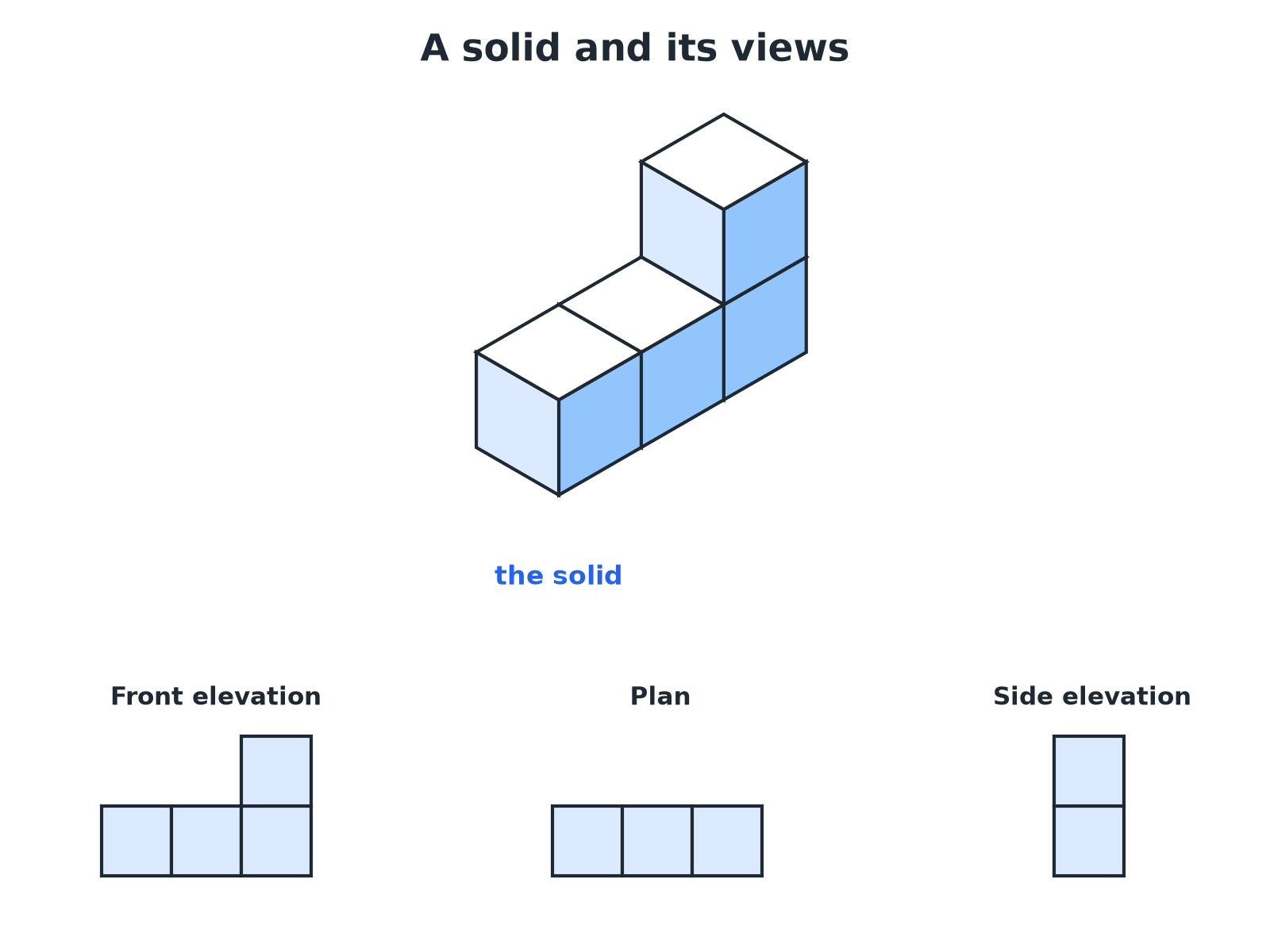
The plan is the view from above; elevations are views from the front and the side.
The Three Views
-
Plan
The view from directly above.
-
Front elevation
The view from the front, looking straight at the face you choose to call the front.
-
Side elevation
The view from one side, usually the right, looking straight at that face.
Drawing the Elevations
A solid is made from four cubes: a row of three, with one more cube on top of the right-hand cube. Draw the front elevation, the plan and the side elevation viewed from the right.
Show the solutionHide the solution
- 1 Front elevation: what you see facing the row Three squares wide; the right column is two high
- 2 Plan: look down from above Three squares in a row (the top cube is hidden above the right one)
- 3 Side elevation from the right: you see the end One square wide and two squares high
AnswerFront elevation: an L-shape of 4 squares. Plan: 3 squares in a row. Side elevation: 2 squares in a column.
Tips for Elevations
Draw only what you can see, with straight lines.
-
Hidden edges
Do not draw edges you cannot see from that direction.
-
Use a grid
One square on the grid stands for one edge of a cube.
-
Check your views agree
The front elevation and plan must have the same width; the front and side must have the same height.
Build and Draw
Build a solid from 5 cubes: a row of three cubes, a fourth cube placed directly behind the middle cube of the row, and a fifth cube on top of the left-hand cube of the row. Draw its plan and its front elevation.
1. Build the solid.
2. Look from each direction.
3. Draw only what you see.
A good answer shows: Plan: a row of three squares with a fourth square behind the middle one (a T-shape). Front elevation: three squares wide, with the left column two squares high and the other two columns one square high.
Can I...?
- 1Name the common solids.
- 2Count faces, edges and vertices.
- 3Check with Euler's formula.
- 4Say what a plan is.
- 5Draw a front elevation.
- 6Draw a side elevation.
- 7Match views to a solid.
- 8Work out the volume of a cube solid from its views.
Summary & Exam Focus
- Faces, edges, vertices: count carefully and check with F + V − E = 2.
- Plan is from above; elevations are from the sides.
- Draw with straight lines on a grid.
- Compare your views for consistency.
Exam focus
A solid is made of 4 cubes: a row of three cubes with one cube on top of the right-hand cube. Draw the front elevation of the solid on a square grid. (2 marks) (2 marks)
Look at the solid from the front only and draw what is visible: an L-shape here. Do not add depth lines.
Key terms
The vocabulary this lesson expects you to use. Each one is linked from the first place it appears above.
- Face
- A flat surface of a solid.
- Edge
- A line where two faces meet.
- Vertex
- A corner where edges meet (plural: vertices).
- Plan
- The view of a solid from above.
- Elevation
- The view of a solid from the front or side.
- Prism
- A solid with the same cross-section all the way through.
Practice questions
Have a go at each one before you open its answer.
-
Question 1 Non-calculator 2 marks
Write down the number of faces, edges and vertices of a square-based pyramid.
Show answerHide answer
Model answer
5 faces, 8 edges and 5 vertices.
Mark scheme
- Two correct — B1
- All three correct — B1
-
Question 2 Non-calculator 2 marks
A solid has 5 faces, 9 edges and 6 vertices. Two of its faces are triangles. Write down the name of the solid.
Show answerHide answer
Model answer
A triangular prism.
Mark scheme
- Triangular prism — B2
-
Question 3 Non-calculator 2 marks
Write down the shape of the plan of a cylinder standing on a flat table.
Show answerHide answer
Model answer
A circle.
Mark scheme
- Circle — B2
-
Question 4 Non-calculator 2 marks
The diagram shows a solid made from four identical cubes. On the grid, draw the front elevation of the solid, viewed from the direction of the arrow F.
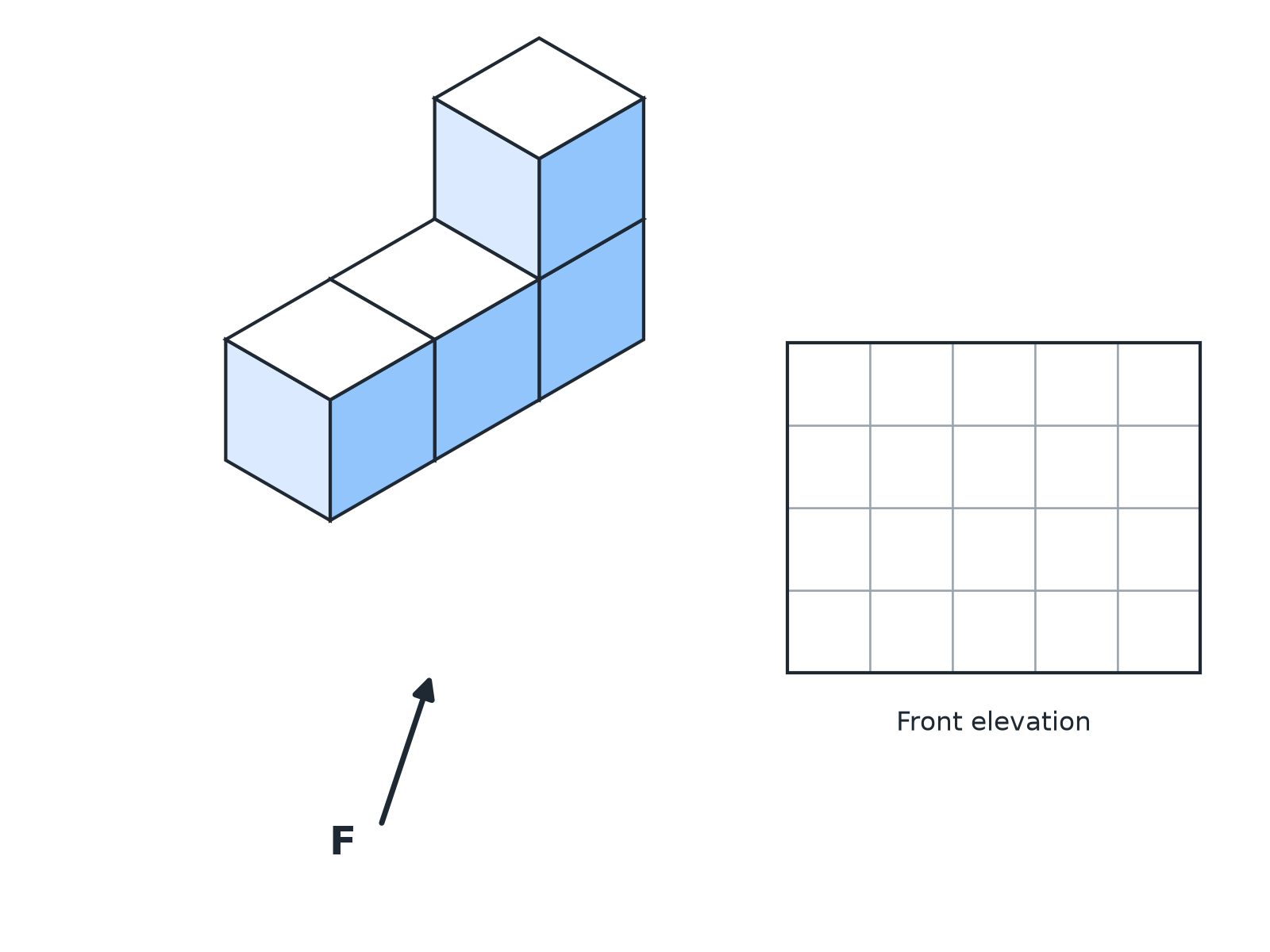
Show answerHide answer
Model answer
An L-shape made of 4 squares: a row of 3 squares with one more square above the right-hand square.
Mark scheme
- Correct number of columns and heights — M1
- A fully correct front elevation — A1
-
Question 5 Non-calculator 2 marks
For the solid in the last question, draw the plan.
Show answerHide answer
Model answer
A row of 3 squares.
Mark scheme
- Three squares in a row — B2
-
Question 6 Non-calculator 3 marks
For the same solid, draw the side elevation viewed from the right.
Show answerHide answer
Model answer
A column of 2 squares (one square wide, two squares high).
Mark scheme
- One square wide — M1
- Two squares high — M1
- A fully correct drawing — A1
Quick check
-
How many vertices does a cuboid have?
Show answerHide answer
C: 8
A cuboid has 8 corners.
-
What is a view of a solid from above called?
Show answerHide answer
B: Plan
The plan is the view from above.
-
How many edges does a triangular prism have?
Show answerHide answer
D: 9
3 on each triangle plus 3 joining them: 9.
-
A cone has how many flat faces?
Show answerHide answer
A: 1
One: the circular base.
-
Which solid has 1 face, 0 edges and 0 vertices?
Show answerHide answer
C: Sphere
A sphere has one curved surface.
-
Euler's formula says F + V − E equals...
Show answerHide answer
B: 2
For any solid with flat faces, it equals 2.
Downloads
Free to keep, print and annotate.
Something here looks wrong?
Tell us what and we will go and look. It goes to whoever writes these pages, nobody else, and we do not ask who you are — so there is nothing to sign and nothing comes back to you.