Viewing as
Teaching this? The teacher view adds 2 files, the mark schemes and the model answers.
Maths · Transformations and constructions
Reflection and rotation
Reflect shapes in mirror lines and rotate them about a centre, and describe reflections and rotations fully.
Warm-up
Answer each one, then check.
-
1
What are the coordinates of the origin?
Show answerHide answer
\((0, 0)\)
-
2
What is the equation of the y-axis?
Show answerHide answer
\(x = 0\)
-
3
What is the equation of the x-axis?
Show answerHide answer
\(y = 0\)
-
4
How many degrees in a half turn?
Show answerHide answer
180
-
5
What is the reflection of \((2, 3)\) in the y-axis?
Show answerHide answer
\((-2, 3)\)
Learning Objectives
- 1Reflect a shape in a mirror line, including \(y = x\).
- 2Rotate a shape about a centre through 90° or 180°.
- 3Describe a reflection fully.
- 4Describe a rotation fully.
Congruent Transformations
-
Object and image
The original shape is the object; the shape after the transformation is the image.
-
Congruent
Reflection and rotation keep the size and shape the same, so the image is congruent to the object.
-
Orientation
A reflection flips the shape; a rotation turns it.
-
Describe fully
Name the transformation and give all the details needed.
A Reflection and a Rotation
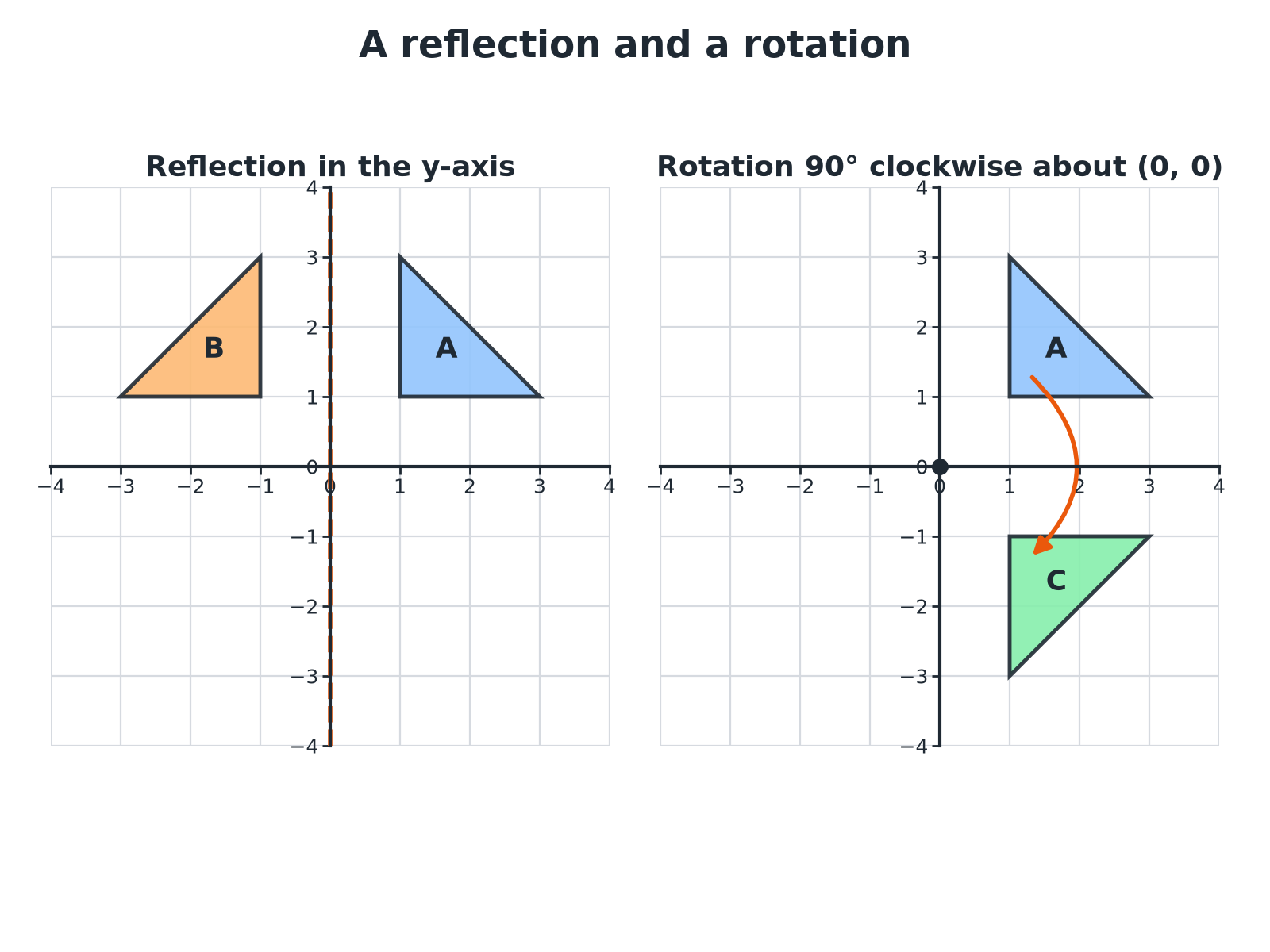
Each point of the image is the same distance from the mirror line, or the same distance from the centre of rotation.
Reflection or Rotation?
Reflection
- Flips the shape over a mirror line.
- Each point and its image are the same distance from the line, on opposite sides.
- Describe with the equation of the mirror line, e.g. \(x = 4\), \(y = x\).
Rotation
- Turns the shape about a fixed point, the centre.
- Each point and its image are the same distance from the centre.
- Describe with the angle, the direction (clockwise or anticlockwise) and the centre.
Reflecting in a Line
Triangle A has vertices \((1, 1)\), \((1, 3)\) and \((3, 1)\). Reflect it in the line \(x = 4\).
Show the solutionHide the solution
- 1 Each point is 3, 3 and 1 away from the line \(x = 4\) horizontally \((1, 1)\) is 3 to the left
- 2 Go the same distance to the right of the line \((7, 1)\)
- 3 Do the same for the other vertices \((1, 3) \to (7, 3)\) and \((3, 1) \to (5, 1)\)
AnswerThe image has vertices \((7, 1)\), \((7, 3)\) and \((5, 1)\).
Rotating About the Origin
Rotate triangle A, with vertices \((1, 1)\), \((1, 3)\) and \((3, 1)\), through \(90^\circ\) clockwise about the origin.
Show the solutionHide the solution
- 1 Rule for \(90^\circ\) clockwise about the origin \((x, y) \to (y, -x)\)
- 2 Apply it \((1, 1) \to (1, -1)\)
- 3 The other vertices \((1, 3) \to (3, -1)\) and \((3, 1) \to (1, -3)\)
AnswerThe image has vertices \((1, -1)\), \((3, -1)\) and \((1, -3)\).
Describing a Rotation
Triangle A has vertices \((1, 1)\), \((1, 3)\) and \((3, 1)\). Triangle B has vertices \((-1, -1)\), \((-1, -3)\) and \((-3, -1)\). Describe fully the single transformation that maps A onto B.
Show the solutionHide the solution
- 1 The shape has turned upside down A half turn
- 2 Each x and y has changed sign Centre at the origin
- 3 Name the transformation with the three details Rotation, \(180^\circ\), centre \((0, 0)\)
AnswerA rotation of \(180^\circ\) about the centre \((0, 0)\).
Quick Rules About the Origin
Handy for checking your answers.
-
Reflection in the y-axis
Rule for \((x, y)\): \((-x, y)\)
-
Reflection in the x-axis
Rule for \((x, y)\): \((x, -y)\)
-
Reflection in \(y = x\)
Rule for \((x, y)\): \((y, x)\)
-
Rotation \(90^\circ\) clockwise
Rule for \((x, y)\): \((y, -x)\)
-
Rotation \(90^\circ\) anticlockwise
Rule for \((x, y)\): \((-y, x)\)
-
Rotation \(180^\circ\)
Rule for \((x, y)\): \((-x, -y)\)
Transformation Detective
Triangle A has vertices \((1, 1)\), \((1, 3)\) and \((3, 1)\). Work out the vertices of its image under (a) reflection in the x-axis (b) reflection in \(y = x\) (c) rotation \(90^\circ\) anticlockwise about the origin. Then say which of the three images touches the original at a point.
1. Apply the rule.
2. Plot the image.
3. Check distances from the mirror line.
A good answer shows: (a) \((1, -1)\), \((1, -3)\), \((3, -1)\). (b) \((1, 1)\), \((3, 1)\), \((1, 3)\), which is the same triangle. (c) \((-1, 1)\), \((-3, 1)\), \((-1, 3)\). Image (b) coincides with A because A is symmetrical about \(y = x\).
Can I...?
- 1Reflect in the axes.
- 2Reflect in a line such as \(x = 4\).
- 3Reflect in \(y = x\).
- 4Rotate about the origin.
- 5Rotate about another point.
- 6Describe a reflection fully.
- 7Describe a rotation fully.
- 8Use the rules for coordinates.
Summary & Exam Focus
- Reflection: name it and give the mirror line equation.
- Rotation: give the angle, the direction and the centre.
- Distances from the mirror line or the centre are preserved.
- Rotations and reflections keep the shape congruent.
Exam focus
Describe fully the single transformation that maps triangle P onto triangle Q, where the vertices of P are \((1, 1)\), \((1, 3)\), \((3, 1)\) and the vertices of Q are \((7, 1)\), \((7, 3)\), \((5, 1)\). (3 marks) (3 marks)
A full description needs the name of the transformation and all its details: for a reflection, the equation of the mirror line.
Key terms
The vocabulary this lesson expects you to use. Each one is linked from the first place it appears above.
- Object
- The original shape before a transformation.
- Image
- The shape after a transformation.
- Congruent
- The same shape and size, possibly turned or flipped.
- Mirror line
- The line a shape is reflected in.
- Centre of rotation
- The fixed point a shape turns about.
- Clockwise
- The direction the hands of a clock move.
Practice questions
Have a go at each one before you open its answer.
-
Question 1 Non-calculator 2 marks
Triangle A has vertices \((1, 1)\), \((1, 3)\) and \((3, 1)\). It is reflected in the y-axis. Write down the coordinates of the vertices of the image.
Show answerHide answer
Model answer
\((-1, 1)\), \((-1, 3)\) and \((-3, 1)\).
Mark scheme
- Two vertices correct — B1
- All three correct — B1
-
Question 2 Non-calculator 3 marks
Triangle A has vertices \((1, 1)\), \((1, 3)\) and \((3, 1)\). Triangle B has vertices \((-1, -1)\), \((-1, -3)\) and \((-3, -1)\). Describe fully the single transformation that maps triangle A onto triangle B.
Show answerHide answer
Model answer
A rotation of \(180^\circ\) about the centre \((0, 0)\).
Mark scheme
- Rotation — B1
- \(180^\circ\) — B1
- Centre \((0, 0)\) — B1
-
Question 3 Non-calculator 3 marks
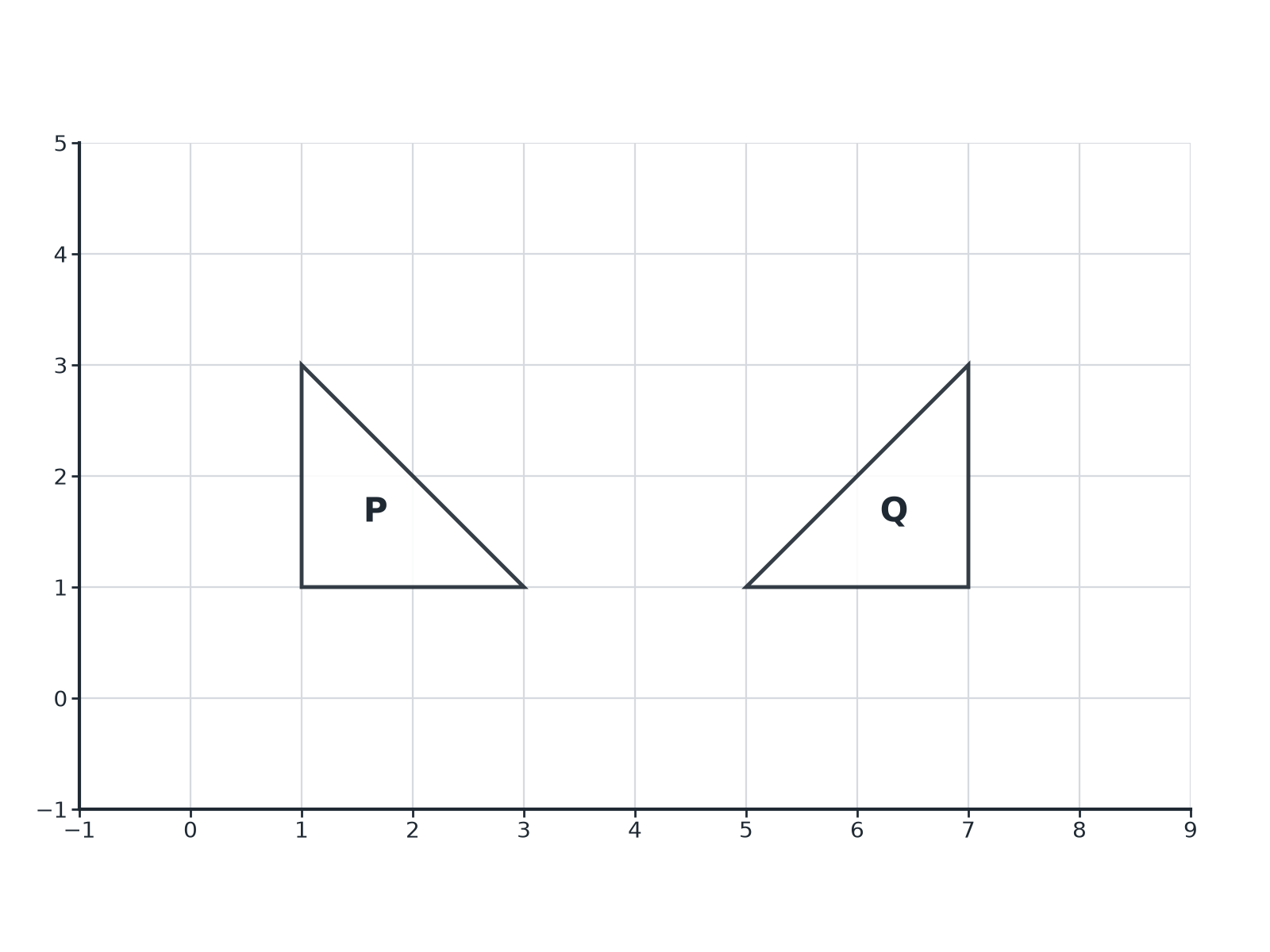
The diagram shows triangles P and Q on a grid. Describe fully the single transformation that maps triangle P onto triangle Q.
Show answerHide answer
Model answer
A reflection in the line \(x = 4\).
Mark scheme
- Reflection — B1
- The line \(x = 4\) — B2
-
Question 4 Non-calculator 2 marks
The point \((2, 5)\) is reflected in the line \(y = x\). Write down the coordinates of the image.
Show answerHide answer
Model answer
\((5, 2)\).
Mark scheme
- One coordinate correct — M1
- \((5, 2)\) — A1
-
Question 5 Non-calculator 3 marks
The point \(P(3, 1)\) is rotated \(90^\circ\) anticlockwise about the origin. Write down the coordinates of the image of P.
Show answerHide answer
Model answer
The rule is \((x, y) \to (-y, x)\), so the image is \((-1, 3)\).
Mark scheme
- A correct rotation method — M1
- One coordinate correct — A1
- \((-1, 3)\) — A1
-
Question 6 Non-calculator 3 marks
The point \(P(4, 2)\) is rotated \(90^\circ\) clockwise about the point \(C(2, 1)\). Find the coordinates of the image of P.
Show answerHide answer
Model answer
P is 2 to the right and 1 above C. After a \(90^\circ\) clockwise turn, the vector \((2, 1)\) becomes \((1, -2)\). The image is \((2 + 1, 1 - 2) = (3, -1)\).
Mark scheme
- Vector from C to P is \((2, 1)\) — M1
- Rotated vector \((1, -2)\) — M1
- \((3, -1)\) — A1
Quick check
-
What is the reflection of \((3, 4)\) in the x-axis?
Show answerHide answer
B: \((3, -4)\)
The x-coordinate stays and the y-coordinate changes sign.
-
What is the reflection of \((3, 4)\) in the line \(y = x\)?
Show answerHide answer
D: \((4, 3)\)
The coordinates swap: \((4, 3)\).
-
To describe a rotation fully you must give...
Show answerHide answer
C: The angle, direction and centre
The angle, the direction and the centre of rotation.
-
What is the image of \((2, 3)\) after a rotation of \(180^\circ\) about the origin?
Show answerHide answer
A: \((-2, -3)\)
Both signs change: \((-2, -3)\).
-
Which is NOT the same size as the original shape?
Show answerHide answer
D: An enlargement
Reflections and rotations keep the shape congruent, but an enlargement changes the size.
-
A shape is reflected in \(x = 4\). A point at \(x = 1\) goes to...
Show answerHide answer
B: \(x = 7\)
It is 3 to the left of the line, so the image is 3 to the right: \(x = 7\).
Downloads
Free to keep, print and annotate.
- Reflection and rotation.pptx Built from the lesson script on 30 September 2026. View
- Reflection and rotation - Completed Notes.docx The full notes for the lesson, to revise from. Built from the lesson script on 30 September 2026. View
- Reflection and rotation - Exam Questions.docx Built from the lesson script on 30 September 2026. View
Something here looks wrong?
Tell us what and we will go and look. It goes to whoever writes these pages, nobody else, and we do not ask who you are — so there is nothing to sign and nothing comes back to you.