Viewing as
Teacher view: planning notes, the answers to every question, and the teacher copies of the files.
Maths · Transformations and constructions
Constructions 1
Construct triangles from their sides or from angles and sides, and construct the perpendicular bisector of a line, using compasses and a straight edge.
Teacher resources
The teacher copies: slides with the questions built in, the answers, and anything else attached to this lesson for whoever is teaching it.
- Constructions 1 - Teacher Slides.pptx Teacher The lesson slides with the teacher's notes on each slide, and every question and mark scheme built in. Built from the lesson script on 30 September 2026. View
- Constructions 1 - Teacher Notes.docx Teacher The complete notes with the teacher's notes and every model answer in full. Built from the lesson script on 30 September 2026. View
Student handouts
The same files the students see, to print or hand out.
- Constructions 1.pptx Built from the lesson script on 30 September 2026. View
- Constructions 1 - Completed Notes.docx The full notes for the lesson, to revise from. Built from the lesson script on 30 September 2026. View
- Constructions 1 - Exam Questions.docx Built from the lesson script on 30 September 2026. View
Warm-up
Answer each one, then check.
-
1
What do the angles in a triangle add up to?
Show answerHide answer
\(180^\circ\)
-
2
What is a perpendicular line?
Show answerHide answer
One that meets another at \(90^\circ\)
-
3
What does bisect mean?
Show answerHide answer
Cut exactly in half
-
4
What is the longest side of a right-angled triangle called?
Show answerHide answer
The hypotenuse
-
5
What is the midpoint of a line 8 cm long?
Show answerHide answer
The point 4 cm from each end
Learning Objectives
- 1Construct a triangle given three sides (SSS).
- 2Construct a triangle given two sides and the angle between them (SAS).
- 3Construct the perpendicular bisector of a line segment.
- 4Explain why a triangle can or cannot be constructed.
The Rules of Construction
Use only a pencil, a ruler for straight lines, and compasses.
-
Keep the construction arcs
Do not rub them out: they show your method and earn marks.
-
Sharp pencil
Thin lines make the intersections easy to see.
-
Keep the compasses fixed
Do not change the radius between two arcs that must be equal.
-
Label the lengths
Write the length beside each side, and mark any angles.
Constructing a Triangle from Three Sides
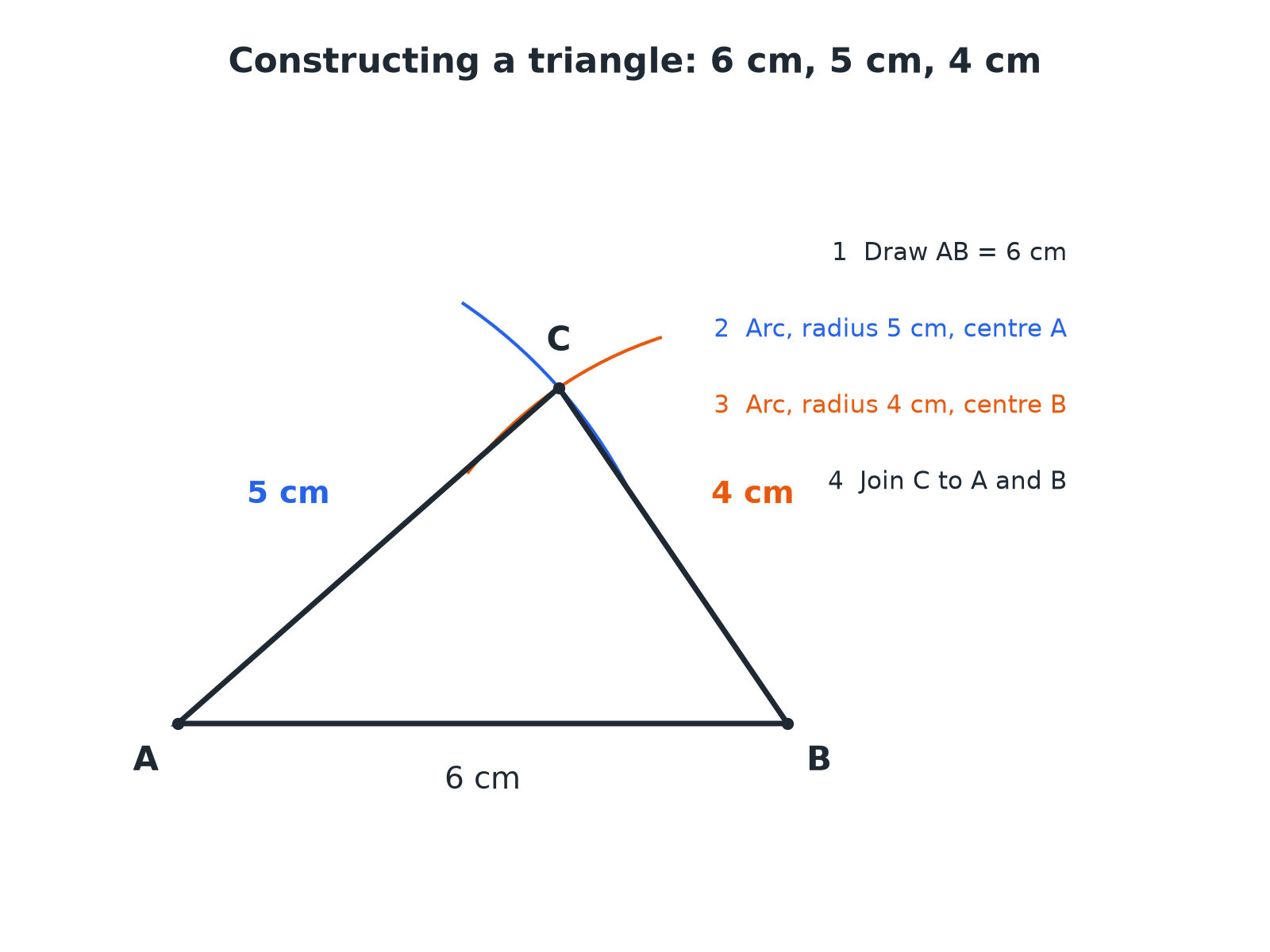
The point where the two arcs cross is the third vertex.
Constructing an SSS Triangle
For a triangle with sides 6 cm, 5 cm and 4 cm.
-
1
Draw the longest side
Measure 6 cm with a ruler and label the ends A and B.
-
2
Set the compasses to 5 cm
Put the point at A and draw an arc above the line.
-
3
Set the compasses to 4 cm
Put the point at B and draw a second arc crossing the first.
-
4
Mark C where the arcs cross
Join C to A and C to B with a ruler.
-
5
Label and check
Measure to check each side and keep the arcs.
Can the Triangle Be Made?
Can a triangle be constructed with sides 3 cm, 4 cm and 8 cm?
Show the solutionHide the solution
- 1 The two shorter sides must add up to more than the longest \(3 + 4 = 7\)
- 2 Compare with the longest side \(7 < 8\)
- 3 The arcs would not meet The two short sides cannot reach each other
AnswerNo: \(3 + 4 < 8\), so the arcs do not cross and no triangle exists.
An SAS Triangle
Construct a triangle with sides of 5 cm and 7 cm and an angle of \(40^\circ\) between them.
Show the solutionHide the solution
- 1 Draw the 7 cm side Label the ends A and B
- 2 Measure \(40^\circ\) at A Use a protractor and mark the angle
- 3 Draw a line from A through the mark Measure 5 cm along it and label C
- 4 Join B to C The triangle ABC is complete
AnswerTriangle ABC with AB = 7 cm, AC = 5 cm and angle A = \(40^\circ\).
The Perpendicular Bisector
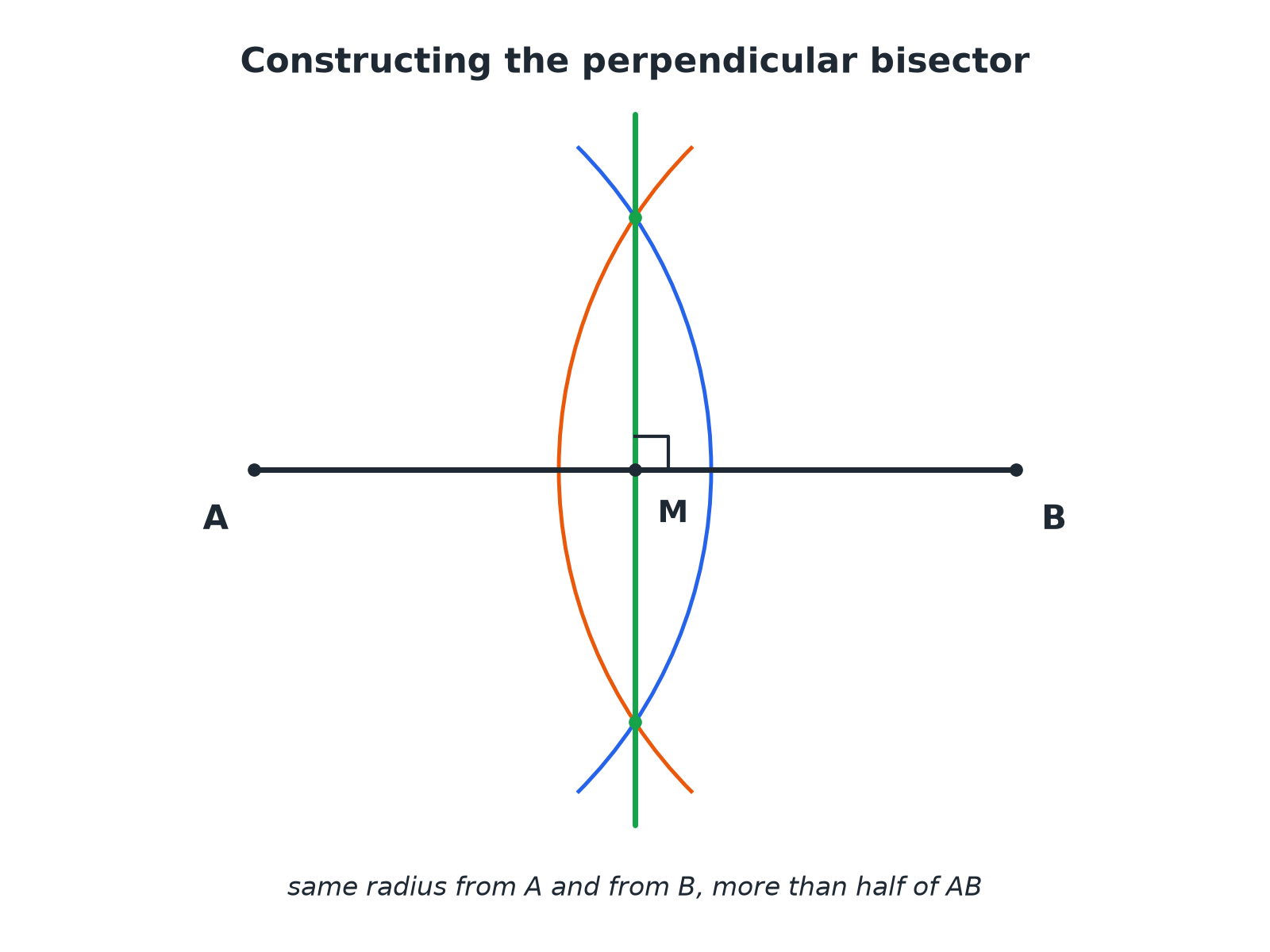
Every point on the perpendicular bisector is the same distance from A and B.
Constructing the Perpendicular Bisector
The same radius from both ends.
-
1
Open the compasses more than half of AB
Any radius bigger than half will do
-
2
Draw arcs from A above and below the line
Keep the same radius
-
3
Draw arcs from B, crossing the first arcs
Do not change the radius
-
4
Mark the two crossing points
One above and one below AB
-
5
Join the crossing points with a ruler
This line bisects AB at \(90^\circ\)
Which Construction?
SSS triangle
- You know all three sides.
- Use two arcs to find the third vertex.
- Always check the two shorter sides add to more than the longest.
SAS triangle
- You know two sides and the angle between them.
- Use a protractor for the angle.
- The third side is found by joining the ends.
Construct and Measure
Construct a triangle with sides 7 cm, 6 cm and 5 cm. Measure the three angles with a protractor and add them up. Then construct the perpendicular bisector of the 7 cm side and check it passes through the opposite vertex or not.
1. Construct with compasses.
2. Measure the angles.
3. Check the sum.
A good answer shows: The angles are about 78°, 57° and 44° (sum 180°). The perpendicular bisector of the 7 cm side does not pass through the opposite vertex because the triangle is scalene; it would only do that for an isosceles triangle with equal sides on either side.
Can I...?
- 1Draw a line of exact length.
- 2Construct an SSS triangle.
- 3Construct an SAS triangle.
- 4Use a protractor accurately.
- 5Construct a perpendicular bisector.
- 6Keep construction arcs.
- 7Test whether three lengths make a triangle.
- 8Explain each step of a construction.
Summary & Exam Focus
- SSS: draw the longest side, then two arcs.
- SAS: draw one side, measure the angle, then measure the second side.
- The perpendicular bisector cuts a segment in half at \(90^\circ\).
- Always leave your construction lines.
Exam focus
Using ruler and compasses only, construct the perpendicular bisector of the line AB. You must show all your construction lines. (2 marks) (2 marks)
Use the same compass setting from both ends, more than half of AB. Do not rub out the arcs.
Key terms
The vocabulary this lesson expects you to use. Each one is linked from the first place it appears above.
- Construct
- Draw accurately using only a ruler and compasses (a protractor when an angle is given).
- Compasses
- An instrument for drawing arcs and circles.
- Arc
- Part of the circumference of a circle.
- Bisect
- To cut exactly in half.
- Perpendicular bisector
- A line at \(90^\circ\) through the midpoint of a segment.
- Vertex
- A corner of a shape.
Questions and answers
12 questions set on this lesson, with the mark schemes and model answers open.
Using ruler and compasses only, construct a triangle with sides of length 6 cm, 5 cm and 4 cm. Show all your construction lines.
Mark scheme — 3 marks available
- A 6 cm line drawn accurately — B1
- Both arcs drawn correctly — M1
- Triangle completed and arcs shown — A1
Model answer
Draw a line of 6 cm. From one end draw an arc of radius 5 cm and from the other draw an arc of radius 4 cm, crossing above the line. Join the crossing to each end.
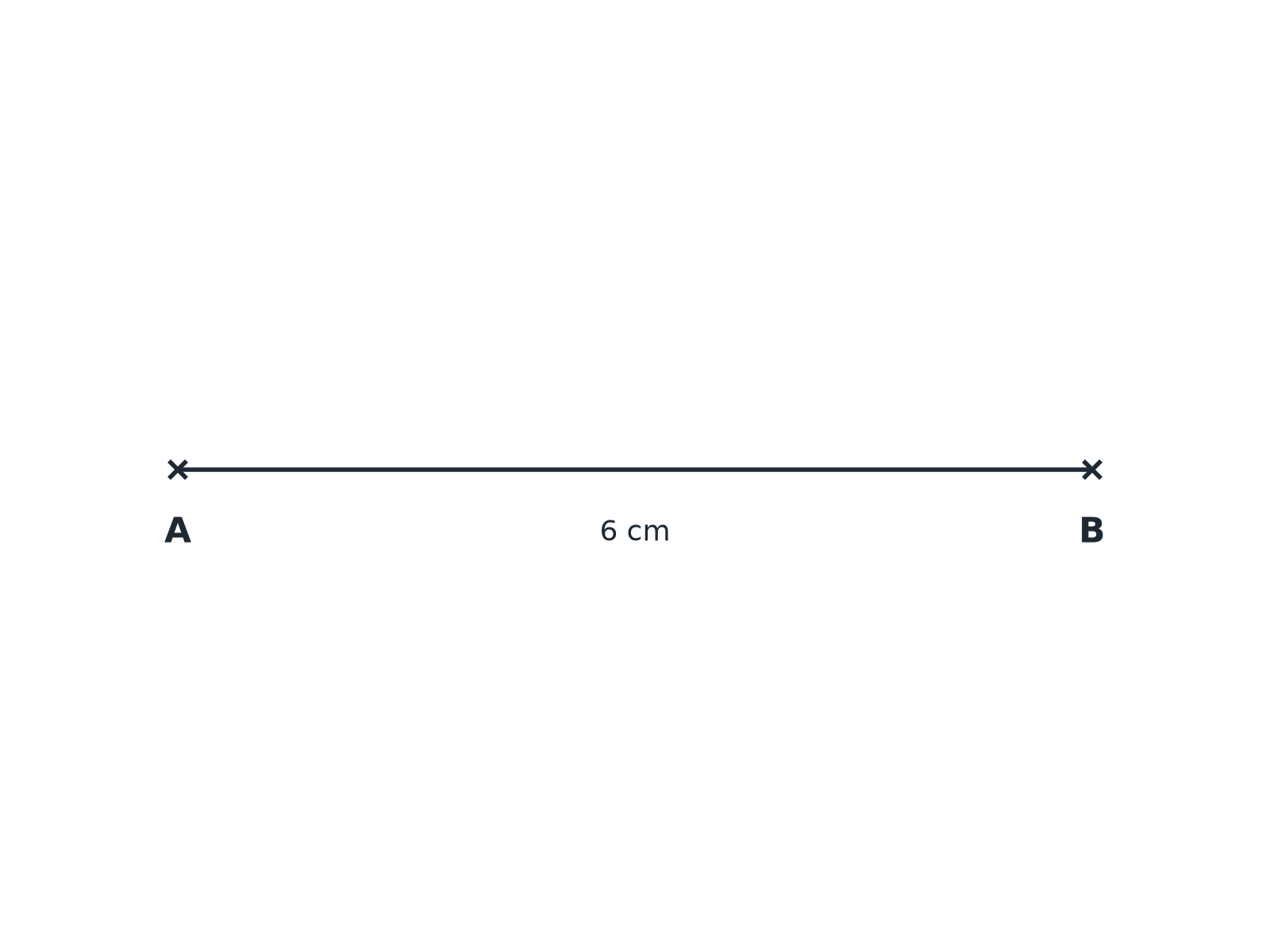
The line AB is 6 cm long. Using ruler and compasses only, construct the perpendicular bisector of the line AB. Show all your construction lines.
Mark scheme — 2 marks available
- Arcs of equal radius from A and B — M1
- Correct crossings, both sides — A1
Model answer
Equal arcs from A and B, with radius more than 3 cm, crossing above and below; a straight line through the two crossings.
Explain why it is not possible to construct a triangle with sides of length 3 cm, 4 cm and 8 cm.
Mark scheme — 2 marks available
- \(3 + 4 = 7\) — M1
- \(7 < 8\), so the arcs do not meet — C1
Model answer
The two shorter sides add up to \(3 + 4 = 7\) cm, which is less than 8 cm, so the arcs would not meet.
Construct a triangle ABC with AB = 7 cm, AC = 5 cm and angle \(BAC = 40^\circ\).
Mark scheme — 3 marks available
- AB drawn accurately — B1
- Angle of \(40^\circ\) at A — M1
- AC = 5 cm and triangle completed — A1
Model answer
Draw AB = 7 cm. Measure \(40^\circ\) at A. Mark C 5 cm from A along the line. Join B to C.
In the triangle with sides 6 cm, 5 cm and 4 cm, measure the size of the largest angle.
Mark scheme — 2 marks available
- Identifying the angle opposite the 6 cm side — M1
- 83 (within the range) — A1
Model answer
The largest angle is opposite the 6 cm side and is about \(83^\circ\) (accept \(81^\circ\) to \(85^\circ\)).
For each set of lengths, state whether a triangle can be constructed. (a) 5 cm, 6 cm, 7 cm (b) 2 cm, 3 cm, 6 cm
Mark scheme — 2 marks available
- (a) Yes — B1
- (b) No — B1
Model answer
(a) Yes, because \(5 + 6 = 11 > 7\). (b) No, because \(2 + 3 = 5 < 6\).
Which instrument draws an arc?
Why: Compasses draw arcs and circles.
The perpendicular bisector of AB meets AB at...
Why: The midpoint, at a right angle.
Should you rub out construction arcs?
Why: No: they show your method and earn marks.
Can a triangle have sides 4 cm, 4 cm and 9 cm?
Why: \(4 + 4 = 8 < 9\), so the arcs do not meet.
To construct an SAS triangle you need a...
Why: A protractor for the angle between the two sides.
Every point on the perpendicular bisector of AB is...
Why: The same distance from A and from B.