Viewing as
Teacher view: planning notes, the answers to every question, and the teacher copies of the files.
Maths · Transformations and constructions
Constructions 2
Bisect an angle, drop a perpendicular from a point to a line, and construct angles of 90°, 60° and 30° using compasses.
Teacher resources
The teacher copies: slides with the questions built in, the answers, and anything else attached to this lesson for whoever is teaching it.
- Constructions 2 - Teacher Slides.pptx Teacher The lesson slides with the teacher's notes on each slide, and every question and mark scheme built in. Built from the lesson script on 30 September 2026. View
- Constructions 2 - Teacher Notes.docx Teacher The complete notes with the teacher's notes and every model answer in full. Built from the lesson script on 30 September 2026. View
Student handouts
The same files the students see, to print or hand out.
- Constructions 2.pptx Built from the lesson script on 30 September 2026. View
- Constructions 2 - Completed Notes.docx The full notes for the lesson, to revise from. Built from the lesson script on 30 September 2026. View
- Constructions 2 - Exam Questions.docx Built from the lesson script on 30 September 2026. View
Warm-up
Answer each one, then check.
-
1
What does perpendicular mean?
Show answerHide answer
At \(90^\circ\)
-
2
What is half of \(60^\circ\)?
Show answerHide answer
\(30^\circ\)
-
3
How many degrees in each angle of an equilateral triangle?
Show answerHide answer
\(60^\circ\)
-
4
What is an angle bisector?
Show answerHide answer
A line that cuts an angle in half
-
5
What are the tools for a construction?
Show answerHide answer
Ruler, compasses (and a sharp pencil)
Learning Objectives
- 1Construct the bisector of an angle.
- 2Construct a perpendicular from a point to a line.
- 3Construct a perpendicular at a point on a line.
- 4Construct angles of \(60^\circ\), \(30^\circ\) and \(90^\circ\).
Bisecting an Angle
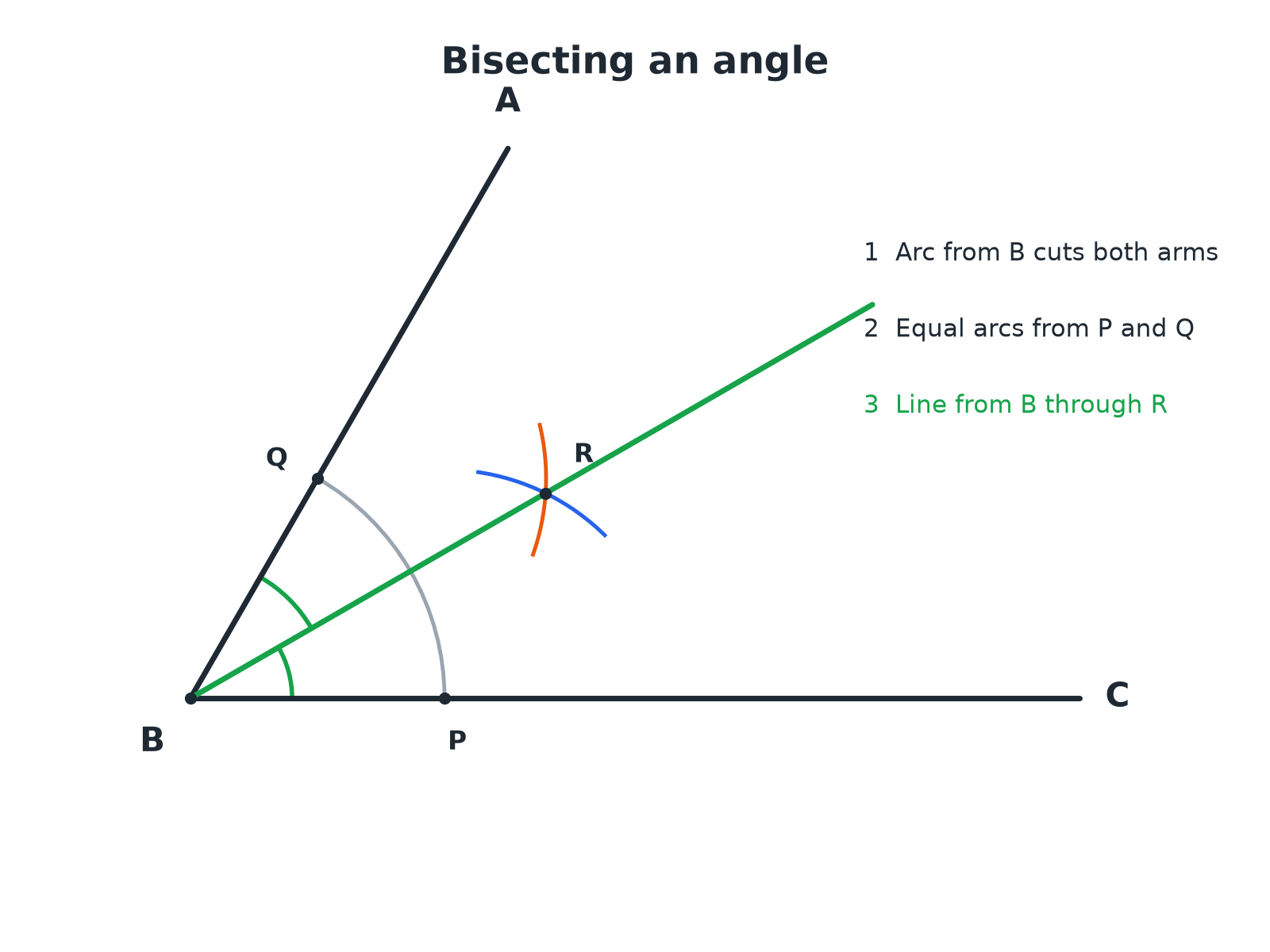
The bisector splits the angle into two equal halves.
Bisecting an Angle
Three arcs and one line.
-
1
Arc from the vertex
Centre B, cutting both arms at P and Q
-
2
Arcs from P and Q
Same radius from each; they cross at R
-
3
Draw the line BR
This is the angle bisector
-
4
Check
Measure the two halves; they should be equal
Angle Bisector Check
Angle ABC is \(70^\circ\). After bisecting it, what is the size of each half?
Show the solutionHide the solution
- 1 The bisector cuts the angle in half \(70 \div 2\)
- 2 Work out \(35\)
AnswerEach half is \(35^\circ\).
Perpendiculars
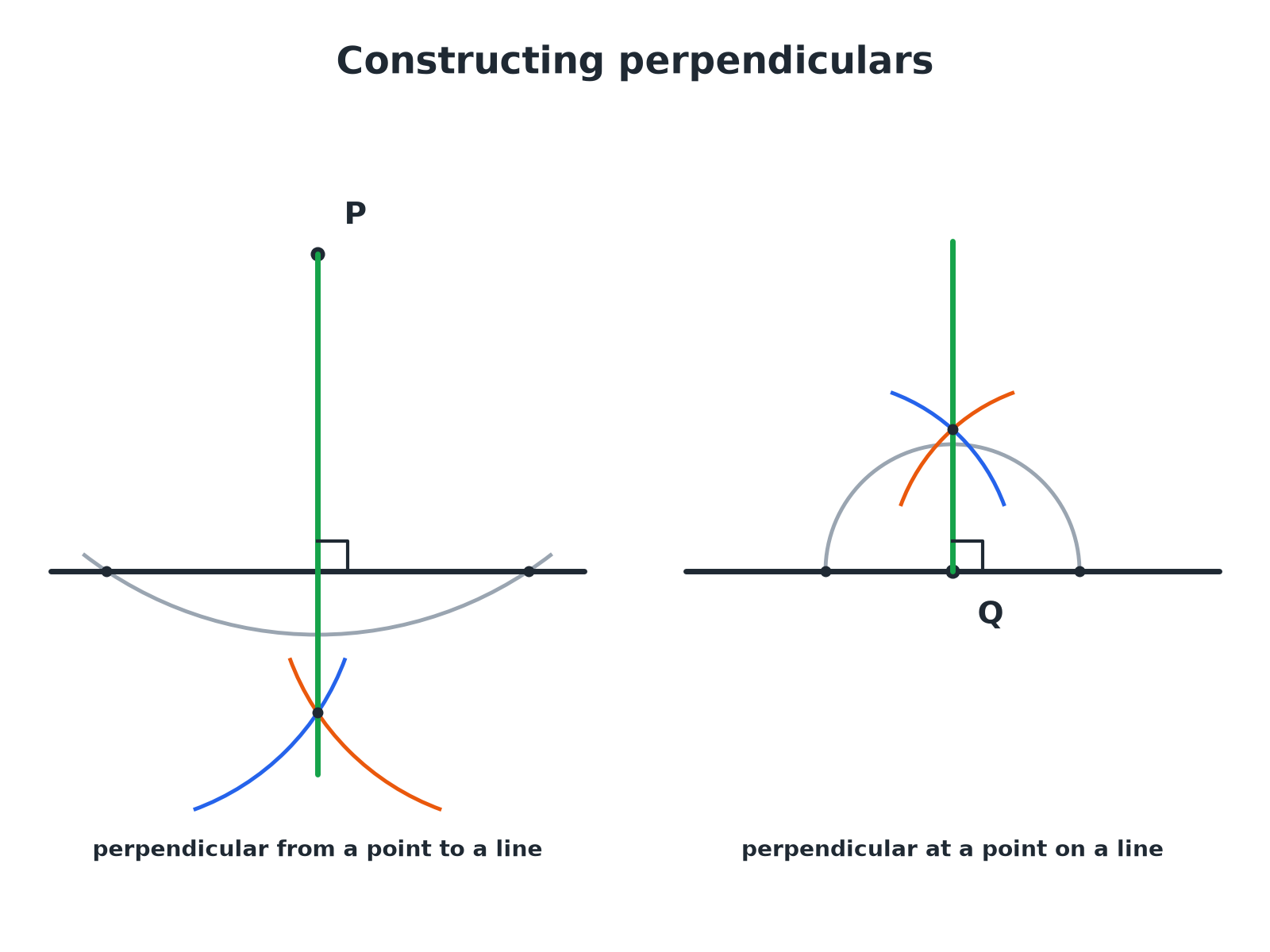
Both use the perpendicular bisector method on a pair of points.
Perpendicular from a Point to a Line
Point P is above the line.
-
1
Arc centred on P
It crosses the line at two points, X and Y
-
2
Arcs from X and Y
Same radius, crossing on the other side of the line at Z
-
3
Join P to Z
This line is perpendicular to the line
-
4
Label the right angle
Mark it with a small square
Perpendicular at a Point on a Line
Point Q is on the line.
-
1
Arc centred on Q
It crosses the line either side at U and V
-
2
Larger arcs from U and V
Same radius, crossing above the line at W
-
3
Join Q to W
This line is perpendicular to the line at Q
-
4
Check
The angle is \(90^\circ\)
Constructing 60° and 30°
Compasses can make an equilateral triangle, which gives \(60^\circ\).
-
60°
Draw an arc from A across the line at B, then an arc of the same radius from B; join A to where they cross.
-
30°
Bisect the \(60^\circ\) angle.
-
90°
Use the perpendicular construction.
-
45°
Bisect a \(90^\circ\) angle.
Build a Kite
Construct an angle of \(60^\circ\) at A. Bisect it to make \(30^\circ\). Then use the perpendicular construction to make a right angle at a point on one arm. Sketch a kite using your construction lines.
1. Make 60° with compasses.
2. Bisect it.
3. Add a 90° angle.
A good answer shows: A \(60^\circ\) angle from an equilateral construction, \(30^\circ\) from the bisector, and a \(90^\circ\) angle by the perpendicular at a point. A kite can be made from two triangles sharing the bisector.
Can I...?
- 1Bisect an angle.
- 2Drop a perpendicular from a point.
- 3Draw a perpendicular at a point on a line.
- 4Construct \(60^\circ\).
- 5Construct \(30^\circ\).
- 6Construct \(90^\circ\).
- 7Explain why the constructions work.
- 8Show all construction lines.
Summary & Exam Focus
- Angle bisector: arc, two equal arcs, join to the vertex.
- Perpendicular from a point: arc, two equal arcs, join.
- \(60^\circ\) from an equilateral triangle; halve it for \(30^\circ\).
- Keep all construction arcs.
Exam focus
Using ruler and compasses only, construct the bisector of angle ABC. You must show all your construction lines. (2 marks) (2 marks)
Start with an arc centred on the vertex, then use equal arcs from the two points where it crosses the arms.
Key terms
The vocabulary this lesson expects you to use. Each one is linked from the first place it appears above.
- Angle bisector
- A line that cuts an angle exactly in half.
- Perpendicular
- At \(90^\circ\) to a line.
- Arc
- Part of a circle's circumference.
- Equidistant
- The same distance from two things.
- Construction lines
- The arcs and lines you leave to show your method.
- Vertex
- The point where the arms of an angle meet.
Questions and answers
12 questions set on this lesson, with the mark schemes and model answers open.
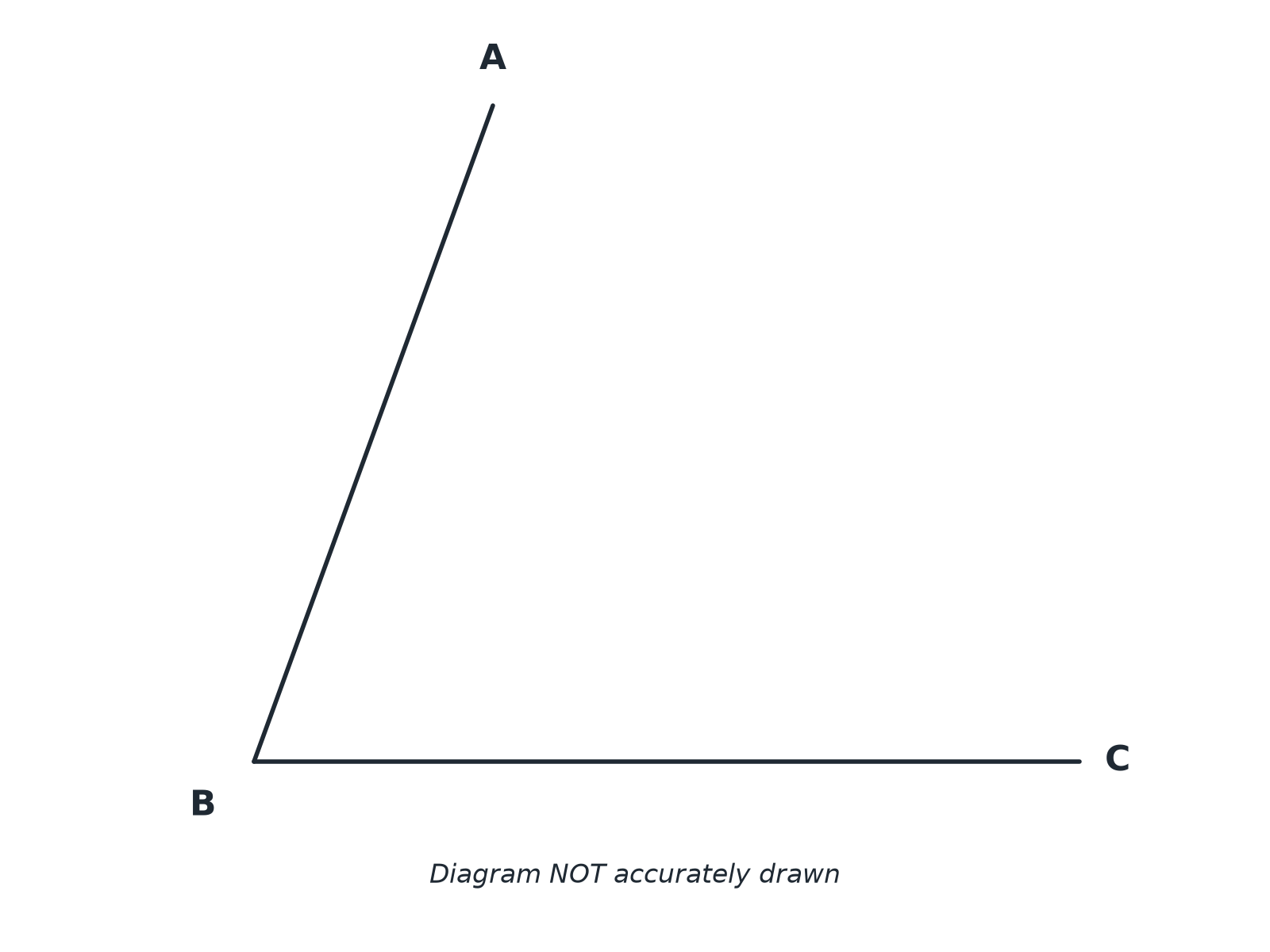
The diagram shows an angle ABC. Using ruler and compasses only, construct the bisector of angle ABC. Show all your construction lines.
Mark scheme — 2 marks available
- Arcs from B and from the two crossing points — M1
- A correct bisector with arcs shown — A1
Model answer
An arc from B crossing both arms, two equal arcs from those points crossing inside the angle, and a line from B through the crossing.
Point P is 4 cm above a horizontal line. Using ruler and compasses only, construct the perpendicular from P to the line. Show all your construction lines.
Mark scheme — 3 marks available
- Arc from P crossing the line twice — M1
- Equal arcs from the two points — M1
- A correct perpendicular — A1
Model answer
An arc centred on P cutting the line twice; equal arcs from those two points crossing below the line; a line from P to the crossing.
Using ruler and compasses only, construct an angle of \(60^\circ\) at the end A of a line AB.
Mark scheme — 3 marks available
- Arc centred on A — M1
- Second arc with the same radius — M1
- Line completed and angle correct — A1
Model answer
An arc centred on A crossing AB; the same radius centred on that crossing; a line from A through the crossing of the arcs.
Using ruler and compasses only, construct an angle of \(30^\circ\) at the end A of a line AB.
Mark scheme — 3 marks available
- \(60^\circ\) constructed — M1
- Bisector constructed — M1
- Angle of \(30^\circ\) — A1
Model answer
Construct \(60^\circ\) at A, then bisect it to make \(30^\circ\).
Q is a point on a straight line. Using ruler and compasses only, construct the perpendicular to the line at Q.
Mark scheme — 3 marks available
- Arc centred on Q — M1
- Equal arcs from both points — M1
- Correct perpendicular — A1
Model answer
An arc centred on Q cutting the line on both sides; equal larger arcs from those points crossing above; a line from Q through the crossing.
Explain why the line through the crossing arcs is the bisector of the angle in the angle bisector construction.
Mark scheme — 2 marks available
- Equal distances used — M1
- Congruent triangles or kite symmetry — C1
Model answer
The point where the arcs cross is the same distance from the two points on the arms, and both points are the same distance from the vertex, so the two triangles are congruent (a kite) and the angles are equal.
What does an angle bisector do?
Why: It cuts the angle exactly in half.
A bisected angle of 84° gives two angles of...
Why: \(84 \div 2 = 42\).
Which angle can be constructed directly with compasses?
Why: \(60^\circ\), from an equilateral triangle.
How do you construct 30°?
Why: Construct 60° and bisect it.
In a perpendicular construction, the angle formed is...
Why: A right angle: 90°.
Bisecting a 90° angle gives...
Why: \(90 \div 2 = 45\).