Viewing as
Teaching this? The teacher view adds 2 files, the mark schemes and the model answers.
Maths · Equations and graphs
Cubic equations
Draw and recognise cubic graphs, find their roots and turning points, and use a graph to estimate solutions of cubic equations.
Warm-up
Answer each one, then check.
-
1
Work out \((-2)^3\).
Show answerHide answer
\(-8\)
-
2
Factorise \(x^2 - 4\).
Show answerHide answer
\((x - 2)(x + 2)\)
-
3
Work out \(2^3 - 4 \times 2\).
Show answerHide answer
\(0\)
-
4
What is a root of a graph?
Show answerHide answer
Where \(y = 0\)
-
5
What shape is \(y = x^2\)?
Show answerHide answer
A parabola
Learning Objectives
CUBIC GRAPH
A cubic graph has an \(x^3\) term and a smooth S-shaped curve. It can cross the x-axis up to three times.
With a positive \(x^3\) term the curve rises from bottom left to top right.
A Cubic Graph
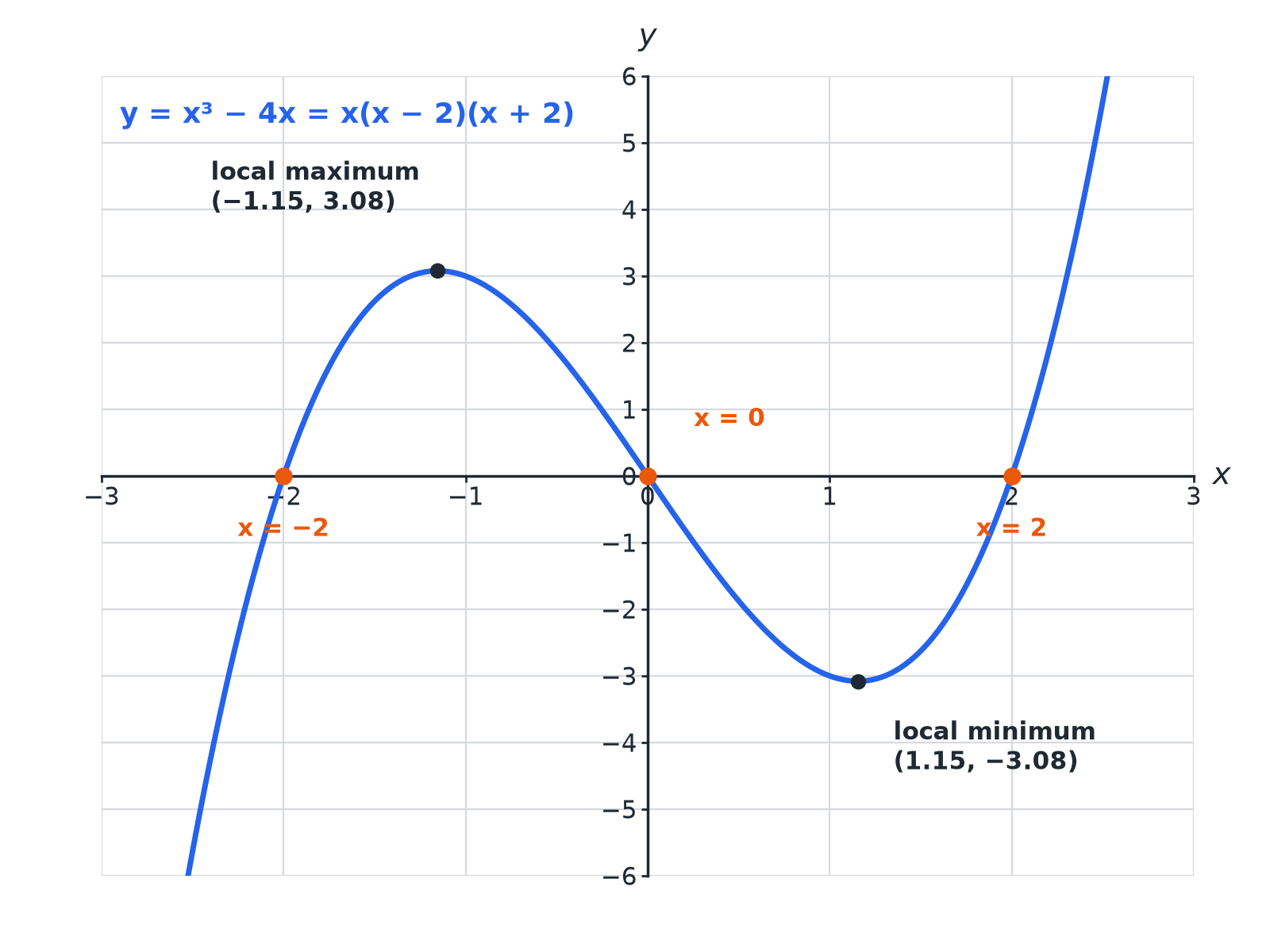
Three roots, one maximum and one minimum.
Table of Values
\(y = x^3 - 4x\).
-
\(y\)
\(-3\): \(-15\). \(-2\): \(0\). \(-1\): \(3\). \(0\): \(0\) | \(-3\) | \(0\) | \(15\)
Roots of a Cubic
Find the roots of \(y = x^3 - 4x\).
Show the solutionHide the solution
- 1 Set \(y = 0\) \(x^3 - 4x = 0\)
- 2 Factorise \(x(x^2 - 4) = x(x - 2)(x + 2)\)
- 3 Solve \(x = 0,\ 2,\ -2\)
AnswerThe roots are \(x = -2\), \(0\) and \(2\).
Solving a Cubic from the Graph
Use the graph of \(y = x^3 - 4x\) to solve \(x^3 - 4x = 1\).
Show the solutionHide the solution
- 1 Draw The line \(y = 1\)
- 2 Read the three intersections \(x \approx -1.9\), \(-0.3\) and \(2.1\)
- 3 Check \(2.1^3 - 4 \times 2.1 = 0.861\), close to 1
Answer\(x \approx -1.9\), \(x \approx -0.3\) and \(x \approx 2.1\)
How Many Solutions?
How many solutions does \(x^3 - 4x = 5\) have?
Show the solutionHide the solution
- 1 Local maximum About 3.1, below 5
- 2 The line \(y = 5\) Meets the curve once, on the right
AnswerOne solution.
Common Mistakes
Draw carefully.
-
Sharp corners
The curve is smooth: no straight segments or points.
-
Negative values
Cube negatives carefully: \((-2)^3 = -8\).
-
Missing solutions
A cubic can have up to three solutions.
-
Turning point values
Read them from the graph or a fine table.
Cubic Table
Complete a table for \(y = x^3 - 3x\) for \(x = -2\) to \(2\). Sketch the graph. How many roots does it have?
1. Cube each x carefully.
2. Join with a smooth curve.
A good answer shows: \(y = -2, 2, 0, -2, 2\). The curve crosses the x-axis at \(x = -\sqrt{3}, 0, \sqrt{3}\): three roots.
Can I...?
- 1Recognise a cubic graph.
- 2Complete a table.
- 3Draw a smooth curve.
- 4Find roots.
- 5Identify turning points.
- 6Draw a line to solve an equation.
- 7Count the solutions.
- 8Avoid common mistakes.
Summary & Exam Focus
- A cubic has an \(x^3\) term.
- It can have up to three roots and two turning points.
- Solve \(f(x) = k\) with the line \(y = k\).
- Factorise to find exact roots.
Exam focus
Use the graph of \(y = x^3 - 4x\) to find estimates for the solutions of \(x^3 - 4x = 1\). (3 marks) (3 marks)
Draw the horizontal line \(y = 1\) and read all three intersections.
Key terms
The vocabulary this lesson expects you to use. Each one is linked from the first place it appears above.
- Cubic
- An expression or equation with a highest power of \(x^3\).
- Root
- A solution of \(f(x) = 0\).
- Local maximum
- A turning point at the top of a hill.
- Local minimum
- A turning point at the bottom of a valley.
- Intersection
- Where two graphs meet.
- Estimate
- An approximate value from a graph.
Practice questions
Have a go at each one before you open its answer.
-
Question 1 Complete the table 2 marks
Complete the table of values for \(y = x^3 - 4x\) for \(x = -3, -2, -1, 0, 1, 2, 3\).
Show answerHide answer
Model answer
\(y = -15, 0, 3, 0, -3, 0, 15\)
Mark scheme
- At least 4 correct — M1
- All correct — A1
-
Question 2 Use the graph 3 marks
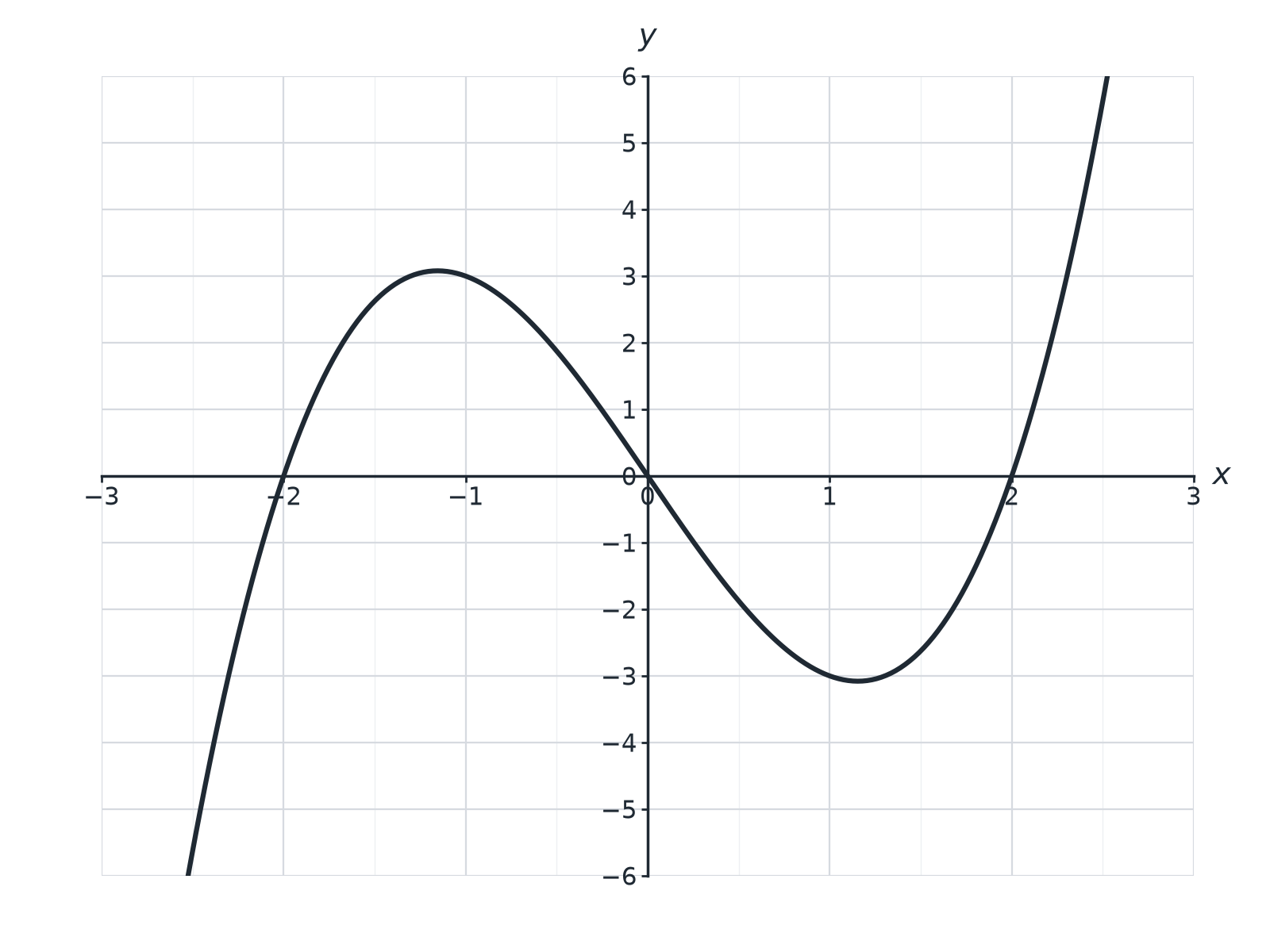
The graph of \(y = x^3 - 4x\) is drawn on the grid. Use the graph to find estimates for the solutions of \(x^3 - 4x = 1\).
Show answerHide answer
Model answer
Draw \(y = 1\). Solutions \(x \approx -1.9\), \(-0.3\) and \(2.1\). Accept \(-2.0\) to \(-1.8\), \(-0.4\) to \(-0.2\) and \(2.0\) to \(2.2\).
Mark scheme
- Draws \(y = 1\) — M1
- Two correct estimates — A1
- All three — A1
-
Question 3 Solve 3 marks
Factorise \(x^3 - 4x\) and hence solve \(x^3 - 4x = 0\).
Show answerHide answer
Model answer
\(x(x - 2)(x + 2) = 0\), so \(x = 0\), \(x = 2\) or \(x = -2\).
Mark scheme
- \(x(x^2 - 4)\) — M1
- \(x(x - 2)(x + 2)\) — A1
- Three solutions — A1
-
Question 4 Explain 2 marks
Use the graph to explain why \(x^3 - 4x = 5\) has only one solution.
Show answerHide answer
Model answer
The line \(y = 5\) is above the local maximum of the curve (about 3.1), so it meets the curve only once, on the right.
Mark scheme
- Line \(y = 5\) is above the maximum — M1
- Only one intersection — C1
-
Question 5 Work out 2 marks
Work out the value of \(x^3 - 4x\) when \(x = 1.2\).
Show answerHide answer
Model answer
\(1.728 - 4.8 = -3.072\)
Mark scheme
- \(1.2^3 = 1.728\) — M1
- \(-3.072\) — A1
-
Question 6 Describe 2 marks
Describe the shape of the graph of \(y = x^3\) and write down its root.
Show answerHide answer
Model answer
A smooth S-shaped curve rising from bottom left to top right through the origin; the root is \(x = 0\).
Mark scheme
- S-shaped curve — B1
- \(x = 0\) — B1
Quick check
-
A cubic graph can cross the x-axis...
Show answerHide answer
D: Up to three times
Up to three times.
-
\((-2)^3 =\)
Show answerHide answer
A: \(-8\)
\(-2 \times -2 \times -2 = -8\).
-
\(x^3 - 4x\) factorises to...
Show answerHide answer
C: \(x(x - 2)(x + 2)\)
\(x(x - 2)(x + 2)\).
-
To solve \(x^3 - 4x = 1\) with the graph, draw...
Show answerHide answer
B: \(y = 1\)
The line \(y = 1\).
-
Between roots of a cubic there is...
Show answerHide answer
A: A turning point
A turning point.
-
The graph of \(y = x^3\) passes through...
Show answerHide answer
C: \((0, 0)\)
The origin, and rises from bottom left to top right.
Downloads
Free to keep, print and annotate.
- Cubic equations.pptx Built from the lesson script on 30 September 2026. View
- Cubic equations - Completed Notes.docx The full notes for the lesson, to revise from. Built from the lesson script on 30 September 2026. View
- Cubic equations - Exam Questions.docx Built from the lesson script on 30 September 2026. View
Something here looks wrong?
Tell us what and we will go and look. It goes to whoever writes these pages, nobody else, and we do not ask who you are — so there is nothing to sign and nothing comes back to you.