Viewing as
Teaching this? The teacher view adds 2 files, the mark schemes and the model answers.
Maths · Multiplicative reasoning
More compound measures
Work with rates, population density, flow rates and average speeds for multi-stage journeys, and convert between compound units.
Warm-up
Answer each one, then check.
-
1
Change 2.5 hours into hours and minutes.
Show answerHide answer
2 h 30 min
-
2
What is density?
Show answerHide answer
Mass divided by volume
-
3
Work out \(60 \div 1.5\).
Show answerHide answer
40
-
4
Work out \(60 \div 60\).
Show answerHide answer
1
-
5
How many litres in 1 m³?
Show answerHide answer
1000
Learning Objectives
- 1Use rates such as population density and flow rate.
- 2Work out average speed for a journey in stages.
- 3Convert compound units, including density.
- 4Solve multi-step problems with compound measures.
Everyday Compound Measures
-
Population density
\(\dfrac{\text{population}}{\text{area}}\), for example people per km².
-
Rate of flow
\(\dfrac{\text{volume}}{\text{time}}\), for example litres per minute.
-
Unit price
\(\dfrac{\text{cost}}{\text{quantity}}\), for example £ per kg.
-
Average speed
\(\dfrac{\text{total distance}}{\text{total time}}\).
Population Density
A town has 60 000 people and an area of 25 km². Find its population density.
Show the solutionHide the solution
- 1 Density \(= \dfrac{\text{population}}{\text{area}}\) \(\dfrac{60\,000}{25}\)
- 2 Work it out 2400
Answer2400 people per km²
Rate of Flow
A tank holds 1200 litres. Water runs into it at 15 litres per minute. How long does it take to fill, in hours and minutes?
Show the solutionHide the solution
- 1 Time \(= \dfrac{\text{volume}}{\text{rate}}\) \(\dfrac{1200}{15}\)
- 2 Work it out 80 minutes
- 3 Convert 1 hour 20 minutes
Answer1 hour 20 minutes
A Two-Stage Journey
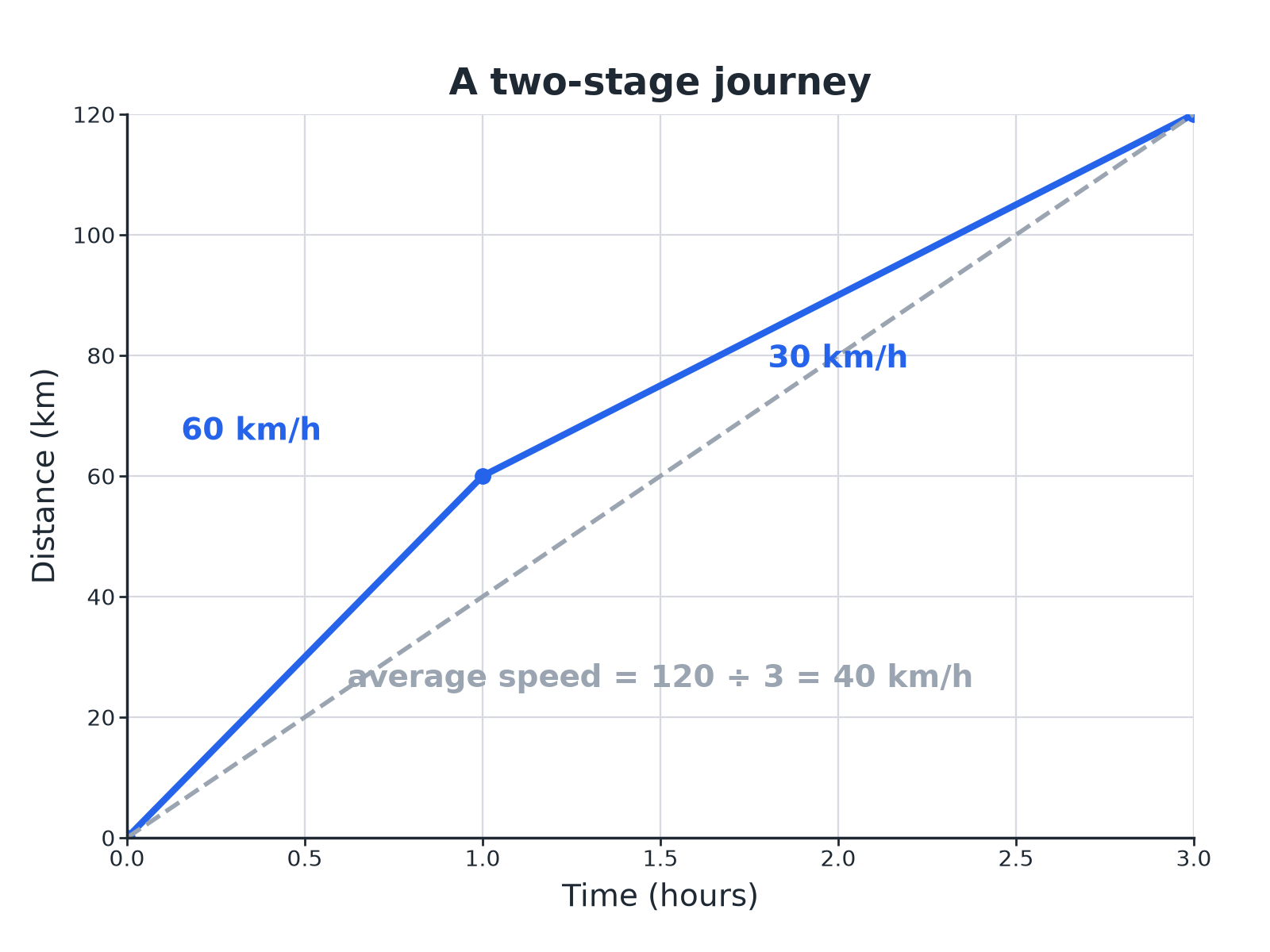
Average speed uses the whole distance and the whole time.
Average Speed in Two Stages
A car travels 60 km at 40 km/h and then 60 km at 60 km/h. Find its average speed for the whole journey.
Show the solutionHide the solution
- 1 Time for stage 1 \(60 \div 40 = 1.5\) hours
- 2 Time for stage 2 \(60 \div 60 = 1\) hour
- 3 Total distance and time \(120\) km in \(2.5\) hours
- 4 Average speed \(120 \div 2.5 = 48\)
Answer48 km/h (not 50 km/h)
Converting Density
Steel has density 7.8 g/cm³. Write this in kg/m³.
Show the solutionHide the solution
- 1 1 g is 0.001 kg and 1 cm³ is 0.000 001 m³ \(1\) g/cm³ \(= \dfrac{0.001}{0.000\,001}\) kg/m³
- 2 Simplify \(1\) g/cm³ \(= 1000\) kg/m³
- 3 Multiply \(7.8 \times 1000\)
Answer7800 kg/m³
Converting Speed the Other Way
A cyclist rides at 15 m/s. Find her speed in km/h.
Show the solutionHide the solution
- 1 15 m per second in 1 hour \(15 \times 3600 = 54\,000\) m
- 2 Change to km \(54\,000 \div 1000\)
Answer54 km/h
Handy Conversions
Learn or work these out.
-
m/s
To: km/h. Rule: Multiply by 3.6
-
km/h
To: m/s. Rule: Divide by 3.6
-
g/cm³
To: kg/m³. Rule: Multiply by 1000
-
cm²
To: m². Rule: Divide by 10 000
-
litres
To: cm³. Rule: Multiply by 1000
Best Journey
Ali drives 90 km at 60 km/h and then 90 km at 90 km/h. Ben drives the whole 180 km at 72 km/h. Who has the higher average speed, and by how much?
1. Find each time.
2. Total distance over total time.
3. Compare.
A good answer shows: Ali: times 1.5 h and 1 h, so 2.5 h for 180 km: 72 km/h. Ben: 72 km/h. They have the same average speed, even though Ali's speeds average to 75 km/h.
Can I...?
- 1Work out population density.
- 2Work out a rate of flow.
- 3Find average speed for a whole journey.
- 4Avoid averaging the speeds.
- 5Convert m/s to km/h.
- 6Convert g/cm³ to kg/m³.
- 7Use unit prices.
- 8Show clear working.
Summary & Exam Focus
- Average speed \(=\) total distance \(\div\) total time.
- Density, pressure and flow rate are all "one thing per another".
- Convert units before dividing.
- m/s to km/h: multiply by 3.6.
Exam focus
A car travels 60 km at 40 km/h and then 60 km at 60 km/h. Work out its average speed for the whole journey. (4 marks) (4 marks)
Find the time for each stage, then divide the total distance by the total time. The answer is not the average of the two speeds.
Key terms
The vocabulary this lesson expects you to use. Each one is linked from the first place it appears above.
- Rate
- A quantity compared with another, such as litres per minute.
- Population density
- The number of people per unit of area.
- Average speed
- Total distance divided by total time.
- Flow rate
- The volume passing a point per unit of time.
- Unit price
- The cost of one unit of a product.
- Conversion
- Changing from one unit to another.
Practice questions
Have a go at each one before you open its answer.
-
Question 1 Calculator 3 marks
A town has a population of 60 000 and an area of 25 km². Work out the population density of the town in people per km².
Show answerHide answer
Model answer
\(60\,000 \div 25 = 2400\) people per km².
Mark scheme
- \(60\,000 \div 25\) — M1
- 2400 — A1
- Units — B1
-
Question 2 Non-calculator 2 marks
A cyclist travels at 15 metres per second. Work out her speed in kilometres per hour.
Show answerHide answer
Model answer
\(15 \times 3600 \div 1000 = 54\) km/h.
Mark scheme
- \(15 \times 3600\) or \(15 \times 3.6\) — M1
- 54 — A1
-
Question 3 Calculator 3 marks
A tank holds 1200 litres of water. Water runs into the tank at 15 litres per minute. Work out how long the tank takes to fill. Give your answer in hours and minutes.
Show answerHide answer
Model answer
\(1200 \div 15 = 80\) minutes, which is 1 hour 20 minutes.
Mark scheme
- \(1200 \div 15\) — M1
- 80 minutes — A1
- 1 hour 20 minutes — A1
-
Question 4 Calculator 4 marks
A car travels 60 km at 40 km/h and then 60 km at 60 km/h. Work out the average speed of the car for the whole journey.
Show answerHide answer
Model answer
The times are \(60 \div 40 = 1.5\) hours and \(60 \div 60 = 1\) hour. The total is 120 km in 2.5 hours, so the average speed is \(120 \div 2.5 = 48\) km/h.
Mark scheme
- \(60 \div 40\) — M1
- Total time 2.5 hours — M1
- \(120 \div 2.5\) — M1
- 48 — A1
-
Question 5 Calculator 4 marks
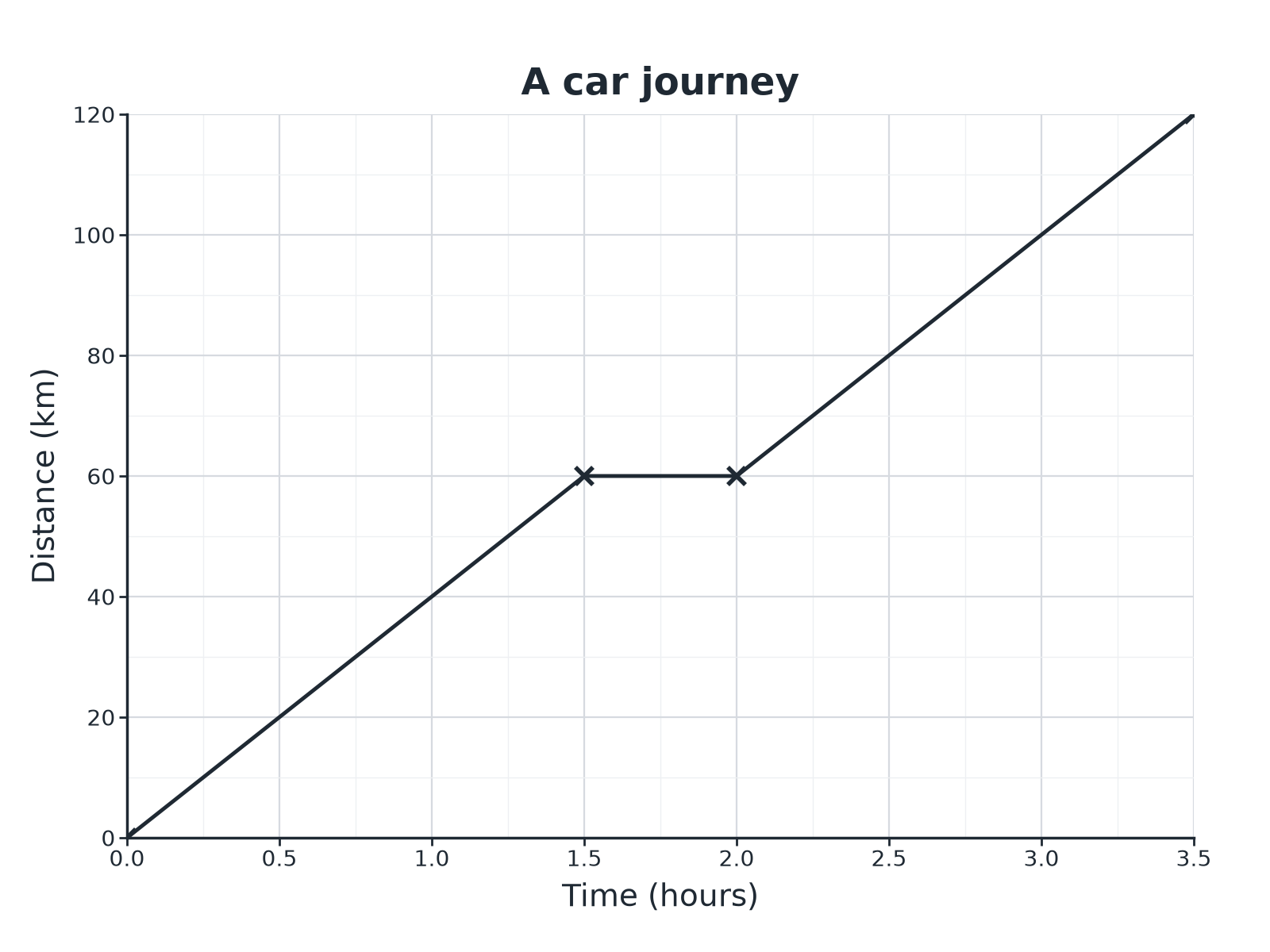
The distance-time graph shows a car journey. (a) Work out the speed of the car during the last part of the journey. (b) Work out the average speed for the whole journey.
Show answerHide answer
Model answer
(a) \(60 \div 1.5 = 40\) km/h. (b) The total is 120 km in 3.5 hours, so \(120 \div 3.5 = 34.3\) km/h.
Mark scheme
- (a) \(60 \div 1.5\) — M1
- (a) 40 — A1
- (b) \(120 \div 3.5\) — M1
- (b) 34.3 — A1
-
Question 6 Non-calculator 2 marks
Steel has a density of 7.8 g/cm³. Write this density in kg/m³.
Show answerHide answer
Model answer
\(7.8 \times 1000 = 7800\) kg/m³.
Mark scheme
- \(7.8 \times 1000\) — M1
- 7800 — A1
Quick check
-
A city has 500 000 people in 250 km². What is the population density?
Show answerHide answer
B: 2000 people per km²
\(500\,000 \div 250 = 2000\) people per km².
-
Convert 20 m/s to km/h.
Show answerHide answer
C: 72 km/h
\(20 \times 3.6 = 72\).
-
A tap fills 5 litres per minute. How long to fill 60 litres?
Show answerHide answer
A: 12 minutes
\(60 \div 5 = 12\) minutes.
-
You drive 100 km at 50 km/h and 100 km at 100 km/h. Your average speed is...
Show answerHide answer
D: 66.7 km/h
200 km in \(2 + 1 = 3\) hours is 66.7 km/h, not 75.
-
How many g/cm³ is 8000 kg/m³?
Show answerHide answer
B: 8 g/cm³
Divide by 1000: 8 g/cm³.
-
A cat food costs £1.20 for 400 g. What is the price per kg?
Show answerHide answer
C: £3.00
1 kg is 2.5 times 400 g, so \(1.20 \times 2.5 = £3.00\).
Downloads
Free to keep, print and annotate.
- More compound measures.pptx Built from the lesson script on 30 September 2026. View
- More compound measures - Completed Notes.docx The full notes for the lesson, to revise from. Built from the lesson script on 30 September 2026. View
- More compound measures - Exam Questions.docx Built from the lesson script on 30 September 2026. View
Something here looks wrong?
Tell us what and we will go and look. It goes to whoever writes these pages, nobody else, and we do not ask who you are — so there is nothing to sign and nothing comes back to you.