Viewing as
Teacher view: planning notes, the answers to every question, and the teacher copies of the files.
Maths · Similarity and congruence
More similarity
Use similar triangles formed by parallel lines, and use the fact that areas of similar shapes scale by the square of the length scale factor.
Teacher resources
The teacher copies: slides with the questions built in, the answers, and anything else attached to this lesson for whoever is teaching it.
- More similarity - Teacher Slides.pptx Teacher The lesson slides with the teacher's notes on each slide, and every question and mark scheme built in. Built from the lesson script on 30 September 2026. View
- More similarity - Teacher Notes.docx Teacher The complete notes with the teacher's notes and every model answer in full. Built from the lesson script on 30 September 2026. View
Student handouts
The same files the students see, to print or hand out.
- More similarity.pptx Built from the lesson script on 30 September 2026. View
- More similarity - Completed Notes.docx The full notes for the lesson, to revise from. Built from the lesson script on 30 September 2026. View
- More similarity - Exam Questions.docx Built from the lesson script on 30 September 2026. View
Warm-up
Answer each one, then check.
-
1
What is the scale factor from 6 to 9?
Show answerHide answer
1.5
-
2
Work out \(1.5^2\).
Show answerHide answer
2.25
-
3
What do corresponding angles on parallel lines do?
Show answerHide answer
They are equal
-
4
Work out \(\sqrt{\dfrac{27}{12}}\).
Show answerHide answer
1.5
-
5
If \(k = 3\), what is \(k^2\)?
Show answerHide answer
9
Learning Objectives
- 1Find similar triangles created by parallel lines.
- 2Find missing lengths using scale factors.
- 3Use the area scale factor \(k^2\).
- 4Work backwards from an area ratio to a length ratio.
A Triangle Cut by a Parallel Line
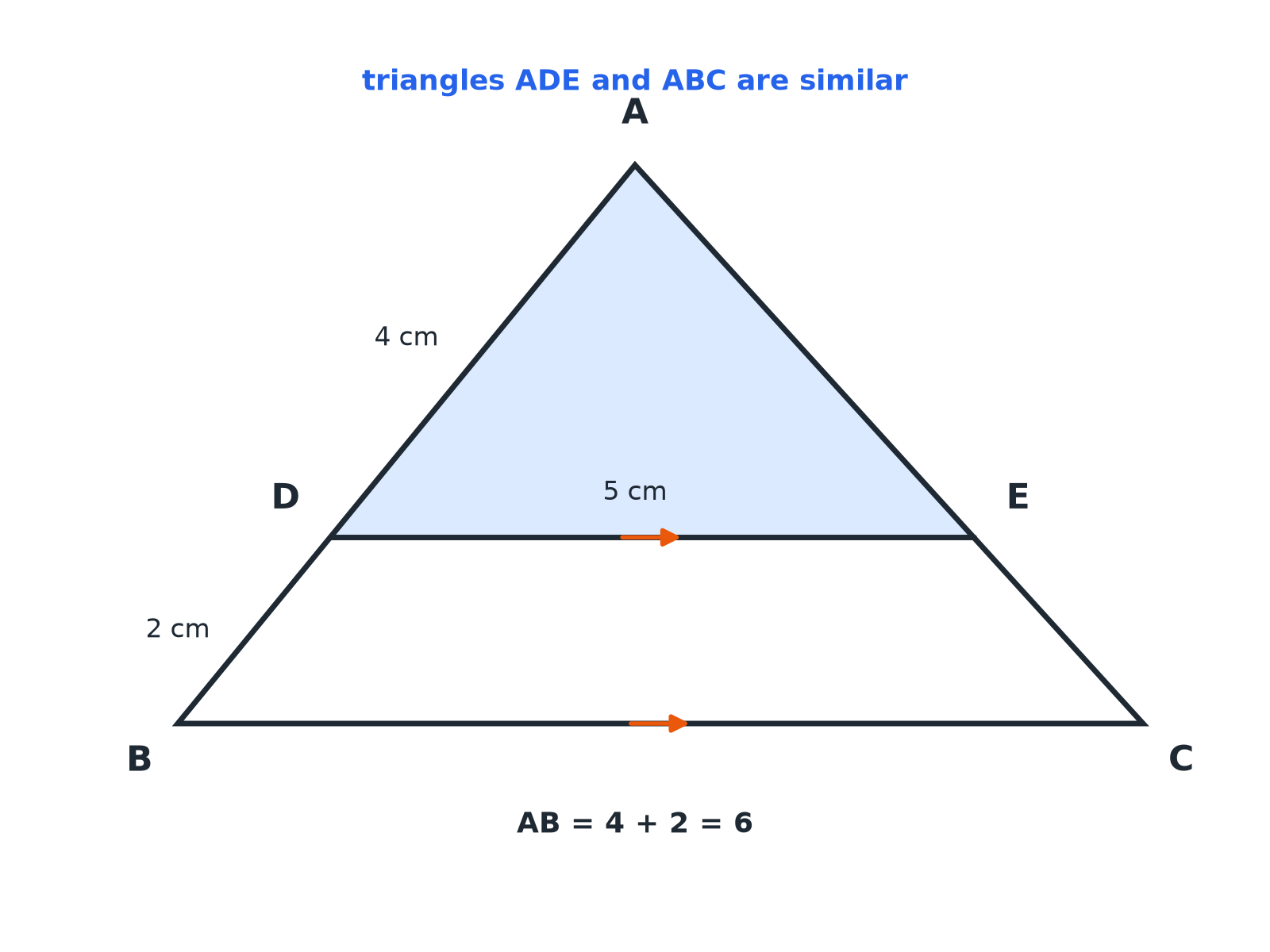
A line parallel to one side of a triangle makes a smaller similar triangle.
PARALLEL LINES
If DE is parallel to BC, then triangle ADE is similar to triangle ABC.
The corresponding angles are equal, and the angle at A is common.
Finding a Length
In triangle ABC, DE is parallel to BC. \(AD = 4\) cm, \(DB = 2\) cm and \(DE = 5\) cm. Find \(BC\).
Show the solutionHide the solution
- 1 \(AB = AD + DB\) \(4 + 2 = 6\)
- 2 Scale factor from ADE to ABC \(\dfrac{6}{4} = 1.5\)
- 3 \(BC = DE \times 1.5\) \(5 \times 1.5\)
Answer\(BC = 7.5\) cm
Watch the Sides
The whole side, not just the piece, is the corresponding length.
-
Use AB, not DB
The similar triangles are ADE and ABC, so AD corresponds to AB.
-
Add the parts
\(AB = AD + DB\).
-
Label the two triangles
Write them in matching order: ADE and ABC.
AREA SCALE FACTOR
If two shapes are similar with length scale factor \(k\), their areas are in the ratio \(1 : k^2\).
Doubling all lengths multiplies the area by 4; tripling multiplies it by 9.
Finding an Area
Two similar rectangles have lengths 12 cm and 18 cm. The area of the smaller is 40 cm². Find the area of the larger.
Show the solutionHide the solution
- 1 Length scale factor \(\dfrac{18}{12} = 1.5\)
- 2 Area scale factor \(1.5^2 = 2.25\)
- 3 Area of the larger \(40 \times 2.25\)
Answer90 cm²
From Areas to Lengths
Two similar triangles have areas 12 cm² and 27 cm². Find the ratio of their lengths in its simplest form.
Show the solutionHide the solution
- 1 Ratio of areas \(12 : 27 = 4 : 9\)
- 2 Take the square root \(\sqrt{4} : \sqrt{9} = 2 : 3\)
AnswerThe ratio of the lengths is \(2 : 3\).
Scale Factors
For similar shapes with length scale factor \(k\).
-
Lengths
Scale factor: \(k\). Example, \(k = 3\): 3
-
Areas
Scale factor: \(k^2\). Example, \(k = 3\): 9
-
Volumes
Scale factor: \(k^3\). Example, \(k = 3\): 27
Shadows and Similar Triangles
A 1.5 m post casts a shadow of 2 m at the same time as a tree casts a shadow of 12 m. Draw two similar right-angled triangles and find the height of the tree. If the post's triangle has area 1.5 m², find the area of the tree's triangle.
1. Draw both triangles.
2. Find the length scale factor.
3. Square it for area.
A good answer shows: Scale factor \(12 \div 2 = 6\), so the tree is \(1.5 \times 6 = 9\) m tall. The area scale factor is \(6^2 = 36\), so the area is \(1.5 \times 36 = 54\) m².
Can I...?
- 1Spot similar triangles from parallel lines.
- 2Use the whole side, not part of it.
- 3Find a missing length.
- 4Use \(k^2\) for areas.
- 5Find an area from a length ratio.
- 6Find a length ratio from an area ratio.
- 7Write the ratio in simplest form.
- 8Explain my reasoning.
Summary & Exam Focus
- A line parallel to a side makes a similar triangle.
- Match corresponding sides in the same order.
- Area scale factor \(= k^2\).
- Take a square root to go from area ratio to length ratio.
Exam focus
In triangle ABC, DE is parallel to BC. \(AD = 4\) cm, \(DB = 2\) cm and \(DE = 5\) cm. Work out the length of BC. (3 marks) (3 marks)
The similar triangles are ADE and ABC. Use AB \(=\) AD \(+\) DB in the scale factor, not DB alone.
Key terms
The vocabulary this lesson expects you to use. Each one is linked from the first place it appears above.
- Similar triangles
- Triangles with equal angles and proportional sides.
- Scale factor
- The multiplier for lengths.
- Area scale factor
- The square of the length scale factor.
- Parallel
- Lines that never meet.
- Corresponding angles
- Equal angles in matching positions on parallel lines.
- Ratio
- A comparison of two quantities.
Questions and answers
12 questions set on this lesson, with the mark schemes and model answers open.
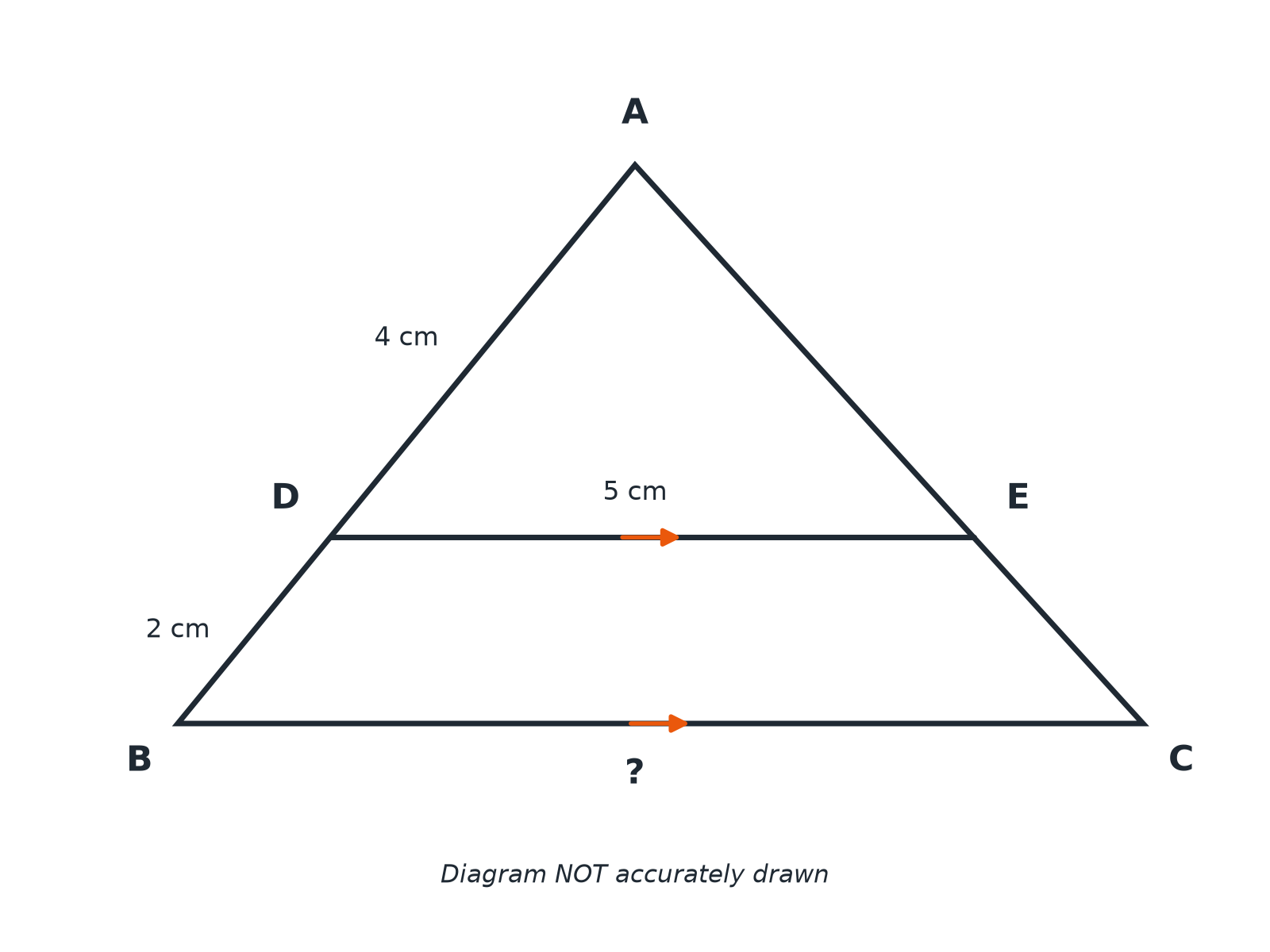
In triangle ABC, DE is parallel to BC. \(AD = 4\) cm, \(DB = 2\) cm and \(DE = 5\) cm. Work out the length of BC.
Mark scheme — 3 marks available
- Similar triangles ADE and ABC — M1
- Scale factor \(\dfrac{6}{4}\) — M1
- 7.5 — A1
Model answer
Triangles ADE and ABC are similar. \(AB = 6\), so the scale factor is \(\dfrac{6}{4} = 1.5\). \(BC = 5 \times 1.5 = 7.5\) cm.
Two similar rectangles have lengths of 12 cm and 18 cm. The area of the smaller rectangle is 40 cm². Work out the area of the larger rectangle.
Mark scheme — 3 marks available
- Length scale factor 1.5 — M1
- \(1.5^2 = 2.25\) — M1
- 90 — A1
Model answer
The length scale factor is \(\dfrac{18}{12} = 1.5\), so the area scale factor is \(1.5^2 = 2.25\). The area is \(40 \times 2.25 = 90\) cm².
Two similar triangles have areas of 12 cm² and 27 cm². Work out the ratio of the lengths of their corresponding sides. Give your answer in the form \(1 : n\) or in its simplest form.
Mark scheme — 3 marks available
- \(4 : 9\) — M1
- Square roots — M1
- \(2 : 3\) — A1
Model answer
The area ratio is \(12 : 27 = 4 : 9\). The length ratio is \(\sqrt{4} : \sqrt{9} = 2 : 3\).
Two similar shapes have corresponding lengths in the ratio \(3 : 5\). The area of the smaller shape is 36 cm². Work out the area of the larger shape.
Mark scheme — 3 marks available
- \(9 : 25\) — M1
- \(36 \times \dfrac{25}{9}\) — M1
- 100 — A1
Model answer
The area ratio is \(3^2 : 5^2 = 9 : 25\). The area is \(36 \times \dfrac{25}{9} = 100\) cm².
A 1.5 m post casts a shadow 2 m long at the same time as a tree casts a shadow 12 m long. Work out the height of the tree.
Mark scheme — 3 marks available
- Scale factor 6 — M1
- \(1.5 \times 6\) — M1
- 9 — A1
Model answer
The triangles are similar. The scale factor is \(12 \div 2 = 6\). The tree is \(1.5 \times 6 = 9\) m tall.
Explain why triangle ADE is similar to triangle ABC when DE is parallel to BC.
Mark scheme — 3 marks available
- Corresponding angles on parallel lines — M1
- Angle A common — M1
- All angles equal, so similar — C1
Model answer
Angle \(ADE\) = angle \(ABC\) and angle \(AED\) = angle \(ACB\) (corresponding angles on parallel lines). Angle \(A\) is common. All three angles are equal, so the triangles are similar.
DE is parallel to BC in triangle ABC. Which triangle is similar to ABC?
Why: The small triangle ADE.
Two similar shapes have length scale factor 4. What is the area scale factor?
Why: \(4^2 = 16\).
Two similar shapes have area ratio \(1 : 9\). What is the length ratio?
Why: \(\sqrt{9} = 3\), so \(1 : 3\).
A shape with area 5 cm² is enlarged by scale factor 2. What is the new area?
Why: \(5 \times 4 = 20\) cm².
In triangle ABC with DE parallel to BC, \(AD = 3\), \(AB = 9\) and \(DE = 4\). What is \(BC\)?
Why: Scale factor 3, so \(BC = 12\).
Two similar triangles have areas 20 cm² and 45 cm². What is the length scale factor from the smaller to the larger?
Why: \(\dfrac{45}{20} = 2.25\), and \(\sqrt{2.25} = 1.5\).